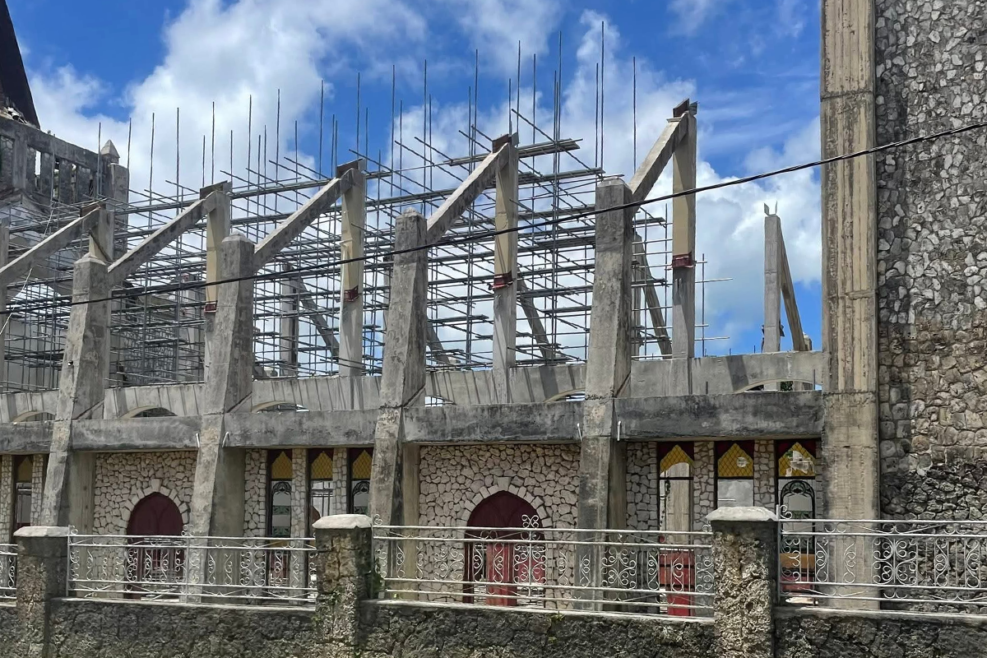
Nuku’alofa — Renovation work at the historic Free Church of Tonga in central Nuku’alofa has drawn public attention this week, as images of the chapel’s open roof structure and construction crews at work have revived interest in the church’s deep royal and external roots.
The restoration has prompted recollection of the Free Church of Tonga’s foundation and its long-standing ties to the Tongan monarchy and the Australian and British Wesleyan Church.
The iconic building—now partially exposed as contractors carry out structural repairs and replace the roof—remains one of Nuku‘alofa’s notable scenic landmarks, located less than a kilometre from the Royal Palace and directly opposite the Mala‘ekula royal tombs.
Passers‑by took photos of the church, capturing scenes of members who had gathered either to assist the construction crew or to prepare food — a typical expression of fafanga, the cultural practice of feeding and supporting those working on a community project.
Looking Back to Foundations
However, a significant history—rich in heritage and royal nation‑building efforts—lies behind this renovation.
A crisis emerged in January 1885 when Tupou I and his advisors—especially former Wesleyan missionary and then‑Premier Shirley Waldemar Baker (Misa Peka), who played a central role—moved to secure full independence from the administrative control of the Wesleyan Methodist Conference of New South Wales.
They finally instructed local members to leave the Wesleyan Church (WC) and join the new body, the Free Church of Tonga (FCT) or Siasi ‘o Tonga Tau’atāina, to be led by the King.
Since there were strong objections from many Wesleyan followers, the King’s decision triggered widespread unrest, which escalated into severe persecution of the remaining Wesleyans by agents of both the Tongan Government and the newly formed Free Church of Tonga.
This period saw not only beatings and torture of Wesleyan adherents but also the onset of what became known in Tongan history as the kuonga ‘o e fakahē, or the era of causing to go into exile.
During this time, several defiant Wesleyan members were forcibly banished to neighbouring islands, including Fiji, between 1887 and 1890.
At the height of the persecution, two nickname titles emerged for the rival churches, as recorded in historical accounts: Fakaongo—literally meaning “to remain loyal to the church in Australia”—for the Wesleyan members, and Tau‘atāina — “the freed ones” — for followers of the Free Church of Tonga.
In 1924, under the guidance of Queen Sālote Tupou III, an attempt at reconciliation was undertaken, which briefly reunited the Free Church of Tonga with the Wesleyan Methodist community.
Although the union was not universally accepted, it succeeded for many, and it ultimately formalised the Free Wesleyan Church of Tonga as the royal and government‑supported church.
The faction that chose to retain its original identity became what is known today as the Siasi ‘o Tonga Tau’atāina or Fakaongo (Free Church of Tonga), whose main headquarters—now a historic landmark—is currently undergoing renovation in Nuku‘alofa.
A Living Landmark
Three secondary schools now operating in Tonga emerged from this historical divide. Tupou College (Toloa) was founded by Tupou I with the assistance of Australian Wesleyan missionary Dr James Egan Moulton.
Tonga College (‘Atele) was later established by Tupou I as part of his movement with Shirley Baker to separate the local Wesleyan members from Australian Methodist authority.
Tailulu College, meanwhile, belongs to the Free Church of Tonga, or Siasi ‘o Tonga Tau‘atāina.
Commenters indicated that the current restoration is seen not only as a measure to prevent further deterioration, but also as an effort to preserve a site deeply intertwined with Tonga’s national heritage.
Community Applauds the Restoration
Social media users say the renewed attention brought by the renovation is welcome, after photos of the upgrades were shared last week by the church’s Facebook administrators.
“This restoration is more than just construction work,” one local church member said.
“It’s a chance for young people to learn the story behind these walls — a story of leadership, division, unity, and the monarchy’s role in shaping our faith tradition.”
The renovation is expected to continue over the coming months, with updates to be provided once the next phase of work begins.