
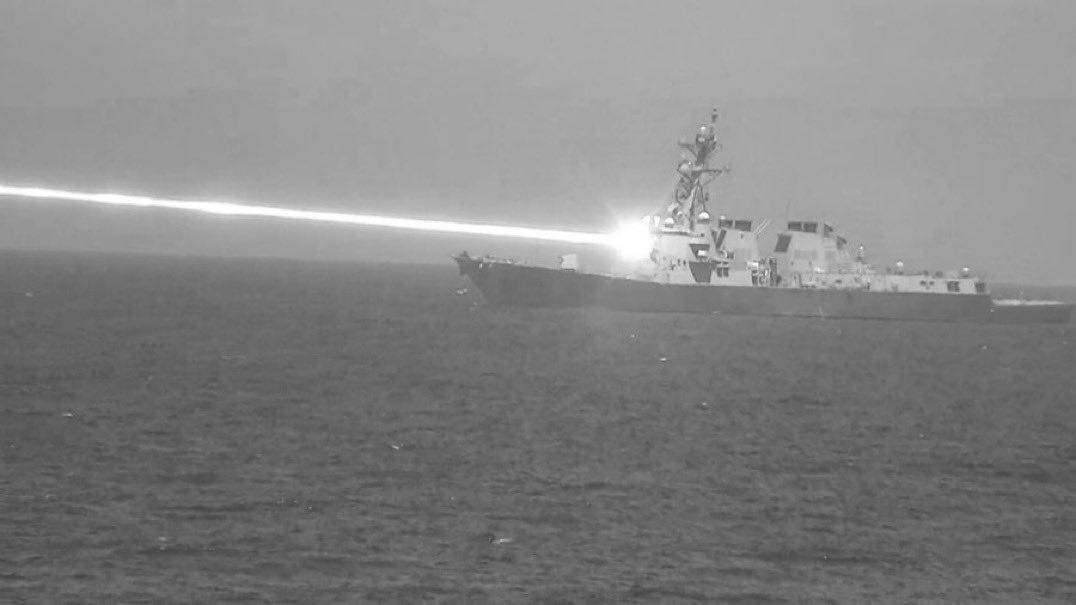
Newly released video footage from United States Central Command appears to show a US Navy destroyer deploying what authorities describe as a next‑generation high‑energy laser weapon during operations in the Middle East — technology they say could reshape the future of warfare, including in regions far beyond the current conflict.
It came amid the US‑ and Israel‑led war against Iran, which escalated after the killing of Supreme Leader Ayatollah Ali Khamenei last Saturday, triggering widespread unrest across the Middle East as Iran launched missiles and drones in retaliatory attacks.
President Donald Trump, in the last 72 hours, claimed that Iranian leaders had contacted the United States seeking to negotiate, saying they were “a little bit late.”
He asserted that Iran’s naval forces had suffered heavy losses, describing 24 ships as having been destroyed within three days.
Trump also said Iran’s air‑defence systems and aircraft had been eliminated, along with key communications infrastructure, missiles, and launch platforms, portraying the country’s military capability as severely degraded.
Laser System Confirmed Tests
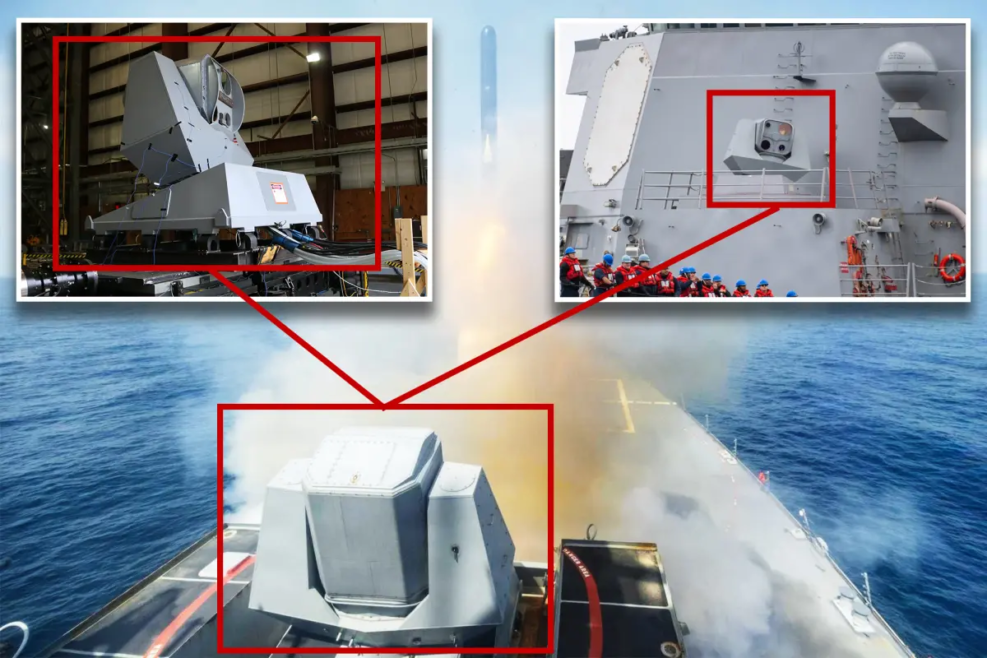
The footage shows the US vessel equipped with a device resembling the High‑Energy Laser with Integrated Optical Dazzler and Surveillance (HELIOS) system.
The Navy has previously confirmed testing the system in early February, during which it said four hostile drones were successfully intercepted.
A similar laser‑based capability is believed to have been used by Israel along the Lebanon border, the New York Post reported.
Videos shared online show rockets being fired by Hezbollah before shortly exploding mid‑air—a response widely attributed, though not officially confirmed, to Israel’s new Iron Beam laser‑defence platform, designed to destroy rockets and drones with concentrated energy beams.
The New York Post has reported that the new laser‑weapon technology has also been used against Iran as part of Operation Epic Fury, the codename for recent US strikes on Iranian targets which began on 28 February.
Analysts say one of the most significant developments is that several of the targeting systems appear to have been operated from space‑based platforms, giving US forces greater precision and faster response times than in previous Middle East conflicts.
What is HELIOS?
HELIOS stands for High Energy Laser with Integrated Optical‑dazzler and Surveillance. It was developed for the U.S. Navy, capable of destroying drones, boats and missiles using a 60+kW laser system, with potential upgrades to 120–150 kW.
It integrates with naval combat systems like Aegis.
HELIOS works by using the powerful 60‑kilowatt laser to burn through incoming drones and small missiles in seconds, guided by the ship’s Aegis combat system.
It can also blind the sensors of enemy drones using an optical dazzler, stopping them from gathering targeting information.
Unlimited Laser Firing Power
Because HELIOS is powered by electricity, it can fire continuously without running out of ammunition, making it highly effective against Iran’s drone swarms. In the current conflict, this system allows the U.S. Navy to protect its vessels cheaply, precisely and at high speed.
Of all the countries developing laser weapons, including China and Russia, the United States appears to be the first to deploy a high‑energy laser system in real military operations, with its HELIOS weapon successfully destroying drones during naval engagements.
The U.S. testing HELIOS under real battle conditions will likely shape future U.S. naval capabilities in the Pacific, which in turn will influence how the United States supports Tonga’s security, maritime surveillance, and officer training.
Why It Matters to Tonga and the Pacific
While the conflict is geographically distant, defence experts say rapid advances in US laser‑based weapons are likely to influence global military strategies, including in the Pacific.
Tonga maintains strong security relationships with the United States, New Zealand and Australia and has sent troops to international peacekeeping missions under US‑led coalitions.
The Kingdom also has thousands of citizens living and working in the United States and Israel, including Tongan soldiers serving in the US military.
For smaller nations such as Tonga, the emergence of cheaper, more precise laser defence systems could shift the global balance of power—reducing reliance on traditional missiles and making advanced defensive technology more accessible to mid‑sized and developing states in the long term.
America’s Early Pacific Role
During the First World War, the United States operated as a protector power in the Pacific, ensuring that hostile forces could not threaten island nations like Tonga.
Although Tonga was never invaded, the presence of U.S. naval forces in the region acted as a stabilising shield — projecting power, deterring enemies, and signalling that Tonga was not alone.
The kingdom relies on the United States as a key security partner through shiprider agreements, maritime patrols, and regional stability operations.
A U.S. Navy equipped with advanced systems like HELIOS is far better able to safeguard Pacific sea lanes and deter hostile activity — fulfilling the same protective role American forces played historically, but with far more precise and modern technology.
If tensions ever rise in the region, Tonga would again be shielded by an American military now armed with the world’s first combat‑tested shipborne laser weapon, providing powerful reassurance for a small island nation in a strategic ocean.