Nukuʻalofa, Tonga — Tonga Meteorological Services has introduced a new mobile phone alert system designed to deliver urgent weather warnings directly to the public, with a test message sent out today to parts of the country.
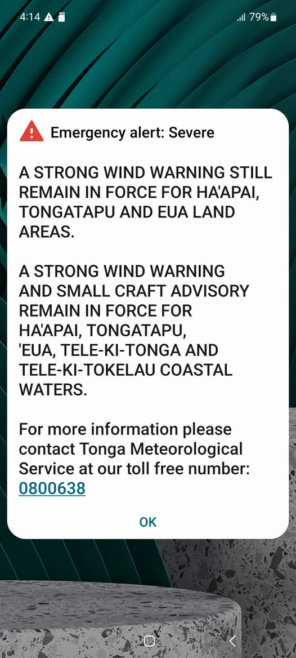
In a statement, Tonga Met advised residents that messages appearing on their mobile phones are part of a cell broadcasting system, a new multi-hazard early warning communication platform aimed at quickly disseminating critical weather advisories.
“This is a CELL BROADCASTING MESSAGE,” the statement said, urging the public to take note of the new system and understand its role in emergency communication.
The alert, as seen on mobile devices, appears as a pop-up notification labelled “Emergency alert: Severe”, prominently displayed on the screen. The message warns that a strong wind warning remains in force for Ha‘apai, Tongatapu, and ‘Eua land areas, along with a strong wind warning and small craft advisory for surrounding coastal waters, including Tele-ki-Tonga and Tele-ki-Tokelau.
The notice also provides contact details for further information, including a toll-free number for Tonga Meteorological Services, allowing users to quickly seek updates.
Tonga Met confirmed that the alert issued was part of a test for Ha‘apai and Tongatapu, as authorities assess the effectiveness of the system in reaching the public during emergencies.
Residents who received the message are being encouraged to provide feedback, including noting their location at the time they received the alert. This information will help authorities evaluate the system’s coverage and reliability.
Strengthening Early Warning Systems
The introduction of cell broadcasting marks a significant step forward in Tonga’s disaster preparedness efforts. Unlike traditional text messages, cell broadcast alerts are designed to reach all compatible mobile phones within a specific geographic area instantly, without requiring prior registration.
The system is expected to play a crucial role during severe weather events such as cyclones, strong winds, and other natural hazards, ensuring timely warnings reach communities at risk.
Authorities say public cooperation during testing phases will be vital to refining the system before it is fully implemented nationwide.
The initiative reflects ongoing efforts to enhance public safety and resilience, particularly in a country highly vulnerable to extreme weather events.