EDITOR’S NOTE:This commentary was edited to reflect the fact that the response from the Deputy Clerk was meant to say that the Parliament using the circular was a normal means of communication.
COMMENTARY: It is time for the practice of using circulars to make decisions in Parliament was reviewed.
Circulars should only be used on agendas that are urgent.
They should not be used on important issues such as pay rises for Parliamentarians.
Such issues should be properly debated in the House so that they can be recorded in the minutes for the public to read and also broadcast for people to listen.
As Kaniva News reported yesterday, the government’s use of a circular to canvas MPs’ views on a pay rise has been called into question.
However, the Legislative Assembly’s Deputy Clerk, Dr Sione Vikilani, said the circular was a normal means of communication approved by the House and any information sent through it was legal.
In Tongan he said: “Ko e tohi ‘avetakai ko e founga ngāue pe ‘oku ‘ataa ke ngaue’aki pea ‘oku ‘ikai ke ta’efakalao ha tu’utu’uni ‘i hono fakahoko ‘i he founga koia”.
Dr Vikilani did not respond to a question asking why a circular was used to ballot the pay hike and not a face-to-face voting in the House.
In 2018 Tonga’s former Prime Minister, the late ‘Akilisi Pōhiva, warned that using circulars in Parliament was open to abuse.
Speaking to Kaniva News, Pōhiva said the use of circulars was normal but did not allow for discussion.
MPs, especially the Opposition, could not debate whatever agenda was being circulated.
He said that traditionally Speakers and the Noble’s representatives, who were mostly the majority in the House, used it to ballot issues they wanted to be decided in their favour.
The late Prime Minister’s comments were made during an interview in 2018 about the decision to approve an invitation from the Tonga Rugby League for a Parliament delegation to attend a match.
The decision was adopted through a circular, by collective resolution of Parliament.
Prime Minister Pōhiva’s concerns are just as relevant today as they were four years ago.
Debates and voting in the House must be open so that all citizens can see how their MPs voted and debate can be held in public.
This was illustrated in our story yesterday when Dr Vikilani would not say how MPs voted on the circular.
A Parliament with secrets is not truly democratic.
Tonga’s Supreme Court has cleared the way for the Anti-Corruption Commission (ACC) to proceed with its judicial review against the National Reserve Bank of Tonga (NRBT) and its Board of Directors, marking a historic first for the fledgling agency.
This decision allows the corruption investigation to move forward, signaling that serious allegations of misconduct by public institutions must be properly examined in the interest of accountability.
The case, which alleges misfeasance in public office and breaches of fiduciary duty, has been hailed as a critical test of Tonga’s commitment to combating corruption.
The Supreme Court rejected the NRBT’s bid to remove parts of the ACC’s case against it. The NRBT argued that the accusations were either baseless, too vague, “or may otherwise prejudice or delay the fair trial of the action.”
In a resounding endorsement of the ACC’s mandate, the ruling upheld the Commissioner’s powers to investigate and initiate legal proceedings, emphasising the “paramount public interest” in holding officials accountable.
ACC Probe Advances
This decision allows the corruption investigation to move forward, noting that it was too early for the strike out request to be addressed “at this stage.”
In his ruling, Mr Bishop also emphasised the Commissioner’s role, which is noteworthy.
This includes saying that ACC must pay attention to “serious and systematic corrupt conduct” as mentioned in the NRBT application.
The court document said: “The Commissioner shall direct its attention to serious and systemic corrupt conduct and may take into account the responsibility and role of other public authorities and public officials in the prevention of corrupt conduct.”
Mr Bishop said that in his opinion, “serious and systemic” does not mean serious and repeated or serious and regular, but simply that the corruption found or suspected must be both serious and referable to the way in which the organization in question conducts its activities.”
The NRBT Board of Directors consists of Chairman Lord Sevele, CEO Tatafu Moeaki, John Paul Chapman, Siosi Mafi, Kilitina Tuaimei’api, Masasso Paunga, and Vika Kaufusi.
The defendants must pay the Commissioner’s legal costs, with the amount to be decided by the court if the matter remains unresolved.
A Long Road to Justice
The Anti-Corruption Commission Act was first enacted in Parliament in 2007.
However, Parliament only passed the Anti-Corruption Bill in February 2023, after former Prime Minister Hu’akavameiliku and his government pushed it through, which enabled the establishment of the anti-corruption watchdog.
The first Commissioner was appointed last year; however, it has been revealed this year that the previous government failed to allocate sufficient resources for its operations.
The current government, led by Prime Minister Aisake Eke, has pledged full support, vowing to provide the ACC with the budget necessary to fulfil its duties.
Monday’s ruling now sets the stage for what could be a defining battle against entrenched corruption in Tonga’s institutions.
Tongans living in Japan are among millions bracing for a possible catastrophic ‘megaquake’ after the Japanese government issued a stark warning that current disaster preparations could fall short, leaving up to 300,000 people dead in the worst-case scenario.
Scientists now estimate a 75-82% chance of a massive earthquake striking the Nankai Trough—a 500-mile undersea faultline—within the next 30 years.
If it hits, the quake could trigger a devastating tsunami, causing up to $2 trillion in damage and nearly 300,000 fatalities, according to a March 2024 government report.
In 2014, the Central Disaster Management Council issued a preparedness plan recommending a series of measures that, it was hoped, would reduce deaths by 80 per cent.
However, the government has stated that the steps taken so far will only reduce the toll by 20 per cent, according to the Kyodo News Agency, and an updated preparedness plan was issued on Tuesday.
This recommended accelerated efforts, including the construction of embankments and evacuation buildings, as well as more regular drills to enhance public readiness.
‘It is necessary for the nation, municipalities, companies and non-profits to come together and take measures in order to save as many lives as possible,’ Prime Minister Shigeru Ishiba told a government meeting, local media reported.
The Nankai Trough is a 500-mile undersea gully running parallel to Japan’s Pacific coast where one tectonic plate is ‘subducting’ – slowly slipping – underneath another.
Tonga Community in Japan
While there is no official data on the exact number of Tongans living in Japan, it is widely acknowledged that a significant community exists.
Many initially arrived on rugby contracts and later chose to settle permanently.
The Tongan diaspora in Japan remains active, as demonstrated last year when they warmly welcomed Tonga’s former Prime Minister, Hon. Hu‘akavameiliku, and his delegation at a special reception.
Commentary – The recent conviction of a Samoan pastor and his church trust for unsafe building practices should serve as a stark warning to Tongan church communities in New Zealand.
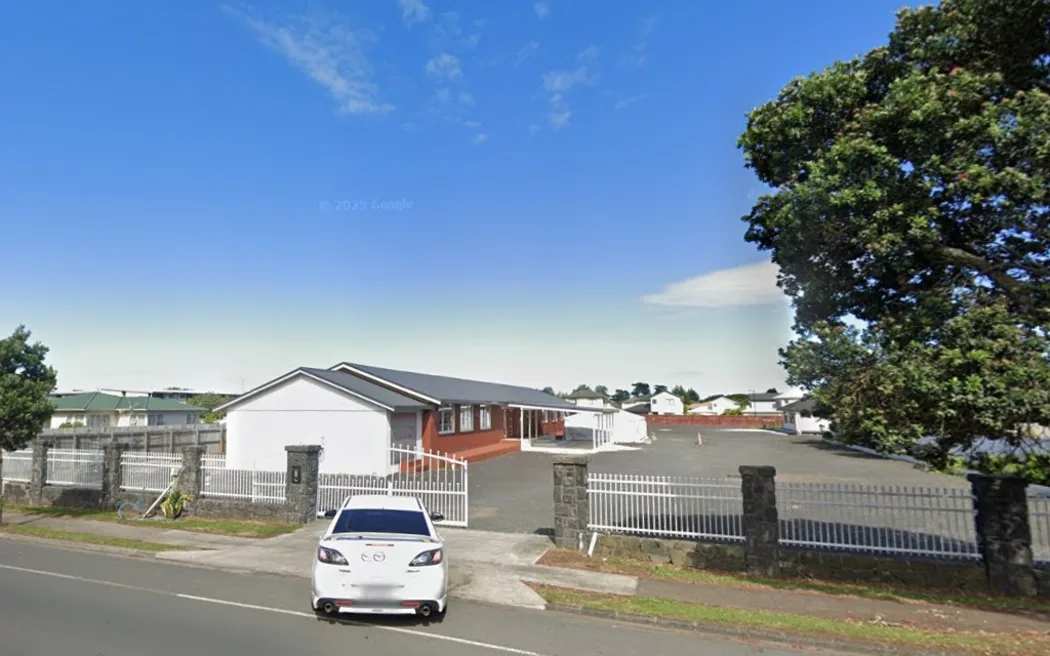
The church on 59 McKenzie Road, Māngere, was prohibited from being used in May 2023. Photo: Google Maps
The Samoan Congregational Christian Church of New Zealand Māngere Trust and its pastor, Sean Palala, were sentenced in the Auckland District Court this week after being found guilty of 15 charges under the Building Act and Resource Management Act.
The court imposed a total fine of $82,000 for unlawful construction and continued use of a church building despite multiple warnings.
The McKenzie Road church in Māngere had been issued a dangerous building notice, yet gatherings continued in defiance of court orders.
The trust was fined for breaching an abatement notice, failing to comply with a notice to fix, multiple violations of enforcement orders, and failing to comply with dangerous building notices.
Pastor Palala was personally convicted, sentenced to 400 hours of community service, and fined $7,000.
Auckland Council confirmed that the trust had repeatedly ignored an interim enforcement order issued in May 2023, which prohibited the use of the building due to safety risks.
Council’s licensing and compliance field operations manager, David Pawson, said the court’s verdict sent a strong message that ignoring enforcement orders and continuing to use unsafe buildings would not be tolerated, according to a report by RNZ.
“Compliance with building and resource consent laws is essential for the safety of our communities,” he said.
Tongan Church’s Warning
This case comes after a Tongan church in Auckland, the Siasi Uēsiliana Tau‘atāina ‘o Tonga New Zealand (SUTTNZ), faced council action last year over an unsafe makeshift structure.
A church steward, ‘Akuila Hafoka, claimed in a viral video that compliance officers had ordered the demolition of their tent-covered timber building, citing fire hazards and code violations.
Building safety experts warn that many Pacific churches—often operating in temporary or modified structures—may be at risk of similar legal action.
Auckland Council reiterated that no community is exempt from building safety laws.
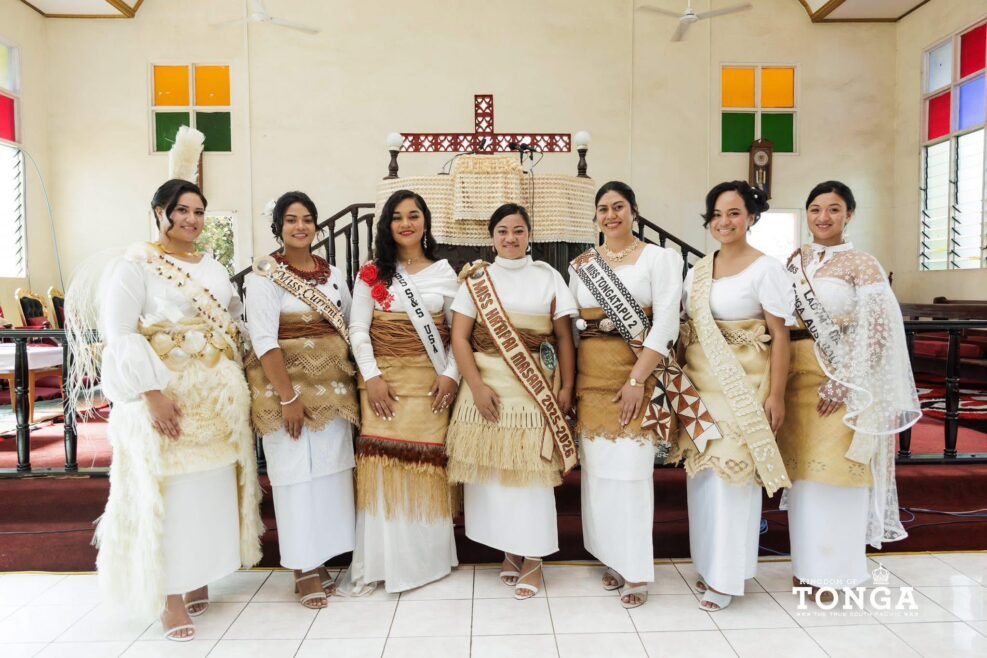
The journey to crown the next Miss Heilala has officially begun, with seven stunning contestants taking the stage at the Fā’onelua Convention Centre for the first judging event: the Pre-Pageant Interview.
Seven shining stars, one unforgettable journey! ✨👑 These inspiring young women light up the stage as they compete for the prestigious Miss Heilala 2025 crown. Each bringing their unique voice, passion, and beauty to celebrate Tonga’s culture and future. Who will take the throne?. Photo/Tonga Tourism, Facebook.
The festival is Tonga’s national beauty pageant, offering young women the opportunity to compete for the prestigious annual title.
The contestants, each representing different sponsors and causes, spoke passionately on topics ranging from technology and tourism to mental health and climate change.
Miss Tika Way, Malia Toatepi Tonga’uiha, from Houma, Tongatapu—now residing in Auckland, New Zealand—wore what has been widely described on social media as the Samoan an ‘ie sina.
Her photos, showcasing the artwork on Facebook, stunned the online community, especially those familiar with Samoan handicraft.
Many praised Miss Tika Way’s ‘ie sina as exceptionally beautiful.
The contestants:
Miss Lady Maria Tonga Australia
Miss Pangaimotu Island
Miss Tongatapu 2
Miss Ha’apai Masani
Miss S & S USA
Miss Current of Love Charity Vava’u
Miss Tika Way Creation
The competition will continue with additional events, including the traditional wear showcase, talent performance, and evening gown presentation, culminating in the grand finale, where the new Miss Heilala 2025 will be crowned.
Air New Zealand has rebooked passengers to Tonga for Thursday, July 3, after their flight NZ970 from Auckland was forced to return due to an engineering issue.
The affected passengers were initially scheduled to arrive in Tonga on Wednesday, July 2.
The incident comes amid allegations that the airline would cease services to Tonga starting July 1—a claim Air New Zealand has denied.
In an email to Kaniva News, Air New Zealand Chief Operating Officer Alex Marren clarified the situation, stating:
“NZ970 Auckland to Tonga returned to Auckland this morning due to an engineering issue, as per standard operating procedure. As a result, NZ971 Tonga to Auckland has been cancelled, and all customers have been rebooked to travel tomorrow. We apologize for any inconvenience and thank customers for their understanding.”
It is understood that the disruption was unrelated to any broader operational changes.
The Tongan government’s push to renationalise luggage handling has sparked debate, with critics questioning whether the transition could disrupt airline operations.
Air New Zealand’s denial clarified the situation and reassured passengers that today’s incident was an isolated technical issue, not a consequence of policy changes.
Nuku’alofa, Tonga – A leaked email has intensified tensions between the Tongan government and local media over conflicting claims about Air New Zealand’s future operations in the kingdom, as the government moves forward with its controversial plan to renationalise airport ground handling services.
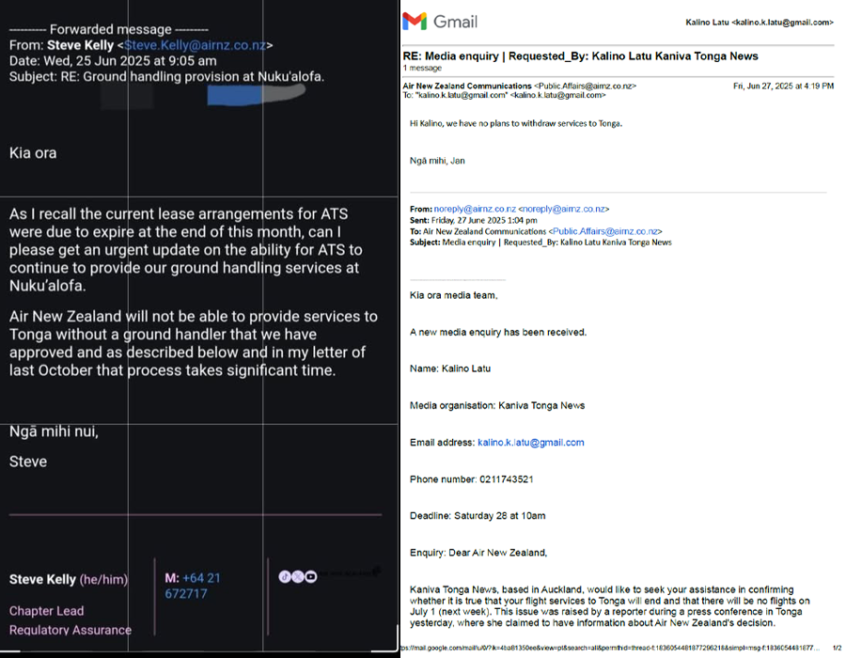
Left: A copy of the email (on black background) purportedly from an Air NZ staff member, shared by Radio FM 87.5 on Facebook. Right: Air New Zealand’s email response to Kaniva News confirming no plans to cancel July 1 flights to Tonga.
The dispute erupted after Marian Kupu, a reporter for ABC in Tonga, repeatedly challenged Minister of Police Piveni Piukala during press conferences, asserting that Air New Zealand had privately warned it would cease services to Tonga if the government stripped ATS (Airlines Terminal Services) of its ground handling role. Piukala stated that the government was “aware” of the issue and was working to resolve it.
In a mixture of Tongan and English, Kupu alleged: “Air New Zealand has already stated, ‘ikai ke nau tō mai nautolu ia ‘okapau ‘oku take over ‘e he pule’anga’. Fefe leva ‘a e kau folau ko ia ‘i he ‘aho ‘uluaki ‘o Siulai?”
Kaniva News, unable to independently verify Kupu’s claims, sought comment from Air New Zealand, which denied any plans to suspend flights.
An Air NZ Public Affairs officer responded last Friday and said the Airlines has “no plans to withdraw services to Tonga.” Kaniva News published a story about the backlash against Kupu and FM87.5 Radio, where critics accused them of spreading misinformation.
Email Disputes Claims
However, the debate took a dramatic turn this morning when FM87.5 Radio publicly shared an email purportedly from Air New Zealand to justify Kupu’s claims. The email shared by the radio station has sparked debate, dividing the online community over conflicting reports and fueling demands for clarity between Kaniva’s coverage and the claims made by Kupu and FM87.5.
The radio-shared email, addressed to an unnamed recipient, warns:
“As I recall the current lease arrangements for ATS were due to expire at the end of this month, can I please get an urgent update on the ability for ATS to continue to provide our ground handling services at Nuku’alofa. Air New Zealand will not be able to provide services to Tonga without a ground handler that we have approved and in my letter of last October, that process takes significant time.”
The radio station posted a caption alongside the purported Air New Zealand email, stating that reporters had received the email on June 25, 2025 – one day before the June 26 press conference where they raised the question. This suggests Kupu’s allegations about Air New Zealand were based on this correspondence.
This is the translation of Kupu’s mixed English and Tongan allegation made to Piukala during the press conference: “Air New Zealand has already stated it will not land here [in Tonga] if the government takes over the ground luggage handling service.”
However, the email shared by FM87.5 Radio does not support Kupu’s specific claim.
The email, instead, focuses on operational requirements, stating only that Air NZ cannot operate without an approved ground handler. This key distinction raises questions about whether Kupu’s interpretation accurately reflects the airline’s position.
Her assertion carries significant weight, as it implies Air New Zealand’s potential refusal to fly to Tonga on July 1 could be politically motivated—a protest against the government’s intervention in ground services.
Air NZ Email Discrepancy
Kaniva News has analysed the email shared by FM87.5 Radio regarding Air New Zealand’s provisional warning about its operations in Tonga and found no confirmation that the airline planned to suspend flights on July 1, as claimed by journalist Kupu.
This was further supported by Air New Zealand’s flight to Tonga yesterday, which departed Auckland at 11am as listed on the airline’s official schedule.
The leaked email, purportedly from Air New Zealand, states that the airline “will not be able to provide services to Tonga without a ground handler that we have approved.“ This clarifies that the airline’s ability to operate depends on having a certified ground service provider in place, not an immediate suspension of flights.
The email does not mention a specific halt to services on July 1, contradicting Kupu’s earlier assertions.
This aligns with Air New Zealand’s direct response to Kaniva News, in which the airline confirmed it had “no plans to withdraw services to Tonga.“ The discrepancy appears to stem from a misunderstanding of the airline’s conditional warning about future operations if no approved ground handler is available.
The Tongan government’s push to renationalise airport services has raised concerns about potential disruptions, but for now, Air New Zealand’s flights remain unaffected.
The government, in its move to rationalise the service, will employ staff from ATS, according to Piukala.
Clash Between Media and Government
The revelation follows heated exchanges between Minister Piukala, Kupu, and FM87.5 Radio Director Katalina Tohi, who has stood by her reporter’s claims.
Piukala, however, remained defiant, reiterating that the government’s decision to take over ground handling was non-negotiable and that “arrangements to address the issue” were being made.
The radio reported that a signed contract was processed on June 30, extending the agreement for three months. No details were provided, but it appeared that this extension was intended for the ATS, with its contract now extended until September.
The Tongan public remains divided, with some accusing the media of sensationalism, while others demand transparency from both the government and Air New Zealand.
The Tongan Ministry of Health has confirmed that hackers stole critical patient information from the national health information system and leaked it online.
This follows the June 15 hack of the databases, an attack that Health Minister Dr ‘Ana ‘Akau’ola described (in Tongan) as having emotionally affected the IT professional responsible for maintaining the system.
The most recent update indicates that what was leaked on June 27 represents merely “a small sample” of “confidential” data.
“No information was deleted or changed as part of this attack,” the Ministry said in a statement this evening.
It is expected that more “information about Tongan patients could be published online, in the future”, by the hackers.
The leaked data is believed to have included “patient information and medical records.”
The Ministry stated that its primary concern is “for vulnerable groups”, who are most acutely affected by breaches of this nature.
It confirmed that the government was expected to directly contact individuals in these groups to ensure they understand the risks and take additional precautions regarding their cybersecurity and personal safety.
The Ministry earlier reported that the Australian Cyber RAPID team restored the system using backups, with recovery “progressing steadily.”
It stated that health records remain accessible as repairs continue.
Ransom Demand Rejected
The INC Ransom group, which demanded US$1 million (approximately TOP$2.4 million) from Tonga, was behind the attack; however, the government rejected the payment.
The Minister of Police, Piveni Piukala, confirmed the demand, stating that paying the money is not globally recommended.
The Ministry’s statement says similar breaches have increased across the Pacific, including a 2022 incident in Australia where hackers accessed limited patient records.
However, the Tonga breach appears more severe, given the confirmed leak and threats of additional disclosures.
The Government of Tonga’s Cyber Security Committee was working in a coordinated effort to continue responding to the attack, with support from Australian Government cybersecurity experts.
The government has established a dedicated hotline for concerned individuals and has pledged to provide updates as the investigation progresses.
Cybersecurity experts emphasised the need for enhanced digital protections across Pacific health networks to combat the rising threat of such attacks.
Tonga’s consulates in Auckland and Canberra are set for a major expansion, with plans to increase office space, staffing, and services to better reflect the significant financial and developmental support provided by New Zealand and Australia.
Deputy Prime Minister Taniela Fusimālohi recently announced the upgrades, emphasising the need to strengthen diplomatic operations in these key locations.
Fusimālohi revealed that the improvements are part of a broader strategy to modernise Tonga’s overseas missions, with potential upgrades also under consideration for other diplomatic posts, including those in New York and London.
Part of the upgrade includes a new Tongan embassy in Fiji. Tongan Prime Minister ʻAisake Eke expressed concern over why Tonga had not established one there earlier, especially since major offices of foreign donors to Tonga—as well as the University of the South Pacific (USP), where the kingdom is a key sponsor—are based in Fiji.
The move aims to enhance consular services, boost trade and investment opportunities, and improve support for Tongan communities abroad.
Fusimālohi stated that the action was necessary to acknowledge the significant number of Tongans living in Australia and New Zealand.
According to the 2018 New Zealand census, 82,389 people identified as being of Tongan ethnicity, representing 1.7% of the country’s total population. In Australia, the 2021 census recorded 43,469 people with Tongan ancestry. Meanwhile, approximately 78,871 individuals of Tongan descent reside in the United States.
“The governments of New Zealand and Australia have been vital partners in Tonga’s development, and it’s only fitting that our consulates there reflect the growing cooperation,” Fusimalohi stated in Tongan.
In 2022, Tonga announced that all requirements for new passports, renewals, and related services can now be processed through the Consul’s office at ‘Atalanga residence in Auckland’s Mount Eden. This marked the first time Tonga officially permitted these services to be conducted outside the country.
The consulate’s upgrade announcement follows Australia’s reaffirmation of its commitment to Tonga’s development with a major $54 million (NZ$54m) investment to strengthen the kingdom’s health infrastructure and economic resilience.
The announcement, made last month by Australian Foreign Minister Penny Wong, was reinforced during her visit to Tonga last week, where she emphasised Australia’s support for Pacific sovereignty.
As part of the deepening partnership, the two nations have also agreed to jointly fund Tonga’s new $60 million parliament complex, a key infrastructure project set to begin construction soon. The amount means New Zealand will donate $41.5 million while Australia provides $18.5 million.
Over the last 15 years, since 2007, 7,150 Tongans have arrived in New Zealand through the RSE worker programme, according to Devpolicy Blog.
In June 2019, the Blog reported that 3,600 Tongan workers had arrived in Australia via the Seasonal Worker Programme (SWP) in the first 11 months of that financial year.
The initiative underscores Australia’s long-term commitment to Tonga’s stability and self-determination
Aotearoa, NZ – The owners of Moana Pasifika have strongly denied allegations of misusing public funding, as an independent review is launched into two Whānau Ora commissioning agencies.
The controversy comes at a difficult time for Tongan rugby, still reeling from the cancellation of Moana Pasifika’s historic home game in Nuku’alofa earlier this year.
Te Puni Kōkiri, the NZ Government’s principal policy adviser on Māori wellbeing, announced the investigation following “serious” claims of inappropriate use of taxpayer money by Te Pou Matakana Ltd and Pasifika Futures Ltd.
Pasifika Futures, a charity and controlled entity of the Pasifika Medical Association Group (PMA)—which owns Moana Pasifika—has held the Whānau Ora commissioning contract for Pasifika communities since 2014.
The contract, worth $44.35 million this financial year, has been a major revenue source for PMA. Records show that in 2022/23 and 2023/24, PMA directed $770,000 annually from the Whānau Ora funds to the Moana Pasifika Charitable Trust, raising questions about financial transparency.
Moana Pasifika’s management insists no taxpayer money was used to support the Super Rugby Pacific team.
In a statement to the NZHerald, chairman Dr Kiki Maoate said PMA “strongly reject” any claims that public funds had been used in an inappropriate manner.
Maoate said Moana Pasifika became part of PMA on July 1, 2024 – at which time the Moana Pasifika Charitable Trust was formally established to hold both the professional rugby team and the Moana Pasifika Community Sports Programme.
“Moana Pasifika has always been more than a rugby team. From the outset, it was established as a platform for social good and long-term transformation for Pacific people.
“That founding purpose made it a natural strategic fit for PMA, which recognised the opportunity to strengthen and expand Moana Pasifika’s reach. With that alignment of values and mission, PMA invested to optimise the organisation’s positive impact, capability and connection to Pacific communities.”
However, the controversy has cast a shadow over the franchise, which has already faced backlash from Tongan fans after relocating its scheduled match against the Chiefs away from Nuku’alofa in March.
Moana Pasifika CEO Debbie Sorensen cited “logistical challenges” as the reason for the cancellation, disappointing many in Tonga who had eagerly awaited the historic game.
“Our hearts are in the Pacific, and that is where we want to be, but it wasn’t possible this time,” Sorensen reportedly said at the time. “We are committed to bringing a game to Tonga in 2026.”
With Tongan rugby still struggling financially and the national team’s future uncertain, this latest controversy adds further strain.
Moana Pasifika was founded to create a professional pathway for Pasifika rugby talent, especially for players who might otherwise be missed by traditional systems. More than just a team, it represents a movement for social change, empowering Pacific communities through sport.
As a not-for-profit, it reinvests earnings back into grassroots development, youth programs, and cultural pride, ensuring rugby becomes a force for long-term growth and opportunity across the region.
Auckland, NZ – A homicide investigation is underway after a man died following an incident in Ōtāhuhu last night.
Emergency services were called to a property on Beatty Street around 8.30pm after reports of a seriously injured person.
Upon arrival, police found a man in critical condition. He was rushed to the hospital but succumbed to his injuries overnight.
Detective Inspector Karen Bright of Counties Manukau CIB stated that authorities are working to determine the exact circumstances of the incident.
“Police are continuing to gather information from the scene, and enquiries into the exact circumstances surrounding what happened remain ongoing.
“We are also making enquiries to locate a person of interest.
“Those involved are believed to be known to each other, and we do not believe there is any ongoing risk to the wider community.”
Detective Inspector Bright says a scene examination is underway at the address,s and there will be an increased Police presence in the area while the investigation continues.
“Our teams are working hard to identify and locate the person responsible and are asking anyone who saw what happened, who has not yet spoken to us, to please get in touch.”
If you have any information that could assist the investigation, please make a report via 105, using the file number 250629/6502 and quote ‘Operation Tell’.
Alternatively, information can be provided anonymously to Crime Stoppers on 0800 555 111 or www.crimestoppers-nz.org(link is external)
Further information will be provided when we are in a position to do so.