A new scientific discovery stemming from Tonga’s massive and deadly volcanic eruption may have revealed a way to help reduce the effects of climate change.
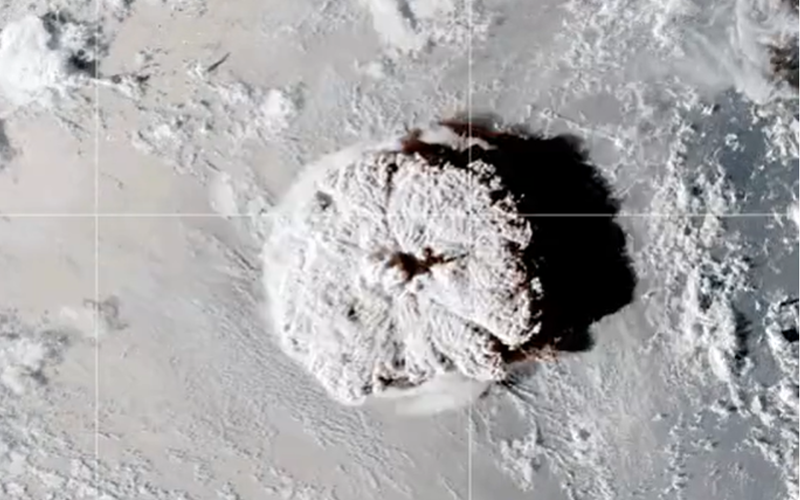
Scientists have confirmed that the eruption of Hunga Tonga–Hunga Haʻapai in January 2022 was the largest volcanic eruption ever recorded by modern instruments.
Now, researchers say the eruption may have revealed an unexpected clue in the fight against methane. This potent greenhouse gas contributes significantly to global warming, according to a new study.
Using advanced satellite data collected during and after the eruption, scientists detected a huge cloud of formaldehyde high in the atmosphere.
“We found a huge cloud of formaldehyde that should normally not be there,” said Maarten van Herpen, a study author, physicist, and executive director of Acacia Impact Innovation, a Dutch consultancy.
Formaldehyde is commonly produced when methane—a potent greenhouse gas—is destroyed in the atmosphere. The discovery suggests that natural atmospheric processes triggered by the eruption may have accelerated methane removal on an unprecedented scale.
Methane is approximately 80 times more effective at trapping heat than carbon dioxide over a 20-year period. Although it remains in the atmosphere for a much shorter time than carbon dioxide, it is responsible for roughly one-third of current global warming. Atmospheric methane concentrations have more than doubled since pre-industrial times.
Scientists say reducing carbon dioxide emissions remains essential because the gas can persist in the atmosphere for centuries. However, cutting methane emissions has increasingly been viewed as one of the fastest ways to slow global warming in the near term due to its relatively short atmospheric lifetime.
The researchers believe they may have observed a chemical process previously identified over the Atlantic Ocean, but on a far larger scale.
The extraordinary conditions created by the Tongan eruption appear to have provided a rare natural laboratory for studying how methane can be broken down in the atmosphere.
While the findings do not suggest volcanic eruptions themselves are a solution to climate change, scientists say understanding the chemical reactions behind the formaldehyde plume could help develop new methods to accelerate methane removal.
If confirmed through further research, the discovery could provide policymakers and climate scientists with a valuable new tool in efforts to curb global warming and limit the impacts of climate change.
This version is written in a newspaper style, with a stronger lead, clearer transitions, and a focus on the significance of the scientific discovery.