New Zealand’s history of special-vote counting has raised questions about whether Prime Minister Christopher Luxon’s narrow parliamentary majority will survive the final election results, potentially placing Fiji-born Opportunity Party leader Qiulae Wong in a decisive kingmaker position.
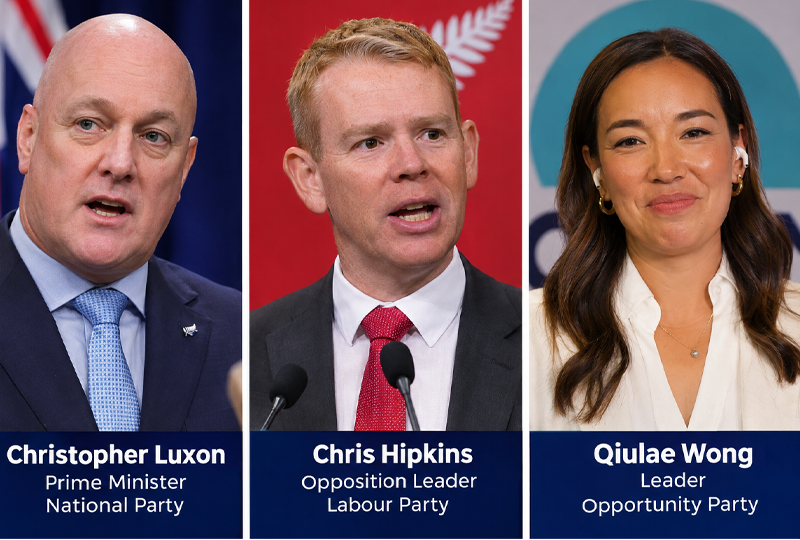
Saturday’s general election left National and its coalition partners, ACT and New Zealand First, with a projected 67 seats in a 130-seat Parliament, just above the 66-seat majority threshold. Labour and its potential governing partners, the Greens and Te Pāti Māori, were projected to secure 56 seats, while Opportunity gained seven.
Special votes, including ballots cast by overseas voters and people voting outside their electorates, are counted after election night because they require additional eligibility checks. The Electoral Commission is expected to declare the official results on Friday, 27 November, potentially changing the parliamentary balance.
National lost two seats between election night and the official count in each of the last three general elections, according to Electoral Commission records.
In 2023, its allocation fell from 50 to 48 seats, following similar reductions from 35 to 33 in 2020 and 58 to 56 in 2017.
Special votes accounted for 603,257 ballots, or approximately 21 percent of votes cast, in 2023, compared with around 17 percent in both 2020 and 2017.
If National’s coalition loses two seats in the current election and Parliament remains at 130 members, its projected majority would disappear, leaving it with 65 seats.
Such a shift could make Wong’s seven projected MPs crucial to negotiations over the next government, although historical voting patterns do not guarantee a similar outcome this year.
Special votes changed government arithmetic in 1999
The 2017 election provides a striking precedent. Although National won more seats than Labour, special votes reduced its parliamentary allocation from 58 to 56, while Labour gained one seat and the Greens another. New Zealand First leader Winston Peters subsequently chose to support a Labour-led government, enabling Jacinda Ardern to become Prime Minister despite National remaining the largest party.
A significant precedent occurred in 1999, when special votes deprived the Labour–Alliance coalition of its projected parliamentary majority.
The coalition finished with 59 seats in the 120-member Parliament, while the Green Party gained seven seats after initially securing none in the election-night allocation.
Labour and the Alliance subsequently formed a minority coalition government.
Wong’s historic breakthrough
Wong, 38, who was born in Fiji and raised in Auckland, is poised to make electoral history as the first leader without previous parliamentary experience to take a party across the five percent threshold and into Parliament under the Mixed Member Proportional (MMP) system.
Her party’s potential influence will depend on the official results and whether either major political bloc requires Opportunity’s support to form a government.
Wong has indicated she is willing to negotiate with either bloc, although Luxon has previously ruled out governing with Opportunity because of disagreements over its tax proposals.
Potential benefits for Tongan families
Opportunity’s economic proposals could have implications for Tongan households, particularly those facing rising living costs and housing pressures.
The party proposes a Citizen’s Income of up to NZ$370 a week for eligible adults, replacing several existing welfare benefits.
It also advocates an annual land-value tax of 1.75 percent on urban land and 0.5 percent on rural land, aimed at discouraging land banking and improving housing affordability.
Opportunity claims its wider reforms would improve household finances and reduce house prices, although the financial impact would vary depending on household circumstances and property ownership.
Whether any of these proposals become government policy could depend on Opportunity’s influence in the next Parliament.
The Electoral Commission is expected to release the official election results on 27 November, following the counting of special votes.