
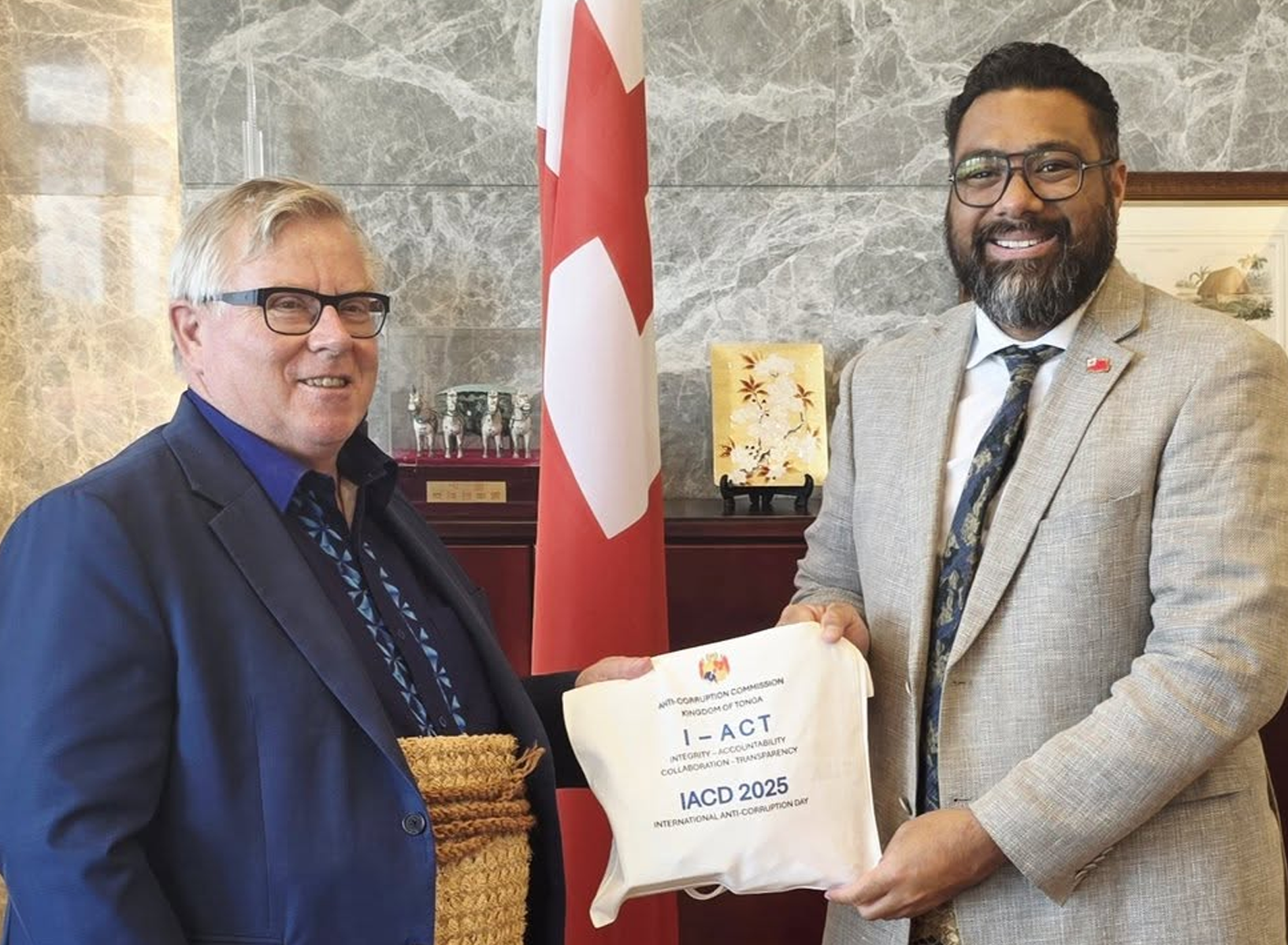
Editorial – The recent resignation of four investigators from the Anti-Corruption Commission has exposed a critical weakness in Tonga’s governance framework: the absence of a formal mechanism that enables citizens and the news media to access information held by government ministers, departments, and agencies.
In New Zealand, such access is provided under the Official Information Act (OIA), which establishes a statutory right to request official information.
The OIA empowers journalists and the public to hold government agencies and officials accountable at a legal level, including the ability to challenge refusals to disclose information through judicial review where necessary.
OIA Should Accompany WPA
This is the legislation that should have been enacted alongside the already approved Whistleblower Protection Act 2024 (WPA), which is intended to protect employees who disclose serious wrongdoing by public officials from retaliation.
The adoption of a whistleblower regime without a corresponding access-to-information law creates an accountability system that is structurally incomplete.
When the ACC Commissioner issued the decision to decline disclosure of why the four investigators resigned, it constituted a final determination based on his assessment—an outcome that could, in principle, be subject to legal challenge were an OIA framework available in Tonga.
Mass Resignation Sparks Concerns
The simultaneous resignation of four investigators, including a director, should not be dismissed as minor; rather, it signals the presence of significant underlying issues within the ACC structure—matters that warrant public awareness and scrutiny.
This is a commission that Tonga has awaited for many years, and less than two years after its establishment, the resignation of the officers—amid allegations that they had raised concerns about the handling of investigative processes—should be regarded as a matter of significant public concern.
Lawmakers should undertake a more thorough examination of this matter. While there is no suggestion of impropriety in the Commissioner’s decision to withhold information regarding the reasons for the investigators’ resignations—on the basis that confidentiality was requested—the issue that warrants scrutiny lies in the adequacy of the legal and policy frameworks governing such situations.
In this context, the case underscores the broader need for the enactment of the OIA.
Whistleblower Law Faces Limits
The country’s WPA is a meaningful step—it signals recognition that insiders must be able to report serious wrongdoing without fear of retaliation.
But in the absence of OIA, the reform risks operating with limited transparency: disclosures may be made, yet the outcomes may not be visible to the public, making it difficult to assess whether accountability mechanisms are functioning as intended.
At a design level, these two legal instruments serve different but interlocking functions:
- Whistleblower laws are inward-facing; they enable and protect the flow of sensitive information into the state’s investigative machinery.
- Access-to-information laws are outward-facing; they regulate the flow of information out of the state to citizens, media, and civil society.
When only the first exists, the system relies heavily on internal integrity—on agencies to investigate themselves and to decide what, if anything, should be revealed. That is a fragile model in any jurisdiction, and especially so in smaller administrations like Tonga, where institutional proximity can blur lines between oversight and influence.
In practical terms, Tonga’s current framework creates three tensions:
First, confidentiality without transparency – Whistleblower protections rightly require strict confidentiality to safeguard informants. However, in the absence of an information‑access regime that balances confidentiality with a presumption of disclosure—the principle that government‑held information should be released unless there is a clear and lawful reason to withhold it—entire matters can remain permanently shielded from public scrutiny. The result is a one‑way valve: information can safely enter the system, but it may never emerge.
This is why an OIA is essential—to enable the public and journalists to scrutinise decisions, ask, and challenge the withholding of information.
Second, accountability without verification – Even when authorities act on disclosures, the WPA provides the public with limited means to verify whether investigations are conducted thoroughly, impartially, or properly concluded. While governments may announce that an inquiry has been undertaken and disclose its outcome, independent reports are often not made publicly available. As a result, the absence of active scrutiny by the news media and the public weakens transparency, making it difficult to assess the rigour and integrity of investigative processes.
Third, deterrence without visibility – When the public cannot see how complaints are investigated or whether misconduct results in consequences, the system’s ability to discourage future wrongdoing is significantly weakened. This represents a compelling rationale for the enactment of the OIA.
Complementary Transparency Safeguards Explained
Comparatively, jurisdictions that have both regimes in place treat them as complementary safeguards. Whistleblower protections encourage the supply of high-quality, insider information. Access-to-information laws create demand-side pressure—from journalists, citizens, and watchdogs—to ensure that institutions account for how that information is handled. Together, they form a feedback loop: disclosures trigger inquiries; transparency requirements surface findings; public scrutiny reinforces institutional discipline.
For Tonga, the path forward is not to dilute whistleblower protections, but to complete the architecture. An access-to-information law—calibrated with appropriate exemptions for privacy, national security, and ongoing investigations—would not undermine the WPA. It would operationalise it. It would provide a lawful mechanism for releasing investigation outcomes, policy responses, and systemic reforms, while still safeguarding identities and sensitive details.
In policy terms, the current discrepancy reflects a partial embrace of accountability: protection has been prioritised over transparency. The next step is to align both. Without that alignment, Tonga risks building a system where wrongdoing can be reported safely—but resolved quietly, and ultimately, invisibly.