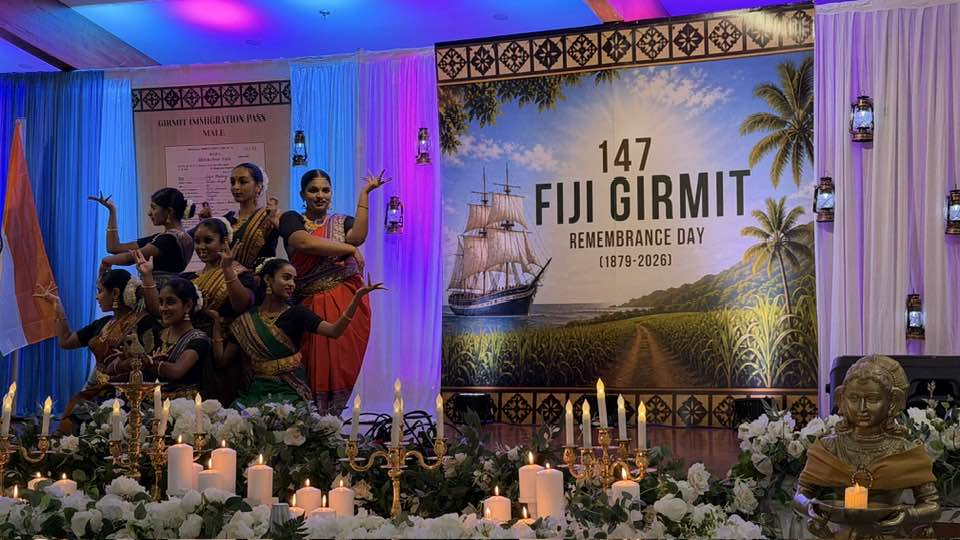
Editorial – As communities across New Zealand commemorated Fiji Girmit Remembrance Day this week, reflections on migration, sacrifice, and national transformation once again entered Pacific public discourse.
Writing after the remembrance gathering in Auckland, Tongan Member of Parliament Jenny Lātū Salesa paid tribute to the “courage, sacrifice, and resilience of the Girmitiyas,” honouring the thousands of Indian labourers who were transported by sea from India to Fiji from 1879 onwards under the British indenture system.
“Their struggles, hard work, and determination laid foundations that generations continue to build upon today,” she said, noting that the commemoration honours not only suffering and sacrifice, but also the enduring cultural legacy carried through Fiji, New Zealand, and the wider Pacific.
Her remarks inevitably draw attention to a broader Pacific reality: migration has long reshaped island societies in ways that continue to influence politics, economics, identity, and interethnic relations generations later.
Passport Sales Legacy Questions
That historical reflection also revives difficult questions in Tonga regarding the kingdom’s controversial passport-sales programme during the 1980s and early 1990s, a policy that eventually resulted in the arrival of hundreds of Chinese nationals into the country.
At the time, many Tongans were reportedly assured that the passport sales — largely linked to overseas Chinese investors seeking alternative citizenship arrangements before the 1997 Hong Kong handover — would not result in significant migration to Tonga itself. The programme was widely framed as an economic opportunity for the kingdom rather than a pathway for settlement.
Yet by the early 1990s, more than 400 Chinese citizens had reportedly arrived in Tonga.
Over the decades that followed, Chinese businesses and Chinese-backed investment established a significant presence in Nukuʻalofa, particularly within the retail and wholesale sectors, where many local residents perceived increasing commercial dominance.
Long-term land leases in parts of the capital also became a source of growing public anxiety among some Tongans, who feared that rising commercial concentration and urban expansion were gradually displacing local communities and pushing many Tongans away from central business areas toward rural districts and outer villages.
For many Tongans, the concern was therefore not solely immigration itself, nor the Chinese community as individuals, many of whom later became part of Tonga’s commercial and social landscape. Rather, the issue became the perception that the public had not been fully informed about the likely long-term demographic, economic, and social consequences of the scheme.
That perception of political dishonesty left a lasting mark.
Migration Policy Lasting Impacts
The comparison between the Girmitiya experience and Tonga’s passport era is not exact. The Girmitiyas arrived under colonial labour systems tied to plantation economies, while Tonga’s migration shift emerged through a state-led citizenship and revenue initiative.
Nevertheless, both histories demonstrate how migration policies can permanently alter Pacific societies in ways governments may initially underestimate, soften, or fail to communicate transparently.
The commemoration in New Zealand also reminds the Pacific of a recurring historical pattern. There is often a period of fear and uncertainty when foreigners suddenly arrive on island shores in significant numbers. Clashes may emerge — whether physical, economic, cultural, or ideological — as societies struggle to adjust to rapid demographic change.
Yet history also shows that over time, communities can gradually move beyond suspicion and division toward coexistence and nation-building.
While laws in Tonga have historically restricted the involvement of foreigners, including Chinese nationals, in certain local business sectors and land ownership, there is a growing advocacy among Tongan leaders for a more inclusive approach grounded in principles of humanity and equal rights.
This perspective emphasises that all individuals residing in the Kingdom should be entitled to fundamental rights comparable to those of indigenous Tongans. Drawing on developments in countries such as Fiji, it is anticipated that, over time, greater participation by ethnic minorities—including Chinese communities—may extend into leadership roles across various sectors of government.
Indo-Fijian National Contribution
The story of Indo-Fijians illustrates this transformation powerfully. Descendants of the Girmitiyas are now deeply woven into Fiji’s national fabric, contributing significantly across business, education, civil society, parliament, and government leadership. What began as a painful and contested migration history eventually became part of the foundation of modern Fiji itself.
Migration in the Pacific is therefore never merely demographic. It touches land, commerce, identity, political representation, and national psychology.
In Tonga’s case, anxieties surrounding economic competition and demographic change later contributed to tensions that surfaced dramatically during the 2006 Nukuʻalofa riots, when many Chinese-owned businesses in Nukuʻalofa were targeted and destroyed.
Today, as Pacific communities honour the journeys of the Girmitiyas and celebrate the resilience of migrant descendants, there is also room for deeper reflection on how governments manage migration narratives at home.
The lesson from both histories may ultimately be less about migration itself than about transparency and public trust. Societies are often more capable of adapting to change when citizens are honestly informed and meaningfully included in national conversations about policies that may reshape the future of their country.
History across the Pacific repeatedly shows that demographic change may eventually be absorbed into national identity — but public distrust born from perceived deception can endure for generations.