Tonga is planning to perform up to 100 hip, knee and other joint replacement procedures next year after the country’s first arthroplasty programme at Vaiola Hospital successfully put its first patient back on her feet and home within days.
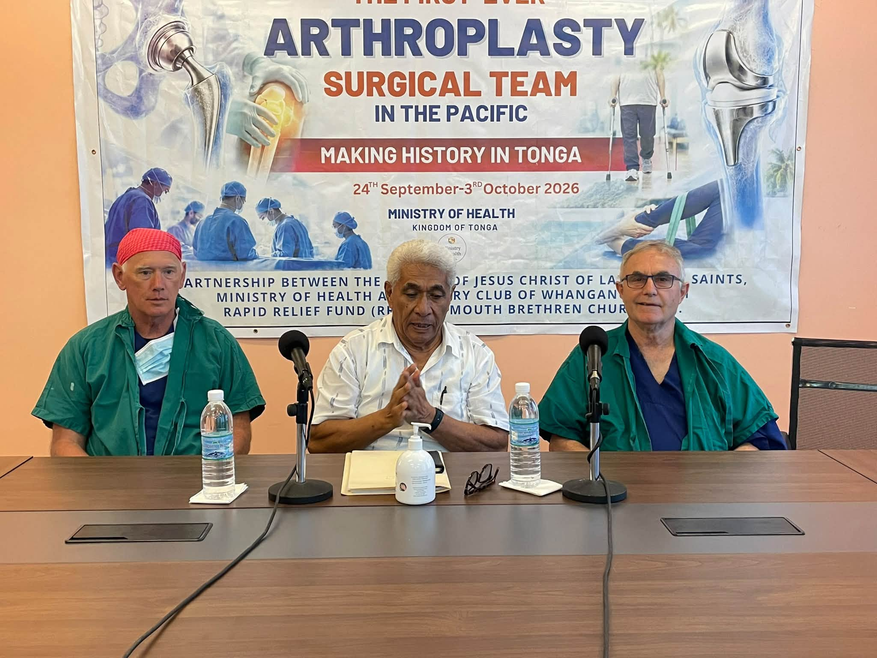
The breakthrough follows the arrival of a volunteer specialist surgical team from New Zealand to perform Tonga’s first joint replacement operations, working alongside Vaiola Hospital doctors and nurses from September 28 to October 2.
The pilot programme was established to bring the highly specialised surgery to Tonga, where there is no resident orthopaedic surgeon and patients have previously had limited access to such treatment.
Previously, Tongans requiring joint replacements, including people suffering severe arthritis of the hips or knees, had to travel to New Zealand or Australia for surgery.
Orthopaedic surgeon Dr John van Dalen estimated that receiving such treatment overseas could cost about NZ$35,000, putting it beyond the reach of many Tongan families.
The breakthrough at Vaiola Hospital means patients selected for the current programme can instead undergo the operations in Tonga and free of charge, with the specialist New Zealand surgical team volunteering its services.
The visiting team’s work has been supported through fundraising and sponsorship, including funding from the Rapid Relief Fund of the Plymouth Brethren church in New Zealand.
The significance is particularly stark given Tonga’s GDP per capita of about NZ$11,500, compared with about NZ$84,000 in New Zealand.
The Ministry of Health said preparations for the next round of patients will begin in November, with the specialist surgical team expected to return in March 2027.
Lord Tangi ‘o Vaonukonuka, Tonga surgeon and former Minister of Health, said the programme was aiming for between 75 and 100 cases next year, subject to funding.
The expansion follows Tonga’s historic first arthroplasty procedures this week, allowing patients who previously had to travel to New Zealand or Australia for specialist joint replacement surgery to be treated at home.
In an encouraging early result, the Ministry said the programme’s first patient was already walking and had been discharged from Vaiola Hospital on Wednesday afternoon after being monitored in the surgical ward.
The current programme, running from September 28 to October 2, involves an eight-member specialist team working alongside Vaiola Hospital doctors and nurses.
The visiting team includes surgeons Dr John van Dalen and Dr Tom Sharpie, anaesthetist Dr Geoff Spenser, Tongan assistant doctors Dr Charlotte Tu‘imana and Dr Letania Mikaele, registered nurses Lynette Sweetman and Lydia Sargent, and logistics coordinator Steve Flaunty.
The mission was sponsored and funded by the Rapid Relief Fund of the Plymouth Brethren church in New Zealand, according to the Ministry.
A critical development enabling the operations to be performed locally was the renovation of Vaiola Hospital’s Central Sterile Supply Department.
Van Dalen said adequate sterilisation was essential for patient safety in complex joint replacement and trauma surgery.
The upgraded facility allows surgical instruments to be cleaned, disinfected and sterilised between operations to standards described by the Ministry as approaching international levels.
Lord Tangi encouraged Tongans suffering from conditions requiring knee, hip and other joint replacements to come forward now that the procedures can be performed in the Kingdom.
“Doing the surgery here in Tonga will make a big difference,” Lord Tangi and van Dalen said, according to the Ministry. “We believe it will change people’s lives, enhance families, and also allow people to be independent.”
The current mission is considered a pilot, but plans are being developed to establish the service annually and potentially bring the specialist team to Tonga twice a year if sufficient funding can be secured.
The longer-term goal is also to strengthen local surgical expertise and build Tonga’s capacity to provide specialised orthopaedic treatment without forcing patients to seek costly treatment overseas.
Clarify the 75-to-100 targetFix the patient timeline