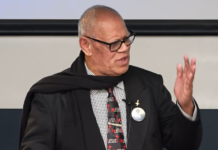
Lord Chancellor Lord Afeaki’s recent return to the Supreme Court bench as Acting Lord Chief Justice has revived scrutiny of his controversial appointment to the same position in 2021—an appointment that prompted a group of senior Tongan lawyers to petition King Tupou VI.

Lord Afeaki assumed the acting role while Lord Chief Justice Malcolm Bishop travelled to New Zealand for a medical check-up last month. During that period, Lord Afeaki presided over several Supreme Court cases, including the sentencing of Maikolo ʻEalele to three years’ imprisonment for serious housebreaking and theft.
His return has brought renewed attention to concerns about the process through which Lord Afeaki, who was not a sitting judge, was previously selected to serve temporarily as the head of Tonga’s Supreme Court.
In October 2021, Lord Afeaki was appointed Acting Lord Chief Justice for four months while then-Lord Chief Justice Michael Whitten was overseas on leave.
At the time, Lord Afeaki chaired the Judicial Appointments and Discipline Panel, which was responsible for considering candidates for judicial office.
Lawyers Alleged Appointment Conflict of Interest
The group of senior lawyers—most of whom were members of the Tonga Law Society—questioned whether Lord Afeaki had sufficient experience to hold such an important judicial position. They subsequently petitioned King Tupou VI, seeking the revocation of the appointment.
“The appointment is tainted with cronyism, personal interest and self-promotion within the Panel,” the lawyers told the King.
“There is a conflict of interest with the Chairperson appointing himself to the position of Acting Lord Chief Justice.
“The Panel is established to consider suitably qualified and appropriate candidates for judicial office and is not established for the promotion of its members to the Judiciary. The decision is not transparent and is wrong.”
Lord Afeaki did not formally appoint himself, as judicial appointments are made by the King acting on advice. However, the lawyers alleged that his position as chair of the panel involved in considering judicial appointments created a conflict of interest.
The petition did not result in the appointment being revoked, and Lord Afeaki continued serving as Acting Lord Chief Justice.
Sentencing decision corrected
Concerns surrounding the 2021 appointment were later followed by questions over multiple versions of a sentencing decision delivered by Lord Afeaki in Rex v Siuʻivahanoa Tuʻipulotu.
Three documents relating to the sentencing on 18 November 2021 appeared on the Attorney General’s Office website. They included two versions labelled “Sentencing Remarks” and a third marked “Corrigendum”—a formal correction.
In the first version, Tuʻipulotu was convicted and sentenced to two-and-a-half years, or 30 months, in prison. The final nine months were suspended for two years from the date of his release, subject to several conditions.
The conditions required Tuʻipulotu to commit no further offence punishable by imprisonment, be placed on probation, report to the probation office, complete a drug and alcohol awareness course and undertake 40 hours of community service.
Another version imposed the same 30-month prison sentence but removed the suspension of the final nine months. It instead directed that, following his release, Tuʻipulotu would be placed on probation for 12 months and complete the other rehabilitative conditions.
The corrected version was marked by the Attorney General’s Office on 22 November 2021 and stated:
“Pursuant to the order of the Court dated 22 November 2021, the following sentencing remarks are to replace those issued on 18 November 2021.”
Earlier Judicial Concerns Resurface
No accompanying document publicly available on the website explained why the original sentencing remarks were replaced or why the suspended portion of the sentence was removed.
Courts routinely issue corrigenda to correct errors in judgments.
In this case, however, the publicly available documents showed more than minor changes in wording: the provision suspending the final nine months of imprisonment was removed.