Children could learn to read and understand Tongan independently through a proposed digital bilingual reading programme that combines illustrated stories with audio narration, enabling them to listen to correct pronunciation even when their parents or guardians cannot read the language themselves.
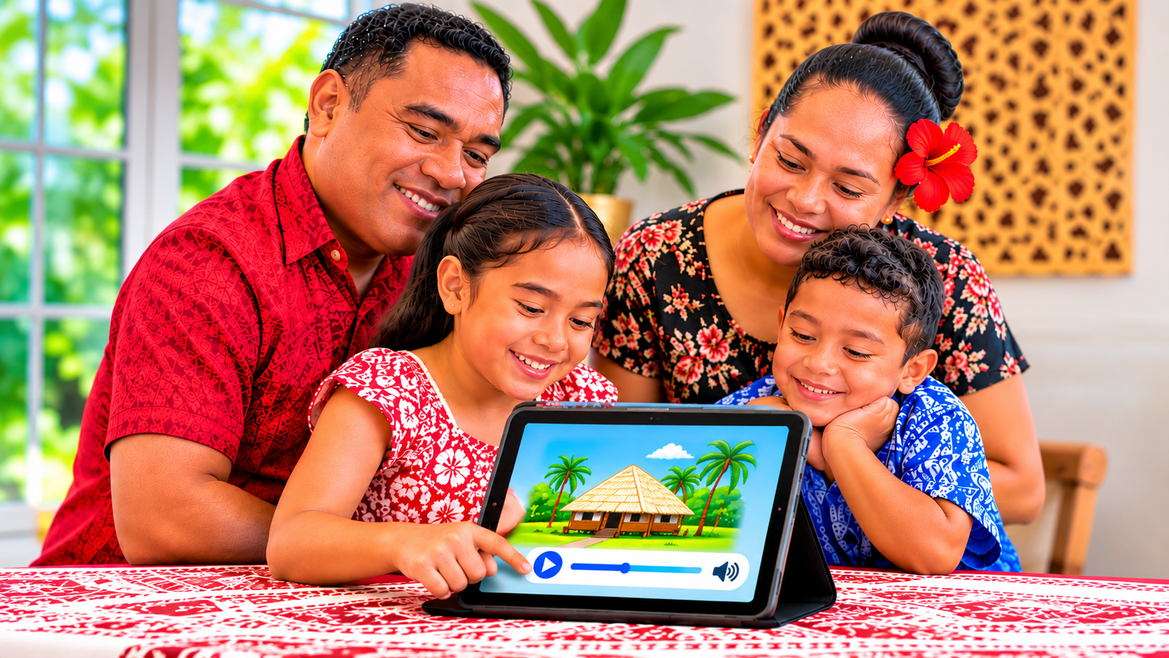
Designed for children aged approximately five to 12, the programme would combine illustrated Tongan stories with authentic voice recordings, English translations and interactive learning activities accessible on mobile phones, tablets and computers.
The initiative is particularly intended for children in predominantly English-speaking households, including families with one Tongan and one non-Tongan parent, and those whose Tongan parents have limited confidence reading or speaking the language.
Addressing a challenge facing Tongan families
For many children of Tongan heritage in New Zealand, opportunities to learn their ancestral language are limited by the predominance of English at home, at school and in everyday communication.
Even children whose parents speak fluent Tongan may increasingly communicate in English, creating challenges for intergenerational language transmission.
The Ministry for Pacific Peoples’ 2026 Leo Moana o Aotearoa Lea Faka-Tonga Report, based on a survey of 545 Tongan participants and talanoa with 25 community members, identified several barriers to learning and maintaining the language.
Among survey respondents, 31.6 percent identified a lack of reading materials in their language as a barrier, while 24.6 percent identified insufficient teachers or resources for community language classes.
These findings highlight the need for accessible educational resources that complement existing language instruction.
How the proposed programme would work
The stories would systematically introduce essential Tongan vocabulary associated with children’s immediate surroundings, including family life, the home, school and everyday activities, before progressing to wider social, cultural and natural environments.
Unlike conventional printed storybooks, the digital resources would allow children to listen to Tongan narration while following the written text, replay unfamiliar passages and practise reading at their own pace.
English translations would support understanding, while interactive exercises would reinforce vocabulary, word recognition and reading comprehension.
The resources would also assist parents with limited Tongan literacy and provide opportunities for fluent Tongan-speaking parents and grandparents to participate in shared reading and discussion.
Once developed, the resources would be freely available through the Ako ʻa Tonga educational website at akoatonga.org.nz.
The initiative remains under development, with implementation dependent on securing the necessary funding and support.
Families invited to share their experiences
To help shape the programme, the Trust is inviting parents, grandparents and guardians to respond to the following questions:
- Community support: Do you support the proposed digital Tongan reading programme featuring authentic Tongan audio narration alongside written stories?
- Reasons for support: If so, what are your main reasons?
- Educational benefits: How do you think audio-assisted stories could help children learn to read Tongan?
- Family needs: What language-learning difficulties could the programme help address in your family?
- Learning content: What subjects would you like the stories to cover?
- Potential use: Would you use these free resources with your children?
- Community participation: Would you be interested in helping test the resources before their public release?
Families may respond to whichever questions are relevant without publicly disclosing personal information about their children.
Community support and participation
The Trust also welcomes written expressions of support from individuals, teachers, Tongan-language educators, schools, churches and community organisations interested in contributing educational expertise, testing resources or promoting the programme.
Feedback can be shared through the comments section of this article or on Kaniva Tonga News‘ Facebook page. Those wishing to collaborate or submit written expressions of support are encouraged to contact Taʻangafonua Charitable Trust directly.
If you want your children to learn to read Tongan but have struggled to teach them yourself, your feedback and support could help turn this proposal into a free educational resource for Tongan families throughout New Zealand.