A Tongan family whose roots in Germany stretch back nearly half a century experienced an emotional reunion with their cultural heritage when they joined fellow Tongans from across Europe to welcome King Tupou VI and Queen Nanasipauʻu during Their Majesties’ recent visit to Berlin.
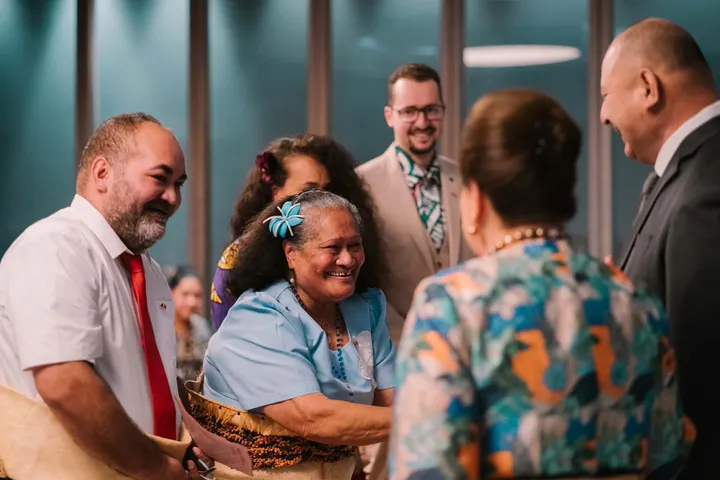
Elina Moana Nive Malia (centre), who has lived in Germany since 1978, smiles as she greets Queen Nanasipauʻu, with King Tupou VI standing nearby, during the royal visit to Berlin in November 2026.
King Tupou VI, Queen Nanasipauʻu and Crown Prince Tupoutoʻa ʻUlukalala visited Germany from November 1 to 6 to commemorate the 150th anniversary of the Treaty of Friendship between Tonga and Germany and 50 years of formal diplomatic relations between the two countries.
Among those attending was 76-year-old Elina Moana Nive Malia, who moved to Germany in 1978 and spent much of her early life there struggling with homesickness, cultural isolation and the difficulties of maintaining contact with relatives in Tonga.
The occasion became particularly memorable when her daughter, Moana Aloha Vo, and son-in-law presented Their Majesties with specially designed gifts — a handcrafted leather chair for the King and a matching handbag for the Queen.
Speaking to Kaniva Tonga News, Moana described the joy of meeting the royal couple and sharing the occasion with Tongans who had travelled from different parts of Europe, including Denmark and Sweden.
She said the two-hour gathering brought a powerful sense of belonging, as though they had briefly returned to Tonga.
“So emotionally to sing and hear the Tongan national song by the Tongans who came to Berlin,” she recalled.
For Malia, the gathering was particularly meaningful given the challenges she had faced since leaving her village of Longoteme.
From Longoteme to Germany
Malia’s journey began when she met Moana’s German father in 1978 during his visit to Tonga.
He had been working in New Zealand as a Volkswagen mechanic after leaving his hometown near Reutlingen, Germany, in his early twenties, despite having little knowledge of English.
The couple initially planned to settle in New Zealand, but his mother’s illness prompted them to move to Germany.
Moana was born there in 1979 and grew up near Stuttgart in a blended family of eight children.
For her mother, adapting to life in a foreign country proved difficult.
She had to learn German while raising the children and working in a fish shop and as a custodian.
At the time, few people in her community knew anything about Tonga, and there were no other Tongans nearby with whom she could share her language and culture.
Moana recalled that her father arranged the first telephone connection in Longoteme so her mother could communicate with relatives back home.
However, international calls were expensive, limiting contact to perhaps twice a month.
Airfares were equally prohibitive, making visits to Tonga rare throughout the 1980s and 1990s.
During those years, only her father managed to visit her in Germany.
A familiar face for Pacific newcomers
As Tongans and other Pacific Islanders gradually began settling in Germany and elsewhere in Europe, Malia became an important source of companionship and support.
Moana said newcomers who heard about her mother would seek her out, knowing they could speak with someone who understood their cultural background and the difficulties of living far from home.
“Just to get the feeling they are not alone, so far away from home,” she explained.
She said her mother earned considerable respect among Pacific Islanders who recognised the challenges she had overcome as an early Tongan settler in Germany.
Despite her responsibilities raising a large family, Malia continued sending financial assistance to relatives in Tonga.
Moana recalled that her German father sometimes struggled to understand this commitment, reflecting differences in cultural expectations.
Her mother nevertheless maintained a strong attachment to her homeland and took pride in her Tongan identity.
Over time, the growing Tongan community established stronger relationships and support networks across Germany.
Royal gifts inspired by a chair made for the Pope
The Berlin gathering also provided Moana and her husband with an opportunity to demonstrate their craftsmanship through two specially designed gifts.
Both previously worked for a major automotive interior company, where Moana was involved in research and development for luxury vehicle interiors, including projects associated with Porsche and Rolls-Royce.
Her husband worked as a vehicle upholsterer specialising in prototype development.
In 2014, he helped produce a chair for the Pope, an experience that later inspired the couple to create a similar gift for Tonga’s King.
They subsequently developed the idea of making a handbag for the Queen.
However, the couple had only four weeks to prepare after learning about the royal gathering from Moana’s brother.
She said finding leather in the desired colour was particularly challenging, while the Tongan embroidery required more than 200,000 stitches.
The handcrafted pieces combined their professional expertise with designs reflecting their Tongan heritage.
Her husband established his own business, Fahrzeug-Sattlerei-Seidel, in 2015 after leaving the automotive company where the couple had met.
The business specialises in upholstery for vehicles, boats, motorcycles and small aircraft.
Returning to the homeland
Nearly five decades after Malia’s departure from Tonga, technology has transformed how overseas families maintain contact with their relatives.
Moana contrasted her mother’s early experiences of expensive telephone calls and limited opportunities to travel with today’s smartphones and instant video communication.
The family is now preparing to visit Tonga from December 9 to 22.
It will be Moana’s husband’s first journey to the kingdom, giving him an opportunity to experience firsthand the culture that inspired his royal gifts.
For Malia, the visit will offer another chance to spend time in the homeland whose language, traditions and family connections she has preserved throughout her life in Germany.