An Auckland man deported from Australia as a 501 after serving prison time as a teenager for a murder-for-hire plot involving a victim with cerebral palsy is again wanted by police.
At one point during the hour-long April 2023 pursuit, Sifa Tevita, now 37, had 20 police vehicles following him.
He drove in the wrong direction down the Waikato Expressway when it was busy with school holiday traffic, nearly hit an ambulance, swerved at members of the public and kept going even after two flat tyres fell off the Porsche.
When police finally caught Tevita, he “refused to provide an explanation, choosing instead to urinate in front of them”, according to court documents recently released to the Herald.
Tevita pleaded guilty to burglary, reckless driving and failure to stop for police and had been set for sentencing this week in Auckland District Court, where he faced a sentence of up to 10 years’ imprisonment.
He was also scheduled to be sentenced for breaching the Returning Offenders Act, which allows Corrections to supervise the reintegration of those returning to NZ after criminal convictions overseas – placing on them parole-like restrictions.
Judge June Jelas instead ordered a warrant for his arrest after he failed to appear for the hearing, with defence lawyer Harvena Cherrington indicating to the judge she had not been able to reach her client.
He remains at-large.
‘Risk to the public’
According to court documents, the crime spree began in affluent Auckland suburb Parnell about 2am on April 16 last year when Tevita and co-defendant Ronald Neilson cased out a gated residence where the 2021 model Porsche 911 C4S and a $50,000 Land Rover Discovery were parked.
They returned at 4am and removed the keys for both vehicles from within the residence.
“The defendant Neilson has driven the Land Rover directly at the security gate, smashing it from its hinges before driving from the property,” states the agreed summary of facts for Tevita’s case.
“The defendant Tevita has followed in the Porsche.”
Neilson has also pleaded guilty but remains at-large after failing to show up for a sentencing last month.
Police spotted Tevita heading towards Hamilton that same day after he attempted to purchase fuel for the sports car at a Waihi petrol station about 7.30am.
He realised police were onto him when they attempted to spike the Porsche’s tyres. When that attempt to stop him didn’t work, police pulled directly behind him with red and blue lights flashing. Tevita sped away.
“The defendant has entered the Waikato Expressway the wrong way before driving south in the northbound lane,” court documents state.
“He proceeded to travel 7km down the wrong side of the Expressway during which time he swerved toward police units travelling northbound and narrowly avoided colliding with an ambulance.”
He then exited the motorway onto Te Rapa Road in Horotiu, driving at an estimated speed of 80km/h despite the two right tyres of the Porsche having completely deflated at that point.
“As the defendant drove south along Te Rapa Rd, he against swerved towards a police unit and regularly travelled on the incorrect side of the road, forcing members of the public to the side of the road,” the police narrative continued.
“At one stage the defendant accessed The Base shopping mall car park, forcing shoppers to take refuge inside the shops, such was the manner of driving.”
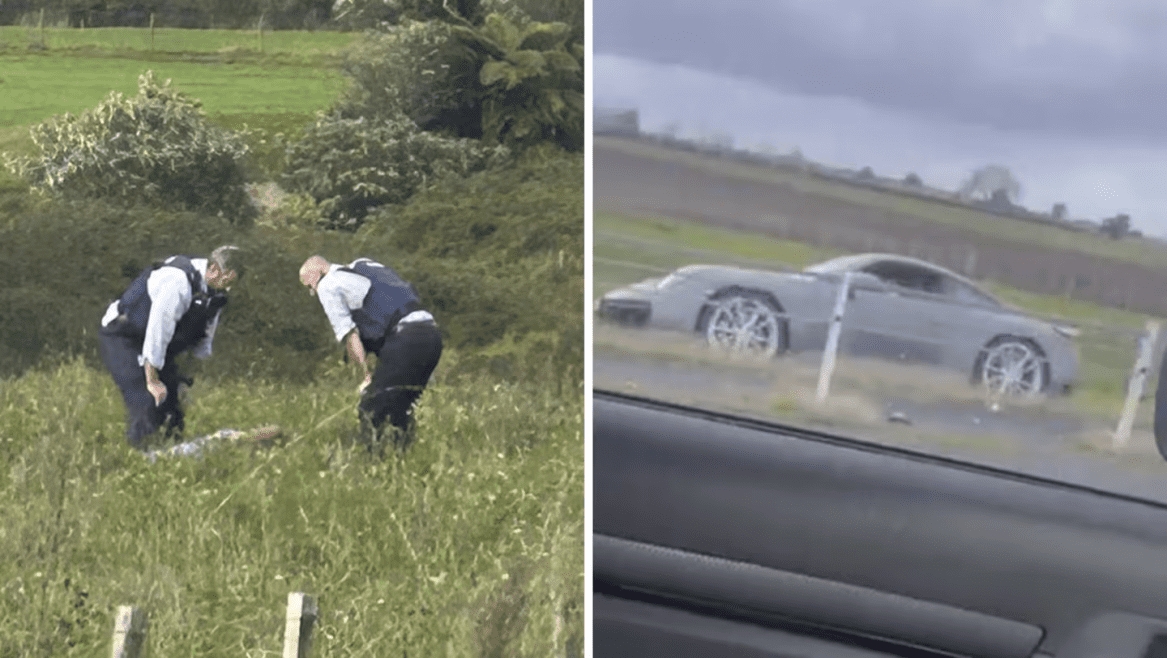
Auckland resdient Sifa Tevita is arrested in April 2023 after a police chase involving a stolen $249,000 Porsche that was driven on the wrong side of the Waikato Expressway. Photo / Ashlee Garrett
He then returned to Te Rapa Rd, continuing to drive on the wrong side in an effort to shake police, the summary of facts states.
He travelled an estimated 80km/h in a 50km/h zone while again swerving towards members of the public, police noted.
“At about this time the two deflated tyres fell off the vehicle, causing the defendant to drive on the rims,” authorities have noted, explaining that he continued to avoid arrest by swerving at police or driving around them on the grass verges before again entering the wrong side of the Waikato Expressway.
“Due to the defendant’s manner of driving and unpredictable behaviour police were required to stop both north and southbound lanes of traffic to reduce the risk to the public,” authorities said.
Tevita continued to drive another 12km, including “extended periods” where he remained on the grass verge, until encountering “a considerable police roadblock” at the Taupiri interchange.
Seeing the trap that lay ahead, Tevita reversed down the motorway then exited between a wire barrier and a roadside fence in an effort to get around the roadblock.
“The defendant managed to drive a further 500m before eventually sliding into a fence, becoming stuck and fleeing from police [on foot],” court documents state.
“When arrested in a nearby paddock the defendant refused to provide an explanation, choosing instead to urinate in front of them.”
‘Not even a panadol’
During a hearing in Hamilton District Court later the same week, Tevita was seen hobbling into the courtroom dock.
He was “not in a good physical state” as a result of the incident, his lawyer at the time, Roger Laybourn, told community magistrate Brenda Midson.
“He has a serious back problem and has advised me that he has not even been provided with a panadol and wants me to raise that [with you],” Tevita’s lawyer said.
“I would like it noted on the file that it does impact on my ability to get coherent instructions from him.
“If a person has a back injury you would think an X-ray would be the minimum until any rational medical decision can be made.”
The magistrate agreed to put a note on the file before remanding Tevita without plea.
The case was later transferred to Auckland District Court.
‘Cruel and merciless’
The Waikato Expressway chase wasn’t the first – or even, arguably, the most bizarre – crime that Tevita has been in the public eye for.
In 2005, at just age 18, he was handed a precedent-setting 18-year prison sentence in a Brisbane courtroom after pleading guilty to slashing the throat of a young man in a wheelchair and stabbing him three times in the back.
The judge stipulated he serve at least 80 per cent of the attempting to kill sentence before eligibility would set in for him to apply for parole.
Tevita was 17 years old at the time of the May 2004 attack, which he said he participated in because victim Michael Birch’s roommate – Benjamin Luke Janz, who also suffered from cerebral palsy – had promised him $500,000 to carry it out.
Birch was left for dead but survived the attack, according to court documents from Australia.
“Mr Birch heard someone running into his bedroom,” the Queensland Court of Appeal recounted while considering if Tevita’s sentence was manifestly excessive.
“A hand came across his face pulling his head back, and he felt his throat being cut. After that, the applicant came back and stabbed him.”
“Are you right to use this?” the victim’s roommate had asked Tevita a short time earlier after handing him a folding knife with a 10cm blade.
“Do it now,” he added.
Janz, who would later receive a 10-year sentence, was described as the more intelligent of the two co-defendants.
“It may be that because of his own disability Janz was unable to carry out the killing himself and so engaged the applicant to do it for him,” the Court of Appeal noted.
Because of his disability, the victim had been in a wheelchair his whole life and was unable to defend himself, the court also noted.
He called police but was unable to speak due to the neck wound. He then wheeled himself outside his flat – the bloody sight prompting neighbours to call for an ambulance.
“The result for Mr Birch has been tragic,” the Court of Appeal justices wrote.
“Despite his disability, he had previously been able to live an independent life. He was a disc jockey for … a broadcasting system that serves the Children’s Hospital. Remarkably, he was also learning to fly an aeroplane.
“Now he can do neither of these things. Because of injuries to his larynx, he is unable to speak above a whisper. He is at constant risk of choking and has to have his food cut up for him to eat.
“It is painful to cough; he is vulnerable to colds, flu and throat infections; and he suffers continuous back pain from the stabbing inflicted on him. He now requires a full-time carer and his mother has had to resume living with him to look after him.”
In determining if the sentence was manifestly excessive, the court noted that “there is obviously not much to be said in mitigation of the applicant’s terrible deed”, adding that it was “cruel and merciless and carried out for money”.
Youth was a factor to consider, but “it does not require much maturity to know not to commit such an awful offence, even though it is clear from the psychologist’s report that the applicant is lacking in ordinary intelligence and insight”, the Court of Appeal found. It dismissed the appeal.
Tevita and his co-defendant were also ordered in 2008 to pay $75,000 in compensation – the maximum allowable under Queensland law – to the victim, according to the Brisbane Times.
The court was told Tevita moved to Australia in 1999, around age 12.
He left school at age 17 and turned to theft to fuel his drug and alcohol addictions.
By the time of his Waikato arrest, he had been released on parole, deported to NZ and was living in Auckland suburb Wesley, where he worked as a scaffolder, according to the more recent arrest records.
Craig Kapitan is an Auckland-based journalist covering courts and justice. He joined the Herald in 2021 and has reported on courts since 2002 in three newsrooms in the US and New Zealand.
A fake tradie who fleeced customers off by more than $280k will be deported to Tonga after inflicting shoddy and incomplete work on vulnerable homeowners’ properties in Sydney and Wollongong.
Tevita Ungounga
Tevita Ungounga launched a charitable website where people who were interested can buy tickets, and the first prize is cash or a house built by him.
The unlicensed tradie did this online business marketing while spending time behind bars.
His sentence comes after he had faced 50 charges from fraud to illegal work, and was put behind bars for breaching his bail by doing more unlicensed and uninsured jobs.
Ungounga destroyed a man’s house and drained his life savings in one of the worst cases seen on A Current Affair has been exposed as a father who regularly attends church with his family.
Ungounga is well known to Fair Trading and New South Wales Police, but despite multiple public warnings and convictions, the 55-year-old from Moorebank has continued to work and left some homeowners in financial ruin.
One of his victims, Ian O’Connor from Illawong, gave Ungounga $235,000 to build a seawall and renovate his quaint home, Australia’s 9Now reported.
The 68-year-old was left with holes in his walls, unfinished rooms, and two years on still has no running water.
“He’s a pig, a disgusting pig,” Mr O’Connor said.
“He seemed quite nice, very friendly, but I guess you could say most conmen are.”
A dengue fever outbreak will be officially declared on Friday in Samoa.
More than 250 cases have been reported, with the majority on the mainland, northwest of Upolu, where most of the population lives.
The World Health Organisation describes denge fever as a viral infection that spreads from mosquitoes to people. Most people don’t get symptoms but for those who the most common were high fever, headache, body aches, nausea and rash.
Samoa’s Director General of Health Alec Ekeroma says a news conference will be held in Samoa at 4pm local time (3pm NZT).
Earlier he said: “No one has died from it, but the country needs to continue its protection measures, and we are planning a national campaign to clean up and destroy breeding sites for mosquitos.”
Samoa’s last dengue situation report dated March 18 – 24 showed 22 new lab-confirmed dengue cases recorded at the time, adding up to 40 cases in March.
The report noted the most affected age groups were those between 5-9 years old and those over 60.
Northwest of Upolu and Apia urban area regions are reported to be the most affected, but some cases have been reported from all regions including Savai’i.
Aiono said there were 20 different definitions of outbreak and they would decide which definition applied now.
If someone has symptoms of dengue-like illness, Aiono said they have to go to hospital so they can undergo blood tests to confirm if they do have dengue.
A public health alert on dengue fever has already been issued advising and encouraging clinicians to collect samples for testing for all patients presenting with dengue-like illnesses.
A Kawerau man is facing numerous charges after allegedly pointing a gun at police, evading arrest and holding people hostage in their own homes.
A 31-year-old Kawerau man has been arrested. Photo: RNZ / Richard Tindiller
The “dangerous and unpredictable incident” began when two police approached a “suspicious” vehicle on State Highway 30 in the eastern Bay of Plenty about 10pm on Wednesday.
The occupant fired a gun, then pointed it at the officers before driving off.
“An immediate police response allowed officers to set up cordons and locate the vehicle, preventing the suspect from leaving the area,” detective senior sergeant Paul Wilson said on Thursday.
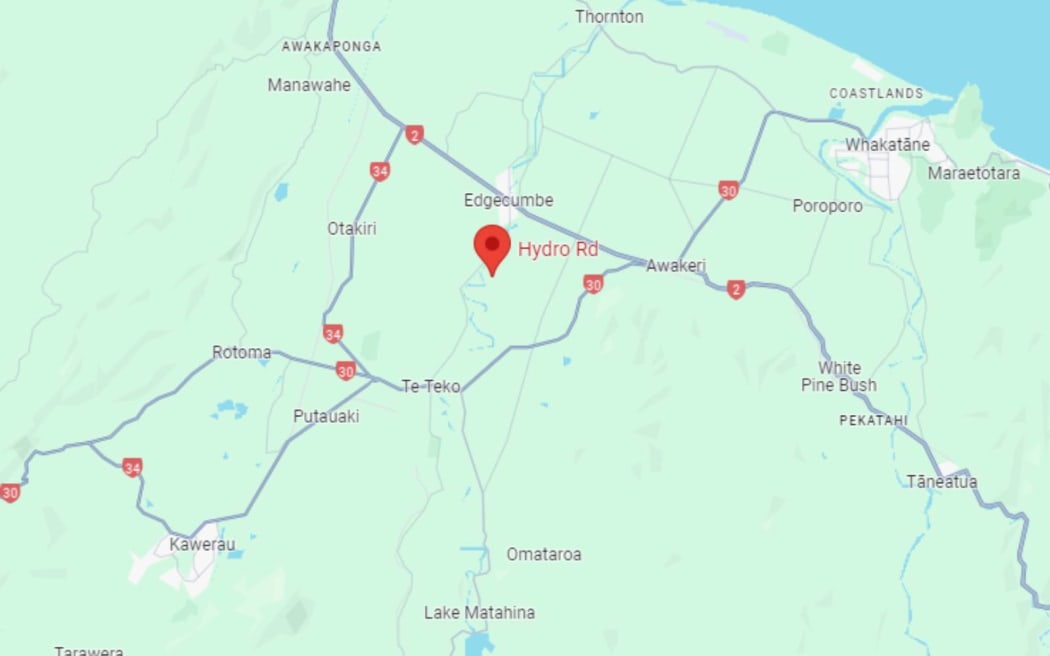
The suspect stopped at a property on Hydro Road, just south of Edgecumbe, and held two people living there hostage, Wilson said.
He then entered another building where he allegedly assaulted and held a third person, in their 70s, hostage.
Police managed to rescue the first two hostages safely at about midnight.
Shortly after at 12.30am, the suspect gave himself up without incident.
One person was taken to hospital with minor injuries.
A sawn-off .22 rifle was recovered, Wilson said. Police will continue to examine the scenes.
A 31-year-old man has been charged with using a firearm against law enforcement, kidnapping, wounding with intent to injure, aggravated burglary, failing to stop, threatening to kill, unlawfully taking a motor vehicle and wilful damage.
He is expected to appear in the Whakatāne District Court on Thursday.
Hydro Road in eastern Bay of Plenty. Photo: Google Maps
“This was a dangerous and unpredictable incident,” Wilson said.
“Three victims have been through a distressing ordeal in their own home, a place where they should feel safe, and two police officers have faced a totally unacceptable threat while going about their duty.
“Police are ensuring the victims and the officers have the support they need.
“I’m proud of the actions of our police, who brought this volatile incident to a peaceful conclusion. Events like this are distressing for our communities; there will be an increased presence in the area and officers will be carrying reassurance patrols.”
Last night, the visiting delegation, made up of members of the United States Congress and the United Nations Foundation (UNF), departed Nuku’alofa, Tonga, following in-depth discussions with representatives from Government and civil society, as well as visits to schools, UN-supported projects, and the Vaiola Hospital.
While in Tonga, delegation met with Hon. Samiu Vaipulu, Acting Prime Minister of Tonga, as well as other Ministers and members of Government – Hon. Tiofilusi Tiueti, Minister for Finance, Hon. Siale Ákauóla, Minister for Health, Mr. ‘Isikeli Oko – CEO for Education and Training Mrs. Kilisitina Tuaimei’api – CEO for Finance, Dr. ‘Ana ‘Akau’ola – Acting CEO, Ministry of Health, Mr. Vatulele Tuputupu – A/CEO, MEIDECC, Miss ‘Olita Tupou – Acting Chief Secretary & Acting Secretary to Cabinet, PMO, Miss Ilaisipa ‘Alipate- Chief of Protocol, Ministry of Foreign Affairs.
“We are grateful to the Acting Prime Minister and Cabinet Ministers for receiving us so warmly today. This meeting provides an important opportunity for the Congressional delegation to gain a deeper understanding of the challenges facing Small Island Developing States like Tonga, and to explore collaborative solutions that the US – through partners such as UN – can bring to help address these pressing issues,” said UN Resident Coordinator to Tonga, Mr Dirk Wagener, who was also part of the delegation.
Tonga faces many developmental challenges, all of which are exacerbated by the climate change emergency, COVID-19 and increasingly frequent and intense disasters.
The interconnectivity of economic, health, development, nutrition, and climate challenges in Tonga, combined with its remoteness, all contribute to its classification as the world’s second most at-risk country in the world in terms of its exposure and susceptibility to natural hazards and the unfolding effects of climate change.
The UN-Tonga Country Implementation Plan (CIP) 2023 – 2025, endorsed by the Government of Tonga in May 2023, defines UN assistance to Tonga to achieve its Strategic Development Framework and the Sustainable Development Goals (SDGs).
With an annual budget for 2023 of USD$17m, the CIP focuses on four pillars – Planet, People, Prosperity and Peace – to contribute to a Pacific region where all people are equal and free to exercise their fundamental rights, enjoying gender equality and peace, resilient to the existential threats and living in harmony with the blue continent.
In total, there are 23 UN agencies working in Tonga, including non-resident agencies.
As the sun rises on Anzac Day dawn services on Thursday, Tongans will remember the 94 young men from the islands who served in the First World War.
The young men who enlisted were mainly expatriate Europeans who had been born in or worked in the kingdom, but several Tongans also enlisted.
A roll call of the names of those who fought in the 1914-18 war contains familiar Tongan names: Fotu, Faletau, Tu’inukuafe, Taliaʻuli, Lomu and Mohenoa.
There are European names like Leger, Mahoney, Cowley, Sanft, Muller, Payne, Hurrel, Harper, Ramsay, Walter and Lynch which are still attached to large families on Tonga
Among those who went to war were people who rose to prominence later in life, such as Sateki Faletau, who served in the Maori Contingent and the New Zealand Medical Corps and later became Governor of Vava’u and Minister for Police.
But there are many more others with more ordinary backgrounds: Bakers, teachers, storekeepers and traders who came home after the war and went back to their trades and professions.
Only one Tongan died during the war. He was Sione Talia’uli, who died of pneumonia in 1918. He is buried in Palestine.
The names of the volunteers from Tonga or those with a connection to the kingdom have been gathered together in a new book by Christine Liava’a, Koe Kau To’a Na’anau Poletau. Valiant Volunteers: Soldiers from Tonga in the Great War.
On Monday some of the names from the book were read out on the Kaniva Tonga Radio Programme.
The broadcast prompted a call from Hehea Sina Faletau who told us that her grandfather, Sateki Faletau had gone to war.
His son, Maile Faletau, served during the Second World War as a medical officer.
There was pride in Hehea’s voice as she explained the connection with Sateki.
Here are the list of the Tongan soldiers taken from Christine Liava’a’s book.
Frederick Bruno Delamere, whose original name was Waldermar Bruno Sanft, was a maritime engineer who had trained with J.H. Adams of New Zealand for six years. When he enlisted in the Australian Imperial Force (AIF), he claimed to be of British nationality. In reality he was a German subject as his parents, Franz Carl Sanft and Martha Agnes Lehmann Sanft were both Germans, although living in Tonga.
Joseph Clarence Hughes was a musician, aged 30, born in Tonga. He enlisted in the AIF in the Australian Imperial Force in June 1916.
Edward Stewart James was a veterinary surgeon. He was the son of the Rev. C E James and was born in Tonga on November 29, 1889, when his father was working there.
Claude Napier King was born in Charters Towers, Queensland, but was living in Nuku’alofa in 1915. He was killed in action on August 8, 1918, by a sniper. His body was not recovered.
Walter Leyden was a son of John Henry Leyden or Lyden and Cecilia Elizabeth Leyden (nee Johnson) of Vava’u, Tonga.
Robert Hugh McGlew was an Englishman who was born in Sydney, New South Wales. He was an accountant working in Tonga and was 36 when he listed in Adelaide, South Australia, in 1917.
Harry Monk was an Englishman who was born in West Auckland and migrated to Australia and then Tonga. He was a surveyor and a member of the Nuku’aofa Club.
James Egan Moulton was the grandson of the Rev James Egan Moulton, founder of Tupou College.
Alfred Egbert Roberts was the son of John Hartley Roberts, Director of Education for Tonga and principal of Tonga College in the 1880s.
John Trotter was appointed as second assistant teacher at Tonga College in 1914, then became Government plantation manager.
Reverend J Laurent F Benezeth was a Marist brother in Tonga. Born in 1881, he is listed on the Tongan War Memorial
Reverend Camille Doizy was a Marist brother in Tonga, born 1884. He left Tonga for France during the war and is listed on the Tongan War Memorial.
William Kanani Rudling was born in Hawai’i in 1896, the son of Thomas George Rudling and his Hawai’ian wife Eugenia Kahele. The family moved to Tonga where T.G. Rudling became the Assistant Collector of Customs and Postmaster in Vava’u
John William Alo.
Charles William Boyer travelled to Auckland from Tonga in early 1916 and joined the 4th Maori Contingent. He was a Lance Corporal in the No 1 Platoon.
Sateki Faletau of Vava’u was a medical student and hospital attendant in Tonga. He was born at Neiafu, Vava’u on October 24, 1894 and came to New Zealand in July 1916, aged 21. He enlisted and served as a Lance Corporal in the Maori Contingent. He embarked for England on October 11, 1916 from Wellington on the Tofua, but was discharged there as medically unfit. He returned to New Zealand then re-enlisted in 1919 in the New Zealand Medical Corps. He was finally discharged in 1920 and returned to Tonga, where he later married Celia Elizabeth Leyden, also of Vava’u. He is listed on the Tongan War Memorial.
His full name was Sateki Veikune Faletau and he became the Hon. Siosateki Veikuna Faletau, 11th ‘Akau’ola, on December 8, 1932. He was Governor of Vava’u between 1936 – 1939, then Lieutenant-Colonel of the Tonga Defence Force during the Second World War and Minister for Police 1939-1952. The late Hon. Siaosi Filiapulotu Faletau, 12th ‘Akau’ola, the late Hon. ‘Inoke Fotu Faletau, 13th ‘Akau’ola, and the Rev Sione Faletau are his sons. His son Maile Faletau also served during the Second World War.
John Harper was a storekeeper for Burns Philp in Tonga. His next of kin was listed as his mother, Mrs Emele Harper of Nuku’alofa. His aunt was Mafikiholeva Percival. In 1916, after being escorted to Auckland because of his intemperate habits, he sailed on the troopship Navua.
Edwin Hughes was a baker and carpenter in Neiafu, Vava’u.
Guy Robert Jury was the son of Captain Jury, a part-Maori settler in Tongatapu with plantations at Fo’ui and Nukunuku
Baisley Leger was the son of James Paul Leger and Mereste Magila Tiumala, both born in Samoa but living in Nuku’alofa since 1897. He was a boat builder who enlisted in New Zealand in 1915, with the Rarotongans attached to B company, 3rd Maori Contingent. He served as a Sergeant and was wounded in a gas attack and evacuated to the 7th Field Ambulance, then to a Convalescent Hospital in France. He married Sela Vete in 1920 and they travelled to New Zealand in 1920. He later married Amelia Toli. He died in Auckland in 1973.
Francis Leger was a seaman, born in 1898, the brother of Baisley Leger. He served in France in the Pioneer Battalion. He returned to Tonga and married Meleane Fatafehi. He died in Vava’u in 1967 and listed on the Tongan War Memorial
David Loma or Lomu was an assistant Harbourmaster of Nuku’alofa, the son of Mafu. He enlisted in the 7th Maori Reinforcement as a Private and embarked from Wellington on August 16, 1916, for England. He is listed on the Tongan War Memorial.
Ernest Mitchell travelled to New Zealand from Vava’u in 1916.
Wiliam Robert Moore, aged 28, was a carpenter who arrived in Auckland from Ha’apai aboard Talune on June 19, 1916.
Adolph Muller was a farmer in Tonga, brother of Miki Muller of Nuku’alofa. They were of Swiss/Samoan descent, being sons of Phillip Muller and Philomena Laukiki. He served in Egypt and Palestine. He returned to Tonga and married Mel Tatafu Fotofili in 1920. He is listed on the Tongan War Memorial. He died in 1960.
Francis Alfred Payne was a farmer who enlisted in Takapuna, Auckland on November 9, 1915. He was born in 1896 in Tonga, a descendent of Alfred Payn and Oli Leva. He embarked from Wellington on February 5, 1916. He returned to New Zealand and was discharged on October 24, 1916. He remained in New Zealand and married Elsie Sunckell from Akaroa in 1920. He served in the Second World War. He died in 1957 in Ashburton, New Zealand, while on holiday.
James Victor Silva, of Portuguese descent, was born in New Zealand in 1889, son of Emanuel and Ethel Elizabeth (Edwards) Silva, but was a carpenter in Nuku’alofa.
Parker Stout Skeen was a cousin of Reginald Skeen. He was a son of Robert Lowis Skeen from New Zealand, chief justice of Tonga and his wife Eliza Fruean.
Sione Taliauli of Nuku’alofa was a young medical student training with Dr Bennett of Blenheim, New Zealand, when war broke out in August 1914. In October 23, 1915 he enlisted in Blenheim and joined the 3rd Maori Contingent as a Private. They trained at Narrow Neck Camp in Auckland then left for Egypt from Wellington in February 1916 on the troopship Navua. On arrival at Suez, he was transferred to various camps within Egypt, appointed temporarily Corporal and then admitted to hospital in Cairo. He died of pneumonia in October 1918. He is buried in Ramallah in Palestine. Sione Taliauli had a child Bakelo or Pakola in Tonga. His medals, the British War Medal and the Victory Medal, were sent to the child care of his aunt Alilua, of Kolofo’ou in 1923. He is listed on the Tongan War Memorial.
George Tu’inukuafe was the son of john Tu’inukuafe (Sione Tuafusi) of Vava’u. He was born in Falepa. He arrived in Auckland in June 18, 1917 as a native clerk and worked as a gardener. He returned to New Zealand in December 1918 and was discharged there at his own request, in March 1919.
Willie John Vea was born on December 19, 1894, and was a medical student from Nuku’alofa. He travelled to New Zealand in 1918. He married Sisilia Fatafehi Tupou in August 1917. He was discharged on December 5, 1918, and returned to Tonga.
Robin Wilkinson Archer was born at Vuna Point, Taviuni, Fiji on April 21, 1874. He was a printer in Tonga.
Augustus Ofa Talauu Chamberlin was born in Nuku’alofa, Tonga in 1895.
Guy Waller Chamberlin, the brother of Ofa, was born in Tonga on August 9, 1898, and served as Private 76528
George Adrian Chester, an Englishman, a civil servant in Tonga Vava’u in 1915.
Henry William Cocker was the grandson of Joshua Cocker, the first British Consul in Tonga.
Joseph North Cocker was another grandson of Joshua Cocker, the first British Consul in Tonga.
Harold Eric Coleman lived in Tonga until early 1915.
Albert William Cook was a seaman born in 1894, the son of Albert William Cook.
Ralph Tugi Cowley was one of the Cowley family who are bakers in Nuku’alofa. He was the eldest son of Alfred and Mary Harriette Cowley originally from Derbyshire, England who arrived in Nuku’alofa in 1885. According to a death notice inserted in the New Zealand Herald by his sister Mrs Morre. He was aged 16 years and 10 months when he died. He is listed on the Tongan War Memorial.
Roy Leslie Donaldson was born in 1889 in Raglan and is listed on the Tonga War Memorial.
Otto Fiedler was the son of John Fiedler of Nuku’alofa.
Dan Flood was a Customs officer born in 1898, whose mother, Mrs J.H. Spurr, lived in Whakatane. He arrived in New Zealand from Tonga in February 1916.
William Flower was a New Zealand railways clerk born in Nuku’alofa in 1898.
Tevita or David Fotu was born on March 19, 1888, in Nuku’alofa, the son of Nai Fotu of Tonga. He was a school teacher employed by the Tongan Education Board. He became a forestry worker at Woodhill, north of Auckland. He died in 1952 aged 64 and was cremated at Purewa Cemeter, Auckland.
Alexander Charles Taufa Goedicke was born in Tonga in May 1896.
Henry Hammerell was born in Samoa and was of Swedish descent. He was married to Alice Rose Cocker. He was killed at the battle of Messines on June 7, 1917. His wife remarried to Taniela Tu’ipulotu Kama of Maofaga. He is listed on the Tongan War Memorial.
George Hurrel was the son of James and Amelia Hurrell nee Lomu of Ha’apai. He was a boat builder born on April 1, 1898 although he gave the date as 1895 on his enlistment papers. He died of influenza while serving in France in July 1918. His father in Tonga received his medals- the British war medal and the Victory Medal in 1921 and 1922 respectively.
Arnold Woodford Izard was the Chief Medical Officer in Tonga in 1914.
Leo Reginald (Mick) Jury was a New Zealand Maori from Wairarapa who had settled at Fo’ui Tongatapu.
Francis Henry Leyden was born in Tonga, the son of John Henry and Cecilia Leyden of Vava’u. He had been in the 2nd reserves and was training at Featherson Camp in Wairarpa when he died of influenza on December 5, 1918 aged 38. His niece Celia or Silia Leyden, a daughter of his brother Robert Leyden, married Sateki Faletau Akau’ola in Vava’u in 1934
James Michael Lynch was the son of Martin and Clara Lynch (nee Parons) of Vava’u. The family moved to Auckland in the early 1900s. He returned to Tonga. James was a Private in the Auckland Infantry Battalion. He embarked for England on June 26, 1916. He returned to New Zealand, then moved to Tonga. He married Sela Tapuaka and later Mele Siale. He returned to New Zealand in the 1950s and died in 1961 aged 74. He is listed on the Tongan War Memorial.
Alfred Patrick Lynch was the brother of James Lynch.
Brian Gerald Mahoney was working in Vava’u, Tonga. He served as a Sergeant in the Auckland Regiment, was commissioned into the Royal Munster Fusiliers in 1917 and then attached to the Royal Air Force. According to a report in the Otago Daily Times he was killed in a flying accident on September 3, 1918.
William Handcock Mackay was a trader working for M.Muller at Tabikofe, Tongatapu and living in Nukunuku.
Tevita Mohenoa (Divit Mohenor) was a ship’s steward, living in New Zealand. His father was Esefe (Esafe) Mohenoa of Nuku’alofa.
Llewellyn Martin Nicholas born on January 18, 1876 in New Zealand and was a trader in Vava’u.
John Oswald was a trader in Tonga and served as a storeman.
Edward Lesley Joseph Parker was born in Tonga on November 2, 1884, and educated there. His brother Francis Robert Parker was born in Eua, Tonga, in 1874
Jack Parsons was born in Tongatapu on 25 March 1896.
William Parsons was the brother of Jack Parsons and was born in Tonga on May 1, 1894.
Thomas William and Harry Parsons were cousins of Jack Parsons and William Parsons, who were part Tongan, and also served in the New Zealand Expeditionary Force.
Charles Stuart Ramsey was the brother of Robert Campbell Ramsey and Arthur Gordon Ramsay. Charles return to Tonga and lived in Niuafo’ou. He is listed on the Tongan War Memorial.
Robert Campbell Ramsay was the brother of Charles Stuart Ramsey, who was born in England in 1890. He won the Military Medal in October 1918 for his actions during an attack on German guns and tanks.
Owen Robert Ricks was born in Canada and was a storekeeper in Tonga.
William Douglas Robbins was an Englishman and a trader at Mu’a. He had been in Tonga since 1910.
Thomas Victor Roberts was the son of John Hartley Roberts, the director of Education and Principal of Tonga College in the 1880s. He was born in Australia in 1880. He worked for the Bank of Australasia and in 1899 he went to Tonga as Chief Clerk in the Customs Dept. He later became Treasurer of Tonga and Assistant Premier in 1907. He spoke Tongan fluently.
Reginald William Skeen was the nephew of Robert Lowis Skeen, the Chief Justice of Tonga. Reginald spent time in Tonga and is named in the Tongan War Memorial.
Robert Stout Skeen was a cousin of Reginald Skeen, son of Robert Lowis Skeen, Chief Justice of Tonga. Robert was a printer’s apprentice in Nuku’alofa.
George Joshua Skudder was a son of George Charles Skudder. George Joshua Skudder returned to Tonga and married Meletonga Prescott, with whom he had 11 chioldren.
Stanley Benjamin Skudder was another son of George Charles Skudder. He returned to Tonga and marry Mele Talia Tupou and had five children. He is also listed on the Tongan War Memorial.
Victor Percy Stuart worked as a clerk for Burns Philp in Tonga. He died in Auckland and is listed on the Tongan War Memorial
William Karmer Walter was born in Maofaga in 1888, the son of Carlos Kramer-Walter from Brazil.
Afelei was possibly a Nuiean living in Tonga. He is mentioned in the Tongan War Memorial.
Fata, a volunteer aged 23, was born in Niue. He arrived in Auckland from Nuku’alofa, Tonga aboard the Talune on on December 6, 1915.
Lauho, a 22 years-old volunteer from Niue, arrived in Auckland from Nuku’alofa, Tonga aboard the Talune on December 6, 1915. His last residence was Tonga, Nuku’alofa.
Mata’afi, a 27 years-old Niuean volunteer, arrived in Auckland aboard the Talune from Nuku’alofa, Tonga
Sino Folitau was a seaman born in Niue in 1888 who arrived in Auckland from Tonga on March 28, 1916.
K Inoke Utonika Thomas, 20, was of partly Tongan descent. He enlisted as no.22 in the 3rd Fiji Contingent on 15 April 1918.
Joseph Ratabua Vave was 21 when he enlisted in the 3rd Fiji Contingent. He was of Fijian and Tongan descent. He was the son of the Methodist minister of Davuilevu, Fiji who in turn was the son of the Rev. Mataiasi Vave from Masilamea, Tongatapu, one of the original Tongan Missionaries to Fiji.
Eminioni Kadivuki was of mixed Tokelauan and Tongan decsent. He was age 20 when he joined the 3rd Fiji Contingent
Barlow is listed on the Tongan War Memorial
Brown from Ha’apai was born in Scotland. He was 29 when he arrived in Auckland on November 7, 1915 from Tonga. He is listed on the Tongan War Memorial.
J. Chapman lived in Vava’u in 1915. He is listed on the Tongan War Memorial.
B Ferguson is listed on the Tongan War Memorial.
Jack Harrison lived in Vava’u in 1915. He is listed on the Tongan War Memorial
Mr Folita (possibly Sino Folitau) was born in Tonga and arrived in Auckland aboard the Talune on March 28, 1916, from Nuku’alofa.
Johnstone is listed on the Tongan War Memorial
W.A. Lee is listed on the Tongan War Memorial.
A.A Smith is listed on the Tongan War Memorial.
Mr Leiden (first name uncertain, but not Walter Leyden or Francis Leyden) was born in Tonga and served in the New Zealand Expeditionary Force. He was 24 when he arrived in arrived Auckland on March 28, 1916 from Tonga.
Mr Teliti (first name uncertain) served in the New Zealand Expeditionary Force. He was 27 when he arrived in Auckland from Tonga March 28, 1916.
William Duncan was a Scotsman born in 1875. He was an agent in Nuku’alofa
James Ferguson Scott.
Arthur F.L. Tindall had lived in Tonga for many years as a trader. He was living at Remuera, Auckland as an Island merchant when he enlisted in the 1st Reserves.
Editor’s note
I would like to thank Christine Liava’a for allowing Kaniva TongaNews to use the list of soldiers and their backgrounds from her book, Koe Kau To’a Na’anau Poletau. Valiant Volunteers: Soldiers from Tonga in the Great War.
You can contact the author at cliavaa@gmail.com if you would like to buy her book.
The book is published by Polygraphianz. The publisher’s website is www.polygraphianz.com
Telling the story of Tonga’s soldiers
Christine Liava’a has written a number of books bringing together the names and biographical details of soldiers from the Pacific islands who volunteered in the First World War.
She began her work on the Tongan book after completing a history of Fijian soldiers. She had also written about soldiers from Samoa and the central pacific islands.
She had earlier republished the index of Niuean solders from Margaret Pointer’s book Tagi Tote E Loto Haaku- My Heart is Crying, a history of the Niuean Contingent in the First World War.
Of those who volunteered from Tonga, she said most were foreigners living in the kingdom.
However, many had Tongan relatives.
“I actually expected that, because it was the same in Fiji,” she said.
“But I was surprised to find that a few actual Tongans did enlist, particularly since they did not need to, were not asked to, and were not British citizens.”
Liava’a said she was disappointed that she had received so little response to the book and hoped that more people would become interested in the soldiers.
The author will be giving a talk at the Auckland War Memorial Museum at the Te Kakano section at 12.30pm on Anzac Day.
She will also be appearing on Tangata Pasifika.
The main points
As the sun rises on Anzac Day dawn services this Saturday, Tongans will remember the 94 young men from the islands who served in the First World War.
The young men who enlisted were mainly expatriate Europeans who had been born in or worked in the kingdom, but several Tongans also enlisted.
The only Tongan to die in the war was Sione Talia’uli’, who was buried in Palestine in 1918.
The names of the volunteers from Tonga have been gathered together in a new book by Christine Liava’a, Koe Kau To’a Na’anau Poletau. Valiant Volunteers: Soldiers from Tonga in the Great War.
Melissa Lee has been booted from Cabinet and stripped of the Media portfolio, and Penny Simmonds has lost the Disability Issues portfolio in a Cabinet reshuffle.
Melissa Lee. Photo: RNZ / Angus Dreaver
Climate Change Minister Simon Watts will take Lee’s spot in Cabinet.
Simmonds was a minister outside of Cabinet.
Prime Minister Christopher Luxon announced the changes in a statement on Wednesday afternoon.
He said Justice Minister Paul Goldsmith – currently overseas – would take over the Media and Broadcasting role, while Social Development Minister Louise Upston would pick up Disability Issues.
Luxon said it had “become clear in recent months that there are significant challenges in the media sector. Similarly, we have discovered major financial issues with programmes run by the Ministry of Disabled People”.
“I have come to the view it is important to have senior Cabinet Ministers considering these issues.”
Viliami Tonga, who up until now had name suppression, pleaded guilty this morning to common assault – one week after co-defendant Paula Lavemai was sentenced in the same courtroom to one month’s home detention for the same August 2023 incident.
Although common assault is usually dealt with in the district court, both men appeared in the High Court at Auckland as four other co-defendants have been charged with a murder alleged to have happened shortly after the road rage attack.
Authorities say Tonga and Lavemai were heading to a Pt England reserve in East Auckland to aid Rebels members in a planned confrontation with members of rival motorcycle gang the Head Hunters.
Tonga and Lavemai are both members of the FITUS street gang which aligns with the Crips and the Rebels.
Patched Head Hunter Charles Pongi was shot during the melee inside the reserve and died later that day after driving himself to hospital.
All co-defendants charged with murder have pleaded not guilty and await trial next year.
The road rage incident was at an Ōtāhuhu intersection shortly after Tonga, Lavemai and others left the Rebels gang pad, according to court documents.
“The group accosted [the driver], demanding he get out of his vehicle, kicking door panels and [another co-defendant] smashed the front passenger window with an elbow strike,” according to the police summary of the incident agreed to by Lavemai.
As that was occurring, another vehicle in the convoy pulled up and joined in, occupants kicking the vehicle.
“Get out of the car or I will shoot you”, one person is alleged to have said while brandishing a pistol.
The gang members jumped back into their vehicles as the light changed and drove off, authorities allege.
The attacked driver followed the convoy, trying to memorise number plates, until a passenger of another vehicle in the convoy produced a long, single-barrelled firearm, court documents state.
“F*** off,” the person is alleged to have said as he showed the weapon. The motorist decided to follow the advice, driving home before calling police.
Police arrested Lavemai after finding his fingerprint on the victim’s car. CCTV in the area also filmed the attack, and Tonga was identified by his “distinctive clothing”, authorities alleged.
Although the motorist did not suffer any physical injuries, the psychological effect of the incident has been long-lasting, Justice Graham Lang noted during Lavemai’s sentencing hearing, suggesting his actions were at “the upper end” of what could be considered common assault.
Justice Lang set a sentencing date for next month.
The judge did not immediately enter a conviction, at the defendant’s request, after Tonga’s lawyer indicated they will be seeking a discharge without conviction.
Common assault carries a maximum sentence on one year in prison.
Craig Kapitan is an Auckland-based journalist covering courts and justice. He joined the Herald in 2021 and has reported on courts since 2002 in three newsrooms in the US and New Zealand.
Tributes have poured in for former ‘Ikale Tahi, rugby league player and coach Heamani Lavaka, who has died at the age of 55 in Parkes, Australia.
New Forbes coach Heamani Lavaka in action for Parkes Boars in 2013. Photo/Forbes Advocate
Lavaka was first capped for Tonga during the match against Samoa in Apia, on 13 July 1996.
Former ‘Ikale Tahi captain ‘Inoke Afeaki who had also played together with Lavaka was among the first to pay tribute to Lavaka on social media.
“Heart wrenching loss, Rest In Peace Heamani Lavaka one of Tonga’s 2003 Rugby World Cup biggest unsung heroes who did some serious grind work to help catapult an amazing young batch that went on to wow the world in the following 2007 and 2011 RWCs”,
Lavaka also played four matches in the tournament, with the match against Canada in Wollongong on 29 October 2003.
At club level, Lavaka played the Australian Rugby Championship for Melbourne Rebels in the 2007–08 season.
Afeaki described Lavaka as “More than just a talented Rugby Player, he will be missed by his community as an influential Coach at the Forbes Rugby Union Club”.
“Condolences to his beautiful family, immediate and wider Rugby mates who share in the sadness in losing Heamani, we will miss your humour, honesty and your commitment to helping your community”.
Lavaka’s coaching career in rugby included clubs in Sydney.
Lavaka’s daughter ‘Emeline Lavaka posted a heartful message on Facebook.
“Thank you to everyone who has been a part of our Dad’s large and wonderful life. Dad passed away yesterday (Monday 22).
“He fought right until the very end and he was surrounded by so much family, music and love when he took his last breaths. Dad was incredibly peaceful in his last moments.
“We will soon share details of Dad’s memorial. Thank you to everyone who has sent us messages of support during this time. Your love is very much appreciated”.
A man has been charged after a bus driver was assaulted in central Auckland on Monday.
Police said they responded to reports of the “violent and unprovoked” assault on a bus about 4.30pm in Ponsonby.
“It’s understood the man boarded the bus on Ponsonby Road without tagging on,” Inspector Dave Christoffersen said.
“The driver has then asked the man to get off the bus, and it is alleged he punched and kicked her in response, and when she pulled over he got off the bus and ran up Ponsonby Road.”
Christoffersen said it was a “completely unacceptable” attack on someone who was just doing their job.
A man found a short distance away was taken into custody, he said.
“Police are now providing support to the driver who is understandably very shaken by what has occurred.
“Thankfully, no serious injuries were reported.”
Auckland Transport public transport relations group manager Rachel Cara said the agency was saddened by the incident.
“We are working with police and our bus operator to assist with investigations and ensure that the driver is receiving the support they need,” Cara said.
“Safety is our top priority on the network.”
The 39-year-old man has been charged and will appear in Auckland District Court on 26 April.