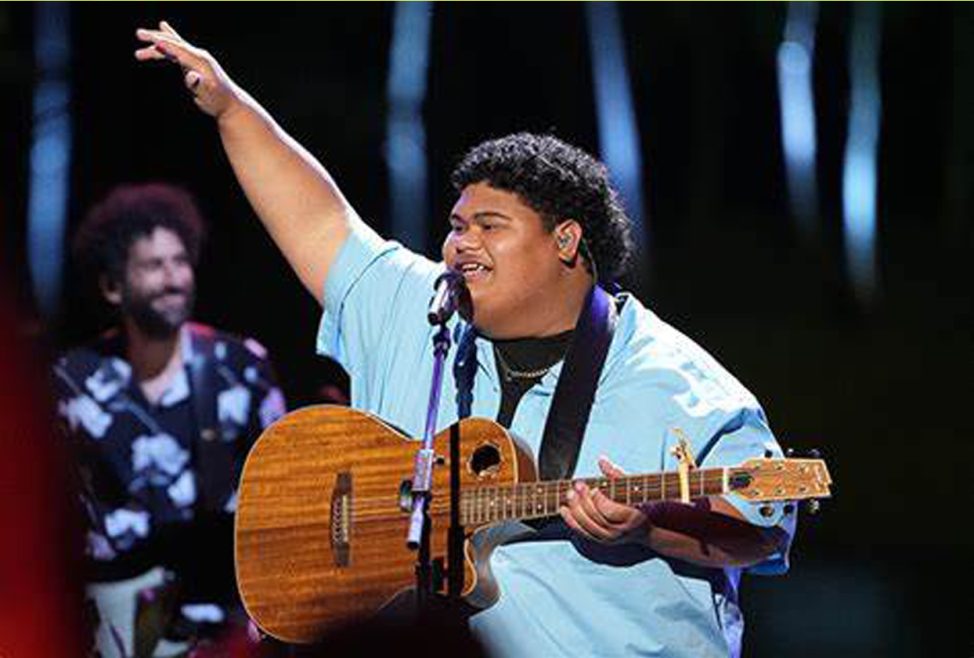
A Hawai’ian academic has called on Tongans to vote for Iam Tongi in the next round of American Idol.
Professor Tēvita O. Ka’ili has also supported a special show for Tongi scheduled for next week as part of the Tongan community’s support for the young singer’s performance in the American Idol final.
Iam Tongi.
Although he is from Hawai’i, Tongi’s mother Lillie comes from Tonga. Her father ‘Uluamu came from Mu’a, Tatakamotonga.
Tongi, 18, was born and raised on the island of Oahu. He currently lives in Seattle.
His father Rodney, also half Tongan, died a few months before his audition for the American talent show. Rodney’s father came from Ha’ateiho. Tongi credits his father for getting him into music.
He says he can hear his father singing.
He is now in the Top 5 of American Idol.
He recently sang at Disney’s Aulani Resort and Spa in Ko Olina, and received praise from judges Lionel Richie, Katy Perry, and Luke Bryan.
“I always dreamed about performing on a big stage in front of a lot of people,” Tongi said.
“This means a lot.”
An American entertainment gossip sites claims Tongi, who is still at high school, has more than 200,000 followers on Instagram and 336,000 followers on TikTok. His videos have racked up more than 1.2 million likes.
He had previously auditioned for American Idol, but did not progress any further.
A Pasifika overstayer who was detained after a dawn raid in South Auckland last month has been granted a temporary visa and will no longer be deported.
Immigration Minister Michael Wood this week confirmed he had sent a letter of expectations to the agency’s chief executive “setting out the Government’s expectation that these sorts of deportations should only occur in extremis – in circumstances that absolutely require it”. Photo/Supplied
The man’s lawyer, Soane Foliaki, said police showed up at the man’s home at 5am, scaring his children and taking him into custody – and though Immigration NZ disputed the timing, it admitted the early morning raid was not a one-off.
The man’s lawyer, Soane Foliaki, said associate Immigration Minister Rachel Brooking reviewed the case and approved the temporary visa on Thursday.
It means the man is now eligible to apply for residency.
“We’re grateful for that. What it does is allows him to file a formal application for residency based on his marriage and his family.”
Foliaki said the man would need to prove to the minister that he was in a genuine and stable relationship, in order to be granted residence, and “he is well beyond that”.
The man was relieved to be granted a temporary visa, he said.
“Over the top. Really really happy. His issue became kind of political being a dawn raid but he’s only aware of that to a particular limit,” Foliaki said.
“It’s become bigger than him but for him personally and his family they’re really happy. All he ever wanted was to go to work, he’s a construction worker, and provide for his family and live peacefully here in New Zealand.”
The temporary visa had come through “really by political pressure”, he said.
Immigration New Zealand has been approached for comment.
Foliaki said the man was detained for three days and two nights at Manukau Police Station before being released hours before he was due to be deported.
“It’s not a nice place for somebody who’s not a criminal.”
The dawn raid caused the man and his family unnecessary harm, he said.
Immigration New Zealand has launched a review into what it calls ‘out of hours compliance visits’ and paused all such operations until the review has been completed.
Siosifa Vailima Tuita, 52, has been sentenced to 12 years in prison for the manslaughter of his twin sister.
Tuita appeared before Lord Chief Justice Whitten in the Supreme Court.
‘Alisi Tuita. Photo/Supplied
The sentence has been backdated to March 7, 2022 when the Defendant was remanded in custody.
The final two years of the sentence have been suspended for a period of two years from the date of the Defendant’s release from prison on condition that the prisoner comply with certain directions of the court.
On the morning of Saturday, 5 March 2022, ‘Alilia Lolohea was at her residence in Falaleu, Vava’u. She lived next door to Tuita and his twin sister, ‘Alisi Tuita. At around 7.35 am ‘Alilia heard a loud cry coming from the Tuita residence. When she got up and opened the door of her residence, ‘Alilia saw Iosifa, who was shirtless, running away from his housee. ‘Alilia then walked to the fence of her property where she saw ‘Alisi lying on her verandah floor.
She and a neighbour summoned the Town Officer, Simoneti Toko, and asked for his help. Simoneti found ‘Alisi lying face down close to the door to the living room, in a pool of blood and with a knife lodged in her head.
By this time, Iosifa Tuita had gone to the Neiafu Police Station where he spoke with Sergeant Fe’aomoeata. As a result, police attended the residence where they found ‘Alisi’s body and rushed her to hospital.
Dr Mosese Taumoepeau examined the body and found that ‘Alisi died at 7.50 am, from a total of nine stab wounds to her chest causing aortic rupture, armpit, back, abdomen and her head where the knife was about five centimetres into her skull.
On October 17, 2022, Tuita appeared before Judge Cooper who noted that the accused had a history of mental health problems and that in those circumstances, it was imperative to understand whether the Defendant was fit to enter a plea.
Tuita made a statement in which he said he said he did not remember doing anything with a knife; that there was a struggle on the front verandah of their house; that his sister fell down and became injured; but did not know how she got her injuries.
Judge Cooper gave directions for a psychiatric assessment by Dr Mapa Puloka as to whether the Defendant was legally insane, as defined by s 17, at the time of the offending.
Dr Puloka reported that the defendant had a long history of alcohol and drug abuse. He began experiencing hallucinations in 2015 and his continued substance abuse led to psychosis, paranoia, and other bizarre behaviours.
He had been admitted to the Vaiola psychiatric unit on a number of occasions.
Tuita told Dr Puloka that on the day in question he arose early and was doing some domestic chores when his sister scolded him for making noise and for his past drunkenness. She threatened to report him to the police and said he would be sent back to the psychiatric unit in Tongatapu.
This made him angry and he picked up a knife and attacked his sister, chasing her as she ran towards the door. He only remembered inflicting two of the nine stab wounds reported by Dr Taumoepeau;
He ran to the police station and told officers that his sister was hurt and that he had stabbed her.
He said he did not intend to kill his sister, only hurt her.
Dr Puloka gave as his opinion that Tuita was suffering from a mental and behavioural disorder due to use of drugs and other psychoactive substances. He said it was unlikely that he was insane during the commission of the offence;
However, his alcohol addiction and chronic brain disorder substantially impaired his mental responsibility for his acts in the killing. His drug related psychiatric or mental disorder and recurrent depressive moods were within the meaning of diminished responsibility during the time of the commission of the offence. Tuita was fit to stand trial.
Tuita later said he would plead guilty to the charge of manslaughter.
In response Lord Chief Justice Whitten said that in his opinion, a defence of diminished responsibility was not actually available under Tongan law and suggested that Parliament consider changing the Criminal Offences Act to include a partial defence of diminished responsibility.
However, the court was advised that following instructions from the Attorney-General, the Crown maintained its acceptance of a guilty plea to the manslaughter charge, principally because, on the evidence, there would be “difficulty in proving the mental element for reckless murder”, and as such, there was “little to no reasonable prospect” of obtaining a conviction for murder.
In sentencing Tuita, Lord Chief Justice Whitten said he would reduce some of the sentence because of the defendant’s mental disorder. However, he said it was not clear what, if any, part the addiction related disorder played in the offending.
“It is even less clear as to whether it would have occurred at all had the Defendant not been so afflicted,” the judge said.
“The Defendant is to be allowed a discount for his guilty plea to manslaughter. I also take into account that but for Cooper J’s astute intervention, the Defendant was prepared to plead, without legal advice or representation, guilty to murder.
“In that regard, I commend this case to Government as yet another example of the potential for travesties of justice resulting from a lack of a full legal aid service, particularly for serious criminal prosecutions”
COMMENTARY: The New Zealand government should treat Tongan overstayers as people fleeing economic war and persecution.
Decades of corruption and mismanagement have led people to flee to New Zealand looking for a better life. Often, because of the way land is owned by the nobility. They have nothing to go back to.
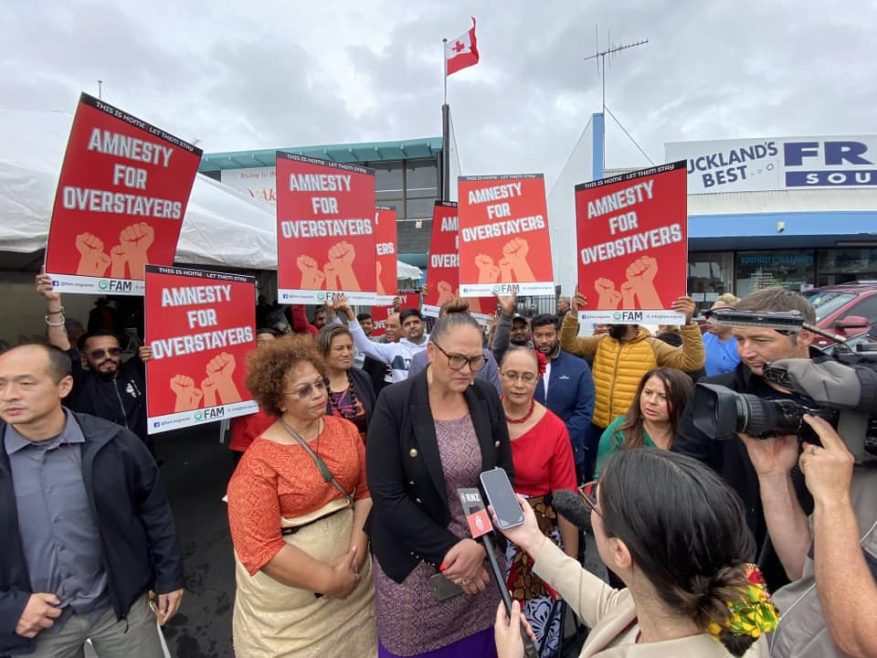
Deputy PM Carmel Sepuloni is being questioned by the media after a public meeting that included government ministers and community leaders following an incident recently that was reminiscent of the Dawn Raids of the 1970s. Photo/John Pulu
Kaniva News does not condone law breaking, but in many cases those who overstay are really in the same position as those fleeing war or persecution. In this case it is an economic war against ordinary people and persecution by a corrupt system that favours the rich and powerful.
The dawn raids of the 1970s were a black page in New Zealand’s history and to see them again is deeply disturbing. The most recent case triggered outrage in New Zealand’s Tongan community whose members were upset by reports that children had been traumatised by the early morning attack.
Immigration New Zealand called the raid an “out of hours immigration compliance visit.”
Tongan community leader Pakilau Manase Lua told a public meeting called after the latest incident: “We are crying for our dawn raiders, we are still being dawn raided.”
Such behaviour by police flies in the face of the Labour Party’s claims that its Children and Families policy puts “the wellbeing of children at the centre of everything we do.”
The dawn raids are uncivilised, inhumane and have no place in New Zealand when human rights are at the core of everything we do to eliminate violence against human beings. They should be scrapped.
New Zealand has a long history of offering a safe home to people fleeing war or persecution especially from the Middle East. Under its Ethnic Communities policy the Labour government has increased the refugee quota to 1,500 places per year and has boosted support to refugee communities already in Aotearoa, helping people reunite with family and supporting their settlement.
The government should re-examine the case of Tongans who come to this country and treat them as refugees. Although they have not fled a physical war or persecution in Tonga, in reality, years of corrupt behaviour by Tongan leaders has traumatised our people.
There is no Ministry of Social Development in Tonga, meaning there is no government help for the people living at the grassroots level. Jobs are scarce and the only reliable financial assistance available is the remittances sent from the kāinga in New Zealand and other countries to Tonga.
Yet while many of the kingdom’s 105,000 people live in poverty, the king is given a budget of about $TP5 million a year from taxpayers’ money. Each noble is given a salary of more than $TP20,000 a year, something that has been criticised for years because there is no job description to justify the Treasury paying out these salaries. The nobles are paid just for being nobles.
Tonga’s political system and constitution have been described by a Commonwealth Lawyer as the worst among all the Commonwealth countries. A poor constitution allows corruption and abuses of power by government leaders. It brings untold moral harm at the grassroots level.
Ordinary Tongans have seen classic examples of these abuses such as the transfer of tens of millions of pa’anga from a Chinese payment to Princess Pilolevu’s Tongasat company, condemned as illegal by the Supreme Court.
The former government of the late Pohiva Tu’i’onetoa was accused of creating its own multi-million roading project just to please some of his Cabinet Ministers who helped him win the premiership election. That roading project was estimated to cost $TP$400 million. It was heavily criticised, with many saying the budget would devastate Tonga’s annual national budgets, which relies heavily on overseas donations, for years. However, Tu’i’onetoa went ahead and approved it and that was his constitutional right to do so.
Some abuses and examples of questionable behaviour go back decades, such as the fate of the $TP119 million loan from China to rebuild Nuku’alofa after the 2006 riots. Critics said that the amount of the loan was imprudent and would burden taxpayers for ages. It was estimated by some economists that the loan should have only be $TP20-30 million. The then Prime Minister Sevele was later accused of not re-paying the money he used to rebuild his business which was burnt down in the disturbances.
About 30 percent of the land in Tonga is controlled by the nobility and the king. This means that most people living on these lands do not legally own them. They are obliged to donate to the nobility from time to time and in some cases, some people have been evicted when they have not donated.
Ordinary Tongans are facing an economic war and persecution and this is why many have overstayed their visas in New Zealand. They do not want to go back and face this war. Rather than stage dawn raids, the New Zealand government should help them.
For more information
‘We’re still being dawn raided’, Tongan leader tells emotional public meeting
Searchers have recovered a body at Abbey Caves in Northland where a student was missing after a school trip during bad weather on Tuesday.
Northland District Commander Superintendent Tony Hill announced the discovery of the body shortly before 6.30am today.
He said the body was found late on Tuesday night after police continued the search using specialist equipment brought up from Auckland.
The Year 11 student from Whangārei Boys’ High School went missing during a trip in to the caves with a school party.
The search for the missing student had been expected to conclude around 5pm yesterday, however, the equipment meant it could continue into the evening, Hill said.
“This helped enable searchers to locate a body, which was successfully recovered late yesterday evening. As such, the search has now concluded,” Hill said.
“While formal ID of the body is yet to take place, police are ensuring the family is being offered support, and our thoughts remain with them at this tragic time.”
Some cordons will remain in place around the caves area while police continued to conduct a routine scene examination, he said.
“We acknowledge this event has been very distressing for the school and wider community, and that there are a number of questions the public will have.
“At the moment, police’s focus is on supporting those affected, and we remind people to please not make assumptions as to what has occurred.”
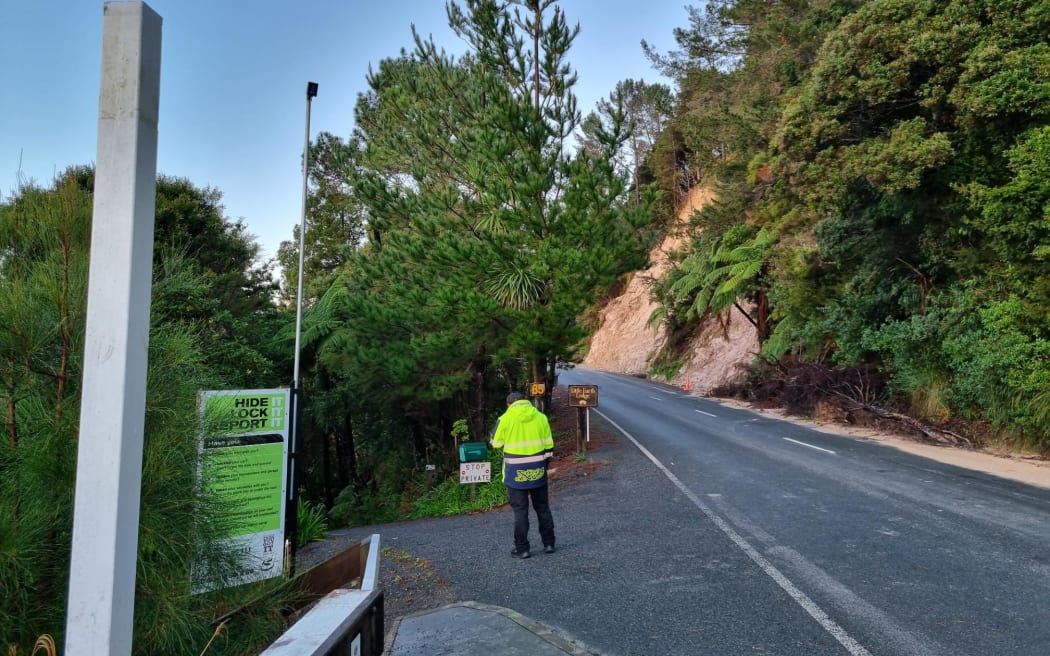
A security guard was at the site on Wednesday morning. Photo: RNZ / Tom Taylor
Fourteen other students and two adults reported being in trouble around 10.30am on Tuesday but made it out of the caves to safety, where they helped by search and rescue teams and St John Ambulance.
‘Cloak of aroha around the whānau’
Ngāti Kahu o Torongare me Ngā Hapū o Whangārei has placed a rāhui at the caves.
Hapū kaikōrero Hūhana Lyndon was at the site on Tuesday evening for prayer and to offer support to the family.
“We received the call that our tamaiti had been found, and so made our way over with our kaumātua to meet the whānau and to support them as well as all of those kaimahi who worked tirelessly through the day to find him.
“All the emergency support services were united in aroha and grief for our whānau as they came through at the same time as us, once word was received that they had found him.
“It was terribly sad and a horrific situation but being there and united in that aroha manaaki for our whānau at that time certainly gave us strength for today and for the days to come.
“It’s a special tribute to the way with which New Zealand police, search and rescue, all of those support services were there and wrapped a cloak of aroha around the whānau.”
Hapū members had also earlier in the day been with the family as they suffered the grief of not knowing what would happen, she said.
“The wairua does settle once you know that you have your boy back.”
Aroha was extended to all the boys who were found and their families and their distress, as well as the staff who were also deeply affected.
“It’s really important to us to manaaki all, to all those affected.
“Our kaumātua are with the school this morning, they assembled early with school leadership as part of what is our approach for managing the emotions and supporting the school culturally and spiritually.”
Kaumātua would help lead in protecting and strengthening the spiritual integrity of the school community, and the Ministry of Education and Victim Support would be sending help, Lyndon said.
The family followed their boy to the hospital after he was recovered from the caves, she said. They needed time and space for themselves and for the wider whānau to be advised.
In a statement yesterday, Whangārei Boys High School principal Karen Gilbert-Smith promised a full investigation into the trip would be held.
The Ministry of Education North leader Isabel Evans said the ministry’s traumatic incident team was at the school to give support, and any investigation would be carried out by the appropriate agency or agencies.
A man has been convicted in the Supreme Court of serious indecent assault and online abuse.
‘Ofa ‘Alifelei, 32, appeared before Lord Chief Justice Whitten for sentencing on one count of serious indecent assault contrary to ss 124(3) of the Criminal Offences Act; and a second charge of using a service to abuse and cause harm by posting an electronic communication contrary to Section 4 of the Electronic Communication Abuse Offences Act 2020.
On July 1, 2022, ‘Alifeleti asked the woman he assaulted out for drinks with a friend Sioeli. The woman is a 24-year-old female from Pangaimotu, Vava’u. They were joined by another person.
During the evening the accused intercepted a phone call from a man on the woman’s mobile. That night he punched her, struck her with a stick and tried to hit her on the head with a piece of timber.
He later photographed her naked and performed sexual acts on her.
The Defendant then took the Complainant into his house and left her inside his room. He threatened that if she escaped, he would find her and shoot her with his gun.
After he left, the woman was able to call her aunt who alerted the police. ‘Alifelei was arrested and the woman was taken to hospital. She sustained swelling over her scalp, a bruise to her right eye, and a fracture to her left forearm.
‘Alifelei was originally charged with, and pleaded not guilty to, [1] causing serious bodily harm; [2] serious indecent assault; [3] using a service to abuse and cause harm by posting an electronic communication; and [4] unlawful imprisonment.
At the beginning of his trial in Vava’u on March 13, the Defendant was rearraigned, whereupon he pleaded guilty to counts two and three and not guilty to counts one and four. The Crown accepted the guilty pleas in discharge of the indictment.
Lord Chief Justice Whitten described the indecent assaults as “not committed to fulfil a sexual desire, but instead to unleash hate, and pure harm to the victim.”
He said the assaults “highly demoralised the victim and her family.”
He described them as the product of” intoxicated, emotional immaturity.”
The court was told that ‘Alifelei was educated to Form 4, but was uninterested in school. His siblings had all moved away and he lived in the family home alone. He earned money by selling crops and kava grown on his plantation.
The Leimatu’a Town Officer described the Defendant as an introverted loner who, much like the other men in his family, did not take part in community activities or attend faikava gatherings where he could socialise with people his age.
‘Alifelei told his probation officer that the victim was his de-facto partner. She and her two young children from her previous marriage moved in and lived with the Defendant in his home. Since last year, the two had been inseparable. However, he believed the woman was also having an affair with a man from her neighbour’s family.
In September last year ‘Alifelei and the woman he assaulted signed an agreement whereby he paid her TP$1000 in exchange for her dropping the charges. However, the Magistrate refused the application to cancel the charges because the woman’s family did not agree.
‘Alifelei has no previous convictions.
Lord Chief Justice Whitten sentenced ‘Alifelei to a total of two and-a-half years in prison. The final 12 months of the sentence is to be suspended for a period of two years from the date of the Defendant’s release.
The World Health Organisation has declared that Covid-19 no longer represents a “global health emergency”.
The organisation said the virus was now an established and ongoing health issue that no longer constituted a public health emergency of international concern.
WHO head Dr Tedros Adhanom Ghebreyesus said the official estimate was that at least 7 million people died in the pandemic but the true figure was likely closer to 20m deaths and he warned that the virus remained a significant threat.
New Zealand epidemiologist Michael Baker said the WHO decision was the right move and global status change made sense at this stage but it made no practical difference to how countries managed the infection.
FAKAMATALA FAKATONGA
Ko e keisi fo’ou ‘e 12,277 ‘o e Koviti-19 ‘i Nu’u Sila ‘i he uike ne lele mai ngata he tu’ua po Sapate.
Ne mate ai ha toko 30 pea ‘alu hake ai ‘a e fika fakakatoa ‘o e mate he Koviti ‘i Nu’u Sila ni ki he toko 2792.
Ko e tokolahi ‘o e kakai mo e vailasi ‘i falemahaki ko e toko 249 ‘o ‘i ai ‘a e toko 12 ‘i he ‘initenisivikea.
Uike kuo osi ne iai ‘a e keisi foou ‘e toko 11,063 na’e lipooti pea mo he toko 26 ne mate tupu mei he vailasi.
Kuo fakaha foki ‘e he Kautaha Mo’ui ‘a Mamani kuo ikai toe hoko a e Koviti-19 ko ha mahaki ke tokanga fakavavevave ki ai ‘a mamani.
Pehe ‘e he kautaha kuo ‘osi lava he taimi ni ‘o tali pea kei hokohoko atu ‘o ‘ikai ko ha toe ‘isiu ke fai ha hoha’a fakavavevave fakamamani ki ai.
Pehe e he ulu o e WHO Dr Tedros Adhanom Ghebreyesus ko e fakaofiofi fakaofisiale kuo mate ‘a e toko 7 miliona he Koviti ka ko e fika totonu oku ‘i he 20 miliona. Pea ne fakatokanga ‘oku kei fu’u fakatu’utamaki pe ‘a e vailasi.
Kuo pehe ‘e he taukei epitemolosisi ‘a Nu’u Sila Michael Baker ko e tu’utu’uni taimi totonu pe ‘eni ‘a WHO pea ‘uhinga lelei pe ‘a hono liliu ‘o e tukunga fakakolope he taimi ni pea ko e toki me’a pe ia ki he ngaahi fonua ke nau tokanga’i e pipihi ‘a e mahaki.
Disgraced politician Etuate Lavulavu has been found guilty of contempt of court.
In a case brought by the Attorney General and heard by Hon. Justice Tupou KC, the court was told that on October 26, 2022 the former MP took part in a live streamed interview on Facebook and Youtube, during which he committed contempt of court.
‘Etuate Lavulavu
In the interview, Lavulavu made a number of comments about the conduct of an earlier trial before Judge Cooper involving him and his wife ‘Akosita.
They were charged with obtaining money by false pretences contrary to section 164 of the Criminal Offences Act, and three counts of knowingly dealing with forged documents contrary to section 172 of the Criminal Offences Act.
The offences related to the operations of the ‘Unuaki ‘O Tonga Royal Institute (UTRI), a private education provider with its head office situated at Tofoa. ‘Etuate Lavulavu was the president. ‘Akosita was the director.
The Lavulavus were convicted in a trial before Judge Cooper, but that conviction was overturned by the Court of Appeal.
In the contempt trial, The Attorney General relied on six statements made by Etuate Lavulavu during an interview with VPON media that constituted remarks to the effect that:
i) Justice Cooper predetermined the case; ii) Justice Cooper’s application of the law was incorrect, iii) Justice Cooper disregarded the Lavulavu’ s arguments without any consideration of them; iv) their convictions were not based on evidence; v) Justice Cooper is not allowed to disregard the testimony of witnesses; and vi) Justice Cooper’s decision was influenced by political figures and persons of high rank.
On February 28 this year the Lord Chief Justice KC ruled that with the exception of the sixth charge, the other charges were broadly consistent with the decision of the Court of Appeal and did not constitute a prima facie case of contempt.
Lavulavu pleaded not guilty to the sixth charge.
The Attorney General tendered evidence based on the interview between Lavulavu and interviewer Sylvester Tonga on 26 October, 2022 titled Polokalama Mavahe that was live streamed on VPON Media & Broadcasting Facebook account on link https://fbwatch/gPTcBpG73q/ and on Youtube at the link https://www.youtube.com/watch?v=aQMkEUhlxx0.
A transcript was presented to the court of Lavulavu saying: “Yes I believe that is what happened and it was not just me who saw them I was very surprised but I don ‘t want to talk about who it was but they are political figures, two of them and others who are in a higher level than the Judge. I think its best if I just leave it at that, but to my knowledge there are people, from what I know, who have been misleading the Court and I feel sorry for the Court. I stayed back when the Court of Appeal trial finished and the appeal judges came and delivered their judgment and I felt sorry for the Judge and I had a lot of love for the Judge. I really felt that he believed these people who were trying to mislead him from the side and that’s where the truth was lost and for other reasons that I will discuss tomorrow.”
In a sworn affidavit Sylvester told the court he had made 10 programmes with Lavulavu.
In the interview already cited, he asked Lavulavu if he believed there were persons who misled the Judge causing his decision to be biased and unfair as decided by the Court of Appeal. Translated from the Tongan , it reads:
“My question to you is that yesterday you raised that there are some people from the outside who have been visiting the office of the court. I want to know whether according to what you know, if there were any others who were affected by the Judge’s decision that was full of bias and unfair and those other grounds that were accepted in the Court of Appeal.”
He confirmed that Lavulavu later identified persons who had influenced the case as the DPP, Crown counsels involved in his case and the Probation Officer.
Judge Tupou said the Crown had proven beyond reasonable doubt that the statements made by Lavulavu had been made via the VPON Media & Broadcasting Facebook and Youtube platforms.
In making his submission the Attorney General quoted Lord Chief Justice Paulsen who said:
“Any act done or writing published calculated to bring a Court or a Judge into contempt or to lower his authority is a contempt of Court. The purpose of this form of contempt is to protect the public (not the Court or the Judge) from the mischief that will occur if the authority of the Court is undermined or impaired.
“In an action for contempt by scandalising the Court, what must be proved beyond reasonable doubt is the publication of material that is calculated, in the sense of likely, to bring a Court or a Judge into contempt or lower their authority in the eyes of the community. There is no requirement that it be proved that they were in fact so undermined.”
Judge Tupou said the clear imputation of Lavulavu’s words was that outsiders were visiting the court office, that those outsiders were people interested in politics and persons who occupied a position higher than the Judge, that those people misled the Judge and the Judge believed them, resulting in the loss of truth.
“A listener or viewer, in my view, would understand from the statements made by Lavulavu that Justice Cooper’s decision to convict him was driven by outside forces, namely, persons interested in politics and persons above his level; that Justice Cooper in believing those persons is not impartial; that the Supreme Court is not an independent institution and is susceptible to political influence and authorities higher than the court,” the judge said.
“The statement strikes at the core function of a Judge and his oath to perform truly and with impartiality his duties as a judge, sufficient to shake the “confidence of ordinary people in the proper, safe and efficient administration of Justice.”
“I am satisfied beyond reasonable doubt that the charges against Lavulavu has been proved. I find him guilty of the offence of contempt of Court,” Judge Tupou said.
For more information
Re-trial for Lavulavus. Judge overstepped the line and took on prosecutor’s role says panel