Nukuʻalofa – The National Reserve Bank of Tonga (NRBT) has issued a warning about an increase in counterfeit banknotes circulating in the country.
The central bank says fake notes have been detected imitating the design of genuine paʻanga currency, and urges the public and businesses to exercise caution when handling cash.
According to the NRBT, counterfeit $100 paʻanga notes from the King Tupou V series have been detected.
These fake notes are printed on clear plastic material to imitate the transparent window feature of genuine $100 notes.
The NRBT clarified that authentic $100 paʻanga notes are not printed on plastic.
The bank also reported counterfeit $5 paʻanga notes from the King Tupou VI 2015 series. These notes are printed on ordinary paper and attempt to replicate the design of the genuine 2015 $5 series.
In addition, fake $50 paʻanga notes from the King Tupou VI 2015 series have been found.
These counterfeits are printed on plain paper, lack serial numbers, and are smaller in size compared to genuine notes.
Some fake notes have been printed on clear plastic material to resemble the transparent window of genuine high-value notes, while others are made from ordinary paper and even plain sheets without serial numbers.
These counterfeits are often smaller in size and do not meet the quality standards of authentic banknotes.
The NRBT believes more counterfeit notes remain in circulation and warns that informal businesses dealing primarily in cash are particularly vulnerable.
The bank is encouraging the public to inspect all banknotes carefully before accepting them and to familiarise themselves with the security features of genuine currency.
Producing, possessing, or knowingly using counterfeit currency is a serious criminal offence.
Anyone who suspects a counterfeit note is urged to report it immediately to the NRBT or the nearest police station.
The Ministry of Education has reportedly issued a directive prohibiting parents from providing food or monetary contributions during Form 2 Common Examinations at government middle schools.
The development follows complaints shared on social media last week, in which Facebook users criticised some school principals for allegedly pressuring parents to make donations—reportedly intended as contributions for teachers who spent extra hours preparing students for exams.
The decision, discussed at a recent Senior Management Team meeting, aims to create a focused and distraction-free environment for students during these critical assessments, according to a statement on the Ministry of Education letterhead seen by Kaniva News and shared on social media.
It says the directive also seeks to reduce financial burdens on families and prevent disputes or incidents that have occurred in previous years.
Under the new policy, parents and guardians will no longer be required or expected to prepare food of any kind or make monetary donations before or during the examinations, it says.
The Ministry emphasised that this measure will become part of formal school rules and policies.
While parents may still choose to show appreciation to teachers voluntarily, such gestures must be initiated independently and not organised, encouraged, or requested by schools, it says.
It also says the directive takes effect immediately and will remain in place for future examinations.
Social media comments
The directive has divided the social media community, with supporters asserting that their actions stem from the cultural practice of fatongia—a cultural obligation including one that shows they care for their children—and expressing a desire to show appreciation for teachers.
“If some can do it, then let them,” one commenter stated.
“It should be based on voluntariness, and that’s perfectly fine,” another commenter said.
However, critics argued that the issue arises when the directive is issued as a formal order from schools, potentially placing pressure on parents who cannot afford to comply.
“Stop burdening parents—they already carry responsibilities for the church, the community, and now the schools,” another commenter said.
In a significant move to ensure impartiality, an investigation into the alleged actions of Tonga’s Minister of Police, which led to the departure of a man subject to a travel ban, has been formally handed over to the Anti-Corruption Commission (ACC).
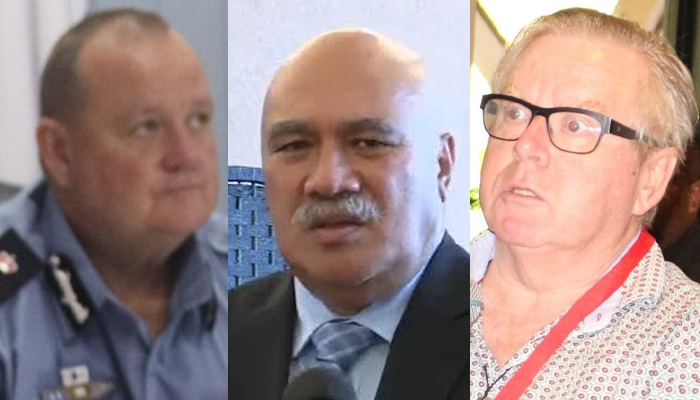
L-R: Police Commissioner Geoff Turner, Minister of Police Piveni Piukala and ACC Commission Chris LaHatte
The announcement came in an official statement addressing growing public concern over the case involving Mormon church leader Pita Hopoate.
Hopoate, who is the subject of an ongoing court matter, left Tonga despite an existing court order prohibiting him from doing so. The alleged role of the Police Minister in this incident is now the focus of the probe.
Police Commissioner Geoff Turner told Kaniva News in a statement this afternoon that Tonga Police had conducted preliminary enquiries after receiving several referrals, including one from the Office of the Prime Minister, urging an investigation into the Minister’s alleged actions.
“I have no doubt that Tonga Police are capable of undertaking an investigation into these allegations that would be actioned without fear, favour, malice or ill-will,” he said, acknowledging the capability of the national police force.
However, in the interests of transparency and to avoid any potential conflict of interest, a decisive step was taken.
“The Commissioner of the Anti-Corruption Commission (ACC) and I have determined that the investigation is better suited to be undertaken by the ACC,” Turner also said.
This transfer of responsibility is now underway.
Tonga Police are currently briefing the ACC and handing over all relevant documentation to support the independent investigation.
He further committed that Tonga Police would provide any additional resources required by the ACC Commissioner to see the investigation through.
As Kaniva News reported yesterday, Prime Minister Aisake Eke has signaled a reluctance to suspend Minister Piukala, invoking the principle that “everyone is innocent until proven guilty.” The Prime Minister confirmed he would await the outcome of the investigation.
We also reported that Piukala, during his regular program with VPON media last week, did not deny the allegation.
Instead, he sought to justify his actions, stating he found it difficult to refuse a request for help from Hopoate.
Customs Minister Mateni Tapueluelu has publicly accused his colleague of interfering with the court and of allegedly assisting a person under a travel ban to flee the country.
The ACC has not yet provided a timeline for the completion of its investigation.
The Police Magistrate in Nuku‘alofa has reportedly ruled to prohibit any further travel by Pelikani ‘Aho, the Police Commander of Learning & Capability Development, amid ongoing legal proceedings concerning the alleged importation of firearms and ammunition into Tonga.
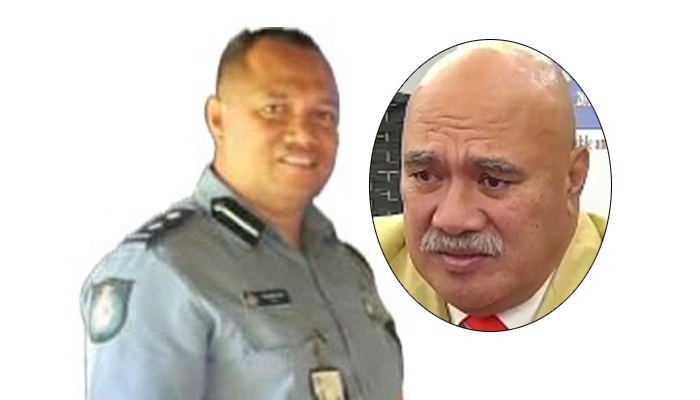
Superindentent Pelikani ‘Aho (L) with Minister of Police Piveni Piukala (inset).
The Kakalu online reported that ‘Aho was granted bail under strict conditions, including a ban on travelling overseas or domestically.
The court reportedly emphasised that the travel restrictions will remain in effect until the case is resolved.
Kaniva News has contacted Police Commissioner Geoff Turner for confirmation.
The ruling comes as Tonga’s Attorney General has advised Prime Minister ‘Aisake Eke to launch a formal investigation into allegations that Police Minister Piveni Piukala interfered with a separate court order preventing Mormon Church leader Pita Foliaki Hopoate from leaving the country last week.
Hopoate was facing a court hearing over a leadership dispute within the Mormon Church’s alumni association. A restraining order issued by Magistrate Judge Ana Tavo Mailangi on October 29 barred him from departing Tonga.
However, Hopoate was allowed to leave after an alleged directive from Minister Piukala was communicated to airport officials, claiming a new court order was being processed to permit his travel.
Customs Minister Māteni Tapueluelu condemned the move, stating that no such court order for release was ever issued and that Piukala’s actions constituted a breach of the law and an abuse of power.
“This decision is not subject to review or override by any executive authority, minister, or official,” Tapueluelu previously told Kaniva News.
Minister Justifies Intervention
In his VPON media show, Piukala did not deny the allegations but defended his actions, saying he felt compelled to help Hopoate leave the country. He claimed it was difficult to ignore Hopoate’s request and believed he had to act in his favour to prevent financial loss and uphold constitutional rights.
“You are innocent until proven guilty,” Piukala said. “Preventing him from travelling has already caused financial loss—money spent, tickets forfeited, disrupted plans. I thought this might already be a violation of our constitutional duty.”
The incident has sparked widespread concern on social media over executive interference in judicial matters and raised questions about the consistency of law enforcement in Tonga.
While ‘Aho reportedly remains grounded under court orders, Hopoate’s departure—allegedly facilitated by the Minister of Police—has prompted calls for greater accountability and respect for the rule of law.
Manu Hausia has been returned to Tonga after being granted parole, three and a half years before his sentence was due to expire.
Manu Hausia
Hausia was jailed for six years and six months in 2023 following a violent attack on his partner in Oamaru, Christchurch, New Zealand.
He pleaded guilty to four charges: attempted murder, injuring and wounding with intent, and assaulting a child.
The then 28-year-old man’s sentence was reduced due to several factors, including guilty pleas, difficulties serving time in a foreign country, and his previously good character.
At the time, Kaniva News and other New Zealand media reported that Hausia stabbed his partner in front of her young son, who called the police.
Justice Rob Osborne described the victim’s injuries as severe: nine stab wounds to her back, three to her face—including one that pierced her cheek—two to the back of her head, and another to her shoulder.
She also suffered cuts to her hand, bruising to her face, jaw, and neck consistent with strangulation, significant blood loss, and damage to her salivary glands, which affected her ability to swallow, speak, and eat.
The judge noted at the time that Hausia would likely be deported at the end of his sentence.
At the time of the attack, Hausia was in New Zealand on an interim visitor visa extended due to Covid restrictions, which had stranded him in the country.
According to the summary of facts, Hausia met the victim at a rugby game in Auckland at the beginning of the year.
They commenced a relationship and moved in together in the victim’s home in Oamaru soon after.
Prime Minister ‘Aisake Eke has confirmed that police will investigate the Police Minister, Piveni Piukala, over allegations he interfered with a court order preventing a Mormon leader from departing Tonga.
Minister Piveni Piukala with Pita Hopoate and an unidentified woman.
As Kaniva News reported yesterday, Customs Minister Māteni Tapueluelu has alleged that Piukala directed airport staff to release Pita Foliaki Hopoate on a flight to the US without legal authority.
Prime Minister ‘Aisake Eke appears to be distancing himself from suspending Piukala, asserting that the matter must wait until the police investigation is concluded.
Defending his actions online, Piukala said he felt compelled to help Hopoate leave the country, stating he found it difficult to ignore his request and thought he had to act in his favour.
Eke said the case was referred to the Attorney General (AG) earlier this week, and a meeting was held yesterday, Friday 7 November, between the AG and the Public Prosecutor (PP) to clarify the legal process and determine the appropriate steps to be taken.
“This matter has attracted significant public attention,” Eke told Kaniva News.
According to the Prime Minister, the AG and PP outlined a multi-step process for assessing the case:
The police will conduct an independent investigation to establish the facts surrounding the case. A meeting between the Public Prosecutor and Police Commissioner was held yesterday to discuss the matter and initiate formal instructions for the inquiry.
A timeline will be set for the investigation’s completion, after which a report will be submitted to the Attorney General and the Public Prosecutor. This report will determine whether any laws were breached.
Following the investigation, the Attorney General will proceed with legal action based on the findings.
Eke said if a breach of law is confirmed, the case will be referred to the judiciary for further proceedings.
“The date and time of any court hearings will be determined by the court’s schedule”, he said.
“At this stage, however, there is no legal basis for punishing Minister Piukala. All procedural steps must be completed before any legal decision can be made.”
The Prime Minister reiterated that under Tonga’s Constitution and laws, every individual is presumed innocent until proven guilty by a court of law.
He also noted that similar cases involving ministers in previous governments were handled using the same legal process now being applied.
“This is the current status of the Government’s handling of the case,” Eke said.
Ursula Primrose Havili, 34, of Halaleva, has been sentenced by the Supreme Court in Nuku’alofa to one year of imprisonment for making a false statement in order to obtain $52,550.00.
Ursula Havili displays a composed demeanor as she listens to her sentencing at the Supreme Court in Nuku’alofa.
The offence occurred in 2023 in Nuku’alofa and involved misleading claims made to Peni ‘Epenisa, Hopoi Fanua, Tu’itupou Vea, ‘Akesa Maloni, Lavinia La’akulu, and Monika ‘Eli.
Havili has been charged in connection with fraudulent vehicle orders placed in April and June.
Reports on the court decisions said the accused used online platforms to order vehicles from Japan as part of the scheme.
A pattern of vehicle sales fraud is emerging in Tonga’s courts, with recent cases resulting in significant prison sentences.
Kisione To’aho, owner of Getpert Computers, received a two-year sentence in May after pleading guilty to defrauding customers of nearly $30,000.
In a separate proceeding, Filimone To’aho was handed a seven-year prison term for a similar scheme that defrauded victims of more than $230,000.
In a recent ruling, the Supreme Court of Tonga convicted ‘Ofa ki ‘Alaki Fo’ou Tokelau of obtaining $17,000 TOP by false pretences from Elisi Sikulu as part of a fraudulent vehicle scheme.
Tonga’s Customs Minister Māteni Tapueluelu has publicly accused Police Minister Piveni Piukala of unlawfully assisting a prominent Mormon leader to depart for the United States last week, in direct breach of an active court travel restraining order.
Police Minister Piveni Piukala (left) and Pita Hopoate are seen with an unidentified woman. Photo/Supplied
The intervention concerns a court restraining order issued by Magistrate Court Judge Ana Tavo Mailangi on October 29. A copy of the order, obtained by Kaniva News, states that Pita Foliaki Hopoate “is restrained and prohibited from leaving the kingdom until further order of the court.”
Hopoate was reportedly facing a court hearing in connection to a dispute over the leadership of the Mormon Church’s alumni association.
A copy of the restraining order was delivered to the Ministry of Customs and Immigration for enforcement, as noted on the court order.
However, it later emerged that Hopoate arrived at the airport and was initially stopped, before an instruction, allegedly originating from Police Minister Piukala, was communicated to airport authorities to allow Hopoate to depart, citing that another court order was being processed to permit his travel.
Acting on the directive, Customs staff then released Hopoate, allowing him to leave the country despite the active restraining order and without any subsequent authorisation from the court, according to Minister Tapueluelu.
In his defence, Piukala argued that his intervention was necessary to prevent Hopoate from facing substantial financial losses on travel and commitments.
Staff shifted after scrutiny
The customs official who permitted Hopoate to depart is now under internal review and has been reassigned to a different division within the Ministry pending an investigation.
When pressed on the reason for the scrutiny, Tapueluelu clarified that this is standard administrative procedure in such cases. He confirmed that the employee retains all entitlements and continues to receive their full salary during this process.
Tapueluelu told Kaniva News the staff acted on a directive from an Immigration Officer. That officer claimed to have received communication from a higher authority instructing them to override the travel ban issued by the Police Magistrate legally.
Tapueluelu identified the higher authority as Minister Piukala. He has declared Piukala’s action a clear contravention of the law and an abuse of power.
Customs Minister Māteni Tapueluelu
“It is unfortunate that the Minister of Police is saying that the two officers should be given a medal. But I strongly urge the public servants to remember that it is the law that rules (rule of law), and under the Police Act, Clause 8 (1)g, police officers must execute the work orders of the Court, like this order. That is the reason they delivered it to the airport. And according to Clause 18 (3), it is prohibited for the Police Minister to issue orders regarding any specific investigation or to any police staff.”
He also said: “A court order was issued to restrict Pita Hopoate from travelling, but he was instructed to leave while that restraining order was still in effect. His departure constitutes a breach of the court order.”
Abuse of power
Tapueluelu stated that any further court order to release Hopoate would require a formal judicial process, wherein lawyers for both parties must present their arguments before a judge in chambers.
Only if they reach an agreement will the conditions and protections be set, followed by the drafting of a release order, which must be signed by the judge and then delivered to the airport authorities.
“We must not bypass the judicial process simply because someone wishes to travel,” Tapueluelu said.
He confirmed to Kaniva News that no court order ever authorised Hopoate’s release, a statement that directly conflicts with the Police Minister’s decision to facilitate his departure.
Only the court
Tapueluelu affirmed that such a court order is mandatory and stated that no Cabinet Minister has the authority to override it for personal or discretionary reasons.
“There have been individuals previously restrained by police under similar circumstances—last year, this year, and in earlier years,” he said.
“This is the norm under the rule of law. Some have been stopped at the airport in exactly the same way.
“It is the court that determines the seriousness and validity of an offence or allegation.
This decision is not subject to review or override by any executive authority, minister, or any other official. It is solely the jurisdiction of the judiciary.”
Piukala responses
Kaniva News contacted Minister Piukala for comment. We also asked what legal authority he relied on to override the court-imposed travel ban. He had not responded by the time of publication.
A Tongan‑language audio recording, obtained by Kaniva News, has been shared by Piukala’s supporters on social media. In the recording, a person who appeared to be Piukala offers a shifting and inconsistent rationale for his intervention on Hopoate’s behalf.
Piukala claimed Hopoate had contacted him, and “he felt deeply troubled due to concerns over the principle of separation of powers”.
He stated that when the restraining order was sent to him, he saw it had been issued by a Magistrate judge, and he strongly felt that Hopoate’s personal freedom was being undermined.
He said: “I asked myself – what if I acted in a way that avoided being implicated in his release. Would I then be complicit in the excuse often used by leaders—saying, Sorry, we can’t interfere in a court decision”?
He justified his intervention by saying that the key to pursuing justice lies in ensuring that Hopoate receives a fair trial.
“You are innocent until proven guilty. In this case, the trial has not yet taken place, and those involved have not yet been convicted.
Preventing him from travelling has already caused financial loss—money spent, tickets forfeited, new tickets purchased, and disrupted plans. I thought this might already be a violation of our constitutional duty, because the Constitution is clear: every citizen should expect that the government will protect their freedom, their property, and their life.”
What is a restraining order?
A court travel restraining order is a legal instrument issued by a judge to prevent an individual from leaving the country. Its primary purpose is to safeguard the integrity of legal proceedings by ensuring a defendant’s availability for trial, enforcing justice, and preventing flight risk.
In cases involving political leaders or high-ranking officials, such orders are typically sought in the context of serious investigations into corruption, human rights abuses, or other major crimes. By restricting the ability to flee the jurisdiction, these orders are a critical tool for upholding the rule of law. They ensure that those in positions of power can be held accountable for their actions, preventing them from evading prosecution and maintaining public trust in the legal system.
In a stark reminder of the persistent threat of human trafficking, Philippine authorities have intercepted two individuals bound for Tonga under the guise of tourism, uncovering a scheme that promised lucrative jobs but led instead to exploitation.
The Inquirer reported the country’s Bureau of Immigration (BI) had stopped the passengers, aged 35 and 31, on October 10 before they could board their flight.
According to the BI, the two were scheduled to travel to Tonga via Singapore aboard a Scoot Airlines flight.
Officials became suspicious during routine immigration checks and prevented their departure.
The report says that after being blocked, the two individuals initially insisted they were tourists but later confessed they were destined for illegal employment in the Kingdom of Tonga.
According to the victims’ statements to authorities, they had been promised work as store cashiers with a monthly salary of P50,000 (NZD $1,475).
Furthermore, the victims disclosed that they had each paid their recruiters fees ranging from P8,000 to P14,000 (NZD $236 to $413) to facilitate the arrangement.
The U.S. State Department’s 2024 Trafficking in Persons Report affirms that the Philippine government fully meets the minimum standards for eliminating trafficking.
The report highlights key actions, including the investigation, prosecution, and conviction of more traffickers—among them, complicit officials—with most receiving significant prison sentences.
As Kaniva News reported previously, Tonga is both a source and destination country for sex and labour trafficking, with East Asian women often forced into prostitution in Tonga and Tongan adults vulnerable to exploitation abroad.
Recent reports highlight ongoing efforts to combat trafficking, including the establishment of a national action plan and a police task force, but challenges remain, particularly in prosecution and identifying and protecting victims.
Ha’apai, Tonga– A new chapter in Ha’apai’s community development was celebrated recently with the official opening of a modern, multi-functional hall designed to strengthen local resilience and foster social connection.
Artist’s impression of the Ha’ato’u Town Hall. Photo/Suppplied
Her Majesty Queen Nanasipau’u graced the occasion as Guest of Honour, arriving at midday to lead the formal proceedings.
The ceremony was followed by vibrant cultural performances and community celebrations, reflecting the spirit of unity and pride among Ha’apai residents.
The newly constructed facility was built to serve as a hub for learning, entertainment, and community events, while also providing shelter during emergencies.
Its design incorporates cyclone-resistant features, solar energy systems, and rainwater harvesting—making it a sustainable and forward-thinking addition to the region.
Proudly funded by the Government of Australia in partnership with Sione’s Foundation, the project highlights the enduring diplomatic relationship between Australia and Tonga, and their shared commitment to supporting local development in the outer islands.
Community leaders praised the hall as a symbol of progress and preparedness, noting its potential to uplift lives and strengthen social bonds in Ha’apai for generations to come.