Home Blog Page 411

Tongatapu woman who attacked her mother with machete wins appeal to reduce sentence

Lilieta Tu’itupou, 30, was found guilty after willfully and without justification hit with the flat side of a machete the left back side of her own mother Mahetani Tu’itupou, 54.

She also without lawful justification hit with a wooden board the back and thigh of her daughter Sisi ‘Upolu Houa.

The prisoner was sentenced in a Magistrate Court to four months’ imprisonment.

The sentencing Magistrate said that Tu’itupou had a previous criminal record and this was part of the reason for not suspending any part of her sentence.

The charge against attacking her mother under section 112 (a) of the Criminal Offences Act is for a minor assault where no major injury is caused liable to a fine of $5000.00 or 12 months’ imprisonment. The attack by a daughter of her mother is much more serious, a court document said.

In allowing the appeal, Supreme Court Justice Tevita Tupou said the Police record shows that Tu’itupou did not have a criminal record.

For this reason, the prosecutor at the Supreme Court did not oppose the appeal and submits that there should be a partial suspension of the sentences as this was her first criminal offence.

The prosecutor also did not support a full suspension because of the use of a weapon for the assault.

Justice Tupou replaced Tu’itupou’s original jail term with three months’ imprisonment with a 12 month’s suspension of her final month in jail. Justice Tupou also reduced the three month’s imprisonment by seven days for the days Tu’itupou was in prison until released on bail on 2 March 2021.

The attacks

The appeal court heard that on 15 February 2021 in Fātumu, the prisoner was with her mother and her four-year-old daughter Sisi ‘Upolu Houa.

Tu’itupou told her mother that there was a funeral in the family of her father. Her mother did not want to take any part in the funeral as she did not like the family of her father.

Tu’itupou was very angry by the attitude of her mother so she went and got a machete to hit her.

Her mother ran outside calling for help from the neighbours and Tu’itupou hit her bottom with the flat side of the machete before help came from the neighbour and stopped the assault.

Her mother went to the Police Station and lodged her complaint about the attack.

At the same time, she lodged a complaint on behalf of Tu’itupou’s four-year-old daughter Sisi ‘Upolu Houa who showed bruise marks on her body and leg.

Medical evidence showed that these bruises were caused by a wooden board which was in the Court room with the machete.

Qantas plane breakdown forces unloading of passengers at Fua’amotu airport

A Qantas plane which arrived in Tonga this morning has experienced what appears to be a mechanical failure.

Qantas plane breakdown in Tonga. [Inset: the passengers can be seen leaving the plane} Photos/Supplied
Palu Aviation CEO Tevita Palu told Kaniva News his company was assisting the aircraft.

“I don’t have any details on the defect now. Palu Aviation engineers are providing the support for Qantas now,” Palu said.

The flight QF6034 TBUADL was scheduled to depart the Fua’amotu International Airport at 10am with more than 200 Tongan workers to work on farms in Australia under the federal government’s Seasonal Worker Program.

The passengers already boarded the plane before they were informed about the problem, a source said.

The aircraft arrived in Tonga at about 7.50am without passengers.

Gov’t should direct pay church school teachers after funding withheld due to breach of agreements, advises Catholic think tank

Some private and church high schools in Tonga still dealt with major blow to their financial position because they have yet to receive any of their frozen funds of more than a million from the government.

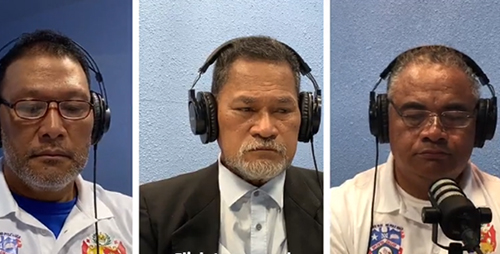
‘Apifo’ou College Think Tank panelists. (L-R) Falakiko Kolo, Tonga Finau, Rodney Halapio

Ex-students hold concerns about the impacts of the hold and how it can affect students’ learning outcomes.

As Kaniva News reported previously, the money was intended to top up the teachers’ pay but a government audit discovered that some of the grants had not been used according to the purpose of the funding programme.

Veteran Journalist Kalafi Moala reported in February that the Ministry of Education and Training (MET) demanded “the Catholic Schools Education Authority a reimbursement of about $500,000 before any further funds would be released to them”.

Moala claimed MET still withheld about TOP$1 million for Catholic Schools.

The Director of Catholic Education declined to talk to Moala regarding the matter.

READ MORE:

Possible solution

But a Catholic school alumni think tank which is based in San Francisco, USA has recently suggested a possible solution that might help resolve the issue.

It said the government should deposit the teachers’ pay directly into their bank accounts and avoid further paying the money through the schools.

The think tank livestream programme which was weekly hosted by former teachers and top scholars of ‘Apifo’ou College said the government wanted to make sure the money was used accordingly.

Former teacher and ex-student Tonga Finau told the programme the Catholic schools have used the money for a “good cause” but unfortunately that fell outside the scope of the contract with the government.

Two other hosts of the programme, Rodney Halapio and Falakiko Kolo, agreed with Finau that it was the government’s constitutional responsibility to assist the schools.

They said the government and the churches should fix the issue as soon as possible.

As Kaniva News previously reported, the latest hold in question was revealed in February by a former Prime Minister and director of the Catholic schools Lord Sevele ‘O Vailahi in a speech he delivered during a live streamed ceremony in Tongatapu attended by the Prime Minister Pōhiva Tu’i’onetoa.

“Today only part of that money has been paid to the teachers,” Lord Sevele said.

Sevele pleaded with the Prime Minister to intervene.

The Tongan funding was supplemented by a shared grant equally donated by the New Zealand and Australian government.

In 2016 the Free Wesleyan Church Schools’ Director of Education, Dr Mele’ana Puloka, said it had been two years since New Zealand and Australian funding was held back from the church’s schools.

She said she knew there were good reasons why the funding had been withheld, but the church could not only pay its teachers and disregard other staff working outside the classrooms.

Those grants were finally released the same year.

Serial thief of more than $20,000 worth of stolen Adiloa Store goods jailed

A former Adiloa Store employee in Nuku’alofa, has been locked up.

Kisione Tauvaka, 20, was jailed for three years, six months when he appeared in the Nuku’alofa Supreme Court last week for multiple counts of theft.

Tauvaka pleaded guilty to three counts of serious housebreaking and three counts of theft.

He would only serve six months after Justice Laki Niu suspended three years of his sentence.

The total value of the stolen goods was $22,934.

The stolen goods included burner oven stoves, washing machines, standing fridge, chest freezer, Chinese mats, mountain bikes, Panasonic microwave oven, tent, sewing machine, lights, and burner stoves.

In May 2020  Tauvaka took the key of the Adiloa Store’s Havelu warehouse without permission and used it to break into the building. He stole from it two stoves, three freezers and several floor mats before re-locked the warehouse and took the stolen goods to his home at ‘Utulau.

He returned the key to the Kolomotu’a warehouse without anyone at work knowing what he had done.

In June 2020, he did the same thing twice at the Havelu warehouse. The first one was on 16 June 2020, when he stole washing machines, stoves, freezers and lights. The second stealing was on 18 June 2020 when he took washing machines, stoves, bicycles, freezers and lights

While he was loading up the items on to a white truck he was using on the third occasion of these offences, a passer-by happened to notice what he was doing and reported the matter to the store manager in Kolofo’ou.

He was later identified by the passer-by as the one inside the Havelu warehouse at the time, the court was told.

He admitted what he had done and he went with the police and collected the items which he had taken. Only part of the stolen goods were recovered.

The prisoner appears to have a problem with alcohol and the court was told he stole these properties so that he would sell them “to afford alcohol”.

He was remorseful and cooperated with the police. At one stage he was beaten up by some persons, who were not the police, after he refused to tell the manager of the store where he had hidden the stolen items. He received medical attention after that beating.

Locals butcher whale stranded in Ha’apai

Locals of Foa, Ha’apai have butchered what appears to be a sperm whale found stranded on the island’s beach.

Locals in Foa, Ha’apai have butchered a whale found stranded on a beach. Photos/Supplied

Reports said a member of the public found the whale on a beach near the Foa causeway.

Photos shared on Facebook appear to show some men begin to hack at the animal and slicing its belly.

The event attracted comments from the online community with whale meat lovers reminiscing about the traditional delicacy.

“The best ocean meat ever,” a commenter said.

“About time for Tonga to lift the ban,” another wrote.

A Royal Decree in 1978 banned hunting and killing of whales in the kingdom to help preserve and protect the endangered species.

There were recent calls for the government to lift the ban with advocates suggesting the whale meat could help support Tonga’s fight against cheap, fatty meat and its contribution to the country’s high obesity rate.

It was proposed to kill 10 humpbacks a year to help the local meat stocks.

In 2017 the then Deputy Prime Minister Siaosi Sovaleni told the Changing Oceania conference in Nuku’alofa that “Since the Royal decree, which banned the hunting of whales in Tongan waters, the Tongan breeding populations have recovered from less than 50 to more than 2000 whales”.

Three countries in the world including Norway, Iceland and Japan allow commercial whaling.

Industries desperate for workers urge government to open borders to Pacific

By RNZ.co.nz and is republished with permission

Fruit, meat works and food processing industries are calling on the government to open Pacific borders to tackle what they’re calling their worst ever labour crisis.

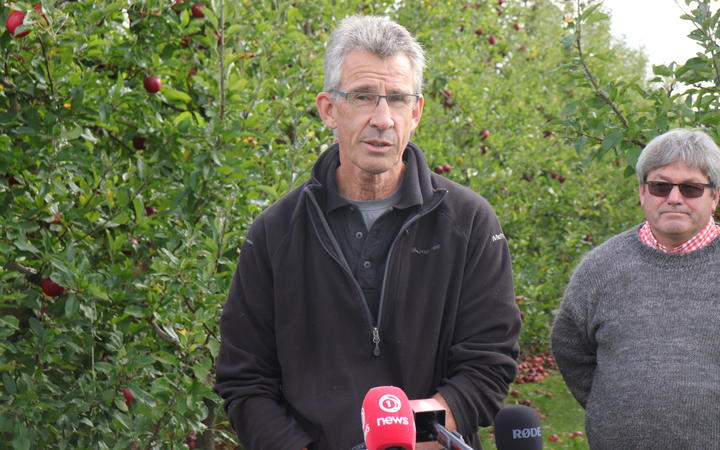
Bruce Mitchell says there just aren't enough workers to harvest his apples for export.
Bruce Mitchell says there just aren’t enough workers to harvest his apples for export. Photo: RNZ / Tom Kitchin

At a media conference in Napier this morning they demanded more help.

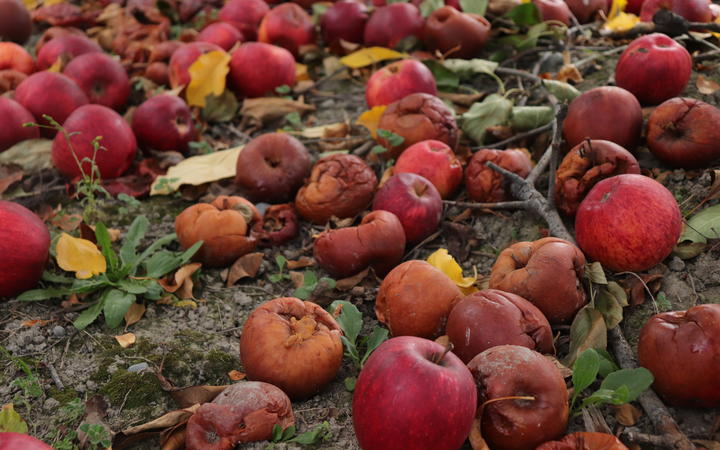
Apples are rotting on the ground at many orchards.

Chestergrove Orchards owner Bruce Mitchell said he could not find enough pickers to pick his royal galas.

“The apple crop that you see here represents 10 to 12 months of planning, investment and work and just days before I came to pick it I had 20 pickers sign up, and at induction two pickers turned up, so we went into crisis mode.”

He said it was the worst his family had ever seen.

“My family’s been involved for over five decades and we’ve never experienced a crisis like this, where we’ve had to walk away from whole blocks of export apples. We’ve got export markets that are crying out for this fruit and we just can’t get it harvested.”

No Fruit rotting on the ground at a Napier orchard.
No Fruit rotting on the ground at a Napier orchard. Photo: RNZ / Tom Kitchin

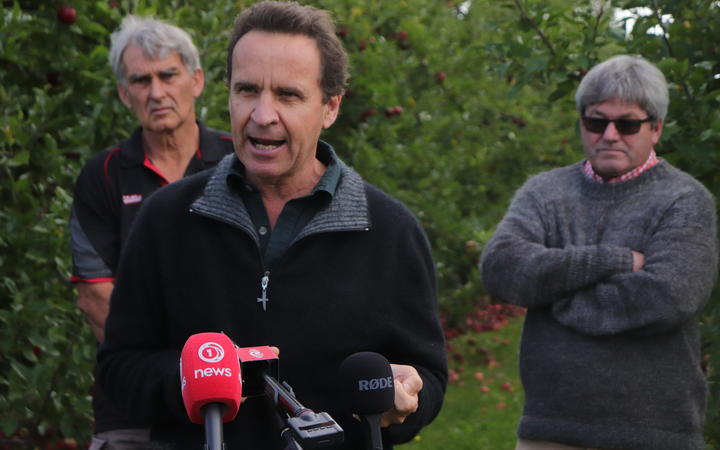
Orchardist John Bostock said the government’s intentions to get Kiwis on board did not work as well as anticipated.

He called for a plan from the government – and said they wanted it sooner rather than later, ideally in the next two months so they could plan their harvest.

“We simply haven’t got enough available New Zealanders to do the job. It’s very very tough and we’re calling on the government to open the Pacific, open the borders for Covid-free countries to come and work in New Zealand for next year.”

Orchardist John Bostock says there needs to be a government plan to tackle the problem.
Orchardist John Bostock says there needs to be a government plan to tackle the problem. Photo: RNZ / Tom Kitchin

In Hastings, Progessive Meats founder Craig Hickson said his company was also short of staff.

“This has been the most difficult and most challenging, worst experience with regard to having sufficient people at work,” he said.

“We in fact have been short of workers right through the peak lamb season which is a little bit longer than the apple season and we still remain short today.”

At the Watties factory in Hastings, agricultural manager Bruce Mckay said he was also facing difficulties.

“We’re having to deal with erratic supply of product coming to the factory,” he said. “We’re having to deal with staff absenteeisms on a grand scale each day.”

After the government announced a trans-Tasman bubble yesterday some have asked why borders to the Pacific Islands are not open.

National Party leader Judith Collins today called for an immediate travel bubble with the Pacific for those reasons.

“These countries are being extraordinarily hard hit by the lack of tourism but also the RSE workers who we have working in New Zealand or have been, they are absolutely crucial to the economy of these countries,” she said.

Prime Minister Jacinda Ardern said the trans-Tasman bubble should open up some space in MIQ.

“Now that we don’t have the trans-Tasman bookings – about 1000 worth – we will be looking at whether or not some of those places can be taken by other low-risk travellers and specifically the Pacific,” she said today.

“So we are working on whether or not that might ease some pressure for horticulture.”

She also said it was not just a case of New Zealand wanting travel. The other side had to agree.

“Other countries, they’re not even allowing in some cases, their citizens to return, so it’s actually not just a decision for New Zealand, there are many Pacific neighbours who are part of the RSE schemes who do not want open borders at this point.”

National Party leader Judith Collins calls for immediate Pacific travel bubble

By RNZ.co.nz and is republished with permission

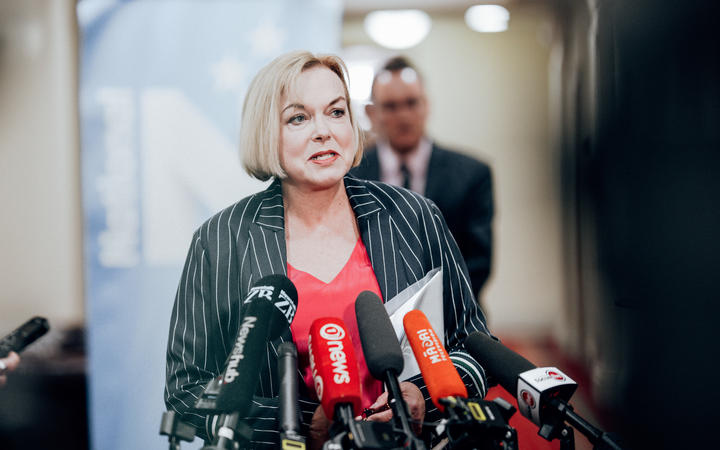
National leader Judith Collins says there’s no reason Pacific nations can’t form part of the new travel bubble now.

No caption
National leader Judith Collins is pushing for a Pacific travel bubble. Photo: RNZ / Dom Thomas

Collins wants the government to move quicker in allowing quarantine-free travel from Fiji, Samoa and Tonga.

A bubble with Australia had been unnecessarily put off and that shouldn’t now be the repeated with safe Pacific nations, she told Morning Report.

The government announced yesterday it would operate the bubble on a state-by-state basis with Australia from 19 April, but Prime Minister Jacinda Ardern warned if there was a local lockdown tourists should not rely on the government to bail them out.

Collins said the ‘traffic-light’ system announced by the government yesterday was a reasonable way of assessing risk associated with any Covid-19 outbreak in Australia and determining whether trans-Tasman travel needed to be paused at any point.

Collins agreed any decisions on travel had to ultimately be based on health considerations and that business interests couldn’t take priority.

But she said the Pacific islands had proven they could maintain a Covid-free status and delaying a Pacific bubble would hurt those nations’ economies, as well as New Zealand’s horticulture sector, which depended on workers from those nations.

She said a date of 1 May had already been agreed with the Cook Islands, and that she was bemused the government hadn’t announced that publicly.

Collins agreed any decisions on travel had to ultimately be based on health considerations and that business interests couldn’t take priority.

But she said the Pacific islands had proven they could maintain a Covid-free status and delaying a Pacific bubble would hurt those nations’ economies, as well as New Zealand’s horticulture sector, which depended on workers from those nations.

“In the Pacific, Fiji, Tonga and Samoa, there is no Covid-19. If anywhere is safe it is those countries and I don’t understand why we don’t have a Pacific bubble. That is something where the government need to move on this,” she said.

But Pasifika nations should be able to join the system immediately, both to alleviate the economic hardship in those countries and to allow Pacific workers into New Zealand to take up work in the horticultural sector, she said.

“I think it can be done very quickly. I’m very aware that the Cook Islands has been told the bubble with the Cook Islands will be open on 1 May, but for some reason the government isn’t telling New Zealanders that. I don’t understand why that is being held back.

“When it comes to Tonga and Samoa they haven’t had one case of Covid-19 in their countries and they’ve got a record of being able to keep it out altogether.

“I think it is really important that we also look at how these countries are being extraordinarily hit by lack of tourism, but also the RIC workers, who have been working in New Zealand.

“They are absolutely crucial to the economy in these countries. Fiji is another example – they haven’t had any Covid in the community for over a year. These are countries were they are crying out for help.”

Prime Minister Jacinda Ardern told Morning Report she was confident the travel bubble was safe and that there existed a good working relationship between the countries’ health authorities to keep it that way.

She said there was an official communication platform operating between Australia and New Zealand and that system was working efficiently.

“Essentially we’ve been able to share information between us…

“We are confident enough of course and you’ll hear epidemiologists and other experts supporting this decision.

“But what we are saying to travellers is just be prepared. You will have seen that we’ve had a number of pauses in the one-way arrangements we’ve had with Australia thus far and if there are outbreaks it may happen in the future.”

If there are cases connected to border, well identified and well contained it was likely travel arrangements would continue, she said.

“If you have a question mark over what happened and how widespread, we may need to pause the travel arrangement for up to 72 hours while we gather more information. And if it’s a larger outbreak we’re likely to suspend.”

A group of ministers, supported by health officials would decide whether to suspend travel or not in light of Covid-19 outbreaks.

“We’ll be utilising the group of ministers in the same way we have for Covid-related decisions that need to be made with urgency… We will always be informed by the director-general of health for our decisions,” Ardern said.

The Cabinet subcommittee would include Covid-19 Response Minister Chris Hipkins, border-related ministers, and the Minister for Foreign Affairs, Nanaia Mahuta, Ardern said.

Can Tu‘i‘onetoa sack convicted governor Viliami Hingano under his ‘everyone is innocent until proven guilty’ house rule?

The Ha’apai governor Viliami Manuopangai Hingano’s guilty verdict last month in the Supreme Court has put Prime Minister Pōhiva Tu’ionetoa’s leadership to the test this week.

(L-R) PM Pōhiva Tu’i’onetoa, Governor Viliami Manuopangai Hingano, Infrastructure Minister ‘Akosita Lavulavu.

Tu’ionetoa was under pressure over calls for his Minister of Infrastructure ‘Akosita Lavulavu to resign as she is currently facing two separate serious fraud charges in courts.

In response to the calls by the Opposition, the Prime Minister said: “Let the law rule.”

Akosita and her husband ‘Etuate face charges of knowingly dealing with forged documents and obtaining credit by false pretenses, after irregularities were found in an audit of the ‘Unuaki ‘o Tonga Royal Institute in 2016 and a land lease complaint in 2020.

Tu’i’onetoa also said: “Everyone is innocent until proven guilty” implying that this was the only justification for him to sack a Cabinet minister who has serious allegations against them.

READ MORE:

But Tu’ionetoa stopped short of answering a question from Kaniva News asking him if this meant he would sack ‘Akosita if the courts will find her guilty.

“I ask you to please re-read and re-read my first response I gave you previously the answer is there and read the constitution to understand it,” Tu’i’onetoa said in response to a question we expected him to reply yes or no.

The Prime Minister was e-mailed another question.

“Will you sack the Ha’apai governor Viliami Manuopangai Hingano after he was recently found guilty by the court of unlawful possession of (198kg) turtle meat”.

The Prime Minister has yet to reply to that question within the last 36 hours.

In convicting the governor last month, the Supreme Court judge said:

“Having heard the accused‘s background, he being a director in the Ministry of Public Enterprises, and he had been a member of Parliament representing District 12 of Ha’apai which included Lofanga, and having grown up and living in Ha’apai, I do not believe his evidence that he did not know that an approval was required before a turtle was killed”.

Tongan courts have no power to  order a cabinet minister or the governors to resign. That power rests with the Prime Minister and the king by the constitution.

The two governors and all Cabinet ministers were appointed by the king on the advice of the Prime Minister.

This means, it was the Prime Minister’s prerogative to appoint and dismiss them through the king’s constitutional power at any time at his pleasure.

FAKAMATALA FAKATONGA

‘E fekau nai ‘e he Palēmia’ Pōhiva Tu’i’onetoa ke fakafisi ‘a e Kōvana Ha’apai Viliami Manuopangai Hingano hili ‘ene halaia ‘i he fakamaau’anga’ ki he ma’u mo e kakano’i fonu ta’efakalao? Kuo ‘osi fakamahino ‘e Tu’i’onetoa hili ha ui kiate ia mei he Fa’ahi Fakaanga’ ke fekau ‘ene Minisitā Ki he Ngaahi Ngāue Lalahi ‘a e pule’anga’ ‘Akosita Lavulavu ke fakafisi tu’unga he ongo tukuaki’i mamafa ‘e ua kuo fai kiate ia kuo’ ne lolotonga tu’u ai ‘i he ‘ao ‘o e fakamaau’anga’. Ko e tali mei he palēmia, tuku ke pule pe lao’. Na’a’ ne toe pehē ‘oku tonuhia ‘a e taha kotoa pe kae ‘oua kuo fakamo’oni’i fakalao kuo’ ne halaia. Ko e fehu’i tatau ne fai ki he palēmia’ ‘o pehē kapau ‘e halaia ‘a Lavulavu’ te ne fekau ke fakafisi? Na’e ‘ikai ha’ane tali mahino ‘io pe ‘ikai ki he fehu’i ko ia’.

Tonga rugby coach Kefu ‘grateful’ for second chance

By RNZ.co.nz and is republished with permission

Tonga rugby coach Toutai Kefu believes the future is bright for the ‘Ikale Tahi now the sport finally has some stability off the field.

The Tonga Rugby Union signed a tripartite agreement with World Rugby and the Tonga government seven months ago, after the global governing body pulled its financial support because of governance and administration issues.

Funding had since resumed, with Kefu reappointed until the end of 2023.

With a new administration in place and a fresh three year mandate, Kefu was “grateful” to be back in charge and believed he could build on his previous four years at the helm.

“I thought myself and my staff did a really good job considering the obstacles that we faced along the way, and I think they looked at it from a perspective if I could have proper assistance and guidance, in terms of a governance and administration point of view, they thought that we could go better.”

As part of his reappointment, the Kolomotu’a-born coach would spend at least four months per year in Tonga to act as a technical director for the union, assisting and educating local coaches.

The Kolomotu’a-born coach did not see eye to eye with former CEO Fe’ao Vunipola but believed the new set-up was moving in the right direction.

“That’s all I’m focused on is looking forward, getting to work with a bunch of new boys again and seeing where we can take this team,” he said.

“I think this team, the potential is enormous and if we have a little bit of luck along the way and be able to qualify some players that want to play for Tonga, if we get all those ducks aligned I think we can really take this team to somewhere where it’s never been before.”

The immediate focus was on finalising an ‘Ikale Tahi squad for two Rugby World Cup qualifiers against Samoa in July, which had been moved to New Zealand because of the Covid-19 pandemic.

Tonga were edged 25-17 by Samoa in Apia.
Tonga and Samoa will play two Rugby World Cup qualifiers in New Zealand in July. Photo: World Rugby / Trina Edwards

With the international borders still closed, Kefu remained unsure which players he would have available for selection, but joked that being the coach of Tonga had made him good at adapting to things.

“I’m basically running with two squads: a squad that’s locally based – New Zealand, Tonga, Australia – and an overall squad where those Northern Hemisphere players are able to make it to New Zealand. There’s so much uncertainty: what you’ve got to plan for is plan for that uncertainty and do the best you can.”

There was also uncertainty over plans for a group of former All Blacks and Wallabies players to switch their international allegiance to Tonga.

Players with eligibility for more than one country could switch their international allegiance by participating in Olympic qualifying events provided they had a passport for the second country and completed a stand down period of three years.

The Final Olympic Sevens Qualifier had been earmarked as a chance for former All Blacks Charles Piutau and Malakai Fekitoa to complete their switch from New Zealand to Tonga.

That now looks unlikely, with the Monaco tournament clashing with the semi-finals of the English Premiership on 19-20 June.

“Malakai is probably the only high-profile player that we know that looks like going to the tournament – we’re still in constant discussions with him,” Kefu said.

“It’s unfortunate about Charles. We still haven’t got the exact date of the tournament and there may be an option of maybe flying Charles in just for the day or day and a half to maybe just qualify him and get him on the field…I know he’s got finals time around that time so we still haven’t ruled him out.

“There’s George Moala as well who’s at Clermont and they look like they’ll be in the midst of finals as well (in the French Top 14) around that Monaco tournament.”

Controversial former Wallabies fullback Israel Folau also expressed an interest in switching his rugby allegiance to Tonga, Kefu said.

The dual rugby and league international played 73 tests for Australia before his contract was torn up in 2019 for posting a meme on social media that said hell awaited “drunks, homosexuals, adulterers” and other groups.

He’s back in Brisbane after a year playing rugby league in France and would be welcomed into a Tongan squad, Kefu said, that supported his right to express his personal views.

“He’s Tongan, he’s a bloody good player – we’re more than happy to have him and accommodate him…we’d have no concerns. We all grew up the same way. We all went to Sunday School and then there’s different divisions of religion that we all grew up in. We certainly all support Israel and his views.”

However, any potential switch would not pay immediate dividends. The former Waratahs star, who was also on the radar of the Tongan rugby league team, last played for the Wallabies in November 2018 and would not have completed the required three-year stand-down in time to represent the kingdom at the Olympic Sevens Qualifier in Monaco.

Meanwhile Kefu hoped to finalise his wider coaching team in the coming weeks and said, while there would be a few changes, he was trying to have as much consistency as possible.

New Zealand, Australia travel no-quarantine bubble to start on 19 April – Ardern, Hipkins

BY RNZ.co.nz and is republished with permission

Conditions for quarantine-free travel between Australia and New Zealand have been met, and a bubble will start in less than two weeks, Prime Minister Jacinda Ardern says.

Cabinet met today to put a date on the long awaited trans-Tasman bubble, soon after New Zealand marked a year since the first national lockdown.

New Zealanders and Australians will be able to travel freely between their respective countries from 11.59pm on 18 April.

Announcing the start date this afternoon, Ardern – alongside Covid-19 Response Minister Chris Hipkins – said Cabinet had accepted the advice of the Director-General of Health and was “confident not only in the state of Australia but also in our own ability to manage a travel arrangement”.

She said Cabinet had been told the conditions to start quarantine free travel had been met.

“The Director-General of Health considers the risk of transmission of Covid-19 from Australia to New Zealand is low and that quarantine free travel is safe to commence,” she announced at Parliament.

“While Queensland has recently undergone an outbreak connected to the border, this too looks contained. And Cabinet believes any residual risk can be managed with additional precautionary processes such as pre-departure testing if needed.”
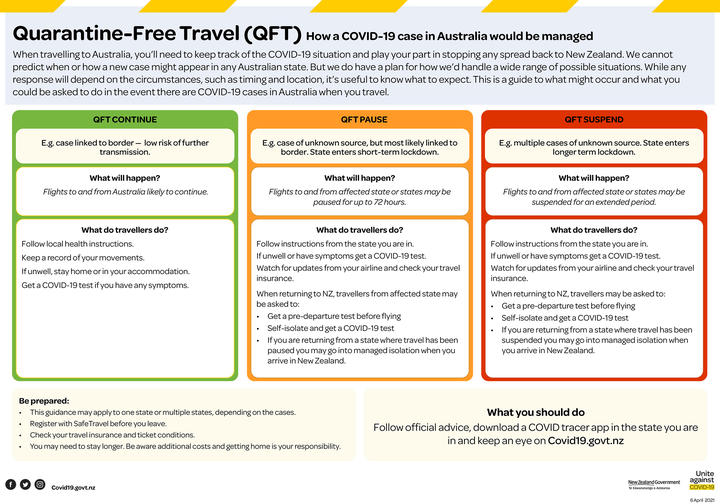
The trans-Tasman quarantine-free travel management system.

The trans-Tasman quarantine-free travel management system. Photo: Supplied / Covid19.govt.nz

However, it will not mean hundreds of spare places in managed isolation will become available, with the government intending to keep 500 aside in case they are needed for the trans-Tasman bubble, and will decommission some smaller facilities.

New Zealand’s bubble will operate on a state-by-state basis with Australia, meaning if there’s an outbreak, New Zealanders in most other states will not be affected.

There will still be an element of ‘flyer beware’ for New Zealanders travelling to Australia, with the government saying it will not be coming to their rescue if they get trapped because of an outbreak.

There are also warnings there will still not be full insurance cover for Covid-19 related travel disruption, even within the bubble.

Ardern had previously said the government had carefully worked through the framework of a trans-Tasman bubble.

But she warned travelling would not be without risk and if there was a community outbreak in Australia, travelling Kiwis may have to stay put, self-isolate or be tested once they returned.

The three-day lockdown in the Greater Brisbane area was lifted over the weekend and there have been no new cases in Queensland for the second day in a row.

In northern New South Wales coronavirus restrictions eased on Monday night after another day of no new community cases.

New Zealand’s tourism industry has been waiting impatiently for quarantine-free visitor flights between the two nations to return, giving a much-needed injection of life into the sector, which could bring an estimated $1 billion into the national economy.

Traffic lights

There will be a traffic-lights system for the bubble: continue, pause and suspend.

‘Pause’ would be a temporary halt to travel, much like the 72-hour suspensions from Australia in response to outbreaks here – namely the Valentine’s Day lockdown.

‘Suspend’ would be a longer term scenario where flights could be suspended for an “extended period” if there was a more serious or widespread outbreak, for example “multiple cases of unknown source… state enters lockdown”.
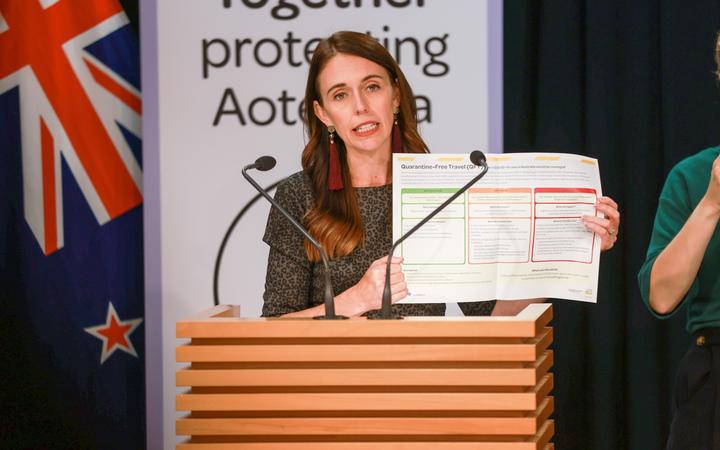
Jacinda Ardern showing traffic light system for travel.

Photo: RNZ / Dom Thomas

Apart from a handful of suspensions, New Zealanders have been free to travel to Australia without quarantining since last October, in what has effectively been a one-way bubble.

Hipkins said the framework announced today would help give Australia an idea of how New Zealand would make decisions.

Ardern said speed would be “of the essence in an outbreak”.

“There is no requirement for either side to give written formal notice before a decision is made because one of the important things we want to preserve on both sides is the ability to move quickly.

“We accept that … Australia may move quickly on a decision, and whilst actually for the most part they are very good at giving us a heads up that may not always happen, that means that they expect and understand if we do the same.”

The countries had committed to sharing information directly, she said.

“We’ll be on similar calls with one another where we’re discussing new information. We have the ability and power to make decisions in New Zealand’s best interests.”

Managed isolation

While ministers did not make a final decision on this today, Ardern gave a strong signal the bubble would not result in large numbers of managed isolation and quarantine (MIQ) spots becoming available.

The main concern was the potential increase in people coming from high-risk countries still ravaged by Covid-19 and experiencing more infectious variants.

Ardern said the government intended to keep most of the space freed up as a contingency; ready to house people in the event of an outbreak where it was not possible to prevent them arriving – for example an outbreak identified in Australia when a flight was already on its way back to New Zealand.

Hipkins told reporters he had always maintained it would not be a “one for one” swap.

“The fact that there’ll be next to no people coming from Australia going into MIQ potentially frees up between 1000 to 1300 spaces on a fortnightly basis,” he said.
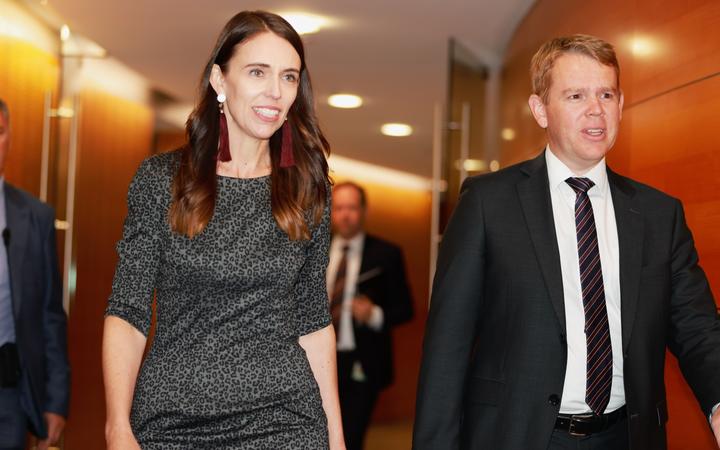
Jacinda Ardern and Chris Hipkins on their way to announce the trans-Tasman travel bubble start date.

Photo: RNZ / Dom Thomas

About 500 of those would be kept as “contingency spaces should they be needed for the trans-Tasman arrangement”.

There are a “small number of facilities” considered to have only been “suitable for travellers in quarantine from low-risk countries”.

“With the opening of travel, we will look to decommission these facilities – but in the meantime we are considering whether they could be used for other low risk countries, such as the Pacific Islands,” Hipkins said.

As a result, it was not expected “a large number of vacant quarantine spaces [would] come on stream … there will, however, still be thousands of spaces in MIQ for Kiwis”, he said.

There has been a huge amount of pressure on MIQs spaces; not only are there still large numbers of New Zealand wanting to return, but also constant calls for them to be used to fill labour shortages, and, for example, reunify migrant families of critical care workers.

Ardern said figures from 2019 showed about 40 percent of tourism arrivals were from Australia.

“They were putting back into our economy over $2 billion worth of spending … the estimates are by the beginning of 2022 we might get to 80 percent of where we were pre-Covid when it comes to Australian travellers.

“What I wouldn’t be surprised we see is that early travellers will likely be those who are travelling to see family and friends. We of course want to encourage people straight off the bat to come whenever they are ready because we are here and ready to welcome them.”

Asked why Australians should come to New Zealand, Ardern said: “We are safe and we cannot underestimate how important that is in this Covid-19 world. We are a safe place to bring your family to come and visit.”

National leader Judith Collins wanted a “reasonable” number of spots freed up for those families once the bubble is up and running – around 20 percent – saying they were “crucial” to New Zealand.

“There’s a lady I saw today whose whose husband is caught in Iran; she and her son are separated from her husband,” she told reporters.

“These are the sorts of things we’re talking about – real people, not just statistics, actually real people – and it’s their lives that are being put on hold.”

Requirements at the border

While arrivals from Australia will not have to isolate at a facility for two weeks, there will be stricter requirements when they land.

Hipkins said travellers “must not have had a positive Covid-19 test result in the previous 14-day period and must not be awaiting the results of a Covid-19 test taken during that 14-day period”.

There will be pre-departure health assessments, obligations on air crew to remain completely separated from crew on any other routes.

“When those in Australia decide to come to New Zealand, they will be making a booking on a green-zone flight.

“That means that there will be no passengers on that flight who have come from anywhere but Australia in the last 14 days. They will also be flown by crew who have not flown on any high risk routes for a set period of time,” said Hipkins.

There will also have to be well functioning green zones in airports to make sure there is no cross contamination between different flights, and contact details for Australian arrivals while they are in New Zealand.

“Passengers will need to provide comprehensive information on how they can be contacted while in New Zealand, complete a pre-departure health declaration and won’t be able to travel if they have cold or flu symptoms,” Hipkins said.

“When they fly, they will be required to wear a mask on their flight, and will also be asked to download and use the NZ Covid Tracer app while in New Zealand”.

There will also be random temperature checks of airport arrivals.