Online users were emotional when photos of a grave site from early 1900s uncovered in Houma were shared to Facebook this morning.
Photos of one headstone showed the name of William Dixon ,67, who was born in Glasgow and died on August 24, 1915.
The grave site was abandoned for years and overgrown with bushes.
The discovery came after locals cleared the area today to dig a grave for Viliami Hiva Niupalau, a cancer patient who died last week.
Older Houma people living overseas were quick to recognise the grave and said on Facebook they knew the site.
One Facebook user who shared a photo of the site and Dixon’s headstone with Kaniva News was thinking of the deceased’s family and relatives in the UK.
“I wish their grandchildren in Scotland could see their graves,” Viliami Maumau said.
“In Loving Memory of William Dixon born in Glasgow, Scotland died August 1915 aged 67,” the headstone read.
Locals claimed the graves belonged to palagi soldiers who arrived in Tonga during the First World War.
The World Wars
During the First World War a mixture of 150 Germans, Samoans, and New Guinea Islanders including their wives and families lived in Tonga. Samoa and New Guinea were both German colonies in 1914 when they were captured by New Zealand and Australia respectively.
Some of them were deported as prisoners of war to New Zealand and others continued to live in Tonga, but had land confiscated and strict sanctions placed on their movements.
Young, able-bodied men of European descent living in Tonga when war first declared took a ship to the closest large port to enlist – mostly in New Zealand and Australia. A total of 91 men born or living in Tonga have been identified as having served in World War 1.
Twenty seven years after Dixon’s death, US troops arrived in Tonga.
As Kaniva News reported in April, in May 1942, 7800 US soldiers and 862 sailors sailed into Nuku’alofa harbour to set up a base in Tonga as part of a defensive chain across the Pacific to keep supply routes open to Australia and New Zealand
Late Queen Sālote Tupou III provided land for an airfield and established the Tongan Defence Force, whose soldiers eventually fought the Japanese in the Solomon Islands campaign.
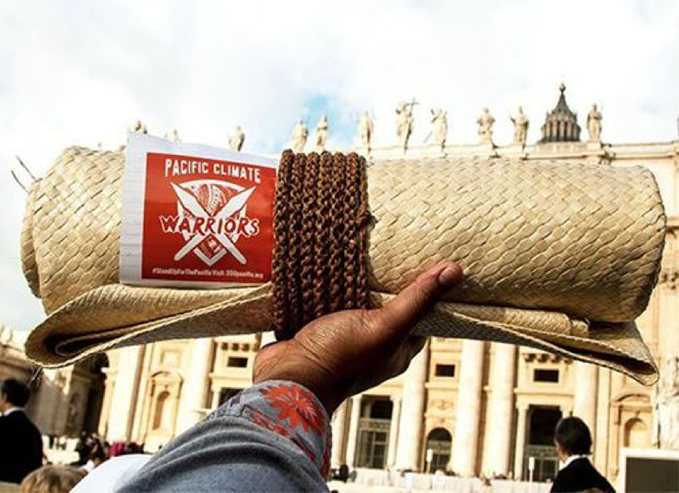
This story originally appeared on Asia Pacific Report and is republished with permissionPacific Climate Warriors – creative action to trigger better responses to climate crisis. Image: Resilience
In this new covid-19 world, environmental and climate crisis defenders are developing new ways to cope and operate under the pandemic constraints.
Groups as diverse as the local branch of the global environmental campaigner Greenpeace Pacific, Pacific Islands Forum Fisheries Agency (FFA), the Green Party in French Polynesia and Greenpeace New Zealand have found solutions.
They have followed in the traditions of the Fiji-based Pacific Climate Warriors – part of the global 350 movement – who have drawn attention to environment and climate crisis issues with colourful and dramatic protests.
The Pacific faces mounting climate change issues, environmental degradation, rapidly rising sea-levels, massive king tides with the salty sea affecting arable land, coral acidification, pollution and – just to make matters worse – wildlife poaching as the plundering of the region’s fisheries goes unabated.
“Climate change could produce 8 million refugees in the Pacific Islands alone, along with 75 million in the Asia-Pacific region within the next four decades [has] warned a report by aid agency Oxfam Australia,” wrote the Pacific Media Centre’s director Professor David Robie in Dreadlocks a decade ago signalling the dire need even then for environmental defenders to pick up the pace.
Greenpeace head of Pacific Auimatagi Joseph Sapati Moeono-Kolio realises that need and is thankful that most parts of Pacific are being largely spared from the covid-19 pandemic that has raged across the world, leaving his organisation free to pursue its green goals.
“Fortunately, many island nations in the Pacific are free of covid-19. As a result, Pacific climate leaders are able to continue our moral and ethical fight for climate justice,” says the Samoan climate change campaigner.
“We are doing so by leading the world in transitioning to renewable energy – in fact Samoa is on track for 100 percent renewables by 2025.
Greenpeace Pacific’s Auimatagi Joseph Sapati Moeono-Kolio … “the transition to
renewables, as an important pillar of climate action, has stepped up.” Image: Greenpeace Pacific
“So, while covid-19 has slowed several things down, the transition to renewables, as an important pillar of climate action, has stepped up.”
Climate change on back burner
The pandemic has forced leading climate change advocates of the Small Island Developing States (SIDS), such as Fiji Prime Minister Voreqe Bainimarama, who was president of the 2017 Conference of the Parties COP23 to push the issue onto the back burner.
Pacific Island climate frontline states such as Kiribati, Tuvalu, Tokelau and Marshall Islands along with Fiji, Vanuatu, Papua New Guinea (Carteret Islands) and the Federated States of Micronesia require a champion for their cause. However, the pandemic has put paid to that, as Auimatagi points out.
“Because of covid-19 our global advocacy moments to elevate the voices of Pacific leaders demanding climate action are limited,” says Auimatagi.
“We are also working on a documentary called Finding Hope: Samoa, where we will meet with people from all walks of life and share their truth of what is happening in their villages as oceans rise and warm.
“With covid-19 and climate change combined, we are seeing dual impacts such as in Vanuatu during the most recent cyclone – Harold in April 2020.
“Communities and families were all social distancing and then the cyclone hit so they needed to decide whether to stay apart at home or take shelter in emergency refuge centres,” he says.
From that occurrence emerges the real and immediate threat of making climate change of secondary importance despite an increase in adverse climate events.
Greenpeace NZ’s Nick Young … “there is a threat that while the world is focused on covid-19, that
climate action takes a back seat.” Image: Greenpeace
Working hard for the Pacific
“Pacific communities are among the first to feel the full impacts of climate change, and there is a threat that while the world is focused on covid-19, that climate action takes a back seat,” says Nick Young of Greenpeace New Zealand.
“Greenpeace internationally is working hard to make sure that isn’t the case.
“The covid-19 recovery also offers a unique opportunity in this regard as billions are spent to stimulate economies around the world and Greenpeace in New Zealand and elsewhere in the world is pushing for a Green Covid-19 Recovery that invests in climate resilience.”
Greenpeace initiatives and campaigns as environmental defenders are still continuing, albeit at a slower pace than usual.
“All of the core Greenpeace campaigns around transforming agriculture and energy, protecting the oceans and shifting away from single-use plastics remain active,” Young says.
However, it is more than the pollution that is a concern with the ocean. Auimatagi talks about this.
Ocean poaching problem
“Ocean poaching is ongoing, carried out by the Chinese and Japanese flagged vessels. While Samoa has one of the smallest Exclusive Economic Zones (EEZs), places like Micronesia and Kiribati are much harder to enforce as they have much larger EEZs.”
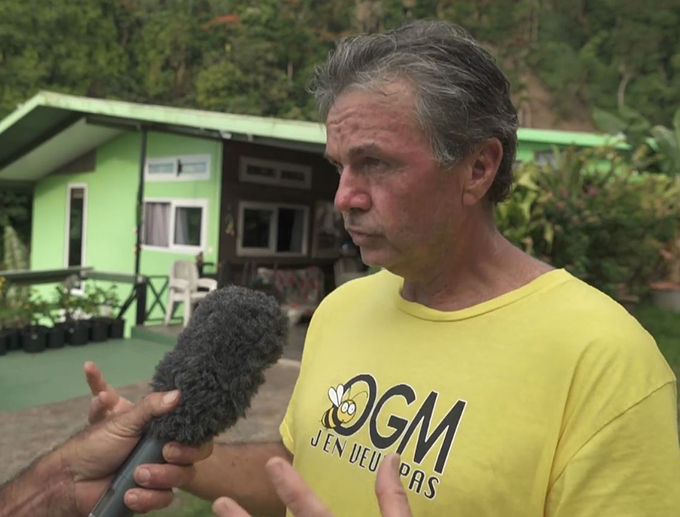
As Jacky Bryant, president of the Green Party in French Polynesia points out: “The 5 million km/2 of the EEZ (Exclusive and Economic Zone) are open to all kinds of abuse by foreign ships and is under surveillance by only one ship belonging to the French state.
“From time to time we have a fishing vessel that gets stranded on the reef carrying tonnes of fish, some legal, some illegal.”
Jacky Bryant of Tahiti’s Greens … economic zone “open to all kinds of abuse by foreign ships”. Image: Heiura Les Verts
Last month, the Pacific Islands Forum Fisheries Agency (FFA) continued its coordination and commitment to regional fisheries surveillance operation.
The 17-nation organisation is based in Honiara, Solomon Islands and its members comprise: Australia, Cook Islands, the Federated States of Micronesia, Fiji, Kiribati, Marshall Islands, Nauru, New Zealand, Niue, Palau, Papua New Guinea, Samoa, Solomon Islands, Tokelau, Tonga, Tuvalu and Vanuatu.
The FFA is charged with protecting Pacific fisheries from poaching among other cooperative activities.
It has recently completed its “Operation Island Chief” (August 24-September 4), conducting surveillance over the EEZs of Cook Islands, Niue, Samoa, Tonga and Tuvalu this year.
Challenging pandemic times
FFA’s Director-General Dr Manu Tupou-Roosen says: “During these challenging times with the focus of the world on the pandemic, we welcome the commitment and cooperation demonstrated across the region to deter illegal, unreported and unregulated fishing in our waters.”
That concerns Greenpeace as well. Young says: “Illegal and unregulated fishing is still an issue in many places, and certainly in the Pacific.
“It threatens ocean life as well as the resilience of Pacific communities who rely on the oceans for their food and way of life.”
The FFA Regional Fisheries Surveillance Centre (RFSC) team, supported by three officers from the Royal Solomon Islands Police Force (RSIPF), had an increased focus on intelligence gathering and analysis, providing targeted information before and during the operation in order to support surveillance activities by member countries,” the FFA said in a statement.
Aerial surveillance of the nations of the EEZ was provided by New Zealand, Australia, USA and France, assisting the fragile small island developing states in protecting them from poaching or overfishing.
In addition to that the cooperation goes as far as working together to prevent covid-19 from being transmitted in the fisheries operations allowing them to continue contributing Pacific Island economies.
“It is crucial for fisheries to continue operating at this time, providing much-needed income to support the economic recovery as well as to enhance contribution to the food security of our people,” says Dr Manu Tupou-Roosen.
Pollution and climate change still major
Greenpeace Pacific’s Auimatagi says that other than poaching, pollution and climate change remain major issues in the Pacific.
“While marine wildlife poaching is, of course, a big issue, the biggest polluter is one of our nearest neighbours. Australia digs up, burns and exports climate destruction to the whole world in the form of coal.
“Climate change is the number one issue on all fronts, including the environment as it is a threat multiplier. The impacts of climate change such as rising sea levels and warming oceans make the impacts of cyclones and ocean wildlife poaching more severe and more difficult to manage.”
Not so in Tahiti as Bryant explains, where covid-19 has taken hold on that part of the Pacific paradise.
Covid-19 cases in French Polynesia (population 280,000) have now reached more than 2700 cases – including territorial President Edouard Fritch and 10 deaths, and Bryant say this crisis has pushed climate change and environmental issues into a secondary status.
“Attacks to our natural environment such as the exploitation of the biodiversity, our cars’ carbon emissions (Papeete has 120,000 cars but luckily, we are an island with regular easterlies) are of governmental responsibilities,” says Bryant.
“There is no clear scrutiny of the climatic effects on the town planning code for example; no compulsory measures for double glazing; using solar panels is not mandatory and the same for photovoltaic, not even for experimental purposes on
an urban area.
No environmental friendly designing
“There are no projects towards designing more environmentally friendly interisland means of transport in order to anticipate any energy crisis with petrol, for example. We carry on training our youth for the combustion engine,” he adds.
While Bryant laments the lack of action in Tahiti, the Greenpeace organisation remains committed to making a better, environmentally safer world.
“We have pushed for a green covid-19 recovery that puts people and nature first, and we are calling for the replacement of current industrial agriculture system with regenerative farming methods – where we farm in harmony with nature and don’t use synthetic nitrogen fertiliser,” says Young.
“Regenerative farming involves growing a large diversity of crops, plants and animals. Synthetic inputs like nitrogen fertiliser are replaced with practices that mimic natural systems to access nutrients, water and pest control required for growth.
“Replace unnecessary single-use products like plastic drink bottles with reusable and refillable options, including glass. Plastic bags, and bottles are just the tip of the iceberg,
“All of the core Greenpeace campaigns around transforming agriculture and energy, protecting the oceans and shifting away from single-use plastics remain active,” he says.
The last word on the issue comes from the Samoan who has been a strong activist for a greener world, Auimatagi Moeono-Kolio.
“When it comes to the environment, Pacific Islanders are always vigilant no matter what is happening in the outside world: It’s a question of means and resources and geopolitics, it’s a very complicated web.”
This is the fifth in a series of articles by the Pacific Media Centre’s Pacific Media Watch as part of an environmental project funded by the Internews’ Earth Journalism Network (EJN) Asia-Pacific initiative.
A Tongan woman who used her time while she was locked down in New Zealand to complete a six-month sewing course said she planned to run her own sewing business when she returned to Ha’apai.
(L-R) ‘Ōlive Ramanlal Vulabh, Director of Tuitui Fashion Academy Tuitui Folauhola and Suitaisa Fine Tonga’onevai. Photo/Kalino Lātū (Kaniva Tonga News)
Siutaisa Fine Tonga’onevai said she was over the moon after she was awarded her certificate.
She has sent a sewing machine to Ha’apai.
“This will help my family,” she said.
As Kaniva News reported earlier this week Tonga’onevai was one of the nine Tongan women at the Tuitui Fashion Academy who received their Level One Achievement Certificates after completing six months’ training at the Three Kings’ school.
The successful women completed a number of modules, including skills such as Measurement, Academic, sewing of Women and Men’s wear Normal Dress, Pacific Wear, Off the shoulder, Suit Jacket, Evening Gowns, Shirt and Suit and Russian Collar.
Tonga’onevai was in New Zealand on a one month visiting visa and was supposed to return to Tonga in April, but the country went into lockdown and flights between New Zealand and Tonga were suspended.
Tonga’onevai, who heard about the Tuitui Fashion training from a friend, has described the opportunity she has received as “extraordinary.”
She said she may have missed the opportunity if the flights had not been suspended.
She said she could sew before she enrolled with Tuitui Fashion, but did not have the proper skills.
“After the course I learned how to measure and sew different types of clothes.”
Another woman who completed the course while she was in lockdown was Olive Ramanal Vulabh.
She is a well-known businesswoman in Tonga.
In presenting the closing speech during the award ceremony in Auckland last week, Vulabh said she was elated after she completed the course.
She said she could now sew various beautiful styles of garments for her family using inexpensive cloth.
She showed the green dress she was wearing during the award ceremony to the guests and told them it looked expensive but the tutor, Tuitui Folauhola helped her buy the material from a store at Otara, South Auckland for only $3 per metre.
She applauded the course and said she was happy to learn about budgeting.
A leader of the PTOA Global Movement has rejected a warning by the Democratic Party and said they were free to help people who were in urgent needs in Tonga.
PTOA Party Leader Semisi Sika (L), PTOA Global Movement Leader Sharon Minna Sekona
Sharon Minna Sekona said no one had trademarked the name PTOA (Democratic Party) and no legal body owned it.
Her statements came after the Party’s core team released a statement last week saying the Party was told people had built houses, staged fundraising, offered gifts and donated food under the PTOA name.
The statement said the Party had not authorised any of these activities and they were not aligned with what founder ‘Akilisi Pohiva had set out in the Party’s manifesto.
The statement said Pohiva had taught that the nation could not be built with offering freebies.
“The will of the people could not be bought using goods or money. The will of the people can only be influenced by enlightenment and knowledge,” it said in Tongan.
“Therefore if anyone or group departs from what ‘Akilisi has taught, they could be regarded as betrayers and misleading people. They have departed the Party’s mission and vision.”
Sekona took to Facebook and blasted Party Leader Semisi Sika for releasing a statement she described as dictatorial and illegal .
She said the Movement supported pushes for a more democratic system in Tonga by providing assistance and help for those who were in urgent needs.
She said they did this through donations and assistances from Tongans overseas to help the poor in Tonga.
The Party’s statement has infuriated some of the Movement’s followers who vowed not to vote for the Party MPs in the coming election.
Meanwhile, supporters of the Party MPs including the PTOA International Movement said the Core team had made the right call.
“Oil and water don’t mix,” said Rev ‘Inoke Masima on the International Movement’s page, referring to the relationship between the Global Movement and the Party.
Last month Kaniva News reported that the PTOA Global Movement had launched a Housing for the Poor scheme, with new houses in Veitongo and one in Holeva, Vava’u.
They were funded by the PTOA Global Movement in collaboration with PTOA Auckland Aotearoa and some chapters in New Zealand and Australia.
The president of the PTOA Auckland Aotearoa chapter, Vainikolo Taufa, said the housing was an attempt to put the late Prime Minister’s mission into practice.
Rifts
There have been rifts in the Democratic movement since the Party’s core team was heavily criticised by the Global team after a meeting in April to decide the fate of MP Mateni Tapueluelu.
The Party later said Hon. Tapueluelu was forgiven but never released any information of why he was forgiven after he was accused of causing the Party to lose the government after the death of ‘Akilisi Pohiva.
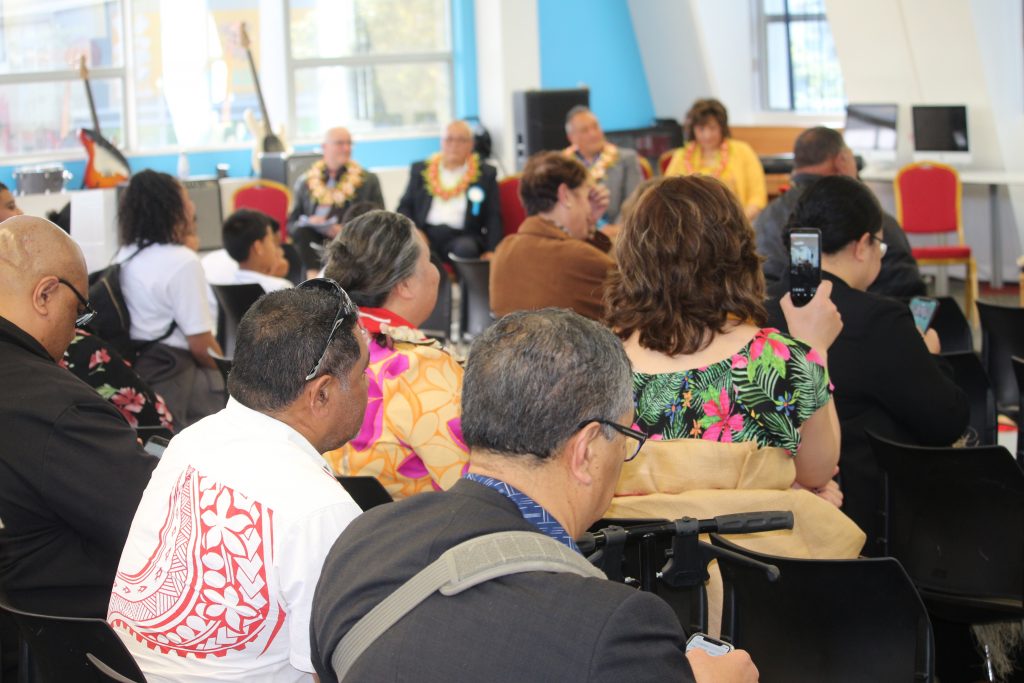
Opinion: Last Saturday night’s meeting with candidates in Ōtāhuhu showed that some people have a long way to go when it comes to mastering the basics of democracy.
Members of the Tongan community in Auckland meeting with the candidates last Saturday in Ōtāhuhu. Photo/Kalino Lātū (Kaniva Tonga)
Tongans know all too well how long and hard the struggle was to install democracy in Tonga and how bitterly those reforms were fought by the old guard.
They only have to look over the seas to Fiji to see a strong Pacific nation that faced years of coups or to Papua New Guinea where corruption and political violence are a way of life.
In New Zealand, things are different. In New Zealand universal human rights are respected and there is democracy and free and open elections in which every eligible person can participate. That is something to cherish.
Unfortunately, it seems some people still need to know this if they want to be properly part of New Zealand life.
One way to show how much they appreciate the gift of democracy is for people to show respect for it.
On Saturday night some people used the evening to ignore the agenda and push their own ideas without considering what was at stake.
The meeting was meant to give everybody the chance to hear what candidates had to say and to ask questions. However, some people at the meeting took up the question time by thanking their favourite politicians for coming and demonstrating their political loyalty.
That used up the time when people could have been finding out more about the candidates’ policies and intentions.
People living in New Zealand need to understand what a gift it is to be able to meet candidates openly and to be able to ask questions. That is not something that happens everywhere. Our readers will know that in Tonga there have been complaints about how such meetings are conducted, with allegations of political figures manipulating the proceedings.
Democracy is a gift and it’s one that should be treasured and shared, even by doing something as simple as not wasting question time at a meeting.
Candidates also need to know how to use these meetings wisely.
Saturday’s meeting was not the first time we have seen candidates use the time simply to attack Labour candidates and their supporters.
As we reported yesterday, the Labour Party has always been strongly favoured by voters from Pasifika backgrounds. While there are no exact figures to show how many Tongans vote Labour, it is still popular in our community.
In the past we have seen some parties putting up Tongan candidates against sitting Labour members. There were even claims that one candidate somehow had royal approval, but that did not help him.
It is natural that opposition parties will attack the government, but if that is all they do, they will not succeed. People will listen to ideas and proposals, but do not respond well to a barrage of negativity.
Instead of just attacking, why don’t these candidates come and tell the community the benefits they will receive if they choose their parties rather than disappointing Labour supporters?
If they made use of that one hour meeting to explain their policies well and their benefits to listeners some Labour supporters might convert and vote for them instead.
Two other issues stood out from Saturday night.
One was that people need to understand that referendums are part of the political process in New Zealand. The two referendums being voted for are being presented as part of the election. One is from ACT and the other is from the Greens and they did not have universal support from Labour MPs.
However, the government will have to accept whatever the results of the vote will be.
Many people may oppose the two referendums, but if they pass, they have to be accepted. It’s part of the process of democracy and the recognition of universal human rights that goes with it.
The other issue is that some church leaders and their activists need to understand democracy better.
A pastor told Labour Member for Manukau East Jenny Salesa during the meeting that he was really concerned about the passing in Parliament of the End of Life Act. He said only God could decide when life should be ended.
After the Second World War II the United Nations issued the Universal Declaration of Human Rights to guide its member states on how to respect people’s rights and build strong democracies. In countries like New Zealand those rights form part of the political culture of the country.
The Declaration is the only document that can serve everyone equally no matter what political, cultural, and religious beliefs they have. Religions cannot serve everyone equally because they differ in their beliefs.
To have candidates and their supporters attacking Labour because they claim they are against Tongan values and Christianity faith is not wise. After all, there are Tongans who are Muslims or Bahai.
Saturday night’s meeting was a small part in the bigger picture of this year’s national elections in New Zealand, but it raised big issues that some people still need to learn.
Three students from Tonga were among a group of university students who met with Pacific
Cooperation Foundation chair John Fiso and PCF Partnerships and Special Projects Officer Laree Taula earlier this month.
Pictured from left were Bryan Wasuka (Solomon Islands), Grace Ailua-Paie (Samoa), Siuola Vaipuna (Tonga), PCF Chair Fiso John Fiso, Young Jin Choi (Solomon Islands), Maryann Olive Penn (Samoa), Fugalaau Mafi (Tonga), Meleteukialupe Soakai (Tonga) and PCF Partnerships and Special Projects Officer Laree Taula.
The students are part of the 2020/2021 intake for the PCF New Zealand Scholarship Internship programme which will officially launch on Friday 13 November.
The students are all studying at Victoria University in Wellington and were attending their internship induction.
This story originally appeared on TVNZ and is republished with permission
The Government has signed an agreement to purchase 1.5 million Covid-19 vaccines, enough for 750,000 people, from Pfizer and BioNTech.
Covid-19 vaccine (file photo). Source: 1 NEWS
The agreement is subject to the vaccine successfully completing all clinical trials and passing regulatory approvals in New Zealand, Research, Science and Innovation Minister Megan Woods and Health Minister Chris Hipkins announced today.
“Our first vaccine purchase agreement has been signed and it brings to fruition some of the critical work going on behind the scenes to keep New Zealanders safe from Covid-19,” Woods said.
“As part of the agreement, vaccine delivery to New Zealand could be as early as the first quarter of 2021. This is just the first tranche of work in a multi-pronged approach to ensuring we secure vaccines for New Zealanders.
“Provided the vaccine is approved for use here in New Zealand by Medsafe, it is possible that some doses will be available to us in the first part of 2021.”
The Covid-19 Vaccine Strategy Task Force is currently negotiating with other pharmaceutical companies, and further announcements are expected in November, Woods said.
“The agreement with Pfizer and BioNTech is the first of a number of negotiations underway as part of our portfolio approach, and good progress is being made in relation to other purchasing negotiations. The additional agreements will ensure that once the portfolio is completed, we will have sufficient Covid-19 vaccines for the whole population,” Woods said.
“A key aim of our portfolio approach is to ensure we have flexibility and choice when it comes to securing the right vaccines for New Zealand and our Pacific neighbours,” Woods said.
It has yet to be decided who would receive the first available vaccines.
“Work at the Ministry of Health is currently underway to determine what an immunisation programme roll-out might look like. A number of factors will influence who will receive what vaccines and when, such as trial data on the suitability of each vaccine for certain age groups,” Hipkins said.
A fund of $66.3 million has been established to ensure Aotearoa is ready for a Covid-19 immunisation programme as soon as there is a vaccine.
Nine students at the Tuitui Fashion Academy have received their Level One Achievement Certificates after completing six months’ training at the Auckland’s school.
Siutaisa Fine Tongaonevai
‘Alai Lelenoa
Tuitui Folauhola, Director of Tuitui Fashion Academy (Left), Mele ‘Uta’atu
Elenoa Vahai (Right)
Konifelenisi Bansal
Suitileilani Tu’utafaiva
Linda Lavaki
Olive Ramanlal Vullabh (Right)
Ma’ata Tu’akalau (Right)
The successful women completed a number of modules, including skills such as Measurement, Academic, sewing of Women and Men’s wear Normal Dress, Pacific Wear, Off the shoulder, Suit Jacket, Evening Gowns, Shirt and Suit and Russian Collar.
In an award function last Saturday night at Three Kings, the smiling students were seen dancing and holding their certificates during the two-hour event.
“This is my dream while I was young,” Tuitui Folauhola, the Director of the Academy told guests.
“When I saw my mum’s leftover pieces of clothing, I put them into the sewing machine and sewed it.”
Folauhola, from Ha’ateiho and Pea, Tongatapu moved to New Zealand from Tonga in 1988 and worked in a number of sewing factories. She later enrolled at Sewtec, now known as the New Zealand School of Arts and Fashions in 2011 and successfully completed the requirements for the National Certificate in Clothing Manufacture(Design and Patternmaking)Level 4 and 5.
She saw some Pacific island women could not complete the courses at Sewtec due to a number of reasons and she thought she might able to assist them. As an island woman she understood their situation in the island ways, she said.
“I thought my experience would really help these women to become successful in a very simple way of teaching,” Folauhola said.
Folauhola has been supervised by Trilise Cooper, a New Zealand fashion designer whose designs have been featured in magazines such as Vogue, Marie Claire, Women’s Wear Daily, In Style and the television series Sex and the City.
The academy was launched in March this year and started with 12 women.
Nine of them received their awards while three were expected to complete their Level One certificates soon.
The academy now has 42 students, all of whom are women.
“I would like to thank all these women who started my academy,” Folauhola said.
“Without you this reef would never have become an island.”
A Tongan community leader in Australia says the Australian government needs to be clear how new budget measures will help support migrant workers.
Rev. Loni Vaitohi from the Shepparton Uniting Church works closely with Tongan seasonal workers and has welcomed the funding, but has questions about how it will work.
“So it would be good when they say for the welfare of the migrant workers what they think for the physical, spiritual, mental health,” the Tongan-born pastor said.
About Aus$9 million has been allocated over the next three years for the welfare of Pacific seasonal workers, but it is unclear what form that support will take.
“I think the assurance measures should cover pastoral work for migrant workers,” Rev. Vaitohi told the ABC’s Pacific Beat.
Rev. Vaitohi welcomed suggestions that workers employed under the Pacific Labour scheme, like those in his northern Victorian parish, would have the option to have visas extended for up to 12 months.
He said it would benefit seasonal workers and farmers, many of whom are dealing with a shortage of farm workers.
“Most of the people who have come to this area have been here before so the farmers are happy because they are learning new skills and they don’t want to have to teach them every year,” he said.
Many Tongan workers have been stranded in Australia because of the Covid-19 outbreak.
However, the government has relaxed restrictions that have allowed them to find new jobs with different farms and employers.
Yesterday’s report on the Land Court ruling against Lord Nuku has led to calls from Democrats for the Noble to stand down as Police Minister.
Democrat supporters also said it raised serious questions about trust in the government.
It has also revived questions dating to 2017 about the fairness of the Constitution to all Tongan MPs and political candidates.
As Kaniva News reported yesterday Lord Chief Justice Whitten said in his summary of a Land Court decision that Lord Nuku had refused to co-operate with the court, tried to cover up his real financial position and tried to avoid responsibility for millions of pa’anga worth of debt.
Judge Whitten made the comments in his summary of a hearing of an application to have an earlier judgement against Lord Nuku enforced.
The court heard that Lord Nuku owed just over TP$4 million.
In 2017 Judge Scott ordered Lord Nuku, Yanjian Group Co and Yanjian Tonga Limited to pay Lord Luani TP$5,556,000.
The amount was later reduced to TP$3,380,335 with costs and interest at the rate of 10% per annum from that date until satisfied.
In his summary of the proceedings, Lord Chief Justice Whitten said that Lord Nuku had failed to provide any documents supporting his claims about his financial status.
“I conclude that it is more likely than not that Lord Nuku has or has had other significant sources of income which he has not disclosed or not fully disclosed in this proceeding,” the judge said.
“In that regard, I note that the entries in the one bank statement produced bear no resemblance to the levels of financial transactions about which Lord Nuku gave evidence.
“That observation alone reinforces the view that it is more likely than not that he holds, or has held, personally or beneficially, other accounts or has otherwise dealt in substantial cash amounts which have not been disclosed in this proceeding.
“For those reasons, I am of the view that upon analysis of the available evidence, it is reasonable to infer that Lord Nuku’s actual income is very likely to be substantially greater than just his Parliamentary salary, and housing and nobles allowances.”
Trust
Commenting on the Global Democracy Movement Facebook page, Democrat supporters claimed the Prime Minister needed to understand that the situation had caused the public to lose hope and trust in him.
They said the situation has caused the public to mock the government and fear there was growing complacency about law and order.
They said that as a Minister Lord Nuku should lead by example and present a good image of the country. The Police Ministry was one of the most important portfolios and its leaders should have clean records.
Online discussions have encompassed comparisons with the dismissal of MP ‘Akosita Lavulavu by the late Prime Minister ‘Akilisi Pohiva after the then Minister of Internal Affairs was charged for obtaining by false pretenses and three counts of knowingly dealing with forged documents. Lavulavu who is still awaiting court hearings, is the current Minister of Tourism and Infrastructure.
Debaters also discussed the case of former Prime Minister and Speaker Lord Tu’ivakanō who received a suspended sentence and a fine for passport, perjury and firearm offences. After his sentencing he still held his seat in Parliament.
They also discussed the charges laid in 2010 against Lord Tu’ilakepa, the then Speaker of Parliament, after Australian police alleged that he was conspiring with the South American drug lord, Obeil Antonio Zuluaga Gomez, to ship cocaine to Tonga to sell in markets in Australia and China. Prosecutors in Tonga later withdrew the charges against Lord Tu’ilakepa due to the complexity of the case. Lord Tu’ilakepa is now the Minister of Agriculture, Forestry and Fisheries.
Constitution
The Land Court ruling once again raises constitutional and legal issues.
In his comments on the Land Court judgement, Lord Chief Justice Whitten said the next general election was due in November 2021. Clause 65 of the Constitution provided that any person qualified to stand for Parliament could nominate as a candidate and be elected, unless an order had been made against them in any court in the Kingdom for the payment of a specific sum of money and the whole or any part of the money owed remained outstanding on the day they submitted their nomination paper.
“Accordingly, if by the time of nominations for the next general election, Lord Nuku has not paid or otherwise secured a release of the judgment debt, it is unlikely he will be eligible to stand for re-election,” the judge said.
As we reported in May 2017, Lord Nuku’s original conviction led to speculation that he would lose his title.
Under Clause 23 of the constitution, no civil servant or Member of Parliament convicted of a criminal offence can hold office under the government or be qualified to vote for nor to be elected a representative of the Legislative Assembly, unless he has received from the King a pardon, together with a declaration that he is free from the provisions of this clause.
The Land Act section 37 also states that if a noble has been convicted in the Supreme Court, he can be stripped of his title along with his estate.
However, Acting Attorney General ‘Aminiasi Kefu said at the time that Clause 23 of the constitution and Section 37 of the Land Acts only applied if the Noble was convicted in the Supreme Court of criminal offences that entailed a jail sentence of two years or more.
The Acting Attorney General said Lord Nuku was not convicted in the Supreme Court of criminal offence. He was convicted and sentence in a civil court case and so he would retain his title and estate.
In November 27 the Acting attorney General said Lord Nuku’s debts would not affect his election to Parliament unless the constitution was changed,
He said Clause 65 of the Tongan Constitution stipulated that a candidate for Parliamentary elections had to get a written clearance from the Supreme Court and Magistrates Court showing they had no record of outstanding order before they could register to become a candidate.
Hon. Kefu said that clause did not apply to the Noble’s Members of Parliament.
“The prohibition was only intended for the people’s Parliamentary representatives,” Kefu told Kaniva News.
The Acting Attorney General said the prohibition counted from the day the candidates submitted their “letter” to register as candidates.
“There is no such “letter” to be handed in by the nobility,” he said.
It is unlikely that the dispute between Lord Nuku and Lord Luani has seen its last day in court.
While the eventual financial outcome will be a matter for the courts, the issues it has raised are political and constitutional. The government, of course, cannot interfere in the courts, but it must at least acknowledge that there is concern, in some sectors at any rate, about the propriety of Lord Nuku’s Parliamentary position.
More importantly, the case continues to raise questions about whether or not the rules regarding eligibility to stand for Parliament are applied equally to Nobles and commoners. There is also the matter of why a difference is made between a criminal and a civil judgement, especially one in which such enormous amounts of money are involved. These are matters that must be resolved.