Details of the agreement between Israel Folau and Rugby Australia remain secret this evening, despite claims that it has drawn a line under the bitter dispute between the player and rugby’s administrators.
Folau had been pursuing a multi-million damages claim against Rugby
Australia after he was sacked for posting comments saying gays faced eternal
damnation.
Last week he upped his claim to Aus$14 million.
The Sydney Morning Herald has
speculated that Rugby Australia was likely to have paid a “significant
amount of money” to the 74-test fullback.
Despite the court settlement, Folau’s future is uncertain.
Australia’s National Rugby League – his original code – has made it clear it does not want him back
and a move to Tonga’s national rugby league team in September failed.
Apology
Rugby Australia apologised to Folau for his dismissal.
Folau posted a statement that “drunks, homosexuals, adulterers” and
others would go to hell.
According to The Guardian,
Rugby Australia, Rugby New South Wales and Folau said the post reflected
Folau’s “genuinely held religious beliefs” and that he “did not intend to harm
or offend any person when he uploaded the post.”
“While it was not Rugby Australia’s intention, Rugby Australia
acknowledges and apologises for any hurt or harm caused to the Folaus,” the
statement said.
“Similarly, Mr Folau did not intend to hurt or harm the game of rugby
and acknowledges and apologises for any hurt or harm caused.”
The statement was issued after 14 hours of mediation at the Federal
Court in Melbourne.
“Extremely
pleased”
This afternoon Folau posted a video thanking his supporters.
“We are extremely pleased with the settlement reached today,” he
said.
“With today’s acknowledgment and apology by Rugby Australia, we
have been vindicated and can now move on with our lives to focus on our faith
and our family. [My wife] Maria and I would like to thank God for his guidance
and strength.
“We started this journey on behalf of all people of faith, to
protect their rights of freedom of speech and religion.”
The Prime Minister of
Tonga, Hon. Pōhiva Tuʻiʻonetoa, joined representatives from the Asian
Development Bank (ADB) and the World Bank Group to inaugurate a new
ADB–World Bank joint office in Nuku’alofa. The new office marks a significant
increase in the development institutions’ presence in Tonga and the Pacific
region.
“ADB and World Bank
financing has helped Tonga achieve real development results,” said Prime
Minister Tuʻiʻonetoa. “The new shared field presence of the two
institutions will allow us to collectively better respond to the development
needs of the people of Tonga.”
The extended presence from both ADB and the World Bank
in Tonga will enable the two institutions to provide more effective support and
responsiveness on the ground; maintain regular and close dialogue with
government, civil society, project beneficiaries, and other stakeholders on
development issues; and allow both organizations to share resources
effectively.
ADB’s Pacific Country
Office (PCO) in Tonga assists the government in implementing its development
strategy. ADB’s program in Tonga focuses on investments in energy, information
and communications technology, transport, and water and urban infrastructure that
will reduce the costs of key services and improve overall productivity.
“Together, ADB and
Tonga have made good progress in renewable energy, information and
communications technology, policy-based budget support, and building resilience
against climate change,” said ADB Deputy Director General for the
Pacific Mr. James Lynch. “Challenges remain as we continue to support
broad-based economic growth and efficient access to basic services.”
Since Tonga joined the
World Bank in 1985, the World Bank has provided US$233.82 million in financing
comprised of US$55 million in International Development Association credits and
US$178.8 million in grants. The World Bank has also significantly scaled up its
financial and technical support to Tonga. Currently the World Bank supports
seven active projects in Tonga representing US$129.17 million in commitments.
“The World Bank has
had a relationship with the government of Tonga for over 30 years and our partnership
sees us supporting Tonga in sectors including fisheries, transport, skills and
education, digital development, resilience and budget support,” said Mona
Sur, Manager of Operations for the World Bank in the Pacific Islands and Papua
New Guinea.
“We are very pleased
to be able to continue supporting transformational projects in Tonga and
working with our development partners on joint projects, such as our
communications & technology project, which was co-financed with the ADB and
helped to significantly increase access and reduce costs of internet services
across the Kingdom.”
EDITOR’S NOTE: We have updated this story to correct what we have earlier on said that the Tu’i’onetoa government has revoked the decision by the ‘Akilisi Pohiva government to write off unpaid tax debts. In fact, it was the ‘Akilisi government which also made the revocation, according to a statement released by the Tu’i’onetoa government last month.
The former Minister of Revenue and Customs, Mateni Tapueluelu, said the previous Cabinet had agreed to write off about 200 irrecoverable business and personal tax debts.
The debts amounted to more than TP$11 million and Tapueluelu
said they had remained unrecovered in the past 10 to 20 years, before he became
Minister.
However, the decision was later revoked by the ‘Akilisi government about a week after it was approved in July.
Tapueluelu said before he submitted the proposal to Cabinet he
was told by the Ministry’s staff, including the CEO, that the Ministry routinely
wrote off debts that had not been recovered within five years.
He said he submitted the list to Cabinet after his Ministry sought
advice from the Ministry of Justice and an International Monetary Fund
consultant.
The former PTOA minister said governments before the ‘Akilisi government had written off irrecoverable debts up to 2014.
He told TBC the late Prime Minister, ‘Akilisi Pohiva had not approved his list. It was approved when it was submitted a second time by the former Deputy and Acting Prime Minister, Hon. Semisi Sika.
Tapueluelu rubbished reports by local news and social media claiming that the former government’s write-off decision was made to cancel the debts of PTOA (Democratic Party) members and two family businesses which belonged to former Minister of Labour, Dr Tu’i Uata, and Hon. Sika.
Kele’a newspaper has published part of the list of names of those people with irrecoverable tax debts which had been seen by Kaniva news. It included a late queen, princes, some members of the nobility and some top government figures.
Tapueluelu was responding after Prime Minister Pohiva
Tu’i’onetoa announced last month that the former government did not follow
proper procedure in deciding to cancel debts to the Revenue Ministry
Tu’i’onetoa said that on July 12 this year Cabinet agreed to
a proposal from the Minister of Revenue and Customs to write off debts of
unpaid tax and duties due to the Ministry for the period of 2004-2014.
He said the former Minister for Finance, Pohiva Tu’i’onetoa, was not present at the cabinet meeting when
the submission was made and that he later advised Cabinet that the proper legal
process to write off debts had not been followed.
According to Section 41 of the Public Finance Management Act,
proposals to write off debt have to be
submitted to the Secretary for Finance and the Minister for Finance for
investigation.
Once that investigation is completed, it was only the
Minister for Finance and no one else, who makes recommendations to cabinet
whether or not to write off the debt.
In addition, when a submission to write off debts was
received by the Ministry of Finance, it was usually referred to the Auditor
General’s Office to verify why the debts could not be collected by the
reporting agencies.
The Auditor General then reported back to the Minister of
Finance and the Minister of Finance reports to Cabinet as to whether the debt
is to be written off or not.
On July 17 the late ‘Akilisi’s Cabinet decided to go back on its decision.
A government spokesman said no debts had been written off and the Ministry of Finance had not received any submission from the Ministry of Revenue and Customs.
For
more information
Government did not
follow proper procedure in deciding to cancel debts to Revenue Ministry
One of Tonga’s most popular acoustic and electric band guitarists and composers, Siale ‘Iongi believes he has recorded more songs ever than any Tongan composers and players.
Siale , 69, said his composition’s music and lyrics were
simple and intentionally written so they could easily move his listeners.
He said most of his songs were composed to tell how he loved members of his family and kāinga, He said sometime people wrote their own lyrics and ask him to compose the music before singing and recording them.
He said he composed his lyrics to the best of his ability and used music that put those at the top of the playlist on national radio for weeks. This included the song widely known today as 747 when it was first released about 30 years ago.
Siale first played his ukulele and recorded his first song when he was 15.
He did not study music or literature and he described how he began his musical career as like using his hand to feel around to see whether he could touch something (‘fāfā holo pe’.)
He began by playing and recording songs composed by various
punakes (composers) at the national radio broadcaster, the ZCO which was later
renamed as A3Z. These included the Tuingapapai,
a song composed by well known musicians the Kefu family from Lapaha.
He later composed his own songs after he organised himself
with some friends into his first acoustic group band called Tupetaiki ‘O e
Funga Vaitaki in ‘Eua.
His first compositions included Si’i Losehina e, a song he composed for his sister Lesieli Tauki’uvea. He also composed a song for one of Lesieli’s daughters, Cindy Tauki’uvea. This popular song was known as Ta’ahine ‘Esi Ko Ma’afu.
He also composed another popular love song known as Funga Pousini, for his sister Seneti and her husband Fauniteni.
Siale said he vividly remembered the song because it was
recorded for ‘Epoki ‘O E 85 (Epoch of 85), an album he regarded as a
milestone in his musical career. He said Seneti and Fauniteni were working in
Samoa when they sponsored them to come to Samoa and recorded the album there.
“It’s a sweet memory I have because they spent a lot to fly us from Tonga to Samoa and they paid for the recording in a studio belonging to a foreigner,” Siale told Kaniva news in an exclusive interview.
Siale said the album was a big breakthrough.
He said his young brother Molonai ‘Iongi had just returned from Hawai’i at the time after studying music there.
Molonai helped in the production of the album and some brass instruments were added to the guitars, drums and keyboard they used.
“If you play that album you can realise there was an
improvement in the instrumentation because of my brother’s help,” Siale said
smilingly.
Criticisms
Siale said he could not deny his critics when they said he failed to observe the cultural standard of composing metaphoric lyrics in some of his songs.
He said his composition style evolved. He used rearrangements of English music for
his lyrics a lot and sometime used foreign music for the verses and composed an
original tune for the chorus.
These days Tongan contemporary punakes could mix Tongan and foreign languages in their lyrics, he said.
The beginning
Siale, who grew up in Tokomololo in Tongatapu, said he went
with his father to the island of ‘Eua in an attempt to bring timbers to build a
church for their Mormon community.
His father then went to the island of Niua and returned with
the ukulele made out of coconut shells and nylon. It was a souvenir for Siale’s
oldest brother, but his brother did not like it, so he took it and began
playing it.
He began by trying to tune it and playing it while he was at
Liahona High School. He did not complete his high school level but continued on
with his musical career, playing the ukulele before adding acoustic guitar and
banjo.
He later shifted from acoustic instruments and established
the Tongan Young Four and the ‘Iongi Brothers, which were electric band groups.
They recorded a number of albums.
Recently he recorded about 15 albums of Tongan songs composed
by various punakes with banjo as the leading instrument. These were songs composed
for Tongan tau’olunga (dancing) and they were popular in the Tongan community
in USA, Australia and New Zealand at Tongan functions and events.
The
main points
One
of Tonga’s most popular acoustic and electric band guitarists and composers,
Siale ‘Iongi believes he has recorded more songs ever than any Tongan composers
and players.
‘Iongi
, 69, said his composition’s music and lyrics were simple and intentionally
written so they could easily move his listeners.
The Tongan government has written to people intending to travel overseas, asking them to hold off until next week when more vaccines are expected to arrive.
Airport banners in Tongan and English have been created and are being
distributed to all airports that cater for international flights, including
Vava’u (flights to/ from Samoa and Fiji).
The Ministry of Health said that excluding vaccine being held on other
islands, the vaccine supply on the main island of Tongatapu is down to 1400
doses.
UNICEF delivered 7000 doses of the MR vaccine to Tonga on November 22
and another 6000 doses are on their way.
UNICEF said it had delivered more than 260,000 vaccines and medical supplies to fight measles outbreaks in Samoa, Fiji and Tonga. It said Samoa, where seven people have died, was the worst affected of the island nations.
Samoan authorities declared a measles epidemic in November.
Vaccinations
Medical teams in Tonga had given 11,869 vaccinations in response to the
outbreak of measles by November 22.
Ministry of Health chief executive Siale ‘Akau’ola told Radio New
Zealand teams had been sent to high schools, initially in areas where there
were pockets of outbreaks, to re-vaccinate people.
The Ministry of Health said the vaccination programme was targeting
groups with the greatest risk of infection, or severe illness, including
infants aged six to 11 months, extended family contacts of suspected and
confirmed cases, adolescents and young
adults aged 10
to 24.
Primary schools will remain closed until the end of the year.
Secondary schools will remain open for the final weeks of term.
Schools have been asked to reduce the size of their graduation
ceremonies.
A week-long gathering of around 5000 Catholic youth members from around the Pacific planned
for the coming week has been cancelled.
The Ministry of Health has noted that about 1000 seasonal workers will
be leaving Tonga to work in agricultural roles in Australia and New Zealand in
coming months and will require vaccination.
The measles outbreak has had repercussions in other countries. As we
reported last week, the Tongan women’s rugby team had to withdraw from the
Oceania Rugby Championships in Fiji after the team was quarantined for measles.
The team was quarantined for 18 days after one player was suspected of
having measles, and tests were conducted on Sunday.
Outbreak
By November 26, 394 cases of confirmed or suspected measles had been
identified in Tonga.
Most of the cases – 344 – have occurred on Tongatapu, where the outbreak
began. Another outbreak on Vava’u
has caused 44 cases.
Another five cases of rash illness have occurred in children on the
island of ‘Eua, with a single case of rash illness in a child notified on Ha’apai.
Most of the sick people are school students and most are male.
Eight people have been hospitalized, but there have been no deaths.
Measles broke out in Tonga in October.
The outbreak has been traced to members of a squad of rugby players who
returned from New Zealand. The first players became infected in New Zealand and
another 12 players became ill after returning to Tonga.
The Land Court has ordered that a ruling on a dispute made on July 9 be set aside.
Judge Niu said Ve’etutu Mahe, Salesi Fohe, Mele Tangi and Zing wang Co Ltd were ordered to vacate a block of land.
Mahe had asked to have the judgment against him set aside.
Judge Niu said he decided on this court of action after considering a
number of issues, among which was why Mahe had not filed a defence in the
original case.
He said Mahe had testified that he had ben advised by the local District
Officer not to do anything, but to wait for the court case and then make his case,
Judge Niu said the district officer’s advice was completely wrong , but he believed Mahe’s testimony.
Mahe had also testified that Lord Samiu Fohe had given him the land, in return for which he had given TOP$4500 along with gifts such as yams, fish and the traditional large pig as signs of appreciation.
He only started building a house on the land in 2020.
Justice Niu said he accepted for the purposes of appeal that Mahe could
prove this in court.
Mahe was ordered to file a statement of defence by December 13.
The matter will be called in chambers on January 15, 2020, for
timetabling.
A jury in Utah has convicted the former nanny of a Chabad emissary in Salt Lake City of sexually abusing Rabbi Avrohom Zippel for about 10 years beginning at age 8.
Alavina Florreich, 70, was found guilty of five counts of aggravated sexual abuse of a child and two counts of forcible sex abuse, the Deseret News reported. She will be sentenced on Jan. 13, and faces up to life in prison. Her attorney said she will appeal.
Zippel, 28, and father of two, first came forward in an article in February in the Deseret News. The newspaper said he may be the first Orthodox rabbi to come forward during the #MeToo movement as a survivor of sexual abuse.
The
rabbi, who works as a Chabad emissary in Salt Lake City, where he grew up, said the
#MeToo movement inspired him to come forward. He also cited as an inspiration
Jewish Olympic gymnast Aly Raisman, who testified in court alongside 156 other
women against former USA Gymnastics team doctor Larry Nassar, who was convicted
of sexually abusing them.
Elizabeth
Smart, who was kidnapped from her home in Salt Lake City in 2002 at 14 and was
sexually abused during her nine months being held captive, was in the courtroom
for the verdict. She has advised Rabbi Zippel throughout the case.
Rabbi
Peretz Chein, the co-founder of the Chabad House at Brandeis University in
Massachusetts, also was in the courtroom. He came forward earlier this year as
a sexual abuse survivor, the newspaper reported.
Florreich,
a native of Tonga, a kingdom in the South Pacific, was arrested in March 2018
on suspicion of 131 counts of child abuse.
Zippel’s
parents were Utah’s first Chabad emissaries.
Tonga’s deputy prime minister Sione Vuna Fā’otusia has been acquitted of charges of wrongful interference with the course of justice and using threatening language to police officers in a dispute over a stolen cow.
The Minister successfully argued there was no case for him to answer, local media have reported.
Crown prosecutors have appealed the magistrate’s acquittal decision.
Fā’otusia, the MP for Tongatapu 7 was charged after an incident that occurred on 12 January 2019.
The court was told a police officer stole a cow from Fua’amotu and sold it to a butchery in Ha’ateiho.
The owner of the cow complaint to police and an
investigation was under way.
Police investigators together with the owner of the cow finally found the cow at a tax allotment belonged to the owner of the butchery. When told by police they have to take the cow with them the butcher refused and said he wanted his money back from the police officer.
The police investigators anyway removed the cow and returned it to the owner. The butcher, a Tongatapu 7 constituent, then complained to the Minister.
The Minister is then alleged to have called the police investigators and used threatening language, including swearing at them for taking the cow.
It is understood the police officer who sold the stolen cow has been suspended from his duty.
He was charged with theft and accepting money as an inducement to refrain from doing his duty as a police officer.
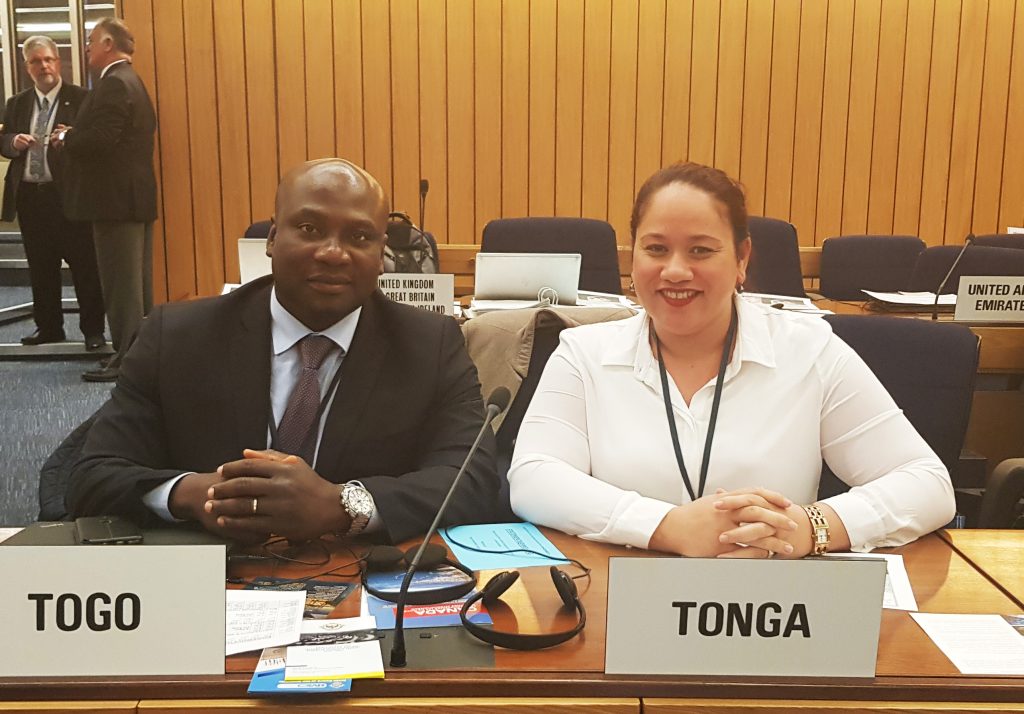
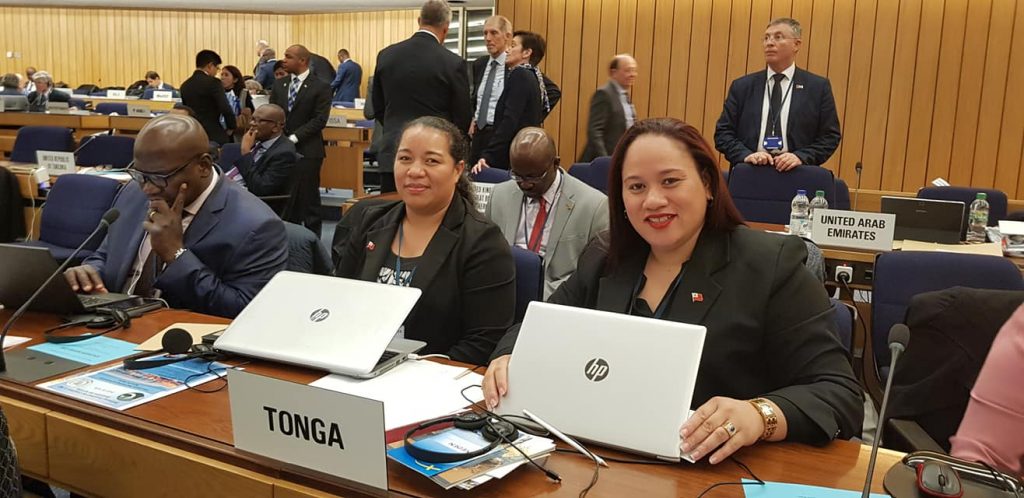
Tonga was committed to carrying out its responsibilities under international maritime law, Minister for Infrastructure and Tourism ‘Akosita Havili Lavulavu said today.
The Minister also
warned of the dangers of global warming and praised the International Maritime
Organisation for regulating greenhouse has emissions in shipping.
She also praised the role of women in the international maritime industry.
Hon.
Lavulavu said Tonga had improved its relationship with the International
Maritime Organisation following an audit by the World Bank.
“The Technical assistance from IMO and development partners will always be welcomed and highly appreciated,” Hon. Lavulavu said.
The
Minister acknowledged there were still many real challenges in complying with
international maritime laws.
Despite
this, safety, security and the role of ships’ crews in the orderly conduct of global
trade were of paramount interest to Tonga.
A Government National Maritime Policy had been established, through technical assistance provided by the World Bank so that all maritime sectors work together.
The Minister also warned of the dangers of global warming and praised the
International Maritime Organisation for regulating greenhouse has emissions in
shipping.
“Customarily,
maritime
safety and navigation, port and infrastructure development, transport policy,
environmental protection, fisheries, security, customs,
maritime tourism and border control, fall within
different departments and ministries
and often there is little to no co-ordination,” the Minister said.
“We
have since rectified the situation.”
She said sharing information and helped decision making and reduced the wastage of limited resources by preventing duplication.
Women
Hon. Lavulavu praised the
IMO for the theme ‘Empowering Women in the Maritime Community.’
Tonga was committed to
this theme He said the Ministry responsible for the maritime division, and the
Permanent mission to the IMO were led by women.
Climate change
Pacific Island states may cease to exist because of climate change, the
Minister said.
He
commended the IMO for taking a leading role on climate change, by regulating
greenhouse gas emissions in shipping.
“Shipping companies and shipowners have risen admirably to the challenge in addressing climate change issues, in partnership with IMO,” the Minister said.
“Without
their endorsement and assistance, IMO will face a greater challenge in
achieving its goal of reducing greenhouse gas emissions.
“Tonga
will enormously benefit from establishing global mitigation, and adapting relevant
measures to address climate change, for our immediate survival.”
Cyber-security
Tonga
appreciates the IMO’s plan to be a ‘knowledge based’ organisation to meet the challenges
and related modern technology issues, such as cyber security with transnational
criminal activities, and autonomous vessels.
“No
doubt, there will be changes in the Organization’s management practices and in
working relationships with Member States,” the Minister said.
“We
will meet the new and unexpected challenges head-on, and manage them
successfully, and effectively.
“It is welcomed with perhaps, a sigh of
relief, for Tonga (and other SIDS) that IMO has plans to improve the implementation
of the existing regulatory regime.
“This is a comprehensive regulatory regime,
that
covers the whole life of a vessel, from start to finish, and its operational
environment.
“We will stand together with other Member
States in meeting our responsibilities, prescribed under international maritime
laws.
“We will need all of the help in
implementing the international maritime laws, and to comply with all
requirements.”
Sustainable
development
Tonga
was strongly committed to achieving the 2030 Agenda for
Sustainable Development and associated Sustainable Development Goals,
the Minister said.
It
supported the IMO’s plans to achieve those commitments.
“This is clearly reflected in the annual IMO’s World Maritime Day theme approved for 2020 – ‘Sustainable Shipping for a Sustainable Planet,” she said.
“A sustainable maritime sector will support
Tonga’s trade and economic activities and at the same time assist in the
fulfilment of its obligations on individual SDGs.”