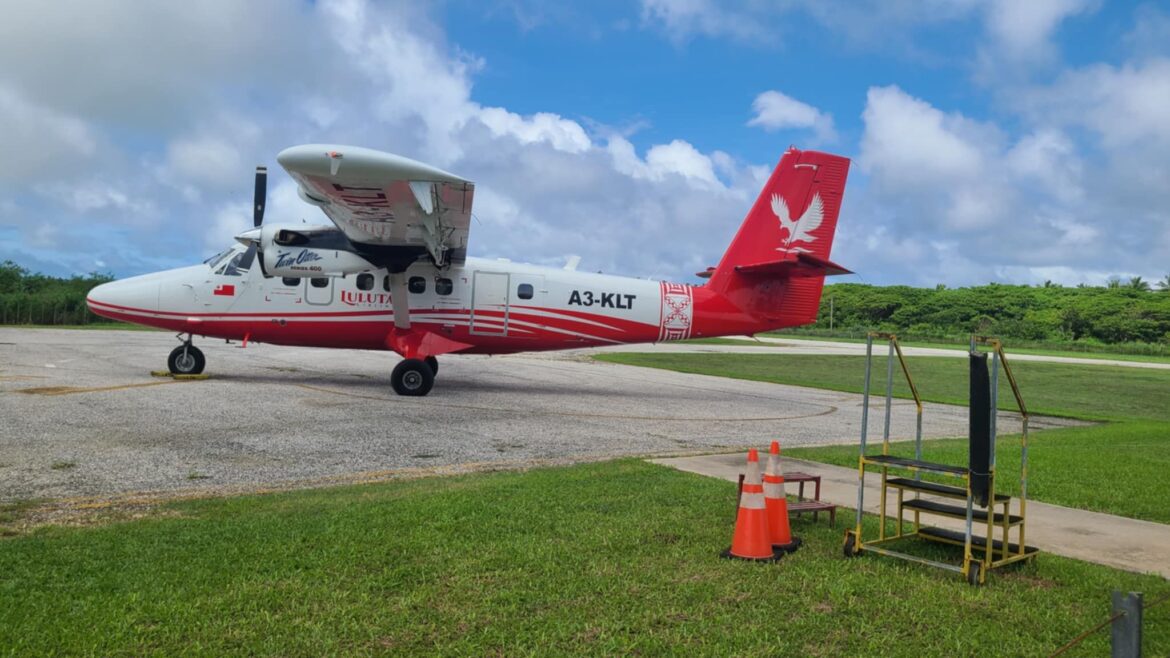
Former Minister of Police Siaosi Sovaleni Hu‘akavameiliku and current Minister of Police Piveni Piukala clashed in Parliament this morning over an aircraft flight that occurred on Sunday.
The questions follow footage of the Lulutai aircraft leaving the Fua‘amotu domestic airport yesterday, Sunday, 30 which triggered debates on Facebook.
The Parliament of Tonga reconvened this morning.
Piukala confirmed in the House that the flight was emergency-related, heading to one of the Niuas to medevac a patient who was in emergency.
Piukala recently denied authorization for a foreign air ambulance to evacuate two patients from Tonga.
Following the flight’s cancellation, Piukala said that his investigation of the application allegedly revealed no tourists requiring medical evacuation, contrary to the original claim.
Hu‘akavameiliku’s questioning revived controversy surrounding his 2024 decision to authorize Lulutai Airlines flights on Christmas Day.
Businesses and trading services are illegal in the kingdom on Sunday, Christmas Day and Good Friday.
As Kaniva News reported at the time, the national airline was accused of breaching the Christmas Day trading ban after reports that it conducted passenger flights on Christmas Day.
At the time, we said that Neiafu town officer had protested at the Vava’u police station after the police arrested his son for illegally swimming in the sea on that Christmas Day.
Lapota told Kaniva News that the Lulutai aircraft flew back and forth from Vava’u and questioned why they were allegedly allowed to conduct business on Christmas Day, at the same time the police arrested his son for swimming in the sea the same day.
We contacted Hu’akavameiliku at the time for comment.
During a press conference, at the time, where he was asked to address the legality of the government airline’s Christmas Day passenger flights, Hu’akavameiliku declined to provide a clear justification for the operations.
While confirming that a ‘provisional permit’ had been issued, he did not explain how passenger services qualified under Tongan law, which only permits Christmas flights for emergencies.
Four guns were located inside a guitar case after an armed call out in Auckland yesterday.
A rifle, a shotgun, and two pistols were found inside a guitar case in a vehicle parked outside an address in Auckland’s Ōrākei. (Source: NZ Police)
Police received a report of a person in possession of what appeared to be a firearm outside a property in Kitemoana St, Ōrākei at around 2.10pm.
Auckland City East Area Prevention Manager Inspector Rachel Dolheguy said police arrived and located the firearms inside a vehicle parked at the address.
She said an armed approach was made but that all parties were cooperative with police.
“A search of the vehicle located a guitar case with four firearms inside, including two pistols, one shotgun and one rifle.”
Dolheguy said taking the firearms out of circulation from the community was a “great result”.
“We continue to be committed to holding people to account and delivering on our intent to keep people safe.”
A 29-year-old man will appear on Auckland District Court on April 4 charged with three counts of unlawful possession of a firearm.
Tongan authorities have lifted the tsunami warning issued after a powerful 7.1 magnitude earthquake struck near Ha‘apai in the early hours of Monday morning.
The earthquake prompted widespread evacuations on the main island of Tongatapu as emergency sirens sounded throughout coastal communities.
The quake hit at a depth of 29 kilometers (18 miles) and was centred about 100 kilometers (62 miles) northeast of the main island in the early morning hours of Monday local time, the U.S. Geological Survey said.
Hours later, a second 6.1 magnitude quake hit in the same area.
Lotu Tupou, a terrified resident of Tongatapu, took to social media to describe the violent shaking that seemed to “go on forever” before tsunami sirens began wailing across the island nation.
MetService had advised residents, especially those in the Ha’apai island group, to move inland as a precaution.
Video shared on Facebook showed long lines of vehicles on roads as they made their way to higher ground inland.
No injuries or significant damage have been reported as of press time.
Debates
Both Tonga Broadcasting Commission (TBC) and Broadcom FM 87.5 remained operational during the tsunami warning, broadcasting live updates and fielding calls from residents.
They routinely intersperse emergency updates with hymns and religious songs.
While some callers offered evacuation advice, others sparked debate, including one who urged listeners to “stay home” on religious grounds.
“It’s Sunday—God has prepared everything for us”, he said.
“The tsunami won’t come,” insisted the caller, dismissing evacuation orders.
In stark contrast, another listener countered: “This is an emergency. We must obey the police and authorities now,” emphasizing the need for immediate action.
The divide highlighted tensions between faith-based trust and official disaster protocols as coastal communities fled to higher ground.
This latest dispute echoes tensions during last year’s Pacific Islands Forum Leaders Meeting in Tonga, when a powerful earthquake triggered a midday tsunami alert.
Local radio broadcasts shifted to playing hymns, but this decision was met with criticism on social media.
Some commenters expressed concerns that the sound of hymns heightened anxiety among children as they attempted to make their way home.
However, proponents of the religious practice argued that Tongans are deeply religious and view God as their saviour.
A powerful 7.1 magnitude earthquake struck near Tonga this morning, Monday, 31, sending panicked residents fleeing inland amid fears of a potential tsunami.
The quake which hit at 1.18am Tonga time was centered 90.3 kilometers southeast of Pangai, Ha’apai and 168.8 km east north east of Nuku‘alofa, at a depth of 10 kilometers, according to the U.S. Geological Survey (USGS).
Terrified Tongatapu residents reported hearing emergency sirens blare within minutes, prompting swift evacuations to higher ground.
Many took to social media describing violent shaking that seemed to “go on forever” before tsunami sirens began wailing across the island nation.
MetService has advised residents, especially those in the Ha’apai island group, to move inland as a precaution.
No injuries or significant damage have been reported as of press time.
Former Prime Minister Hu’akavameiliku took to social media this morning with targeted evacuation advice following the earthquake, urging vulnerable groups to seek specific safe zones rather than rural areas.
The ex-PM’s Facebook post directed Nuku’alofa families to flee to Pili, Fangaloto or Popua.
People were advised to evacuate to the New Zealand High Commission in Popua or Funga Sia mountain.
The absence of early damage reports comes as a tentative reprieve for a nation still traumatized by January 2022’s Hunga-Tonga Hunga-Ha‘apai eruption, which unleashed a deadly tsunami killing five and displacing thousands.
The National Disaster Risk Management Office (NDRMO) and the Tonga Meteorological Services have activated a red alert tsunami warning for all coastal areas of Tonga.
Residents are instructed to move immediately inland.
NDRMO said all coastal communities from Niutōua to Kolovai must seek higher ground immediately.
It advised to avoid Vuna Rd, Hala Taufa‘āhau waterfront and Fanga‘uta Lagoon shores.
Three decades after Selena Quintanilla-Pérez’s tragic murder, her haunting ballad “Dreaming of You” remains a cornerstone of Latin pop history, but newly revealed details about its origins expose a parallel story of cultural preservation.
Selena Quintanilla-Pérez
The song was initially written for the Tongan-American sibling group the Jets, but their father-manager, Maikeli Wolfgramm, rejected it.
Francine Vicki Golde, the song’s writer, revealed something this week that had not been made public since her 1989 ballad was released.
“We thought it would be perfect for them,” Golde said on her website, recalling how she and collaborator Tom Snow composed the song in a Laurel Canyon studio, imagining The Jets’ harmonies over its yearning lyrics, Golde reportedly said.
However, she said their father “didn’t think it was right for them”.
After the Jets turned down the song, Golde visited a friend, publisher and A&R exec extraordinaire Nancy Brennan, who introduced her to Selena in 1993.
“She told me about a young girl she was really excited about, who would soon be recording her first English album and needed songs. She then played me a video of The Barrio Boys featuring this young singer, Selena Quintanilla”, Golde reportedly said.
Dreaming of You, Selena’s fifth and final studio album, is a triumphant milestone and a haunting farewell.
EMI Latin and EMI Records released the album posthumously on July 18, 1995. It debuted at No. 1 on the Billboard 200, becoming the first predominantly Spanish-language record to achieve this feat.
Its success cemented Selena’s crossover legacy, blending Tejano soul with pop ambition.
The track was recorded just weeks before Selena’s tragic death at the age of 23, following her shooting by her former fan club president and manager, Yolanda Saldívar, in a motel room in Corpus Christi, Texas.
The Jets
Saldívar, who was convicted of first-degree murder later that year, remains imprisoned at the Mountain View Unit in Gatesville, Texas, where she was denied parole this week after serving 30 years of her life sentence.
Editor’s comment:
During the Jets’ 1989 homecoming to Tonga, the Tonga Broadcasting Commission interviewed Maikeli. He shared what he said were the challenges encountered by the band as they sought to balance their burgeoning success in the United States with preserving their Tongan cultural values.
At the height of their success, with popular songs such as “Crush on You,” Maikeli declined career-defining opportunities to uphold the veitapui cultural practice. The band’s promoters wanted to change the singers’ performances and styles by using edgier outfits and more provocative lyrics to attract a broader audience.
Nevertheless, he adhered to the cultural standards and said they should not be compromised.
The veitapui practice prohibits physical contact between siblings and cousins of the opposite sex, which may appear culturally unnecessary to some. Additionally, it restricts discussions to topics deemed appropriate solely for romantic partners.
This week, as we observe the 30th anniversary of Selena’s death, I analyzed the song “Dreaming of You” to understand why the Jets declined it, apart from their father’s statement that it was not suitable for them.
When I read all the lyrics, I immediately remembered Maikeli’s interview.
The lyrics may seem harmless in English, but from a Tongan perspective, the siblings’ intended performance could be viewed as contrary to the veitapui practice.
This may explain why Maikeli declined the song, reflecting Tongan cultural values.
Lyrics – Dreaming of You
Late at night when all the world is sleeping I stay up and think of you And I wish on a star That somewhere you are thinking of me too
‘Cause I’m dreaming of you tonight ‘Til tomorrow, I’ll be holding you tight And there’s nowhere in the world I’d rather be Than here in my room dreaming about you and me
Wonder if you ever see (see me) me, and I Wonder if you know I’m there (am I there? Am I?) If you looked in my eyes Would you see what’s inside? Would you even care?
I just wanna hold you close But so far, all I have are dreams of you So I wait for the day (wait for the day) And the courage to say How much I love you (Yes I do)
I’ll be dreaming of you tonight ‘Til tomorrow (’til tomorrow) I’ll be holding you tight And there’s nowhere in the world I’d rather be Than here in my room dreaming about you and me
Corazón, I can’t stop dreaming of you No puedo dejar de pensar en ti I can’t stop dreaming Cómo te necesito I can’t stop dreaming of you Mi amor cómo te extraño
Late at night when all the world is sleeping I stay up and think of you And I still can’t believe That you came up to me and said I love you I love you too
Now I’m dreaming with you tonight ‘Til tomorrow and for all of our lives (’til tomorrow) And there’s nowhere in the world I’d rather be Than here in my room dreaming with you endlessly
Dreaming with you tonight ‘Til tomorrow, I’ll be holding you tight (’til tomorrow) And there’s nowhere in the world I’d rather be Than here in my room dreaming with you endlessly (I’ll be dreaming)
Dreaming of you tonight Endlessly And I’ll be holding you tight (’til tomorrow) Dreaming with you tonight (endlessly) Endlessly Endlessly Dreaming
Six years after his controversial exit from Australian rugby, Israel Folau has publicly staked his claim for a shock recall to face the British & Irish Lions during their highly anticipated July tour.
The 34-year-old dual-code star, now playing in Japan with the Urayasu D-Rocks, confirmed his desire to join the combined Australia-New Zealand XV side, a move that would cap one of the sport’s most polarizing redemption arcs.
The former Wallabies star has sensationally gone public with his hopes of ending a six-year exile from playing rugby in Australia after his bombshell lawsuit against Rugby Australia (RA) in 2019.
The former Waratahs fullback settled his wrongful dismissal lawsuit against his former employer out of court for an undisclosed amount. According to reports at the time Folau had been seeking $14 million in compensation after the governing body tore up his contract for an Instagram post in April, 2019, in which the dual-code international said “hell awaits” gay people.
Fox Sports reported that he reportedly walked away with $5 million. The case divided the country.
Folau has repeatedly said he has no regrets about the Instagram post, which many found offensive.
Now one of the most famous scandals in Australian sport has twisted again with Folau sharing his dreams of playing for an Australian invitational team to face the British and Irish Lions on July 12 at the Adelaide Oval.
“If I do get the opportunity to play and my kids and my wife get to witness that, it would be definitely pretty special,” he said.
According to Code Sports, Folau will need special clearance to be eligible for selection because he switched his allegiance to Tonga in 2022 after being blacklisted by Rugby Australia.
According to the report, the British and Irish Lions will also need to tick off his selection — if it eventuates.
In a powerful celebration of their Tongan roots, American singers Iam Tongi and Dinah Jane—both of Tongan heritage—joined voices in a stunning medley that included the beloved Tongan song Si‘ete Konga Koula kuo Tō ‘i Moana.
Iam Tongi and Dinah Jane
The heartfelt duet, recently shared in a viral Facebook clip, showcases their cultural pride and musical artistry, resonating deeply with Tongan and Pacific Islander audiences worldwide.
Fresh off his American Idol victory, Iam Tongi has become a beacon of pride for the Tongan community, openly honoring his heritage on a global stage.
Long before she became a global star, Jane—a proud Tongan-American—stood nervously on The X Factor stage at just 15.
Her audition launched her into Fifth Harmony, one of the decade’s biggest girl groups, and made her a trailblazer for Pacific Islander representation in mainstream music.
Tongi and Jane were performing a heartfelt duet of Counting Stars (cover) and Si’i Konga Koula, a classic by fellow Tongan-American artist Junior Maile.
Their collaboration arrives at a meaningful time when Tongan diaspora communities, particularly in New Zealand and the U.S., are increasingly embracing cultural traditions.
Some observers note that this renewed engagement may even surpass participation levels in Tonga itself.
This cultural resurgence is vividly embodied in events like New Zealand’s ASB Polyfest—the world’s largest Pacific festival, which recently celebrated its 50th anniversary.
Jane’s most recent release is the single “Let’s Go” featuring Young Go and JKing, which was released on August 21, 2024.
Tongi released several singles, including “Monsters” (2023), his emotional Idol audition song, now on streaming platforms. He also recorded and released “I’ll Be Seeing You” (2023), a tribute to his late father.
The seizure of 50kg of heroin and 210kg of methamphetamine in the Middle East has brought the combined value of narcotics seized by an international naval task force to almost half a billion dollars since New Zealand took command in January.
50kg of heroin and 210kg of methamphetamine have been seized. (Source: NZDF)
It is the third drug bust this year for Combined Maritime Task Force 150 — an operational task force aimed at disrupting drug smuggling operations in the Middle East currently being led by the Royal New Zealand Navy’s captain Dave Barr.
After observing some “suspicious activity” by a trading dhow around 400 nautical miles southeast of the Oman coast, crew of the United States Coast Guard Cutter Emlen Tunnell boarded the vessel and discovered 260kg of narcotics on board, which were seized and later destroyed.
The latest seizure was worth an estimated NZ$87.8 million, bringing the combined total of seized illicit narcotics to an estimated NZ$480 million.
Barr said the bust was a testament to the crew of the USCGC Emlen Tunnell.
“Together with the professionalism of the multinational CTF 150 team and their ability to integrate and work with the many other nations that make up the Combined Maritime Forces here in Bahrain, this work strives to accurately identify vessels of interest, take action to interdict, and ultimately remove these killer substances from the illicit global narcotics market.”
He said it might seem like the amount of intercepted drugs were a “drop in the pond”.
“But so far we’ve removed almost half a billion New Zealand dollars-worth of product from doing harm. Will there be more smuggled? Of course there will. We can’t stop it all, but in a nod to our key partners from India, as Mahatma Gandhi is famous for saying, ‘You may never know what results come of your actions, but if you do nothing, there will be no results’. So we’ll keep trying, and we’ll stop what we can.”
Royal New Zealand Navy frigate HMNZS Te Kaha will join CTF-150 this week.
A man who allegedly abducted a mother and her baby at knife point from a suburban shopping centre has been tracked down by police.
Police allege he forced her into the driver’s seat before getting into the back seat next to her six-month-old baby daughter. (Source: Victoria Police)
The 25-year-old Dandenong man was arrested and charged on Friday after police raided his home over the alleged abduction on May 10, 2024.
The victim, known as Kieren, was getting out of her silver Suzuki at Stud Park Shopping Centre car park in Rowville, Melbourne’s southeast, when the man allegedly approached her with a knife.
Police allege he forced her into the driver’s seat before getting into the back seat next to her six-month-old baby daughter.
The man then allegedly forced the mother to drive to three different electrical stores and go inside to buy four Apple MacBooks while he waited with the child.
He took over driving and pulled over at Robert Booth Reserve in Dandenong, where he got out and left with the laptops.
Kieren and her baby were abducted at knifepoint. (Source: Nine)
The mother sought help from a nearby kebab shop.
She and her baby were not physically injured.
Her alleged attacker faced five counts of kidnapping, three counts of armed robbery, as well as charges of aggravated carjacking, attempted armed robbery, handling stolen goods and possession of a prohibited weapon.
He was expected to appear in Melbourne Magistrates Court later on Friday.
Yolanda Saldívar, the woman who murdered Tejano music icon Selena Quintanilla-Perez in 1995, has been denied parole after three decades behind bars.
Yolanda Saldívar, 64, was denied parole and is currently serving a life sentence for the murder of Selena Quintanilla-Perez, 23, in a Corpus Christi, Texas hotel room during an argument on March 3, 1995
The Texas Board of Pardons and Paroles rejected the 64-year-old’s bid for early release, ensuring she will remain in prison serving her life sentence.
Saldívar fatally shot the 23-year-old superstar on March 31, 1995, at a Corpus Christi motel during a confrontation over money she had embezzled from Selena’s fan club.
The killing sent shockwaves through the Latino community and cemented Selena’s legacy as a cultural legend.
“This decision ensures that Yolanda Saldívar continues to face the consequences of her horrific crime,” said a spokesperson for the Quintanilla family, who have long opposed her release.
Saldívar was the president of Selena’s fan club and had embezzled $60,000 from the group. The superstar was planning on firing her
Saldívar will be eligible for a reviewal of her case for parole in 2030.
Selena’s family announced they were ‘grateful’ after the Texas Board of Pardons and Paroles announced that her killer had been denied parole.
Saldívar was the president of Selena’s fan club and had embezzled $60,000 from the group.
The woman, who was originally trained as a nurse and was reportedly ‘obsessed’ with Selena, developed a reputation for firing boutique employees due to her personal animosity.
Employees began complaining about Saldívar’s bizarre behavior to Selena and her family members by 1994.
The superstar was planning on firing her before the woman killed the pop star.