Unlock this article by subscribing to Kaniva News Premium
Funding Kaniva Tonga journalism every year is great value on a weekly basis. Make a bigger impact today, and protect our independence long term. Please consider annual support
OR
Buy This Article
Unlock this article and gain permanent access to read it. Unlock credits cost: 1 Available credits: N/A
Tonga’s Anti-Corruption Commission (ACC) is setting a strong precedent in transparency by openly publishing a comprehensive list of all gifts and benefits it receives.
The list had been recently released the same day Commissioner Chris LaHatte presented his four-year strategic plan to the public, which Kaniva News reported.
That news received favourable discussions among community members on Facebook.
Many expressed gratitude and excitement to see the long-awaited service finally in action, marking a new chapter in Tonga’s history of ongoing battle against the pervasive corruption that has plagued the nation for years.
The move is similar to that of organisations in New Zealand that provide the same services as ACC.
It aimed to expose how a board handles gifts and hospitality offered to its members, considering that it has profound implications for the trust placed in the governance of the entity concerned.
It also sets a precaution for commissioners and their staff that they should not accept gifts, benefits, or hospitality that would or might reasonably be seen to compromise their integrity by placing them under any obligation to a third party.
The list means the public can easily see which people or organizations have contributed to the ACC, fostering a greater sense of accountability and trust within the community concerning the Commission’s duties.
Publishing the list, the ACC said on its Facebook:
“Declaration
In the course of our duties as the Anti-Corruption Commissioner, we have received the following gifts, benefits or both, the value of which is recorded. The table below shows the bi-annual ACC gift and other benefit declarations”.
Authorities in French Polynesia have seized a record 524kg of cocaine on board a Spanish-flagged vessel.
Over 500 Kg of cocaine seized in French Polynesia Photo: OFAST
The operation on Christmas Eve was conducted by the French Navy Overseas support and assistance vessel Bougainville, in co-ordination with French Gendarmerie and the OFAST (anti-narcotics office), the French High commission said in a release.
The Australian Federal Police was also involved in what is described as an international intelligence co-operation.
The fishing vessel, identified as Raymi, was intercepted and boarded south of French Polynesia’s Exclusive Economic Zone (EEZ), about 700 nautical miles south of Papeete, with 14 crew members from Columbia and Ecuador aboard.
They have been remanded in custody pending a planned appearance before a local court, deputy public prosecutor Yann Hausner said.
A total of 524kg of cocaine was immediately found inside 11 packs.
It has not been established as yet where the vessel was heading.
The estimated street value of the seized shipment was around US$122 million (NZ$215m).
The Raymi was then escorted back to French Polynesia’s capital Papeete, where it was subjected to further searches.
“It’s the kind of operation for which we are also trained”, Bougainville Commander Mathieu Leman told local public broadcaster Polynésie La Première.
Pacific “drugs highway”
French Polynesia, as well as other Pacific countries and territories (such as Samoa, Fiji, Tonga), has been identified as a major transit point of the so-called “drugs highway” from North and South America (the United States, Mexico, Columbia, Ecuador, Panama) to major markets such as Australia, New Zealand and Asia.
In March 2019, another French Navy vessel, Prairial, in collaboration with the US Joint Interagency Task Force – South intercepted a fishing vessel off the coast of Nicaragua with 766kg of cocaine on board.
In the other direction, labs in South-east Asia are also using Pacific islands such as Palau or Papua New Guinea as transit points to ship opium-based and methamphetamines to the US market.
The outgoing Prime Minister, Hon Hu’akavameiliku, denied that his government had received more than “a billion-dollar loan” from China and the ADB.
Hon Hu’akavameiliku (L) and Lawyer Nalesoni Tupou
He was responding after Lawyer Nalesoni Tupou blasted his terms in government labelling Hu‘akavameiliku’s leadership as performing poorly.
Mr Tupou claimed the Hu’akavameiliku administration owed US$380 to China and US$120 million to the ADB.
He converted the total US$500 into Tongan pa’anga as over TOP$1 billion.
Mr Tupou used the term “mo’ua”, meaning debts or money owed to lenders, to describe the debts in Tongan.
It was unclear whether he was referring to the previous government’s existing debts, for which the outgoing government was responsible for payment, or if he was specifically indicating that these were new loans taken on by the Hu’akavameiliku government.
He advocated appointing a new Prime Minister with financial and governmental affairs expertise.
He alleged that Hon Hu’akavameiliku had stepped down because he knew he was no longer fit for the job.
Mr Tupou said Hu‘akavameiliku’s resignation was justified because of all these.
However, Hon Hu‘akavameiliku said in Tongan that he wanted to enlighten the lawyer.
He said: “Ne teeki no e Puleanga neu kau ai mei adb pe Siaina he tau 3 mau Puleanga ai”, saying his government did not secure loans from China and the ADB while he was the leader in the last three years.
He said Mr Tupou was referring to loans made by previous governments, and his government was only paying them back.
The Chnina loan balance was TOP$197.2 million, and the payments so far have brought it down to TOP$157 million or US$75 million, while the balance of the ADB loan was TOP$49 million or US$23, the Prime Minister said.
Hon Hu’akavameiliku blasted Mr Tupou and told him to stop what he had described as misleading the public.
A family in Touliki whose verandah was burgled while they were sleeping in the living room said the crime shows how “brazen and opportunistic” some thieves are.
Man retrieving their laundry after being discarded by the thieves.
The burglar, or burglars, took a washing machine with laundry inside and a bicycle.
The woman, who streamed the incident and shared it on Facebook, said that they had to follow the apparent trail of the burglars through nearby bushes.
They managed to retrieve some of the discarded laundry the thieves left behind.
There were no signs of the washing machine or the bicycle.
She said the laundry was their children’s clothing.
The video showed the woman and a man walking on what had been described as the burglars’ apparent trail.
It led them to a nearby public road, where they believed a waiting vehicle was parked.
“People are that brazen and opportunistic, that they steal the stuff while we were sleeping close by,” she said.
The new government had been urged to hold the previous administration responsible by conducting an audit of its services.
Dr Taniela Fusimālohi. Photo/Fale Alea o Tonga
MP Dr Taniela Fusimālohi, a staunch supporter of the Prime Minister Designate, Dr ‘Aisake Eke, recently said in the House that the audit will ensure transparency and accountability in managing public funds.
He mentioned the former government’s annual budgets as an area of focus for the auditor.
The former Hu’akavameiliku government’s involvement in the national airlines was accused of “secrecy” surrounding its decision-making.
This criticism persisted despite the former Prime Minister providing responses and clarifications to most allegations against him in Parliament, the media, and during his two Motions of Confidence Vote.
However, one of the issues he appeared to have failed to provide a satisfactory response pertains to the Australian $2 million grant his government had allocated to buy the Lulutai’s Twin Otter aircraft last year.
The Prime Minister Elect, Dr Eke and MP Dr Fusimālohi believed the money should not have been used to buy the aircraft.
They previously quizzed the Prime Minister in Parliament about the grant.
At one stage, the Minister for Civil Aviation, Seventeen Toumo’ua intervened and claimed that the fund was specifically granted to assist in purchasing the Lulutai’s Twin Otter aircraft.
According to Hansard number 29 of 2023 the Minister said in Tongan:
“ko e 2 miliona ko eni na’e ‘omai ‘e ‘Asitelēlia ko e ‘omai hangatonu ia ki he vakapuna”.
In English, he said: “The 2 million fund was directly granted by Australia for the aircraft”.
However, the information later provided by the former Australian High Commissioner to Tonga, Rachel Moore, about the grant didn’t seem to be the case.
Kaniva News recently obtained a copy of a letter purported to provide Moore’s responses to MP Fusimālohi after he sought clarification on the grant.
Ms Moore said:
“In 2023 Australia provided elevated levels of direct budget support to the Government of Tonga to support economic recovery following the Hunga Tonga-Hunga Ha’apai volcanic eruption and tsunami and COVID-19 pandemic. The Government of Tonga allocates Australian general budget support at its discretion”.
Ms Moore’s response did not mention that the grant of $2 million was specifically intended to support the purchase of the Twin Otter.
She also clarified other assistance the Australian government had provided to Tonga.
She said: “We appreciate the Government of Tonga’s assessment of the importance of reliable domestic aviation connectivity to economic recovery as well as service delivery. Australia has provided support to Tonga’s aviation sector since mid-2022, including through the wet- lease arrangement between Lulutai Airlines and Fiji Airways to operate regular domestic flights from January to May 2023. Australia has also funded training for Lulutai pilots and engineers and for air traffic controllers from Tonga Airports Limited. Australia continues to work with Lulutai to develop a long-term sustainable business plan and to improve corporate functions and the airline’s reservations and sales systems.”
The question remains: will Dr Eke’s government review Lulutai Airlines and the use of the Australian grant?
The opposition had brought up the grant issue in Parliament in the 2023 Motion of No Confidence against Hu’akavameiliku. They had been concerned at the government’s apparent misleading the House that it was intended for the Lulutai’s Twin Otter purchase. The former Prime Minister had no response.
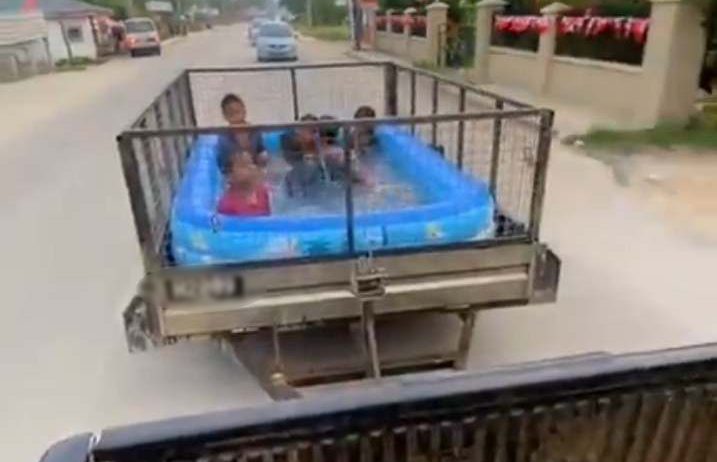
A group of young children have been spotted enjoying and cooling themselves off in a DIY pool placed on a moving trailer in Tonga.
A group of young children has been observed enjoying themselves while cooling off in a mobile pool on a moving trailer in Tonga.
The unusual scene has caught the attention of locals and travellers alike, sparking conversations on social media about the creativity.
The makeshift pool was being towed along a busy road on Tongatapu, with the young children under 10 left unsupervised in the trailer.
It appeared that an inflatable pool was positioned inside the fenced trailer before it was filled with water.
Kaniva News could not independently verify the authenticity of the footage.
The operator of the trailer could not be reached for comment.
Those who shared the footage with some Facebook users poked fun at the unusual scene and couldn’t help but make light of it, posting humorous comments and playful jabs at what they saw.
However, some commenters expressed concerns about the potential danger for the children if something went wrong along the road.
In Tongan, a commenter wrote: “Pe ‘oku fēfē fakakaukau ‘a e faka’uli?”, asking what the driver would think of any danger that could happen.
One commenter said they had seen several incidents where trailers flipped during towing, especially on busy motorways.
It is summertime in Tonga, making it a popular time for festivals and gatherings, while many seek refuge under palm trees or enjoy refreshing coconut water to stay cool.
The increasing number of confiscations of crystal methamphetamine in Tonga since 2018 has raised alarms, a recently released report said.
Note: Flow arrows represent the general direction of trafficking and do not coincide with precise sources of production or manufacture, are not actual routes, and are not weighted for significance/scale. Boundaries, names and designations used do not imply official endorsement or acceptance by the United Nations. Source: UNODC elaboration of national data and reports from origin, transit and destination countries.
The report by the United Nations Office on Drugs and Crime highlighted a worrying trend about how 97.16kg of this dangerous substance affects people’s health.
It said the amount is relatively small compared to drugs seized in other countries of the Pacific, but “given that the population in Tonga is just over 100,000, the quantities seized in the country may be a cause of concern”.
It comes as Tongan authorities grappled to combat rampant illicit drug abuse across the nation.
Earlier this year, a public debate in Parliament rejected a suggestion that the death penalty be used to deter drug offenders.
The report, Transnational Organized Crime in the Pacific: Expansion, Challenges and Impact showed that the value of one gram of methamphetamine in Tonga was reportedly US$ 252.00.
That’s an equivalent of TOP$605.00.
It said this was higher than in any other Southeast Asian countries reported in 2023.
Thereport said: “From 2018 through July 2024, Tongan authorities seized 97.16 kg of crystal methamphetamine, of which more than half (53.5 per cent) was seized in 2023 and 2024 (1 January through 27 July), and about 72.5 kg of cocaine, with total seizures of 58 kg in 2018 and approximately 14.5 kg in 2021”.
Trafficking routes
Tonga is one of the Pacific Island countries most impacted by the increase in illicit drug flows through the Pacific region, including Papua New Guinea and Fiji.
“Recent drug-related cases reported from Papua New Guinea, Fiji, and Tonga also strongly indicate that drug use as well as wider organized crime activities are expanding rapidly”.
Fiji also appears to be growing in importance as a regional hub for drug trafficking and an emerging base for transnational organized crime networks.
“In January 2024, Fijian authorities made massive methamphetamine seizures totaling 4.8 tons; the seized methamphetamine originated in Mexico. Five known related shipments had previously transited through Fiji. Nadi is believed to be the primary transit point in the Pacific, and trafficking groups bring their yachts from Tonga to Fiji, where the drugs are transferred to another vessel for further trafficking”.
Corruption
The report said that corruption has also been an enabler of some of the drug shipments transiting into and through Tonga destined to markets in Oceania.
It reported several incidents in Tonga reported in the media concerning drug arrests.
This included an incident in 2019 in which “a senior customs officer was arrested for his involvement in importing a shipment of 6 kg of methamphetamine into Tonga along with quantities of cannabis, cannabis oil, arms and ammunition from the United States”, the report said.
In August 2024, Tongan police arrested 17 people in relation to methamphetamine trafficking into Tonga.
The suspects were believed to have been involved in the importation, intended sale and distribution of methamphetamine in the country, and the laundering of the proceeds by individuals and businesses.
“During the week-long operation that included raids at multiple locations, police seized 6.1 kg of methamphetamine that was imported from the United States, and made further arrests, including the arrest of a customs officer and a prisons officer who were charged with offenses related to the import, and a prominent businessman who was arrested for money laundering”.
Police also seized numerous pieces of clothing with the logo of the Comanchero Outlaw Motorcycle Gang as well as cash counting machines and drug utensils.
Impacts on health
The report indicated that methamphetamine has been the most frequently used drug in Tonga over the past five years, as observed by experts. This increased usage has contributed to a rise in the number of mental health patients in the country.
It follows previous media reports that the impacts of illicit drugs are being felt acutely in Tonga’s psychiatric ward.
“Between 20% and 70% of all monthly admissions are due to consumption of cannabinoids or methamphetamine or both,” Dr Mapa Puloka, Tonga’s head psychiatrist, was reported by the Guardian as saying.
“Drugs has now become a main precipitating factor for the occurrences of mental illnesses and the frequent relapse of persons with chronic psychiatric disorders such as schizophrenia and bipolar.”
Puloka reportedly said the crisis had become so dire that some psychiatric patients have had to sleep on the hospital floor.
What is crystal methamphetamine?
According to the US Department of Justice, crystal methamphetamine is a colourless, odourless form of d-methamphetamine, a powerful and highly addictive synthetic (man-made) stimulant. Crystal methamphetamine typically resembles small fragments of glass or shiny blue-white “rocks” of various sizes. Like powdered methamphetamine (another form of d-methamphetamine), crystal methamphetamine is abused because of the long-lasting euphoric effects it produces. Crystal methamphetamine, however, typically has a higher purity level and may produce even longer-lasting and more intense physiological effects.
Popular beaches in holiday hotspots in both islands have been forced to close this afternoon after separate shark sightings, prompting evacuations by lifeguards.
Photo: AFP
Lifeguards at Ōhope near the Top 10 Holiday Park in the Eastern Bay of Plenty evacuated the beach after a shark was spotted in the surf about 4pm.
People could be seen standing on the shoreline looking for the shark before leaving the beach soon after.
Lifeguards took down the flags at Ōhope and blew a whistle to alert swimmers of the shark.
Rotorua mother and daughter Mary and Brittany Eriksen, who are staying at their family bach nearby, had just got out of the water and were drying off when they heard a lifeguard blow a loud whistle.
One of the lifeguards then carried a sign above his head that read “shark” to show swimmers what had been spotted.
“At that moment, dozens of people raced out of the water,” Brittany said.
“It was more exciting than scary with everyone trying to spot the fin. He proved pretty elusive though.”
Meanwhile, in the South Island, Swimsafe has red-flagged Christchurch’s New Brighton Beach today due to a shark sighting.
It comes after holidaymakers were warned not to swim at Whiritoa Beach on the Coromandel Peninsula yesterday after reports of multiple shark sightings.
A spokesman for the Whiritoa Lifeguard Service told the Herald there had been three separate shark sightings close to the shore on Friday and the beach had been closed intermittently.
He said they didn’t get a good look at the sharks, but thought they may have been bronze whalers – considering how shallow the water was they came into – and said they were “on the smaller side”. He didn’t know if the separate sightings were of the same shark.
Surf Life Saving NZ earlier said a shark sighting near the flagged area of Waihī Beach, just down the coast from Whiritoa Beach, forced its temporary closure on Christmas Day.