The Anti-Corruption Commissioner has promised to do his best to get rid of all kinds of corruption in the kingdom.
Mr Christopher LaHatte, Anti-Corruption Commissioner. Photo/Anti-Corruption Commission’s Facebook
Mr Christopher LaHatte, who recently took on the role as the first official holder of this position since the Commission’s inception in July, commented while presenting the Commission’s inaugural Strategic Plan for 2024 – 2029.
The plan offers strong protection for whistleblowers, ensuring that individuals can complain without fear of repercussions.
“As we embark on this journey, we invite constructive criticism and open dialogue”, it said.
Mr LaHatte said he was confident that by working together with the community, they could make “significant strides in eliminating corruption and upholding the law”.
The Commission said it combats “corruption through the promotion of transparency, accountability and integrity in public services”.
It is open to individuals from all walks of life, ensuring everyone can seek assistance and bring their concerns forward.
This contrasts with the Office of the Ombudsman, which primarily addresses issues related to government entities and statutory boards.
Anyone can file a complaint with the Commission about potential corrupt conduct.
“This can be done in person in their office in Nuku’alofa, by email or through their website”.
The staff of the Anti-Corruption Commission recently took part in workshops coordinated by local and Australian counterparts to improve and enhance their investigative skills.
It also actively engaged in a public awareness campaign to disseminate information about its duties and policy. This initiative is intended to educate citizens about the services it provides.
What is corruption?
The Transparency International defines corruption as:
“We define corruption as the abuse of entrusted power for private gain. Corruption erodes trust, weakens democracy, hampers economic development and further exacerbates inequality, poverty, social division and the environmental crisis. Exposing corruption and holding the corrupt to account can only happen if we understand the way corruption works and the systems that enable it”.
The public is being warned over the responsible use of fireworks during Christmas and ahead of New Year.
Police said fireworks were enjoyable for many, but they could also be distressing for some people and the elderly.
The police said they have received complaints about deafening fireworks that could be distressing, particularly for people with heart conditions and children.
The community was reminded about the laws for fireworks.
It said that lightning fireworks must cease by 10pm.
It follows warning from Tonga Fire and Emergency Services last month reminding the public “to celebrate responsibly and safely when using fireworks”.
“Fireworks can be exciting, but they can also pose serious risks if not handled properly”.
In 2022, three Chinese men were arrested after Police responded to reports of fireworks being set off in ‘Alo’italau, Vava’u.
Initial indications from the scene were that the suspects were allegedly drunk when the fireworks being let off, Neiafu Town Officer Vāvā Lapota told Kaniva News.
Police could not be reached for comment at the time.
A man has been arrested following the seizure of 3.5 kilograms of methamphetamine by police in Lapaha.
A fight that broke out during a rugby tournament in Salt Lake City resulted in a coach losing sight in one eye after being assaulted by a man with an umbrella, according to police. (Barbra Ford, Shutterstock)
The 41-year-old man has been charged with possession of illicit drugs.
He is remanded in custody, the Police said.
The police expressed gratitude to the community for their contributions through reports, which helped them apprehend the suspect.
“It is through this cooperative effort that together we can defeat the scourge that all types of drugs bring to our communities across the kingdom”, a statement said.
It follows an arrest in 2022 when Police arrested two 20-year-old men, one at Lapaha and the other at Ngele’ia, for breaching curfew. Each had a pack of cannabis in their possession, for which they have been criminally charged.
Police urged the public to report any suspicious activity that might lead to drug-related incidents.
They emphasized the importance of community vigilance in keeping neighbourhoods safe and encouraged residents to share any information that could help combat drug-related crime.
The infights between the local construction companies and the Ministry of Infrastructure over the Hungas’ Tsunami building project took a new twist.
The Ministry has announced that it had awarded the building contracts to Chinese labourers currently in Tonga after a series of failed negotiations with Tongan contractors.
As Kaniva News reported recently, the local contractors were unhappy after the Minister for Infrastructure Hon Seventeen Toumo’ua fixed the contracts for each new house at what was claimed to be an undervalued price.
The contractors eventually submitted a petition to the Parliament before a Parliamentary committee was selected to work on it.
Hon Toumo’ua had been accused of lack of cooperation with the Parliamentary committee.
We contacted the Minister at the time for comment.
In the latest development, the Ministry said yesterday it made the decision after repeated failures by local contractors to deliver on the project.
According to the Ministry, local contractors were given an initial opportunity but could not meet expectations.
“The first group of contractors had their contracts cancelled, and new contractors were hired. However, that also did not work,” the ministry said in a statement.
It said the decision to hire Chinese labourers had been seen as the most practical solution to ensure the project’s completion.
It said that the Chinese labourers were in the process of completing some of the new houses.
Dr ‘Aisake Valu Eke has been elected as Tonga’s Prime Minister designate.
Dr ‘Aisake Valu Eke
His contender, Dr Viliami Latu received only eight votes.
Dr Eke ascended to the position today following his election in a confidential ballot, where he received the support of 16 out of the 24 members of Parliament eligible to vote.
It follows his submission of a motion of no confidence against the former Prime Minister, Honorable Hu’akavameiliku.
However, before the scheduled ballot, Hu’akavameiliku tendered his resignation.
Dr Eke told the House that he was thankful for the result, and this election marks a significant moment in the country’s political landscape, as he brings a wealth of experience and a vision for the future.
In the melodious tones of Tongan heliaki (figures of speech), Dr Eke, with deep reverence, attributed his triumph to God Almighty, the radiant light guiding his path.
With heartfelt gratitude, he acknowledged the steadfast support of the Nobles and the dedicated People’s MPs.
He called forth a spirit of unity, urging all MPs to unite in a shared initiative aimed at elevating the nation, fostering what is best for the people and honouring His Majesty.
By Iliesa Tora, RNZ Pacific and is republished with permission
The Tongan rugby coaching staff will consider bringing in more experienced players, especially those playing club rugby in Europe, for the 2025 test rugby season, head coach Tevita Tuifua says.
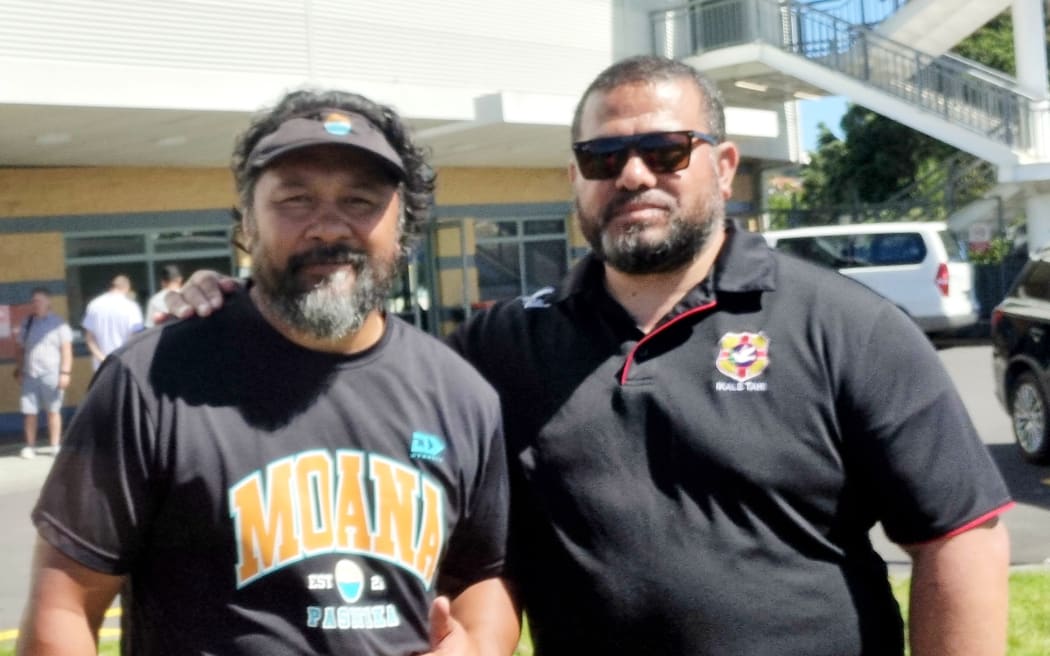
Moana Pasifika assistant coach Vaovasamanaia Seilala Mapusua (left), and ‘Ikale Tahi head coach Tevita Tuifua at the North Harbour Stadium on Thursday. Photo: RNZ Pacific Photo: RNZ Pacific
Spending a day with Moana Pasifika at North Harbour Stadium in Albany last week, Tuifua and his coaching team had the opportunity to witness firsthand the work being done by the franchise club’s coaches.
Tuifua told RNZ Pacific that he wanted to ensure he had the right mix of players, while also making sure the coaching staff had a strong pool of players to work with.
He said the coaching staff had already discussed their plans with Tonga Rugby Union to ensure the national squad was able to play with consistency next year and beyond.
The focus this year had been on lifting the skills and rugby knowlege of their local-based players by giving them an opportunity to play for the ‘Ikale Tahi in test matches, he said.
This meant many experienced overseas-based players plying their trade in Europe were left out, he said.
“We wanted to make sure that we are able to have our own pool of local players and those playing in New Zealand and Australia who we can call upon,” Tuifua said.
“That is important for our growth moving forward. We have seen what happens when the Europe-based players are not available and we have to run around to find players.
“So our strategy is to upskill our players and have that pool of players ready when we need them.”
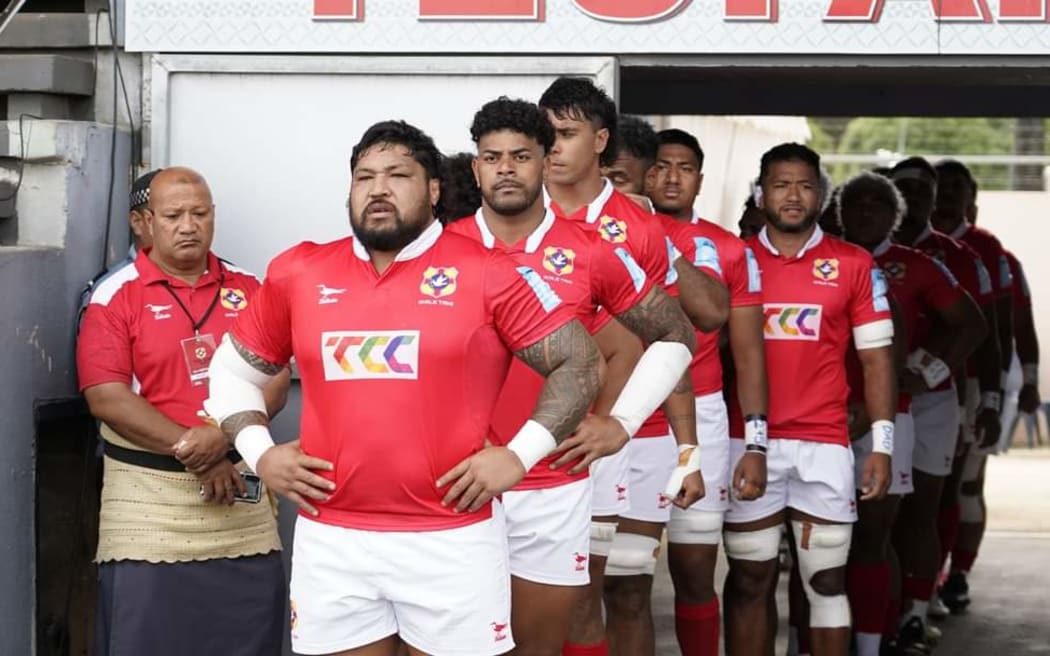
‘Ikale Tahi captain Ben Tameifuna ready to lead his side out against Fiji. Photo: Tonga Rugby Union
Despite calls by some for changes to the Tonga coaching line-up, Tuifua said people needed to understand the group’s focus.
“We are playing test matches, which is good because that is what our players need,” he said.
“But, as I have said, we need to make sure that we have that consistency with our players so the only way we can do that at the moment is give them opportunities to play test matches.
“We have seen some very good talent and am sure if they are mixed in with experienced players, they will lift and they will become better.
“Yes, we acknowledge that we were not as successful as what many would have wanted us to be, but I hope they understand that we are building up and will only get better if we do what we need to do, setting the foundation right.”
Local player pool
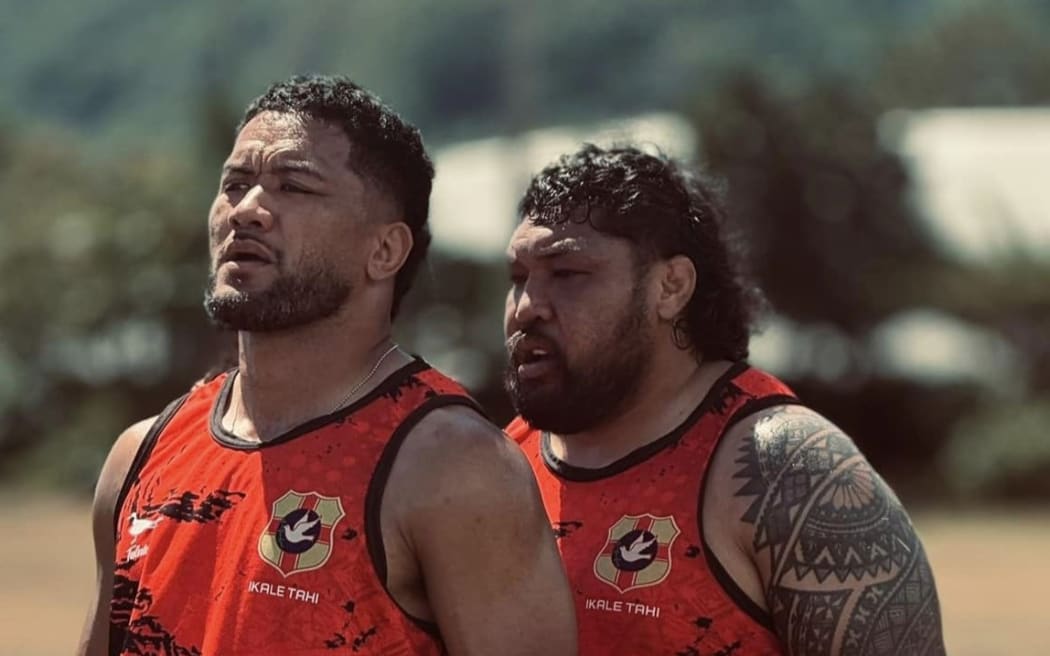
‘Ikale Tahi captain Ben Tameifuna (back) and Tupou Ma’afu Afu work on a lineout move. Photo: Tonga Rugby Union
Bridging the gap back home was critical, he said.
The Tonga Rugby Union is working with Japan in the management of its TRU Academy, which is headed by another ‘Ikale Tahi, Siua Taumalolo.
Tuifua said the academy was focused on upskilling players in the 18- to 20-year bracket.
“That is very important, that we have that continuity,” he said.
He believed improvements would come once the academy set-up was fully functioning.
“That’s going to be a bonus,” Tuifua said.
He pointed to the Fijian Drua set-up, which boosted Fiji Rugby and directly affected the Flying Fijians.
“That’s what we are trying to emulate here,” he said.
“The Flying Fijians have done well because they have the Drua set-up and their high performance unit plus the under-20s through the academy.”
Big year in 2025
2025 will be a big year for the ‘Ikale Tahi, with the 2027 Rugby World Cup qualifiers being the most important assignment on the schedule for them.
Tuifua said that was the primary focus, with plenty needing to be done over the next few months.
Tonga will compete in the 2025 Pacific Nations Cup, which will also double as a qualifier for the world tournament.
The ‘Ikale Tahi and Manu Samoa will have to be at their best to qualify for the final 24.
Beyond that?
Tuifua wanted to see more internationals for his side, with some match-ups against Tier One teams.
“That is what we will then need, more games so our players can have more game time,” he said.
“And if we can get some hit ups against Tier Ones that would be great.”
Tuifua said the pre-season work to train players and schedule matches would continue, looking forward also to the 2025 Super Rugby Series.
“There are a lot of players also playing for Moana Pasifika and the other franchise clubsides in Super Rugby, so that will also be something we will follow with interest,” he said.
Tuifua and his coaching team are contracted to the end of the 2027 World Cup.
The twenty-six members of the Tongan Legislative Assembly will choose the country’s new Prime Minister, through secret ballot, in a special sitting in Nuku’alofa on Christmas Eve.
The Speaker Lord Fakafanua confirmed that the names of two contenders were received by the Clerk’s office when the nomination deadline closed at 4.30pm on Monday, December 23.
He said parliament will sit at 10am on Christmas Eve, when the sealed nomination envelopes will be opened and the nomination procedures takes place, before the actual vote is taken.
The Speaker of Tonga’s Legislative Assembly, Lord Fakafanua. Photo: RNZ Pacific
The 17 Peoples’ Representatives and nine Nobles Representatives will then vote in a new Prime Minister, to replace Hu’akavameiliku Siaosi Sovaleni, who resigned on December 9.
The two nominees are reported to be Dr ‘Aisake Eke and Dr Viliame Latu.
Dr Eke, who filed a motion of no confidence against Hu’akavameiliku late last month, is believed to have the backing of 14 MPs, including three Nobles.
His nomination was handed in by Tongatapu 2 representative, Dr Uhilamoelangi Fasi last Friday.
Dr Latu, a current Cabinet Minister, has been nominated by the current government. His name was registered by Vava’u 14 MP, Mo’ale ‘Otunuku.
To become the new prime minister one of the nominees must win at least 14 votes.
Hu’akavameiliku Siaosi Sovaleni Photo: RNZ Pacific / Lydia Lewis
Interim Prime Minister Samiu Vaipulu was asked by RNZ Pacific, if he and other government ministers supported Dr Latu, to which he replied, “everything will be known on Tuesday”.
There were earlier claims that all 26 MPs had agreed to back Dr Eke.
It is something Lord Fakafanua said would have been ideal but that depended on whether the 17 Peoples’ representatives could unite.
He said the constitution allows for a government of national unity.
Lord Fakafanua said if no one is elected as Prime Minister on December 24, Parliament will have to sit again on Friday, to hold a second round of votes.
United front
Speaking to Tonga TV in Nuku’alofa at the weekend, Lord Fakafanua said the Nobles traditionally voted together as a block and it would be easier if the 17 Peoples’ representatives stood together as a united group.
“It is common knowledge that the Nobles representatives work together as a block,” Lord Fakafanua said.
“The ambition is for the 17 Peoples’ Representatives to also work together with the nine Nobles,” he said.
The MPs will vote by secret ballot, with his Majesty King Tupou VI expected to confirm the new Prime Minister later Tuesday.
The new prime minister will lead Tonga into the next general elections scheduled for November 2025.
EDITORIAL: The sudden resignation of Tonga’s former Prime Minister, leading to the kingdom’s search for a new government leader, has revealed apparent ramifications previously predicted in a report by a Commonwealth expert a decade ago.
It highlights the far-reaching negative consequences of a political instability interwoven with efforts to centralise power.
Since the implementation of democratic reform in 2010, considerable evidence suggests that the subsequent political upheavals have arisen from deficiencies within our constitution.
Power struggle
The former Prime Minister Hu’akavameiliku recently expressed concerns about his prerogatives as the prime minister provided by the constitution. In his speech announcing his resignation in the House, he implied that the king’s continued efforts to circumvent the constitution to intervene in daily government operations significantly impeded his capacity to govern independently.
I have consistently maintained that the king is actively engaged in efforts to undermine the 2010 democratic reform initiatives, demonstrating a clear intention to restore his authority by seizing as many executive powers as possible.
We have seen this in His Majesty’s recent letters to Hu’akavameiliku and his Cabinet, showing his loss of confidence and trust in their performance despite this not being addressed within the framework of the constitution.
The former Hu’akavameiliku government, in one of its responses to the king’s concerns, mentioned advice from the king’s appointed Attorney-General Linda Folaumoetu’i that the Privy Council’s letter stating the King’s concerns was “unconstitutional”.
There was also an incident of constitutional stalemate when the king reportedly chose not to appoint Hu’akavameiliku’s nomination of a new Minister of Fisheries.
Notably, the reform of 2010 was based on the agreement between the people and the late King George V to relinquish his executive powers to a people-elected government.
Executive powers
So, what is executive power?
Executive power is simply the authority given to government officials to enforce laws, make policy, and manage the day-to-day operations of the government.
When King George Tupou V announced the release of his authority, the media characterized this action as the king “voluntarily surrendering his powers to meet the democratic aspirations of many of his people.”
The agreement reflects a significant transformation in Tonga’s governance, moving away from an absolute monarchy to a more democratic political system.
This shift aims to enhance political participation and representation so that taxpayers can run their government and hold its leaders accountable.
Clauses 51 to 55 of our constitution clearly illustrate this significant transition in power, shifting executive authority from the monarchy to a Prime Minister who the people elect.
Constitution reviewed
Peter Pursgloves, a recognized expert in Commonwealth Constitutional law, was engaged in 2012 by Tonga’s inaugural democratic government, the nobility-backed administration of Lord Tu’ivakanō, to evaluate the nation’s first democratic structure.
They undertook this course of action upon realizing substantial deficiencies in the constitution and its inability to facilitate the anticipated democratic framework.
In his report to the Tongan parliament and a copy was submitted to the king, Mr Pursglove highlighted several important points:
He said Tonga’s 2010 constitution is poorly written, promotes secrecy, has compromised the role of the judiciary and parts of it may be illegal.
Tonga’s 2010 constitution does not uphold democracy
The Privy Council lacks any democratic composition or accountability
The judiciary lacks accountability and transparency.
Changes to the judiciary are inefficient, ineffective, unaffordable and possibly illegal.
No public discussions were held regarding the reforms to the judiciary or why they were considered necessary.
“The present Constitution of Tonga can lay claim to being the most poorly structured and drafted Constitution of any Country in the Commonwealth,” the report says.
A decade has passed since Mr Pursglove unveiled his groundbreaking findings, yet the issues he identified have only intensified in significance.
The political landscape of the kingdom now faces a multitude of complexities. These interwoven problems remain increasingly unresolved, casting a long shadow over the government, which relies heavily on foreign donors for more than 50 per cent of its annual budget.
As lawmakers grapple with these escalating challenges, particularly these series of questionable votes of no-confidence motions since 2010, it becomes increasingly evident that the ramifications of our poorly written constitution are more critical than ever, demanding urgent attention and decisive action from those in power.
Tips of the iceberg
Since the democratic reforms of 2010, all four Prime Ministers—including Lord Tu’ivakano, ‘Akilisi Pohiva, Pohiva Tu’i’onetoa, and Hon Hu’akavameiliku—have expressed similar concerns regarding the constitution’s inconsistencies and the implications of the monarchy’s ongoing involvement and influence in governance.
Lord Tu’ivakano initiated the Pursgrlive review. ‘Akilisi Pōhiva accused the king of breaching the constitution, among others, by disregarding his requests to meet to update him about the daily operation of the government. Tu’i’onetoa asked the king that he, as the prime minister, become a member of the Privy Council so that he could update him directly on government operations, but the king declined his request. He also raised his concerns with the king about the Minister of Police’s lack of prerogatives, according to the constitution, to allow him to get involved in the Ministry’s daily operations. Earlier this month, Hu’akavameiliku implied that he was not independent of the king’s repeated influences and interventions.
It is crucial to understand that a capable leader cannot thrive or achieve meaningful results if their leadership operates within a flawed or inadequate constitutional framework.
These issues represent merely the tip of the iceberg and require immediate attention before any other actions, including searching for an effective leader.
A more pressing concern, however, is that our inadequate constitution has not only negatively impacted the political framework but has also, regrettably, provided avenues for our leaders to act opportunistically. This has led to engagement in activities widely regarded as unlawful and abusing people’s wealth. Unfortunately, the democratic system we currently have lacks the essential mechanisms to hold leaders accountable. This deficiency makes it difficult to bring those in power to justice.
We have seen this in the Tu’i’onetoa government, whose handling of the government’s over $400 million road construction project had been mired in controversy since it was revealed that contracts had gone to friends of the government, including Tu’i’onetoa’s People’s Party (PAK – Paati ‘A e Kakai) bigwig and convicted criminal ‘Etuate Lavulavu. The current Minister for Infrastructure alleged millions of dollars remain unaccounted for.
We also experienced this in the Hu’akavameiliku government after he was accused of brazenly rewarding his two outgoing ministers, who the Supreme Court had convicted of electoral bribery, with other government posts. He has also been charged with increasing the budget by more than 50 per cent to support his Cabinet Ministers’ global travels. He had also been accused of his involvement with Lulutai Airlines, which was linked to millions in loans that have been classified as imprudent due to the airline’s consistent financial losses,
The new goverment
The prospect of the new government’s potential to surpass the performance of the previous Hu’akavameiliku administration is somewhat discouraging. The reason for this is the inadequacy of our current constitution and democratic framework.
The expected newly established government seems prepared to prioritize the preferences and directives of the monarch over the principles of democratic governance and the constitution.
This style of governance will maintain and strengthen the political challenges experienced since the 2010 democratic reforms.
We now need a leader who dares to approach the king to discuss Pursglove’s recommendations for our democracy and constitution.
The country is in dire need of a leader who can uplift the government from its current state of turmoil and prevent a complete collapse.
Someone must take bold action, provide direction and strategy, and at the same time, communicate with the king efficiently in terms of our democracy and constitutional challenges.
This leader should be unafraid and never bow to our traditions of unnecessarily feeling intimidated (mālū’ia) by the king’s presence and authorities.
Our current challenging political situation may endure for centuries if we continue our failure to fix the constitutional and democratic issues first.
For centuries, Catholics have flocked to the Italian city of Turin to be in the presence of its famous shroud.
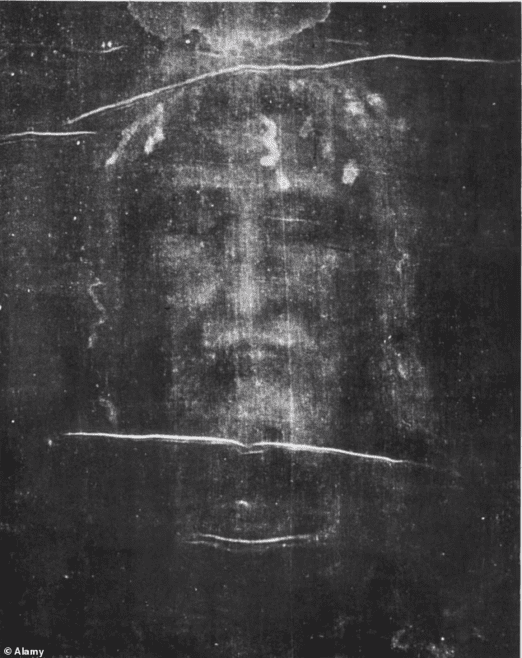
The Shroud of Turin features the image of a man with sunken eyes, which experts have analysed under different filters to study it (pictured)
The venerated piece of linen, measuring 14ft 5in by 3ft 7in, bears a faint image of the front and back of a man – interpreted by many as Jesus Christ.
Believers say it was used to wrap the body of Christ after his crucifixion, leaving his bloody imprint, like a photographic snapshot.
Despite repeated ‘hoax’ claims, a scientist is now convinced that the object really did wrap Jesus – and says there’s an ‘enormous quantity of evidence’ to prove it.
Professor De Caro told The Telegraph: ‘If I had to be a judge in a trial, weighing up all the evidence that says the shroud is authentic and the little evidence that says it is not, in all good conscience I could not declare that the Shroud of Turin is medieval.
‘It would not be right, given the enormous quantity of evidence in favour of it.’
Professor De Caro’s recent x-ray study that found the Shroud of Turin does indeed date back 2,000 years – to around the time Christ lived and died.
We also know from the Shroud of Turin Research Project (STURP) in the 1970s and 1980s that the holy fabric was indeed stained with blood.
The STURP found that the stains have traces of hemoglobin – the protein in red blood cells that delivers oxygen.
The stains also gave a positive test for serum albumin, the most abundant protein in human blood plasma.
In 1981, in its final report, the STURP team wrote: ‘We can conclude for now that the Shroud image is that of a real human form of a scourged, crucified man.
‘It is not the product of an artist.’
So until his new study, ‘the only missing piece of the puzzle was dating’, Professor De Caro told MailOnline.
He said that everything on the shroud is ‘highly correlated to what the Gospels tell about Jesus Christ’ and his death.
The cloth appears to show faint, brownish images on the front and back, depicting a gaunt man with sunken eyes who was about 5ft 7in to 6ft tall.
Markings on the body also correspond with crucifixion wounds of Jesus mentioned in the Bible, including thorn marks on the head, lacerations on the back and bruises on the shoulders.
Historians have suggested that the cross he carried on his shoulders weighed around 300 pounds, which would have left bruises.
The Bible states Jesus was whipped by the Romans, aligning with the lacerations on the back, who also placed a crown of thorns on his head before the crucifixion.
Research in the 1980s appeared to debunk the idea it was real after dating it to the Middle Ages, hundreds of years after Christ’s death – suggesting it was an elaborate medieval hoax.
Professor De Caro and his team at the Institute of Crystallography in Bari, Italy used a technique called wide-angle X-ray scattering (WAXS) on a tiny sample from the shroud, smaller than a grain of rice.
WAXS can date ancient linen threads by ‘inspecting their structural degradation’ at a microscopic level.
Part of the analysis looked at the linen’s cellulose patterns, the long chains of sugar molecules linked together.
These sugar molecules break over time, showing how long a garment or cloth has been around.
Based on the amount of breakdown, the team determined that the shroud was kept at temperatures of about 72.5°F and a relative humidity of around 55 per cent for 13 centuries before it arrived in Europe.
If it had been kept in different conditions, the aging would be different.
Researchers then compared the cellulose breakdown in the shroud to other linens found in Israel that date back to the first century.
They concluded that the structural degradations were ‘fully compatible’ with those of the other linen sample – dated, according to historical records, to AD 55-74.
The team also compared the shroud with samples from linens manufactured between 1260 and 1390 AD, finding none were a match.
The new findings lend credence to the idea that the faint, bloodstained pattern of a man with his arms folded in front were left behind by Jesus’s body.
They also contradict findings in the 1980s that the shroud dates back nowhere near as far as the time of Jesus.
At the time, researchers analysed a small piece of the shroud using carbon dating and determined the cloth seemed to have been manufactured sometime between 1260 and 1390 – during the medieval period.
However, the authors of the new study claim carbon dating would not have been reliable because the fabric has been exposed to contamination through the ages that cannot be removed.
What’s more, there is no way to explain how it could have been forged with medieval technology.
‘While authenticity cannot be established, it should be fairly easy to determine if it is a medieval forgery,’ said Tim Andersen, research scientist at the Georgia Institute of Technology who was not involved with the new study.
‘Yet, despite decades of scientific testing and peer-reviewed articles on it, that conclusion has never been demonstrated.
‘Rather, the evidence has continually pointed away from any known forging
Pacific and Māori leaders say there is a need for community-driven health campaigns to address growing inequities in bowel cancer diagnosis and survival.
Photo: Supplied / edited RNZ / Bowel Cancer NZ / Waikato District Council
Earlier this month, the Government announced the end of a pilot programme that allowed Māori and Pacific people to access bowel cancer screening starting at from age 50, effective 5 December.
Health organisations were informed of this decision, which the Māori Cancer Leadership Network condemned as shocking, citing the disproportionate high bowel cancer death rates among Māori and Pacific communities.
However Tilly Turner, a Māori ward councillor, found the news unsurprising.
“Who’s the first one [that] they cut? Us. They’re cutting back on all of these things to do with Māori development or Pasifika… so I’m not at all surprised. It’s just going to be: keep cutting.”
Turner, the Tai Runga Takiwaa Māori Ward Councillor for the Waikato District Council, shared her concerns.
As a bowel cancer survivor, she described how early detection saved her life after she experienced a blackout during a flight that led to her diagnosis in 2013.
“I had no idea that that’s what was going on in my body. If I didn’t fly they would not have known. I just blacked out on the plane and it happened to be that I had bowel cancer,” she said.
“They found it fairly quickly, at a stage where I had to have quite a bit of my intestines cut out. And closer to the bowel. So they took that out and stitched me up, and I’ve been good since.”
“Far too many Māori and Pasifika are dying that could have a fighting chance if they were screened from 50,” Bowel Cancer NZ medical advisor professor Sue Crengle said. Photo: Supplied/Ministry of Pacific Peoples
Turner encouraged everyone to get tested.
“What we need to do is just make sure that we get out, you know, if you belong to a Hauora of sorts, that you get those tests done, you know?
“Now, because before that education, we didn’t even know how to test. I had no idea that that’s the way that you could test. And I didn’t even know that I was suffering from it until after I was blacking out, and it was just by chance.”
Photo: Supplied/LDR
Turner had no symptoms.
“There was nothing else other than from a child, I have always experienced quite a bit of constipation throughout my lifetime.
“But that was my norm. And so that was just the way it was with me. And so, nothing different. I didn’t see any blood in my faeces or anything, you know, anything like that.
“It was just went up on a plane, blacked out on a plane. I don’t know what that was all about.”
She said bowel cancer is not often discussed, but as a survivor, she felt it’s her responsibility to urge her family to get tested.
“Because I’m a survivor, I see it as my responsibility to make sure my daughters, my family and my community get tested by a certain age.”
“It comes down to each local hauora in each region to ensure a campaign. If the government won’t do it, we have to.”
Turner stressed the importance of community action.
“We’ve been educated enough to know how important this is. If we want to keep our families safe, this has to be part of our conversations.”
Hei Āhuru Mōwai, a national organisation focused on improving cancer care for Māori, described the Government’s decision as poorly informed and devastating for whānau.
The 50+ screening pilot in Waikato diagnosed six people with cancer and led to the removal of numerous precancerous polyps.
Without the pilot screening would not have started until age 60, leaving these cancers undetected and reducing survival chances.
Photo: Supplied/Ministry of Pacific Peoples / Hei Āhuru Mōwai
CEO of Hei Āhuru Mōwai Gary Thompson called for a pause on the decision, citing it’s conflict with current medical evidence and the lack of notice, which left no time to assess it’s impact or inform providers and whānau.
“Returning to the 60-year age limit for Māori and Pacific peoples means that the bowel screening programme will increase inequities in bowel cancer incidence, survival and death rates between Māori and non-Māori,” he warned.
“It will harm Māori and Pacific peoples and worsen the 7-8-year life expectancy gap.”
Photo: Supplied/LDR
Doctor Rawiri McKree Jansen explained that most Māori diagnosed with bowel cancer were under the age of 60, compared to just under a third of non-Māori.
“Bowel screening detects small, potentially curable cancers and prevents cancer by removing precancerous polyps.
“Both Māori and non-Māori have a similar chance of getting bowel cancer, but over half of Māori who get bowel cancer are diagnosed before the age of 60 years (58 percent in females and 52 percent in males).
“This is compared to just under a third for non-Māori (27 percent in females and 29 percent in males).
“For non-Māori, three-quarters of people are diagnosed over the age of 60. Keeping bowel screening available to Māori and Pacific peoples from age 50 would make the national bowel screening programme fair.”
Additionally, Māori bowel cancer rates were on the rise, while non-Māori rates were decreasing.
CEO of Bowel Cancer NZ Peter Huskinson expressed his disbelief at the abrupt cancellation of the programme, especially without a formal statement in the House.
“This decision will mean unnecessary suffering and deaths among Māori and Pacific communities – deaths that could have been prevented with proper screening at the right age,” he said.
Medical advisor for Bowel Cancer NZ professor Sue Crengle said, “More Māori and Pasifika bowel cancer is diagnosed before age 60 years.
“As a result, these groups had less opportunity to benefit from bowel cancer screening than other ethnic groups.
“Starting screening for Māori and Pasifika people at age 50 years mean’t the benefit from the programme was equal across all ethnic groups. It would be incredibly disappointing if this has been stopped.”
Turner stressed the importance of empowerment and community action.
“We can’t do anything about what the government is doing, but it’s up to us to be responsible for our health. Make it an annual thing as part of your hauora check.”
Hei Āhuru Mōwai recommends that bowel screening starts at age 50 for Māori and Pacific peoples.