Wild weather, including severe gales and downpours, swept from the west across much of the North Island overnight.
A woman has difficulty holding an umbrella from strong winds in rainy weather. Photo: 123RF
The wet northerly was still hitting eastern Bay of Plenty on Monday morning, an orange severe rain warning remaining in place for the region.
Fire and Emergency said there were no major weather-related callouts anywhere overnight.
About 230mm of rain fell on Kahurangi National Park in west Tasman. Other South Island locations including Arthur’s Pass and Rai Valley in Marlborough saw up to 130mm.
“It was definitely a very wild night compared to that really settled spell of weather we had last week,” meteorologist John Law told RNZ’s Morning Report.
“I think for most people when they wake up this morning across the North Island, they’ll notice how incredibly warm it is as well.”
Law said most of the warnings had expired, with the rain moving east.
“The final few areas… are still catching that front just that runs through places like the Eastern Bay of Plenty, and we will keep hold that severe weather warning there through to around about 11am, just so that rain just taking its time just to clear away, out towards the west.
“But generally things should get a little bit better as we head through the daytime.”
Temperatures will get up to around 17C in Auckland, Law said, after an “incredibly warm” morning for mid-June.
“I think it is going to stay pretty humid through [the] daytime. Still some more showers as we head through the day, and this week generally a much more unsettled story than the weather we saw last week.”
Down south, snow was a possibility in higher parts of Southland and Otago.
“So it’s a real mixed bag across the country – [you] don’t need your winter woollies today, but maybe from tomorrow I think we don’t need them across the North Island, but down south, I think keep an eye on that forecast.”
Later in the week, MetService is forecasting potential heavy rain on the west coast of the South Island, particularly in the far south and Marlborough, on Thursday.
By Friday, there could be gale-strength winds across the North Island and upper South Island.
A burglar and a man who received stolen goods from Tonga National Museum have been jailed.
The sentencing came after Siosaia Taulahi, 21, and Soane ‘Anitoni, 14, pleaded guilty to counts of serious house breaking and theft after their arrest in March 2023.
They both admitted to breaking into the museum and stealing the valuable handicrafts.
Taulahi and Anitoni gave the stolen items to a co-defendant Tevita Pasi in exchange for methamphetamine.
Mr Pasi was consequently charged with handling the stolen goods and supplying an illicit drug.
According to the Supreme Court decision, Mr Pasi was sentenced to six years and four months’ imprisonment with the last two years being suspended for two years on conditions. The length of his sentence was increased to reflect the fact that he manipulated two younger people to commit these offences, particularly Anitoni who was a child of 14 years old.
Mr Taulahi was sentenced to four years and four months’ imprisonment, with the last two years being suspended for two years on conditions.
Justice Cooper backdated their sentences to start from the date they first went into custody.
Mr Cooper also took into account their early guilty pleas and they did not have previous convictions. They also cooperated with the Police.
The court was told that during the course of the investigation, it was discovered that in February 2023 Ms Milika Pamana, the manager of the museum became aware that the Facebook page of Roselyn Mafikaunanga Tofavaha, who lives in New Zealand, was advertising some of those stolen museum pieces for sale.
When police investigated, they were informed that Mrs. Tofavaha and her husband Lataimuli Vaka had purchased those items from the Talamahu market before selling them in New Zealand.
The following month the police recovered one ta’ovala and two kato.
The investigation led police to Tevita Pasi and his wife. The information they received was that Tevita and Samoana Pasi had received the stolen handicrafts. When they went to their residence, they recovered more of the stolen items.
The court was told that the total value of the items was TOP$231,700.
In an interview with Police on 17 April 2023 Mr Pasi admitted meeting with both Taulahi and ‘Anitoni, taking the stolen items from them in exchange for a gram of methamphetamine.
The court was shown evidence of ransacking or vandalism caused during the break in.
Photographs of the scene showed that in five areas of the museum, graffiti tags were sprayed on the walls floor and a door, in one case using a marker pen.
The museum was assisted by the Ministry of Tourism in restoring this damage.
The cost of that to the Ministry was $1,067.94.
Mr. Taulahi admitted to police that he caused the vandalism.
“This was a break-in at a museum and the items belonged to various collections where the owners felt that their properties were being kept safe and are being preserved. The items that were stolen were very valuable and had sentimental value, hence it is kept in a museum”, the court document said.
Most of the items were never recovered by the Police.
In a victim impact statement Ms Pōmana lamented the loss of the artefacts, tradition and culture.
The court was told, the incident made her feel guilty especially when thinking about the people who lent their artifacts to the museum and put their trust in her.
“There is no say about the mental distress, the emotional distress, and the spiritual stress that I experienced since the day this despicable incident occurred, and that is one of the reasons why I do not wish to talk about what happened because I experience a lot of hurt ever since it happened. I am still scared going to the museum by myself, especially the room where the items were stored.”
Analysis – On his first Pacific trip as prime minister, Christopher Luxon celebrated international relationships, focused on trade and business, and threw in a few ‘bald’ jokes too.
Christopher Luxon with his wife Amanda (right). Photo: RNZ/Giles Dexter
A trip to the Pacific is an easy way for a prime minister to get some space.
With a backdrop of coconut trees, beaches, and harbours at his press conferences, Christopher Luxon could re-route any difficult post-Budget questions towards his ministers back home.
Luxon says he returns from his first Pacific mission to Niue and Fiji excited and inspired, having ticked off everything he wanted to achieve: renewed friendships, some meaningful investment, and more targets set.
These were not places where a New Zealand prime minister could expect to receive a welcome anything less than warm.
These are not trips where the prime minister can expect to face particularly tough challenges. Instead, they are heavy on the vibe.
When asked what his main takeaway was, Luxon said he was “really excited about the Pacific region and the potential of it, now we’ve got to all work together and make it happen”.
The trip allowed Luxon to put some runs on the board.
He made a point that he had already spoken to many Pacific leaders as they passed through Auckland, or over Zoom. But this was the first chance to stand next to them and share their visions for the next stages of the relationship.
Luxon frequently shared jokes with the other leaders in the middle of press conferences, or some good-natured sport ribbing – usually at his own expense, or at the Crusaders’.
A celebration of 50 years of Niue’s free association with New Zealand allowed for reflection and future planning, with a commitment to help the island nation transition to renewable energy.
His visit to Fiji saw the setting of a trade goal, and then a full day to get out and sell it to businesses.
The thorny issues were pushed aside, left for later, and addressed if not quite answered.
Luxon’s approach to foreign policy is to secure commitments around trade and enterprise. He sees the Indo-Pacific as the main area New Zealand should focus on, and believes that if New Zealand can make tangible contributions to another country’s economy, then that will give it the edge when other countries come knocking.
At times, it felt like a return to the campaign. In fact, that was often the point.
Luxon would frequently greet people, including senior ministers, with a “there he is” or a “hello, I’m Chris,” asking about their day and, particularly with other bald men, asking whether they shared the same barber.
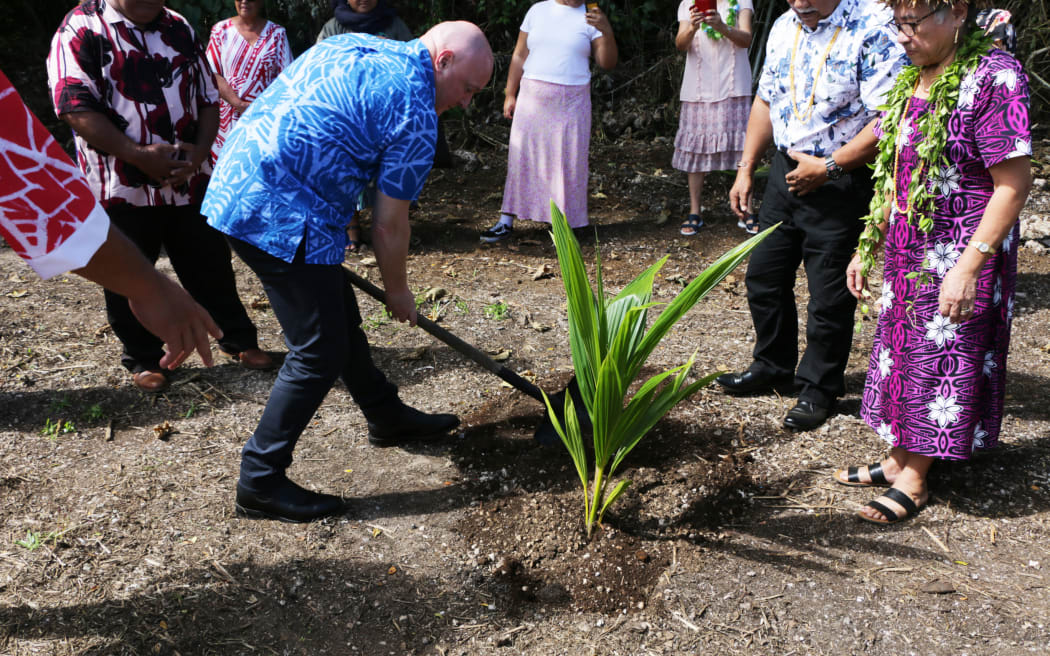
Christopher Luxon planting a coconut tree in Niue. Photo: RNZ/Giles Dexter
A community lunch at a village in Niue, attended by Sir Michael Jones, allowed Luxon to cut loose and dance, while Niue’s Speaker Hima Douglas, a man of many talents, led the band.
The motorcade route from Suva’s airport to the sevusevu ceremony was dotted with enormous billboards of Luxon’s face, welcoming him to Fiji. There was some thought around whether the prime minister, who is teetotal, would partake in the kava, but he drank it with aplomb (and a grimace).
A visit to Tower Insurance ended with the entire floor of identically dressed call centre operators getting up and revealing they were also a choir.
So focused was Luxon on the handshakes and waving that at one point, after the Tower visit, he greeted his own wife, who was accompanying him on the job for the first time overseas, with the same “hello, nice to see you” cadence he had said to everyone else all morning, before quickly realising.
But the trip was also about reminding other countries investing in the Pacific that Luxon sees New Zealand as the dominant partner.
China may have contributed to Niue’s roads and the government vehicles driving on them. But Luxon saw investment in Niue’s energy as its most pressing need, with New Zealand donating $20.5 million to ensure 80 percent of Niue’s energy is renewable.
While he believes it sends a message that New Zealand is the Pacific’s partner-of-choice, some in Niue were agnostic of where the money came from, as long as it came.
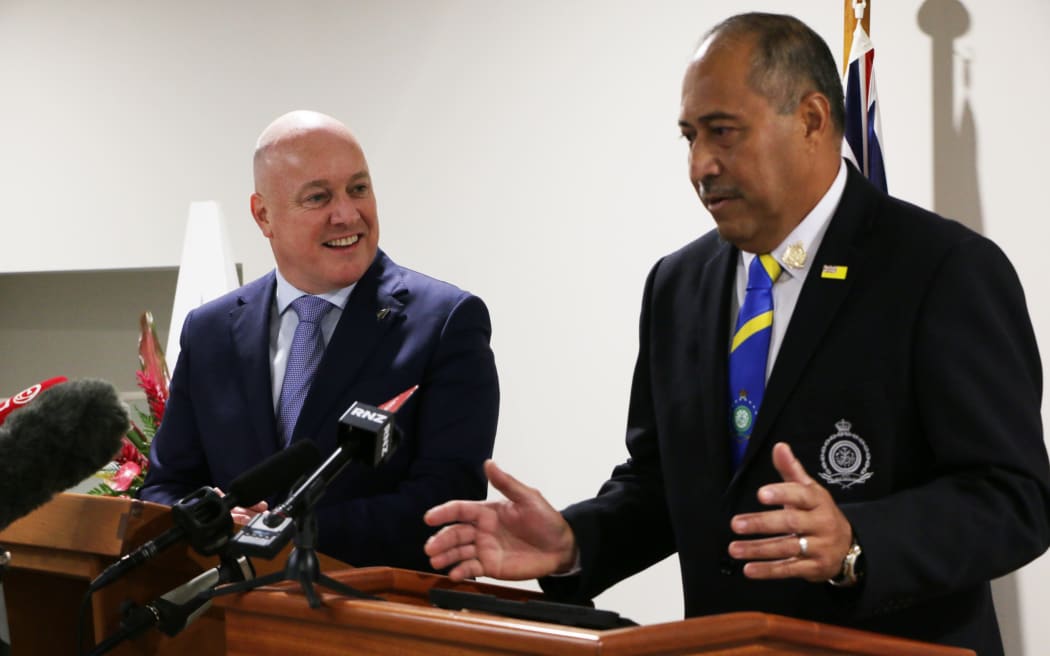
Christopher Luxon and Niuean PM Dalton Tagelagi. Photo: RNZ/Giles Dexter
Niue Premier Dalton Tagelagi acknowledged that Niue was trying not to be so reliant on New Zealand for support, and was friends with everyone.
So resolutely committed to targets back home, Luxon is also setting them overseas.
Talks with Sitiveni Rabuka led to a target of $2 billion in two-way trade by 2030. Luxon said Fiji had demonstrated a desire to boost other sectors and not rely solely on tourism, and he then used every chance he got to sell that message.
A speech to Fijian and New Zealand business leaders in Nadi saw the two leaders in lockstep. As Rabuka talked of his government’s commitments to cutting red tape, Luxon, sat a few metres away, nodded and smiled. His own speech minutes later also spoke of removing red tape.
Speaking after the conference, Luxon said he felt very aligned with Rabuka.
“The challenges that Fiji encounters and the challenges we have at home, we’ve all got to deal with and face up to as leaders and find pathways to take it forward,” he said.
“We do feel we’ve got a good partner here. And I think they feel the same way about us.”
There will be plenty of countries on future itineraries where Luxon faces stronger challenges from leaders less aligned.
Luxon was also keen to highlight the centrality of the Pacific Islands Forum in any discussions around overseas investment and the influence of other nations, and that regional challenges require regional solutions.
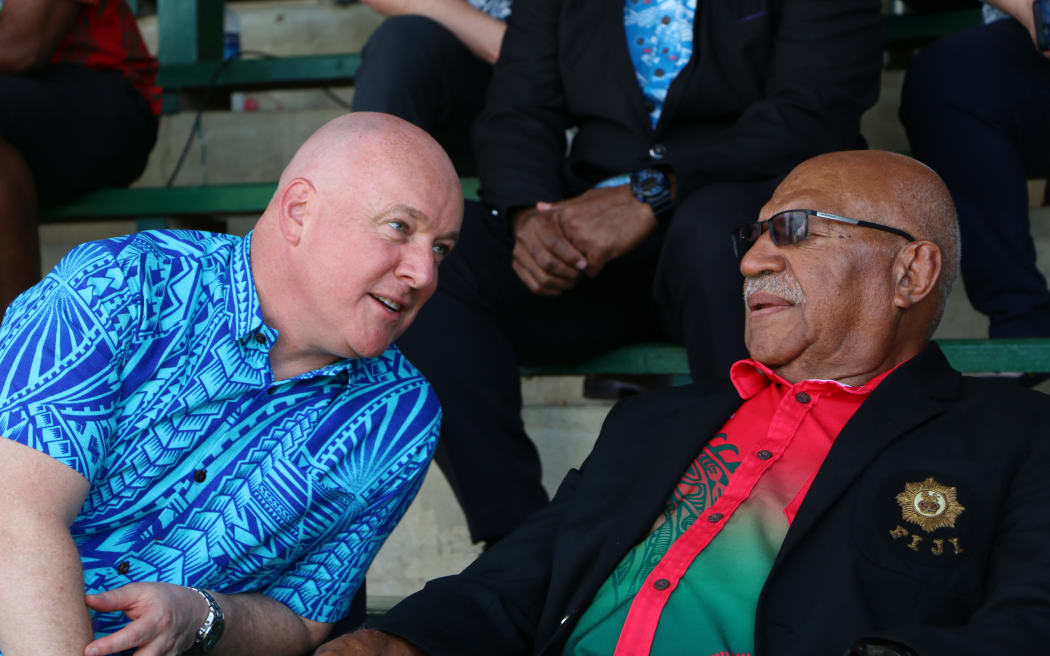
Prime Minister Christopher Luxon watching a Sevens game between the NZDF and Fiji DF, with Fiji PM Sitiveni Rabuka. Photo: RNZ / Giles Dexter
Questions on the influence of China and the US in the Pacific, or the willingness of New Zealand to explore joining the non-nuclear part of the AUKUS agreement, were given the same answers Luxon gives back in New Zealand (an answer from Rabuka that Fiji would actually be in favour of AUKUS was later backtracked with an explanation from his press team that the prime minister had not understood the question).
“My conversations with all major power countries that have come into the region, whether it’s been the US, China, France, EU, UK, India, Japan, has been, look they are all fantastic aid partners and development partners for many of the Pacific island nations,” Luxon said.
“But it’s just important that they come through the front door and work with PIF, given that’s a very important body that I want to see esteemed and actually managing the affairs of the Pacific.”
Some other pressing needs, such as drug trafficking through Fiji, or going further on visas, were addressed with a promise to do more, but no funding or timelines.
In fact, some of the thorniest issues of all to deal with were left just a couple of hours before his final flight back to Auckland.
After news of Australia’s changes to immigration policy, a stand-up was hastily organised, with Luxon explaining he was not given a heads-up and regretted the stance Australia had taken.
Then, shortly after, with the media delegation already on the plane and about to turn on flight mode, the Electoral Commission revealed it had referred National MP David MacLeod to police over his failure to report donations.
Welcome back to New Zealand, prime minister.
Back to the winter chill, and back to the tough talks.
A prisoner who is serving a life sentence after sending illicit drugs to New Zealand, has failed in his effort to have the sentence overturned.
Nomani Kama Manulevu
Nomani Kama Manulevu, 46, was sent to jail for the unlawful exportation of 29.7kg of methamphetamine that was concealed in a refrigerated container to New Zealand in 2021.
He is the first person to receive a mandatory life sentence under the kingdom’s new amendments to the Illicit Drugs Control Act introduced in December 2020
The Court of Appeal declined Manulevu’s appeal, saying there was no risk of a miscarriage of justice.
“A matter being proved “beyond reasonable doubt” and the jury being ‘sure’ of it, were used interchangeably, as synonyms. This ground of appeal is not established”, the recent decision said.
Justice Cooper sentenced Manulevu of Nukuhetulu to life imprisonment after he was found guilty by a jury on 10 August 2023.
“The new provisions provide that a person convicted of importing or exporting a class A illicit drug such as methamphetamine or cocaine, above a certain weight, will receive a mandatory life imprisonment sentence”. Mr Cooper said at the time.
In July 2021, the New Zealand Police and Customs located methamphetamine in a container from Tonga.
Manulevu was responsible to its owner for loading it. He was asked by the director of the operation, Ronnie Kivalu to retrieve two bags from a house at Tatakamotonga and load them into the container.
Manulevu’s admission to the house was facilitated by contact from Ronnie Kivalu’s wife Jessie Forbes to the occupier Sione Ongolea. He admitted Manulevu and Manulevu retrieved the bags. They contained the drugs which ended up in the container.
The bags were in a locked room at the house. Manulevu unlocked the room and then locked himself inside. On the evidence of Sione this was for three minutes, before emerging with the two bags and locking the door behind him.
The Appeal Court said the only issue in the case was whether Manulevu was shown beyond reasonable doubt to have known that the bags he retrieved from the house contained illicit drugs of some description. It was a circumstantial case.
Manulevu’s lawyer, David Corbett, argued, among other grounds, that the Judge was misleading the jury in the summing-up when he said: “Put all the evidence together and you can be sure he knew there was some form of illicit drugs when he put them in the container”.
However, the Court of Appeal said: “In no way was the Judge misleading or overbearing the jury”.
A man attempting to overturn his conviction for rape and assault has failed to convince the Court of Appeal that a trial judge wrongly influenced the jury.
Siotame Hafoka was convicted of rape, and two counts of indecent assault, at the Nuku’alofa Supreme Court in 2022,
Hafoka appealed on the basis that the sexual activity did occur but was consensual.
The court was told that the complainant wished to arrange a loan. Her parents suggested she approach Hafoka. She did so, with prepared documentation.
At his workplace, Hafoka locked the door, and forced her to the back of the shop, where he licked her vagina and raped her.
She escaped on a pretext and went straight to the Central Police Station. She was then too distressed to give a statement but was examined at the hospital.
Her first statement was taken the next day, 3 March 2022.
Hafoka then handed himself in to the police. He gave a comprehensive account, claiming the encounter was consensual.
He subsequently offered the complainant money by way of apology and requested she drop the charges. She at once reported this to the police.
Hafoka’s interview was followed by his being charged with rape and indecent assault.
The charge sheet is in Tongan, with a caution in Tongan and English. It was attached to the record of interview, in which Hafoka said that the sexual activity was consensual.
On the charge sheet, following the caution, he wrote “Io Mo’oni”. The prosecution contended that was an acknowledgment of the truth of the charges.
The defence position was that he was acknowledging the truth of the record of interview in which he denied lack of consent.
In their decision, the Appeal Judges said:
“It remained for the jury to determine the verdict.
The grounds of appeal are not established and we do not perceiveany material risk of a miscarriage of justice. The appeal is dismissed”. .
The Electoral Commission has handed investigation of National MP for New Plymouth David MacLeod’s failure to report $178,394 in donations to police.
In a statement on Friday, the Commission said MacLeod’s original candidate return for the 2023 General Election on 13 February 2024 disclosed $29,268 in donations from seven separate donors.
David MacLeod Photo: RNZ
“On 20 May 2024, the Commission received an amended return. The total donations disclosed in the amended return are $207,662 from 24 separate donors.”
He said he thought the return he was filing was for the 2023 year only, so left out 18 donation he had received when he became a candidate the previous year.
He also failed to disclose a $10,000 donation from 2023, which he said was a mistake he could not explain.
He said he “always fully intended for these donations to be made public” and had never tried to hide them, having written to all donors indicating amounts over $1500 would be disclosed.
The Commission confirmed the matter had been referred to police. It previously said this would be done “if in our view there has been a breach of the Electoral Act”.
“As this matter is now with the Police, the Electoral Commission will not be commenting further.”
Police will now investigate whether laws were broken, and consider any possible prosecution.
If it is won by a single person, it will be the largest prize in Lotto’s history.
Lotto head of corporate communications Lucy Fullarton said no matter what, the jackpot would not roll over.
“Well our game rules say that if the jackpot gets to $50m it can’t rollover – it has to be won that night,” Fullarton said.
“So if it’s not won by a single ticket – if no one single person gets all seven numbers right – then it rolls down to the next division and if it’s more than one person it’s shared equally between them.”
It is only the third time a must-be-won draw of $50m had been reached.
Tickets were selling well, Fullarton said.
“It looks like we’re on track to have about two million sold for Saturday’s draw, which is a lot more than we sold on Wednesday … 1.7 million.”
The first Powerball $50m jackpot was struck in February 2020, when two winners won $25.1m each.
Another $50m must-be-won draw then took place six months later in August 2020 with the prize rolling down to Powerball Second Division.
It was shared by 10 winners, who each received $5.02m.
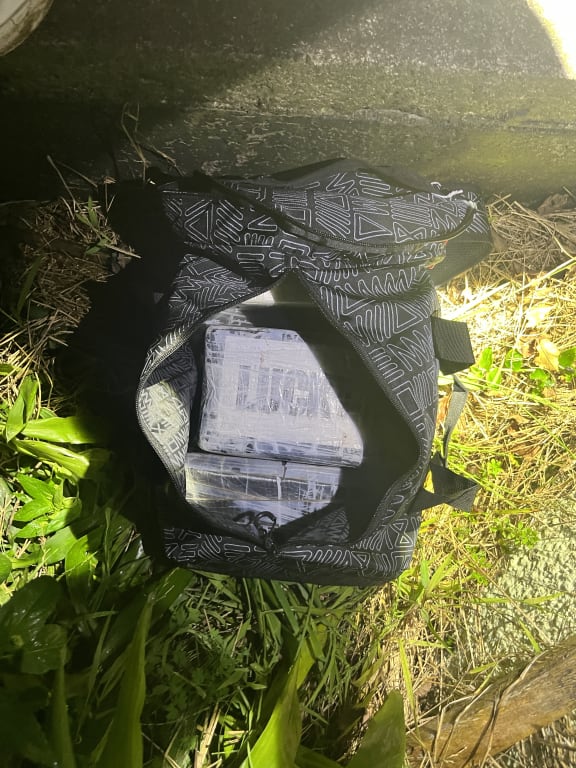
The drugs seized by police. Photo: Supplied / Police
Two men who allegedly flew to New Zealand from Australia to pick up $7.65 million worth of cocaine have been arrested.
Detective Inspector Tom Gollan said the men were found on 1 June at a commercial address in Auckland’s Onehunga.
They were arrested after they allegedly attempted to break into a container where 17 kilograms of cocaine had been placed.
Gollan said the men were believed to be members of an organised crime syndicate and that they only came to New Zealand to pick up the drugs.
One man is an Australian national while the other is New Zealand-born but living in Australia.
Gollan said they were arrested as they left the container yard on electric scooters.
The drugs were concealed in a container, police say. Photo: Supplied / Police
“They left behind a ladder they had transported to the yards by way of the scooters.
“Both men, aged 33 and 42, have since been charged with burglary and the possession for supply of cocaine.”
An investigation has shown the container made its way to New Zealand from Brazil, having transited through Brisbane in Australia before arriving at the Port of Auckland in late May.
Police said the value of the cocaine was $7.65m but it was not known if it was meant for the New Zealand or Australian market.
“This is the 26th TNOC Operational Cell that has been identified and dismantled since 2017,” Gollan said.
“It is disconcerting to see overseas transnational organised groups insert their people into New Zealand to facilitate these crimes and demonstrates their willingness to profit from community misery.
“While these TNOC groups continue to evolve and adapt their offending to avoid detection, but so do we, and yet again we were one rung ahead of them.”
Customs manager Dominic Adams said the “successful seizure” showed partner agencies like police and Customs are always one step ahead of criminal groups.
“We are ever-vigilant to stopping the harm that dangerous substances such as cocaine can cause our communities.”
The two men have appeared in the Auckland District Court and will next appear on 25 June.
A house has been shot at in Auckland’s Onehunga, while there was also a second gunfire incident in Māngere East overnight.
Photo: RNZ / Finn Blackwell
Officers were called to reports of gunfire on Haddon Street in Māngere at about 11pm.
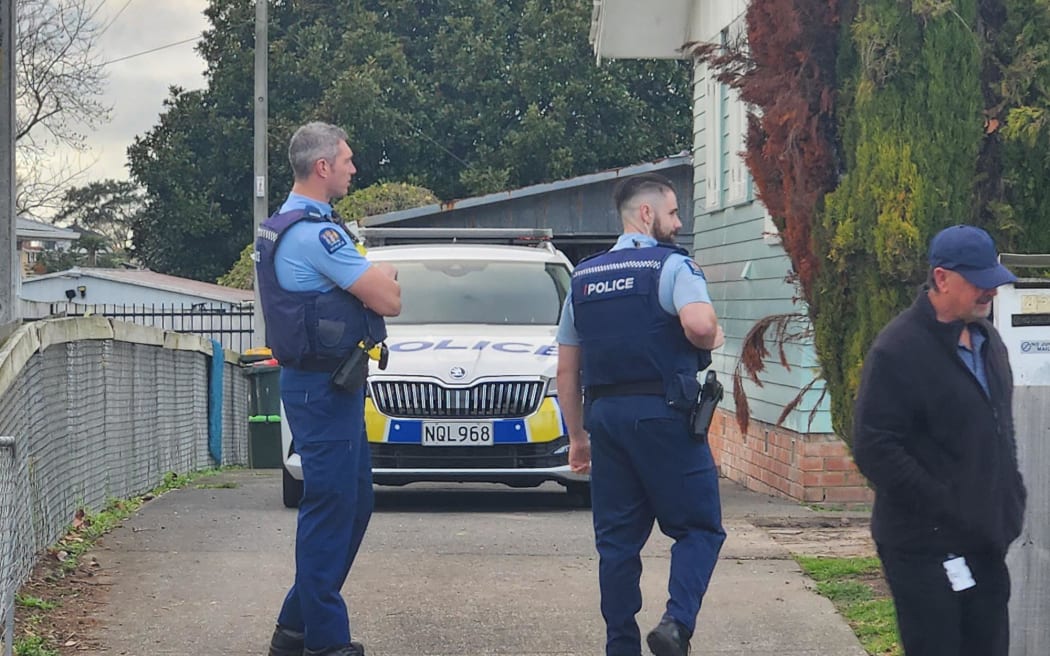
There is a large police presence at the scene this morning, and a number of bullet holes can be seen in the window of the house.
A nearby resident said the shooting had come out of the blue and was worrying, especially for those with children.
“It’s a worry what’s happening in the community,” he said.
Police say no injuries have been reported, and anyone with information should get in contact.
Police at the scene in Māngere this morning. Photo: RNZ / Finn Blackwell
It was the second shooting at an Auckland property overnight, with another house shot at in Onehunga earlier in the evening.
Officers were called to an an address on Ahuwhenua Crescent after receiving reports of gunshots about 10.30pm.
“Thankfully, no injuries have been reported in relation to this matter,” Detective Senior Sergeant Martin Friend of the Auckland City crime squad said.
The suspected offenders had left the area before officers arrived on the scene.
However, police were following leads “which includes reviewing a significant amount of available CCTV footage in and around the area”.
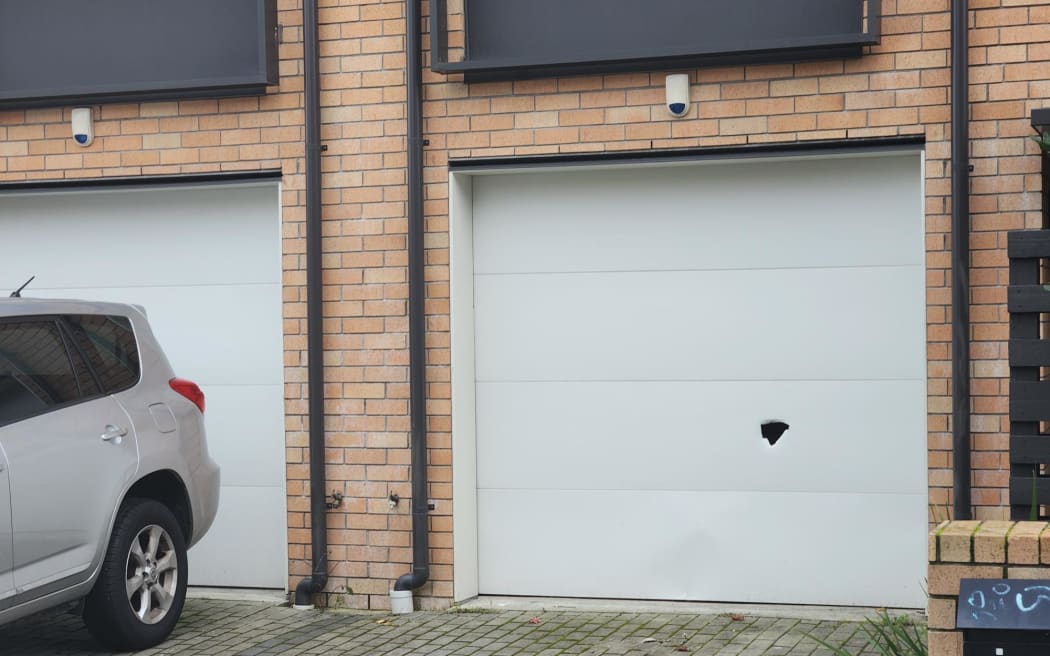
An RNZ reporter at the scene could see an apple sized hole in the garage door of one of the apartments.
The apartment that was shot at. Photo: RNZ / Finn Blackwell
Neighbour Dani was visiting her sister at the time of the incident.
“There was a massive bang like a massive shot. At first we thought it was just like metal or something like that but once we came outside the neighbours came up and said there were men with rifles who had shot through the garage of next door,” she said.
Her sister had lived at her house for two years and nothing similar had happened before.
Another resident said it was usually a very quiet area.
There would be more officers in the area during the day, Friend said.
There are also reports of a second incident involving gunshots occurred in Haddon St in Māngere East shortly after 11pm.
An RNZ reporter at the scene said stickers on the windows show where the gunshots had hit the house.
Police have not commented on this incident so far on Thursday.
Police said they wanted to speak to anyone in the area or who had information.