Monday, April 6, 2026
Home Blog Page 193

Tongan economy came back after volcano and Covid says IMF, but major reforms are needed

The Tongan economy is rebounding strongly according to the International Monetary Fund. However, the IMF said the economic outlook was uncertain and urgent improvements needed to be made.

The IMF said Tonga had suffered from a major double shock in early 2022. After an estimated contraction of two percent, real GDP was estimated to have expanded by 2.6 percent in the financial year from July 2022-June 2023.

The support measures deployed in response to the Hunga Tonga‒Hunga Ha’apai volcanic eruption and tsunami and the local COVID-19 outbreak in January-February 2022, together with aid from the international community, reduced the impact of the socioeconomic fallouts. Recovery after the eruption was driven by strong domestic demand and a pickup in tourist arrivals following once the border was re-opened in August 2022.

However, the kingdom still faced economic pressures. Inflation peaked at 14.1 percent in September 2022, but dropped to 6.6 percent in May 2023. The flow of  remittances was expected to drop from an estimated 44.2 percent of GDP in FY2023 to 39.7 percent in FY2024. Average inflation is projected to be 5.8 percent in FY2024.

The tsunami has also caused soil contamination.

The medium-to-long-term growth prospects are weak. Tonga’s long-term growth is projected at 1.2 percent, reflecting its exposure to increasingly frequent natural disasters, persistent loss of workers to emigration, and limited economies of scale due to geographical barriers.

Tonga’s limited productive capacity and strong foreign demand for Tongan workers have significantly increased inflation risks. A sharp increase in global commodity prices could reduce households’ real purchasing power.

The IMF has warned that Tonga is at high risk of debt distress . Without additional grant commitments to IMF staff’s baseline projection, the present value of public debt-to-GDP ratio is projected to remain above the 70 percent debt-distress benchmark starting in FY2033. This reflects significant development spending needs to achieve its climate resilience and Sustainable Development Goals (SDGs). Debt obligations are largely external, with over half to China Exim Bank. Debt repayments are expected to surge in FY2024, and stay elevated at over three percent of GDP until FY2027.

The IMF has warned that delays in reconstruction and persistently high inflation will incur substantial welfare costs, especially for low-income households and small businesses. The IMF said the Tongan government’s monetary policy should focused on safeguarding price stability and providing ample financial support to the vulnerable, while postponing non-urgent spending.

The government has phased out most pandemic- and volcano-related tax exemptions and plan to gradually normalize current spending, including by limiting the public sector wage bill. The government should also prioritize on the execution of budgets related to reconstruction and social protection.

To achieve the necessary fiscal adjustments, the government needed to reform revenue administration, spending efficiency, and transparency.  Reducing tax exemptions,  setting clear eligibility criteria and allowing the Minister of Finance to have the ultimate authority to grant exemptions would help deliver significant additional revenues and ensure that exemptions are adequately aligned with national strategic objectives.

Enhancing resilience to natural disasters and climate change is a top reform priority . The Disaster Risk Management Act of 2023 marked an important step forward in this regard. It aims to pivot the focus of Tonga’s disaster management frameworks to risk mitigation and preparedness, including by improving coordination across relevant ministries and management of scarce. Expanding the classification of climate change-related spending and strengthening the social protection system were other priorities. Stricter enforcement of the Building Code, especially for residential properties, and facilitating relocation to safer grounds would significantly contribute to enhancing disaster resilience, which should be supported by allocation of adequate fiscal resources.

Developing the private sector was critical to boost Tonga’s growth potential. Other important reform priorities included increasing government spending on education and training, especially to reduce the skill mismatch in the domestic labour market; reducing gender inequality in the labour market, by enacting the Employment Relations Bill which would help better protect women in vulnerable work environments and cutting red tape hindering private sector investment, especially by improving the efficiency of land leasehold administration.
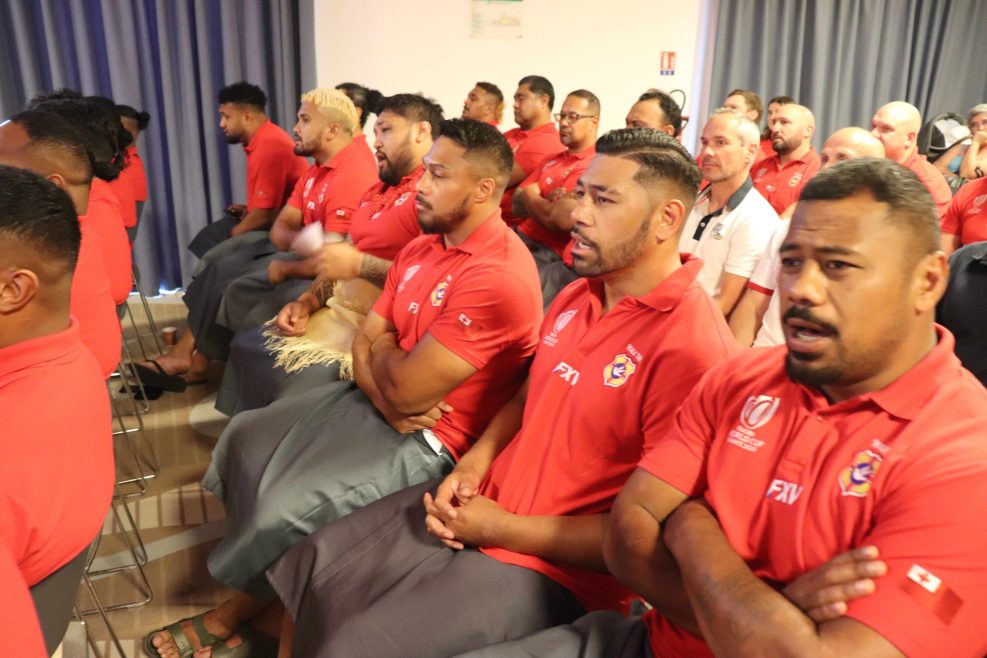
Outrage over Tonga players ‘no pay’ allegations  

Supporters of ‘Ikale Tahi national rugby team have been outraged after reports that players had yet to be paid for recent rugby union World Cup tours.

‘Ikale Tahi

Tonga was eliminated from the tournament after facing consecutive defeats from Ireland, South Africa, and Scotland – three of the top five nations in the rugby world.

However, it exited the competition on a high note by scoring seven tries in total in the game against Romania.

A post on Facebook this afternoon which tagged ‘Ikale Tahi number eight Vaea Fifita and others alleged the players were chasing their payment from  Tonga Rugby Union (TRU) authorities.

TRU could not be reached for comment.

“When could this be stopped,” a commenter asked in Tongan referring to several similar incidents of broken promises in the past following ‘Ikale Tahi previous tours.

The post by the person who went by the name Halaleva Fifita claimed the players had received “various unreliable versions of information” about when will they be paid from TRU.

It also alleged some players were furious about the incident.

Commenters blasted TRU officials about the allegations with some calling on ‘Ikale Tahi players to come forward and share their disappointment on social media.

As Kaniva News reported recently, Rugby World Cup star Charles Piutau opened up on how he and his Tonga team-mates had been forced to wash their own kits and practice with replica rugby balls ahead of the tournament in France, dramatically highlighting the stark contrast in resources between teams.

Tonga’s ‘Sabbath laws’ questioned after vessel allegedly departed Vava‘u this morning

A vessel has been reportedly departing Tonga’s Vava’u island group this morning Sunday 15.

MV Papa Mau. Photo/Vava Lapota

Neiafu Town Officer Vava Lapota has questioned whether the departure had breached Tonga’s Sabbath laws.

“Ko e mavahe atu eni a e vaka uta koniteina mei he uafu vahefonua Vavau ni pongipongi sapate fefe ae ngeia moe molumalu oe lao Sapate”, Lapota posted on Facebook in Tongan.

He also posted photos of the vessel, MV Papa Mau to Facebook.

Authorities could not be reached for comment.

According to the website vessel finder, the current position of Papa Mau is at South Pacific Ocean in the last two weeks.

The vessel is en route to Tonga’s main island Tongatapu, and expected to arrive there on Oct 15, 7am, it said.

“The vessel is a General Cargo Ship built in 1999 and currently sailing under the flag of Antigua & Barbuda”.

The kingdom’s Sabbath laws stipulate that transport services are not allowed to operate on Sunday.

In 2004 the Legislative Assembly rejected a submission that it drop a planned measure to allow some transport services to operate on Sunday, RNZ reported.

The bill was intended to allow aircraft flights, work in the Marine Department, and other related activities, on Sundays.

Seven church leaders presented a petition opposing the bill.

Court of Appeal throws out latest appeal by Lavulavu in long running school funding saga

The Court of Appeal has dismissed an appeal by Etuate Lavulavu to have charges against him dismissed because they constituted an abuse of process.

(L-R) ‘Etuate Lavulavu and ‘Akosita Lavulavu

The appeal was heard by Judges Randerson, Harison and Dalton .

In summarising the background to the case, the court was told that in 2003 Lavulavu and others founded a private education institute in Tonga. He was its president and, at all material times, his wife, ‘Akosita, was its director. From 2013-2015 the Institute obtained grants from the Ministry of Education and Training. The grants were later audited by the Office of the Auditor-General and irregularities were found. It was recommended that $553,800 be reimbursed to the Ministry and that the case be referred to the police for possible further investigation.

In March 2018 the Lavulavus were charged with three counts of obtaining money by false pretences contrary to Section 164 of the Criminal Offences Act. They were convicted after a trial before Judge Cooper. In July 2021 they were each sentenced to six years imprisonment with the final year of Mrs Lavulavu’s sentence suspended for two years on conditions. They remained in custody until bail was granted in September 2022.

Mr and Mrs Lavulavu successfully appealed against their convictions. On  October 10, 2022 the Court of Appeal quashed their convictions and ordered a retrial. The Court of Appeal said there was ample evidence to support findings of apparent bias on the part of the Judge, that the trial was unfair and that the verdicts could not stand.

However, the Court was satisfied that there was sufficient evidence to support convictions on a correct application of relevant legal principles. In November 2022 former Lord Chief Justice Whitten KC set a trial date, for May 8, 2023 if the Department of Public Prosecutions wanted  to proceed with the retrial. Shortly before the trial date the DPP filed an amended indictment which, among other things, invoked Section 8 of the Criminal Offences Act against Mr Lavulavu, alleging that he was guilty as a party rather than as a principal offender.

Mr Lavulavu then applied to have the charges against him dismissed on the grounds of abuse of process. In consequence, the proposed trial date was cancelled. On May 19, 2023, Lord Chief Justice Whitten dismissed Mr Lavulavu’s application. Etuate Lavulavu was given leave to appeal. His wife did not appeal.

If a new trial is to be held it is scheduled to proceed before a Judge sitting alone commencing next Monday, October 16, 2023.

In their summary of Etuate Lavulavu’s latest appeal, the judges said the appeal centred round two main questions, which were whether amending the indictment amounted to an abuse of process and whether there were any other grounds amounting to an abuse of process.

Mr Lavulavu submitted that the amended form of indictment constituted an abuse of process on several grounds, including that it amounted to a completely different charge.

However, the judges said that Lord Chief Justice Whitten had made it clear that the amendments did nothing more than give effect to the Court of Appeal’s decision, not changing the nature of the offence to be considered. The requisite element of section 164, for both Defendants in each count, of false pretences, remained unchanged.

Mr Lavulavu also raised numerous other grounds in support of his contention that there had been an abuse of process such that a fair trial could not be held. These included complaints that there had been an unjustified delay since he was first arrested; there had been improper manipulation or misuse of evidence; that evidence had been lost or destroyed and that there had been adverse publicity in the media.

However, the judges ruled that while the delay since the arrest of Mr and Mrs Lavulavu had been significant, none of the matters raised was so significant as to preclude a fair trial or to justify the allegation of abuse of process.

“Finally, we also reject the allegation that the Lord Chief Justice’s ruling was unfair and constituted apparent bias,” the judges said in their report.

“There is nothing in the extensive materials before us to suggest that the Lord Chief Justice was unfair in any way to Mr Lavulavu or exhibited any favouritism to the prosecutors. We have found his careful and thorough ruling to be correct in law in all respects.”

The appeal was dismissed.

Growing concerns for NZ Tongan church group trying to flee Israel amidst war

By Eleisha Foon of RNZ.co.nz and is republished with permission 

A New Zealand-based church group is attempting to flee Israel by bus with the help of the Tongan Consulate hours before the area they are sheltering in within Tel Aviv goes into lockdown.

The Tongan church group is made up of 45 people – mostly New Zealand citizens over the age of 40 and a 26-year-old woman.

RNZ Pacific spoke to a friend of the group who said this was “a crisis” and called on the Ministry of Foreign Affairs and Trade to provide a safe evacuation.

The friend who wished to stay anonymous to protect the group’s safety said: “If the NZ consul can’t get them out within the next 12 hours, a lockdown will imprison them in Israel for an indeterminate period.”

The concerned friend said a member of the group is battling cancer and is in need of medication.

The group was evacuated and are sheltering at a hotel 20 minutes away from where rockets are being launched.

RNZ Pacific was told by the friend: “The fear, uncertainty, and danger they face is beyond imagination.”

The Ministry of Foreign Affairs and Trade were made aware of the group’s situation three days ago, and the group was told to register to their website online and “wait on an update and response”. They are still waiting to hear from MFAT.

Meanwhile, the group were able to contact the Tongan government which has stepped up to help.

A member of the Tonga Consulate would be guiding the team out of Israel but there are concerns about a lack of funds to fly the entire church group back to New Zealand.

The friend of the church group discussed setting a Givealittle online crowdfunding page if NZ cannot come to the group’s aid.

“They have had to confide in the Tongan Consul, and had plans to fly out today but all commercial flights have been canceled until the 23rd of October.”

MFAT responded in a statement with advice to people attempting to flee the conflict by telling people to “use commercial opportunities to depart” Israel and “to register on SafeTravel for the most up to date information”.

Up to 54 members of the Connection City Church Assemblies of God travelled to Israel for a Holy Land tour, visiting historical Christian sites last week.

Meanwhile, members who were part of the same church cohort as the NZ Tongan church group arrived back in Fiji early this morning from Tel Aviv, Israel after the island nation sent a repatriation flight for hundreds of its citizens including Fijian government officials.

There are 245 New Zealanders registered on SafeTravel as being in Israel and 13 New Zealanders registered as being in the Occupied Palestinian Territories, according to MFAT.

An MFAT spokesperson said anyone that wants to leave Israel or the Occupied Palestinian Territories but can’t, should contact the New Zealand 24/7 Consular Emergency Line on +64 99 20 20 20.

Supreme Court grants leave to seek review of lack of debate over no confidence motion

The Supreme Court has granted leave for a group of opposition MPs to seek a judicial review of the decision of the Speaker of Parliament, Lord Fakafanua, to hold the vote of no confidence in the Prime Minister without debate.

Speaker Lord Fakafanua. Photo/Screenshot

However, Judge N.J.Cooper, presiding, refused  leave for the applicants to seek judicial review of Lord Fakafanua’s decision to allow unelected members to vote on the motion to proceed to the vote of no confidence in the Prime Minister without debate.

The application was supported by seven affidavits, each sworn on September 11, by MPs Dr. ‘Uhila-Moe-Langi-Fasi, Mateni Tapueluelu, Dr. Aisake Eke, Paula Piukala, Kapeli Lanumata, Dr Taniela Likuohihifo Fusimalohi and Mo’ale Finau.

The applicants were all signatories to a vote of no confidence in Prime Minister Siaosi Sovaleni, submitted to Parliament on  August 22 this year by Dr. Aisake Eke.

According to Hon. Tapueluelu’s affidavit the setting down of the vote of no confidence was in the prescribed form and was acknowledged to be so by the Chief Clerk to the Legislative Assembly.

The Chief Clerk to the Legislative Assembly issued a press release stating: “Notification will be issued of the date when the motion will be tabled with the Legislative Assembly; where it will be read out and debated before it is put to a vote.”

The vote of no confidence took place on September 6, 2023 without a debate. There had first been a vote held by the Speaker to proceed with the vote of no confidence without debate.

The applicants submitted that a debate was mandatory under the Rules governing the operation of Parliament and that the members had been promised 10 minutes each to debate the motion by the Speaker.

Not following the Rules in regard to the need for a debate was a breach of the Rules and clause 62 (2) of the Constitution.

Some of the Opposition MPs who submitted the vote of no confidence motion. Photo/Supplied

The applicants argued that the vote to not debate the vote of no confidence breached the Constitution because two unelected members of the government,  the Minister of Foreign Affairs and the Minister of Finance, were allowed to vote.

Judge Cooper said that where there had been a breach of the Constitution the Court was empowered to review and make such orders as was required pursuant to Order 39, Rule 1 of the Supreme Court Rules.

The applicants were therefore granted leave to apply for judicial review of the lawfulness of the Defendant’s actions in not debating the vote of no confidence in the Prime Minister.

Government has learned nothing from the past in its handling of Lulutai Twin Otter purchase

KANIVA COMMENT: The government’s purchase of a De Havilland Twin Otter has stirred up concerns among Parliamentarians about the level of transparency surrounding the deal.

Unfortunately, Tongans do not have to look very far to find  examples of previous governments not being completely open about major purchases. Sometimes, as in the case of the MV Niuvakai, the purchase has led to a major financial disaster.

Unfortunately, the government of Prime Minister Hu’akvameiliku does not seem to have learned any lessons from the past.

As we have said repeatedly, governments must not just do the right thing, they must be seen to do it. If they do not,  people may lose faith in the government if it cannot reassure them that it is acting properly.

If they do not, then people may fear that financial disasters like the one surrounding the purchase of the MV Niuvakai may be in danger of occurring again.

In the end the story of the government’s dealings over the MV Niuvakai came to light, but by then it was too late.

Readers will remember that the Tongan government bought the Niuvākai, then called the St Therese, in February 2014.

In 2019 the Ombudsman reported that a New Zealand-based marine surveyor had identified 17 deficiencies in the MV Niuvākai before Tonga’s national shipping line paid three times what the 34 year- old vessel was worth.

Former Ombudsman ‘Aisea H. Taumoepeau said that in February 2014, Pacific Royale Shipping sold the vessel  to the Friendly Island Shipping Agency for TP$1.5 million/NZ$936,500. 

The Ombudsman said FISA’s board had failed to conduct a proper evaluation of the vessel.

The vessel was bought because it was thought it could carry Tongan produce for sale in Fiji and Samoa.

However, there were not enough goods to export and the MV Niuvakai became a financial liability.

The vessel was unable to lift the 20 foot (six metre) containers typically used for shipping with its deck crane and was deemed to be unprofitable on voyages lasting more than three days.

The purchase of the 35 year old ship was surrounded by controversy, not least because it was surrounded by financial complications.

In March 2014 Kaniva News published details of an e-mail by former Finance Minister Lisiate ‘Akolo which revealed that the Tongan government had urged a potential buyer of the former St Theresa to help pay the owners’ loan with their bank in New Zealand.

The vessel was owned by the Ramanlal brothers, who were close friends of the late King George V.

‘Akolo asked Mosese Uele, director of EZI World Cargo in Auckland, to pay  10-15 percent in advance for the Ramanlals, as part of a settlement payment to their bank.

However, ‘Akolo later admitted the ship could only make a profit if it was restricted to voyages of three days.

Calculations based on the cost of fuel, operational costs and cargo carrying capacity meant it could only profitably sail to neighbouring countries like Fiji, Samoa and American Samoa, Niue and Wallis and Futuna.

The Friendly Islands Shipping agency created a new company called Tonga Exports Shipping Agency Limited (TESAL) to operate the MV Niuvakai.

FISA’s former CEO, Vaka Utapola Vi, told Kaniva News in 2014 that FISA only bought the former St Theresa because the price of  other ships they looked at, including one in the Caribbean, were  either too high or because it would have cost too much to bring them to Tonga.

When he was told a company in Auckland had turned down an offer to purchase the ship because it would lose money on voyages lasting longer than three days, Vi said FISA had tested the ship and he had recommended it.

The MV Niuvakai had had a troubled history since being bought by FISA.

In 2015 it was anchored in Vava’u for a month because of a mechanical failure.

It later became stranded on a reef.

All of this might have been avoided if the purchase of the MV Niuvakai had been open to public scrutiny and Parliamentary debate.

The current government would be wise to be fully open with every aspect of the purchase of Lulutai’s new aircraft. That way it will avoid what it doubtless regards as unwanted – but in our view completely understandable – speculation about the purchase of the aircraft and the government’s financial dealings.

Tongan woman who dies after becoming trapped in burning ute in Sydney laid to rest

The woman who died after becoming trapped in the back of a burning ute following a horrific collision was laid to rest at the Forest Lawn Memorial Park, Sydney.

Heart-wrenching tributes are flooding onto social for the ‘humble and loving’ victim of the fatal head-on crash between two utes in south-west Sydney on September 11

Her relatives and friends remembered her for her “Countless Deeds Of Kindness  and “Always Giving Never Expecting any Favors In Return”.

Sela Maumalanga was a passenger in the ute when it collided with a dual cab vehicle on Menangle Road at Douglas Park, in Sydney‘s south-west, at 4.20am a week ago.

Her uncle Peni Tu Itupou struggled out of the ute with help from witnesses and was taken to hospital with ‘significant injuries’, the Daily Mail reported.

But the damage to the ute prevented those on the scene from pulling Ms Maumalanga free.

The ute burst into flames and Ms Maumalanga, 37, died in the vehicle. 

The other driver, the only occupant of his vehicle, suffered only arm injuries.

Ms Maumalanga was an admired and beloved member of Sydney’s Tongan community, which was rocked by her sudden passing.

‘Sissy, I’m so sorry no one [could] get you out. I’m sorry I was not there with you,’ a loved one wrote on Facebook. 

‘Wake up sis, I don’t want to let you go,’ she wrote.

‘You never changed,’ another added.

‘So humble and loving with a pure heart of gold. Your smile and laughter was so infectious, you made everyone feel loved.’ 

‘The beautiful moments you shared with us will never be forgotten,’ a third wrote.

‘Your countless deeds of kindness, always giving never expecting any favours in return.’

Friends also added to the tributes as they came to terms with the shock death. 

‘Fly high beautiful,’ one wrote.

Ms Maumalanga’s family-oriented nature was clear from the many tributes.

‘No matter how busy we were with our own little family you were always checking up on us,’ one wrote.

‘She always checked up on me and the kids. A beautiful soul taken too soon,’ another friend said.

‘Thank you for being the only one who continued to always check up on my kids,  a third wrote.

GoFundMe has since been started with $7,565 raised in four days. 

‘She was a ray of positivity and she will be missed by everyone,’ it read.

NSW Police confirmed to Daily Mail Australia the cause of the crash is under investigation.

Ōtāhuhu murder case: Sosaia Vaitohi, Methuselah Talakai sentenced for death of Alec Moala

By Craig Kapitan of the New Zealand Herald

Two Crips gang members who killed a father of three in a shotgun ambush outside a South Auckland home – shooting him in the back at close range, after having already inflicted a fatal wound to his torso – remained stand-offish today as they were each handed life sentences.

“Neither of you express any remorse for what you have done,” Justice Sally Fitzgerald told Sosaia Vaitohi and Methuselah Talakai as they sat in the dock in the High Court at Auckland.

She ordered Vaitohi – who wore a jumper emblazoned with the words “blue cartel”, mumbling insults to the judge throughout the hearing – to serve a minimum period of imprisonment of 13 years and seven months before he will be eligible to apply for parole. Talakai was handed a minimum period of 13 years and six months.

The duo were found guilty by a jury in August of opening fire on Alec Junior Moala, 31, in the early morning hours of May 23, 2021. Vaitohi was accused of firing three shots, the first of which missed the victim, while Talakai was found to be the driver and the person most responsible for having instigated the fatal confrontation.

All three men were members of the Crips-affiliated gangs, although Moala, known as “Blacc8”, was in a different sub-group than his attackers.

The bad blood between the victim and the defendants had started a day earlier, after Talakai went to the same home for a drug deal set up by Moala’s cousin that fell through, prosecutors said during the trial. The cousin, Chanelle Mafileo, was allegedly slapped by Talakai as he demanded money from her.

Hours later, Moala got into a heated phone exchange with the defendants about the slap, prosecutors said.

During their five-week trial, Vaitohi claimed he wasn’t at the Ōtāhuhu property where Moala died and didn’t open fire on him. He took the witness box to testify on his own behalf, but the evidence was stymied by his refusal to answer any questions about his co-defendant, saying that doing so would be a violation of his gang code.

“To be clear, gang code will never be something that can come into this courtroom and override… the law,” Justice Fitzgerald said today, finding him to have committed contempt of court but declining to impose an additional sentence, in light of his life term.

The judge also noted that many witnesses in the case claimed memory loss when it came to that night and had to be declared hostile – meaning their initial police statements could be shared with the jury. She described the police statements as “remarkably consistent”.

“No doubt, because of your gang connections a number of witnesses were reluctant to come forward and give evidence,” she said.

The judge today had to warn Vaitohi that he would be taken to a cell and the sentencing would continue in his absence if he didn’t comply with her simple instructions, such as not loudly playing with the folding seat next to him. At one point she referenced his mother, who was pleading with him across the courtroom via pantomime to obey.

Defence lawyer Anoushka Bloem, who represented Vaitohi, has asked for a minimum term of imprisonment of 11 to 12 years, with an additional substantial discount due to his deprived background. He grew up in a gang environment – his father a Black Power member and his older brother in the Crips – and has been in state care and in prisons since a young age, according to a cultural report prepared for the hearing.

The judge allowed a modest six-month discount for Vaitohi’s background but declined to reduce Talakai’s sentence, noting that he seemed to come from a loving home. She weighed possible discounts against the need for denunciation in the wake of an increase in firearms offending in Auckland in recent years, she said.

The hearing started with a victim impact statement from Moala’s widow, who described through tears her struggle to find peace and forgiveness. The couple had been together 16 years and had three young children together.

“You took someone that meant the world to my family,” she said. “My now 9-year-old daughter… always wanted to ask you, ‘Why did you kill my daddy?’

“You will never know the pain you have caused my children and I.”

Vaitohi leaned back with his arms spread over the backs of the two chairs next to him as the widow described her anguish. He wore sunglasses for a medical condition but showed no emotion as she spoke.

Waiting outside the courtroom, a larger-than-usual presence of uniformed police officers waited for the hearing to end.

Craig Kapitan is an Auckland-based journalist covering courts and justice. He joined the Herald in 2021 and has reported on courts since 2002 in three newsrooms in the US and New Zealand.

Covid 19 wage subsidy sentence: Uatesoni Filimoehala created bogus company to get $120k payout

By  Craig Kapitan of the New Zealand Herald

A financially strapped father-of-five who created a fake company in order to defraud the Government of more than $120,000 in Covid-19 wage subsidies has been sentenced to two years and three months’ imprisonment.

Uatesoni Filimoehala had sought home detention as he appeared in Auckland District Court today on four counts of dishonestly taking or using a document.

Judge Robyn von Keisenberg rejected the idea – noting, among other things, that his promise he could pay $20,000 back by Monday appeared to have no basis in reality given his inability or reluctance to pay much smaller instalments in recent months.

“It is evident that offending against the State is not victimless,” von Keisenberg said, quoting an appeal decision issued two weeks ago in which another wage subsidy scammer tried unsuccessfully to have his prison sentence tossed. “…Where the offending involves abuse of a special scheme, particularly one established to assist people in a time of emergency or crisis, this will be aggravating.”

Filimoehala registered 42 Construction as a business in April 2020, just weeks into New Zealand’s first nationwide Covid-19 lockdown and shortly after the wage subsidy scheme became operational.

Within hours he made a first subsidy application, naming himself and his brother as employees, according to court documents. He used an alias, calling himself Watson Filimoehala, to hide his bankruptcy.

He successfully applied for wage subsidies six times over the next 17 months, receiving $126,532 in total. An additional attempt to receive $42,491 was unsuccessful. The employees he listed were actual people, but they didn’t ever work for the company. Some were receiving wage subsidies from their actual employers, court documents state.

Filimoehala pleaded guilty to the charges in Waitākere District Court in May.

During today’s hearing, defence lawyer Graeme Newell submitted a letter of apology as well as letters of support from the defendant’s wife and pastor. They described him as a loving father, a hard worker and a significant contributor to his church’s congregation.

“He’s accepted full responsibility,” Newell said, describing his client as highly remorseful and motivated to pay the money back.

During a sentence indication hearing earlier this year, former defence lawyer Lucy Qian said Filimoehala did not live a lavish lifestyle and his offending was driven by the desire to provide for his children. He had used some of the funds to pay contractors for bills on which he defaulted when he fell on hard times, she said but acknowledged her client couldn’t provide evidence of such payments.

Prosecutor Jessica Blythe, representing the Ministry of Social Development, noted today that Filimoehala faced several significant hurdles in his quest for home detention.

“It was highly pre-meditated offending,” she said of the long-term fraud, noting also that a pre-sentencing report writer recommended a custodial sentence due to Filimoehala’s “poor response” to a community-based sentence in 2014.

She also pointed to the sentencing of fellow wage subsidy fraudster Nathan Peter Irvine Downey, who was given a prison sentence out of Manukau District Court in August despite having paid back all of the nearly $200,000 he fleeced. He appealed that sentence but the effort was shot down in a decision dated September 15 by High Court at Auckland Justice Layne Harvey.

“Mr Downey’s offending involved repeated dishonesty of a system designed to help those most in need during that unprecedented time,” Justice Harvey wrote. “While this specific offending cannot continue to occur as the system no longer exists, abuse of a system of this kind still requires specific deterrence for the future.”

In Auckland District Court today, Judge von Keisenberg said she accepted Filimoehala’s claim he was remorseful. She reduced his overall sentence by 5 per cent for remorse and another 5 per cent for the hardship his imprisonment will cause his school-aged children.

But the judge also agreed with the prosecution that Filimoehala’s offending was highly premeditated.

It is common, although not mandatory, for sentences under two years to be served on home detention instead of prison. But Judge von Keisenberg noted today that even had the sentence been under two years she would have ordered the sentence be served in prison for purposes of deterrence, as was done in the Downey case.

The Covid-19 Wage Subsidy Scheme was established by the Ministry of Social Development in March 2020 to help businesses and their staff survive the initial lockdown and those that followed over the next two years.

Because the fund was established hastily in response to an unfolding situation, the Government acknowledged it was relying on a “high trust” approach to applications. That was necessary, officials said at the time, to provide rapid relief to those who needed it.

Craig Kapitan is an Auckland-based journalist covering courts and justice. He joined the Herald in 2021 and has reported on courts since 2002 in three newsrooms in the US and New Zealand.