Sunday, April 5, 2026
Home Blog Page 195

Goods ‘tampered with expiry dates’ seized in Tongatapu

Convenience stores in Tongatapu face charges after allegations staff have been tampering with expiry dates on products.

Tampered product. Photo/Consumer Protection & Fair Trade

Tonga’s Department of Consumer Protection & Fair Trade would not reveal the details of the products and stores embroiled in a probe but had confirmed its inspectors had identified the products in question.  

“Dear Consumers, please be cautious of some products with expiry dates tampered”, the department said in a post on its Facebook account.

It said some shops had breached the Consumer Protection Act the items had since been seized.

“We will appreciate if you can contact us if you notice the same behaviours in shops near you.

“Contact our Toll-Free Line 0800600 if you come across such issue”.

University of Auckland bestows honourary doctorate on revered academic ‘Epeli Hau’ofa

The University of Auckland is to bestow a posthumous honourary doctorate on the late Professor ‘Epeli Hau’ofa.

Epeli Hau‘ofa at the Oceania Centre for Arts and Culture, University of the South Pacific, Suva, Fiji, 21 April 2006. Photo by Ann Tarte.

Hau’ofa was described at the time of his death by the Sydney Morning Herald as an “inspirational writer, satirist and scholar  . . . . truly a man of the Pacific, one of the region’s leading writers who promoted a positive vision of Oceanian culture and history.”

Tongan academic Dr Melanaite Taumoefolau said the university would honour Professor Hau’ofa at a graduation ceremony at the Fale Pasifika on Saturday October 14.

The ceremony will be held from 10am to midday followed by lunch.

Dr Taumoefolau said there would be a small kava circle with Dr Malakai Koloamatangi and Professor ‘Okusi Māhina and a few others.

It is expected there will be about 100-150 guests, mostly Tongan academics and family from the community.

The ceremony will begin with a prayer, followed by speakers who are expected to include  Tongan poet and academic Konai Thaman and Sione Tu’itahi.

This will be followed by foaki e mata’itohí, then entertainments from TAUA Tongan students Association. Sione Tu’itahi will be MC.

Hauʻofa was born in Papua New Guinea to Tongan missionary parents. He went to school in PNG, Tonga and Fiji and then attended the University of New England and the Australian National University in Australia and McGill University in Canada. He graduated from the ANU with a PhD in social anthropology.

He taught at the University of Papua New Guinea and was a research fellow at the University of the South Pacific in Suva, Fiji. From 1978 to 1981 he was keeper of the palace records in his role as Deputy Private Secretary to King Tupou IV.

While in Tonga he and his wife Barbara edited the literary magazine Faikava. He became the first director of USP’s Rural Development Centre, based in Tonga, in 1981.

He taught sociology at USP in Suva, eventually becoming Head of the Department of Sociology. In 1997, Hauʻofa founded the university’s Oceania Centre for Arts and Culture. Through the centre he was mentor to a new generation of artists, sculptors, dancers and musicians at the USP in Suva.

Hau’ofa was a noted writer. His books included Mekeo: Inequality and Ambivalence in a Village Society, based on his PhD thesis, a novel, Kisses in the Nederends and probably his best known work, Tales of the Tikongs, a lively satire of contemporary South Pacific life, featuring multinational experts, religious fanatics, con men, villagers and corrupt politicians.

Hauʻofa died in Suva on January 11, 2009. At the time of his death, an academic colleague said “his vision and person were extraordinary.”

Biden makes new pledges to Pacific island leaders

By rnz.co.nz

President Joe Biden met Pacific island leaders for a second White House summit in just over a year on Monday, part of a charm offensive aimed at curbing further inroads by China into a strategic region Washington has long considered its own backyard.

US President Joe Biden, right, stands with Prime Minister of the Cook Islands Mark Brown, middle, and Prime Minister of Papua New Guinea James Marape as they participate in a group photo with other leaders at the Pacific Islands Forum as part of the US-Pacific Islands Forum Summit at the White House on September 25, 2023 in Washington. Photo: Win McNamee

Before welcoming the Pacific Islands Forum leaders, Biden announced US diplomatic recognition of two more Pacific islands nations, the Cook Islands and Niue.

“The United States is committed to ensuring an Indo-Pacific region that is free, open, prosperous, and secure. We’re committed to working with all the nations around this table to achieve that goal,” Biden said at the welcoming ceremony.

Biden pledged to work with Congress to provide $US200 million more in funding for the region for projects aimed at mitigating the effects of climate change, spurring economic growth, countering illegal fishing and improving public health, the US said in a document issued after a working lunch with the group.

“These new programs and activities continue to demonstrate the US commitment to work together with the Pacific Islands to expand and deepen our cooperation in the years ahead,” the document said.

A joint statement said the sides agreed to hold another summit in 2025 and political engagements every two years thereafter.

Cook Islands Prime Minister Mark Brown and Forum chair called the summit “an opportunity … to develop our partnerships for prosperity.”

He urged Washington “to actively engage at the highest level” in the 52nd PIF leaders meeting he would host in a few weeks to endorse its 2050 Strategy.

US wants to help island nations fend off China

Biden hosted an inaugural summit of 14 Pacific island nations a year ago and was to meet them again in Papua New Guinea in May. That meeting was scrapped when a US debt- ceiling crisis forced Biden to cut short an Asia trip.

Last year, his administration pledged to help islanders fend off China’s “economic coercion” and a joint declaration resolved to strengthen their partnership, saying they shared a vision for a region where “democracy will be able to flourish.”

Biden said recognising the Cook Islands and Niue as sovereign and independent states would “enable us to expand the scope of this enduring partnership as we seek to tackle the challenges that matter most to our peoples’ lives.”

He highlighted a personal link to the region – an uncle killed in World War Two after crash landing off the coast of Papua New Guinea. He said the summit, as then, was “to build a better world.”

In Baltimore on Sunday, Pacific island leaders visited a Coast Guard cutter in the harbor and were briefed on combating illegal fishing by the Commandant of the Coast Guard.

They also attended Sunday’s National Football League game between the Baltimore Ravens and the Indianapolis Colts. Dozens of NFL players are of Pacific Islander heritage.

Some skip summit

Representatives of all 18 Forum membners attended the summit, but not all at leader level.

Solomon Islands Prime Minister Manasseh Sogavare, who has deepened ties with China, did not attend and a senior Biden administration official said the US was “disappointed” by this.

Washington appears to have made no progress on offers of substantial infrastructure funding and expanded aid to the Solomons. Sogavare visited China in July, announcing a policing agreement with Beijing that builds on a security pact signed last year.

The White House in 2022 said the US would invest more than $810 million in expanded programs to aid the Pacific islands.

Australia’s Lowy Institute Pacific Island Programs director Meg Keen said that while the US had opened new embassies and a USAID office in the region since last year’s summit, Congress had yet to approve most of the funding pledges made last year.

She added that Pacific island countries “welcome the US re-engagement with the region, but don’t want geopolitical tussles to result in an escalation of militarisation.”

Names of children found dead in suitcases revealed

By RNZ.co.nz and republished with permission

The two children whose bodies were found in a suitcase in a storage facility last year can be named.

Hakyung Lee appears in the High Court in Auckland in November, 2022. Photo: RNZ / Nick Monro

They were Yuna Jo, who was born in September 2009, and Minu Jo, who was born in March 2012.

Coroner Tania Teitaha ended a suppression order that had been in place since the bodies were found in August 2022.

Their bodies were discovered after a family bought the contents of an abandoned storage locker in Papatoetoe in an online auction.

Haykung Lee, who is their mother, was extradited from Ulsan, South Korea in November last year.

She has pleaded not guilty to two charges of murder and is set to go to trial at the High Court in Auckland next year.

Two bodies loaded into vehicle at Moncrieff Avenue in Clendon Park

Police and forensic experts at the scene where two bodies were found Clendon Park. Photo: RNZ / Rayssa Almeida

Rugby World Cup stars forced to wash their own kit and denied snacks as chiefs sent plea

By Back MCeachen of express.co.uk

Rugby World Cup star Charles Piutau has opened up on how he and his Tonga team-mates have been forced to wash their own kits and practice with replica rugby balls ahead of the tournament in France, dramatically highlighting the stark contrast in resources between teams.

Charles Piutau and some players of ‘Ikale Tahi team. Photo/Tonga Rugby Union

Pitau and his team were defeated 59-16 by Ireland in their opening game, but despite the visibly tight finances they will be hoping to bounce back with a positive result against Scotland on Sunday.

Piutau made 17 caps for New Zealand but has not been picked since 2015, with Tonga taking advantage of the World Rugby eligibility amendment that allows players to switch national teams if they haven’t played for one team for three years and are eligible to represent another country.

Coming from New Zealand to a Tier Two side in Tonga was a culture shock, Piutau admitted, having opened up on how the team sometimes have to pay out of their own pockets to travel for training camps prior to the World Cup and are not always able to replenish their bodies after training sessions.

“It’s a lot to take in,” Pitau told The Telegraph. “It is a different experience coming into a Tier Two nation with the resources that we have, the time we have together as a team. It’s just about helping the guys around me in the environment to get better. The best thing I can do for the team is be at my best and try to perform.”

Peters returns as Kingmaker under Newshub-Reid Research poll

By RNZ.co.nz and is republished with permission

National and ACT would need Winston Peters’ support to form a government under the latest Newshub-Reid Research poll.

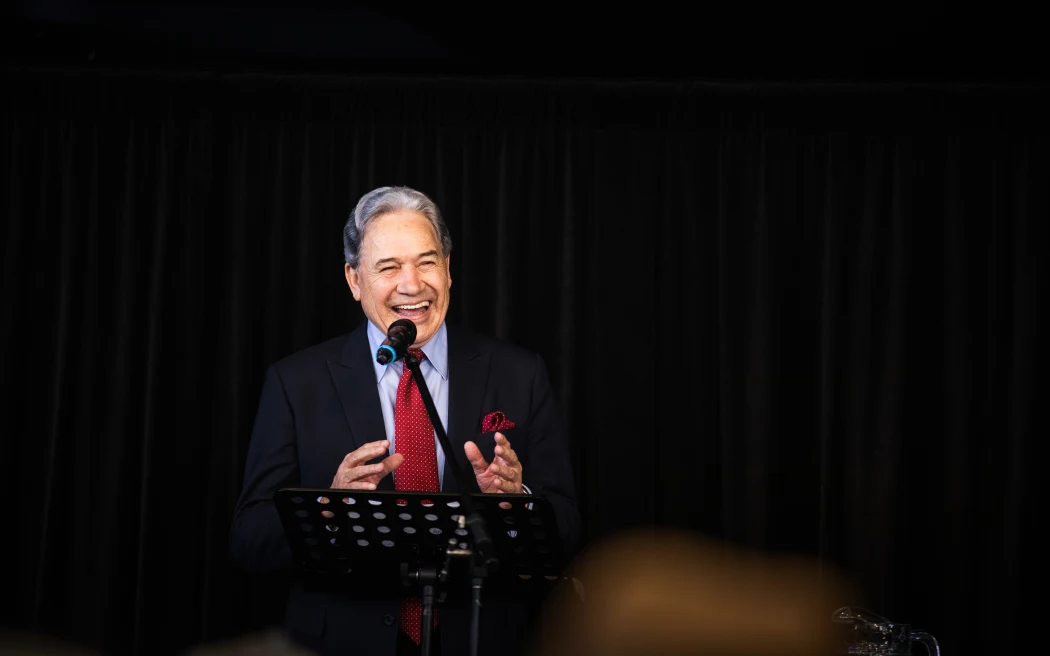
NZ First leader Winston Peters Photo: RNZ / Samuel Rillstone
  • National: 39.1 percent, down 1.8 points (49 seats)
  • Labour: 26.5 percent, down 0.3 points (33 seats)
  • Greens: 14.2 percent, up 1.9 points (18 seats)
  • ACT: 8.8 percent, down 1.3 points (11 seats)
  • NZ First: 5.2 percent, up 0.6 points (6 seats)
  • Te Pāti Māori: 2.2 percent, down 0.9 points (3 seats)
  • TOP: 1.9 percent, up 1.2 points
  • New Conservatives: 1.1 percent

Between them, National and ACT would have 60 seats, just short of the 61 needed to form a government and requiring the support of NZ First’s Winston Peters.

Luxon confirmed on Monday National would form a government with NZ First if required, but his first preference would be for a two-party coalition with ACT.

“If New Zealand First is returned to Parliament and I need to pick up the phone to Mr Peters to keep Labour and the coalition of chaos out, I will make that call. And frankly, I think Chris Hipkins will ultimately do exactly the same thing.”

The left bloc of Labour, the Greens and Te Pāti Māori falls well short of governing, with just 54 seats between them. Peters and Labour’s have Chris Hipkins ruled out working with one another.

On the preferred prime minister stakes, National’s Christopher Luxon has also risen, clearly overtaking Hipkins – who dropped 3.4 percentage points.

  • Christopher Luxon: 24 percent, up 1.5 points
  • Chris Hipkins: 19.1 percent, down 3.4 points
  • David Seymour: 6.1 percent, down 0.9 points
  • Winston Peters: 6 percent, up 1.4 points
  • Chlöe Swarbrick: 4.4 percent, up 1.2 points

The previous Newshub-Reid Research poll a fortnight ago had National up 4.3 points to 40.9 percent, and Labour down 5.5 points to 26.8 percent.

The poll surveyed about 1000 eligible voters between 17 and 23 September and was weighted for demographics, with a margin of error of 3.1 percent at the 95 percent confidence interval.

Minor parties shuffle: Greens up, ACT down

The biggest shifts in the party vote were the 1.9-point lift for the Greens, and the respective 1.8 and 1.3 percentage point drops for National and ACT.

Political editor Jane Patterson told RNZ’s Checkpoint the Greens were likely picking up some of the support of left-leaning voters disillusioned with Labour – but with the major party falling were on track for the opposition benches.

“So they’ll be looking at a strengthened caucus, which does help in terms of resourcing, in terms of number [of MPs] and heft – even in opposition – but really unless they have a very strong Labour Party it’s not going to advantage them in terms of a path to government.”

She agreed ACT leader David Seymour floating the possibility of a confidence-only deal could have been partly behind that party’s fall, although Seymour had been clear his preference was to work directly with National.

The polling period also included TVNZ’s first head-to-head Leaders’ debate with Hipkins and Luxon, and the Newshub Powerbrokers’ debate between minor party leaders.

“We saw David Seymour and Winston Peters on the same stage and I think it was dawning on them even at that point that they needed to be showing that they could be constructive working partners, even if they had maybe different ways of showing it that night,” Patterson said.

Labour’s decline

Patterson said some of Hipkins’ decisions around the wealth and capital gains tax policies were debatable in terms of popularity, but the months of personnel scandals that dogged Labour was probably more damaging.

“I think that really chipped away at the cumulative view of Labour in terms of competence and just the calibre of their ministerial lineup at that point, and Chris Hipkins as leader.”

Voters could also be disillusioned the more centrist path Hipkins had taken Labour in, in a bid to contest closely with National.

Working with Peters was never really much of an option for Hipkins, however, with NZ First having ruled out working with Labour again very early on.

Hipkins ruled out working with New Zealand First if re-elected, saying their values did not align with Labour’s.

On Monday, he described a National-New Zealand First-ACT government as a “three-headed monster”.

Peters has often said voters would ultimately have the final say, however.

Patterson said National would have seen NZ First’s steady rise in the polls, and the decision to keep that option open had not hurt them much, but NZ First was relying on a different constituency.

That would likely mean the party would be unlikely to always listen to Luxon.

Rugby World Cup 2023: Tonga outscored and outpointed by Scotland in Nice

By Iliesa Tora of RNZ.co.nz and is republished with permission

Tonga is out of the running for a Rugby World Cup quarterfinal spot as they were outscored and outpointed by Scotland 45-17 at Stade De Nice in Nice on Monday morning.

Scotland won full points from the game scoring seven tries for a bonus point while Tonga managed to get two tries on the scoreboard.

While Scotland led 24-10 at halftime the game was anyone’s going into the second half.

Captain Ben Tameifuna dived over after Solomone Kata had countered from a Scottish long kick and the former Mate Ma’a Tonga winger set up a ruck in front of the Scotland tryline.

Tameifuna scored and William Havili’s conversion reduced the scoreline to 24-17.

But an option from Tameifuna for a kick towards touchline with a kickable penalty for Havili inside the Scottish 22-metre line backfired and the Scots opened up the scoring with three tries after that.

Tonga looked beaten mid-way through the second spell and were barely hanging on as the game progressed.

In frustration number eight Vaea Fifita hit a ruck illegally and was sent off with a yellow card adding to the earlier one on Afusipa Taumoepeau in the first half. That was upgraded to red after the game, which means his World Cup is now over.

In the end, Scotland had done enough to keep their hopes alive of a possible quarterfinal berth, even though they have Ireland to beat on the way there.

Tongan fans at the Tonga v Scotland match for the 2023 Rugby World Cup in Nice, France.

Tonga fans showed up despite the team’s loss. Photo: RNZ / Iliesa Tora

Tongan captain Ben Tameifuna said it was mixed emotions and feeling after a tough rugby battle.

But he was still proud of the team and the effort they put in, saying the scoreline did not do justice to what they threw into the game.

“Bit of mixed emotions and feeling,” Tameifuna said.

“The boys played with their hearts out there. I know the score does not reflect how much effort we put in throughout this week. I said to the guys you can’t afford to give away easy penalties like that against Scotland with the amount of firepower the backs had.

“They just capitalised on it and I think against South Africa we just have to look at ourselves in the mirror and we can’t afford to give away easy penalties like that. But I am still proud of the boys we fronted right up to the 80th minute.”

Head coach Toutai Kefu said although they are out of the running now for a quarterfinal spot they will play with pride as they had always wanted to do for Tonga, the King and his people.

He said the players let on some easy tries but he was generally happy with how they played, especially on defence, which they were doing a lot of times in the game.

“We’ve always based our pride on our performance and that’s always what we we wanted to put out on the field, and we wanted a performance that not only us but family and the country is proud of.

“I think the boys did that largely. Again we let in some easy tries but there were some really defensive efforts where the boys were absolutely onsong and held out the opposition team for some period.

“I think we are tracking the right way, we will take each game as it comes and I think we have always said that.

“South Africa provides us a massive challenge. We don’t get to play the Springboks often so the boys will be up for that no doubt.”

Tongan fans at the Tonga v Scotland match for the 2023 Rugby World Cup in Nice, France.

Tonga fans were out in full force. Photo: RNZ / Iliesa Tora

He said he was happy that the team improved from what they did against Ireland in their first pool match.

“The biggest difference between both games was we got some balls to fire some shots, we took some opportunities and scored a couple of tries.

“There were probably a couple of opportunities that we missed and we were just not able to sustain pressure on them.”

Game progress

Hooker George Turner opened the scoring in the first half when he dotted down after he was driven over by his fellow forwards to give them a perfect start on five minutes.

Finn Russell converted and Scoland led 7-0 before Havili kicked a penalty and reduced the scoreline to 7-3.

Then winger Solomone Kata raced clear after experienced Malakai Fekitoa and Charles Piutau combined to put the former Mate Ma’a Tonga winger in the clear. Havili converted and Tonga was in the lead 10-7.

Wingers Duhan van der Merwe and Kyle Steyn bagged quick tries before flanker Rory Darge secured the bonus point on the stroke of half-time after wing Afusipa Taumoepeau was yellow carded.

Tongan fans at the Tonga v Scotland match for the 2023 Rugby World Cup in Nice, France.

Some fans were rooting for both teams. Photo: RNZ / Iliesa Tora

Skipper Tameifuna smashed his way through the Scotland defence to bring his side within seven points, but tries from replacement scrum-half George Horne, full-back Blair Kinghorn and replacement wing Darcy Graham sealed their first win of Rugby World Cup.

Mastercard Player of the Match Van der Merwe spoke said it was tough.

“It was pretty tough out there for the first half an hour,” he said post-match.

“I don’t think I’ve ever been hit like that before. But with boys like Finn [Russell] giving me opportunities, it’s just amazing.”

Scotland’s stand-in captain Russell said the bonus win gives them hope of getting into the quarterfinal.

“We’re going to have to get better if we want to stay in this competition after the group stages but we got what we needed tonight, which was a bonus point win.”

Scots dominate stats

Scotland dominated the statistics in the game.

They claimed 59 percent of possession and 64 percent of territory.

They had 335 balls in hand and attacked hard during the game, while Tonga only managed 190 balls to attack with.

The Scots carried the ball over 1095 metres compared to Tonga’s 528 and made 47 tackle breaks, against 11 that Tonga managed.

Tonga made 152 tackles against Scotland’s 110 and missed a total of 47 tackles. Scotland was more spot on with their tackles, missing only 11 in the game.

Tonga coach Kefu said the statistics were against them but they defended well when they could and missed a couple of one-on-one tackles also.

Scotland will now meet Romania and will play Ireland in their last pool match while Tonga gets to tackle defending champions South Africa and then Romania in their last game.

Election 2023: Immigration in spotlight as similar policies announced

By RNZ.co.nz and is republished with permission

National, ACT and Labour have all launched immigration policies targeting migrant parents and grandparents, with Labour also promising amnesty for overstayers who have been in the country for 10 years or more.

Labour leader Chris Hipkins speaking at the party’s immigration announcement on 23 September, 2023. Photo: RNZ / Giles Dexter

The Labour Party promised a 10-year multiple-entry Super Visa that allows relatives to make successive visits of between 6 months and 5 years.

Those on the visa would need a written guarantee of financial support from their children or grandchildren, who must be a New Zealand citizen.

They would also need health insurance for the entirety of their stay and meet good character requirements, said the party.

Labour said the Super Visa would not count towards any pathway to residency.

Meanwhile ACT’s new visa, called the Unite Visa, would enable relatives to visit family in New Zealand for up to five years at a time, with a renewal requirement each year.

Parents and grandparents on the Unite Visa would also have to pay an annual $3500 fee to cover potential health costs.

“There’s no question that the fee is significant and there are some people who will be deterred from coming by the fee, on the other hand I don’t think the taxpayer should have to pay,” said ACT leader David Seymour.

National leader Christopher Luxon with a family from Sri Lanka while out and about in Taupō on 23 September, 2023.

National leader Christopher Luxon with a family from Sri Lanka while out and about in Taupō on 23 September, 2023. Photo: Twitter / Christopher Luxon

The National Party announced their immigration policy earlier today which would allow relatives to visit family members in New Zealand for five years, with the possibility of renewal for another five years.

National said those on the new Parent Visa Boost would need to be sponsored by their children or grandchildren, would not be eligible for NZ Super or other entitlements and would have to have health insurance.

At the moment, a general visitor visa allows a stay of up to 12 months, but it did not allow flexibility to leave the country and come back.

If someone makes multiple journeys, parents and grandparents can only visit for up to six months at a time, with a maximum total stay of 18 months in three years.

A residency visa is also available, but migrants must meet income eligibility thresholds.

When asked about the similarities between Labour, National and ACT’s policy, Chris Hipkins said:

“Well the details were in the New Zealand Herald this morning so I suspect they would have got a bit of a clue to what we were announcing.”

Labour also announced amnesty for overstayers

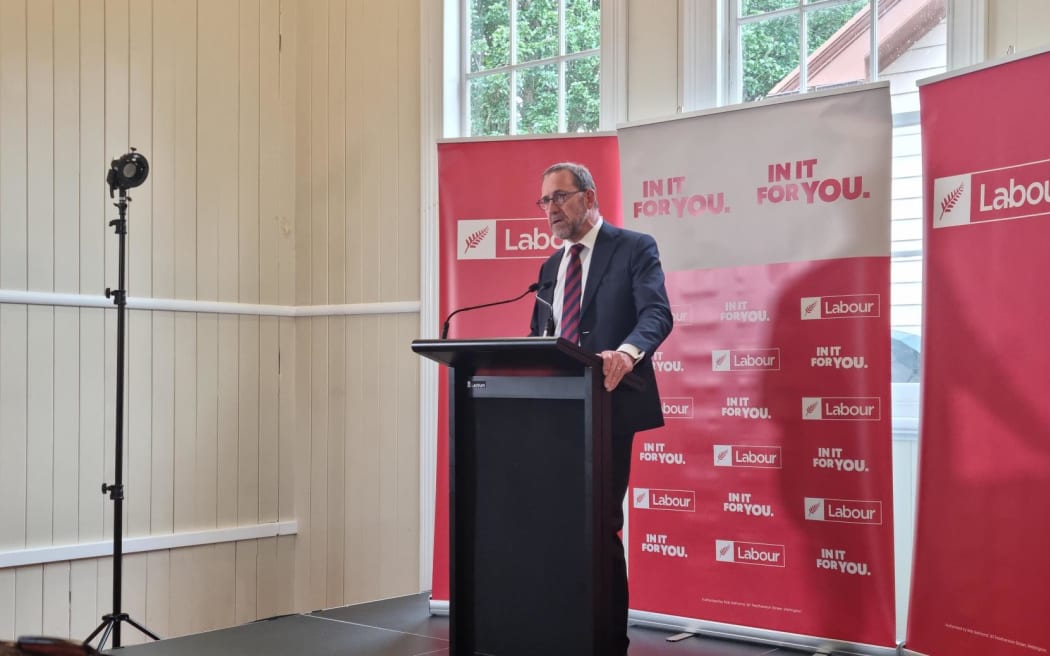
Labour's immigration spokesperson Andrew Little speaking about the party's new visa for parents and its one-off regularisation programme to overstayers.

Andrew Little at the announcement. Photo: RNZ / Giles Dexter

The Labour Party also announced a one-off regularisation programme for overstayers who have been in New Zealand for 10 years or more.

It said this was to honour the historic Dawn Raids apology to Pacific people by backing it up with action.

However, the programme would not be limited to any particular group, meaning people from all migrant communities will be able to apply to regularise their visa status.

“These people are part of New Zealand. In some cases they have been here for decades. They have family here, jobs and church,” said Labour’s immigration spokesperson Andrew Little.

“It’s only fair that children born in this country aren’t held back from making the most of their own lives, because of their parents’ irregular visa status. That is why regularisation will not be limited to any particular group, meaning people from all migrant communities will be able to apply.

“About 14,000 to 20,000 people could be eligible for regularisation, including every survivor of the Dawn Raids era who has never left the country. It means they will have rights at work and access to more government services like higher education,” Little said.

Speaking at the announcement in Auckland, Hipkins said the overstayer regularisation programme was “the right thing to do” to huge applause and some tears in the crowd.

He said the party would deliver the policy within the first 100 days in office, but he admitted he did not actually know how many migrant overstayers there were.

“To be clear these are estimates, it’s not an exact science because obviously the fact that they’re not regular means that we don’t have good information on them.

“It’s our estimate on how many people might be eligible and taken up.”

But Green Party immigration spokesperson Ricardo Menéndez March said he was disappointed with the requirement for people to be in Aotearoa for 10 years to be eligible for the amnesty.

“It calls into question the claim it will benefit 20,000 people. The reality is that it will leave many overstayers who still have roots here exposed to exploitative conditions,” he said.

“The Greens will ensure that an amnesty for overstayers provides accessible residency pathways to everyone, not just those who’ve been here more than 10 years.”

Labour promises 6000 more state houses if re-elected

Part of the Labour leadership team out on the campaign trail for this year’s election. Photo: RNZ / Giles Dexter
By rnz.co.nz and is republished with permission 

Labour says it will build 6000 additional public and transitional houses on top of its existing commitments, if re-elected.

It would take the total built since Labour came into office to 27,000 houses by 2027.

Housing spokesperson Megan Woods said it would be a significant step to eliminate the public housing waitlist.

According to Woods, National had not committed to further public housing beyond 2025 – meaning it would have to spend more than it had currently budgeted if it wanted to match the policy.

“Labour is the only major party with a deliverable plan that will help ensure every New Zealander has access to a warm, dry and affordable home,” she said.

“In just six years we’ve delivered over 13,000 public homes, the most of any government since the 1950s. We’ve also added over 4,000 transitional homes. We are on track to deliver 21,000 public and transitional homes by 2025 and there is more to come. If re-elected, we’ll deliver another 6000 public homes by 2027.

“Labour wants to eliminate the public housing wait list. Delivering over 27,000 new public and transitional homes by 2027 is a significant step forward to achieving exactly that.

“Our government [proud to have] delivered one in six public homes within New Zealand’s entire public housing stock – and we’ll keep going, building significantly more supply into our housing market.

“This is a stark contrast to National, which left government with 1500 fewer public homes than it started with, sucked out hundreds of millions in dividends and has reluctantly said it would complete the number of homes we’ve already funded. If National built public homes at the rate we are, there would practically be no public housing waiting list.

“National want to turn off the public housing tap yet again, with no further commitment for public housing beyond 2025. It’s yet another example of how National cuts investment in public assets like housing, hospitals and schools.

“We will keep investing in this critical safety net, so more New Zealanders who need these warm, dry homes can get them.

“We will also expand the commitment we have already made for 15 percent of newly built public homes to be accessible with universal design, to 25 percent of all new public homes,” Woods said.

National criticises Kāinga Ora ‘failed model’

National Party housing spokesperson Chris Bishop said what was needed was a review of Kāinga Ora’s approach, and National was committed to starting one within its first 100 days if elected.

He said the party would also make Kāinga Ora’s funding contestable.

“We’re committing to what the government announced in 2023, which is the current housing spending track … we’re not committing to the spending track that the Labour Party announced today,” he said.

“So 6000 state houses at $6b, that is a million dollars per state house at a time when the government books are deep in the red,” Bishop said.

“It’s a failed model because all they do in housing is just shovel money into Kāinga Ora which their own officials say is essentially a financial basket case. The leaked documents around a year or so ago indicate that Kāinga Ora will be riddled with debt as late as 2050, it can’t pay its way, they’ve hired 1700 more staff in the last five years alone, spent $24m on back-office renovations.

“Things are so bad at Kāinga Ora they’ve got three Bloomberg terminals even though they don’t need them. What is required there is an independent review and scrutiny of what is a failing organisation.”

“We do want to see more social housing in New Zealand that’s an important part of addressing New Zealand’s housing crisis … but our view is they could be much more efficient and nimble at actually building state and social houses.”

Part of the changes would including making funding contestable, he said.

“We are going to make the capital that the Crown spends on social housing contestable between Kāinga Ora and the community housing sector … we’re also going to make the operational funding which allows the community housing sector to go to financial institutions and borrow, we’re going to make that contestable as well.”

He promised National would continue increasing social housing stock beyond 2025, but the exact mix of funding was up for debate.

Green Party calls for more action

The Green Party said Labour’s public housing plan was a welcome step forward but called it unambitious.

Co-leader Marama Davidson said her party would build 35,000 public houses over the next five years.

“The time is now to scale up building new homes – not let it plateau at a level that falls short of the current build programme. If people want a government that will build thousands more affordable houses in the places people want to live, then only the Green Party will deliver it,” she said in a statement.

Davidson said Labour’s plan would slow the pace of house building instead of continuing to scale up.

“There are currently 4,500 public and transitional homes under construction. The Green Party has a plan to scale this up to 8000 per year by the end of 2026. Under Labour’s plan, the current programme will be tapering off instead of increasing.

“Aotearoa needs a government that will build thousands of high-quality homes where people can live, rest and thrive.”

Bishop said the Greens policy was “in la la land”.

“It is not possible to build 35,000 new public homes in the next five years, the Green Party plan is a fantasy. It’s also a fantasy because the single biggest thing that would contribute to homelessness in New Zealand is part of their plan – which is rent controls.”

Police end crime scene investigations over Ōtara and Māngere shootings

By rnz.co.nz and is republished with permission

The police have completed scene examinations at two homes in South Auckland that were shot at last week.

Shots were fired at the properties in Ōtara and Māngere on Wednesday night and early Thursday morning, but no-one was injured.

The police were yet to establish whether the two incidents were linked.

Alf Filipaina is being recognised for his services to the New Zealand Police and the community.

Auckland City councillor Alf Filipaina. Photo: Auckland Council

Manukau ward councillor Alf Filipaina said the feedback from community leaders was that they did not believe gang tensions would escalate to the point they did about a year ago.

“Within Ōtara, for example, they don’t feel as if the tensions are rising there. For them, it [is just] an outbreak of incidents.”

Filipaina wants to see more police officers on the ground, and more youth workers with local knowledge.