Tongan rugby league fans have been given a cautious boost after Eli Katoa returned to light training with the Melbourne Storm, just two months after suffering a serious head injury while representing Tonga during last year’s Pacific Championships.
Katoa was badly injured during Tonga’s clash with New Zealand at the Pacific Championships, after taking three heavy knocks to the head across the warm-up and match.
He was eventually removed from the field and later required emergency surgery.
In the immediate aftermath, the Storm ruled the powerful forward out of the entire 2026 NRL season on medical grounds, stressing that his long-term health was the club’s overriding concern.
“Eli’s health and wellbeing remain our number one priority,” Storm chief executive Justin Rodski said in a statement issued in November.
“It is great to have him home safely and under the care of our club doctor and local specialists. He is improving each day and looking forward to continuing his rehabilitation from home.
“In consultation with our doctor and neuro specialists, Eli will not return to training this pre-season and won’t be available for the 2026 season. He has a long road ahead in his recovery and his focus will be on returning to full health before considering any form of return to training.”
Despite that prognosis, Storm supporters and the wider Tongan rugby league community were encouraged this week after the club shared videos on social media showing Katoa participating in light handling drills at training.
The club has emphasised that the activity forms part of his rehabilitation programme only and does not signal a return to full training or match play. Katoa is still expected to sit out the 2026 campaign as he continues his recovery under specialist supervision.
For Tonga, Katoa’s progress is being closely watched. The back-rower has become a key figure in the national side’s resurgence in recent years, and his safe return to full health remains the priority for both club and country.
While a comeback timeline remains uncertain, Katoa’s presence back on the training paddock—however limited—marks a significant milestone in his recovery journey and offers hope to Tongan fans following months of concern.
Police have launched a homicide investigation following the death of a 10-week-old baby boy in Auckland, authorities have confirmed.
Detective Inspector Karen Bright of Counties Manukau CIB said police were notified after the infant was taken to Pukekohe Maternity Hospital in a critical condition on 2 January.
Hospital staff alerted police, and the baby was subsequently transferred to Starship Hospital, where it was determined he had suffered non-survivable injuries.
“Tragically, the baby passed away at the hospital on Wednesday, 8 January,” Bright said.
A 27-year-old woman and a 23-year-old man have since been jointly charged with ill-treatment or neglect of a child.
Both are due to reappear in Manukau District Court on 8 May.
Suppression orders are in place protecting the identity of the child and the two people charged.
Detective Inspector Bright said the investigation remains ongoing and that further charges are being considered.
“As the matter is before the court, police are unable to comment further,” she said.
A tragic new detail has emerged in the fatal shooting that claimed the lives of two Tongans and injured six others outside a Latter-day Saint meetinghouse in Salt Lake City, deepening shock and grief within the Tongan community.
Vaea and Nani Tulikihihifo and their baby with Sione Vatuvei (inset).
All the shooting victims were adults. Vaea Tulikihihifo, 46, and Sione Vatuvei, 38, were identified as the two people killed.
Salt Lake City media claimed Tulikihihifo was not involved in the confrontation that preceded the gunfire.
According to his family, he had briefly stepped outside the church during a memorial service to retrieve baby formula from his car for his five-month-old son.
Tulikihihifo left the meetinghouse with the car keys in hand — and never returned.
Seconds later, multiple gunshots rang out in the church parking lot.
Tulikihihifo was struck and collapsed outside. Family members say they do not know whether he ever reached the vehicle before he was fatally wounded.
Vatuvei was also killed in the shooting. Six other people sustained gunshot injuries and were taken to hospital, with varying degrees of severity.
Reports circulating on social media, including livestream videos from the funeral service, seen by Kaniva News, during which the shooting occurred outside, show Vatuvei speaking.
Some commenters have alleged that the footage captures a speech he delivered shortly before he was fatally shot.
Vatuvei was reportedly described by those who knew him as someone who had recently embarked on a new path, seeking to turn his life away from gang involvement.
The shooting occurred while many members of the Tongan and wider Pacific Islander community were gathered inside the meetinghouse to attend a memorial service, heightening the trauma of the event.
Tulikihihifo, originally from Los Angeles, was described by his family as a devoted husband and father who loved his faith, his community, and sports teams from his hometown. Loved ones said his final act — stepping out to care for his child — reflected the kind of man he was.
The incident has sent shockwaves through Tongan communities in Utah and abroad, with calls for justice, healing, and greater attention to community safety. Police say the investigation remains ongoing as they continue searching for the suspect.
What was first reported as a violent confrontation has now taken on a more devastating dimension — the loss of a father whose final moments were spent responding to the needs of his child, not engaging in violence.
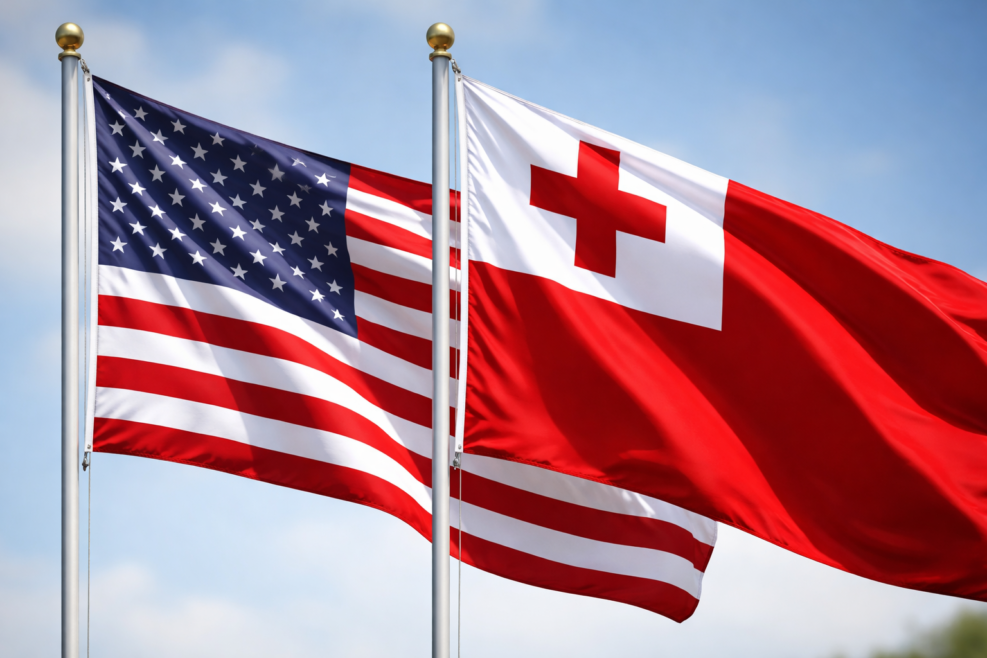
Tongans planning to travel to the United States on visitor visas will soon face new financial requirements, after the US Department of State confirmed that Tonga has been included in a visa bond pilot programme, effective January 21, 2026.
Tonga has been added to a US visa bond pilot programme, requiring some Tongan travellers to post bonds of up to US$15,000 amid tightened visa restrictions and heightened scrutiny of applications.
The bond requirement follows earlier U.S. measures imposing so‑called “partial visa restrictions” on Tongans—actions that have already disrupted family, church, and community travel, and drawn criticism over the Tongan government’s lack of a clear response.
As Kaniva News reported previously, the restrictions introduced on January 1 mean that Tongans may still travel to the United States, but only under heightened scrutiny of their visa applications and, in most cases, only in exceptional circumstances where the visit is deemed to be in the US national interest.
Under the new rules, Tongan passport holders applying for B1/B2 visitor visas — typically used for tourism, family visits, and short-term business travel — may be required to post a visa bond of US$5,000, US$10,000, or US$15,000, depending on the outcome of their visa interview.
The bond requirement applies even if an applicant is otherwise eligible for a visa. The amount will be determined by a US consular officer at the time of the interview, and applicants will only be instructed to post a bond if directed to do so by the officer.
The policy is part of a temporary pilot programme established under US immigration law, targeting countries identified as having higher visitor visa overstay rates. Tonga is one of several Pacific nations included in the programme, alongside Tuvalu, Vanuatu, and Fiji.
How the bond works
Applicants required to post a bond must complete Department of Homeland Security Form I-352 and make payment through the US Government’s official platform, Pay.gov.
The Department of State has warned applicants not to use third-party websites, stressing that the US Government is not responsible for money paid outside its official systems.
Officials have also cautioned that paying a bond does not guarantee visa approval. If a person submits payment without being instructed by a consular officer, the money will not be refunded.
Restricted entry and exit points
As a condition of the bond, visa holders must enter and exit the United States through designated airports only. For now, these are:
Boston Logan International Airport
John F. Kennedy International Airport (New York)
Washington Dulles International Airport
Failure to comply with these requirements could result in denied entry or departure records not being properly registered.
When bonds are refunded — and when they are not
The bond will be automatically cancelled and refunded if:
the traveller leaves the US on or before their authorised stay expires
the traveller does not use the visa before it expires
the traveller is refused entry at the US port of entry
However, the bond may be forfeited if US authorities determine that the visa holder breached the terms, including overstaying, remaining unlawfully in the US, or applying to change or adjust immigration status, such as seeking asylum.
Tongans are among the victims of a shooting at a meetinghouse of The Church of Jesus Christ of Latter-day Saints in Salt Lake City, according to local media reports.
Two people have been confirmed dead. Three others are in critical condition, while three additional victims are listed as being in unknown condition after they were transported to medical facilities by private parties, police reportedly said.
Salt Lake City police spokesperson Glen Mills told media emergency services responded to reports of gunfire at the meetinghouse, with officers and medical teams arriving to find multiple victims.
Police Chief Brian Redd reportedly confirmed that all of the victims are adults and said investigators do not believe the incident was random.
He added that the suspect remains at large and that a significant police operation is underway to locate the individual involved.
A livestream shared on Facebook by a Tongan man at the scene, seen by Kaniva News indicated the victims may have been attending a funeral when the shooting occurred.
The meetinghouse where the shooting occurred serves two Tongan wards, according to the church’s website, as reported by The Salt Lake Tribune. Susi Feltch-Malohifo’ou, chief executive of Pacific Island Knowledge 2 Action Resources (PIK2AR), told the outlet the incident has sent shockwaves through Utah’s Pacific Islander community.
She said her phone had been flooded with messages following the shooting and confirmed that she knows several of those injured, although their conditions were not immediately known.
Feltch-Malohifo’ou said many members of the Pacific Islander and Latter-day Saint communities were attending a memorial service when the shooting occurred outside the church, which primarily serves Tongan congregants.
“Condolences to the family. This is a tragedy in our community,” she said, adding that while PIK2AR has been actively working on violence prevention in Polynesian communities, including gang prevention, it was too early to determine whether that was a factor in the incident. “Violence is never the answer.”
A Supreme Court judgment has revealed that a highly intelligent individual, described as such by the court, who is also a qualified musician, illegally imported hundreds of rounds of ammunition and attempted to mislead Customs officers by presenting an ammunition import licence belonging to one of the nobles of the realm.
Save Mataele
Save Mataele, 46, was fined a total of TOP$2,500 for unlawfully importing hundreds of rounds of prohibited ammunition into the country and repeatedly lying to customs officials in an attempt to conceal the offence.
In a judgment delivered by Justice Paul Garlick KC on 11 November 2025, Mataele pleaded guilty to two counts of unlawful importation of prohibited goods under the Customs and Excise Management Act.
He imported 400 rounds of .22 magnum ammunition and 150 rounds of Hornady Magnum rifle ammunition without a licence.
The court heard that Mataele travelled to a shipping premises to collect a crate he had imported from the United States. When questioned by a customs broker about whether the crate contained restricted goods, he falsely claimed it did not.
After a scan revealed the ammunition, he then lied again, claiming he had declared it and later produced “an import licence for ammunition, which had been granted to Lord Nuku in 2023,” according to the court document.
Justice Garlick said the offending was deliberate and premeditated, noting Mataele’s lack of remorse and his attempts to deceive authorities.
The judgment noted that Mataele’s claim that a conviction would hinder his ability to travel for work could not be accepted as a mitigating factor. The court said he was an “intelligent man” who would have understood the consequences of committing such an offence.
He also expressed concern about the growing prevalence of firearms-related offences in Tonga and suggested serious consideration may be needed regarding sentencing trends for such crimes in the future.
However, the judge acknowledged Mataele’s early guilty plea and the fact that he was a first-time offender.
He imposed a fine of T$2,000 on unlawful importation of prohibited 400.22 magnum ammunition and T$500 on unlawful importation of prohibited 150.22 Hornady Magnum rifle ammunition, to be paid within three months.
Failure to pay will result in six months’ imprisonment. The ammunition is liable for forfeiture under law.
Tonga’s sporting community is mourning the passing of veteran administrator Hiko Fungavaka, who died after a battle with cancer.
Congratulations on being awarded an OHF Life Member in November 2025 to recognise outstanding service.
Widely regarded for his dedication to sport development in Tonga and across the Pacific, Hiko leaves behind a legacy of service, leadership, and commitment to youth and community empowerment through sport.
Hiko was a Life Member of the Oceania Hockey Federation, a recognition shared rarely within Tonga and the wider Pacific for outstanding contribution to the code.
His impact extended beyond hockey, having served the Tonga Association of Sports and National Olympic Committee (TASANOC) as a Sport Development Officer, where he played a key role in delivering and coordinating sport development initiatives across the nation.
In 2016, he transitioned fully into hockey development, bringing the same passion and purpose to strengthening the sport at both grassroots and national levels.
Most recently, he served as Development Manager for the Tonga Hockey Federation, where he was instrumental in driving participation, strengthening structures, and promoting hockey as a growing sport in Tonga.
Hiko also contributed to sports leadership and governance, serving as a Board Member of TASANOC from 2021 to 2025, continuing to advocate for athlete development, opportunity, and sustainability within Tonga’s sports system.
TASANOC and the wider sporting fraternity have paid tribute to his dedication, describing him as a committed leader whose work will be remembered with gratitude and respect.
“Hiko’s contribution to sport will be remembered with gratitude and respect. Our heartfelt condolences go to his family, friends, and the wider sporting community,” the tribute said.
Hiko Fungavaka’s legacy lives on through the athletes, communities, and institutions he supported and strengthened throughout his years of service.
A man already serving a seven-year prison sentence for rape has been given an additional prison term after the Supreme Court of Tonga sentenced him for two further counts of serious indecent assault.
The rapist appeared before Justice Paul Garlick KC and pleaded guilty to two charges of serious indecent assault contrary to section 124(1) and (3) of the Criminal Offences Act.
He had earlier been sentenced in July 2025 to seven years’ imprisonment for rape by the Lord Chief Justice, partly suspended.
Because the earlier rape sentence had already been imposed and the suspended term activated, the Court said it needed to ensure the new punishment was fair, proportionate and reflected the totality of offending.
Offending
The Court was told that in count one, the man touched the complainant’s vagina without consent.
In count two, he kissed the complainant and put his tongue in her mouth. The judge described the behaviour as serious, deliberate and persistent despite the complainant telling him to stop.
The Court identified several aggravating factors, including that the offending was premeditated, involved the use of force and violence, caused both physical and emotional harm to the complainant, and was carried out without any genuine remorse.
The judge also noted that the offender committed these acts while already serving a prison sentence for another sexual offence.
Although prisoner is only 20, had cooperated with police and pleaded guilty early, his previous criminal history included convictions for assault, housebreaking, theft and rape
Justice Garlick KC said that if these offences had been sentenced independently, the appropriate term would have been two years’ imprisonment, partially suspended.
However, because the offender was already serving a seven-year sentence for rape, the Court said it needed to ensure the overall punishment remained proportionate. It therefore imposed six months’ imprisonment on the first charge and three months on the second.
The terms will run concurrently with each other but consecutively to the existing seven-year rape sentence.
The Court also ordered that no material may be published that could identify the complainant, including on social media.
The sentence was delivered in Nuku‘alofa on 8 October 2025.
A man has been sentenced to three years and four months’ imprisonment for a violent machete attack that left his victim with serious and permanent injuries.
Christopher ‘Opeti Tupe, 20, pleaded guilty to causing grievous bodily harm, an offence that carries a maximum penalty of 10 years’ imprisonment.
He entered his plea at the earliest opportunity, had no previous convictions, and fully cooperated with police, factors which the Court acknowledged as significant mitigation.
However, Justice Paul Garlick KC said the offending was extremely serious and demanded an immediate custodial sentence.
Drunken dispute turned into armed attack
The Court heard that the defendant and complainant had been drinking together in ‘Eua Island when an argument broke out.
The complainant became angry after Tupe drove off in his car and later found him at a bar in Tufu, where another fight took place before the complainant returned Tupe home.
Tupe then armed himself with a machete, went to the complainant’s home and repeatedly swung the weapon at him, striking his left arm and other parts of his body.
The victim suffered a deep laceration to his left wrist measuring approximately 6cm by 4cm, with the Court noting the injuries were “very serious and permanent.”
Sentence and Suspension
Justice Garlick said the case clearly passed the threshold for imprisonment, setting a starting sentence of five years, reduced by one third due to the guilty plea and cooperation with police.
While the defence had asked for full suspension, the judge ruled the seriousness of the violence required jail time.
However, he agreed there was strong rehabilitation potential given the offender’s age, remorse, community support and forgiveness from the victim.
The Court suspended the final two years of the sentence for a period of two years, subject to strict conditions, including probation supervision, anger-management and alcohol education programmes, community service, and a requirement not to reoffend.
Tupe must report to probation within 48 hours of release.
The sentence was delivered on 5 December 2025 in Nuku‘alofa.
Analysis – Tonga is facing heightened risk under the United States’ new visa restrictions, announced at a time when the newly appointed Fakafanua administration has yet to provide detailed public clarification of the situation. Analysis of the policy indicates that the Kingdom now sits in a high-risk position, where failure to act could see the current partial restrictions escalate into a full entry ban in the coming months.
Crown Prince Tupouto‘a, Minister of Foreign Affairs and Diplomatic Services, pictured alongside Prime Minister Lord Fakafanua. The image is a cropped section of a photograph originally published on the Australia in Tonga Facebook page.
The review reveals a consistent pattern: countries initially placed under warning or partial restriction often face tougher sanctions if Washington believes its security concerns have not been adequately addressed. In several instances, preliminary restrictions have ultimately expanded into full entry bans.
Countries previously placed in a comparable position to Tonga provide important insight. Laos and Sierra Leone were placed under partial restrictions in June 2025 — the same period Tonga was flagged — but were fully banned last month after US authorities determined that issues had not been resolved. In contrast, Turkmenistan, which was also under partial non-immigrant visa restriction, was removed from the list after US officials said the country had cooperated constructively and demonstrated significant progress.
Based on this pattern, the analysis concludes that Tonga is now at a decisive point. The current partial measures can escalate, and if concerns identified by US authorities remain unaddressed, the Kingdom could face a complete ban as early as June.
Responsibility for addressing the escalating visa restrictions now falls squarely on Prime Minister Lord Fakafanua and his Minister of Foreign Affairs and His Majesty’s Diplomatic Services, Crown Prince Tupouto‘a. The former government had already tasked the Crown Prince with engaging Washington after Tonga was first warned last year, and the expectation is that the current administration must now demonstrate meaningful action to prevent the situation from worsening.
President Donald Trump, who reinstated stricter immigration controls after returning to the presidency in January, has justified the measures as necessary to address weaknesses in overseas vetting systems. US authorities have cited factors including high visa overstay rates, unreliable civil records, corruption concerns, terrorism risks and a lack of cooperation in accepting deportees.
Case-by-case approvals
Despite the restrictions, travel to the United States is not entirely closed.
According to the US Department of State, travellers from Tonga may still be permitted entry in exceptional circumstances if their visit is deemed to be in the US national interest.
These approvals can be issued on a case-by-case basis by the Secretary of State or Secretary of Homeland Security, while the Attorney General may authorise travel where it supports critical US justice or security needs.
Tighter vetting of applications
The US Department of State said that as of 15 December 2025, enhanced vetting now applies to the visa categories restricted for Tonga, including H-1B visas (skilled foreign workers in speciality occupations) and H-4 visas (their dependent family members).
These categories will now face the same level of scrutiny already applied to F student visas, M vocational visas, and J exchange visas.
Applicants are required to make their social media accounts public so consular officers can verify identity, employment and education records, and assess for potential security risks.
US authorities warn that sudden deletion of posts or major last-minute profile changes may raise concerns. Applicants are advised to ensure their online information is accurate, consistent, and free from material that could be interpreted as supporting unlawful activity.
What this means for Tonga
The United States is home to one of the largest Tongan populations in the world, with more than 48,000 people identifying solely as Tongan in the 2020 US Census and over 78,000 identifying as Tongan in combination with other ethnic backgrounds. Any tightening of U.S. travel policy therefore, has significant implications for families, communities and long-standing people-to-people links.
Much of Tonga’s modern connection to the United States has developed through The Church of Jesus Christ of Latter-day Saints, the Kingdom’s second-largest Christian denomination, and through education pathways such as the church’s Brigham Young University–Hawai‘i, which has traditionally enrolled large numbers of Tongan students each year.
That pathway has already been affected. As Kaniva News previously reported, BYU professor Tevita Ka‘ili said visa restrictions have disrupted enrolment, and there are currently no new Tongan students admitted this year.
The potential impact reaches beyond education. Travel restrictions could affect families, church networks, employment opportunities, remittances, community ties and Tonga’s broader diplomatic relationship with Washington.
The coming months will therefore be critical in determining whether Tonga moves toward relief — like Turkmenistan, which successfully engaged the US — or toward harsher outcomes similar to Laos and Sierra Leone, which shifted from partial restrictions to full entry bans.
Clear, proactive communication from government, supported by practical engagement with US authorities, will be essential in shaping Tonga’s future position under the policy.