Home Blog Page 291

“We ran for our lives” says Tonga resort owner

By Fīnau Fonua of RNZ.co.nz and is republished with permission.

Just over a month since Tonga was struck by a violent one-in-a-thousand year disaster, it is still struggling to recover from the fallout of the devastating event which has left many communities in ruins and its inhabitants traumatised.
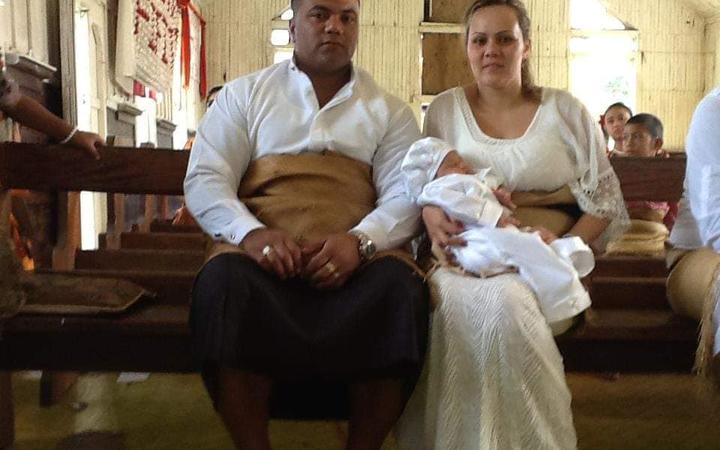
John and Maryanne in happier times. Their Vakaloa resort in Tonga was destroyed. Photo: Vakaloa Resort Hotel

“It’s a day I will never forget” said Maryanne Tuku’afu, the owner of Vakaloa Resort which was destroyed by tsunami waves.

“Someone said to me to look out at the ocean. My room had a view towards the ocean and when I opened the curtains and looked out at the water, it was totally different from usual waves. It became clear to me that there was going to be a tsunami. This was before the first explosion,”Tuku’afu said.

Tuku’afu called her husband from their nearby residence in Kanokupolu, who quickly picked her up and drove away to higher ground.

“When he arrived to the gates to enter Vakaloa, the sea had already reached the main road. We just took off, didn’t even turn at home, we just took off and told everybody on the road at Kanokupolu to move to high ground,” she said.

“It was quite an experience. I thank God that we all made it alive.”

During the eruption of the Hunga Tonga-Hunga Ha’apai volcano, there were successive deafening explosions, with the loudest generating a sonic boom that was heard as far away as Alaska. Tuku’afu said that the sound of the explosion alerted villagers to the gravity of the situation.

“When we shouted out to everyone, they knew it wasn’t a joke because the explosion confirmed that there was going to be tsunami,” Tukuafu said.An undersea volcano eruption in Tonga on Saturday 15 January, 2022. The eruption of the Hunga Tonga-Hunga Ha'apai volcano came just a few hours after Friday's tsunami warning was lifted.
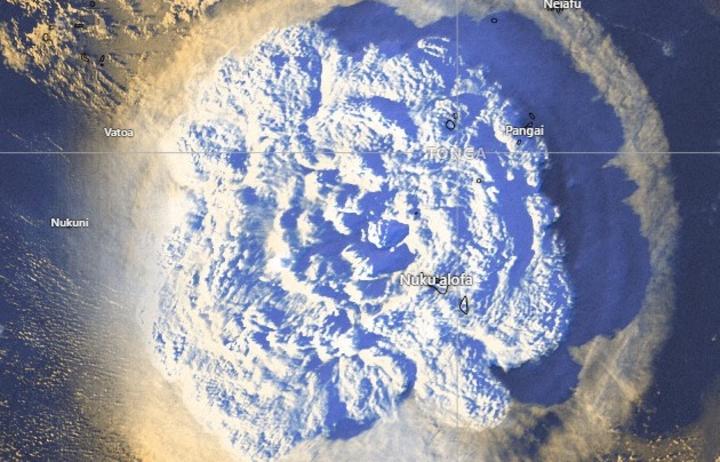
An undersea volcano eruption in Tonga on 15 January, 2022. The eruption of the Hunga Tonga-Hunga Ha’apai volcano came just a few hours after Friday’s tsunami warning was lifted. Photo: Tonga Meteorological Services / EyePress via AFP

“The people who were outside their homes with their families didn’t go inside they just ran, they got in to their van with their kids and took off.”

Tuku’afu along with thousands of residents headed to higher ground where they witnessed ash fall that turned the sky pitch black.

According to NASA, the massive eruption was hundreds of times more powerful than the atom bomb that destroyed Hiroshima. Yet remarkably, the country recorded only three fatalities.

The Difficult Recovery

The fallout of the volcanic eruption and tsunami has been devastating with water shortages affecting most of Tonga and ashfall that covered the archipelago is still being cleared.

Telecommunications remain severely limited with poor phone reception and slow internet, the result of the country’s underwater internet cable being cut by the eruption.Tongan health workers promoting the Covid-19 vaccination drive.
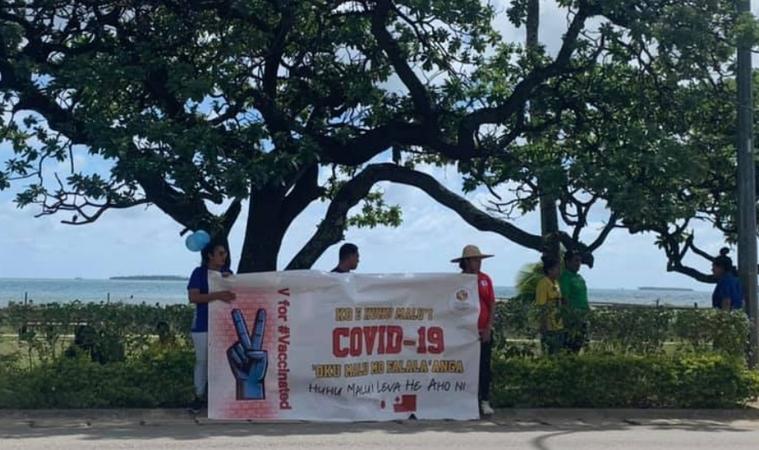
Photo: Supplied/ Tongan Ministry of Health

A recent outbreak of Omicron has been complicating matters even further, with a strict nation-wide lockdown closing down most businesses and requiring all Tongans to confine themselves in self-isolation.

“It really affects not only businesses but also the community because we employ a lot of the locals, and then with Covid-19 now, it’s just really really hard because we were in the midst of cleaning up, and now everything is on hold. Most of our staff have been layoff,” said Tuku’afu.

With so much infrastructure destroyed and damaged by the Tsunami, Tuku’afu said the recovery would be long term.

“It would be really nice to just have financial help from our Government here in Tonga, they have given all the businesses that have been destroyed, an emergency relief fund of $5,000 Pa’anga. It’s very thoughtful and it helps us pay our staff something instead of nothing at all,” she said.

“It just a very tough time for us all. I think god’s grace is sufficient for us. He provides for what we need daily. We’re just happy that we have a breath life.
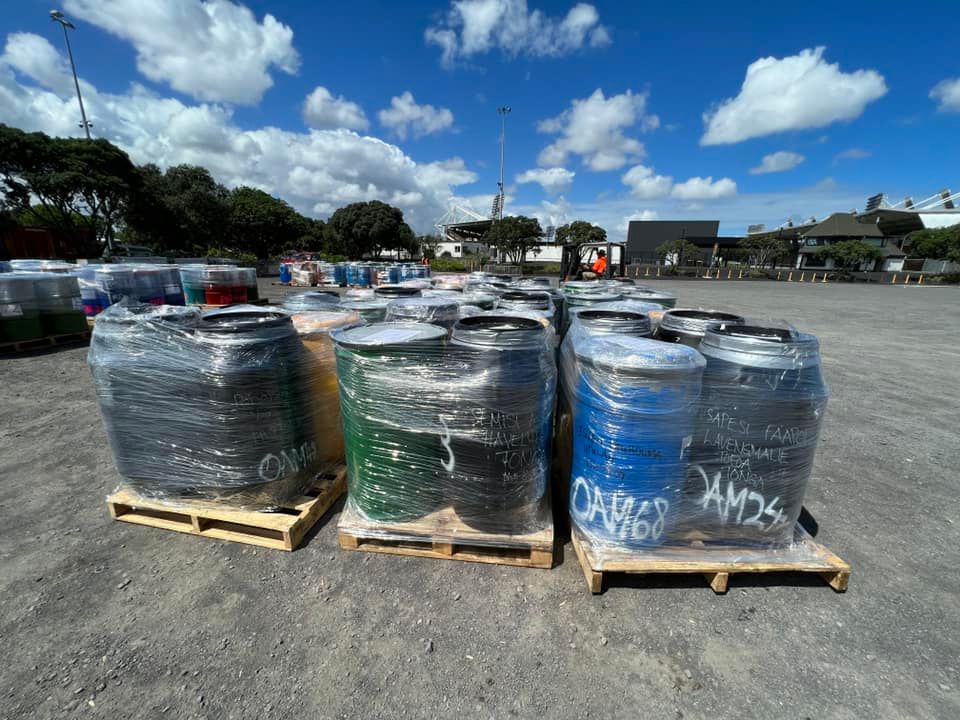
Owners leave cargoes from NZ unclaimed at wharf in Tonga in fear of Covid infection, says CEO

The first shipment of aid sent to Tonga by New Zealand community members and businesses is finally being unpacked after completing mandatory quarantine on Tongatapu. Photo/Aotearoa Tonga Relief Committee

Dozens of owners and customers have not picked up their goods donated by their families and relatives in New Zealand in fear that that could be a chance for them to contract the Omicron virus.

The situation prompted Customs CEO Kelemete Vahe to issue a notice this morning, urging customers to collect their cargoes as soon as they can.

Vahe said these goods can attract charges and liabilities if they continue to stay unclaimed at the wharf.

Vahe told radio FM 87.5 all front liners at the wharf had been tested and their results yesterday had been negative.

Vahe said he appreciated some people’s behaviours at the wharf which showed a high level of following hand hygiene practices. He said some people came with their own pen to sign off their cargoes meaning they did not want to use pens which had been made available by his staff.

Tonga’s current outbreak numbers were 139 cases with 133 cases on Tongatapu and six cases on Vava’u.

Auckland’s Tongan community sent 51 shipping containers with $1.6 million of food and groceries following Tonga’s volcanic eruption and fatal tsunami.

The containers were filled with close to five thousand individual pieces of drums and boxes.

They arrived last week in the kingdom and were being released to the public.

More aid from New Zealand was on its way to Tonga.

Tongan workers in Australia claim abuse by employers; desperate for promised pay rise

Tongan workers under the Seasonal Worker Programme claim they are being financially abused by their employers.

The workers, who spoke to Kaniva News on condition of anonymity, said they were suffering the same plight as ni-Vanuatu SWP workers whose story was reported in the Australian media last week.

The Tongan workers provided documents which appeared to show that large deductions were being made from their pay.

The Tongan workers’ complaint echoes claims made by seasonal workers in Bundaberg, Queensland, who said they had little money left after deductions  were made.

The ABC reported that a group of ni-Vanuatu workers had met with a lawyer to air their grievances.

One worker told the ABC that hundreds of dollars were deducted from his pay each week for expenses, including accommodation and transport to work on farms.

He said he had barely had enough  money to send home and then had none for himself.

The workers complained about their living conditions at backpacker hostels, where they said kitchen and cooking facilities were broken and they had to deal with outbreaks of bed bugs.

Australian lawyer Stewart Levitt said the workers treated “as if they are slaves in our land.”

The workers have called for reforms, including additional support on farms to help them better understand their work agreements.

Desperate for pay rise

Tonga Australia Seasonal Workers Association (TASWA) president Falepaini Maile said today Tongan seasonal wanted to know why a pay rise announced  by the Australian government could not start immediately.

Maile said Tongan workers were desperate for the pay rise.

From April 28 employers will have to pay an hourly minimum of $25.41.

Maile said Tongan workers were facing a host of problems caused  by being stranded in Australia due to the Covid-19 pandemic, including marriage breakdowns and being exploited by unscrupulous employers.  

Union groups have pressured the government for years to properly regulate the Pacific workers’ programme.

Meanwhile, the Samoa Government is demanding a report from the Seasonal Worker’s Division over alleged mistreatment of Samoans workers in Australia.

Tongan man killed in Hawai’i two car crash

A Tongan man has died after a two vehicle accident on Kamehameha Highway in Kahuku on Oahu at around 10 pm Saturday, Feb 12.

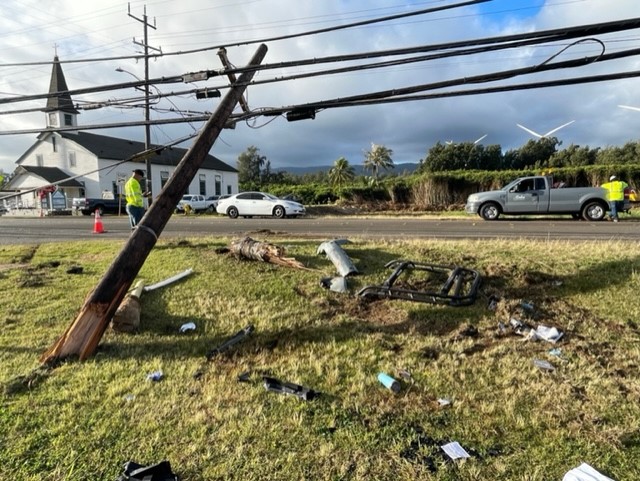
A man died after a two vehicle accident on Saturday, Feb. 12. On Kamehameha Highway in Kahuku on Oahu. Kahuku, Hawaii, Sunday, Feb. 13, 2022

 26-year-old Henry Tonga of Kahuku was driving north on Kamehameha Highway when he hit a woman who was driving from a side street onto Kamehameha Highway going south, local news KHON reported.

The woman’s vehicle lost control, went off the roadway and crashed into a pole.

When the Honolulu Fire Department arrived the woman’s vehicle was on its side. HFD used a battery powered hydraulic rescue tool to get Tonga out of his car. HFD said he was unresponsive.

EMS officials treated them both. Tonga was taken to the hospital in extremely critical condition, and the woman was taken to the hospital in serious condition.

Police said Tonga was pronounced dead at the hospital. He was not wearing a seatbelt.

Police said speed appears to be a factor and it is unknown if drugs or alcohol were involved.

Hawaiian TelCom said crews worked on the pole on Saturday, and that Spectrum also uses that pole.

Check out more news from around Hawaii

This is the seventh traffic fatality on Oahu this year compared to five at the same time last year.

Auckland Council accused of forgetting about Ōtāhuhu town centre upgrade

Stephen Forbes, Local Democracy Reporter, steve.forbes@stuff.co.nz

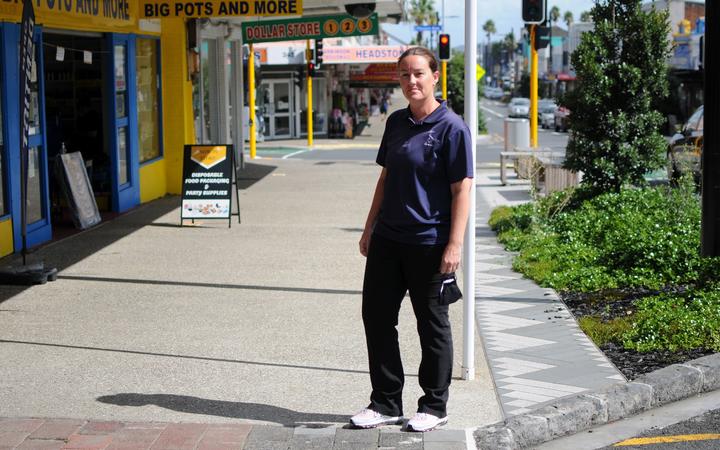
Auckland Council is being asked to finish what it started after a multi-million dollar upgrade of Ōtāhuhu’s town centre was put on the back-burner.Ōtāhuhu Business Association manager Richette Rodger standing on Great South Rd near the intersection with Mason Ave where the work on the upgrade project stopped two years ago.

Richette Rodger standing on Great South Rd near the intersection with Mason Ave where the work on the upgrade project stopped two years ago. Photo: LDR

The council first announced plans for the $16 million upgrade in September 2019.

It said the project would make the town centre safer and more connected and would see pathways widened, native trees planted and the installation of new street lighting and stormwater infrastructure.

The upgrade was focused on the main street, along Great South Rd, from Princes St to Atkinson Ave and Station Rd.

However, the project was one of many postponed across the region due to a council revenue slump caused by Covid-19.

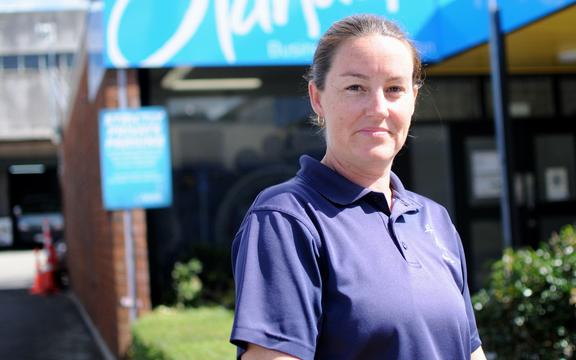
The work has stopped just after the intersection of Mason Ave, Avenue Rd, and Great South Rd, and the remainder, which was due to start in July 2020, has been deferred for at least 12 months.Ōtāhuhu Business Association manager Richette Rodger says Auckland Council appears to have forgotten about completing the town centre’s upgrade.

Richette Rodger. Photo: LDR

Ōtāhuhu Business Association manager Richette Rodger said instead of deferring the project, the council appeared to have forgotten about it.

“It’s like the project disappeared and we haven’t heard anything since.”

Rodger said the upgrade was important for Ōtāhuhu.

“There’s no way we will be able to grow like the other town centres in South Auckland without it,” she said.

The council submitted a list of 73 key shovel-ready projects to the Infrastructure Reference Group in April 2020, which included the Ōtāhuhu town centre project. However, it did not get government approval for funding.

Ōtāhuhu Business Association chairman Rajesh Lal, who runs Stonex Jewellers, said the stretch of Great South Rd outside his store has not had a makeover since 1992.

He said upgrading the footpaths, adding new seating, street lighting and trees would help make the area more attractive to shoppers.

Sheraz Dean, who runs Pasifika Barbers, said he liked the improvements the council had done outside his store to date, and was not as concerned about the work being completed.

“I’m not too worried about it at the moment because it’s been a tough time for everybody,” Dean said.

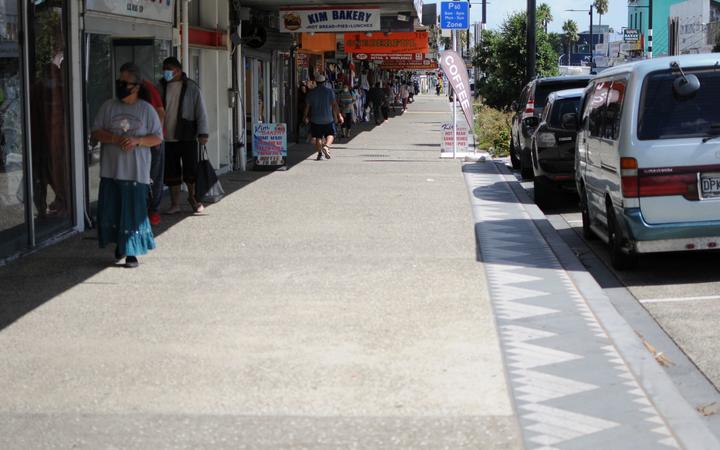
“We can wait.”Some of the work that has been completed further down Great South Rd includes wider footpaths, seating, gardens and street lighting.

Some of the work that has been completed further down Great South Rd includes wider footpaths, seating, gardens and street lighting. Photo: LDR

In a statement, an Auckland Council spokeswoman said the main street makeover was done in sections so it would only proceed when there was available funding. Finance was not available in the 2020 emergency budget.

“The project team has explored alternative funding options to progress the town centre upgrade, including applying to central government’s shovel-ready initiative. No alternative funding options have been identified.”

no metadata

Local Democracy Reporting is a public interest news service supported by RNZ, the News Publishers’ Association and NZ on Air.

UN warns more international help needed in Tonga

The United Nations Pacific office is urging the international community to keep up the support to Tonga and help it build back stronger after the January 15 volcanic eruption and tsunami.

Recovery work is being hampered by the Covid-19 outbreak in the country with 139 cases now confirmed across villages on Tongatapu and Vava’u.no caption

Photo: 123RF

The UN resident coordinator responsible for Tonga, Sanaka Samarasinha, said the initial response from the international community has been overwhelming but there still a long road to recovery ahead.

He said today the UN will deploy the first two disaster response experts – a water and sanitation expert and a disaster response co-ordinator – requested by the Tongan government.

“The assistance that has been provided so far by a number of countries has been contact-less. We are mindful of the need to follow very strict Covid-19 protocols they will be in quarantine for 14 days when they get there.”

Samarasinha said they believe there is still a need for more onground personnel but they do not want an unnecessary influx of international personnel into the kingdom.

World Bank puts a figure on the tsunami damage

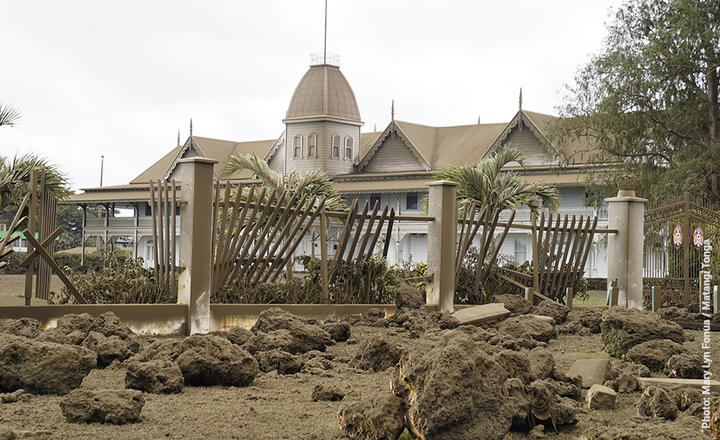
The World Bank said the violent volcanic eruption, tsunami and ashfall in Tonga last month has caused an estimated US$90.4M in damages.The seafront section of the Royal Palace in Nuku'alofa is blanketed in ash and there's damage to the fence and grounds from the tsunami that followed the volcanic eruption on January 15.

The seafront section of the Royal Palace in Nuku’alofa is blanketed in ash and there’s damage to the fence and grounds from the tsunami that followed the volcanic eruption on January 15. Photo: Matangi Tonga

That’s the equivalent of approximately 18.5% of Tonga’s Gross Domestic Product (GDP) according to a World Bank assessment.

The Global Rapid Post-Disaster Damage Estimation (GRADE) report on the January 15 eruption was prepared by the World Bank at the request of the Government of Tonga and in consultation with other partners.

It is the first assessment published following the Tonga disaster that provides estimated costs of the physical damages caused by the volcanic eruption and tsunami.

The report provided estimates of direct damages to residential buildings, non-residential buildings (including tourism, health facilities, schools, government buildings, and private sector buildings), infrastructure (transport, power and water, sea and air and repairs to the submarine cable), agriculture, forestry, fishing, and ashfall clean up.

The World Bank said broader economic losses, such as ongoing impacts on agriculture and tourism, are not reflected in the report and are expected to significantly increase the overall economic impact.

An estimated 85,000 people across Tonga have been affected by what has been described as a ‘once in a millennium event.

FSM helps out

The Federated States of Micronesia is providing $US100,000 to Tonga to help with recovery from the eruption and tsunami.

The President David Panuelo said “to the People & Kingdom of Tonga,….you are with us in our hearts and minds, and we pray for your swift recovery. In the meantime, we extend to you our Blue Pacific solidarity and unity.”

Covid-19: 164 schools and early childhood centres have cases

By RNZ.co.nz and is republished with permission.

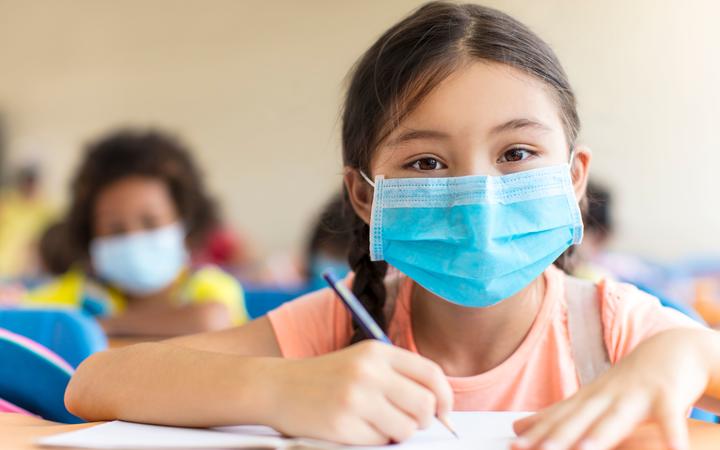
More than 160 schools, kura, and early childhood centres are managing identified Covid-19 cases in students or staff.students wearing  mask and  studying in the classroom.

Children in Year 4 and above are required to wear face masks while indoors. Photo: 123RF

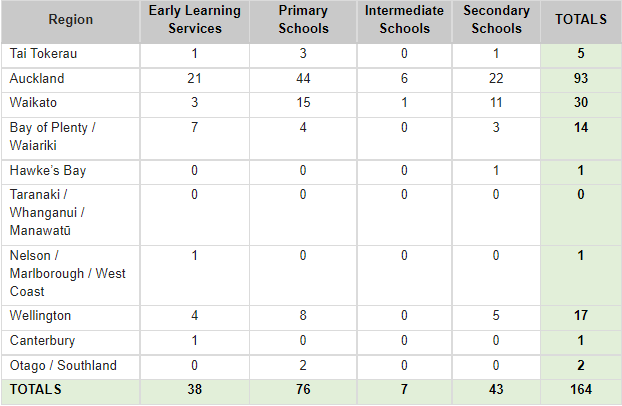
Of the 164 schools and ECEs nationwide with cases, 76 are primary schools.

More than half the educational institutions affected are in Auckland, with 93, followed by the Waikato region with 30 schools and ECEs managing coronavirus cases.

Taranaki, Whanganui and Manawatū are the only regions where none have cases, figures from the Ministry of Education show.

Schools remain open under the Omicron strategy and a mandate requires children in Year 4 and above to wear face masks while indoors to reduce the spread of Covid-19.

For children Year 3 and under, the Ministry of Health said mask wearing was encouraged, but not required.

In Auckland, 21 early learning services, 44 primary schools, 6 intermediate schools and 22 secondary schools have identified cases.

South Auckland primary schools have been [https://www.rnz.co.nz/news/national/461153/south-auckland-primary-schools-consider-onsite-vaccination-clinics

considering whether to host vaccine clinics to help vaccinate the region’s 5 to 11-year-olds]. Principals in the area say Counties Manukau DHB has asked them to allow vaccinations on their sites.

As of Monday, 45 percent of eligible 5 to 11-year-olds have had their first Covid-19 vaccine.Number of schools, kura and ECE by education region managing identified Covid-19 cases, as of 2.30pm 14 February.

Schools, kura and ECE managing identified Covid-19 cases as of 2.30pm 14 February. Source: Ministry of Education Photo: Supplied / Ministry of Education

Arrivals from Tonga will soon have to self-isolate due to rising Covid-19 cases

By RNZ.co.nz and is republished with permission.

Tonga no longer meets the criteria for quarantine-free travel due to increasing Covid-19 cases, Director-General of Health Dr Ashley Bloomfield announced this evening.No caption

Photo: 123rf.com

Tonga now has 139 active cases, 75 of which are from the last three days.

“Following a public health risk assessment, from 27 February travellers from Tonga entering Aotearoa New Zealand will be required to meet some public health requirements, with phased-in changes for travellers from Tonga on flights beginning tomorrow,” Dr Bloomfield said.

People arriving tomorrow will have to take a Rapid Antigen Test (RAT) on days 1 and 5 or 6 but won’t be required to enter self-isolation.

Those who arrive on the 22 February flight and thereafter will have to self-isolate for seven days and take RAT tests on days 1 and 5 or 6.

“During this time, all travellers are encouraged to monitor for symptoms and requested to avoid high-risk settings such as hospitality and large gatherings. They must report any positive RAT and take a follow-up PCR test to confirm their result. If they test positive standard isolation measures will be applied to them.”

Bloomfield said officials would “work through things to minimise disruption for RSE workers and employers under the new settings”.

New Zealand would continue to support Tonga with its Covid-19 response, including through vaccine support, he said.

New fund targets 20,000 nurses who have left profession

By RNZ.co.nz and is republished with permission.

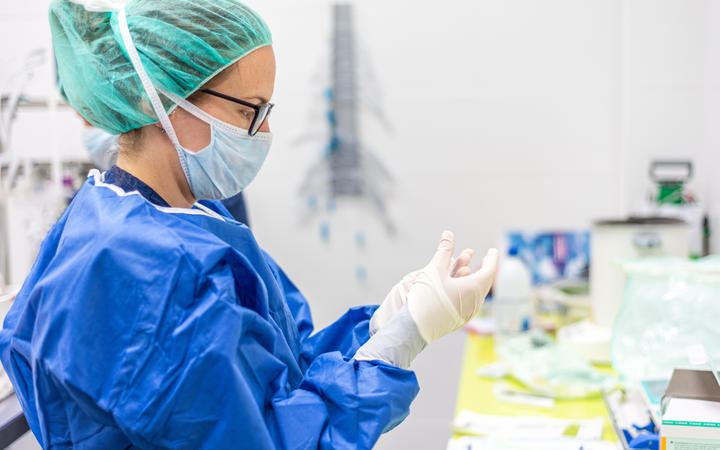
The Health Ministry has launched a $1 million fund to attract former nurses back to the profession in the pandemic. Female nurse puts on protective gloves. Personal protective equipment in the fight against Coronavirus disease .

Another 1000 nurses who qualified overseas may also be eligible for payments from the new fund. File photo. Photo: 123rf

Two hundred nurses are eligible for up to $5000 to cover training, English language tests, and personal costs like childcare and transport.

The ministry’s chief nursing officer Lorraine Hetaraka said there are more than 20,000 New Zealand-trained registered nurses who are not currently practising.

“The support fund is to help nurses who are not currently practising to return to a nursing role, to meet increased demand, support safe staffing, and improve access to care.

“Nurses are one of our cornerstones of the health and disability system and we need more across all areas of the health and disability system in Aotearoa. It’s so important we can grow the workforce to help meet demand and to ensure these nurses are experienced and skilled.”

She said another 1000 nurses who qualified overseas and are working in aged care or as health care assistants, may also be eligible.

The first round of applications is open from today, and closes on 14 March. A second round of applications will open in May 2022.

The launch coincides with other campaigns the ministry is running to help bolster the nursing health workforce, including a domestic recruitment campaign, and a campaign focusing on international nurses with a call to come home.

“I’ve said it many times before – nurses are the first port of call for so many patients across the healthcare system and I really do hope nurses will take the opportunity to apply for this funding and return to practise,” Hetaraka said.

New Zealand to move to Phase 2 of Omicron plan – Jacinda Ardern

By RNZ.co.nz and is republished with permission.

Prime Minister Jacinda Ardern has announced today that New Zealand will move to Phase Two of Omicron plan at 11.59pm on 15 February, when the period of home isolation reduces.

Ardern says the increase in Covid-19 cases is not unexpected and the country will stay in Phase Two as long as daily cases remain between 1000 and 5000 cases.

There is no change to the traffic light system, and schools and businesses remain open, she says.

Bloomfield says Phase Three is not an inevitability, and the objective remains the same – the difference “is simply how much we are able to follow up people, the requirement on people to self-isolate, and the kind of tests we will use”.Covid-19: Next phases of government’s Omicron plan revealed

Phase Two

The move to Phase Two means the self-isolation period for cases reduces from 14 days to 10 days, and for contacts from 10 days to seven.

The period of self isolation also applies to household members.

“We’ve seen that 90 percent of household contacts who were going to test positive do so within those first 10 days,” with Omicron, she says, so there are good reasons for the changes.

She advises people to develop a self-isolation plan, including identifying a buddy who can drop off supplies.

Anyone experiencing symptoms that get worse during isolation – particularly breathlessness – is advised to call Healthline immediately.

Bloomfield says in Phase Two, contacts will also be followed up differently.

People will not be followed up or expected to isolate having been to a hospitality venue unless they were seated at the same table.

“We will be relying on people to notify the people who might have been at the table … we won’t necessarily be asking everybody in that cafe, including the staff, to isolate.”

Ardern says the way to handle this period will be the same as previous times – test, vaccinate and isolate if sick.

“So we are embarking for the first time in the two years since the start of the outbreak into a period where New Zealanders will see more Covid in the community … it will be nothing like we’ve experienced to date but our efforts with vaccination mean we have got to this place without the volume of serious illness and death that so many others experienced.

“And still as always be kind and respectful. I know there is Covid fatigue, but I also know that no one wants to let go of the freedoms we’ve gained from uniting and protecting one another. We need respectful discussion and tolerance as we navigate this next phase together.”

Accessing rapid antigen tests

Phase Two also means the start of the test-to-return-to-work scheme. This would allow critical workers to return to work if they return daily rapid antigen tests.

Employees of businesses signing up to the scheme can go to a provider like a vaccination clinic and get a pack of 10 rapid antigen tests.

In some cases, the tests are being provided directly to workforces.

“We’ve secured enough rapid antigen tests to deal with a widespread Omicron outbreak with 7.2 million in New Zealand now and more arriving over the next week,” Ardern says.

Phase Two will also mean a greater emphasis on digital and automation to speed up contact tracing and other official communications.

“We currently have nearly 5000 active Covid cases, and 39 of those are in hospital, none in ICU … my most important message from this period carries through to the next – get a booster if you haven’t already.”

She says 1.2 million people who are eligible have not yet got their booster.

Anyone who has symptoms or has been in touch with someone who has tested positive should isolate immediately and get a test.

Ardern says the government is trying to ensure it has the supply of rapid antigen tests to meet the needs of the critical workforces first, instead of them being widely available.

Dr Bloomfield says the ministry is working on advice around that but RATs at the moment will be largely confined to the return-to-work scheme. He says some 22.5 million RATs are expected to be in the country by the end of February.

Positive case at Parliament

A member of the Press Gallery at Parliament has returned a positive rapid antigen test (RAT) result for Covid-19.

“We know that they [RATs] are not always 100 percent accurate,” Ardern says.

The individual has taken a PCR test to confirm if they are infected.

This is the first public case of Covid-19 at Parliament.

Anti-mandate protest

The prime minister’s briefing comes in the wake of the protest which built to an attendance of 3000 over the weekend despite appalling weather and a constant stream of loud music and Covid-19 vaccination ads – played at the insistence of Speaker Trevor Mallard.

Asked if it was kind for the Speaker to turn on the sprinklers with the protesters there, Ardern says the Speaker and police have the responsibility of upholding the law and ensuring everyone is safe.

She says in her view the protest has stepped beyond merely a protest, with harassment of others and causing the inability of others in Wellington to move around freely.

She says those on the forecourt of Parliament want to see the removal of all public health measures – the very measures that have kept New Zealand safe. “You’ll forgive me if I take a very strong view on that suggestion.”

Ardern advised the protesters via Morning Report to go home and take their children with them.

Govt support for businesses

Ardern says some sectors have been significantly down on business because of the Covid-19 Protection Framework – the traffic light system – and Finance Minister Grant Robertson is working on “highly targeted, one-off and short term” measures to support those sectors, which particularly includes hospitality.

She says the government will have more to say on that “very shortly”.

The spread of Omicron is also likely to feature at the briefing with cases almost doubling yesterday to a record 810, surpassed today by the announcement of 981 cases.

Prominent epidemiologist Professor Michael Baker also warned today that the real number of cases in Aotearoa could be 10 times the official figure – the real number could be more like 8000.