By Kelvin Anthony of RNZ.co.nz and is republished with permission
A pro-democracy activist in Fiji is calling for the government to provide regular updates about the health of Prime Minister Frank Bainimarama to cancel out rumours and fake news.
Fijian social media has been buzzing with rumours that Bainimarama’s health has deteriorated after undergoing heart surgery at a Melbourne hospital last month.
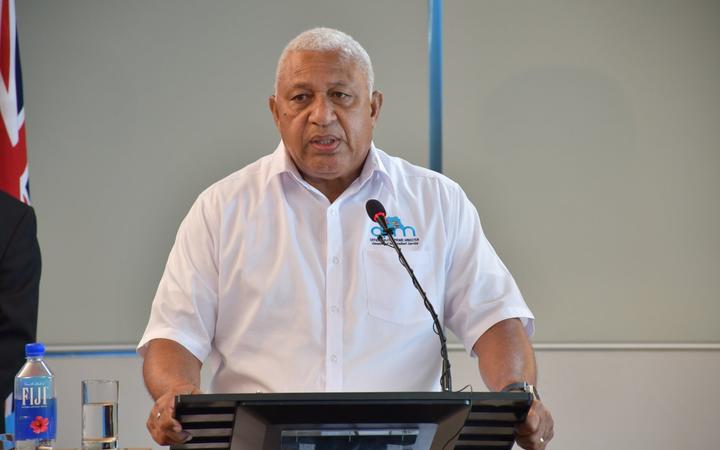
Fiji’s Prime Minister Frank Bainimarama. Photo: Facebook/Fiji govt
But democracy advocate Pita Waqavonovono said Fijian citizens deserved to know the health status of the leader of the country.
He said the government’s decision to remain silent did not help quell such rumours.
“So, the problem here is that all this energy placed on trying to portray positivity, distract and shape opinions is actually met with a question – update us. Is he alive? How can we help? Nothing is coming to us through the traditional forms so social media has taken over that void.”
RNZ Pacific has contacted Fiji’s information department for comment.
The government announced last month that the prime minister was recovering from cardiovascular surgery in Melbourne, Australia.
At a media conference on 15 January, acting prime minister Aiyaz Sayed-Khaiyum said Bainimarama was not expected to return to work until the end of February.
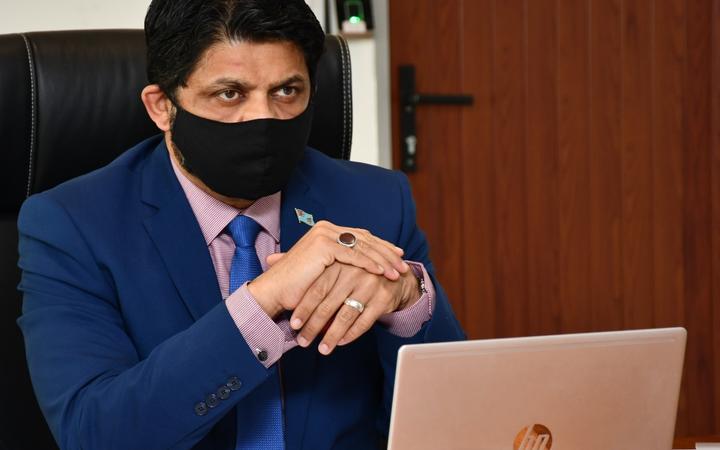
Fiji’s acting prime minister Aiyaz Sayed-Khaiyum Photo: Facebook/Fiji govt
Sayed-Khaiyum said Bainimarama was in high spirits and had spoken with his family.
“Per the doctor’s orders, this type of surgery takes weeks, at a minimum, to recover from. So, we expect to have our prime minister back at the helm of the nation, fitter than ever, by the end of the next month [February],” he said.
Sayed-Khaiyum said he was in Singapore for a medical check-up late last year.
There are 209 new cases of Covid-19 in the community today, with another 14 cases reported at the border.
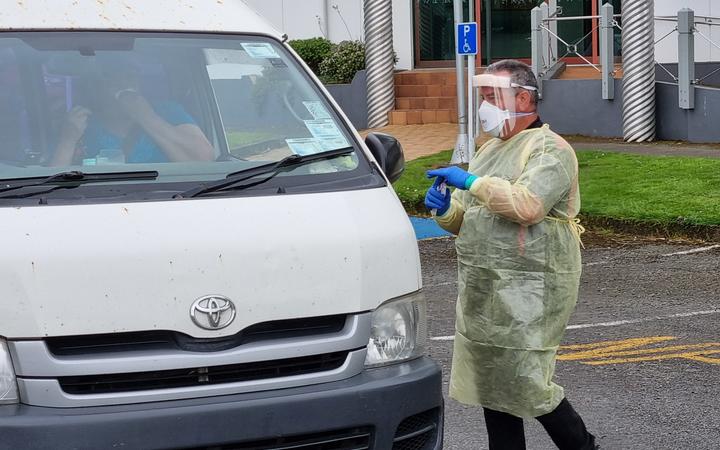
File photo. Photo: RNZ / Jimmy Ellingham
In a statement, the Health Ministry said there were nine people in hospital with Covid-19, with one in intensive care. There are two in Rotorua, one in Hawkes Bay and one in Christchurch ,with the rest in Auckland hospitals.
Today’s new community cases were in Northland (21), Auckland (99), Waikato (51), Rotorua (15), Bay of Plenty (15), Hawke’s Bay (3), Tairāwhiti (4), MidCentral (1).
Of the 51 cases in the Waikato today, less than half have been linked to previously reported cases.
Eighteen of these cases are based in Hamilton, one is in Matamata and the others are still under investigation, the Ministry said.
The 15 cases in the Bay of Plenty include six in Tauranga and nine in the Western Bay of Plenty.
The Ministry said there had also been a case in a resident at Radius Lexham Park aged residential care facility in Katikati.
The case is linked to a previous case in a staff member at the facility who tested positive late last month. All residents have been self-isolating and daily Rapid Antigen Tests are being carried out for all staff and residents.
The 21 Northland cases include 12 cases in Kerikeri, five in Hokianga and four in Whangārei. Thirteen of the 15 cases in Rotorua have been linked to previous cases.
There were also three cases in the Marlborough region – all known close contacts of previously reported cases – that will be added to tomorrow’s numbers.
Today’s 64 cases at the border included travellers from Israel, USA, Australia, UK, Pakistan, India, Italy, France, Sri Lanka, Oman, Japan, Egypt, Portugal, the Netherlands and Bangladesh.
There have now been 16,901 cases of Covid-19 in New Zealand since the pandemic began.
The Ministry said Māori across Aotearoa will today reach 90 percent first dosed. There were just 142 doses needed to reach the milestone this morning.
There were 870 first vaccine doses, 1817 second doses, 4501 paediatric doses and 45,931 booster doses.
Covid-19 Response Minister Chris Hipkins today confirmed that self-isolation rules would gradually be phased out in Aotearoa.
And National Covid-19 spokesperson Chris Bishop said the five-step plan to navigate through Omicron was no good for tourists and thereby tourism businesses because of isolation requirements.
Photos of injuries and serious bruises on what appeared to be a Tongan Seasonal worker in Australia have surfaced on social media, prompting an investigating by the Pacific Islands Council Queensland (PICQ).
An investigation is underway in Australia after photos of an alleged beating surfaced. Photos/Supplied
The photos, which were shared on Facebook on Tuesday appeared to show the bruising was consistent with the man being beaten.
The photos were accompanied with a caption alleging that the incident was part of a pattern of violence kept shrouded in secrecy. There was serious allegation of threatenings and fear of reprisals from the perpetrator—especially if it is a leader of the group.
Kaniva News contacted Tongan authorities for comment.
Commenters on Facebook have identified the victim as well as the accused. Kaniva News cannot publish their identities at this stage for legal reasons.
It is understood the PICQ investigators were attempting to talk to some of the Tongan Seasonal workers who knew about the incident.
The PICQ investigators vowed to continue investigations ‘with the aim of bringing those involved to justice’, a reliable source told Kaniva News.
PICQ described itself on its website as “a non-profit community incorporated association, managed by volunteer representatives of member community groups and individuals who believe in the collective voice for the benefit of all Pacific Islanders”.
About 5,000 Tongan workers were employed across Australia and New Zealand under their respective Pacific temporary labour schemes.
Many of these workers have been absent from home for much longer than usual due to COVID-related travel restrictions, with some now in New Zealand and Australia for more than two years.
Afghan women are accusing the Taliban of using a pregnant New Zealand journalist as a publicity tool to show the world they can offer women rights.
New Zealand journalist Charlotte Bellis. Photo: YouTube screenshot
Charlotte Bellis wrote a column on Sunday saying she had been rejected by New Zealand’s strict hotel quarantine system and was living in Afghanistan, where the Taliban had offered her “safe haven”.
Bellis was working in Qatar, where extramarital sex is illegal, when she discovered she was pregnant with her partner and realised she had to leave.
When she was unable to go home to New Zealand, she briefly moved to her partner’s native Belgium, but could not stay long because she was not a resident.
She said the only other place the couple had visas to live was Afghanistan.
“When the Taliban offers you – a pregnant, unmarried woman – safe haven, you know your situation is messed up,” she wrote.
It made international headlines, but the news prompted scepticism in online groups of Afghan women, Kabul resident Sodaba Noorai said.
Noorai said Afghan women “were surprised” when they heard the news that senior Taliban contacts had told the journalist she would be fine if she returned to Afghanistan.
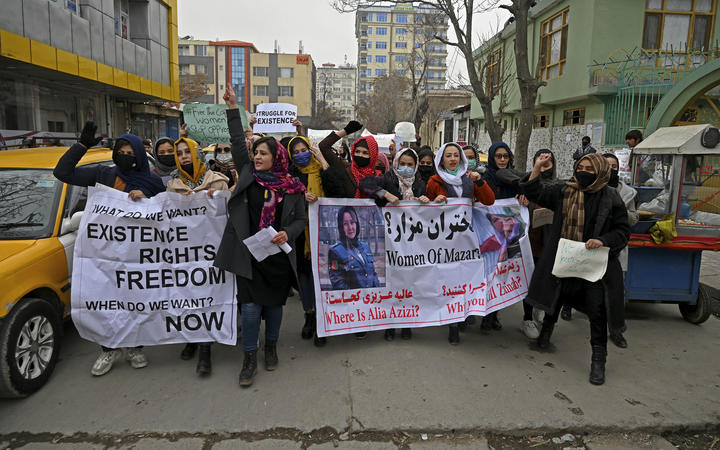
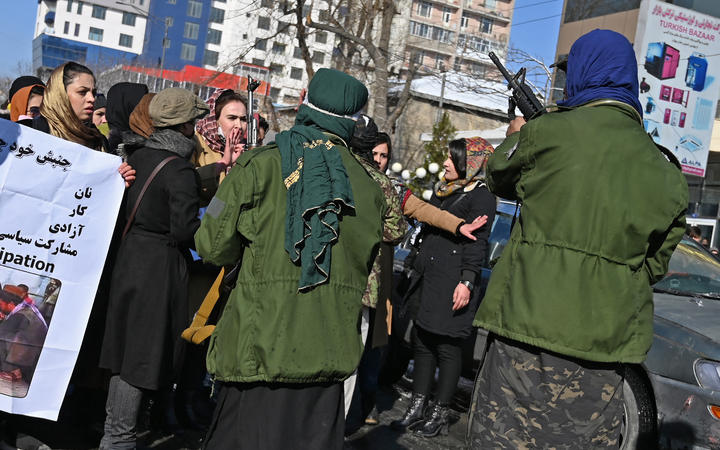
Afghan women march as they chant slogans and hold banners during a women’s rights protest in Kabul on 16 January, 2022. Photo: Wakil Koshar / AFP
“[Afghan women] were surprised the Taliban can treat women in a good manner and know how to respect them,” Noorai said.
“The Taliban is trying to convey the message that they know about human rights, especially women’s rights.
“But in reality their treatment of Afghan women is different to their support and respect for this New Zealand woman.”
Noorai said pregnant Afghan women had been killed by the Taliban for not being married.
Witnesses claim pregnant former Afghan policewoman Banu Negar was shot dead by Taliban militants in September, but the regime has denied the incident.
“This is a double standard where they treat a white, Western woman in a way to show the world that they are behaving like a civilised government,” Pittsburgh University Afghan researcher Dr Omar Sadr said.
“But with respect to the people of Afghanistan and the women of Afghanistan, the Taliban behave totally differently.
“At the moment, Afghan women are degraded as second-class citizens, deprived of fundamental human rights where their protesting is brutally suppressed.
“They are killed, tortured, and in some cases even raped.”
Many women live in fear under Taliban rule
It has been almost six months since the militant group took over Afghanistan, and its treatment of women has become a central point of concern for the international community.
Women say they live in fear, while others have been killed after protesting against the country’s new rulers.
Taliban fighters trying to control women as they chant slogans during a protest demanding for equal rights, along a road in Kabul on 16 December, 2021. Photo: Wakil Koshar / AFP
Afghan activist Rahimi, whose last name has been withheld for security reasons, said she had gone into hiding with her sisters because she was worried she would be arrested and tortured by the Taliban for attending protests over human rights.
“I no longer have a job so I’m in a bad economic situation, I attended many demonstrations for achieving our rights and my life is in danger by the Taliban,” she said.
“We’re afraid of their violence, their rape, their killing and murder, so we’re scared in our house.
“I have a request for the international community – don’t ignore the actions of the Taliban because of this case of this New Zealand journalist.”
Taliban negotiators travelled to Oslo, Norway last week, the regime’s first official overseas delegation since returning to power in August.
US and European diplomats reportedly offered humanitarian aid in exchange for an improvement in human rights.
The Taliban is calling for almost $10 billion in assets frozen by the US and other Western countries to be released, as more than half of Afghans are now facing extreme levels of hunger.
“It is fundamental that we hold the Taliban accountable by their policies and actions on the ground rather than what they do in exceptional cases like Charlotte’s,” Dr Sadr said.
But women like Noorai have urged the international community to stand firm until all women in Afghanistan, not just foreigners, are given basic rights.
“Our message is to not recognise the Taliban until they really change themselves and treat us properly.”
Australian maritime experts claim the final resting place of Captain James Cook’s ship, Endeavour, has been found, in an announcement that has drawn criticism from the principal research team as “premature”.
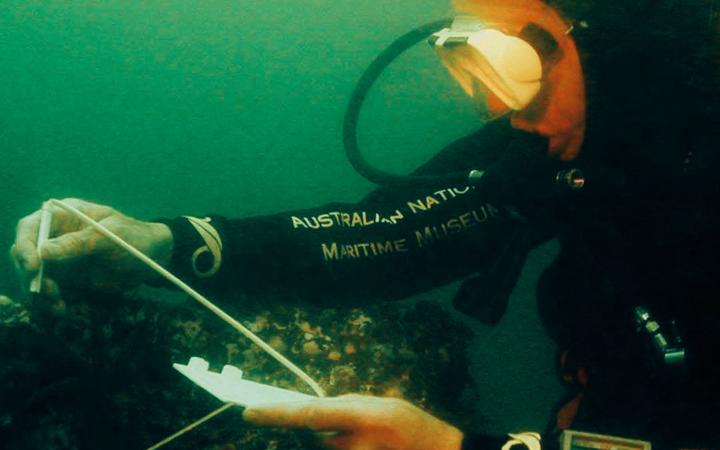
The wreck of Captain Cook’s Endeavour may have been discovered in Newport Harbour, off Rhode Island. Photo: Australian National Maritime Museum
Endeavour, which was scuttled in the harbour as part of the American War of Independence in 1788, has a prominent place in Australian history.
In 1770 it became the first European vessel to reach the east coast.
At an event in Sydney this morning, the Australian National Maritime Museum (ANMM) announced a wreck in Newport Harbour, off Rhode Island in the United States, had been confirmed as the ship.
But an hour later, the Rhode Island Marine Archaeology Project (RIMAP) stepped in, labelling the revelation a “breach of contract”.
The project’s principal investigator Kathy Abbass said any conclusions would be “driven by proper scientific process and not Australian emotions or politics”.
“What we see on the shipwreck site under study is consistent with what might be expected of the Endeavour, but there has been no indisputable data found to prove the site is that iconic vessel, and there are many unanswered questions that could overturn such an identification,” Dr Abbass said.
“When the study is done, RIMAP will post the legitimate report on its website.”
Kieran Hosty, from the ANMM, claimed Dr Abbass had been sent a report 10 days ago outlining the museum’s findings.
“I can’t answer the question about breach of contract, as far as I’m aware the contract with the Rhode Island project expired in November last year.
“Going onto the actual jumping the gun that we haven’t got enough information, I disagree with that.”
He said the wreck had several points “which correspond to what we know about Endeavour.”
In making the initial announcement, ANMM director and CEO, Kevin Sumption, had a different perspective.
“I am satisfied that this is the final resting place of one of the most important and contentious vessels in Australia’s maritime history,” he said.
Maritime archaeologists have been investigating several 18th century shipwrecks in a 2 square mile (5.2 square kilometres) area, known as RI 2394, since 1999.
“The last pieces of the puzzle had to be confirmed before I felt able to make this call,” Sumption said.
“Based on archival and archaeological evidence, I’m convinced it’s the Endeavour.”
Originally launched in 1764 as the Earl of Pembroke, four years later it was renamed Endeavour by Britain’s Royal Navy.
Over the next three years, the ship voyaged to the South Pacific, firstly on an astronomical mission to record the transit of Venus in Tahiti, before charting Australia’s east coast and the coast of New Zealand in 1770.
The vessel lay forgotten for more than two centuries, after it was sold to private owners and deliberately sunk in 1778 by British forces.
While only 15 percent of the vessel remains, efforts are now focused on how to protect and preserve it.
Researchers say several key markers distinguished Endeavour from four other ships sunk in Newport in August 1778:
historical evidence indicates the ship was sunk just north of Goat Island in Newport Harbour, along with four other British transports
the ship was the largest of the five scuttled transports in that area
archaeological evidence indicates RI 2394 is significantly larger than any other 18th century shipwreck site
the length of the surviving hull is almost exactly the same as that recorded for Endeavour
the structural details and shape of the remains closely match historic plans of Endeavour
diagnostic clues such as the construction of the keel along the bottom of the wreck, the joinery used in its bow at the front and the placement of the vessel’s fore and main mast are identical to those shown on 18th century plans of Endeavour
timber samples strongly suggest a vessel built in Europe, not America.
The research team are finalising their report on the site, which will be peer-reviewed and published in the months ahead.
In making today’s announcement, Sumption acknowledged his American counterparts.
“We pay tribute to the work of Dr Kathy Abbass and her team at the Rhode Island Marine Archaeology Project for their ongoing commitment to the site and its history,” he said.
“It’s an important historical moment, as this vessel’s role in exploration, astronomy and science applies not just to Australia, but also Aotearoa New Zealand, the United Kingdom and the United States.”
Federal Arts Minister Paul Fletcher also spoke at this morning’s announcement in Sydney.
He also acknowledged his American counterparts.
“We pay tribute to the work of Dr Kathy Abbass and her team at the Rhode Island Marine Archaeology Project for their ongoing commitment to the site and its history,” he said.
“It’s an important historical moment, as this vessel’s role in exploration, astronomy and science applies not just to Australia, but also Aotearoa New Zealand, the United Kingdom and the United States.”
To mark the occasion, an interactive website has also been launched featuring immersive videos, animation, underwater footage and photogrammetry data sets.
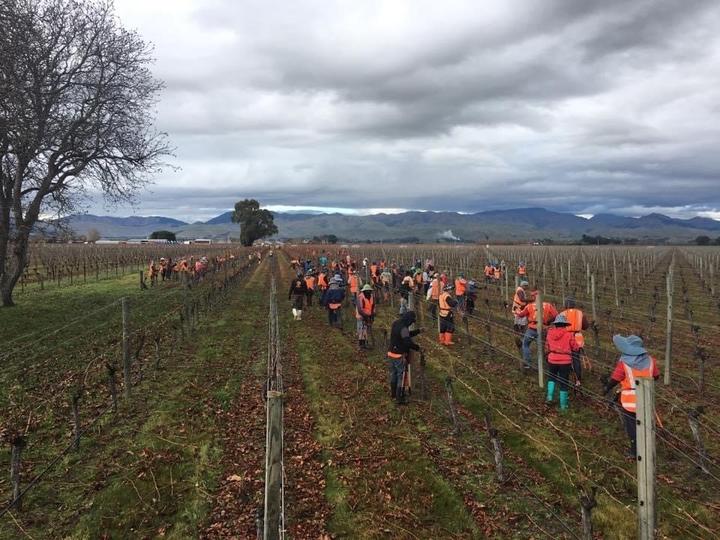
More than 30 Tongans have arrived in New Zealand to join the Recognised Seasonal Employers (RSE) Scheme.
.. Photo: Supplied/NZ Ethical Employers
An Air New Zealand flight left the Tongan capital Nukua’lofa on Tuesday and arrived in Auckland with passengers and cargo from the island.
RSE official Emma Sherwood said this was the first contingent of workers – 32 of them – from the Kingdom since the volcanic eruption and tsunami more than two weeks ago.
“They are going to a number of employers in Hawke’s Bay and Nelson as we come into the pip fruit harvest,” Sherwood said.
“But they will likely be given the opportunity to work in other sectors and different crops that come to harvest as well.”
Sherwood said the focus was now on helping bring more Tongan labourers to work in Aotearoa’s RSE Scheme.
The decision followed the devastation caused by the disaster on 15 January.
Three people died as a result and there was widespread damage to homes, resorts and infrastructure.
Sherwood said New Zealand stands ready to assist the Tongans.
“You know the first question in my first meeting post the tragic eruption with the Tongan group that we work with was what can we do? How can we still get people to New Zealand?
“They were so aware of how important the scheme would be going forward to ensure that workers are able to send money home to support their families.”
There are 800 Tongans in NZ’s RSE Scheme and majority of them work on average for seven months before heading back home, said Sherwood.
Fiji has reported three more deaths and 460 new cases of Covid-19 in the community.
There are now 1,558 active cases in isolation with the death toll at 801.
The deaths were recorded between last Thursday and Friday.
The Government also confirmed that all three victims, aged 46 to 92, had died at home.
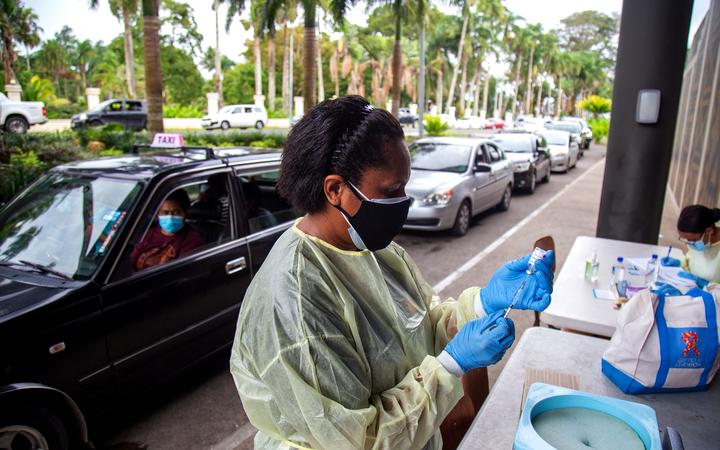
A health worker prepares a dose of the AstraZeneca vaccine for a resident at a drive-through vaccination centre in Suva. Photo: AFP / Leon Lord
Health Secretary Dr James Fong said the 92-year-old woman was from the Central Division.
The 46-year-old woman from the Western Division, had significant pre-existing comorbidities, Dr Fong said.
He said the 79-year old woman from the Central Division had a congenital comorbidity.
“Please note that due to the time required by clinical teams to investigate, classify and report deaths, a 4-day interval is given to calculate the seven days rolling average of deaths, based on the date of death, to help ensure the data collected is complete before the average is reported,” Dr Fong said.
He said as of January 20, the national seven-day rolling average for Covid-19 deaths per day was 2.9, with a case fatality rate of 1.32 percent.
“We have recorded 839 Covid-19 positive patients who died from other serious medical conditions unrelated to Covid-19.
“Their doctors determined that Covid-19 did not contribute to their deaths, therefore, these are not classified as Covid-19 deaths.”
Dr Fong said there were 100 Covid-19 patients in hospital – 42 in the west, 37 in the central division and 21 in the north.
Over 500,000 doses of Pfizer going to Fiji
A commitment of more than half a million doses of the Pfizer vaccine from New Zealand and Australia is expected to boost Fiji’s fight against Covid-19 over the next three months.
The first batch of 175,000 doses arrived in Fiji on Tuesday.
Fiji’s Health Secretary James Fong says the vaccine will be used for children aged 12 years and above, as well as the Covid-19 booster programme.
New Zealand had also committed 100,000 doses.
Australian High Commissioner to Fiji, John Feakes, said Australia would work with UNICEF and Fiji’s Health Ministry to improve the nation’s cold chain storage to support the rollout of the Pfizer vaccine.
Tonga have only four active cases of Covid this morning, a day after it was confirmed five people tested positive.
Minister of Health Dr Saia Piukala. Photo/Screenshot (FM87.5 online)
Prime Minister Hu’akavameiliku said one patient has recovered.
Health official tested 389 suspects yesterday. The results all came back negative.
The Minister of Health Hon Saia Piukala said this morning during a press conference that “Covid-19 is everywhere and is here to stay”.
He said people have to learn to live with it.
He said it says “we learn from our mistakes but God has given Tonga an opportunity to learn from others mistakes”.
Hon Piukala said he was referring to the opportunity of about two years the country was Covid free while the government was gearing up before this week’s first community transmissions.
Health CEO Dr Siale ‘Akau’ola said it was pleasing to see that Tonga was prepared to tackle the pandemic.
He said people can save many lives and help control the pandemic if they all commit to following mask guidelines and other standard preventive measures.
This was the third press conference held by the Prime Minister to update the country’s transmission which led to a five-day lockdown beginning yesterday.
A man’s body has been found by police divers in a lake on Auckland’s North Shore.
Lake Pupuke (file picture). (Source: istock.com)
The Police National Dive Squad was deployed to Lake Pupuke in Takapuna, after the man got into difficulty and disappeared into the water on Tuesday night.
“Despite efforts from his friend, the man disappeared into the water,” police said in a statement on Wednesday.
The body was recovered late on Thursday.
“Our thoughts are with the man’s friends and family at this difficult time, and Police are ensuring there is support for the family in place,” the police said.
Police are referring the man’s death to the coroner.
New Zealanders in Australia will be able to return home by the end of the month under a five-stage reopening plan announced by the government today.
The first stages of the plan would see returning vaccinated New Zealanders able to go into self-isolation and taking a test on arrival, rather than going into managed isolation and quarantine (MIQ).
The five stages:
11.59pm 27 February: Self-isolation opens for New Zealanders and eligible travellers coming from Australia
11.59pm 13 March: Open to New Zealanders and eligible travellers from the rest of the world; skilled workers earning at least 1.5x median wage; working holiday visas
11.59pm 12 April: Offshore temporary visa holders who still meet visa requirements; 5000 international students; consideration of further class exemptions for critical workforces that do not meet the 1.5x median wage test
By July: Anyone from Australia; visa-waiver travel; a new Accredited Employer Work Visa opens and skilled worker exemption is phased out
In October: Border reopens to the rest of the world, all visa categories fully reopen
Unvaccinated travellers would still go into MIQ, but with less demand the Defence Force would begin withdrawing and some facilities would return to being hotels. A core quarantine capacity would be maintained and scaled up, to become a National Quarantine Service.
The self-isolation period for returning travellers would match that for close contacts under the government’s phased approach to Omicron: 10 days under phase one, seven days under phase two and three.
All arrivals will be given three rapid antigen tests, returning results on day 0/1 and on day 5/6, with one extra test. Positive results will be confirmed with a PCR test.
Prime Minister Jacinda Ardern revealed the plan in a speech to Business New Zealand this morning, in which she defended the government’s use of MIQ.
“It’s easy to hear the word MIQ and immediately associate it with heartache. There is no question that for New Zealand it has been one of the hardest parts of the pandemic,” she said.
“But the choice to use it undeniably saved lives … MIQ meant not everyone could come home when they wanted to but it also meant that Covid could not come in when it wanted to, either.”
She said the tools used to help battle the health crisis had not stayed the same, and while some may feel anxious about the reopening plan, the isolation, testing and high vaccination rates would help keep the virus from spreading too quickly.
Ardern said the government would be continually monitoring the value of self-isolation, and it was possible it may not be needed in the “not too distant future”.
She also confirmed she would lead trade delegations this year to Australia, Asia, the United States and Europe.
“New Zealand is in demand. Our exports are at record highs, people want to live and work here, international students want to study here, our friends and whānau want to return,” she said.
“Covid laid bare our unsustainable reliance on temporary migrant labour. Immigration will continue to be a part of our economic story, but we have the opportunity now to build resilience into our workforces while also attracting the skills and talent we need. We have a chance to do things differently.”
“I hear much talk of a return to business as usual but we are better than business as usual … we must now carve our own recovery. On our terms.”
“We are vaccinated, increasingly boosted, and continue to prepare ourselves at home and work with a plan – and so now it is time to move forward together, safely.”
The critical worker border exemptions under Step 1 of the border reopening would cover:




:quality(70):focal(-5x-5:5x5)/cloudfront-ap-southeast-2.images.arcpublishing.com/tvnz/V2Q6UTVFBJBKXPOVQQF6CKGFPU.jpg)
