This article appeared on RNZ.co.nz and is republished with permission.
A 57-year-old Tongan man says he swam about 27 hours to get to shore after getting swept out to sea during Saturday’s devastating tsunami.
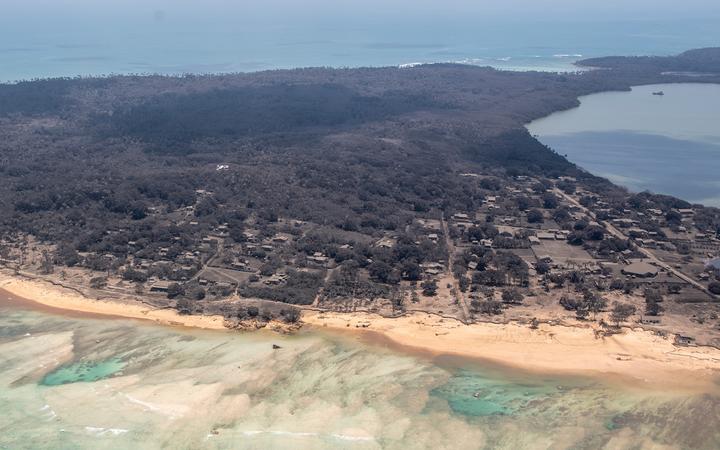
A P-3K2 Orion aircraft flies over an area of Tonga that shows ash from Saturday’s volcanic eruption on homes and surrounding vegetation. Photo: New Zealand Defence Force. Licenced under Creative Commons BY 4.0.
Lisala Folau, who lived on the small, isolated island of Atatā which has a population of about 60 people, was swept out to sea when the waves hit land at about 7pm on Saturday, he said in a radio interview to Tongan media agency Broadcom Broadcasting.
Folau said he was painting his home when he was alerted about the tsunami by his brother, and soon the waves had gone through his lounge.
He climbed on a tree to escape but when he got down another big wave swept him away, he said. The 57-year-old said he was disabled and could not walk properly.
“I just floated, bashed around by the big waves that kept coming,” he told the radio station.
Folau said he kept floating, and slowly managed to swim 7.5km to the main island of Tongatapu, reaching the shore 27 hours later at about 10pm on Sunday.
Reuters was unable to contact Folau or verify the events.
Lisala Folau. Photo/Supplied
The story of Folau’s heroics went viral among Tongan groups on Facebook and other social media.
“Real life Aquaman,” said one post on Facebook, referring to the comic book and film chracter.
“He’s a legend,” said another post.
Atata, which is about 8km northwest of Tonga’s capital Nuku’alofa, or a 30-minute boat ride, has been almost entirely destroyed in the tsunami that hit the islands.
Tongan naval boats are still surveing the smaller islands and evacuating people to the main islands.
A World Health Organisation representative in Tonga says the international airport has been cleared of volcanic ash which will allow humanitarian aid flights to arrive.
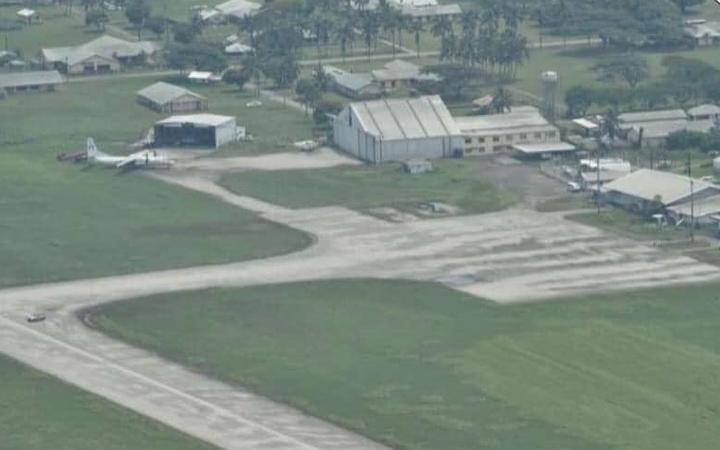
Fua’amotu International Airport seen with a covering of ash in an aerial photo taken from an NZDF Orion earlier this week. Photo: NZDF
Hundreds of volunteers, workers and Tongan defence force personnel have been clearing the debris from the runway by hand.
WHO liaison officer in Tonga Dr Yutaro Setoya, who is in Nuku’alofa on the main island Tongatapu, told RNZ’s Pacific reporter Eleisha Foon there had been a thick layer of ash on the runway preventing planes from landing.
“The runway, I understand, was cleared to be able to be used from outside [the country]. I understand humanitarian flights are coming in,” Setoya told RNZ by satellite phone.
A New Zealand Defence Force C-130 Hercules is on standby and will be able to to take off once the all clear has been given, bringing supplies of water, hygiene kits and other goods. Two Australian Air Force Hercules are also ready to depart.
One of Tonga’s main communications providers, Digicel, said it had restored international calls to Tonga via satellite.
But until the undersea communications cable is restored its network services will not be fully operational, it said.
It is expected to take at least a month to complete repairs on the cable that carries the bulk of internet and phone communications to Tonga.
Digicel Tonga is giving out free sim cards from Thursday morning, with the company saying it knows how desperate family and friends overseas are to connect with relatives.
Three people are confirmed to have died after Saturday’s massive volcanic eruption and tsunami. Houses on the island of Mango in the Ha’apai group were destroyed, and the majority of structures on Atatā on Tongatapu, about 6km north Nuku’alofa, were all but wiped out by the tsunami.
There has been extensive damage to Fonoifua and Nomuka Islands. Evacuations of residents are underway. Western parts of the main island of Tongatapu are also badly hit, with dozens of houses destroyed.
Their first task is to offload desperately needed water, but distributing supplies will be complicated by the need to maintain Covid-19 protocols.
Tonga is free of the virus, and Tongan and New Zealand officials are still working out how foreign assistance can be done in a contactless way.
A second New Zealand Defence Force P3 Orion surveillance flight was carried out on Wednesday and also included Fiji’s southern Lau Islands, at the request of the government of Fiji.
The Tongan government has begun a huge cleanup operation in the capital.
Setoya said Tonga needed access to emergency funding and immediate humanitarian supplies from overseas, but he believed most of the response to the devastating volcanic eruption could be handled domestically.
He said people affected by the volanic eruption were resilient and strong and were helping others clean up.
“Tongan people are strong and very quick to react,” he said.
“People are cleaning ashes from the ground and the roof … hand in hand, cleaning the houses together. So I think there’s a good energy in Tonga.”
He said Tonga needed rain to wash away the ash.
“Because ash is everywhere and has to be washed away before we get clean water [from roofs] … many people depend on rain water in Tonga.”
An expert in natural disasters says it’s absolutely possible Tonga’s volcanic eruption could have sparked tsunami waves reaching 15-metres high at their peak.
GNS principal scientist Bill Fry. Photo: RNZ / Rebekah Parsons-King
Five days on from one of the largest volcanic eruptions in the past 30 years, more details are emerging about the destructive tsunami triggered by Tonga’s Hunga-Tonga-Hunga-Ha’apai volcano, and the damage it caused.
GNS seismologist Bill Fry said while 15 metres is an enormous height to imagine, it’s likely the waves splashed up to that height in some places, rather than rushing in as a wall of water 15m high everywhere.
“It’s quite possible that the 15m is a maximum height that the water reached inland when it was coming in and sloshing around. It had a lot of force. If you think about throwing a bucket of water out onto a deck, if it hits a wall or it hits your fence, that could splash up a bit.
“The same type of thing can happen with a tsunami, and I expect that 15m is probably the maximum extent at which it splashed up.”
Fry said it would not have reached 15m everywhere.
“When we look at point measurements of the wave amplitude or the wave height, with a coastal run up, we’re always seeing something that’s both the effect of the incoming tsunami – the tsunami that was generated, and also the local effects of the coastline, the shape of the coastline.
“Does the coastline look like a funnel that sends all of the energy into a particular place, and of course makes that energy more focused and has higher run ups? Or does it look like a shape that spreads the energy out and has much lower height waves – lower amplitude waves?
“So I think that 15m measurement was probably the former case, where there is some sort of local topography that funnelled the energy to a particular place and made it slosh up to that 15m.”
Foreign Minister Nanaia Mahuta yesterday said the outer islands of Tonga were extensively damaged.
Evacuations began Wednesday morning for residents on some of the smaller islands of Ha’apai, with about 150 people evacuated to other islands, Mahuta said.
The Tongan government said Mango, Atatā, and Fonoifua islands were being evacuated, and multiple people were injured.
People were also being evacuated from the western side of Tongatapu, including Kanokupolu, where dozens of homes have been damaged.
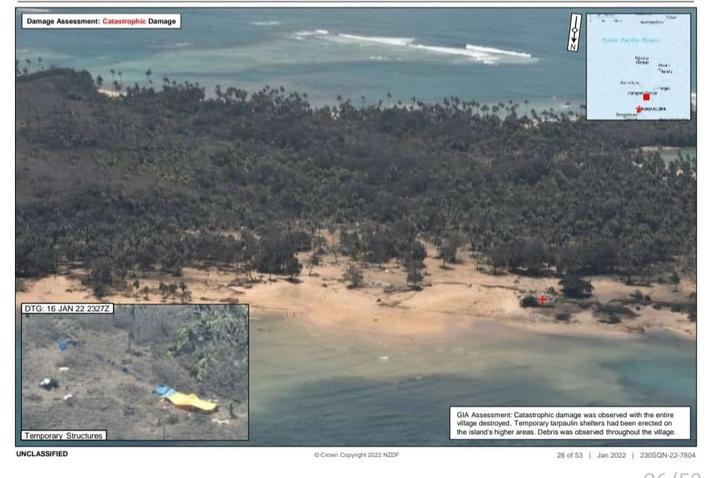
Structures on two islands have been completely wiped out: on the island of Mango, all of the homes have been destroyed – aerial images from a New Zealand Defence Force flight show just a few temporary tarpaulin shelters still standing.
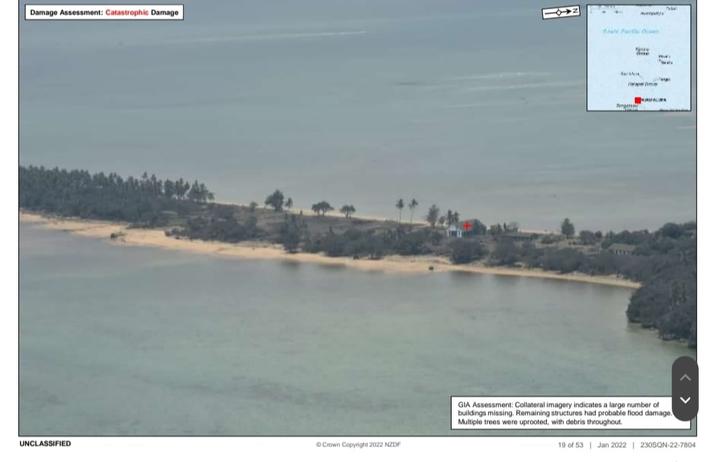
And it appears almost every structure on the island of Atatā has been destroyed. The New Zealand Defence Force described the damage there as “catastrophic” after surveillance flights.
The United Nations Institute for Training and Research (UNITAR) also released a preliminary assessment that 72 structures had been damaged on Atatā and the entire island covered in ash.
The exact damage to the Tonga undersea cable won’t be known until the cable repair ship, the Reliance, arrives in Tonga and pulls the cable up out of the sea.
The cable repair vessel. Photo: Twitter/ @tongaportal
Tonga Cable Limited chairperson Samuiela Fonua said “There is really not much we can say until the ship pulls the cable up so it can be multiple breaks on the segment to Fiji.
“They are bringing a spare repeater (equipment) just in case the repeater is at fault as well. So far, the tests they run indicate the faults that we are reporting now. But there can be other faults on the line when they do the actual connectivity.
“They would normally run tests from both ends so the guys from Fintel (Fiji) did that and it is called a bi-directional assessment and that will somehow determine whether there is cut to the cable.”
He had so far managed to talk to his team of engineers on Sunday and was in contact with them from Auckland, where he had family matters to attend to.
“The fact I’m in Auckland and the only active communication we’ve managed to activate is with our engineers that was on Sunday afternoon we were able to get in touch with them via satellite phone,” Fonua said.
“It was then they informed us together with email from Fintel Fiji that after running some test, that there seem to be a cut on our international cable and our domestic cable.
“It is the southern cross cable extension Suva, Fiji to Tonga. On the international cable it is about 37km offshore from Nuku’alofa and 47km for domestic cable.
On Monday he met with the cable repair company – which was already in motion to begin the task of repairing the cable.
“We had a meeting with the company US Subcom and they have assured us they will initiate the recovery process by starting to prepare the vessel which is currently docked in Papua New Guinea,” Fonua said.
“They are estimating about three or four days of prep work that will allow them to set sail for Samoa and they have a facility in Samoa and normally the ship would be docking in Samoa or New Caledonia.”
The ship had docked in PNG so staff could get vaccinated en route from Singapore where it had been for a five-year routine maintenance.
“They have to travel to Samoa first to pick up their equipment and we some spare stuff there that we will need for the operation. The preparation to come to Samoa is not an issue it will take three to four days and it won’t take long to pick up stuff in Samoa,” Fonua said.
“The real concern for us now regarding time is the readiness of the site or the conditions of the site because the cable lies in the area that was really affected by the eruption and the domestic cable is very near the eruption site.
“So, until they receive some clearances from the government of Tonga they may hang around Samoa for sometime for that to be confirmed but it won’t take that long to come to Tonga. It will take a day and a half to come to Tonga.”
They expected to get clearance fairly quickly with urgency to have the cable repaired so that phone, internet and communications could be restored.
Internal phones restored
Internal phone lines are expected to be re-established soon in Tonga.
Fonua said Tongans would be able to make domestic calls.
The only phone calls being made out of Tonga now have been via satellite phones.
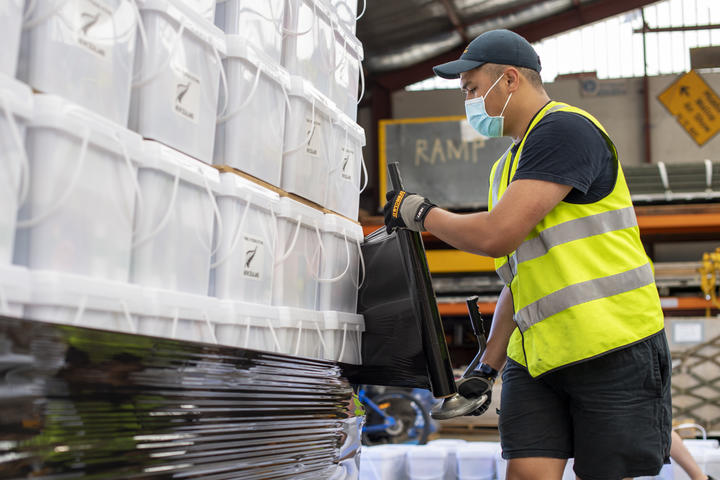
The Aotearoa Tonga Relief Committee is gearing up to collect and send non-perishable foods to Tonga in the wake of the twin disaster.
Another aid consignment for Tonga – this to be sent sometime this week by the NZDF Photo: Supplied / Dillon Anderson Photography via NZDF
The New Zealand Committee is urgently seeking donations of non-perishables like rice, flour, cooking oil, sugar, cabin bread, canned meat, toilet paper, and bottled water.
Priority will be given for family-to-family donations.
Co-chair of the Committee, Anahila Kanongata’a-Suisuiki asked for donations do not expire before at least July this year.
“We are providing a process where they can bring their goods to be sent to their loved ones in Tonga. People will then come to pack their goods into drums – evry item in each drum will be recorded. Big job, but every volunteer that we have got is willing to make it happen,” she said
She said donations can be dropped to Mt Smart Stadium this Friday between 9am to 8pm.
Fiji prepares for acid rain
Fijian authorities are warning the sulphur dioxide (SO2) concentration in the atmosphere has increased overnight and could result in acidic rainfall over the country.
The Department of Environment said it’s monitoring the air quality in Fiji, following the Hunga-Tonga Hunga-Ha’apai volcanic eruption in Tonga last weekend.
Fijians are urged to cover all household water tanks and stay indoors in the event of rain.
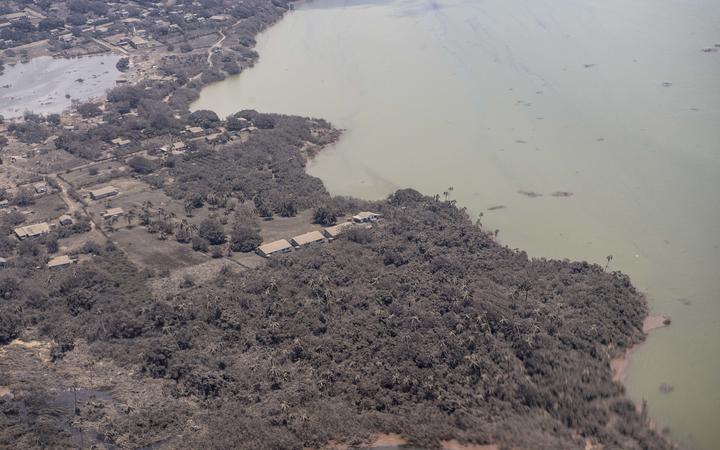
New images appear to show the majority of structures on the Tongan island of Atatā have been wiped out after a tsunami and volcanic eruption last week.
An aerial view of Atatā island taken by New Zealand Defence Force after the eruption of Hunga Tonga-Hunga Ha’apai and tsunami. Photo: NZDF
The New Zealand Defence Force has described the damage to the island of Atatā as “catastrophic” in its surveillance photo, which was posted online by a resort based there.
The United Nations Institute for Training and Research (UNITAR) also released an image of Atatā island on 18 January, with an assessment that 72 structures had been damaged and the entire island covered in ash.
However, it noted it was a preliminary analysis and had not yet been validated on the ground.
The Royal Sunset Island resort posted on Facebook that all residents had now been evacuated to the mainland.
The resort was fully submerged by the tsunami and it was not expected there would be much left.
Other satellite imagery circulating online also appeared to show major damage on the island.
The ships were sent before an official request for help from the Tongan government, but the statement from Minister of Foreign Affairs Nanaia Mahuta’s office this afternoon confirmed the vessels – expected to arrive by Friday, depending on weather – had been approved.
The eruption was likely the world’s largest in the past three decades, and support and aid efforts have been stymied by communications outages after the blast.
US company SubCom expected repairs to the undersea cable, which carries most of Tonga’s communications, would take at least four weeks.
A mobile network was expected to be established using the University of South Pacific’s satellite dish today, though the connection would likely be limited and patchy.
Volcanic activity and tsunami risk continues to be monitored.
The Tongan government has confirmed that all houses on the island of Mango were wiped out in the tsunami that followed Saturday’s volcanic eruption.
An aerial photo taken from a New Zealand Defence force P-3 Orion on January 16, 2022 shows Mango island in Tonga with no houses left after impact from a tsunami. The inset image shows some makeshift shelters. Photo: Crown copyright 2022 NZDF
It confirmed that three people are now known to have died: a 65-year-old woman in Mango and a 49-year-old man in Nomuka, both in the outlying Ha’apai island group; as well as British national Angela Glover in Tongatapu.
The Tongan navy had deployed with health teams and water, food and tents to the Ha’apai islands.
One aerial image taken by the New Zealand Defence Force (NZDF) showed Mango and described the damage there as “catastrophic”.
No houses, but just a few temporary tarpaulin shelters could be seen.
A view over Nomuka in Tonga from a New Zealand Defence Force P-3K2 Orion surveillance flight after the islands were hit by a tsunami triggered by an undersea volcanic eruption. Photo: Supplied / NZ Defence Force
The Tongan government said Mango, Atata, and Fonoifua islands were being evacuated, and that water supplies in Tonga were seriously affected. It said all houses were destroyed on Mango Island, only two houses remained on Fonoifua and extensive damage occurred on Nomuka Island.
The government also said there were multiple injuries.
It is the first official statement the kingdom has made about the disaster to international media.
The government said parts of the western side of Tongatapu, including Kanokupolu, were being evacuated after dozens of houses were damaged, and that in the central district many houses were damaged in Kolomotu’a and on the island of ‘Eua.
A diplomat, Tonga’s deputy head of mission in Australia, Curtis Tu’ihalangingie, earlier described the images taken by the NZDF reconnaissance flight as “alarming”, saying they showed numerous buildings missing on Atata island as well.
“People panic, people run and get injuries,” Tu’ihalangingie told Reuters. “Possibly there will be more deaths and we just pray that is not the case.”
With communications in the South Pacific island nation cut, the true extent of casualties is still not clear.
Australia’s Minister for the Pacific Zed Seselja said conditions on other outer islands were “very tough, we understand, with many houses being destroyed in the tsunami”.
The Tongan navy reported the area was hit by waves estimated to be 5m-10m high, said the UN Office for the Co-ordination of Humanitarian Affairs.
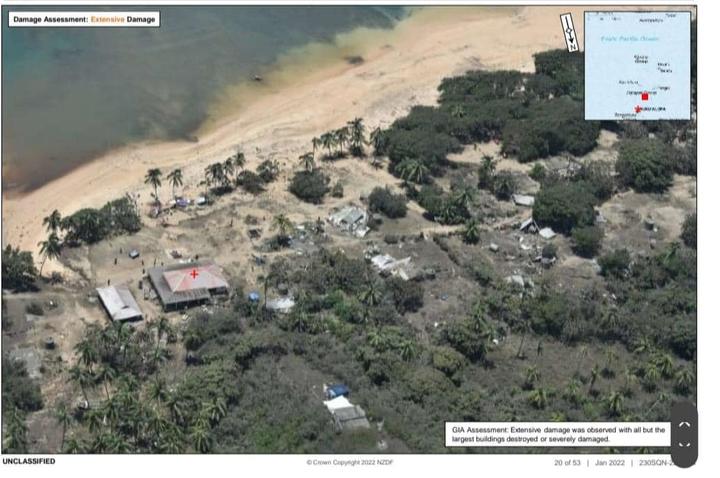
Fonoifua Island in Ha’apai, Tonga, as seen from an NZDF P-3 Orion reconnaissance flight after the eruption of Hunga Tonga-Hunga Ha’apai. The image caption says all but the largest buildings were destroyed or severely damaged. Photo: NZDF
Atata and Mango are between 50km and 70km from the Hunga Tonga-Hunga Ha’apai volcano, which sent tsunami waves across the Pacific Ocean and was heard some 2300km away in New Zealand when it erupted on Saturday.
Atata has a population of about 100 people and Mango about 50 people.
“It is very alarming to see the wave possibly went through Atata from one end to the other,” Tu’ihalangingie said.
The NZDF images were posted unofficially on a Facebook site and confirmed by Tu’ihalangingie.
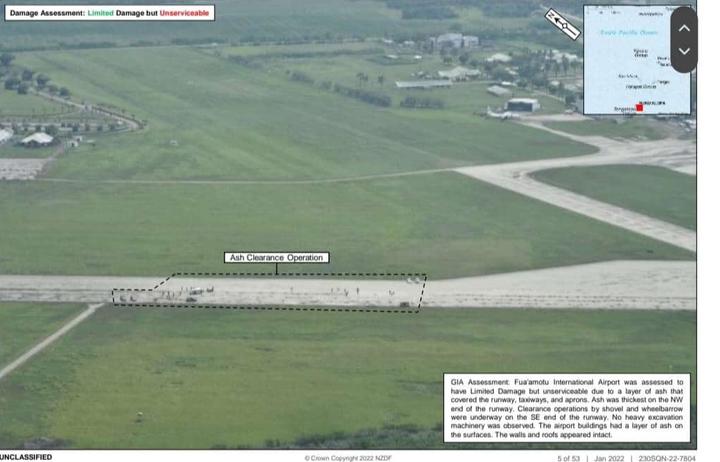
Fua’amotu International Airport in Tonga as seen from a New Zealand Defence Force P-3 Orion reconnaisance flight, after the eruption of Hunga-Tonga Hunga-Ha’apai. The image caption says workers are using shovels and wheelbarrows to clear volcanic ash from the runway. Photo: Crown copyright 2022 NZDF
Taken from a P-3K2 Orion plane, they also showed workers on the runway clearing volcanic ash at Fua’amotu International Airport, the country’s main airfield.
One caption described the runway as “unserviceable” because of the layer of ash on it, meaning aircraft cannot land there.
It said the clearance operation was being done with shovels and wheelbarrows, and that “no heavy excavation machinery was observed”.
The Tongan government said wharves were also damaged in the eruption.
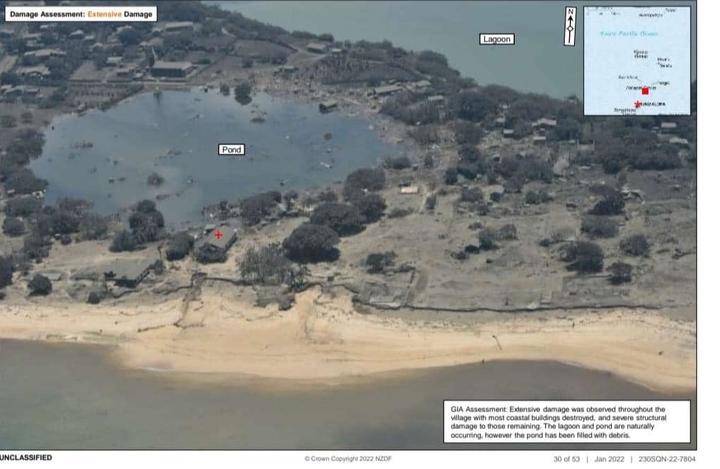
Nomuka Island in Ha’apai, Tonga, as seen from an NZDF P-3 Orion reconnaisance flight after the eruption of Hunga Tonga-Hunga Ha’apai. The image caption says extensive damage was observed through the village with most coastal buildings destroyed. Photo: NZDF
‘We try to keep a positive mind’
Aucklander Lavinia Faleofa’s uncle, cousin and in-laws live on Nomuka island in one of the closest villages to the volcano, just 70km to the north-east.
Faleofa’s aunt is with her in New Zealand, and had been due to catch a repatriation flight back to the island this week.
The family last spoke to their relatives on Friday, when they talked about their aunt finalising the paperwork for her aunt’s flight home.
“There was no thoughts that we would not be speaking after that conversation,” Faleofa told RNZ.
The family have tried to reach their relatives online and have made repeated calls to their home phone.
“We know that it’s down, but we know that there’s always that hope that you might call, it might ring, and they might answer.
“We try to keep a positive mind, we are trying to be optimistic.”
She hoped her uncle and family were able to move inland from their house which faces one of the beaches.
Faleofa said Nomuka was unrecognisable in the aerial images taken after the eruption which had covered the colourful rooftops and white sand with grey ash.
“I can’t come to fathom that, that is what it looks like right now.
“I’ve never seen anything like it”.
Faleofa’s aunt has been on a rollercoaster of emotions, she said. “Without anybody telling us we already knew that there was no way in a couple of weeks that she’d be going back.”
– Reuters / RNZ
FAKAMATALA NOUNOU FAKATONGA
Kuo fakapapau’i mei he pule’anga Tonga ‘i ha’anau fakamatala tonu ki he mītia kuo ‘i ai ha fine’eiki ta’u 65 mei Mango kuo mate, mo e ta’u 49 mei Nomuka pea pehē ki he fefine Pilitānia ko Angela Glover. Kuo ‘osi tuku atu ‘e he pule’anga Tonga ‘ene timi ngāue ki he Mo’ui’ ki he ‘otu motu’ mo e vai inu, me’akai mo e tēniti.
‘Auha kotoa ‘a e ngaahi ‘api ‘i Mango’. Fale pe ‘e ua kei tu’u ‘i Fonoi, pea ne uesia mo Nomuka foki. Ko Mango kuo ‘ikai toe ‘i ai ha fale ai ko e teniti tapoleni pe.
Kuo fai hono fetukutuku ‘o Mango, ‘Atatā, Fonoifua pea ‘oku uesia ‘aupito ‘a e vai inu ‘i Tonga. Pehē ‘e he pule’anga Tonga’ ne lahi ‘a e lavelavea. ‘I ai ‘a e ngaahi fale ne maumau’I ‘I Kanokupolu pea kuo fai ‘a e fetukutuku mei ai. Lahi foki e ngaahi fale ne maumau’I ‘I Kolomotu’a mo ‘Eua.
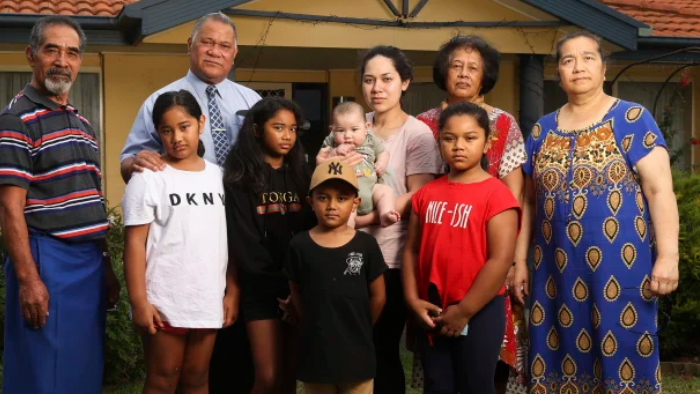
As the first details of the extent of damage in Tonga from Saturday’s volcanic eruption begins to emerge, Tongans in Australia remain anxious to contact their families.
The Aholelei and Kaho family members wait to hear from their relatives (Taani Kaho, Niela Aholelei, Sikahema Aholelei, Roberta Aholelei, Fonise Aholelei, Veteange Aholelei, Eseta Aholelei, Luisa Aholelei, Ofa Kaho and Manuefanga Aholelei) CREDIT:ALEX ELLINGHAUSEN
The Red Cross estimates 80,000 people may have been affected by the eruption and the tsunami that followed.
The first death has been confirmed as a British woman who was swept away.
Satellite photographs show that the uninhabited Hunga Tonga-Hunga Ha’apai island was virtually obliterated by the blast.
New Zealand Prime Minister said Nuku’alofa had suffered significant damage, with boats and large boulders washed ashore on the northern side of the capital.
The city was covered in a thick layer of volcanic dust.
There has been little news of damage in the outer islands. An RNZAF Orion made a reconnaissance flight over the area yesterday to assess damage,
There are fears that volcanic ash may contaminate water supplies and people have been asked to drink bottled water.
As news of the damage emerges, Tongans living in Australia have continued to try to contact their families.
President of the Tongan Association for Canberra and Queanbeyan Sikahema Aholelei said the past few days had spent nervously, watching the news and listening to the radio for updates.
Aholelei told the Melbourne Age the last time he spoke to his family was on Saturday night. He said there was a sound like thunder and then the line went dead.
“We keep trying and seeing if we can contact them by phone, WhatsApp, or Facebook,” he said.
“But maybe they haven’t been able to charge their phones.”
Queensland man Mosese Sitapa said he was calling his son Elone when the tsunami smashed through their home in Tonga.
The last time Sydney resident Petilise Tuima spoke with her family was on Saturday afternoon as they evacuated to higher ground, with 14 people squeezed into a small car.
“We are quite stressed at the moment,” she said.
“They didn’t take any food, they just took water … everyone was packed in the car. Everyone is calling each other within our Tongan groups, wanting to see if anyone has picked up or heard anything … We are just desperate.”
Tongan Olympian Pita Taufatofua has started a fundraising page for victims of Saturday’s devastating volcanic eruption.
He said he had not heard from his family, including his father.
“For now my focus is what I can do from my current position,” he said.
“My focus is on the people of Tonga who will need all our help to rebuild.
“Many Tongans around the world are in the same boat as me and worried about their families in Tonga.”
Last weekend’s volcanic eruption could be an inspiration for the nation’s rugby league team.
Speaking from the UK, Tonga’s coach Kristian Woolf told the Sydney Morning Herald the eruption would motivate the team to “try and put a smile on the locals’ faces” when they played in the World Cup at the end of the year.
Woolf said he and several players, including Konrad Hurrell, had still not been in contact with their families in Tonga.
As we reported yesterday, Tonga has faced severe communications problems, with the undersea cable cut in two places and only very limited satellite communication.
“I know a lot of people over there, I’ve spoken to a number of players who have a lot of close family in Tonga, but nobody has been able to have any contact at this stage – the worst thing is not knowing anything,” Woolf said.
He said news about the eruption was devastating.
“You can only hope everyone has got to higher ground,” Woolf said.
“You hope everything is alright, and everyone is in your thoughts, but not having that contact at the moment makes it really difficult.”
“All the players have either parents or siblings, grandparents, aunties and uncles living there – they have all been affected and are hoping for the best.
“The reason the players make the sacrifices they do to play for Tonga is the chance to make their families proud.
“The time will come to represent Tonga at the World Cup, and hopefully we can put some smiles on their faces.”
Tonga, whose last Test was the historic win over Australia, will have a warm-up game against France in France before the World Cup, which will begin in England at the end of October.
Relief for victims
There has been talk among some rugby league players about putting together a relief package for victims.
Tongan rugby union player Malakai Fekitoa, who plays for the Wasps in the UK, has launched a fundraising drive.
Ha’api-born Fekitoa, who has not been able to contact his mother in Tonga, is raising money to buy essential products.
“I haven’t had the opportunity to communicate with my mother and all my family who are there,” Fekitoa wrote on GoFundMe. “I am making this collection in first person cause I want to make sure that all the aid destined is received by the community.
“We need to send essential products, so we will send as many containers as possible from Auckland to Tonga.”
Fekitoa the next ship was due to leave Auckland for Tonga is on January 22.
More than 130 donations have already been made including from current and former Wasps players.
The main points
Tongan rugby league and union players in the UK are anxious to contact their families.
Players from both codes are planning action to support victims of the eruption.
Kristian Woolf, who coaches Tonga’s national team, said the eruption could be an inspiration for the Tongan side in this year’s World cup.
For more information
‘Worst thing is not knowing’: Tongan players’ agonising wait for contact from loved ones
The Ministry of Foreign Affairs and Trade has confirmed two deaths so far following the volcanic eruption and tsunami in Tonga on Saturday..
“Initial reports from inside Tonga, channeled via Dr Setoya, are that buildings and infrastructure have been damaged – around 100 houses have been damaged and 50 completely destroyed just on the main island of Tongatapu.
“Two deaths have been reported to date. Many remain displaced, with 89 people taking shelter in evacuation centres on the island of ‘Eua and many more seeking shelter with relatives. Around 2cm of ash and dust has fallen on Tongatapu, raising concerns of air pollution and the potential contamination of food and water supplies.
“Thankfully, all health facilities on Tongatapu are fully functioning and clean-up efforts have been initiated”.
A P-3K2 Orion aircraft flies over an area of Tonga that shows Ash on homes and surrounding vegetation. Photo: New Zealand Defence Force. Licenced under Creative Commons BY 4.0.
The Hunga Tonga-Hunga Haʻapai volcano, which erupted on Saturday, was about 65km north of Tonga’s capital Nuku’alofa.
There is now a huge clean-up operation in the town, which has been blanketed in thick volcanic dust.
Serious damage has been reported from the west coast of Tongatapu and a state of emergency has been declared.
The Ministry of Foreign Affairs and Trade has confirmed two deaths so far, but Fiji-based United Nations co-ordinator Jonathan Veitch said there were still areas that had not been contacted.
Acting High Commissioner for New Zealand in Tonga Peter Lund told Tagata Pasifika he could see rubble, large rocks and damaged buildings, with serious damage along the west coast of Tongatapu.
“There is a huge clean-up operation underway, the town has been blanketed in a thick blanket of volcanic dust, but look they’re making progress… roads are being cleared,” he said.
“I have worked in a lot of emergencies but this is one of the hardest in terms of communicating and trying to get information from there. With the severing of the cable that comes from Fiji they’re just cut off completely. We’re relying 100 percent on satellite phones.
“We’ve been discussing with New Zealand and Australia and UN colleagues … and we hope to have this [cable] back up and running relatively soon, but it’s been a bit of a struggle.”
It had been “a lot more difficult” than regular operations, Veitch said.
One of the biggest concerns in the crisis was clean water, he said.
“I think one of the first things that can be done is if those aircraft or those ships that both New Zealand and Australia have offered can provide bottled drinking water. That’s a very small, short-term solution.
“We need to ensure that the desalination plants are functioning well and properly … and we need to send a lot of testing kits and other material over there so people can treat their own water, because as you know, the vast majority of the population in Tonga is reliant on rainwater, and with the ash as it currently is, it has been a bit acidic, so we’re not sure of the quality of the water right now.”
Another issue was access.
“Tonga is one of the few lucky countries in the world that hasn’t had Covid … so we’ll have to operate rather remotely. So we’ll be supporting the government to do the implementation and then working very much through local organisations.”
For those in Tonga who were cut off, Veitch said the main message was “everybody is working day and night on this. We are putting our supplies together. We are ready to move. We have teams on the ground. We are coming up with cash and other supply solutions … so help is on its way”.
A map from the United Nations released online on 17 January illustrated the effects of the volcanic eruption in Nomuka island as detected from a satellite image.
It noted, however, this was a preliminary analysis and has not yet been validated in the field.
Tonga’s deputy head of mission in Australia, Curtis Tu’ihalangingie, said Tonga was concerned that aid deliveries could spread Covid-19 to the Covid-free nation.
“We don’t want to bring in another wave – a tsunami of Covid-19,” Tu’ihalangingie told Reuters by telephone, urging the public to wait for a disaster relief fund to donate.
Any aid sent to Tonga would need to be quarantined, and it was likely no foreign personnel would be allowed to disembark aircraft, he said.
The UN Office for the Coordination of Humanitarian Affairs said there had been no contact from the Ha’apai group of islands and there was “particular concern” about two small low-lying islands – Fonoi and Mango, where an active distress beacon had been detected.
According to the Tonga government, 36 people live on Mango and 69 on Fonoi.
Australia’s Minister for the Pacific Zed Seselja said Tongan officials were planning to evacuate people from outer islands where “they’re doing it very tough, we understand, with many houses being destroyed in the tsunami”.


 A Flourish data visualization