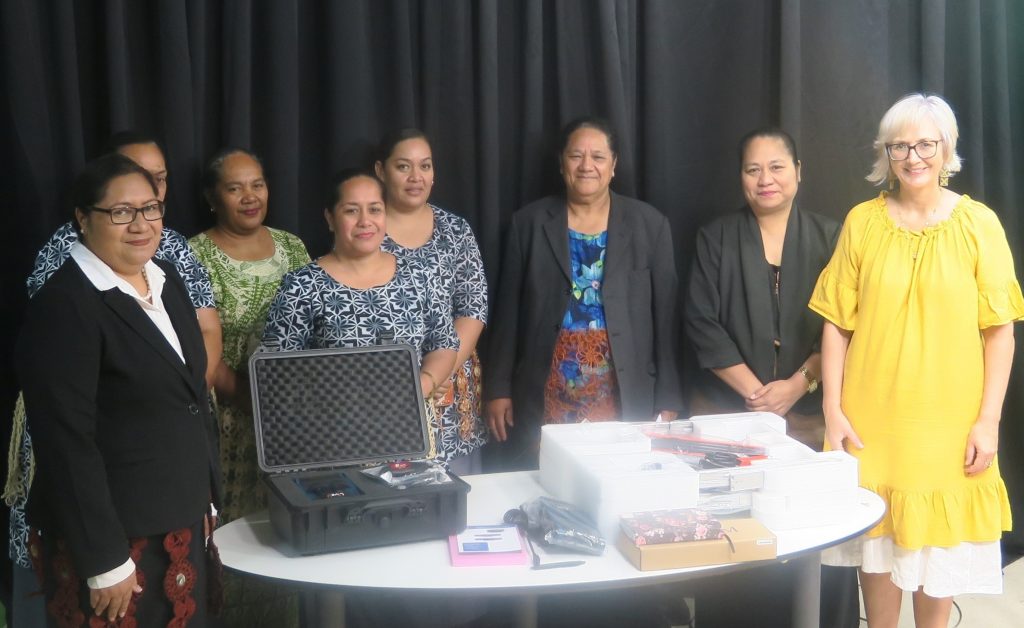
New Zealand High Commissioner Tiffany Babington, presented new broadcasting equipment from Pacific Cooperation Broadcasting Limited (PCBL) to Tonga Broadcasting Commission (TBC) today.
This connectivity initiative reflects Aotearoa New Zealand’s commitment to building strong and more resilient partnerships in the Pacific. Photo/Supplied
PCBL, also known as Pasifika TV, is a New Zealand Government initiative funded by the Ministry of Foreign Affairs and Trade. It aims to strengthen relationships in the Pacific through building the capacity and capability of Pacific free-to-air broadcasters. It supports the Pacific media sector by delivering New Zealand originated content that can be rebroadcast to local audiences and supports the production of local content via the provision of field equipment and training.
Earlier this year, TBC was successful in receiving funding from the contestable Pasifika on Air Fund to produce a series focussing on COVID resilience in the Kingdom. This programme is currently in production in cooperation with Auckland-based production house Sunpix.
After consultation with Pacific broadcasters, and following on from journalism training, PCBL earlier this year gifted TBC field production equipment, including a camera, lighting and audio kits and editing laptops to support remote reporting.
“The further equipment presented today will enable TBC to share live and local news content across the Pacific via PCBL’s PacHub network. PacHub is built on the LiveU infrastructure, which is used widely internationally, and is an industry standard for live transmission and news gathering” Natasha Meleisea, CEO of PCBL said.
“We will soon see eight Pacific countries contributing news content on a daily basis to the Pasifika TV service for rebroadcast across the region. I am pleased Tonga is part of this huge milestone for broadcasting in the Pacific of connecting newsrooms across the Pacific. Sharing news and information will enable Pacific countries to learn more about what is happening in each other’s territories” Her Excellency Tiffany Babington, New Zealand High Commissioner said.
“We are indeed grateful as PCBL has been helping the [Tonga Broadcasting] Commission financially and technically for several years including the hand-over of this equipment under Content Sharing Program of PCBL with TBC and other free-to-air Pacific Broadcasters today. We are pleased that we can continue to provide support to PCBL during this time to best meet the needs of this project, that is to share content LIVE within the Pacific Region.” Mrs Petunia Tupou, Chair of Board of Directors for Tonga Broadcasting Commission said.
This connectivity initiative reflects Aotearoa New Zealand’s commitment to building strong and more resilient partnerships in the Pacific.
Pacific nations are set to benefit after World Rugby decided that players will be allowed to switch national teams from next year subject to certain criteria.
The revised regulation will apply from January 1 and a player must either be born in the country to which they wish to transfer or have a parent or grandparent born in that nation.
The player must also stand down from international rugby for a period of 36 months and may change unions only once, subject to approval by World Rugby’s regulations committee.
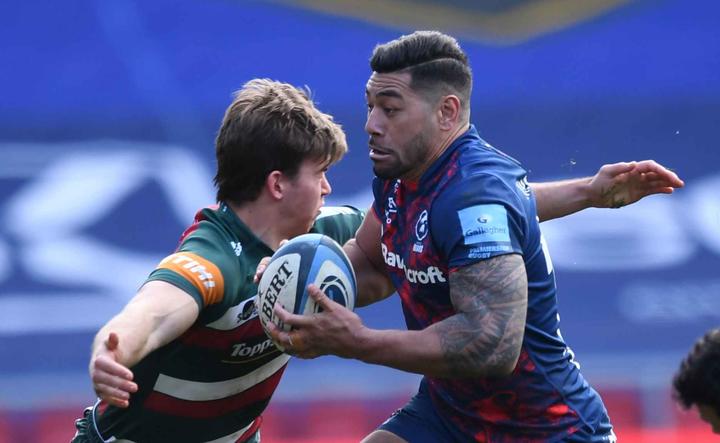
Charles Piutau played the last of his 17 tests for the All Blacks in 2015. Photo: PHOTOSPORT
While the move will help the likes of Tonga and Samoa, with former All Black Charles Piutau among those who will switch nationality, there will be strong opposition from other emerging nations who prioritise the selection of home-grown players and will not benefit from the ruling.
Piutau played the last of his 17 tests for the All Blacks six years ago and has stated that he wants to represent Tonga.
The former Blues and Samoa halfback Tino Poluleuligaga says the changes will be hugely beneficial for the likes of Samoa, Fiji and Tonga.
“It just didn’t feel right that we are at the World Cup every four years but we didn’t have the best players there. So for this rule change to happen it’s absolutely phenomenal. We can’t wait for the 2023 World Cup which is going to feature all our superstars,” he said.
“We have listened to our membership and players and sought to update the regulation recognising the modern professional rugby environment without compromising the integrity of the international game,” said World Rugby chairman Bill Beaumont.
“We believe this is the fairest way to implement progressive change that puts players first while also having the potential to support a growing, increasingly competitive international men’s and women’s game.”
International transfers are currently permitted in rugby sevens to allow players to participate in the Olympics.
COMMENTARY Tongan authorities’ excuses for their lack of flights taking RSE workers home because there were other passengers stuck in New Zealand and Australia and they were all urgent cases are pathetic.
Ministry of Internal Affairs chief executive Dr Fotu Fisi’iahi told Radio New Zealand the government was committed to bringing home the RSE workers, but only when it was safe.
Dr Fisi’iahi said there were more Tongan citizens stranded in New Zealand and Australia than RSE workers and both groups were urgent.
RSE scheme liaison Sēfita Hao’uli has asked Tonga’s newly elected MPs to charter an aeroplane for the RSE workers.
Dr Fisi’iahi said workers could negotiate their own repatriation flight, but the government would have nothing to do with it.
Government mission
The authorities should not compare the RSE workers with other Tonga citizens stranded in New Zealand and Australia. Most of these non-RSE workers did not arrive in these countries on government employment missions. These people mostly came on visitors’ visas and have families and relatives they can stay with during the lockdown.
The RSE workers came through a government mission in late 2019 and have been stuck here ever since. The government should give them special treatment in terms of repatriation. There should have been chartered flights for RSE workers only a long time ago. They were in New Zealand and Australia for long contracts and Covids-19 has left them stranded here for far too long. The RSE workers should have been able to expect that the Tongan government would get them home, but it failed to do this.
Challenging social circumstances
The RSE workers in New Zealand and Australia are now in very challenging social circumstances which have included serious offences such as rape and alleged extra-marital affairs which have led to many family separations. A Tongan RSE employee Hiko Lynch was murdered in New Zealand in June this year in a knifing incident after he hadn’t been able to return home between seasons because of Tonga’s lack of repatriation flights.
Of all these nightmares, the government has these RSE workers’blood on its hands.
It is important for the government to note that the Tongans who became stuck in New Zealand and Australia other than the RSE workers were fine. There appear to be no reports of serious offending from them.
There have been claims that concerns over Tonga’s handling of Covid 19 MIQs and processing of repatriates are exaggerated. There is now a vaccination for the virus plus the 21-day quarantining in MIQs and these should help ease the restriction so that the RSE workers can be returned to Tonga as soon as possible.
Hypocritical
Tonga’s position in handling the repatriation flights also appeared to be hypocritical when compared with other countries’ actions.
The complaints came after the Tongan authorities confirmed to Air Vanuatu that the passengers could travel to Tonga on a chartered flight. The passengers processed their flight tickets and all necessary costs only to be informed a day before their departure that the Tongan government had changed their mind and did not want them to join the special flight.
Chinese repatriates
However, in August an Air Vanuatu flight arrived in Tonga with 14 Chinese workers after a request from the Chinese embassy to bring them to the kingdom. The government said the passengers came to Tonga to work on His Majesty’s Armed Forces’ projects.
It justified the flight by saying Vanuatu was safe and there were no reports of Covid cases there. But why it did not allow the Tongan stranded passengers who wanted to return to the kingdom in May as at the time Vanuatu was Covid free?
This also occurred in the same period that New Zealand reported no Covid cases and lifted its first lockdown on June 8. When New Zealand was declared safe the Tongan government should have organised special repatriation flights just for the RSE workers.
Samoa sets an example
They should certainly have done this after the New Zealand government pushed for it to return its RSE employees. If Tonga’s main concern was because of the limited MIQs, Samoa and some other Pacific countries repatriated their RSE workers and quarantined them just in community halls and no Covid cases were found. Tonga should have learned a lesson from this and followed their example.
This situation has been going on for far too long. Last year the CEO of Tonga’s Ministry of Health, Dr Siale Akauola expressed frustration at the lack of assistance in repatriating citizens stranded abroad.
At the time he made the comments there were more than 2800 people registered with the Tongan government for repatriation, with 1500 in New Zealand, 500 in Australia and the remainder in other countries, including India.
RSE workers provide much needed income for their families and contribute to the Tongan economy. They also bring back much needed skills they can apply at home.
However, they have been let down by the government. It is time the Tongan authorities acted decisively and found a way to bring them home.
————–FAKAMATALA FAKATONGA NOUNOU —————-
Ne lahi pe taimi ke fai mo fakafoki ai ‘a e kau ngāue toli faka’angataha ‘i ha ngaahi puna makehe pe ma’a kinautolu ‘oua toe kau ai ha pāsese kehe he kei hao ‘a Nu’u Sila ni ‘osi ‘ene ‘uluaki loka fakafeituu’ ka na’e ‘ikai sio pehē ‘a e pule’anga Tonga’. Ko e pehē ko ē ‘e ‘ikai lava ke nau fakafoki pe ‘a e kau toli’ ta’e’oange mo e kakai tukuvakā kehe ‘i muli ni’ ko e fo’i ‘uhinga ia’ oku vaivai. He ko e kakai ‘ikai toli ne ‘ikai ‘omi kinautolu ia ‘e he pule’anga’ pea ko ‘enau tu’uvakaa’ ‘oku ala faingamālie pe honau ngaahi fāmili ne nau omi ki ai’ ke nau pine ai. Ko e kau toli’ ne tonu ke tokanga’i makehe he ne fuoloa ‘enau mavahe mei honau ngaahi fāmili ‘o ‘omi ‘e he pule’anga’ pea ko e ngafa ia ‘o e pule’anga ke fakafoki fakavave’i kinautolu he ngaahi tu’unga peheni’. Kuo fakamo’oni’i ‘a e hoko ‘a e ngaahi palopalema lahi fakasōsiale kia kinautolu ‘o kau ai ‘a e faihia ‘oku lolotonga ngāue pōpula ai ha ni’ihi tu’unga he hia hangē tohotoho pea a’u ki he māvae ‘o takitahi ma’ana ‘a e ngaahi fāmili lahi pea fakapoongi foki he ta’u ni ‘a e tokotaha ‘i Nu’u Sila’ ni ne fihia heni ‘ikai ha vaka ke fai mo foki ai. ‘Oku ‘ikai tonu ke fanofano e pule’anga’ ia mei he ngaahi faingata’a ko eni’ he ko ia ne ne ‘omi kinautolu’. ‘Oku hā mai foki hangē ‘oku ‘ikai ma’a ‘a e founga ‘a Tonga’. Ne ta’ofi fakafokifā e kau pāsese mei Vanuatu ‘i Me ke ‘oua na’a nau folau ki Tonga hili ia ‘enau mole hono totongi ‘enau tikite’ ko hono ‘uluaki tala mei Tonga ke nau folau ange. Kae ‘i ‘Aokosi pe kuo tu’uta ‘i Tonga ia ha vakapuna mo e kau Siaina ko e ‘oatu mei Vanuatu ke ō fai e ngāue ‘a e Kau Tau Malu’i ‘a ‘Ene ‘Afio’. Pea ko e fakatonuhia ne ‘omi mei he pule’anga’ ko e pehē ne nau ‘osi sivi kolonitini pea ne kei hao pe ‘a Vanuatu he taimi ko ia’ ‘ikai ha Koviti ai. Ka na’e kei hao pe ‘a Vanuatu ‘i Mē te’eki ai ha Koviti ai kae ta’ofi e folau atu ia ‘a e kau Tonga ko ia’. Pea ko e vaha’a taimi tatau ne kei hao pe mo Nu’u Sila ‘ikai ha Koviti ai. Ko ‘eni kuo ma’u ‘a e faito’o ki he Koviti pea kuo lahi e huhu malu’i ‘a Tonga’. Ne toe mahino ‘i he keisi ko ‘eni ne ma’u ‘i Tonga fakamuimui’ ‘oku lava pe ‘o fakamavahe’i ‘a e keisi ko ia kei taimi ‘o ‘ikai ha uesia ki he komiunitii’. Kuo taimi ke ngāue fakamaatoato ki heni ‘a Tonga ke fakafoki atu ‘a e kau ngāue toli’ he ‘oku fakautututu ‘enau palopalema’ heni’ taimi tatau ko e pa’anga lahi ‘oku hu atu ki Tonga he’enau ngāue’ ‘o tokoni ki he ‘ekonōmia fakalukufua ‘a e fonua’.
The Ministry of Health has clarified the current death toll in the current Covid-19 outbreak.
Photo: RNZ / Dan Cook
Fifteen people have died in the current outbreak.
Of the 15 deaths recorded by the ministry in the current outbreak to date, 10 were unvaccinated, two had one dose less than 14 days before they contracted Covid-19 and three were fully vaccinated (at least 14 days prior to contracting Covid-19).
The ministry said they’ll now be reporting on the vaccination status of those who have died with Covid-19 in the current outbreak.
“These numbers will be published on the Ministry of Health website and updated as privacy considerations allow. There is sometimes a lag between the deaths being reported publicly and their inclusion in the Ministry of Health’s official numbers.”
There is clear evidence that Covid-19 vaccination greatly reduces the likelihood people will end up in hospital or die from Covid-19, the ministry said.
“A British Medical Journal study reported last month, based on research carried out in Scotland, that Pfizer vaccine was 90 percent effective in preventing death from Covid-19 – where most infections were caused by the Delta variant.”
There have been 215 new community cases of Covid-19 reported in New Zealand today, including 181 in Auckland, 18 in Waikato, three in Northland and 12 in the Bay of Plenty
The Ministry of Health said 118 of today’s 215 new cases are yet to be linked.
The 12 new cases today in the Bay of Plenty bring the region’s total number associated with this outbreak to 53. Six of the cases are known close contacts and were already in isolation.
The three new Northland today cases include two in Kaitaia and one in Whangārei. The Whangārei case and one of the Kaitaia cases are close contacts of existing cases and were already isolating.
There was also one new historical case in Christchurch today. They are no longer considered infectious and are a close contact of a previously reported case.
There are no additional cases to report today in Lakes, MidCentral, Wairarapa or Wellington.
Yesterday 215 new community cases and one death were reported. Of those, 196 were in Auckland, 11 in Waikato, four in Northland, one in Bay of Plenty, two in Lakes and one in MidCentral that was announced the previous day.
There was also one new case reported in managed isolation.
There have now been 7484 cases in the current community outbreak and 10,241 since the pandemic began.
There were 18,880 vaccine doses given yesterday – 6496 first doses and 12,384 second doses. The Ministry of Health said 92 percent of eligible people in New Zealand have had their first dose and 84 percent are fully vaccinated.
More than 1,664,000 million requests for a My Vaccine Pass have been processed.
Hundreds of Tongan seasonal workers from the RSE scheme are stranded in New Zealand and desperate to get home.
Sēfita Hao’uli
Before the pandemic, more than 14,000 horticultural workers a year were coming to New Zealand to take part in the Recognised Seasonal Employer scheme, mostly from Vanuatu, Samoa, Tonga, Tuvalu and Kiribati.
But some of those workers have been caught in New Zealand when their home countries closed their borders against Covid-19, and have been unable to fly home.
Regional Seasonal Employer liaison officer Sefita Hao’uli said some of the Tongan RSE workers are looking at their third Christmas stuck in New Zealand and separated from their families.
He has written to members of Tonga’s newly elected parliament pleading for them to sort out the repatriation system between New Zealand and Tonga.
The Tonga government postponed all repatriation flights after a person who arrived from Christchurch last month tested positive for Covid-19.
But Hao’uli said there should still be repatriation flights exclusively for the RSE workers.
“This came to a head last week when we had the repatriation flight that was supposed to have gone back on the 23rd, it was deferred to the 30th because the virus showed up in Tonga with the last repatriation flight.
“After all this time we think that it can be done a lot better than what is happening.”
Two men have been arrested following a police operation in Vava’u during which cocaine, firearm and ammunitions were seized.
Vava’u Police station
A 49-year-old male from Ta’anea was arrested with 254.72 grams of cocaine at Neiafu on Sunday, 14 November 2021, police said in a statement.
Police also arrested a 38-year-old male with a .22 long rifle and more than 700 x .22 ammunition on Tuesday, 23 November 2021.
Both suspects are in police custody while police investigations continue.
“I take this opportunity to acknowledge members of the community who have been helpful to Police in providing timely information.” Said Detective Acting Deputy Commissioner Halatoa Tāufa.
“The nation’s fight against illicit drugs to create a drug-free Tonga is possible only through our collective efforts.”
Meanwhile, an appeal by the two foreign nationals who were arrested in Vava’u in August 2021 and charged with possession of a substantial quantity of cocaine was upheld by the Supreme Court.
Ian Robin Cox and Brenda Cox appealed against the decision in the Supreme Court at Vava’u on 8 October 2021 whereby Justice Cooper refused to extend the applicants’ bail as earlier granted by the Magistrates Court and remanded them in custody pending their trial , which has been tentatively listed to commence in May 2022.
The couple were charged after a raft carrying ‘bricks’ of cocaine washed up on ‘Otualea beach in Vava’u.
Police claimed that in the week of 19 July 2021 , the cocaine was found by Nōmani Naeata who then distributed it to various individuals including the couple.
The Coxes were granted bail to appear before the Supreme Court in the said proceedings, as and when required, on the following conditions, namely:
(a) they must not commit any offence punishable by imprisonment;
(b) they must not leave Vava’u without a court order;
(c) if they have not already done so, they are to surrender their passports to the Court registry in Vava’u forthwith;
(d) their names are to be added to the no-fly list;
( e) they are to report to the Neiafu Police Station once a week; and
(f) Mr Cox is granted permission to travel to Tongatapu for work purposes, during which , he is to report to the Central Police Station in Nuku’alofa once each week.
There are 215 new community cases of Covid-19 in New Zealand today, the Ministry of Health has confirmed.
In a statement, it also said a person has died from Covid-19 in Auckland City Hospital. The patient was in their 50s and was admitted to hospital on 17 November.
“Our thoughts are with the patient’s whānau and friends at this deeply sad time.”
It also said there are 88 people in hospital including six in ICU.
Of the new cases today, 196 were in Auckland, 11 in Waikato, four in Northland, one in Bay of Plenty, two in Lakes and one in MidCentral that was announced yesterday.
All four cases announced in Northland today are linked to existing cases. One case is in Whangārei and three are in Kaikohe.
A case in Whangārei Hospital has been discharged.
In Waikato, six of the 11 cases today are still to be linked to existing cases. Six cases are in Huntly, three from Kawhia, one from Te Kuiti and one from Ōtorohanga.
In Tauranga, one close contact, of a Covid positive person who visited a Tauranga retirement village, has returned an initial negative test.
Three cases are at the border, including one historical case.
The ministry also said that dialysis patients were now eligible to get the booster Pfizer vaccine, due to being immunocompromised.
New recommendations have been released on the Ministry of Health website determining who is eligible to receive a third shot.
In October, a third primary dose of the vaccine was recommended for people who are severely immunocompromised because they are at higher risk of sever outcomes from Covid-19.
On 3 December, the country will leave behind the alert level system which has been in place since early 2020 and move into the traffic light system.
File image. Photo: RNZ / Samuel Rillstone
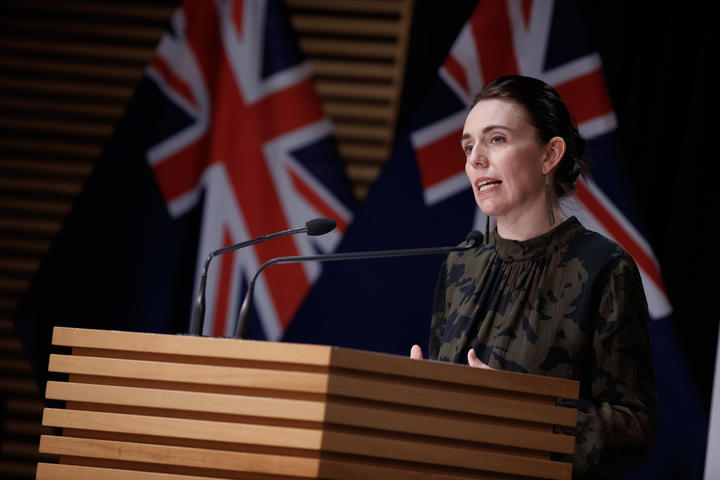
Prime Minister Jacinda Ardern announced the move today, saying the most important thing to communicate about the traffic light system was “for the most part, if you’re vaccinated, you can go about doing all the kinds of things you’d usually expect … what varies is just how large those gatherings are at different levels”.
So what is the traffic light system – formally the Covid-19 Protection Framework – and how does it work? Here are the basics:
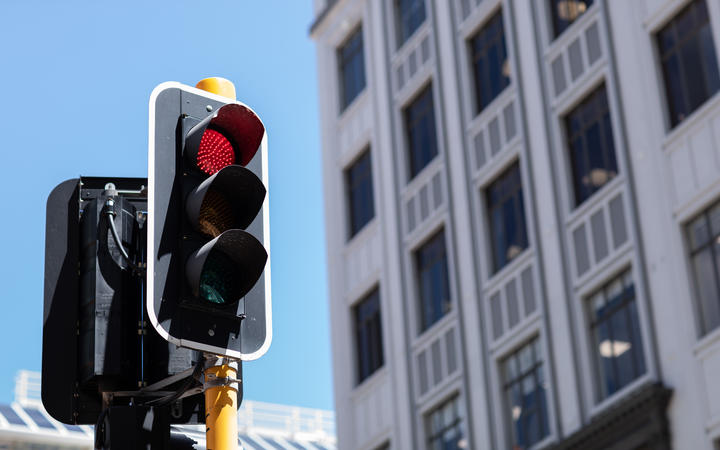
The system will involve three settings – green, orange and red.
Vaccine levels will play a key determining factor for which regions go into red and which go into orange on 3 December, Ardern said.
“We will look at … vaccine rates, we will look at case rates, and that will be the major determining factor but we’ll also be pragmatic. So you know, a good indication is if you’ve hit 90 percent first dose is a good indication of where you’re heading.”
“If you want to be guaranteed that no matter the setting that we are in, that you can go to bars, restaurants and close-proximity businesses like a hairdresser, then you will need to be vaccinated,” Ardern told media in October.
Back then, Ardern also said the vaccination certificates would allow businesses to be able to open and operate at any level.
Red
The red setting will allow hospitality to open with vaccine certificates, but gathering limits, physical distancing, masks and other public health measures would be used.
Record keeping and scanning will be required, with face coverings mandatory on flights, public transport, in taxis, retail, and in venues.
Public facilities can open with up to 100 people and 1m distancing. Retail needs to have 1m distancing too.
People are advised to work at home, but ECEs, schools and kura can open with public health measures.
Some outdoor community events will be allowed with limited capacity.
Photo: RNZ / Vinay Ranchhod
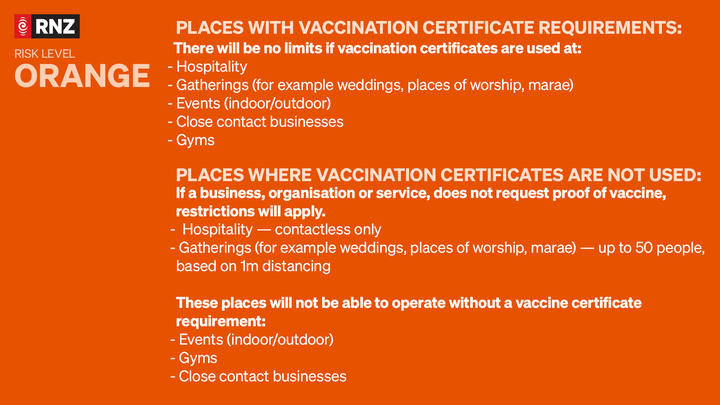
Orange
At orange, gathering limits can lift. Places that choose not to use vaccination certificates will either be closed or have public health measures in place.
There will be no limits for the following if vaccination certificates are used: Hospitality, gatherings (weddings, worship, marae), events, close contact business, gyms.
Without the use of certificates, hospitality and gatherings will have limits applied
Without the use of certificates, events, gyms and close contact businesses will not be able to operate.
Photo: RNZ / Vinay Ranchhod
Photo: RNZ / Vinay Ranchhod
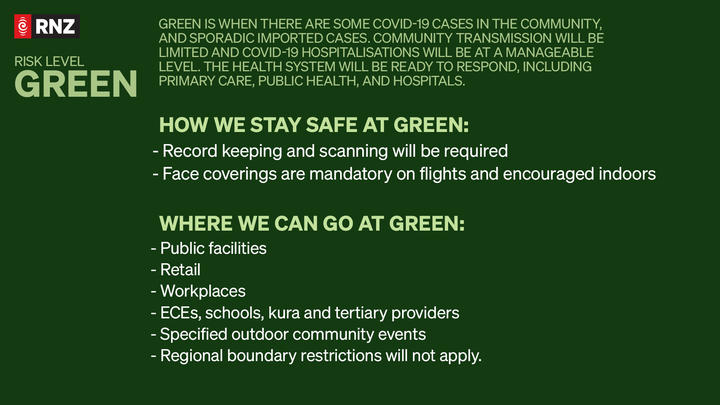
Green
Green is when there are some Covid-19 cases in the community but at low levels.
Fully vaccinated people can enjoy all events and hospitality and gatherings by showing a vaccine certificate.
Premises choosing not to use certificates will face restrictions similar to the current alert level framework.
New Zealand will move into the Covid-19 traffic light system at 11.59pm Thursday 2 December, Prime Minister Jacinda Ardern says.
At a post-Cabinet briefing this afternoon, Ardern said “The hard truth is that delta is here and it is not going away”.
“And while no country to date has been able to eliminate delta completely once it’s arrived, New Zealand is better positioned than most to tackle it because of our high vaccination rates and the inbuilt safety measures in the traffic light system like vaccine passes.”
The government will provide extra guidance for businesses to prepare. An assessment toolkit will be released for those businesses wanting to require their staff to be vaccinated.
Legislation will be introduced and passed this week to enable that, Ardern said.
Tomorrow, the verifier app for businesses that require proof of the vaccine pass for entry will be launched.
Businesses will not be required to use it, but it will be useful, she said.
Guidance this week will also set out how businesses can operate safely under the traffic light system.
From this Thursday, hairdressers and barbers in Auckland will be able to open if they require proof of vaccination from customers.
Some 83 percent of eligible New Zealanders are fully vaccinated. Ardern says if all those people who are now overdue for their second shot got it today, that number would rise to 88 percent fully vaccinated.
Ardern said when the government considers alert levels on 29 November, it will be considering regions’ likely status over summer as well as their vaccination rates.
Hendy said it could be quite confusing to move Auckland to level 3.3 this week and then maybe next week move to the traffic light system and vaccine passes.
File photo: Prime Minister Jacinda Ardern Photo: Pool / Stuff / Robert Kitchin




 A Flourish data visualization