Saturday, April 4, 2026
Home Blog Page 356

Tonga national rugby coach clinging to life after stabbed inside family home

By Tyson Otto, news.com.au

A Wallabies cult hero has reportedly been stabbed inside his family home in a “stabbing rampage” where his wife and children were also injured.

Wallabies legend Toutai Kefu has been rushed to hospital and is reportedly clinging to life after being stabbed during a home invasion.

The Australian rugby cult hero was stabbed in the stomach inside his family home in Brisbane during an incident where his wife, son and daughter are also reported to have been injured.

All four were taken to hospital in ambulances.

The 47-year-old is undergoing surgery at the Princess Alexandria Hospital.

He was reportedly defending his family after three men broke into the family home in Coorparoo around 3am (AEST) on Monday morning.

According to Channel 7, neighbours were woken and raced to the scene to help, holding down one of the alleged offenders who was arrested at the scene.

According toThe Courier-Mail, two men are in police custody.

Sunrise’s Brisbane correspondent Bianca Stone reported Monday morning Kefu is “fighting for life”.

She described the incident as a “stabbing rampage” and a “large brawl” when speaking on Channel 7 Monday morning.

His wife suffered a significant arm injury, while his son suffered lacerations to his back and abdominals. His daughter suffered a hand injury.

Kefu played 60 times for the Wallabies, including winning the World Cup in 1999, and made 103 appearances for the Queensland Reds during his career.

He is currently the head coach of the Tongan national team.

China’s three-child policy campaign leaves many sceptical

By RNZ/Radio New Zealand and is republished with permission. 

China’s Family Planning Association has launched a competition encouraging the public to come up with slogans to promote its three-child policy, but the appeal has been met with anger and sarcasm on social media.

A family negotiates traffic on a scooter in Kunming, China.

A family negotiates traffic on a scooter in Kunming, China. Photo: 123rf

Three months ago, the Chinese government scrapped its two-child policy in a bid to address the crisis of a rapidly ageing population and falling birth rate.

China’s controversial one-child policy was officially axed in 2015, ending more than three decades of the strict birth control.

But the latest census data revealed population growth had fallen to its slowest pace since the 1960s, posing a major challenge to policymakers in Beijing.

The contest by the Family Planning Association aims to “advertise a new time of marriage and family planning culture”.

It runs until 15 September, and 35 slogans will be chosen with cash prices up to 1000 yuan (NZ$220).

Although the campaign received some welcoming messages on social media, such as “the more children, the merrier”, overwhelmingly responses have taken either an angry or mocking tone.

“Your sex organs don’t belong to you, but the country,” one person wrote on Weibo.

“One person exceeds the birth limit, the whole village will be sterilised,” another wrote, a saying which resembles an old slogan used during the one-child policy.

Some people shared grim memories about having a forced abortion in the past, while others called out the discrimination against women when they had more children, especially in the workplace.

Chinese women say they aren’t convinced

Jessie Zhang, 30, is a single mother who works in IT in the eastern coastal city of Hangzhou.

She told the ABC that having children was a personal choice and slogans wouldn’t encourage more women to give birth.

“I don’t want to have more children, that’s not the purpose of my life,” Zhang said.

“Reproductive rights should be controlled in my hand; men shouldn’t have too much say in it.”

Summer Xia, 36, is an accountant from the southern province of Hainan and a mother of two daughters.

She said she was already struggling to raise two children due to rising costs of education and living, despite her family having two incomes.

“It’s too much financial pressure,” Xia said.

“The grandparents are too old to take care of the children … after six months of maternity leave, we had to hire a nanny.

“Although it’s not very expensive to attend a public school, the quality of education there is poor, so we had to hire a private tutor.”

A nurse holds a baby at the Xiyuege Centre, or "Lucky Month Home", in Beijing. Concerns about slow population growth led to a three-child policy in May this year.

A nurse holds a baby at the Xiyuege Centre, or “Lucky Month Home”, in Beijing. Concerns about slow population growth led to a three-child policy in May this year. Photo: AFP

Last month, new restrictions were placed on private tutoring in China, a move to tackle the huge burden on school children and their parents’ finances.

“The government said they wanted to relieve the burden for children, but doesn’t change the test-oriented education system,” Xia added.

She said her decision to have a second child wasn’t swayed by the two-child policy, instead she thought it would be too lonely for her first daughter to grow up without a sibling.

“I think any independent woman won’t be influenced by these slogans,” Xia said.

“It might work for older generations, or for men, but definitely not women.”

“At least women who I know think so, no slogans can touch my heart.”

Brothers at a bakery in the Muslim quarter in Xi'an city, China.

Brothers at a bakery in the Muslim quarter in Xi’an city, China. Photo: 123rf

Sarcasm a creative way to criticise policy

Dr Pan Wang is a senior lecturer in Chinese and Asian studies from the University of New South Wales.

She told the ABC the slogan contest signalled that the Family Planning Association was eager to revamp its reputation, given its role in the previous policies.

“It helps with trust-building between people and the government – not just mandate top-down policy and control people’s reproductive rights in its own hands,” she said.

“But rather, invite people to be part it, given the propagandisation of completely different messages during the previous family planning campaigns.”

Dr Wang said people using sarcasm or dark humour to criticise policymakers was a way to get around internet censorship.

“People are aware that ‘throwing an egg [direct criticism or protest] against a rock [government]’ will lead to nowhere,” she said.

“Rather, giving sarcastic suggestions on social media helps to draw public attention.”

Wei-Jun Jean Yeung, founding director of the Centre for Family and Population Research at the National University of Singapore, said Chinese people were tired of slogans after family planning policy changes.

“It would be better to pay attention to young people’s constraints and preferences more realistically,” she told the ABC.

“It is much harder to force people to have babies than not having babies.”

Is the three-child policy doomed to fail?

For decades, Chinese families were told not to cross the red line of having more than one child, and the notion that one child was enough was instilled in many millennials.

Experts said the one-child policy had changed people’s mindsets profoundly.

“Very few people will consider having a third baby these days,” Professor Yeung said.

“After four decades of one-child policy, the social norms have changed about childbearing in China.”

China’s total fertility rate of women currently sits at 1.3, lower than the replacement rate of 2.1, according to the National Bureau of Statistics.

To reverse the trend, both Professor Yeung and Dr Wang said the Chinese government should tackle issues such as discrimination against women in the workplace and at home, affordable childcare and long-term monetary incentives.

This week, the Beijing government said it would reward women who have a third child with an additional 30 days of maternity leave and 15 days of parental leave for the father.

China’s marriage rate has also fallen to a record low of 1.16 per cent, and that has prompted the central government to look at ways of trying to slow the number of divorces.

“If people don’t get married, they are not likely to have babies, because the current system does not recognise babies born outside of legal marriages,” Professor Yeung said.

A photo of a smiling mother and son embracing and holding head by the pool

Photo: xixinxing/123RF

Reluctance to abolish birth restrictions altogether

As a tool to manage its large population, family planning has long been “a fundamental policy of the country” in the eyes of the Chinese Communist Party.

Breaching birth restrictions in the past meant large fines and sometimes even punishments such as invasive procedures and the installation of intrauterine devices.

But the party is reluctant to abolish birth restrictions altogether.

Last month, Yang Wenzhuang, director of the Population and Family Department of National Health Commission, said while more support measures should be taken to meet the needs of the parents, family planning policy had to be adhered to.

“We are now promoting balanced population development in the long run, which is different from the population development goal of the 1970s and 1980s, which was to control rapid population growth,” he said at a media briefing last month.

Professor Yeung said although she thinks China should relax the birth restrictions completely, it won’t have much impact on population growth.

“At this point, it probably wouldn’t make much difference for the fertility rate,” she said.

“The Chinese government is worried that rural or low-income families may have too many babies that create a potential poverty problem for the country.”

But for Summer Xia, she just wants full control of her reproductive rights.

“I think China’s family planning policies in the past are inhumane … they are against human rights,” she said.

“Everyone should have their reproductive rights, it’s up to themselves to give birth.

“If the government wants to encourage people to have more children, that’s fine, but they shouldn’t force them.”

China’s Family Planning Association didn’t respond to a request for comment.

-ABC

One seriously injured after fight in South Auckland

By ONE News and is republished with permission. 

Several people have been hospitalised after a reported fight in South Auckland.

1 NEWS
Police officers. Source: istock.com

Police said one person was in a serious condition after the incident on Dawson Rd, Clover Park, about 9.30am Saturday.

A spokesperson said inquiries into the incident are underway.

Anyone who witnessed the incident and has not yet spoken to police is asked to call 105, quoting event number P047538013.

New rules aimed at stopping youth from vaping come into effect

By RNZ.co.nz. Republished with permission

New vaping legislation has come into effect today which may make it harder for teenagers to access nicotine products.

General retailers – dairies, supermarkets and service stations – across the country will now only be allowed to sell three vape flavours – mint, menthol, or tobacco.

It is part of a roll-out of SmokeFree legislation that is aimed to protect young people from being influenced to start smoking.

Vape stores are supportive of the legislation, but are preparing for an influx of teenagers trying to buy e-cigarettes from their stores as a response to the regulation change.

For many general retailers, such as dairy owners, this comes as a relief.

PJ is the manager of a store near a high school and said he has almost 20 teenagers try to purchase vape products in his shop each week.

“They try for the peace ice, or watermelon flavours which are popular,” he said.

Flavoured vapes are popular among teenagers, and up until November last year, there were no age restrictions on purchasing the products.

Retailer fines for selling tobacco products to minors can reach up to $10,000.

Other vape liquids are now only at specialised stores, which have tighter security and prevention mechanisms to deter those under 18.

Specialised vape stores are now gearing up for an increase in teenage foot-traffic.

Most stores have long-standing R18 policies for vape products and entrance into the store, but some managers have said they still see teenagers trying their luck.

Nabhik Gupta, a spokesperson for Shosha, the country’s largest retailer of vape products, said their stores already have issues with teens coming inside.

“We have around 90 stores, they experience these things at least a couple times per week,” said Gupta.

They have been reminding their staff of the changes and of their responsibilities as retailers.

The government’s next step in the rollout of the smoke-free legalisation is a ban on smoking and vaping in vehicles where there are children. That comes into force at the end of November.

Critical blood shortage in Fiji

By RNZ/Radio New Zealand and is republished with permission.

Blood stocks all across Covid-19 stricken Fiji are critically low and volunteers have had to reach out to their personal contacts to ask for blood donations.

Although the Fiji National Blood Service has a regular pool of blood donors which kept blood supply sufficient, the current challenges of the country’s Covid outbreak is keeping donors away, which is a huge problem for the country’s three largest hospitals.

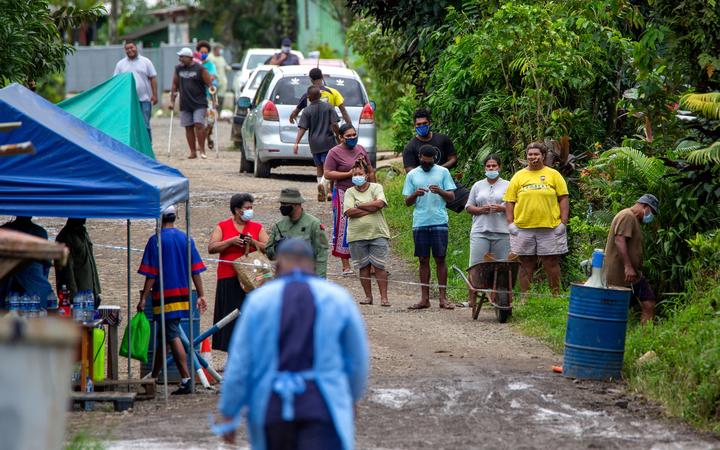
Residents look on as police check people are wearing face masks in Suva,  as a worsening outbreak of the Covid-19 coronavirus Delta variant has overwhelmed the South Pacific nation's largest hospital.

Residents look on as police check people are wearing face masks in Suva, as a worsening outbreak of the Covid-19 coronavirus Delta variant has overwhelmed the South Pacific nation’s largest hospital. Photo: AFP or licensors

The Fiji Red Cross Society’s Neomai Kafoa, who is the focal point for its Covid-19 work, said the situation was so serious that they had 85 volunteers on the phones urging friends and family to donate blood.

“So it’s quite critical at this point. The need for blood is dire, if I can say, right across the country. And this is further exacerbated because of the fact that there’s sort of fear around approaching medical facilities to donate blood.

“So there was a sort of generally a shortage there. And now it’s worse because of the situation,” Kafoa said.

“At this point, there is no specific target. We’re trying to get people to at least come forward and donate. So that’s the first point is to just bring people forward to donate.”

In the past, the work of the Red Cross to drive blood donations was mainly limited to awareness activities leading up to World Blood Donor Day which falls on the 14th of June.

But Kafoa said with Covid-19 they noticed the government became overwhelmed and was having to make regular community requests for blood donations, so they offered to help the Fiji National Blood Service.

“So our volunteers are already trained in specific areas of health and those volunteers are the ones that we’ve identified for this particular task. And they have undergone training as well for the blood drive to further support that work,” she explained.

“And so these volunteers, what they do is that we’ll have to call around and get blood donors and they’ll liaise with our divisional teams who then liaises with the Ministry of Health to be able to provide locations for these blood drives to happen.”

Reaching out

There have been times in the past when the Fijian Blood Bank has been depleted and patients at government facilities have had to reach out to their family members to donate blood.

But according to the Red Cross, which is the government’s community blood drive partner, current shortages are exarcebated by public fear of contracting Covid-19 at government health facilities.

The organisation says it is working to ensure blood donors know of safe locations where they can donate blood.

“The obvious fear from the public is if I go to this particular facility, I might catch it. So while the arrangements are there, the gap we feel is that people are not getting sufficient information so they’re not really identifying the places that they need to go to be able to do that.

“So the support that we are providing is also to be able to identify venues that people can go to, to be able to give blood and getting that information to everyone is where the issue is,” Kafoa said.

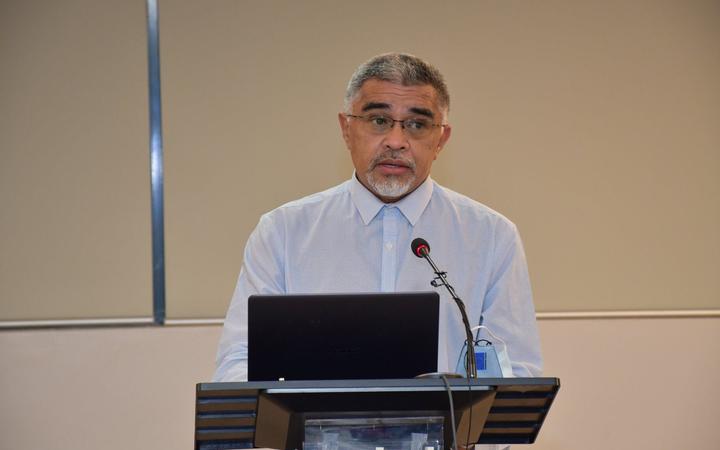
Dr James Fong.

Dr James Fong. Photo: Fiji govt

Meanwhile, Fiji’s Permanent Secretary in the Ministry of Health James Fong has been stressing the importance of donating blood and reminding the public that COVID-19 can’t be transmitted by blood transfusion.

“The virus is transmitted from the respiratory tract as droplets and to a smaller extent as airborne in confined spaces. It is not transmissible in blood,” Dr Fong said.

“As such we need asymptomatic people to donate blood. Even in this COVID times, blood still is essential. The child we saved in Kadavu through Medivac this week was save by blood transfusion and Surgery.”

In the first eight days of August, Fiji has recorded over seven thousand (7198) new infections and 60 Covid-19 deaths. There are currently over 24,000 (24,138) active cases of Covid in the community.

Since the current outbreak began in April there have been more than 300 covid-related deaths and close to 37,000 confirmed cases of Covid-19.

The government continues to resist imposing a national lockdown, insisting that its mass vaccination program is the only way out of the outbreak.

Police hunt for Maserati used in Auckland hit and run

By RNZ/Radio New Zealand is republished with permission.

Police are investigating a hit and run incident in Auckland where a motorcyclist was hit to the ground and knocked unconscious by a Maserati.

Maserati Levante

Not the actual vehicle. Photo: Supplied / NZ Police

Police said the victim was on his motorbike waiting to turn right when a person driving a Maserati – believed to be a dark-coloured Levante model – hit him and immediately left the scene.

The incident happened on 8 July 2021 about 10.18pm on Great South Road at the intersection with Greenlane East.

Constable David Smith said the motorcyclist suffered serious injuries and the incident could have been much worse.

“Along with being knocked unconscious, the victim also sustained leg injuries and we are lucky that we are not dealing with more serious injuries or worse, a fatality,” Smith said.

“The offending vehicle was tracked on CCTV driving in the Penrose area prior to the crash. We also believe during the crash it has sustained damage to its right side and possibly its front.

It is also missing part of its right wing mirror cover.

“Police are asking our community if they know who this driver is or who the vehicle belongs to, to please get in touch with us as soon as possible.

“This driver has hit someone, injured them and then driven off with no regard for their safety so it is imperative that we identify and locate them so they can be held accountable for their actions.”

Fair Go: Three NZ Post customers puzzled over lost parcels

By ONE News and is republished with permission. 

It might have a fancy new logo and a jazzed up website. It might spend millions on becoming “future focused with sustainability plans”.

But NZ Post’s customers have come to Fair Go with some pretty basic, old-fashioned gripes, summed up as “what’s happened to my post — and why can’t NZ Post help me find it?”

Christine had two parcels make it safely all the way from China to Auckland. It was NZ Post’s job to get them from Auckland to Greymouth but they never arrived, and Christine says she got mixed messages from NZ Post as to their fate.

NZ Post has now apologised and offered Christine compensation, but has been unable to say what actually happened to the parcels.

Annette sent a cake by NZ Post courier from Stratford to New Plymouth. The overnight courier didn’t get to the destination the next day, or the day after that.

First Annette was told not to worry as the cake was in the chiller, then she was told it had been damaged and destroyed.

Annette complained to NZ Post that they had no right to destroy her property. But NZ Post says Government health rules say damaged food cannot be delivered or returned — it must be disposed of.

She was originally denied compensation because the cake was a perishable item, but the company has now also compensated and apologised to Annette.

They say perishables like food should be sent using a specialist courier service.

Bernie sent a parcel to Italy during the months of Covid-19 shutdowns and delays last year.

Due to problems at Customs, the parcel was eventually returned to Aotearoa, but it then ping-ponged between two mail centres in Auckland, and then back and forth to Porirua several times.

Bernie desperately tried to simply have it delivered to his home, but it took weeks of chasing up NZ Post before it happened.

NZ Post said the initial problems were caused by glitches involving codes on the parcel and then a scanner problem, and then the difficulties of trying to track down Bernie’s parcel among tens of 1000s.

They are spending $170 million dollars on a massive upgrade, which they say will mean quicker responses and better outcomes for the likes of Annette, Christine and Bernie.

NZ Post simply has to remember to make sure its priority is its customers, Bernie says.

Person shot in south Auckland

BY RNZ.co.nz. Republished with permission

A person is in a serious condition following a shooting in Auckland.

Emergency services were called to a house on Whimbrel Road in the suburb of Flat Bush after 1pm today after reports a firearm had been discharged.

They said a vehicle was seen leaving the property just before officers arrived.

A person was found with a gunshot wound and they were taken to hospital.

Investigations are continuing.

MMA fighter Fau Vake attack: Man sentenced to home detention

by RNZ.co.nz. Republished with permission

A man who admitted punching a young MMA fighter in the head three times who later died in hospital has been sentenced to six months’ home detention.

Ofa He Mooni Folau at the High Court at Auckland on 10 August 2021. He was sentenced to six months home detention.
Ofa He Mooni Folau at the High Court at Auckland today. Photo: RNZ / Marika Khabazi

Ofa He Mooni Folau is one of four men charged in relation to the death of Fau Vake, a 25-year-old rising MMA fighter.

Folau, 29, is not alleged to have been responsible for Vake’s death, but did admit punching him and his brother three times each after leaving a central Auckland bar early one Sunday morning in May.

He pleaded guilty to two charges of assaulting with intent to injure.

The three other men charged have interim name suppression, and have pleaded not guilty and will go to trial next year.

One is charged with manslaughter.

Fau Vake
Fau Vake died in hospital. Photo: Instagram / Fau Vake

More to come…

Tonga confirms next vaccination stages, Pfizer for pregnant women

By RNZ/Radio New Zealand and is republished with permission. 

Tonga’s Ministry of Health has confirmed a schedule of when Covid-19 vaccines will next become available for the Kingdom.

To start, a consignment of 10,000 doses of AstraZeneca Covid-19 vaccines is scheduled to arrive tomorrow.

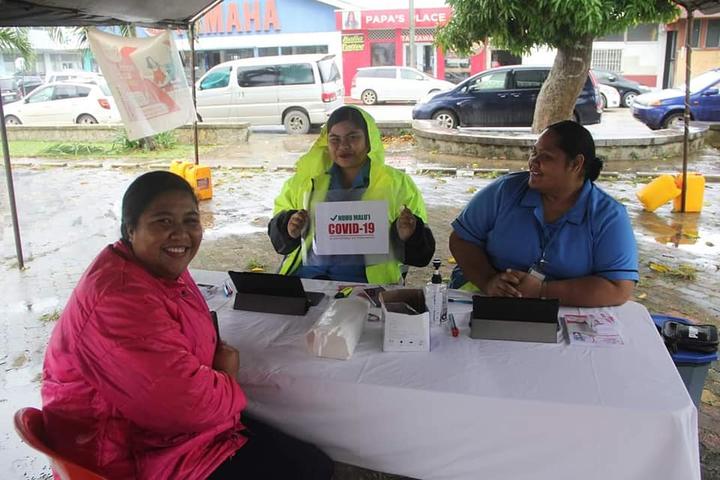
Health workers offering Covid-19 vaccinations in Tonga.

Photo: Supplied / Tonga Ministry of Health

Tomorrow’s doses are funded by the Australian Government thorugh the COVAX facility and will be sent to Ha’apai.

Another batch of Covid-19 vaccines is expected to arrive around mid to late August, funded by Japan.

Ministry of Health CEO Dr Siale ‘Akau’ola says these vaccines will be used to vaccinate people living at Tongatapu, Eua and the Niuas.

More vaccines, including Pfizer doses, funded by New Zealand, are planned for rollout in Tonga at the end of August or towards the last quarter of the year.

Dr ‘Akau’ola said these vaccines will be used to vaccinate anyone else in Tonga who may have missed out in the early vaccination stages.

Pfizer vaccines to be used for pregnant women and youth

Tonga has confirmed that Pfizer vaccine doses sent from New Zealand will be used for the youth aged 12 to 17 years and pregnant women.

The Ministry of Health CEO Dr Siale ‘Akau’ola told local media that if there are pregnant mothers who wished to be vaccinated with AstraZeneca vaccines now, they won’t be turned away.

Tonga’s vulnerability to impacts of Covid-19 infection in terms of non-communicable disease risk factors remains high.

Dr ‘Akau’ola said that combining these two risks, make the risk for an unvaccinated pregnant woman extremely high.

He explained that concluded that the risk of the Delta variant of Covid entering Tonga from Fiji was increasing, and that if an outbreak happened in Tonga, it could be too late to vaccinate pregnant mothers to protect them.

Dr ‘Akau’ola said their only chance was to get vaccinated while Tonga is still Covid-19 free.

He said data on the safety of Covid-19 vaccine to pregnancy was being continuously collected and analysed. Results so far have not shown any significant short term adverse effects.

However, the WHO is advising countries that are choosing to give vaccines to pregnant women, to first consider if the risk of getting Covid-19 is greater than the risk of adverse events from getting the vaccine, which has so far been shown to be extremely low.