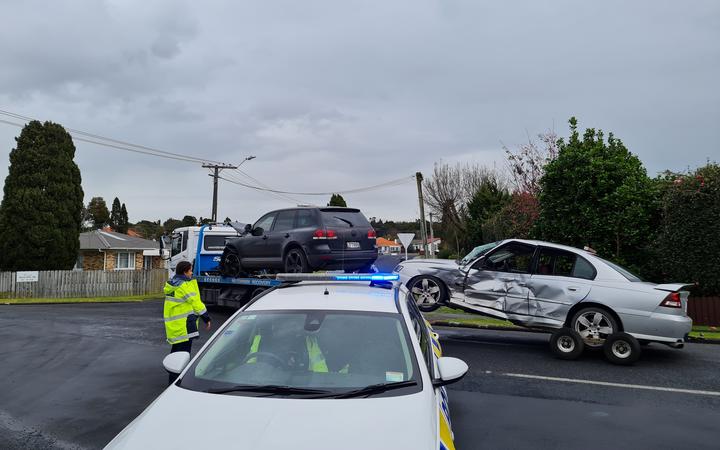
Three people have been arrested after a vehicle that had been allegedly carjacked crashed into another car in Ōpaheke in Auckland this morning, injuring a child.
Photo: RNZ / Kate Gregan
Police said just after 11am they observed someone with outstanding warrants in a vehicle travelling in the Wattle Downs area. The vehicle was signalled to stop but failed to do so.
Spikes were successfully deployed to stop the vehicle in the Red Hill area, where the occupants fled their car and forced two other people out of their own vehicle.
“It was reported at the time that a firearm may have been presented,” Area Commander for Counties Manukau South Inspector Joe Hunter said in a statement.
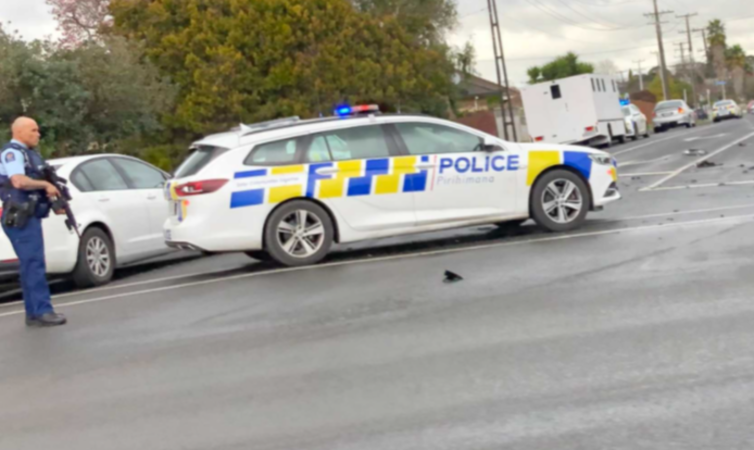
Armed police on Ōpaheke Road at the intersection with Settlement Road. Photo: Supplied to RNZ
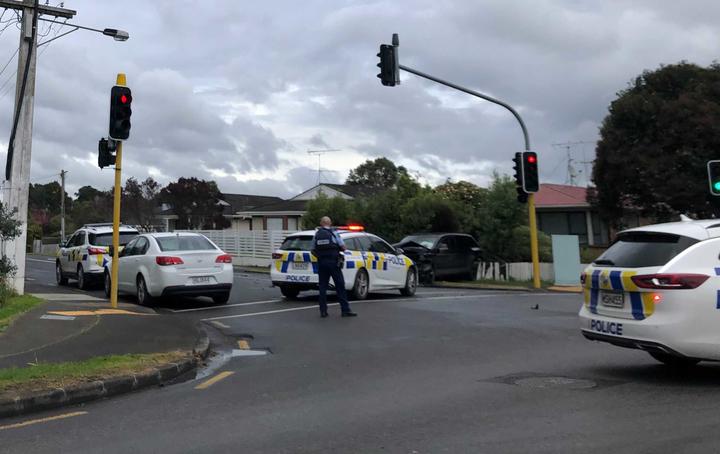
That stolen vehicle fled the scene and was stopped by spikes on the road with support from police air units. It collided with another vehicle at the intersection of Ōpaheke and Settlement Roads, and the three occupants fled on foot.
Police on the scene quickly arrested one of the suspects and the two remaining suspects were found after a search in the area.
A child was taken to Middlemore Hospital for observation after the incident and is in a moderate condition. Victim Support has also been engaged for parties involved.
Armed police responded to the area as a precaution given the reports of firearms.
Police also located two firearms in the original vehicle that failed to stop.
“Police have responded to an incredibly volatile situation today where the decisions made by these three people have been incredibly reckless and dangerous,” Hunter said.
“Our community are as equally as disappointed as police are in this high risk behaviour that puts people’s safety at risk. Police have no tolerance for these actions and we will hold them accountable.”
Police are not currently seeking anyone else in connection with this matter.
Three foreign nationals have been arrested in a Vava’u drug busts carried out this week.
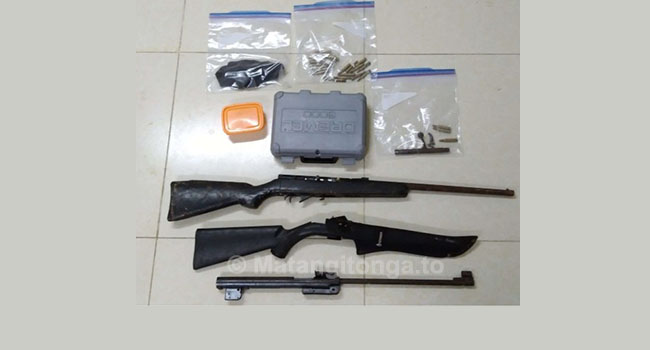
An unlicensed .22 rifle and ammunition seized during raids. Photo/Supplied
A 70-year-old British male and his 58-year-old American wife were arrested at Houmelei along with a 25-year-old American male.
Police have also seized almost 2kg of cocaine from a workshop at Neiafu owned and run by the 70-year-old and from the couple’s rented residence at Houmelei.
The arrest was part of the ongoing investigations into the washed-up cocaine in Vava’u.
“We want members of the public, locals and foreigners alike to take heed of the fact that possession or distribution of any drug is a serious offence,” said Acting Deputy Commissioner Halatoa Tāufa.
Packages of cocaine washed ashore in Vava’u. Photo/Supplied
“I take the opportunity to acknowledge members of the community who have been helpful to Police during this investigation.”
As Kaniva News reported previously, cocaine worth more than TOP$4 million has washed up on Hōleva and Ha’alaufuli beaches, with police scouring nearby shores for similar illicit packages.
In 2012, a yacht which washed up in Vava’u seas with a badly decomposed body on board was carrying more than 200kg of cocaine worth up to US$120 million.
Pensioners struggling to get home from Australia are having their superannuation payments stopped and some may be forced to start paying them back.
Jo-Ani Robinson flew to Sydney in March to help her son who had just been diagnosed with stage four bowel cancer.
She had a return flight booked for 31 July and enough heart medication to last her stay.
However her flight was cancelled and she could not secure another one before quarantine-free travel shut down for eight weeks.
Her medication was running out and she was told if she was not back by 20 September her pension would be stopped.
“I got in touch with the Ministry of Social Development (MSD) to email them about my plight, because I was worried about my superannuation because I’m aware that you can only be out of the country 26 weeks… and I got a rather brash email back saying – you knew you went over there in Covid times, so it’s your fault.”
MSD also told her if she could not get back by October she would have to start repaying the superannuation she received while she was in Australia.
She said the stress was unbearable.
“I feel quite sick about everything the New Zealand government has put me in such a predicament. I have no where else to go to.”
Another woman, Frances, also flew to Sydney to be with family but ended up needing emergency surgery and was only recently given clearance to fly by doctors.
“I was trying to get home before the cut off point for superannuation but the flights had stopped and MSD kindly told me that they will not extend the superannuation payments.”
MSD has since reversed that decision saying it had been trying to get in touch with Frances for some time to clarify her circumstances.
While that brought some relief, she was disappointed of the stress went through.
Neither of the women were eligible for a place on the government-managed flights out of New South Wales because they arrived in Sydney prior to 6 April.
Beneficiary advocate Kay Brereton said people in these circumstances were being treated unfairly.
“They’re not people who went on holiday for a bit of a galavant because the borders were open. They’re people who went over there to connect with family – quite often unwell family – and we need to realise that this isn’t all holiday-makers stuck in NSW.
“There’s a whole heap of reasons and some of them really deserve our compassion.”
There was no reason why people’s financial support should be cut off at all, she said.
“When we had our lockdown in 2020 we had people who were on benefits, or eligible for benefits, all around the world.
“Special rules were put in place to support those people because they couldn’t return to New Zealand because we’d closed our borders. What’s different now? I’m not sure.”
Minister for Social Development Carmel Sepuloni said the circumstances were not as extreme as last year’s lockdown so the special rules were not required.
She urged anyone in exceptional circumstances to get in touch with MSD and explain why they were out of the country for longer than expected.
In a statement an MSD manager Jason Dwen said Robinson should continue to try and get a flight home before 20 September.
“It has been widely publicised that Air New Zealand is putting on extra flights and using bigger aircrafts to return people to New Zealand as a result of “the bubble” being put on hold.
“We’ve continued to encourage [her] to check the Air New Zealand website regularly to book a return seat to fly as soon as she can to ensure her NZ Super payments continue past 20 September – and to keep us updated to any changes in her circumstances.”
MSD could not say how many people in Australia currently had their superannuation payments suspended or were paying it back due to being out of the country for too long.
By Christine Rovoi, RNZ Pacific Journalist and is republished with permission.
A new vaccine may be needed if the Delta variant of Covid-19, which is currently in Fiji, continues to mutate, health experts say.
The government says more than 22,000 people with Covid are in isolation and the death toll has passed 260, and climbing.
The victims included an 11-month-old baby, pregnant mothers, a 15-year-old teenager and a 102-year-old woman.
The government maintains there is no need to impose a complete shutdown of the country.
According to the Health Ministry, the average deaths per day is eight, while the daily average infection is 1039 cases or 1174 per million population.
The US Centers for Disease Control and Prevention has placed Fiji on level 4 of its Covid-alert due to the growing number of cases in the Pacific nation.
Professor Fiona Russell from the University of Melbourne said reports that more people are dying from the virus in Fiji should be a concern.
She said the mutation of the Delta strain could happen.
“That is a characteristic of all viruses, not just the coronavirus and there are other mutations that have already occurred. At the moment what we’ve found is that the variants have become more transmissible. We have to keep an eye on that and there’s ongoing studies to monitor it. And it may be that in the future, people in Fiji may need a booster.”
Russell also said Fiji’s health facilities could easily get overwhelmed if people do not take heed of Covid-safe protocols.
She warned the country was very early on in the outbreak and should take heed of what had happened in countries such as India.
“If Covid-19 takes off in Fiji, then the hospitals may get full and that is if you get sick with anything at all, let alone Covid, then the doctors and nurses may not be able to treat you properly because they’re just so busy treating all the other Covid patients.
“We certainly in Australia were worried about that and so we made plans for that in case that was to occur.”
She praised Fiji’s efforts in trying to contain the disease.
Russell said the seriousness of Covid-19 was evident in how quickly it had spread during the second wave in the country.
Govt urged to change strategy
New Zealand epidemiologist and University of Otago professor Michael Baker agrees.
He said Fiji was going backwards in its fight against the pandemic.
Despite the Fijian prime minister’s refusal to enforce a national lockdown, Baker said it was not too late for the government to change its strategy.
“The situation in Fiji is very worrying. They’ve really lost control of this epidemic at this point given the record number of infections that are of a very widespread nature.
“It depends what their overall strategy is. If they want to return to elimination position, I think they need to act very decisively now and that actually offers a much better route back to economic recovery than trying to suppress the virus and live with it which hasn’t really worked very well in the past.”
Fijian epidemiologist doctor Donald Wilson said the country is overwhelmed by the pandemic.
He warned the current trend of infections could force officials to make “unethical medical decisions”.
“The worry is that when the health system becomes overwhelmed, when it cannot any longer peak in lots of patients who have severe disease, then unfortunately like what has been happening in other countries where doctors have to do the unethical thing of needing to choose who to put on ventilators and who not to.”
Fiji PM Frank Bainimarama visited the Covid-19 testing facility in Suva. Photo: Facebook / Fiji government
Dr Wilson said a mass vaccination campaign aims to immunise 600,000 Fijians by November this year.
Close to half a million Fijians or 84.4 percent of the target population have received their first dose of the AstraZeneca vaccine, while just over 158,000 or 27 percent have got both jabs.
The head of Fiji’s vaccination taskforce, Dr Rachel Devi, said the only good news is the Moderna vaccine, now in the country, is also effective against the Delta variant, the UK variant and the Wuhan strain of the virus.
“We have important strategies in terms of how or when and where we roll this out across the country. This would definitely boost it up especially right now we weren’t vaccinating our pregnant women with the AstraZeneca unless these individuals consented. But I know there’s quite a lot of build-up in that area now. There’s a lot on safety reasons as well.”
Meanwhile, an Australia-based Fijian academic warns Fiji is suffering its worst medical, social and economic crisis since the measles epidemic of 1875 which led to the deaths of a third of the country’s population.
Professor Wadan Narsey said this could have been avoided had the government listened to the best medical advice – not just in Fiji, but also from its major partners New Zealand and Australia.
He said Fiji’s tragedy stems from its heath system being unable to cope with the crisis and has seen deaths soar to over 260, and climbing.
This story appeared on One News / TVNZ and is republished with permission
We’re in Te Whanganui-a-Tara to meet three wāhine who work with taonga puoro (traditional Māori musical instruments). We ask why these taonga almost disappeared and what their dreams are for the future of the practice.
The members of Maianginui discuss the challenges involved when carving out spaces for wāhine Māori in music and other art communities.
They discuss the common misconceptions of the roles that atua wāhine played in our pūrākau and origin narratives, both of taonga puoro and other instruments of traditional Māori existence.
It is apparent that there is still mahi needed surrounding the erasure of atua wāhine and wāhine Māori in te ao hurihuri.
This is episode one of He Kākano Ahau Season 2: Wawatatia, a podcast hosted by Kahu Kutia.
You can listen to the full 40-minute podcast here, or search “He Kākano Ahau” on any podcast app to subscribe to the series.
May we boundlessly dream of possibilities beyond our wildest imaginations. May we weave communities of support, compassion and active solidarity. With our history in front of us, and our tūpuna at our shoulders, may we walk into a future that is connected and thriving for us all. This is He Kākano Ahau Season 2: Wawatatia.
By One News / TVNZ and is republished with permission
Dame Valerie Adams didn’t know why she kept looking up into the stands and imagining her children during the women’s shot put final in Tokyo yesterday.
What she does know is it helped her claim a historic bronze medal.
“In a normal world they would’ve been there watching and it would’ve been great but it was just awesome to draw that energy from that feeling that I had in just imagining them up there,” Dame Valerie told media after the final.
“It was just knowing, ‘there goes my why’ and wanting to make them proud.
“It was an emotional day and an awesome day for me and my little family.”
Dame Valerie Adams reacts after winning bronze in the women’s shot put final. Source: Getty
During the media conference, Dame Valerie had a photo of her two young children attached to a lanyard so they could be part of the experience.
“This is my why. These two children are my why and I hope I just made them proud.”
Heading into the last round of the final, Dame Valerie was sitting in the bronze medal position thanks to her third attempt of 19.62m.
Portugal’s Auriol Dongmo was right on her tail though, having thrown 19.57m in round four.
Thanks to the seeding in the first three rounds, Dongmo would make her final attempt just before Adams, meaning the Kiwi would enter her final throw knowing whether she needed to beat the Portuguese athlete or if she had already won a medal.
As it turned out, Dame Valerie got to make her last attempt knowing she’d already earned a place on the podium with Dongmo only managing 19.45m with her final effort.
The moment wasn’t lost on the Kiwi who couldn’t contain her emotions after her final throw.
“It was just the feeling, the release of ‘we did it’,” Dame Valerie said, reflecting on the moment.
“I was extremely emotional in that moment, just reflecting on what had happened in the last five years, what it’s taken to be here, how much work it had taken, the many travels up and down the country to make this happen, being away from my children to make this happen.
“I guess that all just surfaced at the very moment of knowing you’ve secured a medal and that all came out at that very moment and I couldn’t contain it.
“It was such an amazing feeling – it may have looked a bit intense from home but it was just so amazing. It was almost like a release of energy.”
Adams finished behind American Raven Saunders and Olympic champion Lijiao Gong from China.
The temporary release of the jailed fraudster Lavulavu couple last week has opened the Prison Commissioner’s power to make such decisions to criticism.
(L-R) Prison Commissioner Sēmisi Tapueluelu, ‘Etuate Lavulavu and Akosita Lavulavu
Critics were seriously concerned about the timing of the release, saying it was too early.
Chief Justice Michael Whitten denied the Lavulavus’ bail bid on July 9 while awaiting their appeal application to be heard either in September this year or March 2022.
Critics were baffled by the release because in sentencing ‘Etuate Lavulavu, the Supreme Court judge said he posed a risk of re-offending as his offences were not out of character and was known to be deceitful.
Some argued that the Prison Commissioner Tapueluelu’s decision has downplayed the seriousness of the couple’s offending.
Tapueluelu’s decision has been blasted as showing lack of respect for the presiding Supreme Court judge and the Chief Justice’s judgement of the case.
The couple did not show any sign of remorse during their trial and persistently insisted that they were innocent. The judge described their crime after plundering more than half a million pa’anga from international-funded government school funding scheme as “the worst sort of dishonesty.”
The judge said ‘Akosita had supplied false references, something the pre-sentence report described as “an act of dishonesty which further proves her true character.”
Fear for another early release
Some fear the decision to allow the Lavulavus to go home might set a precedent for letting them out well before the end of their six-year jail term.
Commissioner Tapueluelu said the release was legal and was part of the prison’s rehabilitation programme for all prisoners. He said the Lavulavus were released for only three hours. He said they were accompanied by two prison officers in a prison vehicle during the visit to their home.
As Kaniva News reported on Friday a member of the public spotted a marked prison vehicle parking at the Lavulavus’ residence before taking a photo of it. It was then uploaded to social media before it was widely shared to Facebook which sparked huge public outrage on social media.
Concerning
The Lavulavu’s temporary release has drawn concern because there appears to have been no serious grounds on which to release the couple.
The Commissioner said the Lavulavus were released after they asked to go home because they had various commitments which had been left unfinished.
In Tongan he said: ““ngaahi me’a kehekehe pe ‘oku te’eki ai ke tukunga lelei.”
He also appeared to have provided conflicting information about the couple’s situation by saying this was the first time for them to be let out, but he also said they had previously been released to have their Covid-19 vaccination done.
He also appeared to be uncertain about his response before saying that if somebody has evidence that the Lavulavus were previously released they should come forward and prove it.
Leave permission
Tapueluelu said that as Prison Commissioner he could consider allowing a prisoner to take leave and be released unsupervised after serving six months of their imprisonment term.
For the Lavulavu couple, he said they had been allowed to go home, but because they had not spent six months in prison, they were accompanied by prison officers.
Tonga’s Prison Act says the Commissioner “may, by order in writing, grant a prisoner leave to be absent from the prison in which he is being detained for (d) compassionate purposes as the Commissioner thinks fit; or (e) any other purpose as the Commissioner thinks fit.”
Political circus
Unfortunately, while the Commissioner has relied on the Act to defend his decision, he finds himself in the unenviable position of being in the midst of a political circus.
As a number of former Police Commissioners have found, civil servants are constrained as to what they can say and must stand by while political questions are raised and accusations are made.
In this case some people have argued that the section of the Prison act upon which the Commissioner relied leaves his office open to pressure from politicians.
There is no evidence whatsoever that the Commissioner was influenced by anyone in his decision making. However, as a Cabinet appointee answerable to Justice Minister Sāmiu Vaipulu, there is the risk that the Commissioner will be the subject of political speculation and accusation.
This is, sadly, even more likely given Prime Minister Tu’ionetoa’s earlier behaviour with regards to the Lavulavus. The Prime Minister devoted an enormous amount of time defending former Infrastructure and Tourism Minister ‘Akosita Lavulavu.
Hon. Tu’ionetoa even criticised the Supreme Court’s ruling by saying “it is not easy to judge others because that decision was made by a sinner as they have lack of experience and wisdom from God.”
Given his inability to defend himself by commenting publicly, it would help considerably if Vaipulu issued a public statement acknowledging Commissioner Tapueluelu’s absolute integrity in discharging his duties.
It would also help calm down the general atmosphere surrounding this case greatly if the Prime Minister released a statement guaranteeing that there had not been nor would there be any political interference in the Prison Commissioner’s work.
FAKAMA’OPO’OPO FAKATONGA
Na’e pehē ‘e he Komisiona Pilisone’ Sēmisi Tapueluelu ‘oku fakalao pe ‘a ‘ene tu’utu’uni ke tuku ange ki tu’a ‘i ha houa ‘e tolu ‘a e ongo mātu’a Lavulavu’ he uike kuo ‘osi’ hili ‘eni ‘a hono ‘ikai tali ‘e he ‘Eiki Fakamaau Lahi’ ‘ena kole ke na ‘atā pe ki ‘api ‘o tatali ai ki he’ena tangi kuo fai’.
Ko e me’a na’e ‘ikai fakamahino mai ‘e Tapueluelu’ ko e kupu’i lao ko ‘eni’ ne makatu’unga ai ‘ene tu’utu’uni’ kupu 46 ‘o e Lao Pilīsone’ ‘oku’ ne tala mai ko hono tuku ange ‘o ha taha pōpula hangē ko e ongo Lavulavu’ ‘e makatu’unga ia ‘i he fakakaukau lelei pe konisenisi mo’ui’ ‘o e komisiona’. ‘Oku fakalea fakapālangi ‘eni he lao’ ‘o pehē – as the commissioner thinks fit.
‘Oku ‘ekea leva heni ‘a e makatu’unga ‘ene faitu’utu’uni ke tuku ange kei hengihengi toki uike ‘e ua pe nai ‘eni ‘ena ‘i pilīsone’. Na’e fakamatala’i mahino ‘e he Fakamaau Lahi ko Cooper ‘a e mātu’aki mamafa ‘o e hia ne fai ‘e he ongo Lavulavu’ pea toe fai ‘e he ‘Eiki Fakamaau Lahi Whitten ‘a e fakamatala tatau ‘o tu’unga ai ‘a e ‘ikai ke ne tali ke peila kinaua ki tu’a ‘o tali tangi ai.
Ko Akosita, makehe mei he’ene kākaa’i e pa’anga ‘a e pule’anga’ na’a’ ne toe fa’u ‘a e ngaahi tohi fakamo’oni loi ke taukapo’i’aki ia ‘i ha tala tu’utu’uni ‘a e fakamaau lahi’ pea ne pehē ai ‘e he fakamāu’ kuo toki e’ee’a ai ‘a e lanu totonu ‘o e fefine’ ni.
Ko ‘Etuate na’e pehē ‘e he fakamaau lahi ko e tangata ia ‘e toe faihia pe ia (reoffending) he ne ‘ikai ko ha me’afo’ou ia ki hono sino’ ‘a e loi mo e kākaa’.
Ko e tu’utu’uni’ a Tapueluelu’ ‘oku ava ai e matapā ke fakaanga’i ‘a e lao pilīsone’ he ‘oku’ ne ‘oange ‘a e fu’u mafai faka’aufuli ki he komisiona toko taha ke ne fai ha tu’utu’uni ‘e ala lau ‘oku hangē kuo’ ne ta’etoka’i ‘a e ngāue ma’ongo’onga ‘a e pule tolu ‘o e fonua’ pe fakamaau’anga’ ke fakapapau’i ‘oku tautea’i a’ua’u ‘a e kakai fai hia lalahi ‘o e fonua’.
‘Oku mahino ‘i he tu’utu’uni ‘a Tapueluelu na’e ‘ikai ha ‘uhinga malohi fau mo fefeka ke tuku ange ai ‘a e ongo Lavulavu ki tu’a ‘o ne tala ki he mitia’ ko ‘ena ō ki honau ‘api’ tu’unga pe he ngaahi me’a ne te’eki tukunga mālie.
Na’e ‘osi ‘ave kotoa ‘e he ongo Lavulavu ‘a e ngaahi ‘uhinga ta’e tukunga mālie ko ‘eni’ ki he fakamaau lahi kau ai ‘a e pehē ‘oku ‘i ai ‘ena fānau’ ‘o kole ‘aki ke na ‘atā pe ki tu’a ‘o tali hopo tangi ai. Ka ne ‘ikai tali ia ‘e he ‘e he ‘Eiki Fakamaau Lahi’. Pehē ‘e he ‘Eiki Fakamaau Lahi’ na’e tonu ke na ‘uluaki fakakaukau’i ‘ena fānau’i pea ne toki fakahoko ‘a e hia’. He’ikai ke na ō faihia pea na fakamu’omu’a mai ‘ena fānau ko ha paletu’a ke malu’i’aki kinaua.
‘Oku hanga ‘e he tu’utu’uni ‘a Tapueluelu’ ‘i he malumalu ‘o e kupu’i lao pilisone ko ‘eni ‘o fakama’ama’a’i ‘a e tu’utu’uni ‘a e pule tolu ‘o e fonua’ pea ‘e ala lau hangē ha ta’efaka’apa’apa’.
‘I hono tautea’i ‘o e ongo Lavulavu na’e pehē ‘e he fakamaau lahi’ ko e hia na’a na fakahoko’ ko e kovi taha ‘eni ‘o e ngaahi hia ta’efaitotonu kuo faka’ilo he fonua’. ‘Ikai ha’ana momo’i fakatomala pe kole fakamolemole pea na vili kikihi pe ‘ena tonuhia’ neongo e mahulu atu ‘a e ngaahi fakamo’oni ko e hia ko ‘eni ne na fakahoko’ ne na kaungāfai tokoua pe ai.
Ko e toki uike pe ‘eni ‘e ua nai ‘e na ‘i he ‘aofinima ‘o Tapueluelu kuo tuku ange kinaua ia ke na ma’u e tau’atāina ‘o e kakai fai lelei’ neongo ko e houa ‘e tolu.
Ko e hā e me’asivi falala’anga ne ngāue’aki ‘e Tapueluelu ke ne falala ke tuku ange e ongo faihia lalahi ko ‘eni ke na ō ki honau ‘api ‘i he ki’i fo’i uike pe ‘e ua ko eni kuo nau feohi ai?
Kapau kuo’ ne faka’atā kei hengihengi pe ‘a e ongo Lavulavu’ ‘i loto he uike ua ko ‘eni’ pea ‘oku ‘i ai e tui lahi ‘e ‘ikai fuoloa mei heni kuo’ ne faka’atā ‘e ia ke foaki ha livi (leave) ‘a e ongo Lavulavu ke na ‘atā ā ki tu’a. ‘A ia ko e mafai fakalao ‘eni ‘oku ma’u ‘e he pule pilīsone’ hili ha māhna ‘e ono ha ngāue pōpula ‘a ha taha.
‘Oku lelei pe ia ke ‘i ai ha lao pehē, ka ko hono foaki mola ke faitu’utu’uni toko taha ‘a e Komisiona’ ‘oku mōhū fili ia. ‘Oku totonu ke ‘i ai ha pēnolo pea tataki ‘e ha fakamaau pe mataotao he lao’ ke nau fai ‘a e tu’utu’uni ke toki faka’atā ha taha pehē hangē ko e ongo Lavulavu.
‘Oku palopalema ‘a e pikitai ‘a Tapueluelu ki he lao’ ‘o ‘asi mai hanngē ‘oku ne pehē ko e me’afua tonu taha pe ia mo ta’ele’eia ke ne ngāue’aki he ‘oku ‘ikai ke hoko pehē ma’u pe ia. Ko e konisenisi mo’ui’ ‘a e me’afua lelei taha’.
Ko e fiha’i lao ‘eni ‘a e pule’anga’ hono tamate’i pe liliu pe fakatonutonu mai ‘e he fakamaau’anga ‘oku hala pea na’e ‘ikai tonu ke fa’u ha lao pehē.
Na’e toki ‘osi ni e tu’ukaivi mai ‘a e ‘Eiki Palēmia’ ‘o taukave’i e kupu 23 ‘o e konisitūtone’ ‘oku ne ‘oange e totonu ‘a Akosita ke kei minisitā pe mei Hu’atolitoli kae ‘oualeva kuo mahino ‘ene tangi’. Ka ko e hā e me’a ne hoko’ ne iku holomui ‘a e palēmia mo ‘ene kupu 23 kae fekau ke fakafisi leva ‘a Akosita. Ko e taha e ‘uhinga ki heni’ ko e mahino ki he palēmia ‘oku fepaki ‘a e konisitūtone filifilimānako kupu 23 mo hono konisēnisi mo’ui na’e foaki ‘e he ‘Otua’.
Ko ia ‘oku totonu ki he kau taki pule’anga’ ke nau fai fakapotopoto ‘a ‘enau faitu’utu’uni’ ‘o fakatatau mo honau konisēnisi’ he ko e me’afua ia ‘oku haohaoa pea tolonga’.
Neongo hono fakatonuhia’i ‘e Tapueluelu ‘ene tu’utu’uni ‘aki e lao’ ka ‘oku’ fakaava ‘e ia heni foki ‘a e matapā ke sio atu ai ‘a e kakai’ ki hono tu’unga mo ‘ene felāve’i mo e kau politiki ‘a e pule’anga’. He ko e tangata ngāue ia ne fokotu’u ‘i he mafai ‘o e kapineti’. Ko ‘ene komisiona’ ‘oku ne ‘i he malumalu ai ‘o e minsitā polisi’ ‘a Looti Nuku pea mo e ‘Eiki Palēmia ‘o e fonua’.
Ne ‘ikai puli ki he tokolahi ‘a e tu’ukaivi ‘a e palēmia’ ‘i hono tauvake’i mo malu’i ‘a Akosita’.
Neongo ‘oku ‘ikai ha fakamo’oni ki ha kaunga ‘a e palēmia mo minisitā polisi’ ki he tu’utu’uni ko ‘eni ‘a Tapueluelu ka ‘e sio pehē atu ‘a e kau fakaanga’ he ko ‘ene kei ‘i he lakanga’ mo ha’ane toe hokohoko atu ‘e ‘i he mafai ia ‘o e kapineti’ mo e PSC.
Seasonal workers from Tonga, Samoa and Vanuatu will be allowed into the country without having to go into managed isolation from September, the government says.
In a post-Cabinet media briefing this afternoon, Ardern announced Cabinet had made the decision to allow Recognised Seasonal Employer (RSE) workers from those countries to travel one way, without using MIQ.
You can watch the media briefing here:
The countries this would apply to reflected the fact all three nations had experienced very few cases of Covid-19, she said. Tonga had seen zero Covid-91 cases, Samoa just one, and Vanuatu had four – all those cases having been at the border with no community transmission.
“We know our agricultural sector is experiencing challenges,” she said. “We’ve heard the call from Primary sectors and others to bring in additional workers in a safe way and we think that is now possible.
“We’ll be working through some of the detail including repatriation … so that we don’t risk stranded workers.”
The government is also looking at additional health precautions for the workers.
She said 150 workers were being brought in every 16 days but this would open up for significantly more.
The government did not know the exact number of additional RSE workers expected to come in, but Ardern there were about 7000 in New Zealand right now and the norm was about 10,000. One of the constraints is the one-way nature of the restriction-free travel, she added.
“Travellers would still undergo quarantine on return to their home country, as has been their home country’s policy.”
Immigration Minister Kris Faafoi told the media gathering he had been speaking to the industry, and businesses were keen to work with the government on ensuring there are enough workers to meet the demands of the horticulture sector.
Cabinet may allow medical travel to NZ under some circumstances
Ardern said Cabinet would be willing to consider allowing people in who may have critical medical conditions from one of the countries where quarantine-free RSE workers will be allowed to travel from, but wanted to get the system up-and-running first.
Covid-19 Response Minister Chris Hipkins said such people would need to be in a dire medical situation to allow for that.
Hipkins says he was also checking on whether the settings were right for people in New Zealand now who need to travel overseas for treatment.
He also said the government did have systems in place to review individual cases and urged people to make use of those.
Ardern said there was however a lot of demand right now for MIQ. “There are peak points where, for instance, in April and May we had capacity. The minister at that time urged New Zealanders to come home…”
She said the minister was looking at settings changes to make the system fairer, including the voucher system.
Hipkins said the increase in demand for MIQ had changed quickly, going from thousands of vouchers available to next to none within the space of a few days. He said the government was considering issues of fairness to make sure everyone was getting a fair opportunity to get back to New Zealand.
There had been opportunity for New Zealanders to come back, but the reality in a global pandemic was travel was going to be difficult and expensive and “people should grab whatever opportunities they can get”, he added.
He said it was challenging to match timings of room availability with flight availability, calling it a “huge logistical undertaking”.
Possible extension for residence applicants
Cabinet is also seeking advice on whether to allow people waiting for residence visas to stay in New Zealand longer.
Ardern said she wanted New Zealanders to come home if they desired to, but she wanted them to come back to a safe New Zealand and the border management had been part of what has kept the country safe.
Vaccine update
Ardern said she would from today provide an update on vaccinations each week.
She said more than a quarter of a million New Zealanders had been vaccinated last week, after the success of the mass vaccination event in Auckland, and rejected claims there was a syringe shortage.
“We will likely see more mass vaccination events like this over the coming months,” she said.
253,163 – The number of people who got vaccines last week
15,881 – Mass vaccination event inoculations over three days
345,734 – Number of vaccination bookings made last week:
Less than 1 minute – Average time for people spent waiting on the new 0800 number
Last week some 76 sites were brought on to provide vaccinations, including on Rakiura/Stewart Island, which was open to all the residents there, Ardern said.
The Prime Minister also commented on the Human Rights Commission’s inquiry into housing. The Commission stated successive governments had failed to live up to the promise of creating the conditions to enable everyone to live in a decent home.
Ardern said the commission was an independent body and had the prerogative to look into whatever they considered necessary, but that it had acknowledged the work the government had carried out to provide for address the country’s housing need.
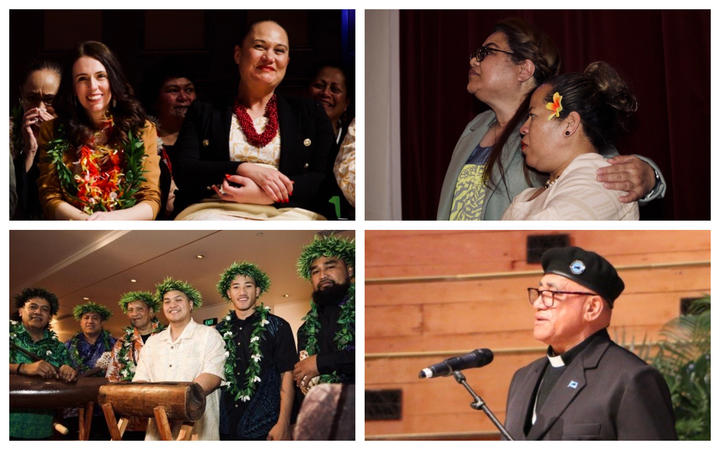
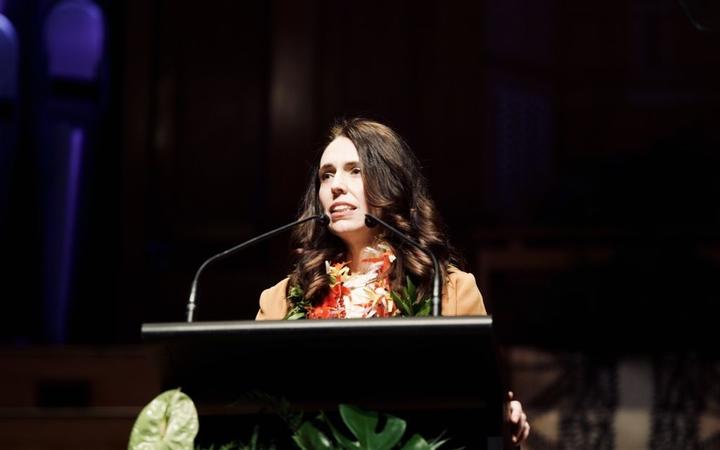
Prime Minister Jacinda Ardern today gave a formal and unreserved apology on behalf of the government for the Dawn Raids which she said left Pacific communities feeling “targeted and terrorised”.
Photo: RNZ / Marika Khabazi / Anric Sitanilei
Ardern delivered the speech as part of a three and a half hour ceremony in front of more than 1000 people at the Auckland Town Hall.
She said the raids to find, convict and deport overstayers often took place late at night or early in the morning and were said to involve harsh verbal and physical treatment.
“Today I offer, on behalf of the government, a formal and unreserved apology to Pacific communities for the discriminatory implementation of immigration laws that led to the Dawn Raids,” Ardern said.
“Residents in those homes were woken abruptly, physically removed from their beds and forced into police vans to be taken for questioning.
“Some were hauled to the police station to appear in court the next day barefoot, in pyjamas or in clothes loaned to them in the holding cells; others were wrongfully detained.”
Ardern said the raids went well beyond upholding immigration laws and “whole communities felt targeted and terrorised”.
Jacinda Ardern said 50 years after the Dawn Raids the wounds are still deep. Photo: RNZ / Marika Khabazi
Protests from the youth group the Polynesian Panthers, coupled with the increasingly negative public reaction led to the end of the Dawn Raids in 1976, Ardern said.
She said following an inquiry in 1986 it was found that although Pacific people only represented about a third of overstayers, they represented 86 percent of prosecutions.
“The government expresses its sorrow, remorse, and regret that the Dawn Raids and random police checks occurred and that these actions were ever considered appropriate,” Ardern said.
“Our government conveys to the future generations of Aotearoa that the past actions of the Crown were wrong, and that the treatment of your ancestors was wrong. We convey to you our deepest and sincerest apology.”
She said nearly 50 years after the Dawn Raids the wounds are still deep and the government recognises that no gestures can mend this hurt.
Ardern said the government will provide $2.1 million in education scholarships and fellowships to Pacific communities in New Zealand.
She also announced $1m in Manaaki New Zealand Short Term Training Scholarships for young leaders from Samoa, Tonga, Tuvalu and Fiji.
Ardern acknowledged all those who were directly affected by the Dawn Raids and those who continue to suffer as a result of them.
“It is my sincere hope that this apology will go some way in helping the Pacific youth of today know, with certainty, that they have every right to hold their head up high, and feel confident and proud of their Pacific heritage, and in particular the sacrifices their parents and grandparents have made for Aotearoa New Zealand,” she said.
Pacific community response
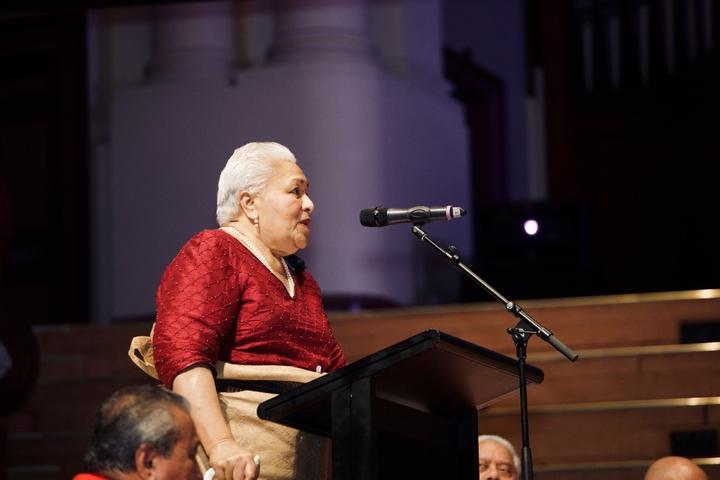
Her Royal Highness Princess Mele Siu’ilikutapu Kalaniuvalu Fotofili spoke on behalf of the Tongan community.
She said she vividly recalled the Dawn Raids and the injustice of the treatment applied specifically to her community.
Her Royal Highness Princess Mele Siu’ilikutapu Kalaniuvalu Fotofili spoke on behalf of the Tongan community. Photo: RNZ / Marika Khabazi
She expressed gratitude to Jacinda Ardern and her government for making the right decision to apologise and to right “the extreme inhumane and unjust treatment of the Dawn Raids era”.
She said an apology was a move in the right direction.
Princess Mele Siu’ilikutapu Kalaniuvalu Fotofili said she accepted the government’s gifts which she described as “very significant indeed” saying it signalled the government’s desire to mend the rift.
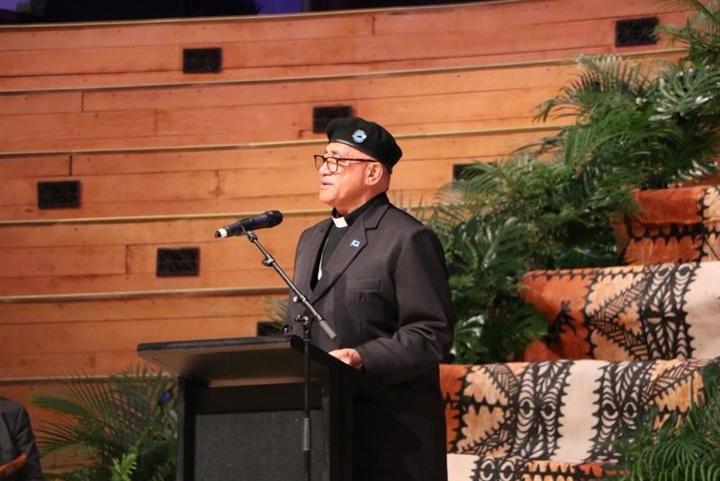
Reverend Alex Toleafoa of the Polynesian Panthers. Photo: RNZ / Anric Sitanilei
A member of the Polynesian Panthers Reverend Alex Toleafoa said they came today in peace.
He said many of the Polynesian Panthers were only 16 or 17 years old when they were standing against racism.
“Fifty years on we still continue that legacy which has led us to this time and this place.”
Reverend Alex Toleafoa said they have gone into schools to help teachers and educators understand the Dawn Raids.
“A frequent response we have from students is disbelief that anything like the Dawn Raids could actually happen.”
He said there is a need for more knowledge about this part of Pacific people’s history.
He said a new dawn is today spreading across the nation.
A representative for the Samoan community and community leader, Toesulu Brown, said the Dawn Raids are part of New Zealand history but do not define us as a community today.
She said the future of our children can be navigated through the acknowledgement of our past history.
“Today’s event can represent a new dawn, one that is full of promise for reconciliation in a genuine coming together.”
Brown thanked Jacinda Ardern and her government for today’s historic apology.
Other responses included a spoken word piece from spoken word artist Marina Alefosio, the band Tone6 and the Free Church of Tonga choir and brass band.
By One News / TVNZ and is republished with permission
The princess of Tonga shed tears as she formally accepted Jacinda Ardern’s apology on behalf of the Government that oversaw the dawn raids of the 1970s.
Princess Mele Siu’ilikutapu. Photo/Sreenshot
The practice saw immigration officials target the homes of Pacific Islands people in the early hours of the morning, beginning in the 1970s, in a crackdown on alleged “overstaying” on their visas.
Princess Mele Siu’ilikutapu Kalaniuvalu Fotofili began her acceptance speech by mixing the tears with laughter.
“This is a typical Polynesian, crying, we are so emotional, I tell you, I’m sorry, it goes with the make-up,” she said.
She then went on to thank Jacinda Ardern.
“I am very grateful for your Government for making the right decision to apologise to right the extreme, inhumane, racist and unjust treatment specifically against my community in the dawn raids era,” Princess Mele Siu’ilikutapu told Ardern at the Auckland Town Hall this evening.
“Let me assure you that we have accepted the fact that some of our people at the time were on the wrong side of the law – yes,” she said, looking at giggles from the crowd.
“This should not have warranted the unleashing of police dogs on our people, the raids of our houses in the early hours of the morning and many other extreme measures put in place at the time.”
Ardern was visibly emotional as she listened to the Tongan royal speak while Social Development Minister Carmel Sepuloni, who is of Tongan descent, wiped tears from her eyes.
The princess thanked Ardern for the gifts announced to the community today as a token of the Government’s formal apology. The gifts include: $2.1 million in academic and vocational scholarships to be made available for Pacific communities; $1 million in Manaaki New Zealand Short Term Scholarship Training Courses for delegates from Samoa, Tonga, Fiji and Tuvalu; and resources made available to schools and kura who choose to teach the history of the dawn raids.
The Ministry for Culture and Heritage and Ministry for Pacific Peoples will also provide support to enable Pacific artists and/or historians to work with communities to help develop a comprehensive historical record of the dawn raids period.
“Right Honourable Jacinda Ardern, the apology is a move in the right direction – in the right direction of the healing process. I acknowledge with deep gratitude the gifts that you are presenting to us this evening,” Princess Mele said.
“I am sure my community is also grateful for the gifts as an exchange of good gestures; as a beginning of a caring, closer and better relationships between your Government and future leaders and our Pacific peoples.”
“However – love you, Jacinda – the vā could be better and complete should the Government promptly respond to the immigration-related needs of the community.”


.jpg.-416290044.png?fm=webp&w=784&h=441&fit=crop)