Former world heavyweight champion Joseph Parker is facing a possible suspension from boxing after testing positive for cocaine.
Joseph Parker
The 33-year-old New Zealander returned an adverse finding in a Voluntary Anti-Doping Association (VADA) test conducted on October 25, the day of his fight against Britain’s Fabio Wardley at London’s O2 Arena.
Parker, who lost the bout in the 11th round, did not test positive for performance-enhancing substances but for a recreational drug, according to sources close to the investigation.
Cocaine is classified as a banned substance under the World Anti-Doping Agency code, and its use during competition can lead to a ban of up to two years.
The British Boxing Board of Control and UK Anti-Doping are now reviewing the case.
Queensberry Promotions, Parker’s British promoter, confirmed the failed test in a statement, saying VADA had informed all relevant parties of the adverse finding.
“While the matter is investigated further, no additional comment will be made at this time,” the statement read.
Parker, who held the WBO heavyweight title from 2016 to 2018, had been on a comeback trail with six consecutive wins before his defeat to Wardley. He has not yet commented publicly on the test result.
The boxer is entitled to request a B-sample analysis, although such results rarely differ from the initial finding.
If confirmed, the ban would derail Parker’s hopes of another world title shot and could sideline him from the sport for a significant period.
Nuku‘alofa – Minister of Police Piveni Piukala has publicly rejected an investigation by the Anti-Corruption Commission (ACC) into his alleged role in facilitating the departure of a high-ranking Mormon leader from Tonga, describing the probe as “veve” (rubbish) and accusing the judiciary of incompetence and bias.
Sylvester Tonga, VPON Media host and director with Minister of PolicePiveni Piukala
The ACC is examining claims that Piukala assisted Pita Foliaki Hopoate in departing for the United States despite a court-issued restraining order prohibiting him from travelling.
Police Commissioner Georff Turner told Kaniva News the case was referred to the ACC “to avoid any potential conflict of interest.”
“Mr Hopoate is the subject of an ongoing court matter, and a court order is in existence that prohibits him from leaving Tonga,” Turner said.
It is understood that the restraining order followed legal action brought against Hopoate by ‘Epalahame Taukei’aho, a member of their Mormon Church school alumni association.
Minister’s Media Defence
On Tuesday, November 11, Piukala mounted a vigorous defence during his regular segment on VPON—a media platform widely regarded as a political influencer—asserting, without challenge from host Sylvester Tonga, that his actions were justified.
Tonga informed Piukala that a report indicated the lawyer representing Taukei’aho had rejected what appeared to be an earlier claim by Piukala of an alleged agreement with Hopoate’s lawyer to process legal documents—an arrangement that, if accurate, might have enabled Hopoate to travel to the United States despite his court-issued restraining order.
Responding in Tongan, Piukala argued the issue stemmed from rote learning (“ako ma’uloto”), claiming the judiciary lacked sufficient understanding to handle the matter (“‘ikai ha maama fe’unga”).
He further alleged that the judge had “admitted” she did not review the background of the charges and was unaware of Hopoate’s identity, noting that the man was a retired Area 70 of the Mormon Church, “a position highly regarded” within the faith.
Piukala criticised the court for issuing the restraining order without hearing Hopoate’s side, claiming the judge had not called Hopoate or his associates before signing the order.
He warned that fully addressing the matter could “open a can of worms,” suggesting deeper, undisclosed complications.
“I acted with good intentions and am willing to go through the issue at all costs,” Piukala said. “I am glad this issue is unfolding, as it will reveal matters we did not expect.”
Lawyer Denies Agreement
Meanwhile, Allyssa Kafoa, lawyer for complainant Taukei’aho, vehemently denied what appeared to be an earlier allegation by Piukala that she had agreed with Hopoate’s lawyer to allow him to leave while processing the cancellation of the restraining order, according to Kakalu Online.
The paper quoted Kafoa as saying Piukala approached the judge in an attempt to release Hopoate, offering to act as “surety.”
It reported the judge rejected Piukala’s proposal and told him she needed to contact Kafoa first.
Political Fallout
The allegations have become a focal point for Piukala’s political opponents, who accuse him of undermining the rule of law.
His latest comments, directly challenging the integrity of both the ACC and the judiciary, are expected to intensify the political crisis and raise questions about the separation of powers between the police ministry and the courts.
The ACC has not yet issued a public response to Piukala’s accusations.
Kaniva News was unable to reach the judge or the Anti-Corruption Commission (ACC) for comment.
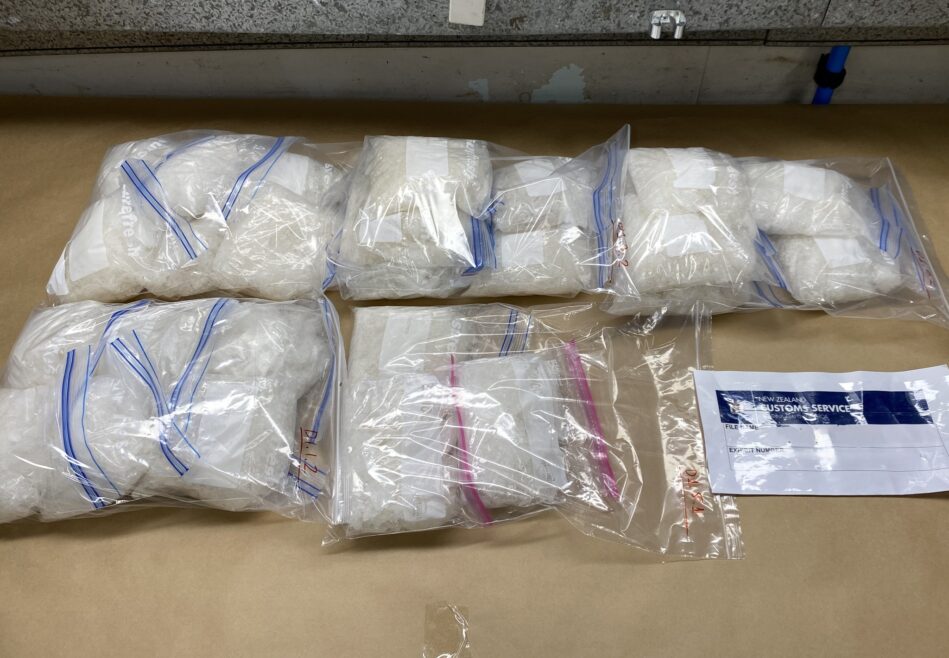
Auckland, NZ – In a significant pre-holiday blow to international drug trafficking, Customs officers at Auckland International Airport have intercepted five methamphetamine couriers in just over a week, seizing millions in illicit substances.
Customs officers at Auckland International Airport have caught five methamphetamine couriers in just over a week.
The crackdown began on November 2 with the seizure of nearly 30 kilograms of methamphetamine from three United States nationals. This week, the streak continued with two more high-volume interceptions.
On Monday, November 10, a 32-year-old US national was arrested after an inspection revealed his two suitcases contained 36 vacuum-sealed packages.
The haul, an estimated 19 kilograms of methamphetamine, has a potential street value of up to $5.7 million.
The previous day, officers uncovered a more clandestine smuggling attempt.
A 69-year-old French national, travelling from South Africa via Hong Kong, was found carrying a hollowed-out wooden box disguised as a book titled ‘Apologise, Forgive, Forget’.
The prop concealed just under two kilograms of methamphetamine, worth approximately $594,300.
Customs Auckland Airport Manager, Paul Williams, issued a stern warning to criminal networks.
“Criminal networks are actively targeting New Zealanders by pushing their products here for profits. They keep sending packages, and we keep seizing them. We have every intention of continuing to catch drug couriers heading into a busier summer season.”
The back-to-back seizures signal both a persistent threat from international drug syndicates and a heightened, successful enforcement effort at the border.
Nuku’alofa– Tonga heads into its November 20 general election under rules that exclude its vast overseas population, even as new figures and international warnings underscore a stark reality: more than twice as many Tongans live abroad as in the kingdom.
Photo/Kaniva Tonga News
An estimated 200,000 Tongans reside in Australia, New Zealand, and the United States, compared to just 110,000 living in Tonga. Despite their economic importance—sending millions in remittances annually—the diaspora has no legal right to vote in national elections.
A new report by the International Monetary Fund (IMF) this week confirms Tonga’s rising “outward migration,” warning that the trend is weakening the country’s potential economic growth. It comes amid renewed calls for diaspora voting rights, including fresh demands to allow Tongans working in Australia and New Zealand under seasonal labour schemes to participate in national elections.
This follows revelations that Tonga is considering a review of its electoral system after next week’s polls.
Electoral Commissioner Pita Vuki acknowledged that a review of the electoral system is likely after the polls, citing concerns about declining turnout and structural weaknesses. He confirmed that 64,700 voters are registered for this year’s election, up from 60,000 in 2021, reported RNZ.
It remains unclear whether the review will include consideration of legalising voting rights for Tongans living in the diaspora.
The debate over voting rights comes amid a deepening “brain drain.” Government reports for 2024 and 2025 show thousands leaving for better wages abroad, leaving 861 civil service positions vacant this year alone.
As we recently reported, Tonga’s Ministry of Health was facing a severe staffing crisis, with Vaiola Hospital losing 45% of its nursing workforce since the COVID-19 pandemic. The hospital’s Matron, Akesa Halatanu, said the decline was mainly due to overseas work opportunities and personal reasons.
Advocates say the exclusion of overseas Tongans from voting is indefensible.
ʻOfa Guttenbeil-Likiliki, director of the Women and Children Crisis Centre, reportedly said that Tonga has gone through 14 years and four elections since the 2010 reforms without any move to amend the Electoral Act.
She told RNZ that around 5,000 Tongans working in Australia and New Zealand under labour schemes are being “deprived of their basic human right to vote,” adding that the issue affects the entire diaspora, whose financial contributions are vital to Tonga’s economy.
In 2021, ABC News reported calls from Tongan lawyer Leilehua Faʻonevai in Australia urging Tonga to allow its citizens abroad to vote. She argued that Tongans in Australia play a crucial role in supporting the kingdom’s economy through remittances and should have a voice in national elections.
Global Tongan Footprint
Recent census data shows that more than 200,000 Tongans now live in Australia, the United States, and New Zealand—excluding those in other parts of the world. Official figures indicate that the United States recorded 78,871 people of Tongan descent in its 2020 Census, while Australia reported 43,465 in 2021.
New Zealand’s 2018 Census listed 82,389 people of Tongan ethnicity, with more recent estimates suggesting the number has grown to around 97,824.
The US figures include individuals of full or partial Tongan ancestry.
Significant communities are concentrated in Utah and California in the United States, New South Wales in Australia, and the Auckland region in New Zealand—underscoring the global reach of Tonga’s population beyond its borders.
Nukuʻalofa – The National Reserve Bank of Tonga (NRBT) has issued a warning about an increase in counterfeit banknotes circulating in the country.
The central bank says fake notes have been detected imitating the design of genuine paʻanga currency, and urges the public and businesses to exercise caution when handling cash.
According to the NRBT, counterfeit $100 paʻanga notes from the King Tupou V series have been detected.
These fake notes are printed on clear plastic material to imitate the transparent window feature of genuine $100 notes.
The NRBT clarified that authentic $100 paʻanga notes are not printed on plastic.
The bank also reported counterfeit $5 paʻanga notes from the King Tupou VI 2015 series. These notes are printed on ordinary paper and attempt to replicate the design of the genuine 2015 $5 series.
In addition, fake $50 paʻanga notes from the King Tupou VI 2015 series have been found.
These counterfeits are printed on plain paper, lack serial numbers, and are smaller in size compared to genuine notes.
Some fake notes have been printed on clear plastic material to resemble the transparent window of genuine high-value notes, while others are made from ordinary paper and even plain sheets without serial numbers.
These counterfeits are often smaller in size and do not meet the quality standards of authentic banknotes.
The NRBT believes more counterfeit notes remain in circulation and warns that informal businesses dealing primarily in cash are particularly vulnerable.
The bank is encouraging the public to inspect all banknotes carefully before accepting them and to familiarise themselves with the security features of genuine currency.
Producing, possessing, or knowingly using counterfeit currency is a serious criminal offence.
Anyone who suspects a counterfeit note is urged to report it immediately to the NRBT or the nearest police station.
The Ministry of Education has reportedly issued a directive prohibiting parents from providing food or monetary contributions during Form 2 Common Examinations at government middle schools.
The development follows complaints shared on social media last week, in which Facebook users criticised some school principals for allegedly pressuring parents to make donations—reportedly intended as contributions for teachers who spent extra hours preparing students for exams.
The decision, discussed at a recent Senior Management Team meeting, aims to create a focused and distraction-free environment for students during these critical assessments, according to a statement on the Ministry of Education letterhead seen by Kaniva News and shared on social media.
It says the directive also seeks to reduce financial burdens on families and prevent disputes or incidents that have occurred in previous years.
Under the new policy, parents and guardians will no longer be required or expected to prepare food of any kind or make monetary donations before or during the examinations, it says.
The Ministry emphasised that this measure will become part of formal school rules and policies.
While parents may still choose to show appreciation to teachers voluntarily, such gestures must be initiated independently and not organised, encouraged, or requested by schools, it says.
It also says the directive takes effect immediately and will remain in place for future examinations.
Social media comments
The directive has divided the social media community, with supporters asserting that their actions stem from the cultural practice of fatongia—a cultural obligation including one that shows they care for their children—and expressing a desire to show appreciation for teachers.
“If some can do it, then let them,” one commenter stated.
“It should be based on voluntariness, and that’s perfectly fine,” another commenter said.
However, critics argued that the issue arises when the directive is issued as a formal order from schools, potentially placing pressure on parents who cannot afford to comply.
“Stop burdening parents—they already carry responsibilities for the church, the community, and now the schools,” another commenter said.
In a significant move to ensure impartiality, an investigation into the alleged actions of Tonga’s Minister of Police, which led to the departure of a man subject to a travel ban, has been formally handed over to the Anti-Corruption Commission (ACC).
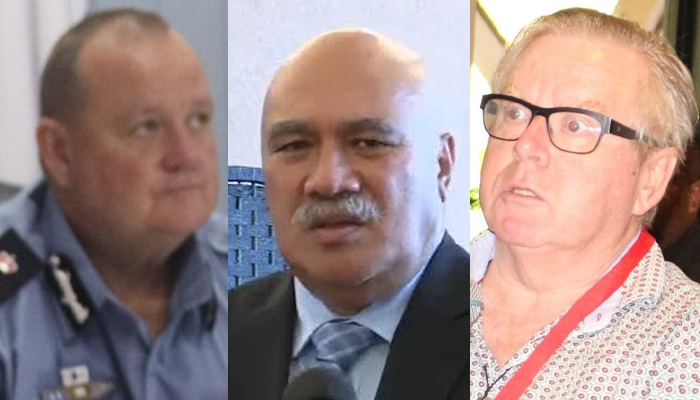
L-R: Police Commissioner Geoff Turner, Minister of Police Piveni Piukala and ACC Commission Chris LaHatte
The announcement came in an official statement addressing growing public concern over the case involving Mormon church leader Pita Hopoate.
Hopoate, who is the subject of an ongoing court matter, left Tonga despite an existing court order prohibiting him from doing so. The alleged role of the Police Minister in this incident is now the focus of the probe.
Police Commissioner Geoff Turner told Kaniva News in a statement this afternoon that Tonga Police had conducted preliminary enquiries after receiving several referrals, including one from the Office of the Prime Minister, urging an investigation into the Minister’s alleged actions.
“I have no doubt that Tonga Police are capable of undertaking an investigation into these allegations that would be actioned without fear, favour, malice or ill-will,” he said, acknowledging the capability of the national police force.
However, in the interests of transparency and to avoid any potential conflict of interest, a decisive step was taken.
“The Commissioner of the Anti-Corruption Commission (ACC) and I have determined that the investigation is better suited to be undertaken by the ACC,” Turner also said.
This transfer of responsibility is now underway.
Tonga Police are currently briefing the ACC and handing over all relevant documentation to support the independent investigation.
He further committed that Tonga Police would provide any additional resources required by the ACC Commissioner to see the investigation through.
As Kaniva News reported yesterday, Prime Minister Aisake Eke has signaled a reluctance to suspend Minister Piukala, invoking the principle that “everyone is innocent until proven guilty.” The Prime Minister confirmed he would await the outcome of the investigation.
We also reported that Piukala, during his regular program with VPON media last week, did not deny the allegation.
Instead, he sought to justify his actions, stating he found it difficult to refuse a request for help from Hopoate.
Customs Minister Mateni Tapueluelu has publicly accused his colleague of interfering with the court and of allegedly assisting a person under a travel ban to flee the country.
The ACC has not yet provided a timeline for the completion of its investigation.
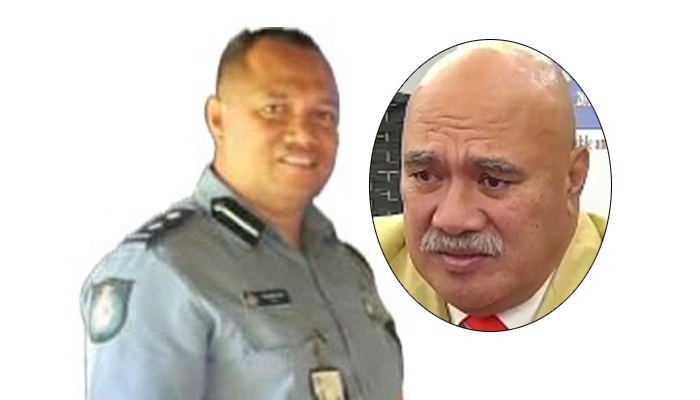
The Police Magistrate in Nuku‘alofa has reportedly ruled to prohibit any further travel by Pelikani ‘Aho, the Police Commander of Learning & Capability Development, amid ongoing legal proceedings concerning the alleged importation of firearms and ammunition into Tonga.
Superindentent Pelikani ‘Aho (L) with Minister of Police Piveni Piukala (inset).
The Kakalu online reported that ‘Aho was granted bail under strict conditions, including a ban on travelling overseas or domestically.
The court reportedly emphasised that the travel restrictions will remain in effect until the case is resolved.
Kaniva News has contacted Police Commissioner Geoff Turner for confirmation.
The ruling comes as Tonga’s Attorney General has advised Prime Minister ‘Aisake Eke to launch a formal investigation into allegations that Police Minister Piveni Piukala interfered with a separate court order preventing Mormon Church leader Pita Foliaki Hopoate from leaving the country last week.
Hopoate was facing a court hearing over a leadership dispute within the Mormon Church’s alumni association. A restraining order issued by Magistrate Judge Ana Tavo Mailangi on October 29 barred him from departing Tonga.
However, Hopoate was allowed to leave after an alleged directive from Minister Piukala was communicated to airport officials, claiming a new court order was being processed to permit his travel.
Customs Minister Māteni Tapueluelu condemned the move, stating that no such court order for release was ever issued and that Piukala’s actions constituted a breach of the law and an abuse of power.
“This decision is not subject to review or override by any executive authority, minister, or official,” Tapueluelu previously told Kaniva News.
Minister Justifies Intervention
In his VPON media show, Piukala did not deny the allegations but defended his actions, saying he felt compelled to help Hopoate leave the country. He claimed it was difficult to ignore Hopoate’s request and believed he had to act in his favour to prevent financial loss and uphold constitutional rights.
“You are innocent until proven guilty,” Piukala said. “Preventing him from travelling has already caused financial loss—money spent, tickets forfeited, disrupted plans. I thought this might already be a violation of our constitutional duty.”
The incident has sparked widespread concern on social media over executive interference in judicial matters and raised questions about the consistency of law enforcement in Tonga.
While ‘Aho reportedly remains grounded under court orders, Hopoate’s departure—allegedly facilitated by the Minister of Police—has prompted calls for greater accountability and respect for the rule of law.
Manu Hausia has been returned to Tonga after being granted parole, three and a half years before his sentence was due to expire.
Manu Hausia
Hausia was jailed for six years and six months in 2023 following a violent attack on his partner in Oamaru, Christchurch, New Zealand.
He pleaded guilty to four charges: attempted murder, injuring and wounding with intent, and assaulting a child.
The then 28-year-old man’s sentence was reduced due to several factors, including guilty pleas, difficulties serving time in a foreign country, and his previously good character.
At the time, Kaniva News and other New Zealand media reported that Hausia stabbed his partner in front of her young son, who called the police.
Justice Rob Osborne described the victim’s injuries as severe: nine stab wounds to her back, three to her face—including one that pierced her cheek—two to the back of her head, and another to her shoulder.
She also suffered cuts to her hand, bruising to her face, jaw, and neck consistent with strangulation, significant blood loss, and damage to her salivary glands, which affected her ability to swallow, speak, and eat.
The judge noted at the time that Hausia would likely be deported at the end of his sentence.
At the time of the attack, Hausia was in New Zealand on an interim visitor visa extended due to Covid restrictions, which had stranded him in the country.
According to the summary of facts, Hausia met the victim at a rugby game in Auckland at the beginning of the year.
They commenced a relationship and moved in together in the victim’s home in Oamaru soon after.