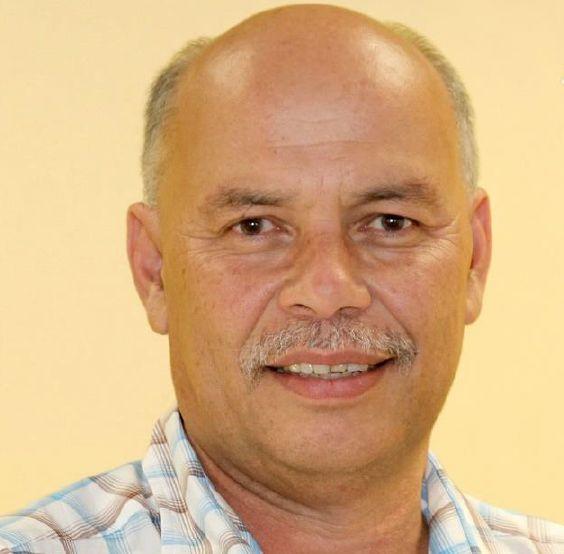
Samiu Fifita pleaded guilty to the charge that on or about 23 June 2020, at Sia’atoutai he knowingly possessed without lawful excuse, 0.16 gram of methamphetamine.
Police received information that Fifita was supplying or selling drugs at Kahoua from a red truck he was using.
The police drove to Kahoua in two vehicles via Sia’atoutai. At Sia’atoutai, they met the drug dealer driving the red truck and they stopped him.
Sniffer dogs were used before they found something inside the storage compartment of the vehicle. When Police officers opened it, they found $760.20 in cash inside. Fifita told the police that his wife had given him that money to buy pig feed for their piggery.
The dog also sniffed something in a small child’s shoe by the handbrake. The police found $2.00 and one pack of methamphetamine in it.
“You told the police you did not know whose pack it was but that the little shoe was your son’s.”
“The police also found two scales under the driver’s seat and you told the police that you used the scales for weighing the pig feed.
“The methamphetamine was weighed and was found to be 0.16 gram an it was analysed and was confirmed to be methamphetamine.”
His judgement statement said methamphetamine is a class A drug under the Act and says the sentence (a) for a class A drug less than 1 gram in weight, the sentence is a fine not exceeding $10,000 or imprisonment not exceeding 3 years or both.
For the offence of possessing 0.16 gm methamphetamine Justice Laki Niu sentenced Fifita to nine months imprisonment but that sentence is fully suspended for three years from March 15 upon condition that he would not commit an offence punishable by imprisonment within the period of suspension .
“You must attend and complete the Salvation Army course on drug and alcohol awareness as the Probation Officer shall arrange for you,” the judgement said.
“You must serve 50 hours of community work which the Probation Officer shall arrange for you.
“You must report to the Probation Officer with a copy of this sentencing immediately after you leave this Court this morning to make the necessary arrangements for the work and course I have ordered.
“The police shall forthwith with destroy the 0.16 of methamphetamine in respect of this offence. (f) The police may make application for forfeiture of the $760.20 under the Proceeds of Crimes Act. If they do not wish to apply, they shall return that money to you, the accused.”
International spectators will not be allowed to enter Japan for this year’s Olympic Games amid public concerns over coronavirus, organisers said on Saturday, setting the stage for a drastically scaled-back event.
Some 600,000 Olympic tickets purchased by overseas residents will be refunded, as will another 300,000 Paralympic tickets, Toshiro Muto, the chief executive of the Tokyo 2020 organising committee told a news conference.
He declined to say how much the refunds would cost.
The Olympic Games were postponed last year due to the Covid-19 pandemic. While the outbreak has chilled public opinion toward the event, both organisers and Prime Minister Yoshihide Suga have vowed to press ahead with the Games.
The decision on international spectators will “ensure safe and secure Games for all participants and the Japanese public,” Tokyo 2020 organisers said in a statement following five-way talks that included the head of the International Olympic Committee, Thomas Bach, and the Tokyo governor.
“People who are involved in the Olympics in some way may be allowed to enter the country, whereas regular visitors will not be able to,” Tokyo 2020’s Muto said.
He said costs for hotel cancellations would not be covered. Organisers may also consider cutting the number of staff members who will participate in the Games.
The Games are scheduled for 23 July 23 to 8 August, and the Paralympics from 24 August to 5 September.
Media polls have shown that a majority of the Japanese public are wary about letting in international spectators to watch the Games as the country grapples with the tail-end of a third wave of the pandemic.
New Zealand reaction
The New Zealand Olympic Committee has expressed its disappointment on behalf of the 1600 New Zealand fans set to travel to this year’s Tokyo Games after it was confirmed international spectators won’t be allowed to attend.
The Japanese Government and Games organisers have made the call to ban foreign supporters from the Games, to be held in July and August, due to fears they could spread Covid-19.
NZOC chief executive Kereyn Smith says although this situation is frustrating for New Zealand fans and athletes, the NZOC understands the reasoning behind the decision.
She says while New Zealand athletes thrive on knowing friends, whānau and fans are in the crowd, they will have to rely on support from back in New Zealand this year.
Stripped down Games
A stripped-down Games means the government will not get the tourism boom it had long counted on. Japan has grown increasingly reliant on foreign tourists, particularly from Asia, to bolster its weak domestic economy.
Like other countries, it has seen tourism unravel with the pandemic and its hotels and restaurants have been hit hard.
Saturday’s decision did not cover local spectators. Muto said organisers will decide next month on caps for spectators in venues.
“It’s very unfortunate,” Tokyo Governor Yuriko Koike said of the decision on international spectators, speaking to reporters after the meeting.
But she added that the conclusion was “unavoidable” given that the main priority for holding a successful Games would be the health of the athletes and the Japanese public.
Kyodo news service earlier reported that organisers were leaning towards barring overseas volunteers from helping at the Games.
Sources told Reuters earlier this month that the Japanese government had concluded it will not be able to allow spectators from abroad.
The family of a man who was taken to hospital in a serious condition are asking the community to pray for him.
It is understood a machete was involved in a fight before the victim was injured.
A sister told Kaniva News he was allegedly beaten during an incident at the Feitu’u Lalo in Lapaha.
The man was only named on Facebook as Sitefi.
“We have nothing to offer and we ask for your prayers for our brother. Lord we ask that you make everything possible,” a caption posted to Facebook with photos purported to show the victim lying in hospital with head and hand injuries.
A man has been jailed after he attacked a teenager in Tongatapu with a machete.
‘Inivenesi Helu was sentenced to two-year imprisonment at the Nuku’alofa Supreme Court on March 5 after he swung a machete and hit Tevita Hafoka’s right arm. The last 12 months of his sentence were suspended on condition.
Helu pleaded guilty to one count of causing serious bodily harm.
The dramatic incident unfolded on 12 July 2020, at about 3.30pm after Hafoka, Siua Moimoi and Tevita Fuafili were approached by a woman at a Chinese shop complaining that Siua’s younger brother, Moli, took her vehicle. Not long after, Moli arrived in a vehicle with Helu.
Siua punched Moli which resulted in Helu taking a baseball bat from the vehicle and chasing Siua. After an altercation between Helu and Siua, Helu left.
People, including Hafoka, started to gather. They saw Helu return to where the crowd had gathered. Helu yelled in Tongan “drink like people ‘ who have pubic hair”.
When no one responded, Helu punched 17-year-old Hafoka. Hafoka then ran out on the road and challenged Helu to a fight. Helu walked over to the victim and produced a machete. As Hafoka turned to run, Helu swung the machete and hit Hafoka’s right arm. Helu chased Hafoka but could not catch him.
Hafoka was taken to hospital where he was treated for a seven cm deep laceration which required internal and external sutures.
Later that day, Helu was arrested. The following day, his mother and de facto partner apologised to the Hafoka’s mother.
In sentencing Helu Lord Chief Justice Whitten said he is to be given credit for any time spent in custody on remand in relation to this matter.
“The final 12 months of the said sentence will be suspended for a period of 2 years on condition that during that suspension period, the Defendant is:
(a) not to commit any offence punishable by imprisonment;
(b) be placed on probation;
(c) report to the probation office within 48 hours of his release from prison;
(d) reside where directed by his probation officer; and
(e) complete a course on alcohol awareness and life skills as directed by his probation officer.
Failure to comply with the above conditions will likely result in the Defendant being required to serve the suspended period of his term of imprisonment.”
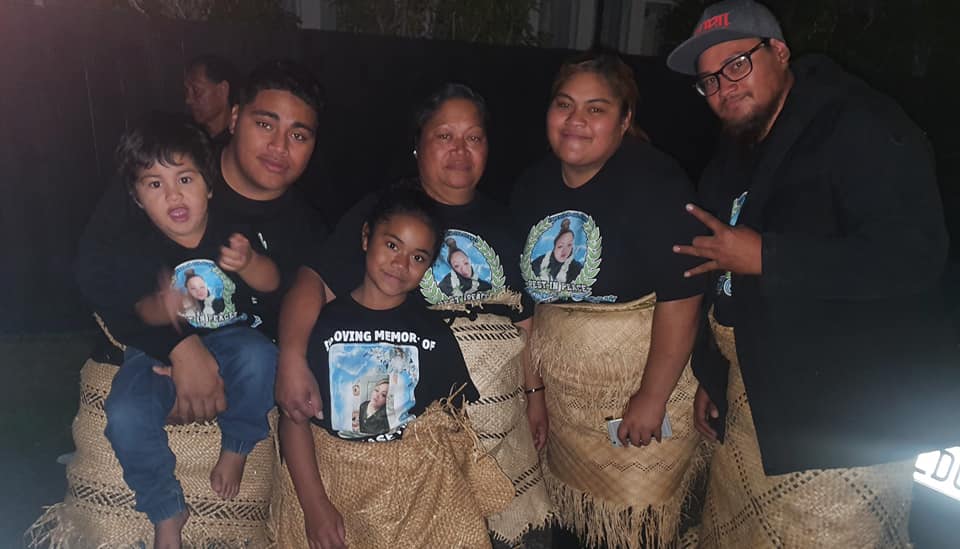
The funeral services of a slain daughter and her husband, who police believed he killed her before attempting to take his own life and later died in hospital had been described as wonderful.
Mother of four Toakase Finau, 29, and father of her children Viliami Latu, 31, were buried together in the same plot at the Manukau Memorial Garden, Papatoetoe this morning.
Videographer Rev Vosailangi Sikalu who filmed the burial services said it was “hugely pitiful”.
Finau’s mother ‘Alilia Teu Kata acknowledged the inspiring way the two families have grieved together asking her own family and kāinga to leave everything behind.
“To my kāinga (relatives) if you are sympathising (with Toakase) leave Viliami alone as Toakase’s paternal side were not happy with me on that. The funeral services were wonderful,” Kata posted on Facebook this afternoon.
She said she was not a person who interfered with other people’s affairs.
The pair’s tragedy haunted the Tongan community since their tragic deaths were revealed in the news last week.
Some of Finau’s kāinga and friends couldn’t bear to see how her life ended in such a dreadful way and attempts by both families to handle it with respect and dignity didn’t deter them from venting their frustrations on Facebook.
After Kaniva posted the news with double headshot photos of the pair and shared them to Facebook some supporters of Toakase didn’t accept it.
“Can you please delete Viliami’s photo,” a commenter said.
“I wouldn’t want to be buried together with my killer if I was the victim,” another wrote.
As we reported earlier this week, tributes had been also shared online for Lātū.
A commenter said she was surprised at “how he chose that pathway for him and his wife to go through”.
Last night Kata spoke during the pair’s wake. She described Finau as unique and loving among all her five children. She said Finau was her second daughter and the third was ‘Ana who died in April last year.
Finau’s family believed Latu contacted Finau last week asking to see their children at his court-appointed bail address in Pukekohe.
Finau’s family also believed the deceased pair met after Finau arrived and discussed their relationship during which Finau appears to have declined a suggestion by Latu for them to reunite.
Police have charged a 26-year-old man from Veitongo with attempted robbery and bodily harm.
Lord Dalgety of Scotland Tonga. Photo/Ministry of Information and Communications (Tonga)
The suspect was arrested on March 16 after Lord Dalgety of Sikotilani Tonga, 76, was assaulted during an attempted armed robbery at his home in Ha’ateiiho last month.
He is remanded in police custody to appear at the Magistrate’s Court later this week after the incident on February 8.
As Kaniva News reported last week, Lord Dalgety was reportedly rushed to Vaiola hospital.
Police reportedly said the king’s noble received minor injuries and nothing was stolen from his house.
The Scottish QC and former Conservative politician was charged with perjury over evidence he gave to a Royal Commission into the 2009 sinking of the MV Princess Ashika ferry, which claimed the lives of 74 people.
Lord Dalgety was secretary of the firm which operated the government-owned ferry. An official report into the disaster described him as an “evasive” character who “clearly lacks integrity and honesty”, and who was “unfit to hold such an important position”.
However, the Tongan life peer was cleared in 2012 after the court case against him was thrown out due to insufficient evidence.
This Asiapacificreport.co.nz story is republished with permission.Many Pacific nations are highly vulnerable to the effects of climate change. Image: In the Eye of the Storm
New Zealand has long had a privileged relationship with its Pacific neighbours. Now, in the dawning era of the climate crisis affecting millions of lives across the Pacific, the country has its helping hand outstretched. But with the controversial record of climate adaptation and mitigation strategies, does this hand have an ulterior motive? Matthew Scott investigates.
SPECIAL REPORT:By Matthew Scott
The beach is vanishing, one day at a time. The sea approaches the coastal village. It will not be negotiated with.
With seawater flooding the water table, crops that have fed the islanders for centuries are losing viability. The problem is invisible, under the people’s feet. But it demands change.
Each year, the cyclones have seemed to get more volatile and less predictable. What used to be a cycle of weathering the storm and rebuilding has become a frenetic game of wits with the elements.
In 2012, 3.8 percent of the total GDP of the Pacific Islands region was spent on the rebuilding efforts needed after natural disasters.
In 2016, that number had risen to 15.6 percent.
The effects of climate change are increasing the volatility and unpredictability of tropical cyclones in the Pacific.
That number has nowhere to go but up.
This story is playing out all over the Pacific, where economically vulnerable nations are some of the first to become victims to the encroaching climate crisis. Countries like Kiribati and Tuvalu, which have contributed least to the carbon emissions driving climate change, are on the brink of becoming its first casualties.
With millions of lives in the balance, this is a moral issue. New Zealand has responded according to its conscience.
Or at least it appears so.
The New Zealand Aid Programme sends 70.7 percent of its aid to countries in the Pacific. This is a higher proportion of our foreign aid budget than any other country. As such, New Zealand is inextricably entwined with funding and encouraging processes of climate adaptation and mitigation in the region.
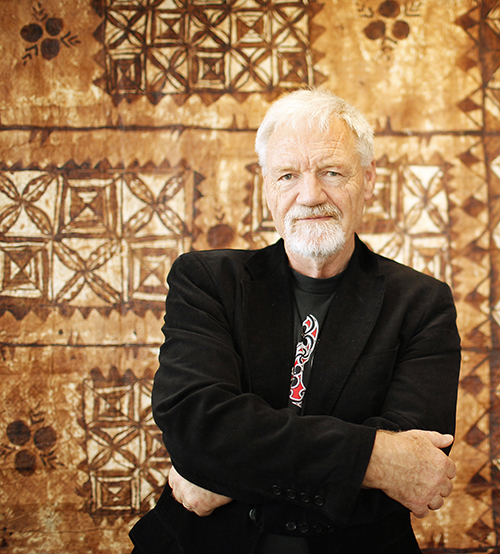
Professor Patrick Nunn … most Pacific climate aid breeds economic dependency and fails to help nations create a sustainable and self-reliant future. Image: PN Twitter
However, recent findings from the studies of Professor Patrick D Nunn from the University of the Sunshine Coast in Queensland, Australia, suggest that the most common forms of climate aid to Pacific nations breed economic dependency and fail to help them create a sustainable and self-reliant future.
On the surface, New Zealand’s climate aid policies seem like a life preserver to its drowning neighbours. But when the programme is considered in the long-view, does that life preserver come with a dog collar?
Ruined sea walls line the beaches of the South Pacific, a visual reminder to the people of the islands that the promise of help is sometimes broken.
Why should NZ help? New Zealand has long played a custodial role in the Pacific. A shared colonial history and geographical location has created a familial bond between New Zealand and countries like the Cook Islands, Samoa and Tonga.
Employment opportunities stimulated immigration to New Zealand after World War Two, when the NZ government opened its doors to the Pacific to fill labour shortages. Soon, the industrial areas of New Zealand cities were centres of the Pacific diaspora.
Nowadays Auckland is the biggest Pasifika city in the world.
But there was always a two-faced element to New Zealand’s treatment of the Pacific. It welcomed Pacific people in on the one hand, but then punished them and sent them away with the other.
Norman Kirk’s government introduced the Dawn Raids in 1973, when crack police squads stormed homes and workplaces looking for overstayers – countless migrants from the Pacific were separated from their families, lives and livelihoods.
Between 2015 and 2019, the Ministry of Foreign Affairs and Trade provided $200 million in climate aid to the Pacific.
Does the same flavour of double-dealing hang over New Zealand’s climate aid programme?
“People argue that aid is buying influence,” says Professor Patrick D Nunn. “I don’t think they are far off the mark.”
New Zealand’s motivations for climate aid in the Pacific are murky when the communication within the government bodies responsible is studied.
“The region is also that part of the world where our foreign policy ‘brand’ as a constructive and principled state must most obviously play out,” wrote NZ’s Ministry of Foreign Affairs and Trade (MFAT) in its October 2017 Briefing to an Incoming Minister.
This suggests an ulterior motive to the helping hand. The MFAT website says that strengthening New Zealand’s national “brand” is in order to promote New Zealand as a “safe, sustainable and stable location to operate a business and to invest”.
So New Zealand may have self-interest at the heart of its movements in the Pacific. As a capitalist nation holding its breath through a decades-long wave of neoliberalism, this is no surprise.
Where is the money going? But that doesn’t mean that New Zealand’s climate aid in the Pacific cannot have altruistic effects. Surely it is the outcome rather than the intention that ultimately matters.
However, it is still necessary examine where New Zealand’s money is going.
A 2020 study from Professor Nunn and a group of other academics casts doubt on whether current modes of climate adaptation can effectively promote long-term solutions for the islands.
“It’s unhelpful in the sense that it’s implicitly encouraged that Pacific Island countries don’t build their own culturally-based resilience,” Professor Nunn says. “It’s encouraged that they adopt global solutions that aren’t readily transferable to a Pacific Island context.”
One of the more visible examples is the ubiquitous sea wall. Sea walls protect coastal communities from rising sea levels throughout New Zealand, so it seems obvious that they could do the same job for Pacific neighbours.
But New Zealand invests in building its walls to stand for the long-term, and the country has access to the capital and human resources needed to maintain them.
This is not always the case in the developing countries of the South Pacific.
“Usually there’s not enough data to inform the optimal design of sea walls,” says Professor Nunn. “So the sea wall collapses after two years. Then the community struggles to find funds to fix it because they are not part of the cash economy.”
Professor Nunn blames this recurring issue on the short-sightedness of foreign aid programmes from the governments of developed countries in the region.
“You can’t uncritically transfer solutions from a developed to a developing country context – however obvious they seem.”
Professor David Robie … “We build sea walls where they would plant mangroves.” Image: Alyson Young/AUT
Academic and journalist Professor David Robie, the recently retired director of the Pacific Media Centre, sees New Zealand’s relationship with the Pacific as neocolonial.
“We build sea walls where they would plant mangroves,” he says. Mangroves, of course, don’t require upkeep, and they are a solution that people in the Pacific have used for centuries. They might not always fulfil the urgent interventions required during the climate crisis, but as New Zealand seeks to advance our “brand” in the Pacific, do we give them due consideration, or do we fall back on our own western solutions by default?
“It would have been better to not have had such a neocolonial approach,” says Professor Robie. “We could have encouraged the Pacific countries to be a lot more self-reliant.”
Short-term solutions for long-term problems According to an MFAT Official Information Act release on climate change strategy, climate aid consists of 190 different activities across the Pacific. Of these activities, the largest focus is put on agriculture (25 percent), followed by energy generation and supply (20 percent) and disaster risk reduction (12 percent).
With the long-term projections of sea levels rising, are these areas enough to safeguard our Pacific whanau long into the future?
Professor Nunn spoke about plans by Japanese foreign aid to divert the mouth of the Nadi River in Fiji in order to stop the growingly frequent flooding of Nadi town.
“It would be far more useful for the Japanese government to develop a site for the relocation of Nadi town,” Professor Nunn said. “Somewhere inland, somewhere in the hinterland. Put in utilities and incentivize relocation of key services – because the situation is not going to improve. In 10-15 years, large parts of Nadi town are going to be underwater.”
So it goes across the Pacific.
New Zealand’s strategies of capacity building and disaster management are noble on the surface, but are we arranging deck chairs on the Titanic?
Climate change is an epoch-defining force that is inevitably going to render swathes of the globe uninhabitable. We can fund short-term adaptation to these issues and feel better about ourselves and our Pacific “brand”, but the real solutions lie in establishing humane systems of relocation around the Pacific.
Some of this comes in the form of increasing New Zealand’s own quota for climate migrants seeking asylum in New Zealand. For countries that consist of primarily low-lying atolls such as Kiribati, leaving their ancestral homeland will one day sadly be the only option.
Other nations such as Fiji and Samoa have the capacity to weather the storm if development is focused in the right direction – the gradual relocation of population centres inland, away from the risks of increasing flood frequency and rising tides.
MFAT has stated in an Official Information Act release of July 2019 that three quarters of their investment into climate aid “will go towards supporting communities to adapt in situ to the effects of climate change, which will enable them to avert and delay relocation”.
These goals are stuck in the short-term. This is procrastination on an international scale. The effects of climate change are no longer just theories, or nightmares that may or may not come true.
There is a clear road map to a future in which many areas in the Pacific are in peril. New Zealand has a moral duty to make sure that the effect of its aid helps not just the current members of Pacific whanau, but also the generations to come.
Examining NZ’s aid In July, 2019, an inquiry was launched by the Foreign Affairs, Defence and Trade Committee into Aotearoa’s Pacific aid. The committee examined every facet of how the lion’s share of our foreign aid budget is spent. With Pacific aid, this means a discussion of climate change is inevitable.
Their findings were released last August.
Overall, the committee paints the picture of a considered approach to foreign aid, with New Zealand making an effort to take responsibility as the most developed economic power in our geopolitical bloc to bring about a world in which people have social mobility and human rights are protected.
Much of the report, however, centred around the committee’s recommendations as to how MFAT should proceed.
Some of these recommendations shine a light on the potential problems inherent to our regime of climate aid.
They recommended that the aid programme take steps to “more deeply engage with local communities, ensuring all voices within those communities are heard, and their viewpoints respected.” This suggests a certain level of overhanded detachment coming from New Zealand’s aid programme.
They also suggested that MFAT places a heightened emphasis on social inclusion step up efforts to make sure development is centred around locally-owned industry.
The committee also asked for public submissions.
Some of these provided perspectives that the committee themselves may have glanced over.
“Pushing New Zealand values into the Pacific—particularly when tied to monetary support—could be viewed as a renewed form of colonialism,” submitted one anonymous member of the public. Another raised that “greater engagement is needed with local communities to ascertain both their values and needs, and for aid to be appropriately tailored.”
These criticisms are not definitive proof of missteps on the part of the ministry. However, they are talking points that the ministry themselves seem unwilling to address.
When questions of neo-colonialism and unsustainable aid programmes were raised to the ministry, a spokesperson provided answers that glossed over the criticisms.
“Four principles underpin New Zealand’s international development cooperation: effectiveness, inclusiveness, resilience and sustainability,” said an MFAT spokesperson when asked if there was a risk of breeding economic dependency via New Zealand forms of aid.
“Their purpose is to guide us and those we work with in our shared aim to contribute to a more peaceful world, in which all people live in dignity and safety, all countries can prosper, and our shared environment is protected.”
It sounds admirable, and it places New Zealand on the right side of history. But it doesn’t answer the specific concerns that have been levelled at the aid programme – the fact that deliberately or not, New Zealand may be guilty of building a relationship of dependency with countries in the Pacific.
Are answers like these just a further attempt to bolster the “brand” that New Zealand is trying to sell to the Pacific, and indeed the rest of the world?
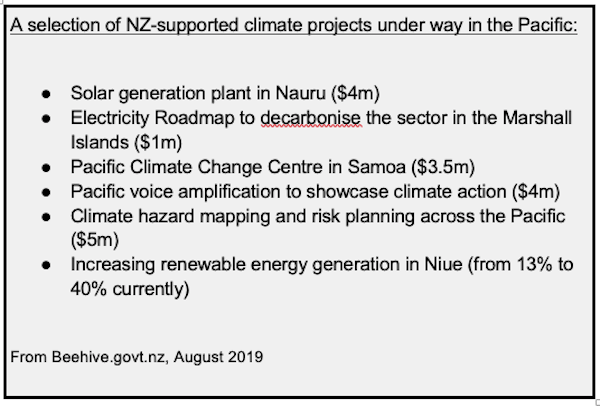
A selection of NZ government climate aid projects, August 2019. Table: beehive.govt.nz
Pouring money into the problem When New Zealand signed the Paris Agreement in 2016, we were putting ourselves forward as one of the countries committed to strengthening the global response to the burgeoning climate crisis. John Key pledged to provide up to $200 million in climate aid over the next four years. Most of this was focused on the Pacific.
The Paris Agreement recognised that the Pacific was indeed one of the world’s most vulnerable regions when it comes to the effects of climate change – this is for a multitude of reasons. There are the obvious, such as the fact that countries consisting of low-lying atolls such as Kiribati and the Marshall Islands are the most at risk from rising sea levels, but the reasons are as numerous as they are insidious.
Small populations reliant on a narrow array of staple crops and food sources put the people of the Pacific in a particularly precarious position. The effects of colonisation have left these countries socio-economically deprived and in thrall to developed countries like Australia, New Zealand, the United States and China.
So the reasons why the Pacific is so vulnerable to the crisis are complex and various. It therefore follows that the solutions to the crisis are as well.
Chief among these is shifting from expensive answers to the problem to those that don’t cost anything at all. Cashless adaptation could come in the form of education or placing a greater emphasis on indigenous solutions to climate change.
Steering the ship towards cashless adaptation would reduce vulnerable countries’ reliance on their wealthier neighbours.
Another solution is the slow relocation of coastal cities into the hinterlands of the countries, such as Fiji’s Nadi, where flooding in the central business district is becoming more and more frequent.
Foreign aid can play a part in encouraging and funding such projects, but at the end of the day, it is the governments of these countries themselves that hold the reigns. The city of Nadi will not be moved without the constant efforts of the Fijian government over the course of generations.
In their 2019 paper “Foreign aid and climate change policy”, Daniel Y Kono and Gabriella R Montinola claim that while foreign aid for climate adaptation and mitigation is on the rise, the manner in which it is employed may render it toothless and unable to make changes for the people of the Pacific in the long term.
The main reason for this conclusion is that there has been little to no evidence that foreign climate aid in Pacific nations can be correlated with Pacific governments enacting policies addressing the crisis.
It is arguable whether foreign aid can be expected to affect the policies of recipient governments. However, it is undeniable that solutions to climate change require the synchronised action from both suppliers and recipients of this aid.
Help comes on NZ’s terms In order to plant the seeds for long-term viable responses to climate aid, New Zealand’s approach must consider the worldview of people in the Pacific.
Professor Nunn sees this as another form of developed countries employing neocolonial tactics in order to build relationships of dependency with countries in need.
“You cannot take your worldviews and impose them on people who have different worldviews and expect those people to accept them,” he said.
On many of the islands of the Pacific, the scientific worldview does not hold automatic precedence over spiritual and mythological views, as it does in the secular West.
Low science literacy and a stronger connection to nature through cultural tradition and ritual such as religion mean that if the sea level rises, people in the Pacific often tend to consider it a divine act.
Practitioners of foreign aid need to show cultural competency if their approach is going to be picked up by the people of the Pacific.
“You’ve got to understand why your interventions are failing,” says Professor Nunn. “You go in there and argue on the basis of science. Nobody in rural Pacific Island communities gives a stuff about science. What they understand is God. To ignore that and pretend that it’s not important is just going to result in a continuation of failed interventions.”
Understanding is the route to developing a system of long-term and sustainable examples of climate change adaptation and mitigation in the Pacific.
“Empowering Pacific Island communities means understanding them,” says Professor Nunn. “Not just what their priorities are, but also how they’ve reached those priorities.”
With crisis comes opportunity Prior to 2020, climate change was on its way to being a top-priority issue to governments all over the world – particularly those in highly-affected regions like the Pacific. Then 2020 happened.
Covid-19 has dominated public talk for months and there are no signs of this changing any time soon. Big ticket issues like social inequality and climate change found themselves on the back-burner during the New Zealand election, and the same could be said in societies around the world.
The virus has brought global tourism to a standstill and threatened the safety of many already vulnerable indigenous populations. Both impoverished and tourism-reliant nations in the Pacific have been placed in drastically uncertain financial straits.
Although the rates of infection have been fortunately low across the Pacific, countries like Fiji and the Cook Islands have lost their main source of income – holidaymakers seeking a sun-soaked patch of white-sand beach.
The beaches are there waiting, but the planes haven’t begun to land yet.
With the threat of economic ruin hanging over their heads, Pacific nations’ climate change options have been reduced even further.
But from the perspective of analysing the problematic elements of New Zealand’s climate aid programme, there is a silver lining.
In April, MFAT reported that almost two-thirds of their development programmes had been affected by covid-19 in some way. In the Foreign Affairs, Defence and Trade Committee’s Inquiry into New Zealand’s aid to the Pacific report, it is said that recovery from this will require a range of responses, including stopping, reassessing and adapting, or re-phasing projects on an individual basis.”
Herein lies the opportunity.
The aid programme is on the verge of a massive shake-up, as MFAT reanalyses the best approach in a covid-stricken world. Now is the time for reassessment of our position as aid donors with the work of Professor Nunn in mind.
The committee’s report went on to say “the ministry pointed out that travel restrictions due to covid-19 mean that it will need to rely more heavily on local staff and expertise to provide aid. The ministry also hopes to move to a more adaptive and locally-empowered model.”
So it may be the virus that forces our hand and has the end result of more of the authority placed locally across the Pacific.
If we are indeed guilty of perpetuating a neo-colonial system of foreign aid, this could certainly be part of the remedy.
We are being given a nudge, if not a shove – an impetus to change. We can resist that or take the opportunity in our hands.
Now is the time to change, and ask the government for more equitable and sustainable forms of climate assistance in the Pacific.
Matthew Scottis an Auckland-based journalist for Newsroom who is interested in New Zealand’s place in the Pacific. He is a contributor to Asia Pacific Report and his stories can be seen here. Twitter: @mnscott1992
This RNZ.co.nz story is republished with permission
The race is on to reach Pasifika communities to counter the spread of misinformation about the Covid-19 vaccine.
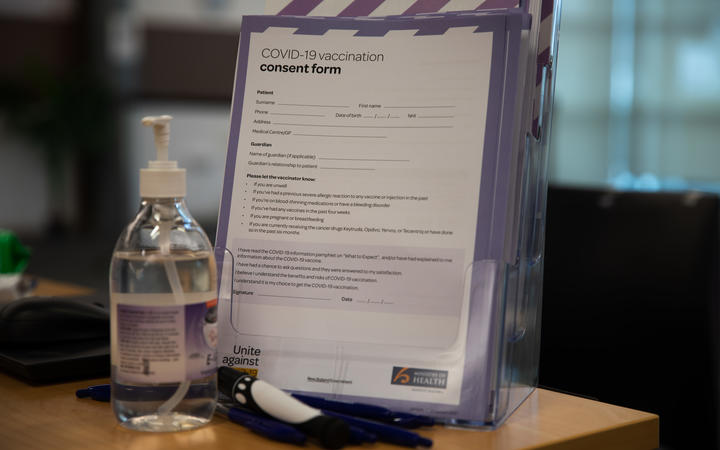
The consent form for the Covid-19 vaccination at a facility in South Auckland. Photo: RNZ / Simon Rogers
Pacific and Māori communities have the highest risk of dying from Covid-19 and that has caused leaders and doctors within this group to work hard to dispel fears and misinformation about what it might mean to get the jab.
“People can have confidence that the vaccine is effective and safe,” said Auckland University public health professor Dr Colin Tukuitonga, who has 40 years’ experience in medicine.
The amount of research, testing and studies behind the vaccine was “phenomenal”, he said.
People with reservations have every right to ask questions – but can rest assured there is nothing to be worried about, he said.
“It is highly effective. There is increasing evidence that it reduces transmission to others and protects us all as a nation and community.”
There have also been very few side effects so far, besides a headache and sore arm and most medication and vaccines have side effects anyway, he said.
“In Israel where they have pretty much vaccinated everyone, they have found the vaccine to reduce hospitalisation and infection.”
Widespread vaccination against Covid-19 was an important tool in efforts to control the pandemic.
What to know about Covid-19 Pfizer vaccine
New Zealand has secured 10 million doses of the Pfizer/BioNTech vaccine – enough for 5m people to get two doses.
The vaccine is for people over 16 years because it is yet to be tested on a younger age group.
Like all medicines, the Pfizer/BioNTech vaccine may cause side effects like a headache and/or sore arm in some people. These are common, are usually mild and don’t last long.
Nine out of 10 people will be protected.
There has been at least 250m doses given around the world.
New Zealand’s Medicines and Medical Devices Safety Authority, Medsafe is closely monitoring the safety of the Pfizer/BioNTech vaccine.
Impacts of the vaccine are monitored and reported to the World Health Organization (WHO).
Cultural nuances when communicating to Island communities
Colin Tukuitonga Photo: PMA
The Pacific peoples’ ethnic group is the fourth largest major ethnic group in New Zealand, behind European, Māori and Asian ethnic groups.
The Ministry of Health has been on a mission to communicate helpful information to people about the vaccination.
Anyone calling the Covid Healthline can speak with someone in their own language, with access to interpreters for over 150 languages, including te reo Māori and the nine main Pacific languages.
Māori and Pacific providers hold trusted relationships with the whānau they serve and play a crucial role to maximize uptake and achieve equity, a Ministry of Health spokesperson said.
Dr Tukuitonga praised Associate Minister of Health Hon Aupito William Sio for organising meetings with Pacific leaders and groups about the vaccine – which sometimes included up to 500 people over Zoom.
A Ministry of Health spokesperson said it planned to support district health boards to engage with people who may be hesitant about getting a vaccine dose.
Efeso Collins said a conversation approach is needed to connect with Māori and Pacific communities. Photo: RNZ / Jessie Chiang
But Manukau councillor Efeso Collins was “not convinced” that the Ministry of Health had been taking the “right approach” to connect with Māori and Pacific communities – although small improvements were only just being made.
“Those of us who were raised in the islands have an oral tradition. The Ministry of Health need to understand that just sending out information on a sheet of A4 or link on a website isn’t the way you engage with these communities.”
He wanted “trusted community champions” to be sent into communities to have a korero and discussion around the table.
Change could only truly happen in family homes, he said, where they can air any fears around the vaccine and address certain distrust when it comes to public institutions.
“If we don’t take a conversation approach then we will always allow misinformation to win the battle and that’s where I believe the Ministry of Health have fallen over, because we haven’t trusted local organisations to go into the community and talk to the families.”
Church influence and community champions
About 70 percent of Pacific Islanders attend church regularly, so leaders of these congregations are being reminded of the influential role they play as a vaccine messenger.
Efeso Collins planned to help those on the fence about the vaccine in his South Auckland electorate.
He encouraged the importance of “a conversation after church … with a coffee and a muffin to talk through distrust to make a difference”.
Social workers and community groups who already have trusted connections with whānau would also be valuable in helping vulnerable people who had digested misinformation.
There were still small groups across the country who did not believe in vaccines and their views had led to the spread of misinformation and wild allegations, founded on rumours and falsehoods.
“The Tamakis of this world are a nuisance,” Dr Tukuitonga said, but believed overall that most Pacific peoples would choose the vaccine.
“She told me she would come with a birthday cake and candle for me to blow out. It’s a pity that it did not happen,” ‘Alilia Teu Kata told Kaniva News of a special gift her murdered daughter promised for her birthday today Friday 19 March.
(L-R) Toakase Finau, Viliami Latu
The bodies of her daughter Toakase Finau and her husband Viliami Latu are expected to be laid to rest at 9am tomorrow morning Saturday, March 20 at the Manukau Memorial Garden in Papatoetoe.
Kata’s reactions during her birthday appear to show she was attempting to cope with the tragedy that killed her daughter. She has welcomed her friends and members of her family who have paid tributes and wished her well on her special day.
“I would like to thank our heavenly father for the love and blessing in which I have another year of life. Happy birthday to me,” Kata wrote on Facebook in Tongan.
The outpouring of love and birthday wishes for Kata’s birthday on social media showed how she was overwhelmed with support after the tragic death of her daughter.
“Happy birthday ‘Alilia Teu Kata on this very devastating day,” a commenter wrote on Facebook.
“We love you and thinking of you while you are grieving your daughter’s death,” another wrote.
‘Alilia Teu Kata in the middle, third from the right. Some of Toakase’s children are understood to be in the photo but Kaniva News couldn’t be able to identify them.
The wake tonight at the Kingwater & Sons Funeral, Burial and Cremation, Ōtāhuhu, has brought together both families of the couple to mourn their deaths in front of their coffins.
The body of estranged Finau of Māngere, was found at a property on McNally Road, Pukekohe while Police carrying out a bail check on Wednesday 10. Latu was also found at the property with critical injuries and rushed to hospital where he died two days later.
Latu, the father of Finau’s four children, was on electronic bail following a violent rampage where he shoved a child from a moving car before allegedly assaulting a witness, Stuff reported.
It is believed he contacted Finau last week wanting to see their children at his court-appointed bail address.
Finau’s family also believed the couple met after Finau arrived and discussed their relationship during which Finau appeared to have declined a suggestion by Latu for them to reunite.
This RNZ.co.nz story is republished with permission
Police have confirmed two people are dead and a third is in a critical condition after a “serious incident” in Epsom.
Photo: RNZ / Dan Cook
Police said they were called to an address at The Drive, Epsom about 11.30am and found two people with critical injuries. The pair died despite efforts to help them.
A third person found at the home was taken to hospital with critical injuries.
Police put a scene guard in place.
St John Ambulance said there was a rapid response team, three incident managers and one crew on site.
Photo: RNZ / Dan Cook
An RNZ reporter near the scene in Epsom said there was a cordon and police vehicles nearby.
An area of Green Lane Road West and The Drive was cordoned off to pedestrians.
Emergency services refused to comment further on the nature of the incident at this stage.

 Mother of four Toakase Finau, 29, and father of her children Viliami Latu, 31, were buried together in the same plot at the Manukau Memorial Garden, Papatoetoe this morning.
 She said she was not a person who interfered with other people’s affairs.