Home Blog Page 400

High number of Pasifika children experience material hardship

By Sela Jane Hopgood of RNZ. This story is republished with permission

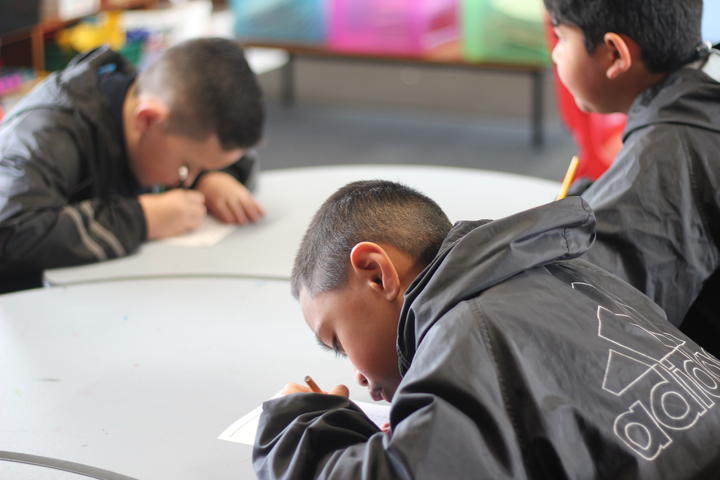
Statistics NZ’s latest official child poverty figures show Māori and Pacific children were higher across almost all measures, compared with all children.
No caption
Photo: RNZ Pacific / Sela Jane Hopgood

For the year ended June 2020, one in four Pasifika children lived in households experiencing material hardship.

That is a similar reading to the report ended June 2019 where almost one in four Māori children (23.3 percent) lived in households that are doing without six or more of the 17 material basic needs, and the rate was higher for Pacific children at 28.6 percent.

Stats NZ describes material hardship as the “number of households missing out on more than 6 of the 17 basic things most people would regard as essentials.

“Examples of essential items lacked include the household respondent reporting serious restriction on eating fresh fruit or vegetables, putting off a visit to the doctor because of a lack of money, or not being able to pay the gas or electricity bill on time.”

Children’s Commissioner Judge Andrew Becroft said the figures for Pasifika, Māori and disability stopped him in his tracks and should be a profound concern for all New Zealanders.

Children's Commissioner Andrew Becroft told the Waitangi Tribunal that Oranga Tamariki needs to devolve more power and resources to iwi.
Photo: RNZ / Meriana Johnsen

“They’re deeply distressing figures especially when for European, it’s one in eleven, a much smaller figure and that’s something that ought to be of enduring concern.

“The government have introduced a series of packages such as the child poverty reduction package, there’s the child wellbeing strategy, and if we really want to hit child poverty on the head we need to have sustained, continuous, bold and ongoing packages and commitment.

“We need specific targeting for Pacific and Māori, there’s no way around that. I mean, how can a western world country not feel shame when the level of disproportionalities is laid bare,” Becroft said.

The stats released this week are echoed in the Salvation Army’s State of the Nation report released this month.

It shows Māori and Pasifika child poverty rates are more than 50 percent higher than those for European children and rates of material hardship were two to three times higher.

A policy analyst Ronji Tanielu said she was sick and tired of seeing how bad the statistics were for Pacific people.

“There’s a systems’ problem here, there’s a structural problem here, but there’s also challenges for Pasifika people, some of our communities need to ask themselves hard questions such as why are we giving to churches, to the point where it puts our families at risk?

“When it comes to Pasifika and the poverty out there, some of it unfortunately are the bad decisions families make, but a lot of it is the limited options they have,” Tanielu said.

“One of the most challenging cases are to do with housing and children – there was a solo Pasifika mother in her 20s with four kids living in emergency housing.
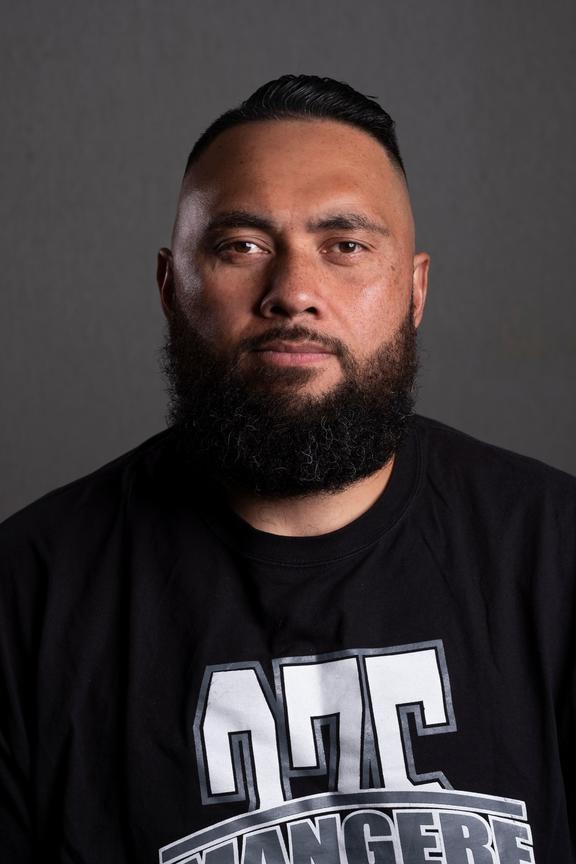
No caption
Photo: Supplied / Ronji Tanielu

“Her situation was risky because there were gangs living there also, dealing with meth in the motel and this mother is trying to raise her kids in that environment.

“That’s one of many horror stories out there, but as a Christian church and charity and we have remained hopeful for our community as we do see stories of transformation out there,” he said.

Although Stats NZ’s report ended in the early stages of the pandemic last year, Becroft is almost certain that the situation for poverty is now worse for families that are struggling.

“The real question for this country is realise the burden of Covid-19 is disproportionately shared by children and particularly children doing it tough.

“We have a choice; do we want the burden to be shared by children doing it tough or not? We can fix it if we want to. We’ve got money, there’s surpluses, we’re told it’s kept for a rainy day.

“Ask children who are really in material hardship, they will tell you it’s pouring down outside.

“This is the time to act. Covid-19 can’t be an excuse to do less, it’s an opportunity to do better,” Becroft said.

Across the wider New Zealand population, one in nine children were living in material hardship, down from one in eight a year earlier.
Covid-19 testing staff brace for influx after new cases

By Kate Green of RNZ. This story is republished with permission

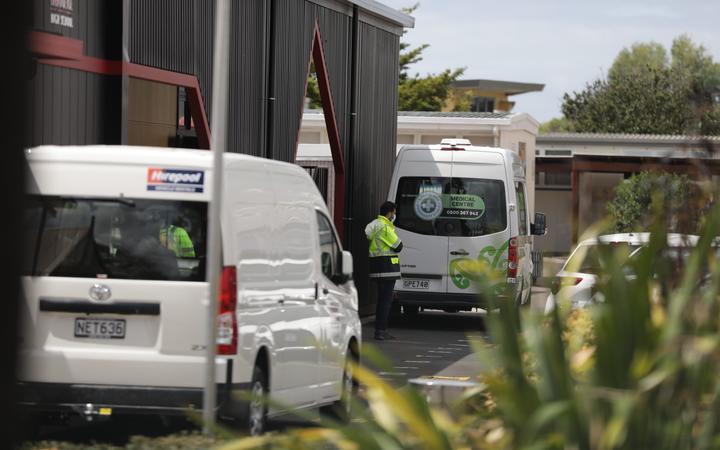
Exhausted Covid-19 testers in South Auckland are bracing for a big surge after three new cases of infection were confirmed in the cluster around Papatoetoe High School.

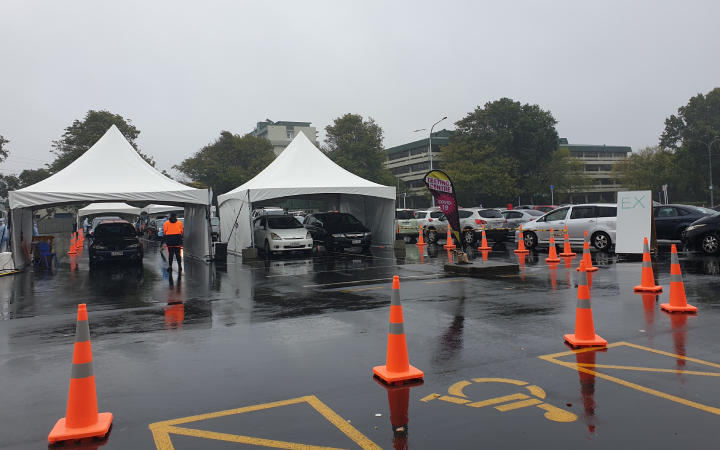
Covid-19 testing centre in Ōtara.
(File photo) A testing station in Ōtara last week. Photo: RNZ / Liu Chen

Yesterday, a student considered a casual plus contact was confirmed to have the coronavirus and last night, two siblings, a teenager and an infant, also tested positive.

The teenager recently finished school and had been working at Kmart Botany. They were at work on Friday 19 February and Saturday 20 February between 4pm and 10pm. People who visited the store during those times are being asked to isolate and call Healthline.

The parents and a third older sibling have returned negative tests so far, the ministry said in a statement. The family has been transferred to the Auckland quarantine facility.

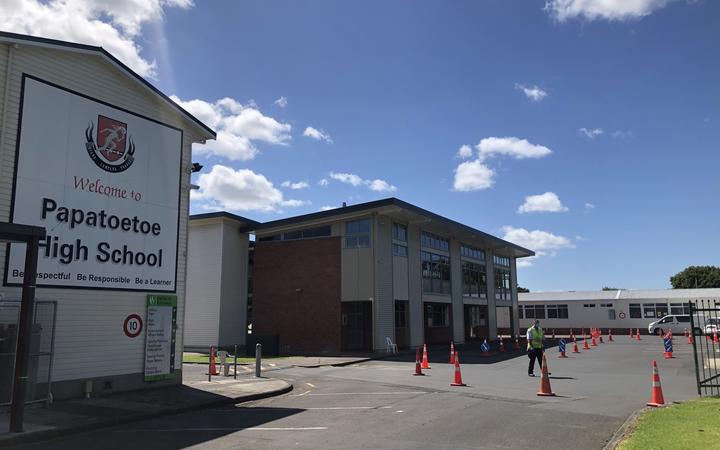
Papatoetoe High School opened on Monday and Tuesday this week, having been shut all last week and now school remains closed until further notice.

Principal Vaughan Couillault said it was tough but they just had to get on with it.

“We’re probably feeling a little bit crestfallen, but once you get over yourself, because it’s not about you, the team just clicked back into action,” he said.

Papatoetoe High School on Thursday 18 February.
Papatoetoe High School is closed until further notice Photo: RNZ / Kate Gregan

The school is re-testing all staff and students.

When asked whether the school should have remained shut this week, Couillault said they followed the advice from authorities.

“I’m not one to second guess Dr Bloomfield and Minister Hipkins. They’ve done a pretty good job of keeping New Zealand safe up to now, as has the Prime Minister, and it’s just an unfortunate set of circumstances.

“I don’t believe it’s the decisions that are wrong, it’s the virus that’s the pain,” Couillault said.

On Wednesday morning some 1500 students were being asked to stay home and complete their classes online.

Year 13 student Yash said the situation was difficult.

“Our schoolwork is messed up, it’s like we’re supposed to be doing stuff for our class that we can’t do, it’s getting delayed, so it’s stressful,” he said.

“A week of school being closed was good and all, but then having another week closed, it’s just too much,” Yash said.

Security ramps up ahead of Covid-19 testing at Papatoetoe High School on 23 February.
Testing was under way again at Papaptoetoe High School on Tuesday. Photo: RNZ / Simon Rogers

Joseph, 17, hopes things return to normal as quickly as possible.

“To be honest it’s pretty dumb, because I come to school to enjoy myself and come and learn as well. Since it is my last year I was hoping to end it with a good year, but I guess I can’t,” Joseph said.

Faazio, also in his final year of high school, said he was coping but finding things tough.

“Right now it’s kind of difficult because we’re getting assignments slowly and lockdown came in, and yeah, it’s kind of hard for me right now but the support from the teachers is really helping,” said Faazio.

Ata, 16, is also feeling stressed.

“It’s not easy to learn from home. If we get confused with questions, there’s no one to ask. Everyone is kind of sad as well, because we’re going to be stuck in lockdown again,” Ata said.

The Ministry of Health has said everyone in a Papatoetoe High School household should stay at home until advised otherwise.

Nearly 700 students were tested at the school on Tuesday.

Household contacts are asked to get swabbed at a different testing station, with many heading down the road to Ōtara .

South Seas Healthcare chief executive Silao Vaisola-Sefo, who runs the testing station, said they had doubled worker numbers to cope with the expected influx today – and staff are exhausted.

“It’s more the mental thing than anything, to be honest. It is tiring, it’s long hours, but yeah, it’s just getting as many swabs as possible,” he said, adding that it was tough on the community.

“You can just feel the tension. But I think what’s really pleasing is that people just know what to do straight away. I think when we go up to level two and three, people just know what to do – and I’m not just talking about the workers, I’m talking about the public.

“As soon as that announcement came, I saw people with masks already in the town centre,” he said.

Anyone who feels unwell, should stay at home and call Healthline for advice.

Two new Covid-19 community cases in Auckland: Teen who works at Kmart and infant

This TVNZ’s story is republished with permission

The Ministry of Health has announced two new community cases this evening.

1 NEWS
Kmart Botany. Source: Google Maps

The two cases are siblings of the case notified this afternoon who is a student at Papatoetoe High School.

South Auckland student becomes ninth community Covid-19 case discovered in latest cluster

“The teenage sibling, known as Case J, recently finished school and has been working at Kmart Botany,” the Ministry of Health says.

“Case J was at work on Friday 19 February and Saturday 20 February between 4pm and 10pm. Kmart Botany is regarded as a location of interest.”

The ministry is asking anyone who was at Kmart Botany, 500 Ti Rakau Drive, Botany Downs, at these times to immediately isolate at home and call Healthline on 0800 358 5453 for advice on isolation timeframes and testing requirements.

“Thirty-one staff at Kmart have already been identified as close contacts and are isolating and being provided with public health advice,” the ministry says.

Another location of interest has been released, Dark Vapes store 30 Springs Road, East Tamaki, Auckland.

New locations of interest revealed after three new community cases announced today

Anyone who was at the store on February 19 between 2.30 and 4pm and February 20 between 7 and 8.30pm is also asked to seek a test and stay home and isolate.

1 NEWS
Dark Vapes, East Tamaki. Source: 1 NEWS

The new cases come as earlier today Director-General of Health Dr Ashley Bloomfield said the family at the centre of the new community cases weren’t able to be tested earlier as they “could not be contacted” over the last week.

The student whose positive result was announced earlier this afternoon was tested as part of requirements for Papatoetoe High School students to have returned a negative test before returning to school today.

News of the positive test has seen the school closed again and all staff and students requiring retesting.

In new advice released this evening, the Ministry of Health is advising everyone in a Papatoetoe High School household to stay away from work or any other school, educational facility or community setting (e.g. the supermarket or any other place outside the home).

When contacted by 1 NEWS tonight, the Ministry of Health was unable to confirm or deny reports tonight’s new case had previously been told to isolate before they worked their shift at Kmart.

However, they did confirm the advice released tonight, for all household contacts of all Papatoetoe High School students and teachers to isolate, is new information in the wake of today’s cases.

Last Wednesday, Director-General of Health Dr Ashley Bloomfield said households connected to Papatoetoe High School were asked to “work from home or stay home for the rest of the week” and avoid large gatherings and visitors.

Initially, only the casual-plus contact, the person who attended the school, was required to isolate — not the entire household. Households were only required to isolate if one member was a close contact to a confirmed case.

All students and teachers were required to return a negative Covid-19 test before returning to school this week.

The cases come as Auckland returned to Alert Level 1 today.

NRL to launch investigation over David Fifita incident

By Travis Meyn and Peter Badel, News Corp Australia Sports Newsroom. 

The NRL has launched an investigation into the Gold Coast Titans amid revelations of a cover-up involving $3.5 million recruit David Fifita.

News Corp can reveal the NRL was unaware a payment had been made to the family involved in Fifita’s bizarre incident during the Christmas break.

Fifita was arrested after allegedly trespassing at a Gold Coast property in December but was later released without charge.

Watch Live & On-Demand coverage of NRL pre-season trial matches on Kayo. New to Kayo? Get your 14-day free trial now & start streaming instantly >

While the NRL Integrity Unit’s investigation has not formally concluded, it was believed Fifita would escape sanction over the incident given he was not charged by police.

However the NRL is now probing further after being made aware of a potential compensation payout which could have salary cap implications.

NRL chief Andrew Abdo confirmed the league had not been told about the payment and an investigation was underway.

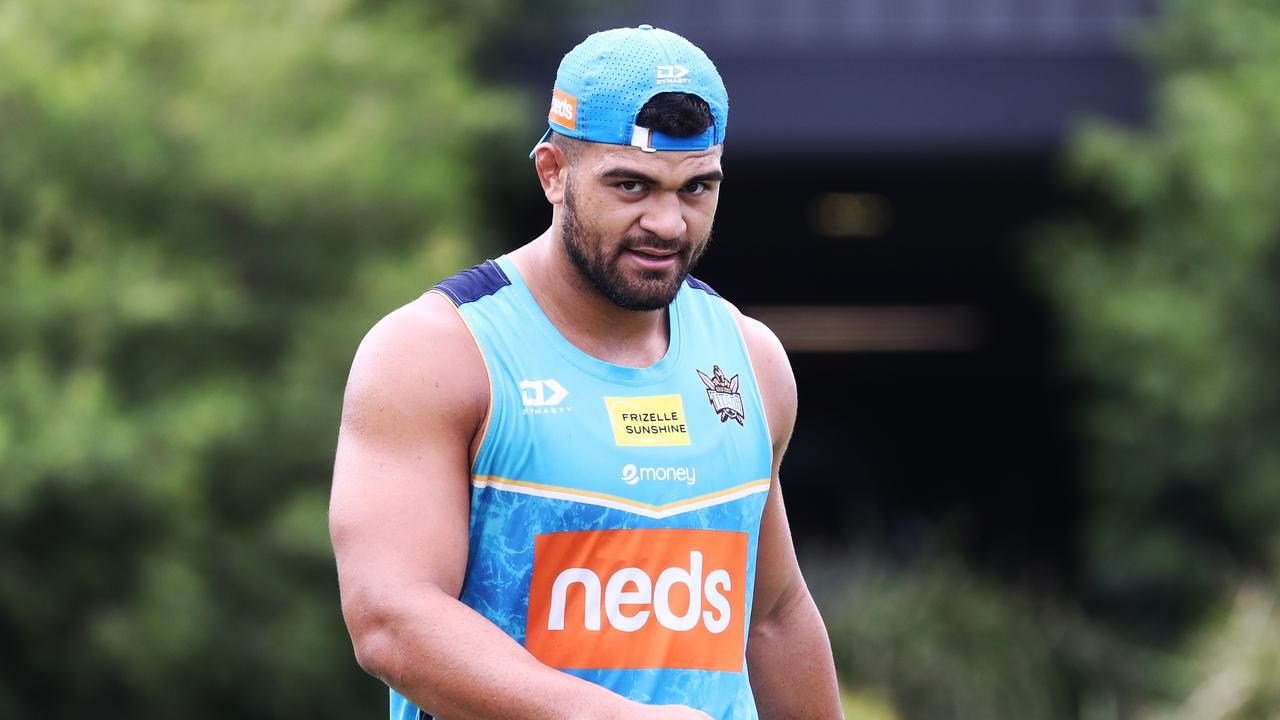
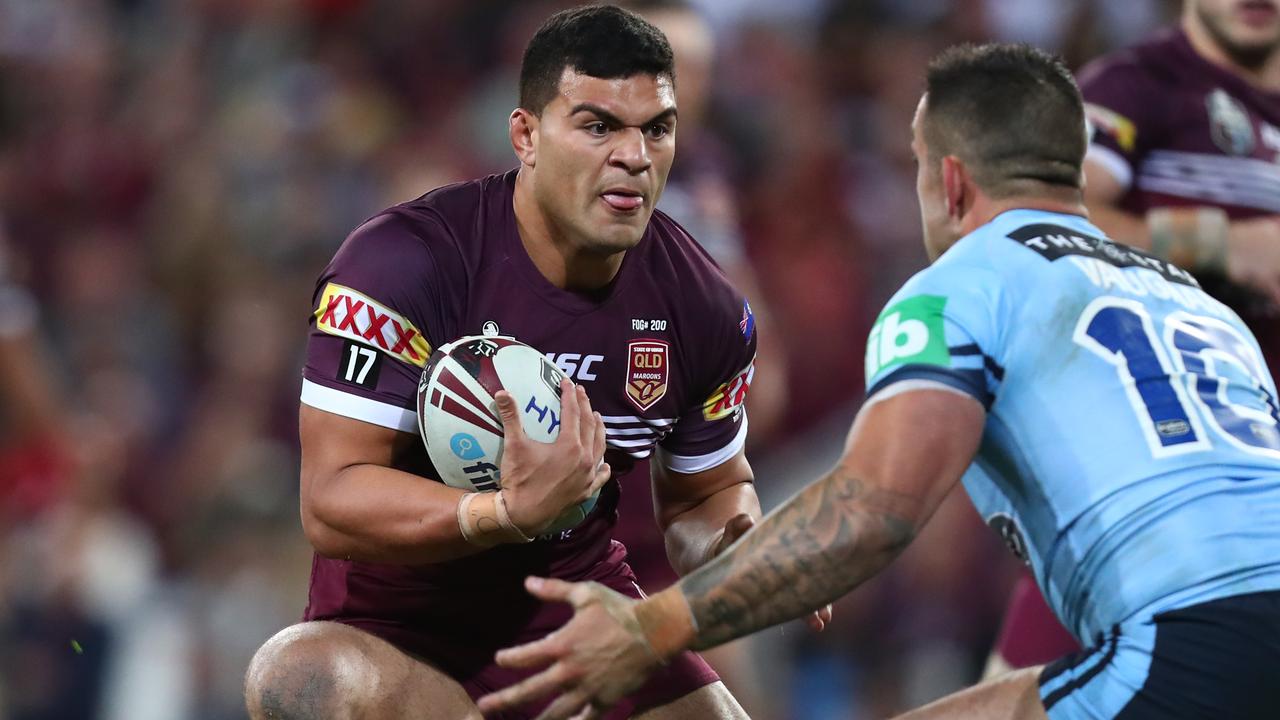
David Fifita at Titans training. Picture: Jason O'Brien
David Fifita at Titans training. Picture: Jason O’Brien

“This is live at the moment,” he said.

“It is fair to say that we obviously weren’t given all the information by the club in the first instance which we are going to deal with. There is an investigation going on.

“The Fifita case was not totally closed by us.

“We have requested some additional information from the Titans and we will review that information.”

The NRL’s investigation will look into whether the money was paid by Fifita or the Titans given there are potential salary cap implications if the club has made the payment.

If the payment is deemed salary cap compliant, Fifita’s actions are still expected to be re-examined as the NRL investigates what transpired to prompt compensation.

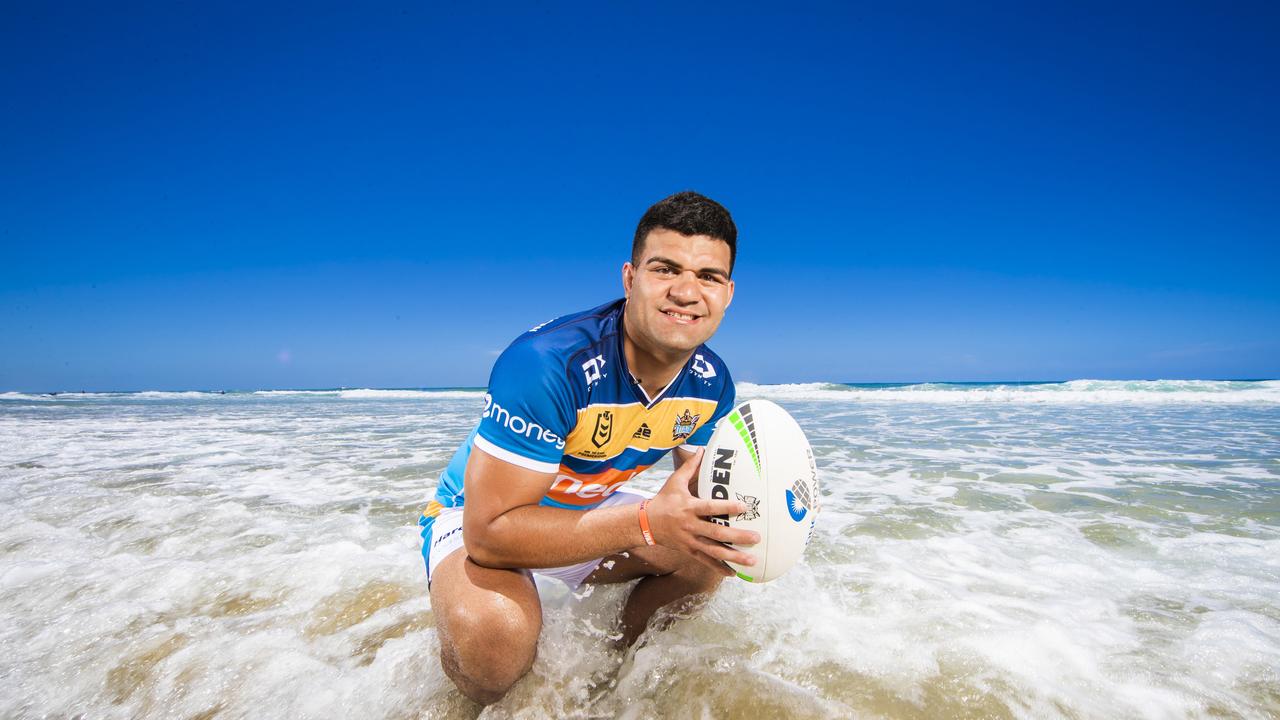
David Fifita is arguably the biggest signing in Titans history. Picture: NIGEL HALLETT

Titans CEO Steve Mitchell would not confirm who made the payment, but was adamant the club hadn’t breached salary cap rules.

“The Integrity Unit has asked for more detail which we are supplying,” he said.

“We are completely salary cap compliant.

“It has been a matter of getting it all put to bed and wrapping it up. There are a couple of small pieces they need which we are providing.

“We are always salary compliant and work very hard at that.”

Fifita was arrested by police about 8am on December 27, following reports of trespassing at an address in Clear Island Waters on the Gold Coast.

He was questioned at Broadbeach police station and released without charge. Fifita was later issued an adult police caution.

The NRL’s Integrity Unit made inquiries but no formal sanctions were announced and the incident was put down to being a mix-up, with reports suggesting Fifita had entered the wrong room of an address he had been invited to.

However, revelations a payment was made have raised further questions about what actually transpired.

On a club record three-year deal, Fifita will pocket $1.25 million this season and is arguably the biggest signing in Titans history, rivalling the failed acquisition of Jarryd Hayne from the NFL in 2016.

Fifita, who turns 21 on Thursday, is scheduled to make his first playing appearance in Titans colours on Saturday night in Lismore when Gold Coast faces New Zealand in a trial match.

He featured for the Indigenous All Stars in last Friday’s game against the Maori All Stars in Townsville, but is yet to play for the Titans.

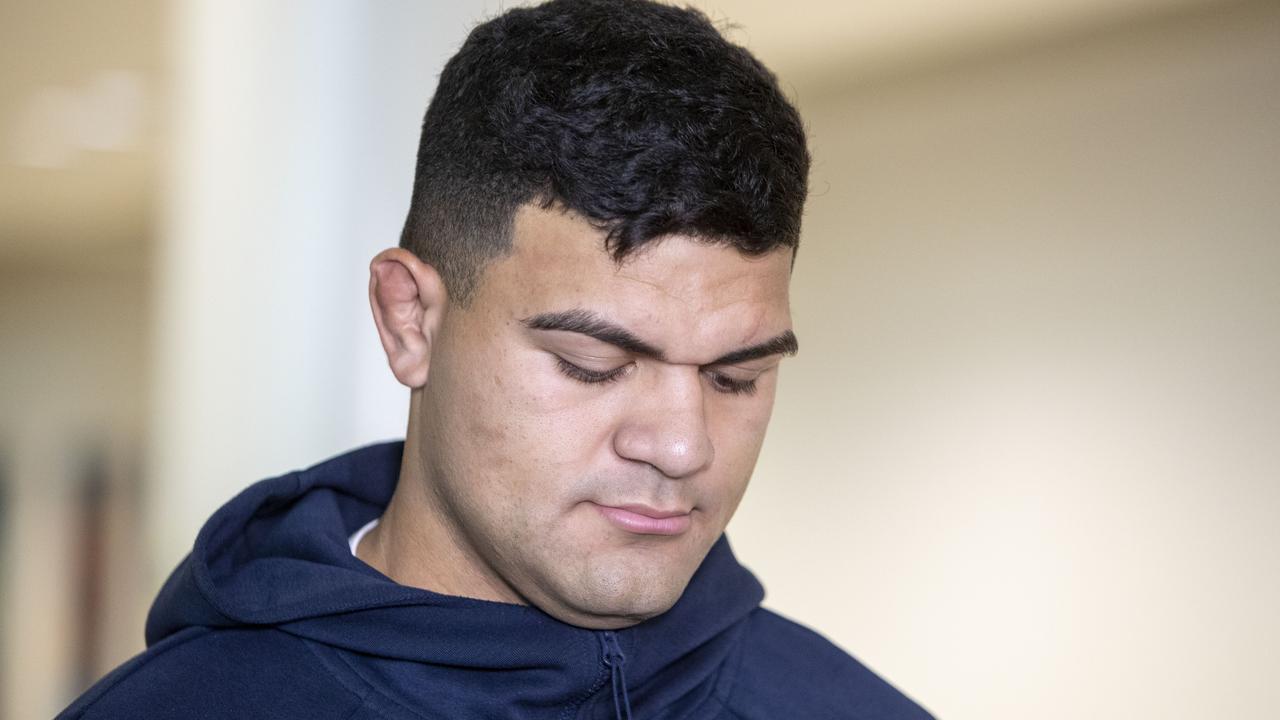
David Fifita at Brisbane International Airport after arriving home from Bali in 2019.

The NRL’s fresh investigation around their star recruit will be an unwanted distraction for the Titans only two weeks before the 2021 season kicks off.

It is not the first time Fifita has been involved in an incident where money has been exchanged.

In November 2019, while contracted to the Broncos, Fifita was detained in a Bali jail for three days following an incident with a nightclub security guard.

A Broncos employee flew to the Indonesian island immediately to help broker Fifita’s release, which only occurred after a “peace agreement” was reached.

Fifita is believed to have paid $30,000 to secure his release from the jail.

The NRL was made aware of the Bali payment which was paid for by Fifita. There were no salary cap implications due to the transparency.

Fifita was released from the jail after the agreement was finalised and his camp has consistently maintained he was the victim of an extortion plot due to his status as an NRL rising star.

Fifita became the first player born this century to play in the NRL when he made his debut for the Broncos in 2018, playing 11 games in his rookie season.

He played three State of Origin games for Queensland in 2019 but missed last year’s series after undergoing knee surgery following an injury-plagued final season at the Broncos.

In early January, Titans coach Justin Holbrook spoke to media and claimed the Fifita trespassing issue had been “resolved” but would not comment on whether the club imposed any sanctions on their highest-paid player.

“Yeah, I did (speak to him). It’s not good but it’s been resolved now,” he said.

“We’ve got to move on now.”

David Fifita made his State of Origin debut for Queensland in 2019.

Fifita made a dramatic shift from the Broncos to Titans in the off-season following an ugly contract spat with Brisbane.

He has only faced the media once since joining the Titans, when he was unveiled in Gold Coast colours last November.

“It feels great to be a Titan,” Fifita said at the time.

“There’s no pressure. I am looking forward to the expectation.

“It’s a new challenge, a new opportunity on the Coast, so all the money stuff, my mum looks after that so I don’t have to worry about that.

“All I need to worry about is getting my body right and ripping in next year.

“It would mean everything to make (the Titans a force). That’s the goal next year — top eight, top four.

“I know myself and the boys will train hard and I can’t wait for round one.

“My ultimate goal is a premiership, 100 per cent.”

It now remains unclear whether he will be allowed to play in Round 1 given the NRL’s hard-line stance on player behaviour.

Two siblings of latest Covid-19 case test positive

This RNZ.co.nz story is republished with permission

Two siblings of the latest Covid-19 case from Papatoetoe High School have also tested positive.

Security ramps up ahead of Covid-19 testing at Papatoetoe High School on 23 February.
Photo: RNZ / Simon Rogers

Earlier today, the Ministry of Health said a teenager considered to be a casual-plus contact of the community cases had tested positive.

The Papatoetoe High School student had not returned to school on Monday when it reopened, Minister of Covid-19 Response Chris Hipkins said.

The new cases are the siblings of today’s case – a teenager and an infant. The parents and a third older sibling have returned negative tests so far, the ministry said in a statement.

The family has been transferred to the Auckland quarantine facility.

The teenage sibling recently finished school and has been working at Kmart Botany. They were at work on Friday 19 February and Saturday 20 February between 4pm and 10pm.

The ministry said it is now a location of interest and anyone who was there at those times is considered a casual plus contact.

If you are a casual plus contact, you are advised to immediately isolate at home and call Healthline on 0800 358 5453 for advice on isolation timeframes and testing requirements.

No caption
Photo: Google Maps

Thirty-one staff at Kmart have already been identified as close contacts and are isolating and being provided with public health advice.

Dark Vapes at East Tamaki has also been identified as a location of interest, with a visit on 19 February between 2.30pm and 4pm, and 20 February, between 7pm and 8.30pm.

The up to date locations of interest can be found here.

On the ministry’s website, the advice is for casual plus contacts of these locations to isolate at home for 14 days from date of exposure, have tests at day five and day 12 after exposure, call Healthline 0800 358 5453.

The ministry said more locations of interest for today’s cases were being investigated. The infant does not have childcare outside the home.

A testing centre was set up at the school this afternoon and 672 tests were done today.

Testing will be available again at the school tomorrow for those who were unable to receive it today.

The ministry is advising everyone in a Papatoetoe High School household must stay away from work or any other school, educational facility or community setting (e.g. the supermarket or any other place outside the home).

The school remains closed and no students or staff will be able to return until advised by a Medical Officer of Health.

At this point, household members who are not students or staff do not need to be retested, unless they have symptoms or are asked to do so.

Further updates on contact tracing and genome sequencing of today’s earlier reported case would be available tomorrow, the ministry said.

Facebook news ban lifted in Australia

By Tom Minear and Shoba Rao, News Corp Australia Network

Facebook has lifted its ban on news after it blocked Australian users and refused to pay media outlets for news content.

Facebook has lifted its ban on news after it blocked Australian users from sharing or viewing local or international news content, as a protest against paying for news.

The pages will return in coming days, and are as a result of ongoing discussions between the company’s boss Mark Zuckerberg and Treasurer Josh Frydenberg.

The tech giant has called a truce with the Morrison government, which is hopeful Facebook will now move quickly to sign commercial deals with news businesses.

Its move to ban news followed the passage of the News Media and Digital Platforms Mandatory Bargaining Code.

Mr Frydenberg has now reached an agreement with Facebook to amend the law – after days of negotiations with Mr Zuckerberg – which is expected to pass the parliament this week.

The changes will make it clear that the Treasurer’s decision to designate a platform to force it to negotiate with news outlets will depend on whether the platform has already reached commercial agreements with them.

Platforms will also be given one month’s notice if the government does intend to designate them under the code.

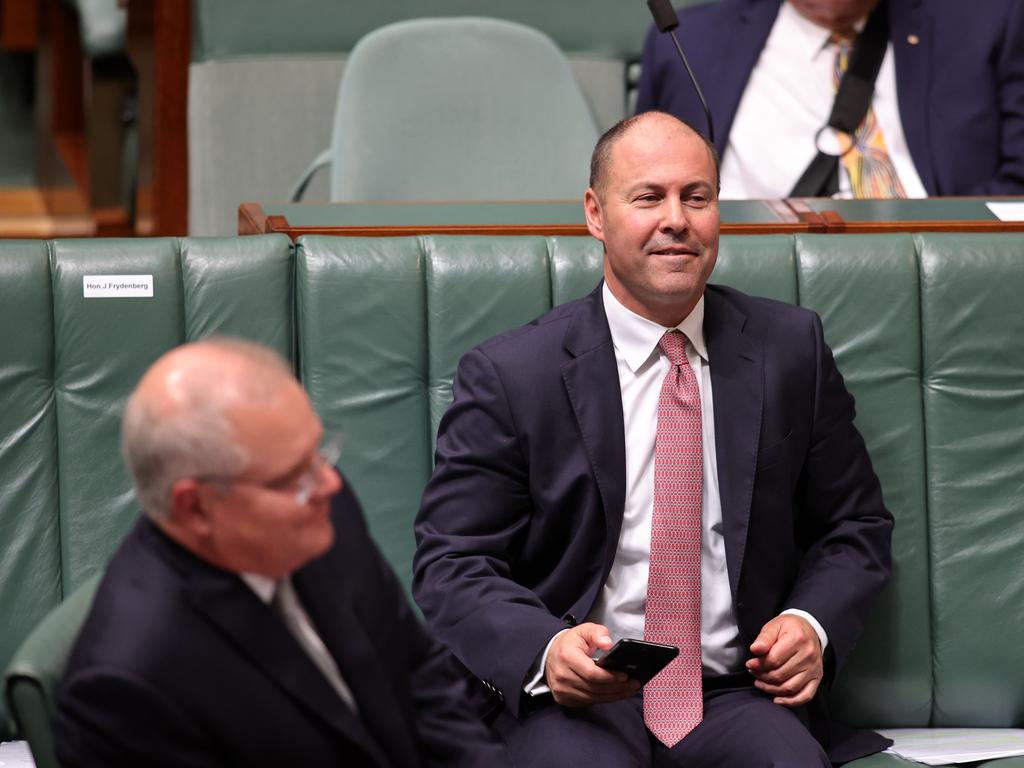
Josh Frydenberg with Prime Minister Scott Morrison during Question Time in the House of Representatives in Parliament House Canberra. Picture: NCA NewsWire / Gary Ramage
Mark Zuckerberg, chief executive officer and founder of Facebook. Picture: Getty

Facebook’s Australian chief Will Easton said the company was pleased to reach a deal.

“We have consistently supported a framework that would encourage innovation and collaboration between online platforms and publishers,” he said.

“After further discussions, we are satisfied that the Australian government has agreed to a number of changes and guarantees that address our core concerns about allowing commercial deals that recognise the value our platform provides to publishers relative to the value we receive from them.”

“As a result of these changes, we can now work to further our investment in public interest journalism and restore news on Facebook for Australians in the coming days.”

Facebook Australia boss Will Easton.

Facebook Australia boss Will Easton.

The multibillion-dollar tech giant shocked its 17 million local users with the sweeping bans last week that impacted emergency services, TV stations, charities, state government departments, satire sites and music bands.

Facebook was forced to reinstate the posts of government pages, including health departments and weather services, after the ban wiped posts with essential information.

Efforts in Australia to make Google and Facebook pay for news has garnered worldwide attention, creating what some call a defining moment for the web and for journalism, and even a litmus test for democracy.

The European Commissioner for digital services, who is helping draw up new EU rules for online business, backed Australia in its dispute with web giant Facebook on Monday.

Thierry Breton, Brussels’ top official for the EU internal market, said Facebook had been wrong to kick Australian media off its service in a row about paying for news.

Separately, US tech titan Microsoft joined European media in calling for EU members states to follow Australia in setting up a mechanism to ensure that news publishers are paid.

The European Union has also passed a rule requiring internet “gatekeepers” like Google or Facebook to negotiate fees for including news stories and links.

Parker and Fa’s camps try to create hype in build up to fight

By Patrick McKendry* (RNZ)

What do you do when, a few days from what has been described (probably rightly) by the promoter and main protagonists as New Zealand’s biggest ever heavyweight boxing contest, the country’s attention seems more focused on what’s happening on and off the Hauraki Gulf and whether the Black Caps can continue their stunning start to the T20 cricket series against Australia?

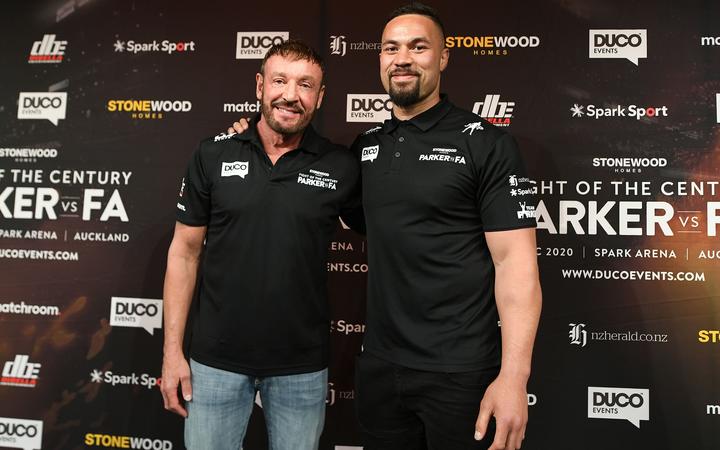
The Joseph Parker- Junior Fa fight will be held in either February or March.
The fight was originally scheduled for December last year but was postponed following a blood test Photo: Photosport

You go back to boxing’s tried and tested technique of creating conflict at the pre-fight press conference, and if neither Joseph Parker nor Junior Fa are willing to swing any metaphorical punches before their showdown at Auckland’s Spark Arena on Saturday night (they haven’t been), it’s generally up to others to attempt to create a hype that is so far failing to materialise in the warm summer air.

Step forward then Kevin Barry, Parker’s mentor, and Eugene Bareman, the self-confessed “celebrity trainer” who is an assistant in Fa’s camp. Both had been given licence to generate a little frisson that has been lacking so far, and it would probably be agreed it was Bareman, the zen-like, smiling assassin who has navigated Israel Adesanya’s groundbreaking MMA career at his City Kickboxing gym, that took the points victory with an entertaining performance that remained respectful but still contained a few zingers.

Bareman, tongue-in-heavily-bearded cheek, scored points with a few lazy jabs at Barry when hinting Parker had decided it was time to change trainers. Parker has been with Barry almost since he turned professional back in 2012 and has always maintained he will remain loyal.

“Joseph has said to me that he wanted to come to City Kickboxing,” Bareman said. “You’ll have to talk to him about the capacity – maybe he just wanted to come and have a cup of tea with me, maybe he just wanted to train, I don’t know. We never got into the details, but I will email him the gym fees tomorrow and he can look them over. If he can afford it, which I think he can, then he can join the gym like everybody else.”

Trainer Kevin Barry (L) and boxer Joseph Parker
Trainer Kevin Barry and Joseph Parker Photo: PHOTOSPORT

This answer, about 12 minutes into a half-hour press conference, not surprisingly pricked the attention of the assembled media, undercard fighters and various entourages like little else this morning.

Barry wasn’t biting, however.

“It’s very common this close to the fight that fighters and other people around the team make comments to deflect from the fight, to try to raise an emotional response, to try to get you to lose your focus,” he said.

“Right at the moment Joseph, myself, [manager] David Higgins and our whole team, are very focused. We understand the significance of this fight. We aren’t going to be dragged into out-of-the-ring discussions.”

This was despite the best efforts of both Bareman, Fa’s manager Mark Keddell and master of ceremonies Stephen McIvor, who clearly decided that a straightforward approach to proceedings was in order. One of McIvor’s first questions to Fa was whether he had spoken to Shane Cameron recently, and whether the man who was brutally knocked out early in his famous all-Kiwi heavyweight fight against David Tua in 2009 had offered any advice about not meeting the same fate.

Eugene Bareman (left) and Israel Adesanya.
Eugene Bareman and boxer Israel Adesanya Photo: Photosport

Bareman and Keddell laughed at a question about as subtle as a brick through a window.

“Umm, I have been speaking to Shane Cameron but that was a while ago,” Fa replied. “He just told me to enjoy the ride really, to make the most of this opportunity I’ve been given.”

Bareman’s other shot at Barry was over a dispute over the judges which has been simmering for days. The Fa camp don’t want two of the three judges to be from Christchurch due to the Barry family’s reputation among the boxing fraternity in the city. It is an issue that is close to a resolution, according to fight promoter David Higgins, who is also Parker’s manager, but Bareman was making hay while he could.

“Well,” he said, “we definitely didn’t want Kevin’s mate from the pub to be one of the judges.”

The only fire coming back from the Parker camp was when Higgins said of Fa’s manager Keddell, who is also from Christchurch and in fact went to the same school as Barry (St Bede’s): “Dealing with Mark Keddell has been trickier than dealing with [well-known promoters] Eddie Hearn or Bob Arum,” Higgins said.

“It’s his big moment to shine. You know, he’s the smartest man in the room. We’re actually a lot more relaxed about it because when Junior’s lying on the ground it doesn’t matter who the judges are.”

The only fire, that is, apart from Parker’s response to Bareman’s changing trainers jibe, when he replied: “I think we discussed a cup of tea, like he mentioned. [It was] more for when after I beat Junior, I can use them for sparring.”

It was a good morning for the Fa camp, although whether it counts for anything remains to be seen. It may get a few more eyeballs to the pay per view broadcast, but, rated No5 by the WBO to the No3-rated Parker, a former world champion, Fa is a big underdog.

Near the end it was left for Bareman to sum up with what he described as a “little homage to the human side of the sport”. Naturally it contained a sneaky punch.

“Joseph has a dream to get back the world title. Junior has a dream to set up his family and his young kids for the rest of their lives,” he said.

“Someone’s not going to be able to achieve that dream. That’s the other side of the sport that we have to understand. Someone’s going to fade away a little bit and they have to go what fighters go through – a little bit of depression and then rebuild themselves. That’s sad. There can only be one winner and unfortunately for Joseph and Kevin it’s going to be us on Saturday.”

*Patrick McKendry is an Auckland-based sports writer who has covered all of Joseph Parker’s major fights since he turned professional in 2012.

Neiafu home uninhabitable after fire rips through property

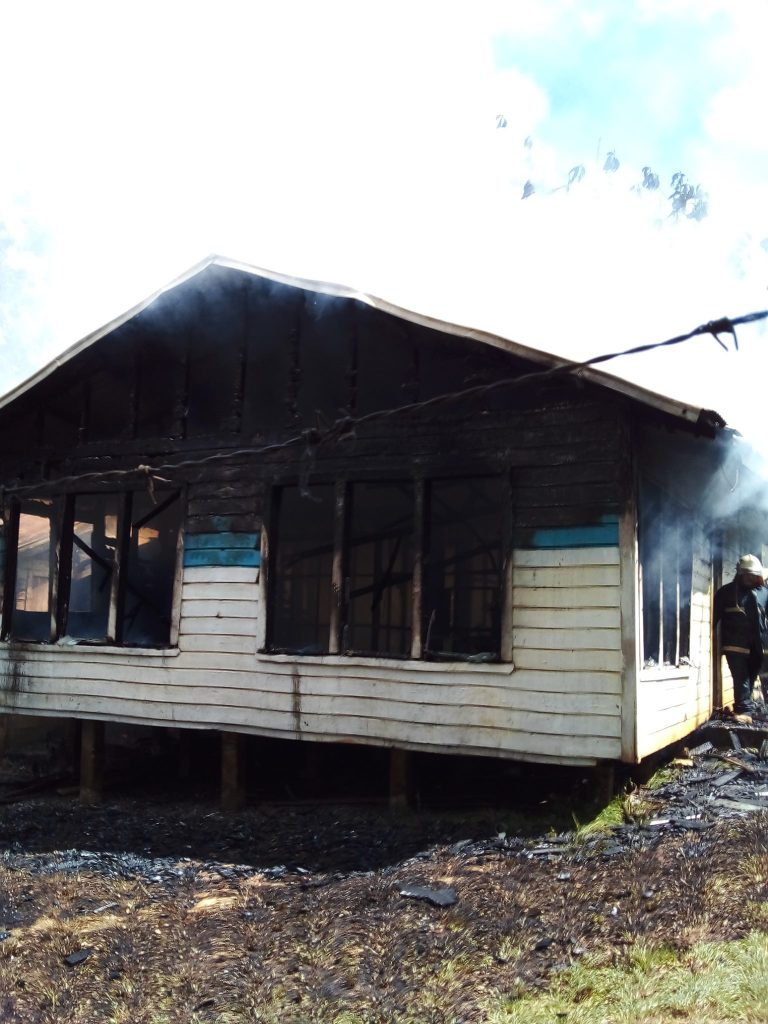
A Neiafu home in Vava’u is now uninhabitable following a house fire this morning.

The house is uninhabitable in Neiafu after it was gutted by fire. Photo/Supplied

Fire services were called to the scene at about 10.30am.

A fire engine was sent to extinguish the blaze.

Neiafu Town Officer said no one was in the house at the time of the blaze and the fire gutted the entire home.

He said a couple and their children were living in the house.


Auckland will move down to Alert Level 1 today ‘bar anything significant’ – Ardern

This TVNZ story is republished with permission

Ahead of the Government’s review of the country’s Covid-19 alert levels this afternoon, Prime Minister Jacinda Ardern says “bar anything significant”, Auckland will move from Alert Level 2 to 1.

“Bar anything significant coming through, I had an expectation we would continue to move down alert levels,” Ardern told Breakfast.

Ardern said Auckland was placed in Alert Level 2 from last Thursday only as a “precautionary” measure, after Cabinet received “considered advice” from experts like her chief science adviser and the Director-General of Health.

“Every time we’ve had an adjustment in our alert levels, we prefer to step down rather than make big leaps. That gives us a chance to check we’ve got our settings right,” she said.

Ardern said Cabinet had the confidence to lower alert levels even if the source of the latest Auckland Covid-19 outbreak hadn’t been determined because of mass testing and wastewater testing.

That testing had revealed no new cases of Covid-19 in the community since Friday, when a household contact of three previous cases in Auckland tested positive for the virus. The Ministry of Health has said all close contacts of the latest community outbreak have returned negative test results.

Cabinet will also consider today whether face coverings will remain mandatory on public transport in Alert Level 1 and 2. Until last week, only Aucklanders have been required to wear face masks on public transport at all alert levels.

Women ‘ignite a fire’ to keep cultural traditions alive

This RNZ.co.nz story is republished with permission

A Tongan community group in New Zealand hope their efforts to make koloa, or cultural treasures, inspires other Pasifika community groups to explore and preserve their own cultures.

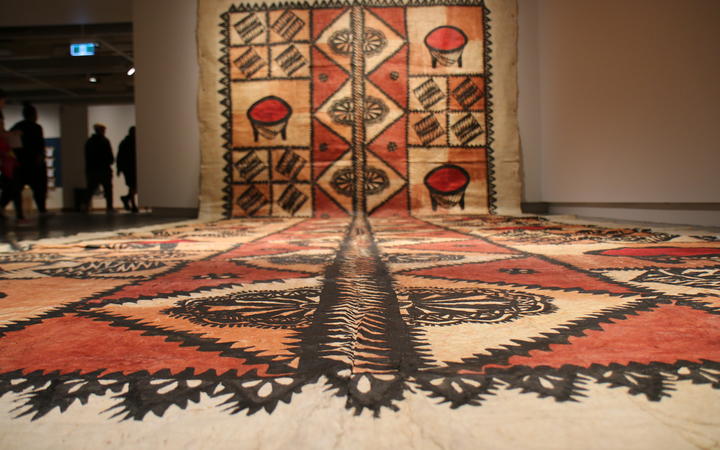
A majestic example Tongan ngatu dedicated by one of the matriarchs of the Akomai Heritage Group to her sons' love of Kava drinking.
A majestic example Tongan ngatu dedicated by one of the matriarchs of the Akomai Heritage Group to her sons’ love of Kava drinking. Photo: Artwork by Akomai Heritage/ Photograph RNZ Pacific/Koroi Hawkins

Akomai Heritage have recently completed a week-long interactive exhibition of the inner workings of a koka’anga (ngatu-making work party) with sprawling exhibits of beautiful finished pieces of Tongan ngatu or bark cloth and other koloa at the Te Papa museum in Wellington.

One of the founders of the group, Kaufo’ou Katoa-Taulata, said it stemmed from a desire to strengthen connections to their Tongan culture.

“Ngatu is embedded in every fibre of our culture and our heritage,” Katoa-Taulata said.

“We are born into ngatu and we are buried with ngatu. We celebrate with ngatu and we also mourn with ngatu,” she said.

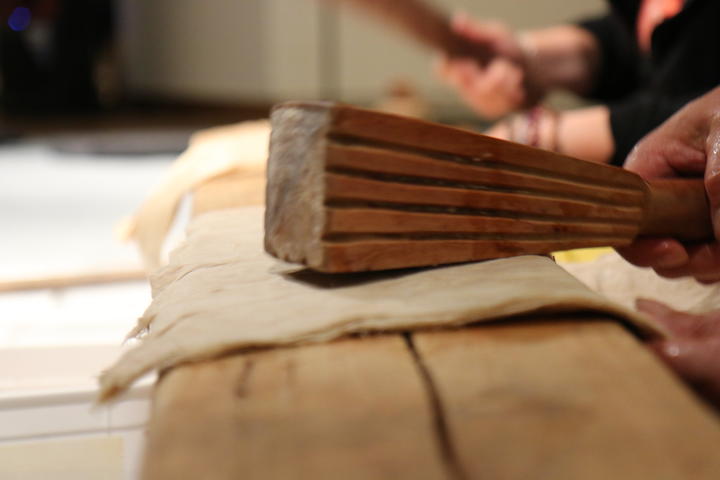
Pounding the hiapo (mulberry tree) bark one of the first stages of making ngatu.
Pounding the hiapo (mulberry tree) bark one of the first stages of making ngatu. Photo: RNZ Pacific/ Koroi Hawkins

Kaufo’ou Katoa-Taulata said their journey of rediscovery began in 2017.

“This started three-and-a-half years ago when we, the women’s fellowship of the St John’s Uniting Church, came together and we started doing little displays and little workshops and little heritage jobs.”

Katoa-Taulata said they started out learning how to make ceremonial baskets and blankets.

“Then we started thinking, ‘let’s go bigger; we have seen these smaller things being made overseas but we haven’t seen a ngatu being made outside of Tonga’, the real authentic ngatu.”

To help realise this vision Katoa-Taulata said they reached out to the elders in their own families.

“We have the resources and the knowledge of our mothers who are gold and so we decided, ‘let’s use our mothers to the fullest and to the best of their capacity’ while they are still alive and strong enough to impart that knowledge to us.”

Katoa-Taulata said that is how the name Akomai Heritage was chosen. “Literally it is the cry to say ‘mothers teach us. Teach us to know and teach us to teach others’.”

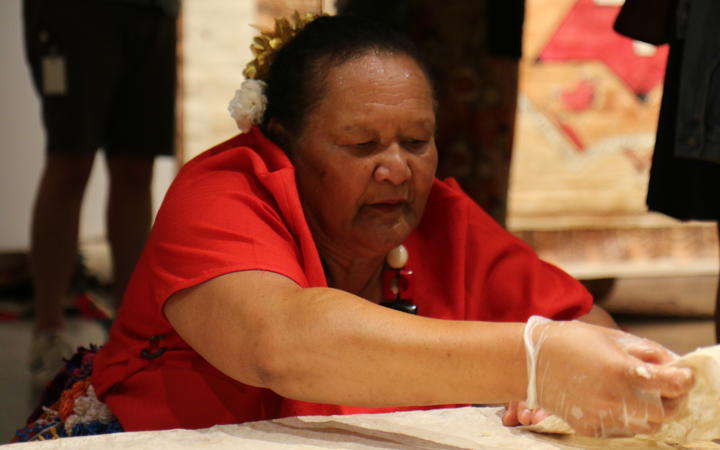
Melesiu Katoa of Tatakamotonga village in the Niua Islands says she is happy to be passing on a lifetime of ngatu making experience to younger generations of Tongans.
Melesiu Katoa of Tatakamotonga village in the Niua Islands says she is happy to be passing on a lifetime of ngatu making experience to younger generations of Tongans. Photo: RNZ Pacific/ Koroi Hawkins

And there are many others, of all ages, involved in Akomai.

The group’s entire ngatu making process from the pounding of the hiapo (mulberry tree bark) to the rubbing, joining and dyeing of the feta’aki (bark paper) on the papa (convex table) covered with kupesi (pattern boards) to the final painting of the ngatu involved three generations of Tongan families.

One of the teenage contributors, Daphnie Katoa, said at first she did not understand the significance of what she was being taught.

“When we first started, I was like ‘what is this for? I don’t need to be here. I don’t know how to do it’ but then as we went on I realised that the reason for our weekly gatherings for this koka’anga was to teach us so that we can carry it on and teach other people.”

Now Katoa said she feels blessed to have taken part.

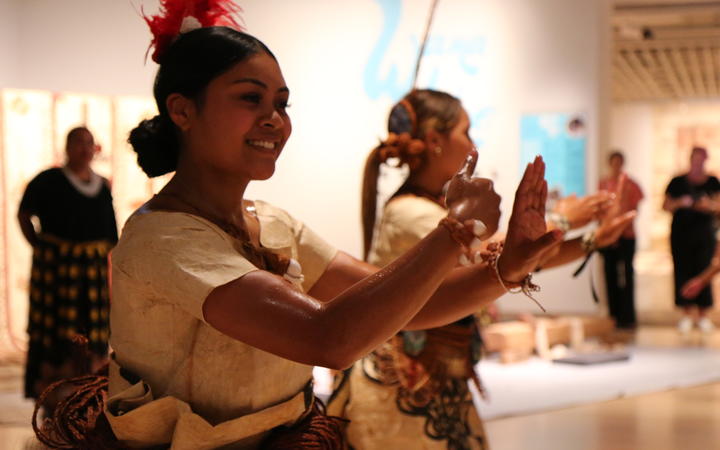
Daphnie Taulata (Left) performs a Tongan cultural dance at the Te Papa Museum in a costume made of ngatu or bark cloth. Wellington February 2021
Daphnie Taulata (Left) performs a Tongan cultural dance at the Te Papa Museum in a costume made of ngatu or bark cloth. Wellington February 2021 Photo: RNZ Pacific/ Koroi Hawkins

The largest ngatu on display at the Te Papa exihibition was the church launima almost 23 metres in length and four metres in width.

It was so long it that it was only stretched out to its full length for the opening of the exhibition.

Most of the designs and geometric patterns on the ngatu displayed were distinctly Tongan such as the floral motif called the koesei, the kingdom’s coat of arms and the kanoa.

Fusion of two cultures

But there was one ngatu, a 12-metre piece, that had a unique blend of Tongan and Māori symbolism.

The artist behind this creation, Mele Tonga-Grant, said she made it for her children who are of both Tongan and Māori descent.

“This piece is in dedication to my children and their whakapapa where they come from. So a lot of the Māori motifs that I have used are from the iwi that their dad comes from,” Tonga-Grant explained.

“So I have got the niho taniwha that speaks to Te Aro Kairangi and the story of Whātaitai Ngake. So those stories but then also like we have come in from Tonga.”

Tonga-Grant said she felt it was important for her children to embrace both cultures.

“Because a lot of people like ask my kids, ‘are you Tongan or are you Māori?,” she said.

“It’s like why can’t you be both? And why can’t you embrace both and show both in the way that we do things and in our art as well?”

Mele Tonga-Grant created a ngatu with both Tongan and Maori motifs as a tribute to her children who are of both Maori and Tongan descent.
Mele Tonga-Grant created a ngatu with both Tongan and Maori motifs as a tribute to her children who are of both Maori and Tongan descent. Photo: RNZ Pacific/ Koroi Hawkins

Tonga-Grant said she hopes to be able to pass on the knowledge of koka’anga and the ngatu making process to her children just as her mother has passed it on to her.

“It is so important to instill in them those connections, those deep-rooted values that we have culturally in both areas and I don’t ever want to lose any of that,” Tonga-Grant said.

“Because that helps to shape the way that we think; the way that we do things and the way that we move as well as Pacific people.”

The knowledge being passed down through the Akomai Heritage is coming from the Masila sisters from Nuia Fouo and Tatakamotonga in Tonga.

Seventy-year-old Melesiu Katoa is one of the sisters. She said she has been making ngatu for as long as she can remember and that her mother was her teacher.

“I started learning when I was three years old beating with the tutu and learnt how to do the koka’anga at home.”

She said passing on the knowledge meant a lot to her.

“I am very happy. Even when I pass away I have already passed on my knowledge to my Akomai group and they can pass it on to all my children and all my mokopuna and anybody who wants to learn how to make the tapa.”

Steady hands in the final stages of Tongan ngatu making, adorning the ngatu with intricate Tongan symbols and designs.
Steady hands in the final stages of Tongan ngatu making, adorning the ngatu with intricate Tongan symbols and designs. Photo: RNZ Pacific/ Koroi Hawkins

Curators of the Akomai exhibition at Te Papa said thousands of people visited and interacted with the Tongan community throughout the week of the exhibition earlier this month.

Kaufo’ou Katoa-Taulata said it was an honour to be able to share Tongan culture with people from all different nationalities and cultural backgrounds.

She said many who came through were very hands on, taking part in demonstrations of the different stages of making ngatu and she hopes they left inspired.

“I think Akomai hopes that we will ignite some kind of fire in other Pacific and other Tongans to carry on this project or this vision wherever you are in the world.

“As long as you have the passion and the drive we can maintain and practise our cultural heritage.”

Mele Kaufo'ou Katoa-Taulata one of the founding members of the Akomai Heritage group.
Mele Kaufo’ou Katoa-Taulata one of the founding members of the Akomai Heritage group. Photo: RNZ Pacific/ Koroi Hawkins