A 23-year-old Fangaloto man has been arrested in connection to armed robberies of several Chinese retailers in Tongatapu this week.
Nuku’alofa Central Police Station. Photo/Kalino Lātū
The suspect and an associate allegedly robbed Chinese shops in Houmakelikao, Kapetā, Tofoa and Maúfanga starting on Saturday 9 January.
Police said two men wearing masks entered the shops armed with a machete and a piece of metal.
Cash and goods were stolen before the offenders fled in a car, a black Nissan cube, Police said.
A search warrant was executed at a residence at Fangaloto resulted in the arrest of the main suspect and the recovery of some of the stolen goods and cash as well as the machete that was allegedly used in the robberies.
“Our investigations team has worked tirelessly over the last three days together with help from the public and the Chinese community to make an identification and gather information.”
“We hope this arrest brings some reassurance to the community, who may have been alarmed by this incident.”
Police alleged the suspect and his associates were involved in the recent spate of armed robberies.
“This spike is in contrast to recent trends over the last two years when only one armed robbery was recorded in 2019. Partnerships between the Chinese community, Tonga Police, and the Community Patrol volunteers have helped to keep these incidents rare and our communities safe.”
Police investigations continue with the search for all other accomplices. Anyone with information that may assist this investigation is urged to call 7401634 or 23713.
Former Deputy Prime Minister Vuna Fā’otusia was reported in Parliament this afternoon to be unwell.
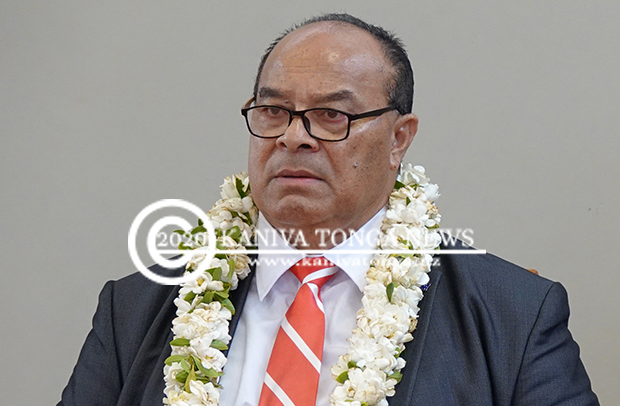
Minister of Justice Hon. Vuna Fā’otusia. Photo/Kalino Lātū (Kaniva Tonga News)
He was present in the House during morning sessions but could not make it to the ballot of the Vote of No Confidence against the Prime Minister.
Former Prime Minister Lord Tu’ivakanō asked the government to help transfer Fā’otusia to a New Zealand hospital for medical treatment.
Responding, the Prime Minister Pōhiva Tu’i’onetoa told the House he was late to the session because he was talking with Fā’otusia, implying he was outside Parliament with Fā’otusia while he was suffering from what appear to be a medical event.
Fā’otusia was admitted to a hospital in New Zealand last year for medical treatment. He returned to Tonga in December before resigning to support the PTOA Democrats by joining them to get the number of 10 MPs required by the law to sign a Vote of No Confidence before it was submitted to the House.
Fā’otusia said he was concerned about what he sees as the undue influence of disgraced former MP ‘Etuate Lavulavu on the Prime Minister and the cost of the government’s prayer and fasting excursions to the outer islands.
As Kaniva News reported earlier today, the Prime Minister Tu’i’onetoa will remain in power after the no-confidence vote was defeated in parliament this afternoon.
Hon Tu’i’onetoa has come under fire amid accusations his government has designed the tendering process for its multi-million roading project so the contracts would be given to three of its friends.
All the tenders have been awarded to companies with links of varying strength to the government, a conflict of interest that would raise red flags in Australia and New Zealand.
Hon Tu’i’onetoa, the second commoner elected to lead the country, has been prime minister for just over a year.
Hon Tu’i’onetoa has come under fire after his government was accused of designing the tendering process for its multi-million roading project so the contracts would be given to three of his friends.
All the tenders have been awarded to companies with links of varying strength to the government, a conflict of interest that would raise red flags in Australia and New Zealand.
Hon Tu’i’onetoa won the vote of 13 noble and Cabinet legislators. Nine MPs from the PTOA Party voted against the Prime Minister.
Hon Tu’i’onetoa, the second commoner elected in September 2019 to lead the country since 2010 political reforms, has been prime minister for just over a year now.
What has been claimed to be the first baby shower in Tonga has been praised for being conducted in a Tongan manner.
Decoration was made using Tongan handicrafts
A group in Houma is claiming to have held the first such event in the kingdom.
While it is not known whether any baby showers have been held before in Tonga like this one in Houma, the live streaming of the ceremony has attracted viewers from Tonga and overseas.
A baby shower can fulfill many roles, including gift-giving to the mother, a revelation of the baby’s gender, a ceremony to celebrate the delivery or expected birth of a child or the transformation of a woman into a mother.
Guest and family members are served with food during the baby shower ceremony
It is common in New Zealand, Australia, the United States and other foreign countries. It is not a traditional Tongan cultural ceremony.
Some Tongans overseas have held baby showers.
“Excellent! This is a normal ceremony in foreign countries and it is now being conducted in Houma, Tongatapu,” a Houma Facebook page spokesperson wrote in Tongan.
The Houma ceremony was live streamed by one of the most popular livestream service in the kingdom, Livestream Tonga, which has more than 70,000 followers on Facebook.
Salina Vakameilalo speaking to the guests during the ceremony
The ceremony drew praise from viewers in Tonga and overseas.
By today it had garnered 312 reactions, 208 comments and 30 shares.
Many viewers applauded the idea and marveled at how it was conducted in the Tongan way.
It was performed on the town’s rugby field where marquees were set up for the family members and guests.
Both families of the parents, Paea and Salina Vakameilalo attended and the programme included speeches from both families and a prayer service.
Some baby shower games were played during the event and prizes were awarded before the food was served.
“What fun, what a great idea – a gender reveal and baby shower at the same time,” a commenter wrote.
Some made jokes and told other villages and towns in Tonga that Houma was the first to perform a baby shower ceremony in the kingdom.
“Tonga….you first saw it in Houma! Gender reveal and baby shower” another commenter wrote.
“Bravo Houma you have baby shower and gender reveal ceremony.”
Horse trading continues as the vote of no confidence approaches, with the PTOA Party approaching Independent MPs in Prime Minister Pōhiva Tu’i’onetoa’s Cabinet.
It is understood the PTOA is focusing on three Independent Cabinet members in particular to join their attempt to oust the Prime Minister.
Meanwhile, the Prime Minister appears confident he will survive.
He said nothing about the Vote of No Confidence in his New Year message to the nation last week, instead talking about his Cabinet’s agenda for this year and Bills to be submitted to the House.
This appears to imply that he believes his Cabinet and the Nobles will stand by him and outnumber the PTOA in the vote
Parliament will reconvene next Tuesday, January 12, and Members of the Privilege Standing Committee are expected to meet to discuss the vote of no confidence in the Prime Minister.
MP for Tongatapu 2, Sēmisi Sika filed a motion for a vote of no confidence in Hon. Tu’i’onetoa on December 10.
The motion was supported by 10 MPs.
The vote of no confidence detailed a list of concerns, including the allocation of road building contracts, Covid-19 preparedness and what was seen as selective government support for businesses.
Deputy Prime Minister Sione Vuna Fā’otusia’s resigned in the wake of the motion, citing concerns about what he sees as the undue influence of disgraced former MP ‘Etuate Lavulavu on the Prime Minister and the cost of the government’s prayer and fasting excursions to the outer islands.
No government has been defeated by a vote of no confidence since legislation to allow them was introduced as part of the 2010 political reforms.
The first motion for a Vote of No Confidence in Tongan history was tabled in June 2012 when the late ‘Akilisi Pohiva tabled a Vote of No Confidence against Prime Minister Lord Tu’ivakano. The motion was unsuccessful.
In 2016 amendments were introduced to require that any motion of no confidence must be signed by 10 MPs and that it must be put to the vote within five working days of it being tabled.
In February 2017, Hon. Pōhiva defeated a vote of no confidence tabled by the Nobles and opposition MPs.
Because the current motion was tabled on the final day of the last Parliamentary session, the Speaker, Lord Fakafanua, ruled that it be tabled on the next sitting day, January 12.
Auckland-based Tongan businessman Sione Foaki Fifita claimed this week the government had agreed to pay his freight expenses for the shipment of heavy machinery from New Zealand.
Prime Minister Tu’i’onetoa (far left) and Sione Foaki Fifita (far right) after the Prime Minister’s first meeting in New Zealand with the Tongan community in 2019. Photo/Kalino Lātū (Kaniva Tonga News)
Speaking to FM 87.5 Broadcom, he said the money was supposed to come from the money the government would pay him for the contract he had been awarded to build and repair roads and the foreshore on Ha’apai.
Fifita implied that this was the reason he did not pay the shipping company bill himself.
Fifita was responding to questions from the radio about a complaint from the New Zealand-based Tongan company, Tripac International Ltd, which is also known as the Friendly Islands Freight, after he and the government failed to pay the shipping fee of more than TP$100,000.
The complaint was previously reported by Kaniva News after we talked to Friendly Islands Freight Ltd Director Angina Fīnau, who confirmed the government still owed him the money.
In our story last month we reported that Fīnau was considering suing the Tu’i’onetoa government over the fees.
It is understood the equipment was held at Tripac’s facility at the Queen Sālote wharf when the freight charges were not paid. The equipment was later released after a request from the government, it has been claimed.
The Minister of Finance and Prime Minister Pōhiva Tu’i’onetoa were contacted for a comment for our December story, but did not respond.
The controversy surrounding the government’s deal with Fifita included complaints that the government had awarded a contract to a person with close ties to Hon. Tu’i’onetoa.
Critics have claimed that Fifita and Hon. Tu’i’onetoa come from the same village, Talafo’ou , and have strong family connections.
Critics said local companies had their own equipment in Tonga to do the work.
They said the local companies had been investing in Tonga for years and could not believe the government could award it to a New Zealand-based company.
This story originally appeared on RNZ.co.nz and is republished with permission.
The President of the Tonga Rugby Union, Siaosi Pohiva has confirmed Peter Harding has been selected as the new Chief Executive Officer of the Tonga Rugby Union.
Matangi Tonga reports the appointment of Harding, taking from the vice president Fe’ao Vunipola, marks the beginning of the reforming of the troubled union.
On 25 September 2020, a tripartite agreement was signed by World Rugby Ltd, the Government of Tonga, and the Tonga Rugby Union.
David Carrigy signed the agreement for the World Rugby Ltd, Poasi Tei signed for the Government of Tonga, and Siaosi Pohiva signed for the Tonga Rugby Union.
“We agreed this agreement outlines the objectives, high level requirements and performances measures for the Tonga high performance programme and the responsibilities for all parties during the 2020-2024 period,” said Siaosi.
There was also an understanding that once a new CEO was selected, World Rugby would proceed with its program to provide strategic input, administration leadership and governance to the Tongan Rugby Union high performance program to maximise the potential for sustained international success by Tonga Rugby.
Peter Harding has been in affiliation with the development of Tongan Rugby, since 2012, either as the high performance general manager for the Tongan Rugby Union or the team manager for the ‘Ikale Tahi, Tonga’s National Rugby team.
Peter Harding, new CEO of Tonga Rugby Union Photo: World Rugby
This story originally appeared on RNZ.co.nz and is republished with permission
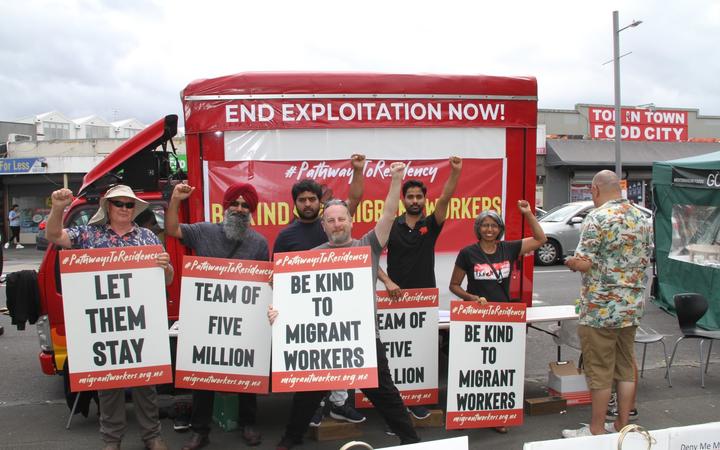
Labour unions are calling on the government to give residency to long-term migrant workers who now call New Zealand home.
People at the Pathway to Residency petition in Auckland. Photo: Supplied / Migrant Workers Association of Aotearoa
Workers who arrived with big dreams say the ever-changing threshold for skilled migrants’ pay and points mean their efforts are in vain. A petition started by Migrant Workers Association, Unite Union, One Union and First Union, “Pathway to Residency”, has collected 15,000 signatures.
It’s almost 10 years since a Bangladeshi man, who doesn’t want his name used, arrived in New Zealand. The cafe worker said he was twice invited to apply for residency in 2016 and 2018, but due to an unsupportive former employer, he missed the opportunities.
He has worked long to meet the rising points requirement, which is 160, but early last year, Immigration New Zealand changed the hourly pay rate threshold for his skill level to $25.5 and he is $1 short.
“At this moment, I can’t apply for my residency because I don’t meet the requirement to apply for residency, and also there’s no application that they’re taking [due to the Covid-19 pandemic]. I don’t know what I’m going to do, my visa is expiring in less than 12 months.”
He said he’s made New Zealand home but didn’t see any future.
“I spent my almost 10 years, half of my youth here. I’m 32 now. I don’t know if I go back home next year, what I’m going to do,” the man said.
Another man from India has been here for almost nine years, working first in retail and now IT. His two children, 2 and 4 years old, were born and are growing up here but he needs to regularly renew his work visa as well as visitor visas for his children and wife.
“Everytime I have to pay immigration fees, sometimes lawyer fees, and supply police clearance and medical certificates,” he said.
He said he doesn’t meet the current requirements for points or salary, and even if he were to finally meet the threshold after a few years, he’s not confident about the ever-rising bar.
“I can’t trust Immigration New Zealand, maybe they will introduce some new thresholds and new points then,” he said.
President of the Migrant Workers Association Aotearoa, Anu Kaloti, said they’re looking at people who have been here for five years or more and those with highly-sought-after skills.
“These would be people who are already here … they contributed to New Zealand economy hugely. We’re not asking for new migrants to be brought in, we’re saying that people who are already here, let’s look after them and let’s allow them to be here permanently.”
There are 189,000 temporary migrants with work rights in New Zealand as of last month.
Kaloti said there are also workers who weren’t even able to return to New Zealand after the border closure in March. She said migrants often fall into the cracks in the system and don’t enjoy the same privilege as residents or citizens.
“We have to remember that benefits like unemployment benefit and other benefits through Work and Income that comes out of our taxation, so these are migrant workers who’ve been working here for years and years and contributing to the the economy and paying their taxes.”
Unite Union national director, Mike Treen, said with borders closed due to the pandemic, new migrants aren’t arriving to renew the workforce, so it makes sense to keep those who’re already here.
He said Immigration has made it progressively harder for migrants to become residents, so there are too many people on temporary visas in the country. He said change is needed.
“I think this is a once in a generation opportunity to fix a broken system so we have made it harder and harder for people who we brought to New Zealand with promises of being able to transition to residency,” he said.
Immigration Minister Kris Faafoi said the government’s priority is getting New Zealanders into jobs and encouraging employers to continue focusing on longer-term workforce planning, training, and improving wages and conditions to attract a local workforce.
By Joseph Tanfani, John Shiffman, Brad Heath and Mark Hosenball
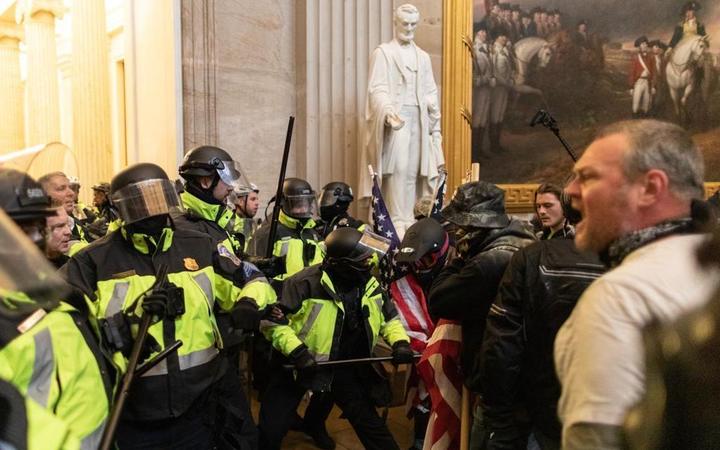
The chaos inside the US Capitol on Wednesday local time came after the police force that protects the legislative complex was overrun by a mob of Trump supporters in what law enforcement officials called a catastrophic failure to prepare.
Police intervene as US President Donald Trump’s supporters breach security and enter the Capitol building in Washington DC. Photo: AFP
The siege of the Capitol, home to both the US Senate and the House of Representatives, represents one of the gravest security lapses in recent US history, current and former law enforcement officials said, turning one of the most recognisable symbols of American power into a locus of political violence.
While events such as a presidential inauguration involve detailed security plans by numerous security agencies, far less planning went into protecting the joint session of Congress that convened on Wednesday to ratify the results of the 2020 presidential election, the officials said.
That lapse came despite glaring warning signs of potential violence by hardline supporters of President Donald Trump, who are inflamed by Trump’s baseless claims of a stolen election and hope to block the inauguration of President-elect Joe Biden.
And security initially was handled almost entirely alone by the US Capitol Police, a 2000-member force under the control of Congress and dedicated to protecting the 126-acre Capitol Grounds.
For reasons that remained unclear as of early Thursday, other arms of the US federal government’s vast security apparatus did not arrive in force for hours as rioters besieged the seat of Congress.
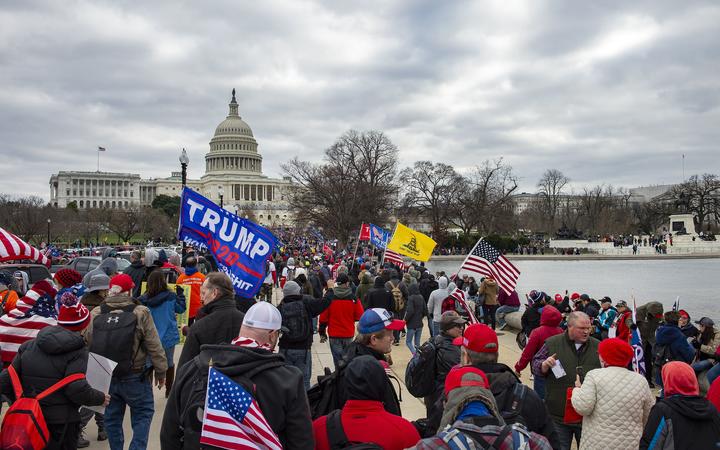
The Capitol is a short walk from where Trump in a speech railed against the election just before the riot began, calling the vote an “egregious assault on our democracy” and urging his supporters to “walk down to the Capitol” in a “Save America March”.
The counting of the electoral votes of the presidential election by Congress, normally a formality, was preceded by weeks of threats in social media that planned pro-Trump protests could descend into violence.
Despite those rumblings of danger, the Capitol Police force did not request advance help to secure the building from other federal agencies such as the Department of Homeland Security, according to one senior official. And National Guard reinforcements, summoned by the city’s mayor, were not mobilised until more than an hour after protesters had first breached the barricades.
In stark contrast, those agencies were aggressively deployed by the Trump administration during last summer’s police brutality protests in Washington and elsewhere in the United States.
The Capitol Police did not respond to requests for comment.
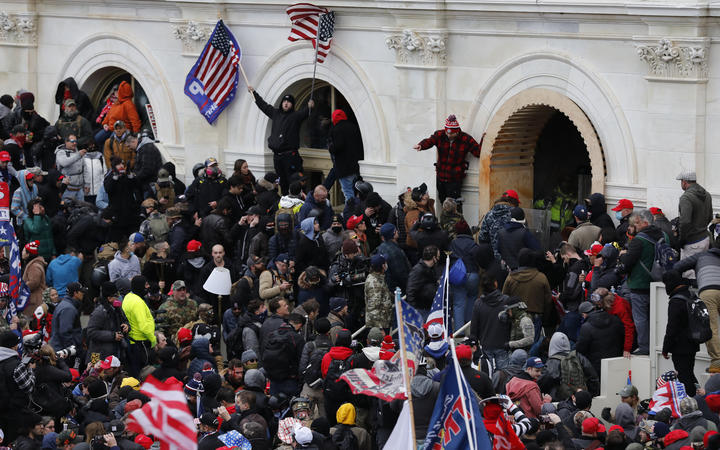
Supporters of US President Donald Trump storm the US Capitol during a rally to contest the certification of the 2020 US presidential election results. Photo: AFP
The force’s officers are trained to keep protesters off the Capitol’s marble outdoor steps, to protect the complex like a citadel. But there are so many windows and doors in the 19th-century complex that it is difficult to defend them all, said Terrance Gainer, who served as Capitol Police chief and later as the US Senate’s Sergeant at Arms, its chief law enforcement officer.
“Once they lost the steps, they lost the doors and windows,” Gainer said.
As hordes of rioters streamed into the heart of American government, they could be seen on camera roaming freely through the historic halls – swinging from a balcony, rifling through the offices of House Speaker Nancy Pelosi, and even sitting in the chair reserved for the Senate’s presiding officer.
One rioter was captured by a Reuters photographer casually shouldering a large Confederate battle flag as he strode inside the Capitol – a searingly evocative inversion of the failed 1861-1865 insurrection against the American republic by Southern states in an effort to perpetuate slavery.
“I truly had to suspend my disbelief because I didn’t think you could breach the Capitol,” former Capitol Police chief Gainer said.
“I have great confidence in the men and women who protect Congress, but there will need to be a full accounting. We’re going to have to have a deep dive into what went wrong.”
Lawmakers inside the building blamed a lack of preparation for the historic security breach.
“I think police did a good job under the circumstances, but there clearly wasn’t enough planning,” said Representative Vicente Gonzalez, a Texas Democrat.
The long-planned protest, Gonzalez said, called for an “overwhelming display of force” by police.
‘It looked like the Keystone Cops’
Some Democratic members of Congress, worried about the prospects of violence, tried for more than a week to press agencies for information about what they knew about threats or countermeasures, according to one congressional source. But there was no sign anyone was gathering serious intelligence about possible disturbances or planning to counter them, this source said.
Typically, law enforcement agencies in the American capital spend weeks or months planning for large protests, one former Justice Department official said. Officials from dozens of agencies, including local police, Capitol Police, the Secret Service and the federal Parks Police, ordinarily gather at the Washington field office of the Federal Bureau of Investigation, the premier national law-enforcement agency, to coordinate their response. But it’s not clear how much of that planning happened for Wednesday’s event.
A senior federal law enforcement official familiar with the planning to protect other federal sites on Wednesday, including the grounds where Trump spoke, said that he was shocked that the Capitol Police were not better prepared.
“It looked like the Keystone Cops out there,” said the official, who spoke on condition of anonymity. “It should have never happened. We all knew in advance that these people were coming, and the first order of policing is presence.”
“The Capitol Police force is essentially a guard force, so it’s hard to understand why they weren’t better prepared.”
The challenges of securing the Capitol have been discussed in hearings and in reports for years. In 2013, Gainer said he proposed a fence, to be called the Capitol Gateway, to stop such a mass assault. It was never built.
“The idea was roundly defeated,” he said, because members of Congress wanted to protect the public’s access, and did not want the complex to look like a fortress.
Trump launched march to the Capitol
Trump on Twitter promised a “wild” event aimed at reversing his loss in last November’s election – and appeared to encourage his supporters to act.
“Our country has had enough, and we will not take it anymore,” Trump said at Wednesday’s rally. “You have to show strength, and you have to be strong.”
The White House did not respond to requests for comment on Trump’s role in inspiring the violent protests or on the collapse of security at the Capitol.
As Trump returned to the White House, the crowd headed to the Capitol building.
Photo: AFP
After a perimeter was quickly breached, Capitol Police officers seemed to be alone in battling the extremists on the building’s steps, according to witness accounts and video from the scene. They were unable to secure all the doors and windows in the sprawling complex.
Protesters surged inside the building, which contains the chambers of both houses of Congress. Video footage showed Capitol Police overwhelmed by vastly superior numbers of intruders as the mob grew into the thousands.
Two US officials said that Washington city officials had hoped to avoid a militarised response in the days before the protest.
The fear: They were concerned about a repeat of the scenes of the harsh federal response to anti-racism protests that took place across the street from the White House in June. They said it was unclear why it took as long as it did for the city police force to arrive at the Capitol.
Whatever the case, they added, the delay was too long.
A US defense official said Washington Mayor Muriel Bowser requested National Guard troops at around 2pm. That was about 45 minutes after the rioters had breached the first barricade.
Acting Defense Secretary Chris Miller activated the full DC National Guard at about 2.30pm, the official said.
By then, the Capitol was under lockdown. In the rotunda, the iconic circular room under the Capitol dome, tear gas masks were being distributed. Police evacuated Vice President Mike Pence – who was there to preside over the formal counting of the Electoral College votes for the election he and Trump lost – and members of the House of Representatives and Senate.
The police used pepper spray and tear gas on the protesters. They tried to barricade doors with furniture but quickly lost the battle.
One woman was shot and killed by Capitol police inside the building, and pipe bombs were recovered at the offices of the Democratic and Republican national committees, Washington Police Chief Robert Contee said. He didn’t explain what prompted officers to shoot the woman.
Calls to ‘rise up’ for Trump
While the mob invasion of the Capitol was unprecedented, there were ample warning signs in the days leading up to the protests. Many Trump supporters who travelled to the capital shared plans and organised on social media websites such as Parler, a Twitter-like service that has attracted right-wing extremist groups.
Some posters discussed ways to illegally sneak guns into Washington. In a post on the social media app Parler, the leader of the far-right extremist group the Proud Boys, Enrique Tarrio, promised the group’s attendance at Wednesday’s rally. Tarrio was arrested on Monday in Washington for destruction of property during a protest last month and possession of a firearm magazine. He pleaded not guilty but was ordered to leave the city on Tuesday.
Joe Biggs, a Proud Boys organiser, said more than 65 members of his group attended the protests but that he did not know whether any of them entered the Capitol building. He said he advised other Proud Boys to stay inside and avoid confrontations with police.
On Twitter, starting on 1 January, there were 1480 posts from accounts related to the QAnon conspiracy theory movement that referenced Trump’s rally on 6 January and contained references to violence, said a former intelligence official who monitors extremists on social media.
These included calls for “Patriots to Rise Up.”
In one popular post on the TikTok video app, a man said that bringing guns to Washington is the “entire reason we’re going”.
Neil Trugman, a former Capitol Police intelligence officer, called Wednesday’s invasion of the complex unfathomable. He said the force generally prepares for much smaller groups under rules designed to allow for maximum expression of free speech rights.
“We’re all witnessing something we never imagined,” said Trugman, who recently retired as chief of police for Amtrak, the US passenger rail company. “I’m not sure any chief of police could have handled this any differently.”
He blamed Trump for inciting the riot: “This is no longer just a protest. They crossed the line. This is terrorism.”
Dramatic flooding in Ha’alaufuli, Vava’u this morning sent residents into panic as houses became uninhabitable and the only drain became blocked.
Kaloni’s house in Ha’alaufuli was flooded after a heavy rain this morning. Photo/Screenshot
The water washed away rocks being used to fill the new roads which are being built as part of Prime Minister Pōhiva Tu’i’onetoa’s controversial multi-million road project.
Ha’alaufuli residents called on road work contractor, disgraced ‘Etuate Lavulavu to come and work on the roads to help ease the flooding.
They said they had warned about possible problems when the road works began.
‘Asinate Fifita Tu’akalau shared a video of the flooding to social media this afternoon, which was seen by Kaniva News.
Neiafu Town Officer Vāvā Lapota described the rain as “huge” and said it lasted from 7am until 4pm.
Kaloni, a local widow, who spoke on the video, said she had pleaded with Lavulavu to be careful about how the roads were built and was scared any heavy rain might flood her house.
She said Lavulavu did not appear to listen.
“No one listened to me,” Kaloni said.
The video showed her walking on a verandah in what appear to be floodwater.
“Look at this,” she invited viewers to look at the water.
She said there was no flooding like that before to her property.
Kaloni, who appeared emotional, said on the video she went to the estate holder as well as the district officer and complained to them about the road construction.
She invited viewers in the video to see the state of the road works.
“Kovi ‘aupito (very bad),” she said.
She said before her husband’s death he told her that if the road was built it would cause flooding.
She said the road was higher than the stone fence of her property, which Kaniva News estimated from the video as about a metre high.
The Prime Minister’s road project was announced as Tonga’s biggest project.
It was estimated to have cost taxpayers TP$300 million, to be completed in four years.
Critics of the project claimed the contractors did not have enough experience.
There have been repeated complaints about the awarding of the contracts to people with close tie to the government.
In his New Year’s speech the Prime Minister praised the project and said it was built solidly to last for a long time.
The new roads in Vava’u and in Tongatapu have been previously reported to have been damaged by heavy rains and tropical cyclones.





 Some baby shower games were played during the event and prizes were awarded before the food was served.