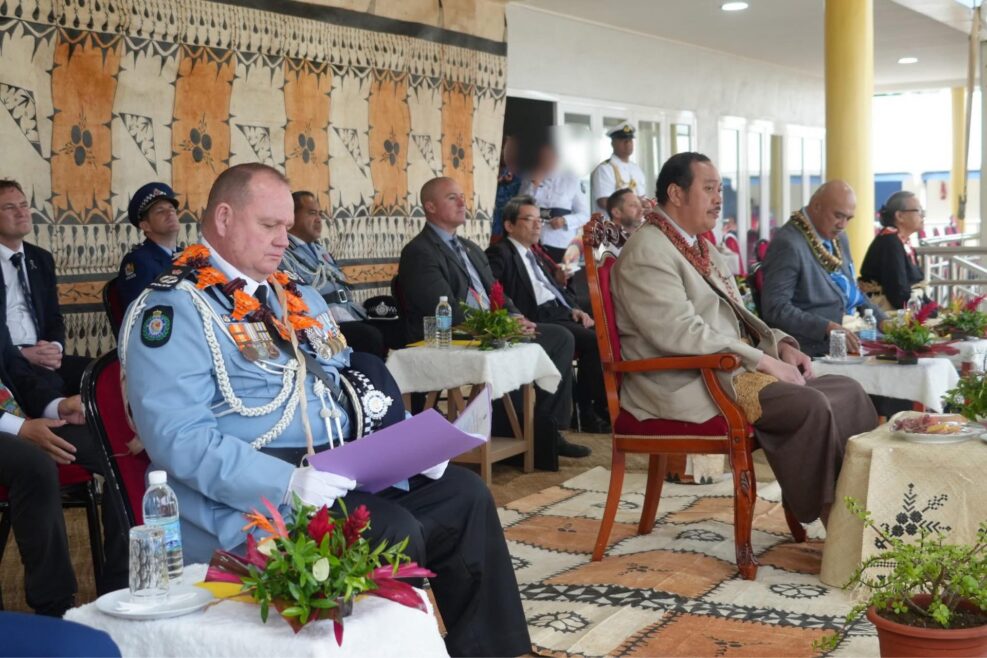
Nuku’alofa, Tonga — His Royal Highness Crown Prince Tupoutoʻa ʻUlukalala presented awards yesterday to 51 police officers who successfully completed the Diploma in General Policing Level 5, marking a significant milestone in Tonga’s law enforcement development.
His Royal Highness Crown Prince Tupoutoʻa ʻUlukalala presents certificates to graduating officers at the Diploma in General Policing Level 5 ceremony, joined by Minister of Police Hon. Piveni Piukala and Police Commissioner Geoff Turner.
The Crown Prince’s presence and active participation in the ceremony underscored the importance of professional training within the Tonga Police Force.
They reflected the Royal Family’s continued support for strengthening public service across the nation.
The diploma recipients were recognised for their commitment to modern policing practices, leadership, and ethical conduct.
The qualification represents a key step in enhancing the capacity and professionalism of Tonga’s frontline officers.
“Professional policing is the foundation of a safe, peaceful, and prosperous Tonga,” said a spokesperson for the Tonga Police.
“This achievement is not only a personal accomplishment for the officers but also a meaningful contribution to national progress.”
The Diploma in General Policing Level 5 is part of an ongoing initiative to elevate law enforcement standards in Tonga, ensuring officers are equipped to meet the evolving challenges of public safety and community engagement.
Nuku’alofa, Tonga — The Governments of Japan and Tonga signed an agreement on Thursday, September 25, 2025, to introduce an Electronic Machine-Readable Passport (EMRP) system in the Kingdom of Tonga.
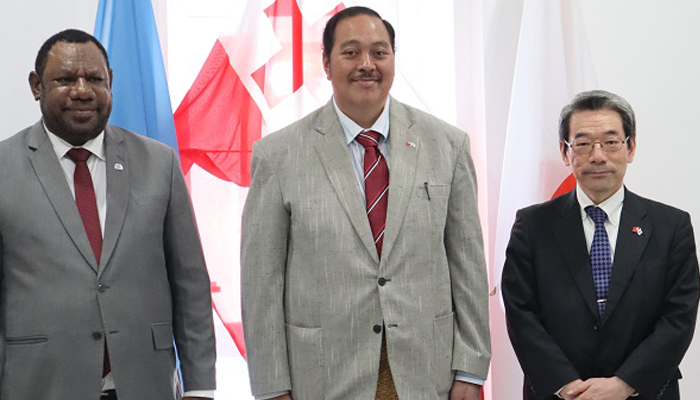
His Royal Highness, Crown Prince Tupouto’a ‘Ulukalala, Tonga’s Minister for Foreign Affairs honoured the occasion and witnessed the signing ceremony by His Excellency Mr. INAGAKI Hisao, Ambassador of Japan to Tonga and Mr. Solomon Kantha, Chief of Mission and Subregional Coordinator for the South Pacific, International Organisation for Migration, Fiji.
The initiative is backed by a grant of 882 million Japanese Yen—approximately USD $6 million—from the Government of Japan.
The signing ceremony was witnessed by His Royal Highness Crown Prince Tupouto’a ‘Ulukalala, Tonga’s Minister for Foreign Affairs, and officiated by His Excellency Mr. Inagaki Hisao, Ambassador of Japan to Tonga, alongside Mr. Solomon Kantha, Chief of Mission and Subregional Coordinator for the South Pacific at the International Organisation for Migration (IOM).
Ambassador Inagaki praised the trilateral collaboration between Japan, Tonga, and IOM, noting that the e-passport system aligns with the goals of the PALM10 Leaders’ Declaration and the Joint Action Plan, particularly in the areas of peace, security, and digital connectivity.
Mr. Kantha emphasised the project’s people-centred approach, highlighting its role in equipping frontline officers with the tools and training needed to make informed decisions at the border.
The EMRP system marks the next phase of Japan’s support for Tonga’s border management, following the successful implementation of the Migration Information and Data Analysis System (MIDAS) in October 2024. IOM, which has been active in Tonga since 2018, will execute the project in close coordination with Tonga’s Immigration Division and Ministry of Foreign Affairs.
The new e-passport system will replace Tonga’s manual, paper-based passports, offering faster, more secure access to government services and international travel.
Editorial – In May 2025, Tonga Police charged 14 civilians for gathering at a bush area in Mataki’eua, citing public drunkenness, loud music, and disorderly behaviour as serious concerns.
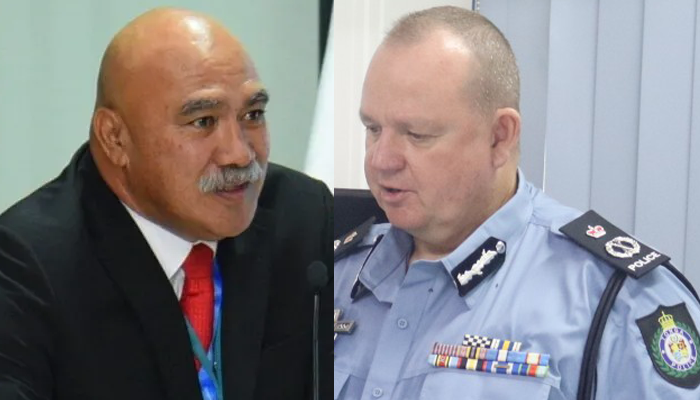
Minister of Police (L) and Police Commissioner Geoff Turner
The group of approximately 130 people had gathered overnight in Mataki’eua, prompting swift police intervention and public statements from the Ministry of Police emphasising the importance of law and order. Roadblocks were later set up around the area to prevent further social gatherings.
Yet, just three months later, in August 2025, a court ruling exposed a deeply troubling contradiction: several off-duty Police officers themselves had been involved in a drunken incident in Sopu in January 2024 — an event far more serious in nature.
The court found that on the evening of January 27, 2024, a group of police officers consumed alcohol during a dinner celebration at Popua Park.
Later that night, they continued drinking at the Reload Bar in Nuku’alofa until it closed around midnight.
Following this, they drove to Sopu for what has been “euphemistically” described as “a drink-up.”
The Police officers had been drinking heavily and were so intoxicated that their testimonies were deemed unreliable, according to court documents.
One officer admitted to consuming 24 bottles of beer before driving, while others rated their drunkenness between 5 and 10 on a scale where 10 meant completely drunk.
Court documents reveal that one of the police officers admitted to the judge that he had been driving a motor vehicle while completely unfit to do so due to the amount of alcohol he had consumed.
During the “drink up”, two police officers were reportedly injured following an alleged assault by their colleagues.
Two officers were subsequently charged with causing serious bodily harm and common assault.
However, the court acquitted both, citing a lack of evidence to prove the charges beyond reasonable doubt.
In his ruling, Justice Paul Garlick KC said: “It is impossible to say how the events at Sopu turned from a “drink up” into a violent incident. Reluctantly, I am driven to make a finding of fact that I cannot rely upon the evidence of any of the police officers as accurate or reliable. I have reached this conclusion for three reasons. First, it is abundantly clear that they were all completely incapacitated as a result of the amount of alcohol they had consumed. Secondly, I cannot be sure that their evidence is fair and unbiased, rather than being based upon their concern to justify their conduct and to support their colleague who was injured in the drunken melee that blew up into an incident which was undoubtedly fuelled by alcohol, together with an abandonment of the sort of conduct that one would rightly expect of police officers, whether on duty or off-duty.”
The Judge stated that Sopu is a public place, and therefore, the police should not have been consuming alcohol there.
The irony is difficult to ignore. Police issued official statements warning the public and highlighting the seriousness of civilian misconduct during the Mataki’eua gathering. The Minister of Police even addressed the media, expressing concern over public drinking and dancing—and many of those involved were swiftly prosecuted.
Meanwhile, there has been no comparable level of public concern or accountability shown by the Ministry regarding the conduct of police officers involved in that violent, alcohol-fuelled incident in Sopu.
These officers, who are expected to uphold the law, have not faced any publicly disclosed disciplinary action, despite the court ruling in August 2025 that found their evidence unreliable due to extreme intoxication.
The court’s findings not only cast doubt on the officers’ credibility but also raise serious questions about double standards and accountability within the force.
If the law, transparency and accountability to the public are to be respected, they must be applied equally — especially by those who enforce them.
Honiara, Solomon Islands — His Majesty King Tupou VI of Tonga, who also serves as Chancellor of The University of the South Pacific (USP), has arrived in the Solomon Islands ahead of this week’s USP Graduation Ceremony in Honiara.
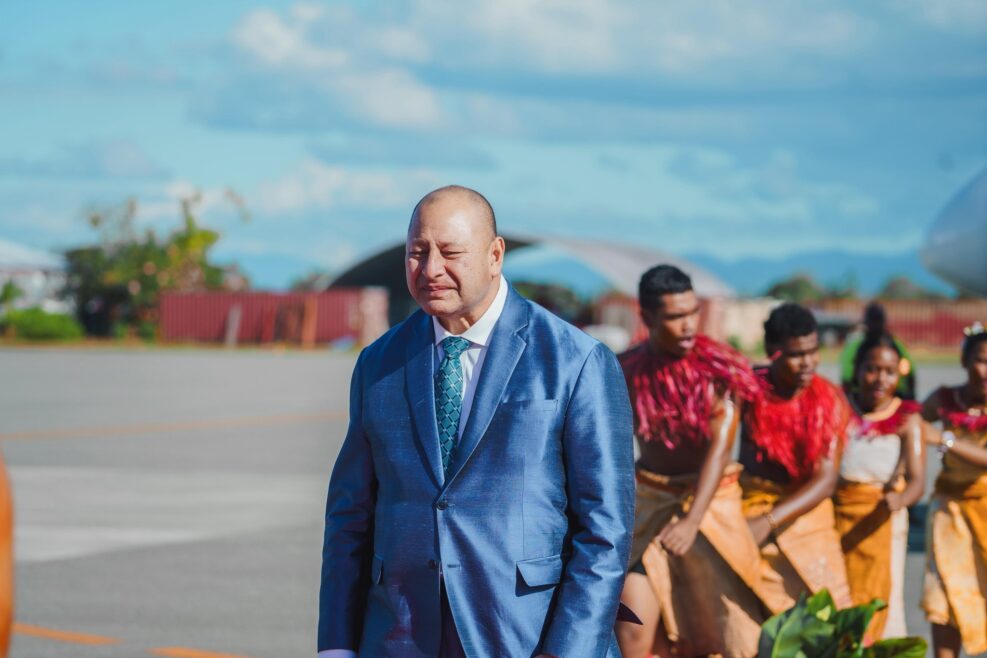
In true Pacific spirit, His Majesty was greeted at Honiara International Airport with a traditional welcome by Tafivaka, a cultural dance group from Tikopia. Tikopia is a Polynesian island in the Temotu Province, Solomon Islands. Photo.USP Campus, Solomons Islands
The King’s arrival marks a significant moment for the regional university, as it continues to celebrate academic achievement and unity across the Pacific.
His Majesty was welcomed at Honiara International Airport with a traditional cultural performance by Tafivaka, a dance group from Tikopia — a Polynesian island in the Temotu Province of Solomon Islands.
As Chancellor, King Tupou VI’s presence underscores USP’s role as a unifying institution for the Pacific region, bringing together students, families, and communities to celebrate education in a distinctly Pacific way.
The graduation ceremony is expected to draw attendees from across the region, highlighting the university’s reach and the importance of higher education in fostering regional development and cooperation.
Earlier this month, His Majesty King Tupou VI of Tonga was in Fiji for his formal appointment as Chancellor of the University of the South Pacific (USP).
The University of the South Pacific (USP) is a premier intergovernmental public research university serving 12 island nations across Oceania.
Established in 1968, USP is jointly owned by its member countries, including Tonga, and stands as a unique regional institution committed to delivering high-quality tertiary education and conducting research tailored to the specific needs of the Pacific region.
His Majesty is in Honiara for events at the University of the South Pacific (USP) campus in that country, located at King George VI in Honiara.
Otago, NZ – A couple accused of orchestrating a fake cancer scam and defrauding family and friends of more than $1 million is scheduled to appear in court in September 2026.
Sepiuta Setaita Vave, 38, and Andrew Stewart Jones, 28, were arrested on August 14 at a property in Wānaka, where they had recently relocated from the West Coast.
The pair appeared via audio-visual link at the Christchurch District Court on Thursday, where it was revealed that Vave, who is Tongan, is also facing a new charge of unlawful sexual connection, according to RNZ.
However, no details have been released regarding the new allegations.
Court documents reportedly reveal the couple is jointly accused of obtaining $1,044,500 by deception from one or more victims, across four alleged offences committed over more than three years.
All offences are said to have occurred at a single Canterbury location, which is currently subject to name suppression.
According to The Press, the first alleged amount was $617,700, obtained between December 2021 and April 2023.
The second was $89,000, between November 2023 and January 2024. The third involved $224,000 in late 2024.
The fourth was $113,800 in February.
A report by The New Zealand Herald stated that the Tasman Organised Crime Unit (TOCU) began investigating the pair in early August.
“Their lavish lifestyle has been funded with money allegedly defrauded from family, friends and associates, for cancer treatment that inquiries show was never required and never obtained.”
Police said the offending spanned two years, during which the couple allegedly claimed the money was for medical treatment that was not required.
Investigators have identified 10 potential victims.
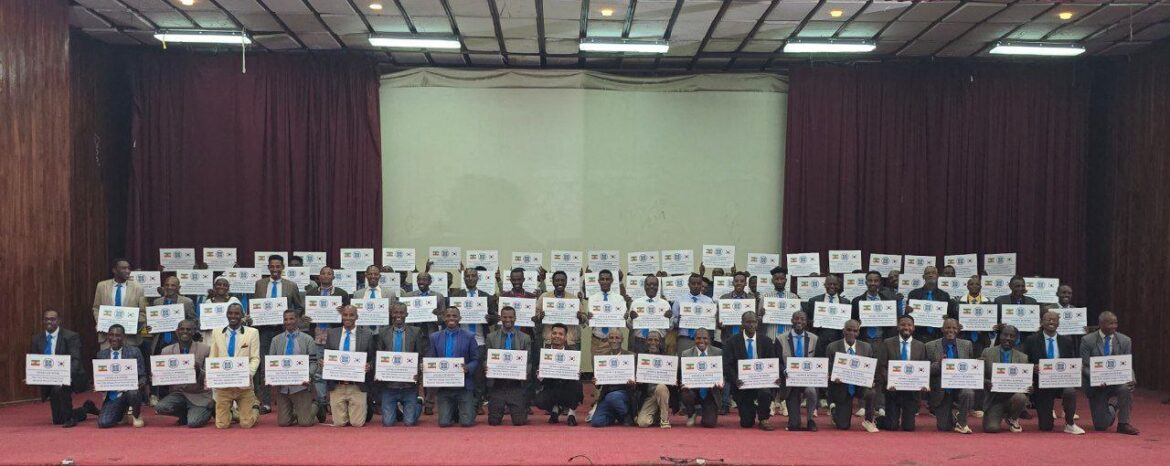
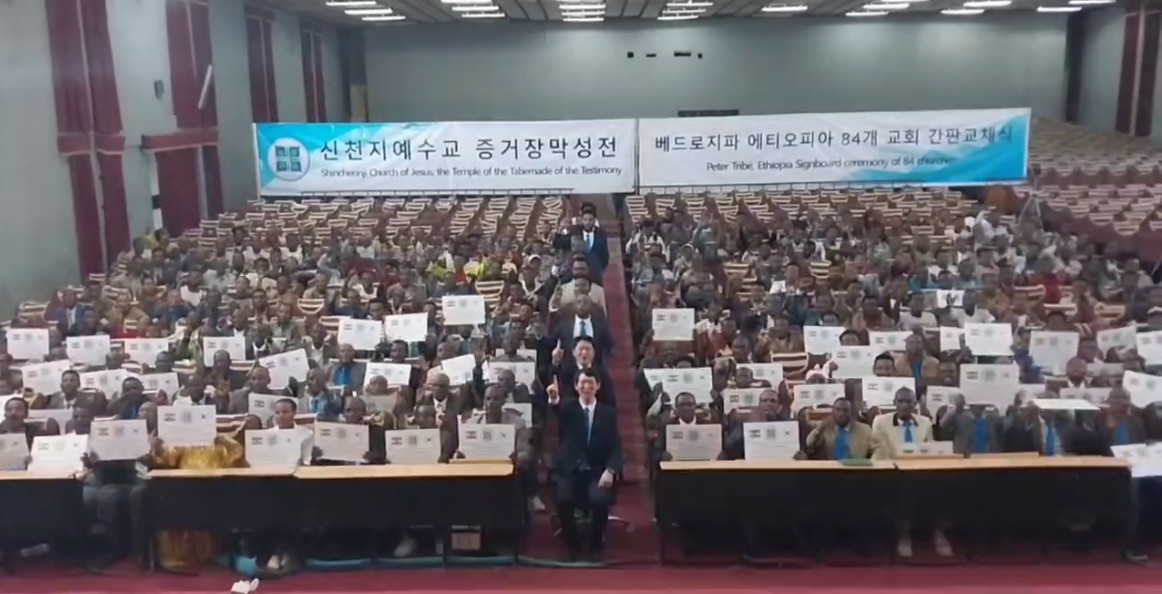
A total of 84 churches across 10 cities in Ethiopia have officially changed their church signboard names to Shincheonji Church of Jesus, the Temple of the Tabernacle of the Testimony (Chairman: Lee Man-hee, hereinafter “Shincheonji Church of Jesus”).
On the 10th, the Peter Tribe of Shincheonji held the “Ethiopia 84 Churches Signboard Changing Ceremony.” During the event, 84 church pastors declared that they had become members of Shincheonji Church of Jesus, committed to preaching the Word of the New Covenant Revelation, and resolved to become one through the “revealed Word.”
1–2. On the 10th, representative pastors from 84 churches in Ethiopia posed for a commemorative photo at the “Shincheonji Church of Jesus, the Temple of the Tabernacle of the Testimony, Peter Tribe, Ethiopia Signboard Changing Ceremony.” Photo/Shincheonji Church of Jesus
This development stems from the participation of Pastor Asefa Angeto (President of the Misgana Denomination Association) in the “2nd Global Invitation Revelation Seminar” held last November at Shincheonji Cheongju Church. After returning to his home country, Ethiopia, Pastor Asefa continued to lead local seminars based on the Word he had learned.
Pastor Asefa had traveled to over 100 churches in 10 cities, conducting seminars and testifying to the revealed Word he learned from Shincheonji.
This signboard replacement is being regarded as more than a simple change of signage—it is seen as a major breakthrough in spreading a Word-centered transformation across the Ethiopian Christian community.
1–2. On the 10th, representative pastors from 84 churches in Ethiopia posed for a commemorative photo at the “Shincheonji Church of Jesus, the Temple of the Tabernacle of the Testimony, Peter Tribe, Ethiopia Signboard Changing Ceremony.” Photo/Shincheonji Church of Jesus
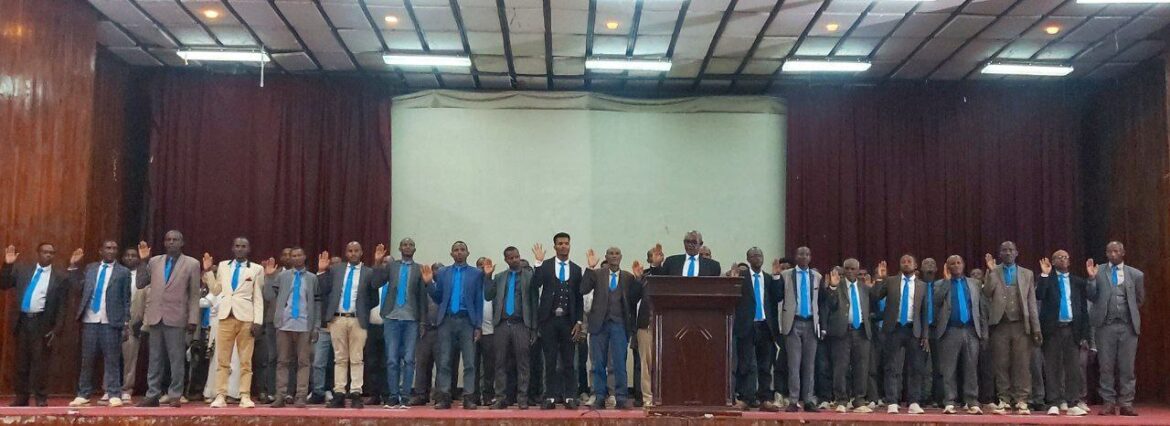
At the commemorative ceremony, the 84 representative pastors declared, “We have become members of Shincheonji Church of Jesus, having mastered the Word of the New Covenant Revelation. We resolve to preach this Word throughout Ethiopia, so that both pastors and believers alike may follow only the truth and devote themselves more fervently to the ministry of the Word.”
A representative of the Peter Tribe of Shincheonji stated, “Currently, 181 pastors in Ethiopia are learning the revealed Word from Shincheonji Church of Jesus. We will continue to make known the fact that the prophecies of Revelation have been fulfilled today, and we will do our utmost so that churches around the world may become united through the Word.”
On the 10th, during the “Shincheonji Church of Jesus, the Temple of the Tabernacle of the Testimony, Peter Tribe, Ethiopia 84 Churches Signboard Changing Ceremony,” representative pastors from all 84 churches conducted a pledge ceremony. Photo/Shincheonji Church of Jesus
Pukekohe, New Zealand — A Tongan woman has been sentenced to nine months of home detention after pleading guilty to evading nearly $1.5 million in taxes through her labour contracting business.
Haitelenisia Kaumavae, the owner of M & H Kaumavae Ltd, appeared in the Pukekohe District Court on 23 September.
She admitted to four representative charges of tax evasion, including aiding and abetting her company in failing to meet its tax obligations.
According to Inland Revenue, Kaumavae’s offending was “repetitive and premeditated.”
Over a period of several years, she failed to file income tax returns for four consecutive years.
During a three-year period, she either failed to submit GST returns or submitted false ones. Additionally, she did not file PAYE returns for a total of 40 months.
The total amount evaded was $1,487,359.41, comprising GST, PAYE, and income tax.
A review of bank records showed that M&H issued invoices to growers for labour services, which included GST and a 15% withholding tax deduction—yet the taxes were never paid.
Despite the seriousness of the offence, the judge noted that Kaumavae did not personally profit from the scheme, citing her cultural obligations as a mitigating factor.
She was sentenced to nine months of home detention, followed by six months of post-detention conditions, and ordered to pay $6,500 in reparation, with payments to be set by the court registrar.
Inland Revenue described the case as a “wilful example of repeated fraud,” highlighting the importance of accountability in protecting public funds.
One Tongan noble has allegedly been stripped of his title, while another is facing the threat of serious legal proceedings.
Lord Veikune (L) and Lord Tu’ilakepa
The news follows earlier online statements by the King and Queen, in which they warned members of the nobility about their responsibilities to the country, including the expectation of loyalty to the monarch.
The spotlight intensified this week after reports emerged that His Majesty King Tupou VI has allegedly stripped Noble Veikune of his hereditary title, although the Palace has released no official statement.
Residents of Longoteme, an estate belonging to Lord Veikune, told Kaniva News that a Royal Palace Office staff member convened a meeting to inform them of the alleged revocation of the estate’s title.
It has been reported that the title is now reserved by the King, pending the noble’s eldest son reaching the legal age to inherit it.
The reported removal of the Veikune title follows a historical precedent set in 2006, when Siosifa Fatafehi Fuatakifolaha Veikune, the father of the recent titleholder, was stripped of both his noble status and his role as Speaker of Parliament.
He was convicted of tax evasion and bribery, triggering constitutional provisions that prohibit any person convicted of a criminal offence punishable by more than two years’ imprisonment from holding elected office.
Under Tonga’s Land Act, individuals convicted of indictable offences are also barred from holding noble titles, reinforcing the legal basis for the King’s alleged decision.
Land Dispute Sparks Legal Threat
Meanwhile, Lord Tu’ilakepa, Chairman of the Whole House Committee, has been accused by a relative on social media of alleged misconduct involving his noble title and land rights on Ofu Island.
Asinate Fifita Tu’akalau has threatened legal action against Tu’ilakepa on Facebook, accusing him of wrongdoing.
The allegations, though unverified, have ignited public debate and concern over transparency and governance within Tonga’s noble class.
Tu’ilakepa was previously accused in 2010 by Australian authorities of conspiring with convicted Colombian drug lord Obeil Antonio Zuluaga Gomez to traffic cocaine through Tonga to Australia and China.
The charges were dropped in 2013 and the case was never formally adjudicated, leaving lingering questions about the extent of his involvement.
Attempts by Kaniva News to contact the Royal Palace were unsuccessful. Both Tu’ilakepa and Veikune could not be reached for comment.
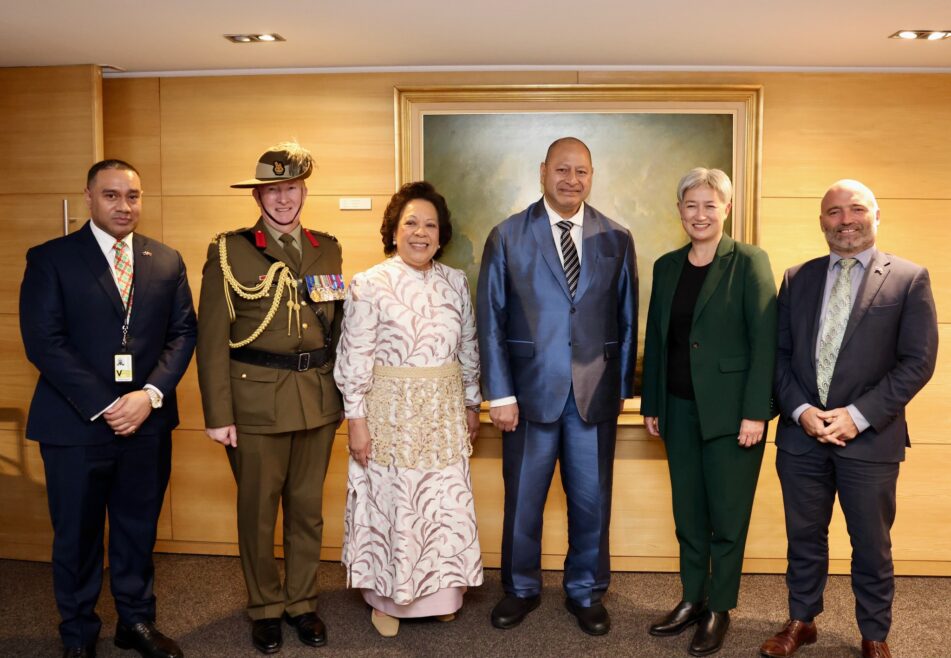
Canberra, Australia — Marking a powerful milestone in two centuries of friendship, His Majesty King Tupou VI and Queen Nanasipau’u of Tonga have arrived in Australia for a historic state visit from 18 to 24 September, celebrating 200 years of diplomatic and cultural ties between the two nations.
Australia and Tonga’s relationship is built on deep cultural and personal connections spanning 200 years. Photo/Penny Wong, Senator for SA (Facebook)
The visit underscores a shared commitment to shaping a peaceful, stable, and prosperous Pacific region.
Today, in a landmark moment, His Majesty joined Australia’s Governor-General, Her Excellency Sam Mostyn AC, Tongan Deputy Prime Minister Dr Taniela Fusimālohi, and Australia’s Attorney-General the Hon Michelle Rowland MP to witness the signing of a Statement of Intent—a pledge to elevate bilateral relations through a comprehensive agreement named Kaume’a Ofi, meaning “close friends.”
The Kaume’a Ofi agreement reflects the warmth, trust, and shared values that have defined the Tonga–Australia relationship for two centuries.
It promises deeper cooperation across diplomacy, development, and regional security.
In addition, both countries will sign a Memorandum of Understanding on Cyber Cooperation, aimed at strengthening national security, managing cyber threats, and harnessing emerging technologies for mutual benefit.
Their Majesties’ visit also highlights the rich cultural and personal connections between the two nations.
A special church service in Sydney, led by Reverend Charissa Suli—the first Tongan Australian to become President of the Uniting Church in Australia—will bring together members of the Tongan diaspora from across the country.
In recognition of Tongan Australians who contributed to disaster relief efforts following the 2022 Hunga-Tonga-Hunga Ha’apai volcanic eruption, His Majesty will confer Royal Order of the Crown of Tonga and Coronation Medals.
Her Majesty Queen Nanasipau’u will lend her support to Australian researchers working to combat cervical cancer, reinforcing the shared commitment to health innovation and scientific collaboration.
This royal visit not only celebrates a historic milestone but also sets the stage for a future of deeper partnership and mutual respect between Tonga and Australia.
The Tongan Government has announced a groundbreaking change to its constitutional processes, now requiring Noble Representatives to obtain the same legal clearance as People’s Representatives before they can be nominated for Parliamentary elections.
The constitutional change follows instances where Noble MPs, previously fined in courts, were nominated without issue. In contrast, nominees for the People’s Representatives—required to obtain a court clearance—sometimes had their nominations revoked.
The government announced the change today, stating that the Nobles’ representatives had agreed to the amendment before it was approved by the Legislative Assembly and signed by the king.
This change closes a previously reported loophole that created a different standard of accountability for the two groups of MPs.
The reform directly addresses Clause 65 of the Constitution, which stipulates that a candidate for the People’s Representatives must obtain a written clearance from both the Supreme and Magistrates Courts confirming they have no record of outstanding court orders before they can register as a candidate.
Until now, this clause did not apply to the Nobles’ Representatives.
Uniform Pre-Election Eligibility Standards
The change ensures that all prospective MPs, regardless of their status, must now prove they are in good standing with the judiciary before seeking office.
This new requirement operates alongside existing laws that bar convicted individuals from office.
As per Clause 23 of the Constitution, any civil servant or MP convicted of a criminal offence is disqualified from holding office or being elected unless they receive a royal pardon.
Furthermore, Section 37 of the Land Act states that a noble convicted in the Supreme Court can be stripped of their title and estate.
Former Acting Attorney General ‘Aminiasi Kefu had previously clarified to Kaniva News that these serious consequences—under Clause 23 and the Land Act—only applied if a Noble was convicted in the Supreme Court of a criminal offence carrying a jail sentence of two years or more.
The latest amendment, however, targets an earlier stage in the electoral process.
It mandates that nobles must now also satisfy the pre-emptive, procedural check of Clause 65, ensuring a clean slate from lesser judicial issues before their names can even appear on a ballot.
Closing the Accountability Gap
In 2017, Judge Scott ordered Lord Nuku, Yanjian Group Co, and Yanjian Tonga Limited to pay Lord Luani TP$5,556,000.
At the time, former Attorney General Aminiasi Kefu told Kaniva News that if Lord Nuku stood as a candidate, the outstanding fine would not affect him, as the relevant constitutional clause applied only to elected members of the People’s Representatives.
Meanwhile, People’s Representative Māteni Tapueluelu’s election to Parliament in 2014 was overturned, and he was removed from the assembly due to an outstanding debt from 2011. However, Tapueluelu successfully appealed the decision after the court found his debt had been stayed.