This story was originally appeared on TVNZ and is republished with permission
New Zealanders have voted for introducing assisted dying.
The preliminary referendum results show 65.2 per cent were in favour of the End of Life Choice Act coming into force.
This means if the final vote is reflected in the official results, assisted dying will become legal for people who meet a certain set of criteria.
The official results are set to come out on November 6, which would include special votes that are estimated to make up 17 per cent of the overall vote. The results could impact the final referendum results.
A ‘yes’ result would mean the End of Life Choice Act would come into force 12 months after the official results are released (November 6, 2021). If it is voted down by the public, it will be repealed.
If the majority say yes, it will lead to those that meet a certain set of criteria being able to request an assisted death.
They would have to be a New Zealander aged over 18, suffering from a terminal illness that’s likely to end their life within six months, be in an advanced state of irreversible physical decline, be experiencing unbearable suffering that cannot be eased in a manner the person considers tolerable and also be competent to make an informed decision.
Reasons that can’t be used to request assisted dying include – being of advanced age, suffering from a mental disorder, or a mental illness or having a disability of any kind.
If a medical or nurse practitioner suspects a person is being pressured into assisted dying, then no further action is allowed.
The End of Life Choice Act passed in Parliament on November 13, 2019.
The provision for a referendum was a bottom line for New Zealand First MPs, who voted in favour of the second reading but threatened to pull any further support if one was not held.
It was a long process of MPs working through proposed changes, occasionally staying until 1am to comb through the finer details of the bill. In that time the scope of the bill was narrowed to allow people with a terminal illness with less than six months to live.
The bill passed the first time in 2017 by 76-44, and the second 70-50 in June, 2019.
Tongans living in New Zealand have just voted on two highly controversial proposals in a national referendum that was held as part of the national elections.
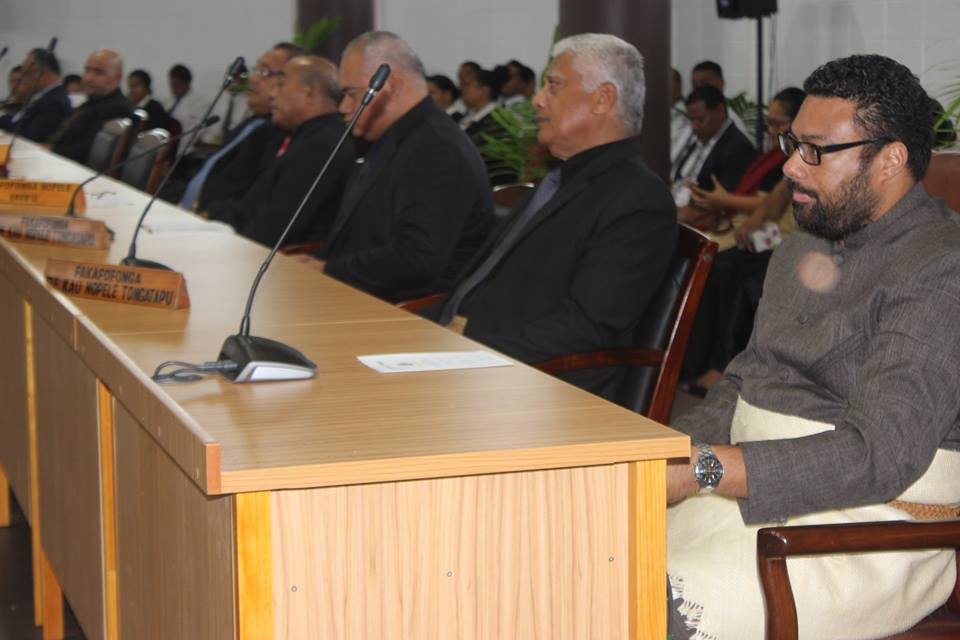
Speaker Lord Fakafanua (R) and Parliament members of the nobility. Photo/Fale Alea ‘O Tonga
Whatever the outcome of the vote, the decision of the referendum will reflect the voice of the people.
And yet their cousins in the kingdom did not have a say when Parliament voted unanimously to pass Clause 89(a) amending the constitution.
The amendment to the constitution means judges will have to take into account custom, tradition and culture in their court rulings is a threat to the kingdom’s democracy.
It could have a major effect on society and appears to be wide open to abuse.
The move has been strongly criticised by the Tonga Law Society. President of the Law Society, Sione Fonua, said it should have been vetted by the public because people could use it to their own advantage.
The director of the Women and Children Crisis Centre, Ofakilevuka Guttenbeil-Likiliki, said she was deeply concerned that rape, sexual assault, domestic violence cases could be hijacked by so-called ‘traditions and practices.’
Unfortunately, all too often Tongan traditions serve elements of injustice, unfairness, prejudice and inequality.
The fahu system in which only the eldest daughter in the family is entitled to be honoured and received presentation of koloa (cultural goods such as fine mats), food and money, is unfair because her other young sisters did not receive such entitlements.
The same traditional restrictions apply to land ownership and family possessions. Only the eldest son is entitled to receive these after the death of their father. The nobles allow their people to live on their land, but most of the land remains registered under the noble’s names, not the people.
This means these people have to live in fear and keep their nobles happy by making sure they donate whenever the nobles want.
Are these the kinds of traditions the new amendment expects the courts to take into account when they are making decisions?
This is not just a question about the law, this is about Parliament with its noble-led government majority ignoring the views of the people, who pay their salaries. It is unacceptable and uncivilised.
The Tongan Law Society is right to argue that the amendment should have been put out to public consultation.
Readers will remember the enormous stink the then opposition kicked up over the Six Amendments the government of the late ‘Akilisi Pohiva wanted to push through to strengthen Tongan democracy, demanding they go to the public for discussion.
The Six Amendments were first submitted to the House by the Tu’ivakanoo’s noble-led government and debates in the House at the time showed the noble MPs supported it. However, most of those Noble MPs fought relentlessly to oppose the amendments when they were reinstated about a year later by the Late Pohiva government.
Now an amendment with the potential to undermine the functioning of justice has been kept from the public.
Consulting with the people would have given them more time to understand the details of the Bills before Parliament made a decision. Without it people could be left puzzled and confused by the new law. The people should have had a voice. They should have been heard.
Sadly, it seems the Noble-led government cares only for the benefit of a minority – the nobles, the royals, their heralds and a few conservative commoners who support them.
Once upon a time the common people were called the kainanga e fonua ( food scraps of the nation).
When we see what potential there is for the law to be abused in the name of customs and traditions, we could be forgiven for thinking that some of the high born in the kingdom still regard commoners as lesser beings, inferiors whose voice should not be heard.
Voice of the people
If the constitution is to be changed or laws are to be passed that have a significant impact on society, then the public should be the ones to have the final say.
This is what happens in New Zealand and Australia.
In Australia the constitution can only be changed if a referendum is held. The change must be approved by a majority of voters across the Commonwealth and a majority of voters in a majority of states.
In New Zealand, counting of the referendum ballot began this week and people are waiting anxiously for the outcome.
Whatever the outcome, it will represent the voice of the people. That is how it should always be in Tonga.
Building a good relationship at home helps young Pasifika women establish a balanced view about what counted as beautiful.
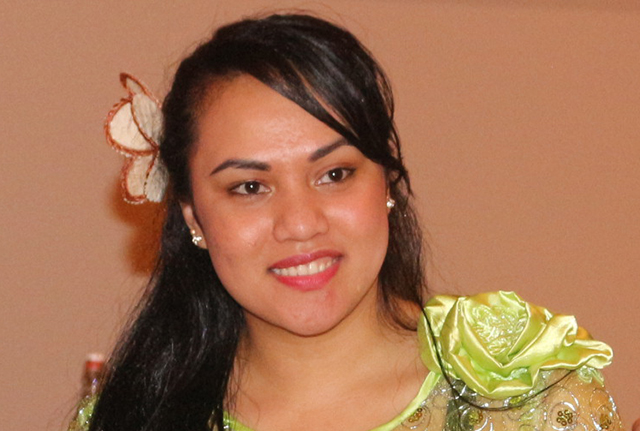
Malia Lēsina Kelela Lātū. Photo/Kaniva Tonga News
That is one of the key findings of an MA thesis, Pasifika women, beauty and race, by Tongan scholar Malia Lēsina Kelela Latu, who will graduate from AUT next March.
Latu’s work focusses on Pasifika women’s perceptions of beauty and how the media reinforces white standards rather than reflecting the multi-cultural nature of society.
“Whiteness and western ideology is still privileged,” Latu said.
“In the same way that society privileges whiteness, mainstream media homogenises this notion of beauty.”
This meant the mainstream media promoted the idea that there was one standard of beauty.
For years, the notion of whiteness served as an ideal for women and many women of colour wanted to meet these standards.
Latu said there was concern that Pasifika women were still mostly left out of arguments about standards of beauty, but they needed to speak up.
“There is still lack of diversity when it comes to beauty products and the appreciation of black beauty,” Latu said.
“For years the focus has always been on western beauty and in order for progress to occur, women of colour need to continue being vocal about these issues.”
Women interviewed told Latu they regarded television as having the highest capacity to produce unrealistic beauty standards. As one of them said:
“When I was growing up on TV the main character is always like… white girl, white girl, white girl! You have quirky white girls, white girls with big glasses, big eyebrows, but that is always like the standard and the only coloured women who gets praised are like… you either have to look like Beyonce or Rihanna.
It starts from a very young age and it keeps building up. You start to realise…what does it mean when people are like, “oh you are pretty for an Islander?” or “you are skinny for an Islander?” Like what is that supposed to mean?”
They thought these standards had been held by society for many years.
Although they thought social media also generated negative images of beauty, they thought women had more power to generate beauty standards or ideals because of its accessibility and participatory features.
Latu said it became evident from her research that fostering of good relationships at home helped to balance the negative standards of beauty that are placed on women.
For most participants, the perceived benefit of compliments from family and friends held significant value in helping them feel confident. As one interviewee said:
“My aunty is very important to me because I have always had natural curly hair and I used to straighten it all the time. She would encourage me to be natural. She would say stuff like, ‘your hair is perfect that is who you are, that is your identity so you should keep it natural’ that is why she is so dear to me because she always made me believe that I am beautiful from hair to the colour of my skin.”
UPDATED: The woman who died in a head-on collision in Tongatapu on Sunday has been identified by a family member to Kaniva News.
Sitela Fungavaka, 76, died after a car she was a passenger in and driven by her husband Sitiveni Fungavaka collided with another car on Hala Tahi road at Talafo’ou.
Sitiveni, who was also known by the name ‘Āmone Afu, was a former police officer and also a former ‘Ikale Tahi captain. He was unharmed, his daughter Vāsiti Fungavaka told Kaniva News.
It is understood the deceased’s children and grandchildren in New Zealand gathered for a prayer vigil for their mother in Auckland this week.
As Kaniva News reported on Monday, police have arrested and charged a 21-year-old man from Vaini with reckless driving causing death.
Police said: “A car heading south driven by the accused with two other passengers were speeding along Hala Tahi at Talafoóu, lost control of the vehicle, swerved and crashed into a car heading north driven by a man from Holonga…”
The two passengers who were with the accused sustained serious injuries and were taken to the hospital.
A 21-year-old Vainī man was arrested in connection with a crash in Hahake that killed a woman and sent her husband and others to hospital.
Photo taken at the scene in Hahake. Photo/Sitiveni Takai (Facebook)
Police said the 76-year-old woman from Holonga died in hospital yesterday Sunday 25.
“A car heading south driven by the accused with two other passengers were speeding along Hala Tahi at Talafoóu,” Police said in a Facebook post.
It said the driver “lost control of the vehicle, swerved and crashed into a car heading north driven by a man from Holonga with one passenger, a 76-year-old woman.”
“Police can confirm that the 76-year-old woman passed away at the Vaiola Hospital last night.
The two other passengers with the accused sustained serious injuries.
This is the sixth road fatality for this year, it said.
The accused is remanded in police custody while police investigations continues.
A new law means that Tongan civil servants could be charged with criticising the government if somebody decides they have used an offensive emoji online.
Civil Servants need to be very careful about using social media
That’s one entirely possible interpretation of a new law which was revealed by Tonga Broadcasting Commission this week.
But while the law sounds absurd, it is no joke, because people could lose their jobs.
It is part of an attempt by the government to limit the right of civil servants to freedom of expression, even, apparently, when they are speaking in a completely private capacity.
This is in complete contrast to New Zealand where civil servants have the same rights to freedom of speech and political activity in their private lives as other New Zealanders.
Attorney General Linda Folaumoetu’i told the TBC civil servants could be punished under the law for defamation in writing or emojis.
The law can be used against civil servants who support a group on social media whose political views go against the government and could cause disorder.
Mrs Folaumoetu’i said civil servants must maintain high standards of behaviour and treat political and civil service colleagues with respect.
“They have to be politically independent.”
All civil servants “must be very cautious” about any information they intended to release on social media to support any political cause, she said in Tongan.
The government will come after its civil servants if they used reaction signals like “thumb up or like” to support any opposing political views (“poupou ki ha ngaahi tui fakapolitikale kehe”,) Folaumoetu’i said during an interview in Tongan with TBC.
No details or any documents about the new law have been released to the media or published on the Attorney General’s Office website.
Public Service Commission CEO Dr Lia Maka said this law controlled all civil servants and those who worked for government on contract basis, she told Television Tonga.
They could not criticise the government through social media and those who have personal accounts on all social media platforms including Facebook, Tumblr, Tweeter, Instagram, Youtube, Whatsapp and Snap Chat had to understand this law.
Punishment could include dismissal.
Dr Maka said the law was discussed with different groups and government CEOs before it was submitted to the Attorney General Office.
“Although everyone has a right to freedom of speech they have to all come under the government’s Code of Ethics,” Dr Maka told the Television.
The civil servants also are not allowed to release any confidential information.
Folaumoetu’i also said the law protects the Royal Family and any attempt to insult them.
Civil servants who used government technology for their social media use as well as using their own technologies while at works could be investigated and punished under this law.
Undemocratic
The Tongan governments actions are in line with attempts by governments in many undemocratic countries to gag civil servants and prevent them from enjoying the rights of ordinary citizens.
Unfortunately, even some supposedly democratic nations have tried to follow this trend.
Earlier this year an Australian civil servant quit his job as a policy officer after being threatened with the sack if he didn’t delete a blog post on how Covid-19 had benefited big tech companies. The department’s actions appear in conflict with civil servants’ right to make “public comment in an unofficial capacity,” which is set out in the Australian Public Servants’ Code of Conduct.
Tonga’s Parliament has passed tough new illicit drug laws providing for severe penalties.
The new law stipulates a maximum fine of TOP$1 million pa’anga or life imprisonment, or both, for anyone who is arrested with one or more kilograms of meth.
Anyone who was captured with 28 grams of meth could receive life imprisonment.
The brief information about the laws was released on Parliament’s Facebook page last week in Tongan language.
The law allows police to shoot the tyres of the vehicle of a suspected drug dealer.
Some police vehicle have to be fitted with bulletproof armour to better protect officers on dangerous jobs, according to new laws, the Hansard said.
The law also empowers police to use an ordinary citizen as a source of information to find illicit drugs.
Under the law, a Police Officer can enter a home if he got approval from a Police Magistrate. Previously, Police can only get such approval from the Chief Justice.
A father who knows that his son is dealing with drugs can also be charged.
In what Lord Chief Justice Whitten described as a tragic case, the Supreme Court has sentenced a man to five and-a-half years prison for causing death by driving.
The victim, local businessman, Tausinga Taumoefolau . Photo/Facebook
The sentence has been added to his existing term and he will serve a total of eight years. It has also been backdated to the date of his arrest.
In September 2019 the accused, Lemoto Manu, was convicted by Judge Cato on a count of grievous bodily harm and sentenced to four and a half years imprisonment.
Manu’s victim, local businessman Tausinga Taumoefolau, was left in a vegetative state which has rendered him dependent on the support and care of his family, likely for the rest of his life.
The court was told Manu had long standing mental problems, but had been found fit to stand trial.
In that trial Judge Cato ordered that, pursuant to Section 67 of the Mental Health Act, Manu was to be detained at the mental health facility at Vaiola Hospital under the care of Dr Puloka.
Manu was released from hospital in December 2019. Dr Puloka told Lord Chief Justice Whitten that at the end of every year, the psychiatric ward was inundated with more patients than it could hold.
To accommodate the overflow the hospital released some of the inpatients whom the medical staff assessed as representing a low risk. Despite the fact that he was serving a sentence for grievous bodily harm, the inpatients released included Manu.
On the afternoon of December 28 Manu returned to the psychiatric ward and collected three patients without their doctor’s permission. They began driving around while drinking Tongan alcohol brew known as “hopi”. By 9pm it was raining heavily. The Defendant was driving their vehicle west on Vuna Rd, speeding and swerving across the road.
The passengers could see a small white car parked ahead on the left side of the road. In it the victim was buying tomatoes from a nearby vegetable stall. As he held money out his car window for the seller, Manu’s vehicle swerved over the footpath and collided with the rear of the victim’s vehicle. The defendant’s vehicle was estimated to have been travelling at between 80 and 100 kph.
The victim’s vehicle was propelled into the concrete fence of the Chinese Embassy. Manu then drove off. The victim was then rushed to the hospital but was declared dead on arrival.
He was arrested the next day and admitted to the offending.
Further psychiatric evaluations were requested, including an assessment of whether a defence of insanity had been considered. Dr Puloka stated that it was unlikely that Manu was legally insane at the time of the offence.
Judge Whitten said the deliberate use of a motor vehicle after long bouts of heavy drinking, contained an element of willfulness that was repugnant and showed disregard for the law and for the safety of others.
The offending occurred while the Defendant was serving a sentence for a very serious grievous bodily harm and left the scene without trying to help the victim.
“Having regard to the nature and seriousness of the offences, I do not consider the extent of the additional time to be served for this offence upon the expiration of the current sentence for grievous bodily to be excessive,” Lord Chief Justice Whitten said.
“The overall result is an appropriate response to the Defendant’s recidivism, his disregard of the law and his demonstrated danger to the community and himself. “
The Supreme Court has imposed sentences on a group of men involved in what the judge called “a senseless and irrational waste of a life.”
Sione Feimoefiafi, right (Family photo)
The men were convicted on a range of charges following the death of Sione Feimoefiafi.
Mr Justice Cato said the accused and the deceased had been watching the final of an American football match in the Tali’eva Bar in Nuku’alofa on February 4, 2019. The match ended before the fight broke out in the late afternoon.
The fight lasted three minutes as it moved from inside the bar to the road.
“The bar had opened about 12pm and no doubt alcohol played a part in the irrational and brutal acts that followed,” the judge said.
“There was very little evidence as to the background for this offending. Feimoefiafi appeared to have annoyed some of the men earlier, but there was no evidence on his part of any conduct that could be said to have justified any assault by the accused whatever, still less the rampage of violence.
“All the accused acknowledged the violence he suffered at their hands was wrong, and I accept that their acknowledgement of this was genuine and his death was something they will have to live with, in addition to the sentences I have imposed.”
Siafa Nai, Kona’i Bloomfield and Vilaketi Bloomfield were convicted of manslaughter.
Tangi Nai and Sione Bloomfield pleaded guilty to common assault
Siafa Nai was sentenced to 12 and-a-half years backdated to take into account earlier periods of custody. The final two years of his sentence were suspended on condition, among other things, that he not commit any offences punishable by imprisonment during the period and undertake courses on alcohol abuse and anger management.
Kona’i Bloomfield was sentenced to 11 years and 6 months for manslaughter Like Nai, the last two years of his sentence was suspended on conditions.
Vilaketi Bloomfield was sentenced to eight years and nine months with the last two year suspended on conditions that he follow rules laid down by the court.
Tangi Nai was sentenced to 70 hours community work. The judge said Nai had pleaded guilty to the assault, was acquitted on other charges and spent a couple of months in custody on remand before being granted bail.
Sione Bloomfield was sentenced to 80 hours community work for common assault.