Home Blog Page 435

Police arrest Tuitupou; record shows he also escaped from prison 20 years ago

The man who escaped court custody in Auckland on Monday morning, after allegedly posing as a prisoner being let out on bail, has been located and arrested by Police.

William Tu’itupou, 48, will face an additional charge of escaping custody and is due to appear in Auckland District Court tomorrow.

Tuitupou had previously been remanded in custody and was taken to court to appear in relation to numerous charges on Monday.

His arrest today comes after Police made a number of enquiries to locate him, including conducting door knocks and reviewing CCTV footage.

He was considered dangerous and the public had been advised not to approach him.

Earlier escape

An old Herald report described the bold escape: “King Cobra gang associate William Tuitupou escaped after taking a bench apart with a spanner and using the planks to scale a perimeter wall.”

He would not be found until two months later, the report said.

Now, 23 years later, police are hunting him yet again and warned the public that he is considered dangerous and should not be approached.

Inspector Grant Tetzlaff confirmed Tuitupou to be a patched member of the King Cobras.

“He has links across Auckland and into other parts of New Zealand.

“We are making a number of inquiries to locate him and these are ongoing.”

As a result of Monday’s escape, Police and the courts are now working to review the circumstances of the incident and identify exactly how this was able to have happened.

Tonga reopens border next week to repatriate stranded nationals from Fiji and NZ, says PM Tu’i’onetoa

The government will bring the first batch of stranded Tongans from Fiji starting next week, the Prime Minister Pōhiva Tu’i’onetoa has confirmed to Kaniva News this afternoon.

He said the flight is expected to return medical doctors with their families as well as Tongan students in Fiji.

They will go through two weeks’ quarantine in Tonga until it’s safe for them to be allowed to help doctors in the kingdom.

He said more repatriation flights will follow through to allow the return of thousands of stranded Tongans and seasonal workers from New Zealand.

Hon Tu’i’onetoa said the repatriation flights from New Zealand will start no later than the first week of August.

He said there was growing concern about Tongan fruit pickers in New Zealand during the Covid-19 crisis.

He said Tonga will continue to close its borders to international passenger flights.

“First there is difference between closed border and repatriation flights and that should be made clear,” the Prime Minister told Kaniva News. 

“Tonga’s borders will still be closed to any international passenger flights from other countries except for the repatriation flights for Tongans who wanted to return home.”

He said Tonga is still Covid-19 free because of the closure of its borders.

“But this is the beginning of returning of Tongans stranded overseas,” he said.

“Some countries like New Zealand have complained about behaviours of some Tongan Seasonal Workers.

“So we have no choice but to bring them back home,” the Prime Minister said.

Tonga suspended all international travel in March before it went into lockdown to curb Covid-19 infections.

Nearly 7,000 Tongans are expected to return to the kingdom during the repatriation operation.

As we reported earlier this morning, the Prime Minister reportedly said “the government is looking at an emergency plan after talks with New Zealand High Commissioner to Tonga yesterday (Wednesday).”

“Every passenger will be screened three days before leaving New Zealand and go through two weeks’ quarantine in Tonga until it’s safe for them to go home,” he told PMN.

This afternoon’s news comes after he told Parliament last week that the plan to open the border for incoming passengers between New Zealand and Tonga this week was deferred.

He also told the House the government has received two equipment required for screening of Covid-19 patients and that’s meant Tonga was in a better position in its fight to combat spread of Covid-19 pandemic.

Tonga “emergency” border reopening decision expected today puts fruit pickers first, reports say

The Tu’i’onetoa government was expected to make a decision shortly whether or not to open its Fua’amotu international airport to incoming passenger flights.

This has been reported in a number of media platforms this week including the Pacific Media Network which runs the Tongan Radio Programme on Radio 531PI.

PMN said Prime Minister Pohiva Tu’i’onetoa told its news services “the government is looking at an emergency plan after talks with New Zealand High Commissioner to Tonga yesterday (Wednesday).”

The PMN said: “Every passenger will be screened three days before leaving New Zealand and go through two weeks’ quarantine in Tonga until it’s safe for them to go home.

He told Parliament last week that the plan to open the border for incoming passengers between New Zealand and Tonga this week was deferred.

He also said the government has received two equipment required for screening of Covid-19 patients and that’s meant Tonga was in a better position in its attempt to make sure Covid-19 could not enter the country.

He told PMN although a lot of Tongans want to return home, doctors and fruit pickers will get priority.

“He believes most doctors are desperately needed because Tonga has a shortage of medical professionals and most fruit pickers are already in isolation here in New Zealand and are considered safe.

“The Prime Minister also urged Tongans who are stranded abroad and wanting to come home, that they should be more understanding because the Kingdom is not fully prepared to deal with the pandemic.

“All flights into Tonga were halted in March stranding at least seven thousand Tongans abroad in New Zealand, Vanuatu, Solomon Islands and a number of other countries.”

The Prime Minister has been contacted for comment.

Two men remanded for sentencing after court finds them guilty on sexual assault charges

Two men have been convicted of a range of sexual assault charges in the Supreme Court.

They appeared before Justice Cato on June 22-26.

The first man was charged over three counts dating to 2017 and two counts relating to events in February 2019.

The first man was found guilty on two charges of indecent assault of a child, rape of an adult and domestic violence.

The judge said he had no reason to doubt the testimony of the complainant on the indecent assault charges.

He said the rape and domestic abuse charges had been established beyond reasonable doubt.

He was acquitted of another charge of indecent assault of a child.

The second man was found guilty on one count of indecent assault of a child dating to 2016.

Judge Cato said he was satisfied beyond reasonable doubt that the allegations were proven.

A third man was charged with rape, but was found not guilty and discharged.

Both men remanded for sentencing


Immigration Tribunal cites preservation of family in allowing man to stay in New Zealand

The New Zealand Immigration and Protection tribunal has ordered that a Tongan man be allowed to remain in the country.

The Tribunal said there were  exceptional circumstances of a humanitarian nature that would make it unduly harsh for him to be deported from New Zealand and that this would not contrary to the public interest.

The 36 years-old man became a New Zealand resident in March 2013.

The man and his family were granted residency in 2013

His liability stems from his conviction on November 27, 2018, for indecent assault on a man.

He served a period of home detention and has been unemployed ever since.

A  number of family members have disowned him because of the shame they felt he had brought on them.

The appellant was deemed liable for deportation because he committed the offence within five years of receiving his residency visa.

The appellant said his family would suffer if he was deported.  If the family all went to Tonga he would spend all his savings on the move and there would be nothing left to start a new life.

The Tribunal was told the wife was in poor health, spoke limited English and did not drive. She relied heavily on her husband for help with the children.

A statement in support of the appeal said the couple’s children, who were New Zealand citizens, would suffer if they had to return to Tonga because they were unlikely to be able to attend an English speaking school and would therefore be disadvantaged when they returned to New Zealand later in life.

The Tribunal ruled that there was a public interest in the preservation of family unity and in the observance of New Zealand’s international obligations in that regard.

There would be a profoundly adverse effect on the appellant’s wife and five young children if they remain in New Zealand after his deportation.

The man’s liability for deportation was therefore suspended for three years on condition that he not be convicted of any jailable offence during this time.

COMMENTARY: Deportations will achieve little except to help big countries hide from their responsibilities

Kaniva comment:

Deportations will achieve little except to help big countries hide from their responsibilities

The policy of deporting criminals who have barely any connection with the kingdom to Tonga is cruel, cowardly and highly dangerous.

The latest person to face deportation from Australia is Sedeli Huakau Taualii, 44, who left Tonga as a 20 month old infant in 1976.

He may have little memory of the islands. He is, to all intents and purposes, an Australian. Whether he has any relatives left in Tonga who would take him in or whether he speaks Tongan or knows anything of Tongan culture is not known.

As Kaniva News reported on Friday, he had a visa, but this was cancelled in 2016 after he was jailed for six years for armed robbery. He has been a member of a number of violent bikie gangs  notorious for their involvement in drugs and crime.

Section 501 of the Australian Migration Act allows the government to deport people who fail character tests.

Nobody can say that Taualii will do anything but lead a respectable, reformed life in Tonga.

However, all the evidence says that criminals deported to Tonga from Australia, New Zealand and the United States have an extremely hard time fitting in and have  contributed to the explosion of drug-related crime.

Between 2014-2019, 400 people with criminal records were deported from New Zealand to the Pacific islands.

Massey University researcher Jose Luis Sousa-Santos told Newsroom it was “irresponsible” of New Zealand to deport young people who had lived in New Zealand most of their life, and expect them to reintegrate.

The same situation has occurred in New Zealand to which many bikies have been deported from Australia.

New Zealand police have reported an increase in violent gang-related crime

New Zealand Police Association president Chris Cahill said many of the bikies sent to New Zealand had spent their lives in Australia and had few ties to the country.

“The only links they’ve got (here) are straight back into gangs. The public are now seeing the problems they’re causing,” he said.

Deputy Prime Minister Winston Peters has called Australia’s deportation policy “a festering sore” and said New Zealand taxpayers should not be expected to pay for keeping criminals in the country.

Tongan taxpayers doubtless feel the same way.

Deporting criminals who have almost no knowledge of the islands to which they are being sent is simply cruel. If they don’t know the culture or the language there is little hope of rehabilitation and so sending them to Tonga is pointless.

All deportations do is to allow Australia – and New Zealand and the United States, for that matter – to polish up their crime statistics while dumping the problem on countries least equipped to deal with it.

Years of intelligence work  by international police forces show that the Central Pacific is now a major gateway for drugs from South America on their way to  New Zealand and Australia. Whether in Toga, Fiji or Samoa, the international drug lords and their local minions pose a threat.

Concentrating large  numbers of criminals who often already have records of being involved in the drug trade would appear to be, in the long term, highly dangerous not just to the islands, but to Australia and New Zealand, which are the target of the South American cartels.

If the deportees grew up to be violent thugs while living in Australia, New Zealand or the United States, it is up to the governments of those countries to realise that their societies failed these young men and it is up to them to rehabilitate them.

To ignore that responsibility and to use islands with which they have  barely any connection as a human rubbish dump is simply cowardly.

The main points

  • The policy of deporting criminals who have barely any connection with the kingdom to Tonga is cruel, cowardly and highly dangerous.
  • The latest person to face deportation from Australia is Sedeli Huakau Taualii, 44, who left Tonga as a 20 month old infant in 1976.

Patched gang member William Tuitupou escapes custody at Auckland District Court

Police are appealing to the public for sightings of William Tuitupou, who is wanted by Police.

The 48-year-old patched gang member escaped custody at the Auckland District Court at about 11.30am today, after having posed as another prisoner who was being bailed from the court.

Tuitupou had previously been remanded in custody and was taken to court to appear in relation to numerous charges this morning.

Police are currently making a number of enquiries to locate him, including conducting door knocks and reviewing CCTV footage.

Tuitupou is described as 180cm tall, of medium to solid build, with short black hair.

He was wearing a white top with black and white stripped sleeves, with pink shorts and green sneakers at the time.

He is a patched gang member and is considered dangerous and should not be approached by the public.

Anyone who sees Tuitupou or has information about his whereabouts is urged to call 111 or Crimestoppers 0800 555 111.

Police and the Courts are urgently reviewing the circumstances surrounding this incident in order to identify how this was able to occur.

Assault on growers’ co-operative by dictatorial British consul gave King Tupou II opportunity to re-assert his authority

This is the third and final articles marking Emancipation Day.

A fight over a growers’ co-operative helped King Tupou II regain his authority and curbed the power of the British Consul in Tonga.

The Tonga Ma’a Tonga Kautaha  was established to help Tongan growers sell their copra without going through European middlemen. Despite its rackety accounting procedures and its seat-of-the-pants administration, it increased growers’ incomes so much that some European traders began to worry they would go out of business.

The co-operative was the brainchild of Alexander Cameron, the kind of dissolute, disreputable young man that English families despatched to the colonies in the hope that even if they didn’t do terribly well, they would no longer disgrace the family.

Cameron failed in Sri Lanka and Australia, tried peddling aluminium ladders in India and eventually washed up in Tonga, where, having failed in one more job, he followed the traditional path of the beachcomber and took to drink and the local women.

Setting up the Tonga Ma’a Tonga Kautaha was a stroke of genius. Tongan growers received the same profit for their exports as Europeans and Cameron was regarded with reverence by many of the co-ops members who believed he was “an angel descended from Heaven to deliver them from the bondage of the White traders.”

The success of the Tonga Ma’a Tonga Kautaha co-op drew the attention of the new British consul, William Telfer Campbell, who enlisted the aid of the British-backed Prime Minister Mateialona to shut down the operation and get rid of Cameron.

Campbell has been described as arrogant, pretentious, humourless, unbending, dictatorial and self-important. He interfered in the most trivial matters, terrified his staff and was convinced that the previous Treaties of Friendship and their amendments – particularly that of 1905 – gave him the authority to order the king and Parliament about as he saw fit. He also seems to have been prone to paranoia, seeing plots against him wherever he looked.

Campbell made it clear he regarded King Tupou II as incompetent and believed Tonga should be annexed and the king deposed. He certainly believed that every decision made by the king or the Tongan Parliament had to be referred to him. He tried to interfere in government appointments and insulted members of the nobility by berating them in public.

Campbell then focussed his attention on the Tonga Ma’a Tonga Kautaha, instigating its closure and the seizure of its books and assets. His actions cost about £8,000 in Tonga taxpayers’ money.

According to historian Penelope Lavaka, on whose PhD thesis is article is largely based, the co-operative association served as a vehicle for Tongan hopes of regaining some independence.  Members hoped that European business skills would provide the key to economic improvement.

By February 1910 the association had 3280 members (1280 in Tongatapu, 1200 in Vava’u and 800 in Ha’apai), comprising about 60% of all taxpayers. Among their members were many of Tonga’s most influential chiefs and nobles.

Campbell had nothing but contempt for the co-op and its attempts to bypass European traders. He seems to have found Cameron’s lifestyle, drinking and marriage to the daughter of a European trader and a Tongan woman as reprehensible.

Campbell seized his chance to move against Cameron when he presided over a libel suit Cameron had brought against a former employee. This was when he impounded the co-ops books and after an audit made by a Sydney accountant who was passing through town, Campbell used the resulting report to declare that the books had been faked. He then used this to induce the Prime Minister to close the Tonga Ma’a Tonga Kautaha.

Cameron was charged in the High Commissioner’s Court with having “unlawfully, wilfully and with intent to defraud” published a false balance sheet and embezzled co-op funds. However, when the case went to court in late 1910, the embezzlement charge was  thrown out and Cameron was cleared of falsifying the balance sheet.

Undaunted, Campbell continued his attack on Cameron and the co-op, which had re-emerged as a flourishing business under the direction of Cameron’s former Auckland agent, Robert Millar. Campbell wanted to have Cameron and Millar removed from Tonga, but when the motion was put to the Acting High Commissioner in Fiji, he was told not to involve the High Commission in any way. Given Cameron’s acquittal, the popularity of the co-op and reservations about Campbell’s behaviour, the High Commission saw the situation as politically dangerous. More importantly, the British authorities in Suva saw the power of their agent in Tonga as more limited than he did.

The Tonga Ma’a Tonga Kautaha struck back with their own law suit. They lost the case, but in fact the verdict opened up legal considerations that changed the whole political situation. The Colonial office thought the outcome could be reversed on appeal and believed Prime Minister Mateialona lied during the trial. A week after the trial the co-op re-formed and legislation enacted in Tonga to reinforce the anti-Kautaha faction was found to be constitutionally invalid.

However, Campbell still believed the Treaties and subsequent amendments overrode the Constitution and tried to persuade the High Commissioner to remove the king and deport his European opponents.

Tupou II now argued that Clause III of the 1900 Treaty stopped the British Consul from interfering in Tonga’s internal affairs and said Campbell’’s view of his own position was “totally erroneous.” He said that if he were forced to do whatever Campbell wanted, Tonga would lose the last shreds of independence.

“I have tried to preserve to my people’s national existence, but there is a limit to my endurance,” His Majesty wrote.

“What does Great Britain want? Does she desire to further extend her dominions by adding to her wide empire the little kingdom of Tonga? No resistance can be offered. We can make no appeal to arms. Our only appeal can be made to the justice which is supposed to characterise Great Britain’s treatment of weaker nations.

“Does Great Britain desire to render the foreign traders richer, or does she truly desire to leave my people happy and contented?”

The King also asked for Campbell to be removed, saying his behaviour was ”most  distasteful.”

“We are not deficient in intelligence,” the king wrote.

“Send us a wise and tactful man, to whom we can safely appeal for advice, and you will find that we are not slow to take advantage of wisdom.”

For the first time since the signing of the 1900 Treaty, the Western Pacific High Commission was forced to adopt a new respect for the Kingdom’s autonomy. The Colonial Office said that the 1905 Agreement did not mean the British Consul could insist that the Tongan authorities had to follow their advice on any matter.

The High Commission blamed Campbell for the financial, administrative, legal and constitutional problems arising from his attack on the Tonga Ma’a Tonga Kautaha. He was sent back to England and pensioned off. His successor treated the king much more politely.

On October 14, 1911, Tupou II informed the High Commissioner that Prime Minister Nateialona had lost his confidence. The Tongan constitution empowered the King to dismiss the Prime Minister. The Colonial office realised Mateialona was being punished for his loyalty to the British Consul, but they had to admit they had no legal right to intervene.

In return for the withdrawal of the charges and the promise of a noble title, Mateialona resigned as Prime Minister.  By 1912 the British-Tongan relationship was re-defined to Tonga’s advantage and the authority of King Tupou II was re-established.

As historian Penelope Lavaka put it, the battle over the Tonga Ma’a Tonga Kautaha had given the king a significant victory. It reinforced  the Tongan Government’s right to determine its own policies without the interference of the British Government.

The King has established his ascendancy over the British and over his own Kingdom.

The main points

  • A fight over a growers’ co-operative helped King Tupou II regain his authority and curbed the power of the British Consul in Tonga.
  • The Tonga Ma’a Tonga Kautaha was established to help Tongan growers sell their copra without going through European middlemen. Despite its rackety accounting procedures and its seat-of-the-pants administration, it increased growers’ incomes so much that some European traders began to worry they would go out of business.

For more information

Penelope Lavaka. The Limits of Advice. Britain and the Kingdom of Tonga 1900-1970. PhD thesis. Australian National University, 1981.

Amanda Lee (2019) Tau: A brief history of the Tongan military from the late nineteenth century to the present. MA thesis. University of Hawai‘i at Mānoa, 2019.

Heather Devere, Simon Mark & Jane Verbitsky. ‘The language of friendship in international treaties.’ Paper presented to the IXth Congress of the French Association of Political Science, Toulouse, 2007.

Paul van der Grip. Manifestations of Mana: Political power and divine inspiration in Polynesia. LIT Verlag Munster 2014.

Peter Hempenstall & Noel Rutherford,  Protest and Dissent in the Colonial Pacific, USP, 1984.

Notorious Aussie bikie gang boss being deported to Tonga

A Tongan bikie boss in Melbourne, Australia is set to be kicked out of the country and deported to Tonga leaving his 11 children behind.

Sedeli Huakau Taualii, 44,  who has been linked to the Hells Angels, Rebels and Bandidos has been banished from Australia after a court rejected his bid to stay.

The Australian government and law enforcement consider the Rebels to be a criminal organisation although the club claims to be a group of motorcycle enthusiasts rather than gangsters. The United States Department of Justice considers the Hells Angels to be an organized crime syndicate

Taualii arrived in Australia from Tonga as a 20-month-old in 1976 but that has not enough to save him from deportation back to the Pacific nation, the country’s media reported.

Taualii was president of the Rebels’ Sunshine chapter in 2006 but left after a dispute with the outlaw motorcycle gang’s national president, his appeal to the Federal Court’s Full Court was told, the Biker-News reported.

He then became president of the Bandido’s Sunshine chapter and later saddled up with the Hells Angels, quitting them in 2014.

But Taualii – in fighting Home Affairs Minister Peter Dutton’s ruling – refuted any claim he had tried to join the Comanchero outfit during a subsequent spell in prison.

Mr Dutton’s office ruled he did not pass a character test after serving six years in prison for armed robbery, cancelling his visa in 2016.

Taualii argued his staying in Australia would be in the interests of his children, that he has lived there since being an infant and had contributed to Australia through his employment.

Tauali’i’s legal team submitted the original ruling failed to find that the minister did not give proper consideration to the prospect he may suffer hardship from his health conditions if sent back to Tonga.

His appeal was dismissed.

Indonesian trolls target Tongan beauty Diamond Langi over Papuan solidarity

By Sri Krishnamurthi, contributing editor of Pacific Media Watch . This article is republished with permission under Kaniva News partnerships with Pacific Media Watch.

Miss Universe NZ 2019 beauty queen Diamond Langi is being trolled by thousands of Indonesians on social media for speaking up about discrimination against West Papuans.

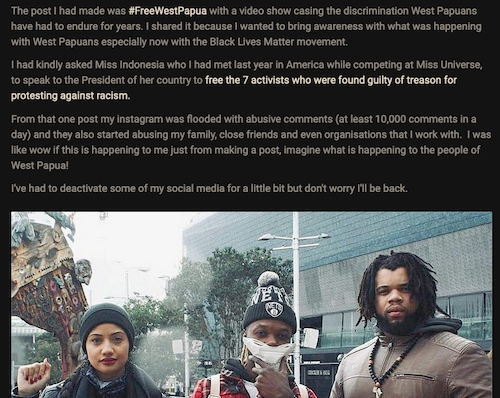
“The post I had made was #FreeWestPapua with a video showcasing the discrimination West Papuans have had to endure for years,” she declared on Coconet TV’s Facebook and Instagram pages two days ago.

READ MORE: 

On her “Women of the Islands – Diamond Langi” webpage on the Coconet TV website, the Auckland-born Tongan beauty queen is quoted as saying:

“I shared it because I wanted to bring awareness with what was happening with West Papuans, especially now with the Black Lives Matter movement.

“I had kindly asked Miss Indonesia (Frederika Alexis Cull), who I had met last year in America while competing at Miss Universe, to speak to the president of her country [Joko Widodo] to free the seven activists who were found guilty of treason for protesting against racism. 

She says that from that one post she has been hounded by Indonesian trolls who still exist on her Facebook page.

While there was support for her stance, some of the abuse from some Indonesians bordered on plain hatred, whereas others claimed the Melanesian region of West Papua belonged to Indonesia [it was annexed by Jakarta in in 1969 in a disputed colonisation process that has resulted in armed struggle and peaceful resistance ever since – Pacific Media Watch].

‘My Instagram was flooded’
“From that one post, my Instagram was flooded with abusive comments (at least 10,000 comments in a day) and they also started abusing my family, close friends, and even organisations that I work with,” she says on her Coconet TV webpage.

Diamond Langi comment
Some of Diamond Langi’s #FreeWestPapua solidarity comments. FB screenshot/PMC

“I was like, wow if this is happening to me just from making a post, imagine what is happening to the people of West Papua!

“I’ve had to deactivate some of my social media for a little bit but don’t worry I’ll be back,” she says.

But she also had support for her stance.

“Very concerning that our beautiful Pacific sister, Diamond Langi’s public Facebook page is under attack by a few propaganda-fuelled keyboard warriors from Indonesia, because she’s chosen to use her emerging platform and political freedom to stand in solidarity with our indigenous whanau in West Papua,” @Oceania Interrupted said on Facebook.

“Black Lives Matter all over the world, even in the Pacific – and bullying someone for standing in solidarity with indigenous people in our Pacific context, who continue to be brutally oppressed, exploited, silenced and killed in their own land is sickening!

“If you haven’t already, please go on her page, show some love for what she is standing in solidarity for; And if you know a thing or two about THE REAL WEST PAPUA [sic] situation, please school the ignorant bullies on her page and in our world,” the cultural activist group says.

Earlier this year, Langi acted in a Polish-American feature film titled, Sosefina. The film is written by Manu Tanielu and Namualii Tofa and directed by Hinano Tanielu.

The theme of Sosefina has been to tell the story of a marginalised and overlooked Polynesian community. The movie was released in the United States on 31 January 2020.