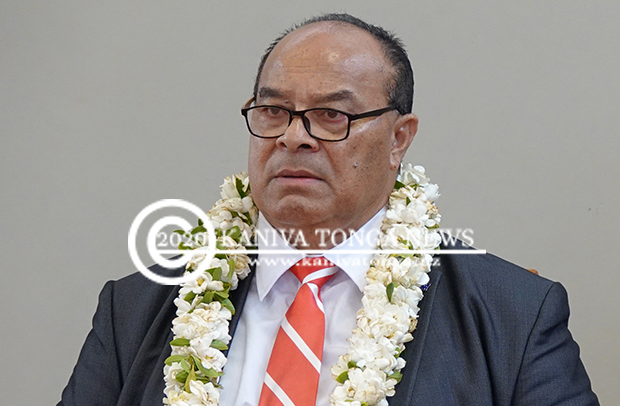
Tonga Power Ltd said today it would be very difficult for TPL staff to turn off the kingdom’s power supply.
The comments came after a group of staff threatened to shut down the country’s electricity in a letter listing five grievances against alleged decisions of the TPL Board of Directors.
TPL has sent four staff behind the petition home and issued a statement saying the country’s power supply was safe.
Chairman of the Board of Tonga Power Dr. ‘Aisake Eke said the petition was sent to the Prime Minister.
The petition has not been publicly released.
The Board of Directors said it did not have any issue with the petition, but was concerned by a threat to turn off the power and to call a strike on October 2.
The strike did not go ahead.
The Board said it would address the staff grievance.
Some of the staff directly involved had been asked to take time off from work whilst investigations were conducted.
Acting CEO Nikolasi Fonua said he could not comment on the details of the petition until their investigation was completed.
The main points
Tonga Powers Ltd said today it would be very difficult for TPL staff to turn off the kingdom’s power supply.
The comments came after a group of staff threatened to shut down the country’s electricity in a letter complaining about the TPL’s board of directors.
Parker’s promoters David Higgins and Eddie Hearn said getting the fight over the line is “huge” for New Zealand.
“With both boxers inside the WBO top 10 world rankings and in their prime, this is undeniably New Zealand’s fight of the century,” Higgins said.
“This is going to be a war,” Hearn added.
“There’s plenty of needle with the amateur rivalry and there’s national pride at stake. A win over Fa will catapult Joe back into world title contention.”
The fight will also be broadcast by Spark Sport for New Zealand audiences, ending a long run of Parker bouts being televised by SKY Sport Arena.
Adding to the occasion is the fact a full crowd will be able to attend the event, given New Zealand and specifically Auckland remains at Alert Level 1 during the Covid-19 pandemic.
As amateurs, Fa and Parker split two wins each when they faced off in the ring with Fa taking the first and last of the four encounters.
Source: 1 NEWS
Since both have turned professional though, their paths have been remarkably different with Parker going on to claim and then eventually lose the WBO world heavyweight title while Fa has gone undefeated but also dealt with health issues.
Parker was last in the ring in February when he claimed a TKO victory over American Shawndell Winters in the fifth round; a win that moved him to 27-2 in his professional career.
Fa – the WBO oriental interim heavyweight title holder for the last two years – hasn’t fought since last November when he took down Devin Vargas with a unanimous decision after 10 rounds, taking his record to 19-0.
Parker is currently ranked third in the WBO’s heavyweight rankings while Fa sits three places back in sixth.
ANZ has made a decision to close its Vava’u Branch on 25 November 2020 after careful consideration, said ANZ Tonga branch boss, David Dudley.
“We will continue to operate our main branch at Nuku’alofa,” he told Kaniva News in a statement.
ANZ customers can go to ANZ Nuku’alofa branch for over the counter transactions.
Customers can also use its ANZ Pacific App, Internet Banking, the ANZ Call Centre, and its bank mail secure messaging service, which means they have banking solutions available to them 24 hours a day.
“ANZ has observed an incredible change in their business with customers managing their day-to-day banking via internet banking and the ANZ Pacific mobile app. Equally, businesses are accepting more electronic payments from their customers.
“Here in Tonga, we’ve seen a significant increase in our Tongan retail customers using our Internet Banking and the ANZ Pacific App to do their banking in the last year alone.
“Ultimately, this change of behaviour has led to a decline in the number of customers coming into our Vava’u branch, which led us to review its future. In fact, over the counter transactions at our Vava’u branch have reduced by 26% in the 15 months ended May 2020.”
This trend is being experienced by banks throughout the world, and is not forecast to change as online banking becomes easier and more accessible.
“Like a lot of businesses, we’re using technology now to help our customers interact with us when, where and how they want to. Having a shop front isn’t indicative of accessibility but good customer service is.
“We’ll still be supporting the community by helping locals with their banking needs, to grow their businesses and build their futures.
“All ANZ Vava’u staff have been offered a position and relocation to our main ANZ branch in Nuku’alofa. We will continue to work through options with our staff over the coming weeks.
“Over the coming weeks, ANZ staff will be available to talk to our Vava’u customers and help them get started on our digital channels.
“ANZ has also waived the fees for all our Vava’u customers on our new Visa Debit cards, so ANZ Vava’u customers can use any bank ATM or POS terminal as well as order and pay for goods online.
“Our customers can call us on 20500 or go into the Vava’u branch between 9.00am and 4.00pm weekdays before the 25th November, 2020 to get set up.”
Tongan breadfruit growers got a boost this week with a glowing report from Canada on the benefits of breadfruit.
The report could be good news as the kingdom’s breadfruit growers look for new markets to help restore Tonga’s economy when the pandemic ends.
Canadian researcher Professor Susan Murch has praised breadfruit for its nutritional qualities and potential for providing a wide range of benefits to consumers.
Professor Murch, from the University of British Columbia, is interested in finding alternative crops that can provide sustainable food sources.
A team from the university, which has completed an extensive study of 94 different types of breadfruit, has found it contains high levels of protein and amino acids, vitamin A and B vitamins, as well as iron.
It also found that some varieties have 60 per cent starch which is digested more slowly than wheat starch, providing health benefits for people with diabetes.
Professor Murch said the fruit was often described as the ‘Potato of the Pacific’ because of the many ways it can be cooked.
It could be ground to make gluten free flour and can also be a source of insect repellent, latex and fibres for making clothes.
The Canadian report could help Tonga find new markets which can be fully exploited once opportunities for trade returns to normal.
Problems
The Tongan breadfruit industry is small and has suffered over the years from a range of problems.
It has been estimated that up to 70% of the kingdom’s breadfruit crop was going to waste.
This could be attributed to lack of export markets, but also because, as we reported yesterday, some people see it only as food of last resort.
In 2015 New Zealand suspended breadfruit imports from the kingdom after fruit fly eggs were found.
Other countries have also imposed import restrictions.
This year it was badly affected by Cyclone Harold in April and then from the closure of borders due to the Covid-19 pandemic.
Develop
Despite these issues, Tonga’s breadfruit growers have actively worked to develop the industry. In 2016 Tonga hosted members of a regional farmers network for the first Pacific Breadfruit Roundtable.
The following year Japan committed $3 million to a five year project to help develop its breadfruit industry, working in partnership with the Tongan government and Nishi Trading.
Another boost came last year when the Australian Department of Agriculture released a report on biosecurity requirements for importing fresh breadfruit from Tonga, Samoa and Fiji.
This final report recommends that fresh breadfruit could be imported to Australia as long as it met biosecurity requirements.
Fruit flies and mealybugs have been identified as the main problems.
These measures are high temperature forced air treatment, or gamma irradiation treatment for fruit flies and visual inspection and treatment of crops before export.
In 2019 vegetables made up 34% of Tonga’s exports, worth US$5.4 million.
When the pandemic recedes Tonga’s exports will need to be rebuilt.
This week’s report shows just how much contribution the breadfruit industry could make.
A small plane reportedly broke down on the runway at Vava’u International Airport on Friday, sources said.
It was believed the aircraft was in difficulty before it managed to land.
The aircraft in question was first mistaken by eye witnesses for a Lulutai airlines’ aircraft and it triggered debates on social media. But it was later on made clear it was a private plane owned by a foreigner.
The details of the incident were still unknown.
Photos purporting to show the incident have been circulated on social media.
The photos appear to show a fire engine parked by the aircraft on the runway.
No reports of injuries.
Tongan authorities could not be reached for comment.
One of the most important tenets of successful government is openness and transparency, but right now the public could be excused for thinking that the situation regarding the kingdom’s new airline is less than transparent.
Last month Kaniva News and other Tongan media reported that Maikolo Fa’asolo was no longer CEO of Lulutai airline. In response the government declared that this was not the case, only to fall completely silent when we published evidence that clearly showed this was not true.
The public needs to know what happened to Maikolo Fa’asolo who seems, on every indication, to have been eminently qualified for the job.
However, there are other serious questions that also need to be answered.
The public should also be told why the Tongan government appears to be attempting to set up its own aviation engineering works, thereby duplicating facilities owned by Real Tonga.
Questions should also be asked about why the government seems keen to restore its MA60 to airworthiness, despite concerns surrounding the type’s safety record.
The government should also be asking itself what will happen, when border restrictions are lifted and the tourist industry revives, if the New Zealand government is not happy with the certification process for Lulutai.
It has been normal in the past for the government to debunk allegations against the government or the Prime Minister, but not in this case.
Prime Minister Pohiva Tu’i’onetoa said his government would respond to the serious concerns about Lulutai published by Kaniva and other media. Since then, the only solid response has been a press release from the Ministry of Civil Aviation.
That press release went some way to throwing light on the situation by making it clear that PASO had no official involvement in the certification process of Lulutai. The work was done by a person connected to PASO working as a private consultant.
“In statements made by the Hon. Prime Minister of Tonga, and by the Hon. Minister for Infrastructure on the 23rd of September 2020, it was stated that PASO’s advice was sought, and that they were involved in the certification process. It is believed that this was a reference to Mr. David Tohi being a PASO consultant,” the press release said.
“It is hereby confirmed that PASO was not engaged by Tonga’s Civil Aviation Director, in any capacity whatsoever, for the certification process of Lulutai Airlines.”
The government needs to be aware that the situation has provoked public discussion that has encompassed comparisons with the failed multi-million pa’anga Royal Tonga Airlines project, the sinking of the MV Ashika, Tongasat and the scandal over Chinese loans.
Kaniva news is not suggesting for a moment that this is anything more than wild speculation, but the government needs to realise that with the internet, one person’s speculation can very rapidly become somebody else’s reality.
The government also needs to keep in mind that one day these people will be voters.
None of this is helped by the long history of dubious dealings that has tarnished the reputation of Tongan leaders.
Lies and suspicions of lies go back at least as far as the Nuku’alofa riots and the enquiry into what happens to the Chinese loan.
Even the late Prime Minister ‘Akilisi Pōhiva disappointed people.
Given the tumultuous history of Tonga’s airline services, the government must realise that the controversy surrounding Lulutai is precisely the kind of situation that can seriously undermine public confidence.
Not only general members of the public, but experts familiar with the airline industry have expressed doubts about the level of due diligence involved after the government admitted PASO was not involved.
The government cannot keep trying to brush this issue off or hoping it will go away. Voters want to think they can trust their government to be completely honest. Travellers want to feel reassured that everything is above board with the country’s only airline.
It is time for the government to be absolutely open about every aspect of Lulutai’s situation, for the good of the public and the good of its own reputation.
A Tonga man is expected to be deported to the kingdom after serving six months’ home detention at an Auckland address for wounding with intent to injure and indecent assault.
His sentence conditions included a prohibition on consuming alcohol or enter licensed premises without prior written approval.
‘Atunaisa Kilikiti Vakalahi, 21, was sentenced in the Nelson District Court on Friday on four assault charges, Stuff reported.
He was in New Zealand working as part of the Recognised Seasonal Employer (RSE) scheme.
The court heard Vakalahi assaulted three people after a night drinking in Nelson.
Judge Jo Rielly told Vakalahi reports provided to the court showed his behaviour was “very out of character”. He had no previous convictions.
“It is also very clear that the level of intoxication that you were influenced by at that time was the key factor that caused you to offend as you did.”
On June 20, Vakalahi was on Bridge St Nelson after a night out drinking. The assaults occurred around 4.20am when a group of three people unknown to Vakalahi were waiting for a taxi, according to the Stuff.
“He forcefully groped the genital area of a 19-year-old woman and punched a 19-year-old man and 27-year-old woman in the head when they stepped in to intervene. One victim required eight stitches for a gash to her head.
“Judge Rielly said the repercussions of Vakalahi’s actions were significant. He had lost his orchard job and was served a deportation order.
“Vakalahi had expressed “very genuine and real sorrow and sadness” for his actions from the outset.”
The ANZ bank in Tonga is expected to close its branch in Vava’u in two months’ time, reports said.
Neiafu Town Officer Vāvā Lapota claimed the closure process began yesterday Friday 2.
The bank could not be reached for comment.
Meanwhile, the Australia and New Zealand Banking Group Ltd has temporarily removed the transfer fee for money transfers via ANZ internet banking from Australia and New Zealand to Tonga and several other Pacific Island nations.
Pacific Cooperation Foundation (PCF) Board Chair John Fiso said all banks should do the same thing.
“Given the situation with COVID-19, the announcement made by ANZ is a sigh of relief for Pacific families here in New Zealand who often send money to their relatives back in the Pacific region,” Mr. Fiso said.
Mr. Fiso said PCF was talking with New Zealand Ombudsman Nicola Sladden and Chair of the Transparency International New Zealand Board, Suzanne Snively.
ANZ’s Regional Executive for the Pacific, Tessa Price said removing the fee would help boost the Pacific economies by encouraging people to go online and send money quickly and cheaply to their family and friends.
“Money sent home by family and friends is a stable source of income for many Pacific families. In some cases, it can be up to 25 per cent of a household’s disposable income,” Ms. Price said.
“So, it’s really important that we keep costs as low as possible, especially given the economic conditions in the Pacific which are tough due to COVID-19 and the impact it has had on tourism.”
ANZ Pacific Economist, Kishiti Sen said no matter the circumstances, Pacific families would continue to send money home.
As government financial support was reduced there would probably be a reduction in remittances during the next four months.
This story has been updated with additional information from ANZ Bank.
A Tongatapu police officer has been charged with rape and indecent assault of a teenage girl while she was in police custody.
The 29-year-old officer has been suspended from duty.
He appeared in a Magistrate Court today Friday 2 and was remanded in custody.
In a statement released this afternoon, Police Commissioner Steve Caldwell said the alleged offences occurred on Sunday while the 18- year-old young woman was in police custody.
“It was reported to Police on Tuesday 29 September and after a criminal investigation an arrest was made on Thursday 1 October 2020,” Caldwell said.
“The matter is also a subject of a separate Professional Standards investigation.
“Commissioner Caldwell suspended the police constable prior to his arrest.
“This matter is now before the Court and we wish to protect the privacy of this young woman and her family. Full victim support services to the young woman and her family have been put in place.”
The Supreme Court has sentenced a former school teacher to two years in prison for cultivating cannabis.
The sentence has been fully suspended for three years.
Tinitale Finau was found guilty by a jury of growing 54 cannabis plants, at ‘Ohonua, ‘Eua.
Judge Niu said two police officers, Hungalu and Fa’asolo were led by a little girl into the bush area near the ‘Eua High School at ‘Ohonua and showed them where she had pulled out three cannabis plants which her father had brought to the police station.
The area shown to them contained several other well weeded and maintain cannabis plants.
“The little girl left and the two officers hid nearby and waited to see if anyone would come to tend the plants, but no one did and so they left at about 9 pm,” Judge Niu said.
“The next morning Officer Hungalu and Officer Tu’ivai went back about 6 am and hid and waited. About 9am you arrived. They then came out and arrested you and charged you with possession of the plants.
“Then together with you they searched in the bush and found two other plots of cannabis, and you told them of a fourth plot. Later on you told them of another three plots, making a total of 54 cannabis plants.”
Finau was head of the maths department at ‘Eua High School until he was charged.
“I agree with the Crown counsel that the appropriate sentence for your offence is two years imprisonment,” the judge said.
“I agree with the probation officer that your sentence be suspended.”
Juidge Niu said Finau had led a productive and useful life and continued to contribute to the community.
“You have rehabilitated yourself and have got on with your kava farming to maintain yourself and your family. This offence is out of character for you and I believe you will resume your law-abiding life in the years to come.”
The judge sentenced Finau to two years’ prison fully suspended for three years, on condition that he not commit another offence punishable with imprisonment during the period of suspension and serve 80 hours of community service.