Nuku’alofa, Tonga – Tonga remains under gale warnings as severe southeasterly winds persist across the island nation, coinciding with the final days of the Free Wesleyan Church’s annual conference in Ha’apai.
A church member roasted two whole cows and placed them in front of the marquee, allowing anyone to take some meat. Photo/Supplied
The Tonga Meteorological Services has issued ongoing alerts for damaging winds and hazardous seas, urging residents to take precautions.
Residents across Tonga can expect cloudy skies with scattered showers over the coming days. In the capital Nuku’alofa, temperatures will range between a mild 20°C at night and a warmer 27°C during the day.
The Tonga Meteorological Services advises the public to prepare for possible rainfall disruptions while noting that the temperatures remain within seasonal norms.
At sea, conditions remain extremely dangerous. The Met Service has issued stern warnings to fishermen and sailors, urging them to avoid all unnecessary voyages.
Life-threatening marine conditions persist, with gale-force winds creating massive swells and hazardous waves. Authorities emphasize that these conditions pose significant risks to all vessels, particularly smaller boats.
The combination of unsettled weather on land and treacherous sea conditions continues to impact daily life across Tonga’s island groups. Residents are advised to monitor official weather bulletins for updates as the situation develops.
Leadership Transition Confirmed
Despite gale warnings, Ha’apai church members prepared a lavish conference feast—tables piled with roasted pigs, yams, and other traditional dishes—defying the harsh weather.
Photos shared on social media captured attendees dancing in halls and marquees, celebrating this triennial gathering.
The event marks a special religious pledge, with families dedicating months to preparing exceptional meals as an act of devotion.
Two whole roasted cows were displayed outside the marquee, with church members inviting everyone to share in the feast.
Hundreds of worshippers, including Their Majesties, attended the conference, demonstrating the church’s resilience and central role in Tongan society.
The largest religious denomination concluded its annual conference with key leadership decisions.
Delegates re-elected Dr Tevita Havea as church president, ensuring continuity in the church’s leadership.
Meanwhile, Feleti Atiola, the current secretary, retains his position.
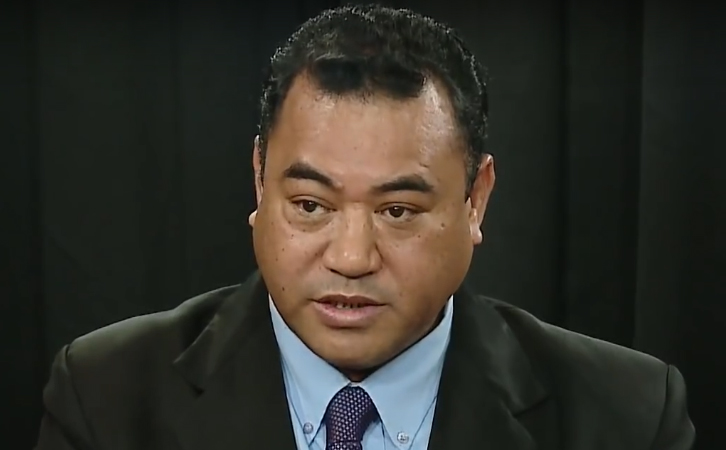
Tonga’s Minister of Customs, Mateni Tapueluelu, has acknowledged the growing frustration among Tongans in New Zealand, Australia and the US over undelivered shipments and auctioned cargoes—but says his hands are tied due to jurisdictional limits.
Former Minister of Revenue Māteni Tapueluelu. Photo/Tnews, Youtube
The Minister’s remarks came after photos and videos surfaced online last week showing shipments belonging to Tongan diaspora families, auctioned at Queen Sālote Wharf over unpaid fees.
Many shipment owners claimed that NZ, the US, and Australia freight forwarders misled them. They had paid thousands for freight and clearance, only to discover the fees were never fully settled when their shipments arrived in Nuku’alofa.
These complaints mirror issues Kaniva News has frequently reported throughout its 20-year history. In some past cases, our investigations and exposés forced identified agents and companies to reimburse affected customers.
Minister Tapueluelu clarified that Customs does not hold the disputed cargoes; rather, shipping companies retain them due to unpaid freight charges.
“We wish to make clear at the outset that the cargoes in question are not held by Customs,” the Minister said.
Unpaid Freight Consequences
He said the cargo is held by shipping companies because, in many cases, “the freight forwarder business in New Zealand, the US or Australia has not paid the shipping company the freight for the export of the cargo to Tonga.”
He said that “in many cases, the freight forwarders would only pay for costs in the foreign country to book the space on the vessel, as well as handling fees to load and export the containers.’
When the cargo arrives in Tonga and the owners approach the Tongan agents to get the release documents from the shipping company, the cargo owners discover from the shipping agents that the freight has not been paid in full or at all, according to the Minister.
When the importer cannot pay the freight, the shipping companies or agents will not release the cargo.
Mr Tapueluelu said the shipping companies or agents “are able to do this because they have a lien over the goods under their shipping contract”.
“Until the freight is paid, the cargo will remain in storage at the international wharf and this would mean that storage fees also accumulate for the goods.
Avoid Storage Fees
“The longer it takes to settle the freight, the more the storage accumulates. Freight charges and storage fees are not Customs fees and are required to be settled before the Customs processing begins.”
When shipments arrive in Tonga Tapueluelu said “it is the responsibility of local shipping companies/agents and licensed warehouse operators” to inform their customers, the owner or notifying party listed on the shipping documents for the goods.
He said Customs deals directly with Tongan warehouse operators licensed under Customs law to store such goods.
The Ministry requires these operators to ensure timely clearance of goods by contacting their customers to arrange for clearance. Additionally, they must maintain proper records of all goods stored in their warehouses, the Minister said.
Under Customs law, the timeframe for clearance of imported goods is six weeks. If they are not cleared within six weeks, they are overdue for clearance, and Customs may dispose of the goods by auction.
“Despite this timeframe, Customs gives every opportunity to importers to clear their goods by following up with warehouse operators to conduct stock takes and reminding them to contact importers”, the Minister told Kaniva News.
‘We do not hold auctions every 6 weeks. Instead, we defer the timing of the actual auctions to give importers and warehouse operators more opportunity to clear the cargo and have it released to the owner.
“On average, we would arrange auctions twice a year if the goods are long overdue for clearance and, (1) the goods are beginning to deteriorate; OR (2) there is lack of storage space in the warehouses that keep them and the old cargo need to be cleared to make space for new cargo; OR (3) the goods have been abandoned by their owners.”
The news finds many in the Tongan diaspora feel helpless, caught between overseas forwarders and local shipping agents.
Some affected customers told Kaniva News this appeared to be a long-standing scam used by certain agents to defraud vulnerable customers, taking advantage of cultural reluctance to pursue legal action or demand refunds.
Editor’s Note: For years, Tongan diaspora communities have endured this unresolved problem. While New Zealand has laws—such as Commerce Commission oversight of shipping companies—authorities seem oblivious to how these exploitative practices devastate our people financially.
Some affected customers contacted us following last week’s auction. We have chosen to withhold their identities—as well as the names of the shipping agents involved—while we conduct further investigations.
Additionally, we are escalating this matter with New Zealand authorities to determine whether a permanent resolution can be achieved.
Over a year after Lulutai Airlines’ SAAB 340B (A3-PUA) veered off a Tongan airport taxiway and hit “a disused refuelling bund,” investigators have published their final report.
A Lulutai Airline Saab 340 aircraft that slid off the runway at Tonga’s Fua’amotu airport on Friday, 8 December 2023. Photo/Supplied
All three crew members and 35 passengers evacuated the aircraft without injury, but the aircraft sustained significant structural damage.
The investigation was conducted by the Tongan Civil Aviation Office, with the Office serving as the chief investigator.
The investigator found that the flight crew misdiagnosed a tripped circuit breaker as a hydraulic fluid leak, leading to improper handling of the emergency.
The circuit breaker had cut power to critical hydraulic indicators, but the first officer failed to identify it during initial troubleshooting—likely due to “expectancy error.” Believing they had a hydraulic leak, the crew shut off the hydraulic pump, which had been functioning normally, leaving the system without pressure, the 50-page report says.
Despite following parts of the hydraulic loss checklist, the crew did not complete all steps and had only a basic understanding of the system’s limitations.
After a safe landing, the captain decided to taxi toward the terminal, believing residual brake pressure was sufficient.
However, hydraulic pressure depleted near the terminal, causing a loss of braking and directional control, “resulting in the aircraft veering off the apron and the collision.”
Maintenance Failures and Unrecorded Defects
The investigation uncovered additional safety lapses including that the aircraft’s flight data recorder (FDR) was not recording critical information due to a malfunctioning data acquisition unit.
The issue had been incorrectly attributed to a high-frequency radio problem, leading to a misdiagnosis.
The unit’s circuit breaker had been manually locked out eight days before the incident, yet the defect was neither properly documented nor repaired in accordance with maintenance protocols.
The report says: “This was due to a flight data acquisition unit having an internal fault which resulted in its circuit breaker tripping. The fault identified by the tripped circuit breaker, went unrectified as it was misdiagnosed as an issue with the aircraft’s high frequency radio system, and had been isolated with a locking collar to prevent resetting likely 8 days before the accident.”
Missing Underwater Locator Beacon Further scrutiny revealed that the cockpit voice recorder’s underwater locator beacon (ULB)—a crucial device for locating wreckage in water—had been removed at least five months prior to the accident.
Despite its absence, no entry was made in the aircraft’s technical logbook to record the deficiency or prompt corrective action.
Systemic Logging Lapses While routine maintenance tasks appeared to be consistently recorded, these two critical defects—the inoperative FDR and missing ULB—were overlooked entirely.
The omissions raise concerns about oversight in the airline’s maintenance documentation processes, particularly for safety-critical systems.
While the airline’s CEO was seated in the cockpit jump seat, investigators found no evidence of interference in the crew’s decision-making.
Safety Recommendations
The report highlighted several key areas requiring improvement, including enhanced crew training on hydraulic system failures and stricter adherence to checklist procedures.
It also emphasised the need for more rigorous oversight of maintenance logging and timely defect rectification.
Additionally, the report stressed the importance of ensuring that critical recording systems, such as the Flight Data Recorder (FDR) and Cockpit Voice Recorder (CVR), are fully operational before flight to support effective incident investigations and safety measures.
Lulutai Airlines has since reviewed its procedures to prevent similar incidents. The accident underscores the importance of accurate troubleshooting, thorough checklists, and proper maintenance documentation in aviation safety.
Tongan students hoping to study in the United States face stricter visa requirements after the Trump Administration announced that all applicants must now allow U.S. officials to review their social media accounts.
The new rule, announced Wednesday by the U.S. State Department, comes as Tongans reel from recent reports that the U.S. may impose a travel ban on Tongan citizens unless the Tongan government meets undisclosed demands.
Tonga was among 36 countries the Trump Administration wanted to convince with a proposal that they were taking genuine steps to improve their passport vetting process, prevent ‘widespread government fraud,’ accept deportees from other countries, and reduce overstays in the U.S.
While there are no specific statistics on how many Tongan students travel to the U.S. to study each year, a significant number of Tongan members of The Church of Jesus Christ of Latter-day Saints (LDS Church) attend Brigham Young University (BYU) in Hawai’i annually.
The LDS Church is the second-largest denomination in Tonga and was responsible for the first large-scale migration of Tongans to the United States in the early 1950s.
US Tightens Social Media Vetting
World media reported that the order applies to all “international student visas”, with no exceptions mentioned.
New applicants will now have to make their social media accounts public for enhanced vetting, the BBC reported.
It said the student visa appointments halted in late May as it worked to step up measures to restrict applicants deemed hostile to the US.
“As part of last week’s announcement, they said scheduling would now resume, and they would now be asking all applicants to make their social media accounts public for enhanced screening”, the BBC reported.
A spokesperson for the US State Department told the BBC that those who keep their social media accounts private may be deemed to be trying to hide their activity.
They said officials had been instructed to expand the social media vetting of applicants and search for “any indications of hostility toward the citizens, culture, government, institutions or founding principles of the United States”.
“It is an expectation from American citizens that their government will make every effort to make our country safer, and that is exactly what the Trump administration is doing every single day,” a senior State Department official said.
Who will be affected?
The new guidelines will affect all applicants who apply for F visas, which students primarily use.
Applicants for the M visas, used for vocational students and those applying for J visas, used by exchange students, will also be affected, a State Department spokesperson told the BBC.
Tonga’s Ministry of Health has confirmed that critical patient records remain inaccessible two weeks after a devastating cyberattack crippled the National Health Database.
Despite efforts by local and Australian cybersecurity teams, officials admit that retrieving data from 2020 onward, when the new system was installed, has proven extremely difficult.
Health Minister Dr ‘Ana ’Akau’ola reportedly revealed that while administrative records are secure, hackers continue to hold patient information hostage.
The Ministry of Health has now urged patients to bring their medical ID when visiting the hospital.
This could help identify them and assist doctors who may still remember their conditions for treatment, even though hackers have stolen their actual records.
Global Assistance Mobilised
Additional cybersecurity specialists are expected to arrive in Tonga soon to reinforce the team of Australian experts already on the ground.
The joint task force, collaborating with Vaiola Hospital’s ICT team and CERT Tonga (Computer Emergency Response Team), is racing against time to restore access without capitulating to the hackers’ ransom demands.
Though the ransom remains undisclosed, sources suggest it could be in the millions of dollars.
The Tongan government has not confirmed whether it will negotiate with the attackers.
Impact on Healthcare Services
The prolonged outage has forced healthcare providers to rely on manual record-keeping, causing delays and disruptions.
Patients with critical conditions are prioritised, but officials warn that full system recovery could take weeks or longer if the data cannot be decrypted.
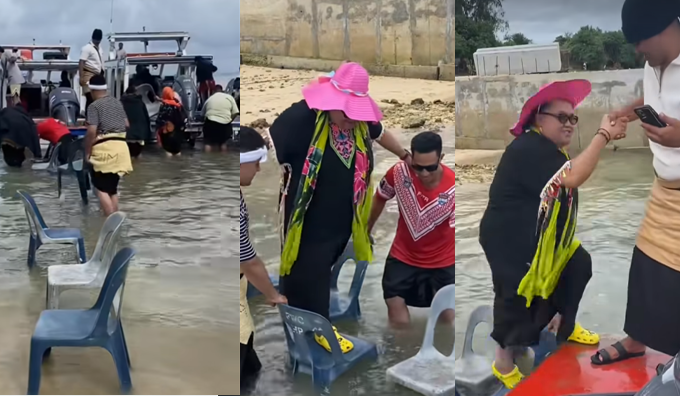
Residents of Hā’ano in Tonga’s Ha’apai islands crafted a temporary “chair-wharf” to help passengers board boats from the sea.
When the ocean doesn’t give you a dock, you build one—out of chairs! 🪑💡 Ha’ano’s brilliant temporary fix for boat boarding. #TonganIngenuity
This event coincides with significant gatherings in Tonga, where Methodist churches are holding their annual conferences in Vava’u and Ha’apai.
Their Majesties, King Tupou VI and Queen Nanasipau’u Tuku’aho, are currently attending the Free Wesleyan Church’s 101st annual conference in Pangai, Ha’apai.
The church’s event also celebrated the 50th anniversary of a cross that appeared on the ground outside the Pulela’ā Free Wesleyan Church in Pangai in 1975.
A common saying in Ha’apai is “Ha’apai maheni faingata’a”—meaning “Ha’apai is accustomed to hardships”, reflecting their resilience despite scarce resources like wharves and safe boats. For years, they have endured and mastered the challenges of island life.
The makeshift “chair-wharf” was set up when church officials and youth attendees arrived in Ha’ano for the 2025 Free Wesleyan Church Youth Conference.
A video posted to Facebook yesterday shows people arranging chairs in a line from the sandy shore through shallow seawater, creating a stable pathway for travellers to walk and embark onto waiting boats.
The makeshift method highlights the resourcefulness of island communities in areas lacking formal port infrastructure.
The caption, “Chair-wharf in action,” has since sparked reactions online, with many viewers amused and impressed by the improvised system.
Overseas Ha’apaians sharing and commenting on the video expressed nostalgia, reflecting on their lives in the islands before emigrating.
“Stand up Hā’ano and take the lead”, a commenter wrote in Tongan.
“Love you Hā’ano”, another wrote.
However, some commenters inquired about a wharf that was planned.
Nuku’alofa, Tonga—The Eke government has announced it will not purchase the ATR 72 aircraft, marking a clear shift away from direct state involvement in the financially troubled Lulutai Airlines.
It follows the government’s announcement that the national airline’s three small aircraft fleet is fully functional and breaking even as part of their promised review since taking power from the former Hu’akavameiliku government in December.
The revelation comes as the deadline to bid for Lulutai Airlines shares is just one week away, with submissions closing next Monday
The government has issued an open call for Expressions of Interest (EOI) from potential buyers, emphasising financial stability, aviation expertise, and alignment with Tonga’s national interests.
Prospective buyers must meet stringent requirements to qualify for the acquisition of Lulutai Airlines. These include demonstrating financial strength by submitting audited financial statements as proof of stability, as well as having relevant industry experience in aviation operations, aircraft maintenance, or tourism and logistics.
Additionally, investors must show a commitment to safety and operational efficiency, with a proven track record of improving airline performance. Finally, bids will be evaluated based on strategic value, ensuring alignment with Tonga’s long-term economic and transportation objectives.
The government has emphasised that only serious investors with the capacity to sustain and grow the airline will be considered.
Fleet Expansion Abandoned
The purchase price for a new ATR 72-600 aircraft is typically around US$26 million (TOP$63 million).
However, the purchase faced heavy scrutiny after the Parliament was not officially informed about the 2023 Twin Otter acquisition, which only came to light through a Kaniva News report.
Prime Minister Eke’s administration has now halted the ATR 72 deal entirely, opting instead to restructure Lulutai Airlines and seek private investment.
Deputy Prime Minister Taniela Fusimalohi confirmed the cancellation after former PM Huʻakavameiliku pressed him on whether the budget included funding for Lulutai.
“No,” Fusimalohi responded, before announcing the government’s decision to abandon the ATR-72 acquisition. In Tongan, he said: “‘… ko e tu’u ia ki he kaha’ú, ia ‘ikai ke ‘i ai ha ATR 72.”
The Deputy Prime Minister did not elaborate on why he mentioned the cancellation of the ATR-72 purchase when responding to Hu’akavameiliku’s question to clarify whether it had been part of the previous government’s plans to acquire the aircraft.
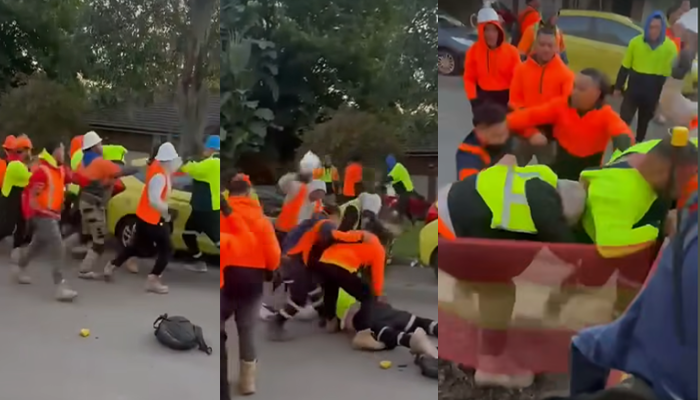
A violent early-morning brawl involving at least 20 tradies at a Sydney construction site has gone viral, prompting Tongan communities to speak out about similar incidents they’ve encountered before.
A wild all-in brawl has erupted at a worksite in Sydney’s northwest as a large group of tradies squared off
The chaotic fight, captured in footage circulating on social media, shows workers in high-vis gear throwing punches, kicks, and even using hard hats as weapons outside Meriton’s Castle Grange construction site in Crest Hill.
One worker was repeatedly struck in the head with a hard hat as onlookers filmed the clash.
The construction company has confirmed that every worker involved in the brawl has been fired.
NSW Police were called to Sexton Ave around 7am on Tuesday, but said most of the brawlers had dispersed by the time officers arrived.
“Officers have been informed that the brawl involved two apparent groups wearing hi-vis clothing and construction attire,” police said in a statement.
A 43-year-old man and a 55-year-old man were treated by paramedics for minor injuries before being taken to Westmead Hospital.
Tongan Communities React: “We’ve Seen This Before” As the footage spread online, members of Tongan online communities expressed concern, sharing stories of similar violent incidents they’ve witnessed or experienced in the past.
Some warned that tensions among workers, particularly in labour-intensive industries, can escalate quickly if not addressed.
“It’s not the first time we’ve seen fights like this,” a commenter wrote in Tongan. “Sometimes it’s over work disputes, sometimes cultural misunderstandings—but it always ends badly.”
Authorities have not confirmed whether cultural tensions played a role in this incident, but investigations are ongoing.
What Sparked the Violence? The exact cause of the brawl remains unclear, with witnesses giving conflicting accounts.
Some claim it was a personal dispute, while others suggest it may have been work-related.
Workplace safety advocates have called for better conflict resolution measures on construction sites to prevent such outbreaks.
Police are urging anyone with information or additional footage to come forward as they piece together the events leading up to the brawl.
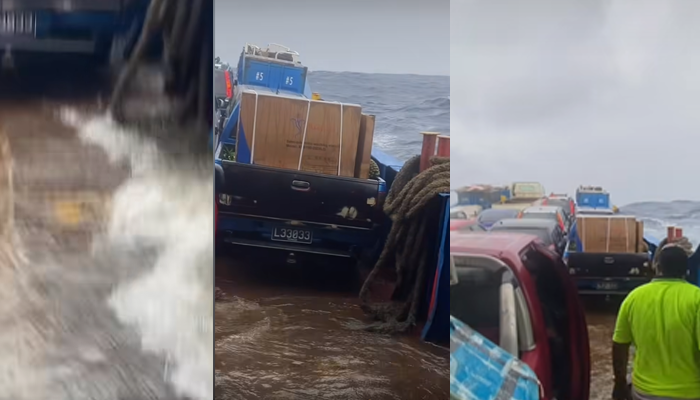
Nuku‘alofa, Tonga – The MV Onemato was forced to turn back to Tongatapu after powerful waves tore off its bow door while en route to ‘Eua.
Crew members battle flooding after massive waves breach MV Onemato’s deck, ripping off the bow door mid-voyage. The stricken ferry returned to Tongatapu as Tonga MetService issued gale warnings across the islands.
Despite the severe damage, no injuries were reported among passengers or crew.
Shocking footage uploaded to Facebook by Lie Fifita shows the moment violent waves breached the vessel, flooding the deck as crew members rushed to secure the area.
It shows rogue waves crashing onto the deck of MV Onemato, flooding the vehicle hold as crew members scramble to secure the area.
The ferry bound for ‘Eua was forced to return to Tongatapu after encountering the dangerous weather system that had triggered gale warnings across Tonga.
While the trip from Tongatapu to ‘Eua Island typically takes an hour by boat, the crossing is notoriously hazardous and must not be underestimated.
It follows Tonga Meteorological Services issuing urgent weather alerts across the kingdom, upgrading Vava’u’s strong wind warning to a more serious gale warning today.
Met said that the gale warning remains in effect for Ha’apai, while strong wind warnings continue for Tongatapu and ‘Eua. All Tongan land areas remain under heavy rain warnings and flash flood advisories.
Commenters on Facebook offered their best wishes, while others cautioned about the dangers of the notorious route, especially when a weather warning was in place.
Maritime authorities are expected to investigate the incident, which has shaken travellers and prompted calls for stricter safety measures on inter-island vessels.
U.S. President Donald Trump announced on social media Monday that Israel and Iran had reached a “complete and total ceasefire,” set to be phased in over the next 24 hours.
The unexpected declaration came amid escalating tensions between the two Middle Eastern powers, but key players quickly cast doubt on the claim.
The ceasefire is set to start in approximately six hours, the president said.
“It has been fully agreed by and between Israel and Iran that there will be a Complete and Total CEASEFIRE (in approximately 6 hours from now, when Israel and Iran have wound down and completed their in progress, final missions!), for 12 hours, at which point the War will be considered, ENDED,” the president wrote on social media.
Reuters report said Trump appeared to suggest that Israel and Iran would have some time to complete any missions that are underway, at which point the ceasefire would begin in a staged process.
Earlier, Iran said it launched an attack on U.S. forces at Al Udeid Air Base. Qatar stated that its air defences successfully thwarted the strike on the facility—which had been evacuated—shooting down 18 of the 19 missiles fired.
The BBC noted that it had not received independent confirmation of a ceasefire from Iranian sources.
It comes after Iran says more than 400 people, including 13 children, have been killed and at least 3,056 others wounded since Israel launched its attack on June 13. In Israel, at least 24 people have been killed in Iranian strikes