Tonga international Solomone Kata has extended his stay with Leicester Tigers.
The 30-year-old dual-code international has made 25 appearances for the East Midlands side since arriving for last season.
Kata joined the Tigers after a short stint with Premiership rivals Exeter, having previously played for Super Rugby sides ACT Brumbies and Moana Pasifika after forging a professional career in rugby league with NRL side New Zealand Warriors.
“I think my best days as a player are ahead of me and I’ll always give my all for the fans and for my team-mates while I’m here,” Kata told the club website.
Kata, a versatile back who has established himself at centre with Tigers, has featured seven times so far under Michael Cheika this season, scoring three tries to take his overall club tally to seven.
“Sol is a big talent and also a big character inside the squad,” Cheika said.
“We really welcome his decision to stay with the club as I know he is a player in demand.”
Kata is the third Tigers player in as many days to sign a new deal with the club, following England lock Ollie Chessum and Scotland prop Will Hurd.
The motion of no confidence against former Prime Minister Hu’akavameiliku has alleged that the Tonga Development Bank (TDB) had violated the established loan limits for clients.
‘Emeline Tuita, TDB CEO
It also claimed that the bank’s financial status remains uncertain due to the inability of companies with government-guaranteed loans to fulfil their repayment obligations.
The former Hu’akavameiliku administration has been accused of legal violations due to its failure to present evidence of the loan guarantee to the House. It has also been accused of failing to prevent the two banks, TDB and Tonga National Reserved Bank (TNRB), from entering into a legal dispute, which is currently awaiting a court decision.
The allegations come at a challenging time for TDB as it faces a court battle while also confronting a wave of misinformation that it claims is damaging to its public image on social media.
Earlier this month, the bank urged its clients in an effort to maintain their trust following police executing a search warrant at the bank for the second time within a few months.
Vote of no confidence motion
One of the seven motions presented to the Parliament as part of the vote of confidence accuses Hon Hu’akavameiliku of failing to uphold the rule of laws which govern TDB and TNRB.
The motion, which had been listed as number four, raised concerns among the Opposition MPs after it had been reported that in 2022, the TDB allegedly breached the lending limits set for the bank when processing a loan application. As a result, a subsequent agreement was established in which the government eventually acted as a guarantor in 2022 with a mission to resolve this matter by May 2024, the loan guarantee’s end date.
The motion said the government has yet to submit any proof of the guarantee.
As seen by Kanivca News, the motion and a copy of the TDB 2022 Annual Report have been submitted as an appendix. It specifically referenced page three, item 39, paragraph two of the report as supporting evidence for the claims made by the movers.
Government as owner
The motion emphasised the legal obligation of the government to appoint the two banks’ boards of directors and chief executives.
It also said that the government failed to manage a dispute between the two banks, which escalated to legal proceedings that resulted in substantial fines and costs.
It said the Lord Chief Justice had ordered that TNRB and its Governor pay TOP$15 million to TDB as part of the dispute between the two banks. It appeared that the defendants subsequently initiated a legal challenge against this ruling.
“The costs incurred will be financed through the banks’ proceeds, which may have been reserved for their development projects intended to benefit the people”, the motion said in Tongan of the banks’ legal dispute.
The motion said that this was the first time in the history of Tonga that the two banks had engaged in a conflict that ended up in court.
In his response, Hon Hu‘akavameiliku said in Tongan: “It is important to note that the two banks operate as separate legal entities that function independently from government decision-making processes”.
Regarding the bank’s court disputes, the former Prime Minister said waiting for the court decision would be wiser since they were still in progress.
Dr ‘Aisake Valu Eke, who took the initiative to propose the vote of no confidence motion against former Prime Minister Hon Hu’akavameiliku, is reportedly emerging as a strong candidate for the position of Tonga’s next Prime Minister.
Dr ‘Aisake Eke
All 26 MPs will meet on Christmas Eve to select the Kingdom’s new prime minister.
It follows Hon Hu’akavameiliku’s recent resignation ahead of a second vote of no confidence motion against him.
The constitution stipulates that the Lord Speaker will issue letters to MPs calling for their nominations for leader.
The nominations must be submitted by December 23, and the election of the prime minister will be conducted by secret ballot on Christmas Eve.
However, people close to the MPs claimed that Dr Eke had strong support from the nine nobles and all the MPs who signed the vote of confidence motion against former Prime Minister Hu’akavameiliku.
A source said Dr Eke “is doing very well and his support is strong and deep”.
The people’s elected MPs had been approached by Kaniva News about their preferred candidates.
Their liaison officer, MP Dr Taniela Fusimālohi, responded in Tongan that “it is left for the Speaker to make it public when the time is right, which is December 24”.
The numbers
Other sources said Cabinet ministers from Hu‘akavameiliku’s government, who were apparently unhappy with the vote of no confidence motion, could likely nominate a candidate.
However, the sources said they did not have the number, the same situation that led to Hu‘akavameiliku choosing to resign ahead of his vote of no confidence instead of facing the potential loss.
Before Hu’akavameiliku quit, he had nine MPs who could support him after his Minister for Lands and Survey, Lord Tu’i’afitu, resigned last month. Of the nine remaining members, four were People’s Members of Parliament (PMPs), including the Prime Minister, two were Nobles’ Members of Parliament (NMPs), and three were Non-Elected Members of Parliament who could not vote on the VONC, according to the constitution. The two remaining nobles resigned after Hu’akavameiliku’s resignation, reducing the number of supporters for Hu’akavameiliku to only four.
This means a new PM candidate from Hu’akavameiliku’s supporters needed 10 more MPs to win. He could count on five MPs who supported Hu’akavameiliku – Tevita Puloka, Dulcie Tei, Sione Taione, Veivosa Taka and Mo’ale ‘Otunuku – and possibly two NRs who have often sided with Hu’akavameiliku, Lord Tuiha’angana and Lord Fakafanua.
On the other hand, Dr Eke reportedly said he was confident he had the number after submitting the vote of no confidence last month.
He had the seven PMP signatories, who were Dr Langi Fasi, Mateni Tapueleuelu, Dr ‘Aisake Eke, Piveni Piukala, Kapeli Lanumata, Mo’ale Finau and Vatau Hui. They were also guaranteed the vote of Dr Tanieta Fusmalohi, who was still returning from overseas. So they secured eight guaranteed votes in addition to the seven members of nobility MPs, totalling 15 votes—sufficient to ensure a clear victory.
Background
Dr Eke received his Doctor of Philosophy from the University of Southern Queensland in Australia after conducting his research on, “An exploratory study on the quality of service in the public sector in Tonga”, completed in 2013.
He was a former Secretary and Minister for Finance.
As Kaniva News previously reported, Dr Eke, who was one of the witnesses for the convicted Lavulavu couple, has pledged to fight to clear his name after the Supreme Court judge said he was not telling the truth.
Dr Eke had given evidence that non-government schools were allowed to set their own fee system and that it was acceptable to write a cash receipt of the value of the barter item tendered.
Justice Nicholas Cooper said Dr Eke provided no proof for his claims and that all his credibility was gone.
Dr Eke said what he provided to the Court was true and he stood by those statements.
“Non-government educational establishments in Tonga are free to formulate their operations and policies and how school fees are paid”.
Growing concerns emerged one year following the crash of the Lulutai SAAB 340 aircraft, which resulted in the plane being no longer operational.
Poasi Tei, Lulutai CEO
The aircraft slid off the runway at Tonga’s Fua’amotu airport in December 2023 and hit a concrete block.
As Kaniva News reported previously, a preliminary report from the investigation into the crash organised by the Ministry for Infrastructure’s civil aviation department detailed damages, including hydraulic fuel loss and other safety problems.
The report also said there were signs that the aircraft’s record may have been deliberately disabled.
With technical assistance from the Australian Safety Transport Bureau (ATSB), the Chief Investigator is expected to submit a final report at the completion of the investigation.
Insurance concerns
Some members of the public who asked not to be identified told Kaniva News they wanted to know whether the SAAB 340 was insured, and if not, they wanted to know why.
Some said Lulutai was a government-owned asset, and it is responsible for ensuring effective management practices that minimize potential losses that may adversely affect taxpayers.
We have contacted Lulutai chief executive Poasi Tei for comment.
The Opposition mentioned in its recent vote of no confidence motion, which led to the resignation of former Prime Minister Hu’akavameiliku, their ongoing concerns about Lulutai’s financial status.
It said there were concerns about mishaps with Lulutai flights and the failure of the government to submit to Parliament a specific statement on these incidents or any plans to prevent air accidents and ensure air safety in the future.
Chatham aircraft leasing
The concerned citizens believed that had Lulutai properly managed the maintenance of the SAAB 340 and insured it, it would not have been necessary to hire Chatham Airlines from New Zealand to provide services during peak seasons.
They believed it costs a lot of money for Lulutai, which one expert previously claimed operated at millions of loss, to hire the Chatham Airlines aircraft.
The latest was last week when Lulutai Airlines said a chartered Chatham ATR 72 aircraft would make 12 scheduled flights a week from Tongatapu to Vava’u and return.
Government funded
The vote of no confidence motion claimed the government had invested $21 million in Lulutai Airlines as its shareholding and an additional $2 million in its current financial budget. Still, it failed to submit any financial statement to the Parliament.
Hu’akavameiliku, in his response to his latest vote of no confidence motion, saidthat Lulutai Airlines was a government-owned company. He also referred to what his government announced last month, saying it finally approved Lulutai Airlines Limited to become a public enterprise.
He also claimed that budget statements had been submitted to the House.
As Kaniva News reported previously, the Hu’akavameiliku government was accused in the House of hiding behind the Companies Act to allow Cabinet Ministers to continue as members of Lulutai’s Board of Directors, although the law says they can only retrain members within 12 months.
Prime Minister Hu’akavameiliku insisted that it was up to the government to consider when it was fit to cease its membership.
The government has fully funded Lulutai Airlines since its inception in 2020.
A man has been jailed for 12 years and 10 months after admitting to stealing two cars at knifepoint in two separate incidents on Tongatapu.
Justice Nicholas Cooper, in sentencing, said Taniela Vaka, 42, had been indicted at the Magistrate Court, and the details of his offences and charges were not available to him.
In the first incident, Police apprehended the prisoner and interviewed but, “Extraordinarily, it appears he was then released on bail. For a man who had just admitted an armed robbery that appears to raise some serious questions,” said Mr Cooper.
The court heard that on 20 November 2023, the victim was walking to his car at approximately 11.30pm, having bought groceries from a store in Kolofo’ou. He got into his vehicle.
Mr Vaka got into the front passenger seat, produced a knife and instructed the victim to drive.
Mr Vaka directed him to drive to Ananā. As he drove, at knifepoint, he took an opportunity to flee and jumped out of the car.
The victim went to the police and reported the loss of his car, worth approximately $20,000.00 and the groceries and cash therein, worth about $5,782.00. Albeit that only $50.00 was made up in cash.
Mr Vaka was arrested that same day. He was interviewed on 4 December 2023 and admitted his involvement in the offence.
Mother and daughter
In the second incident, a mother and 27-year-old daughter were in their car at their gate on 23 January 2024. They were waiting for the husband and father of their family to lock the front gate and get in their car to join them.
Instead, Mr Vaka, armed with a knife, got into the rear seat and, at knifepoint, commanded the two women to drive.
He took a handbag belonging to one of the victims and stole cash from it, TOP $1,000.00 and NZ$ 200.00.
Mr Vaka then got out of the vehicle, but not before threatening both ladies that he would return to find them at their home if they reported this offence to the police.
A member of the public who knows Mr Vaka saw the women being threatened in their car with a knife and raised the alarm.
“The police chased him, but he hid. He evaded them initially”, the court heard.
The Police attended to the victims and recovered the knife from the car.
Mr Cooper said: “I note that no details as to this weapon have been provided, either for this offence or the last”.
“No circumstances have been provided to explain Mr Vaka’s arrest”.
Calculating his jail term, Mr Cooper said: “That gives a sentence of 12 years and 10 months’ imprisonment”.
“Regrettably Mr. Vaka has committed offences of this kind time and again.
Drug Addiction
“He indulged in drug use and, I have no doubt, then robbed and stole to fund that habit.
“He did not care about the harm and fear he caused.
Mr Cooper also said he refused to suspend any part of Mr Vaka’s sentence since he “ clearly is a high risk of re-offending and to society at large”
“He must serve his full term and no part can be suspended. His sentence will be back dated to his first remand, 21 May 2024”.
A man sailing alone across the Pacific Ocean shared a harrowing update of how he “almost died” after he suffered a blow to the head that knocked him unconscious.
Luke said the incident left him in shock and needing to make a mayday call ( Image: sailing_songbird/Instagram)
American solo sailor Luke Hartley, who goes by sailing_songbird on Instagram, shared the concerning update in a post uploaded to the platform on December 12. In the video, Luke said he was hit in the face by his sailboat boom, which extends out from the mast, at “an incredibly high speed” while he was about a mile out from the nation of Tonga.
The impact swept former music teacher Luke off his feet and left him draped unconscious for a time over the lifelines of his 27ft-long sailboat Songbird. The clip, which Luke said was very difficult for him to watch and can be viewed on his Instagram.
The clip, showed him calling for help as part of a mayday where he expressed concerns he was about to pass out. Fearing he would not be able to complete an anchorage alone, he requested assistance from nearby sailors.
Luke said the incident left him in shock and “in no way capable” of completing the sail to get into the Vava’u island group in Tonga without an engine. He believed he was haemorrhaging “since all I could see was green”.
Thankfully, after an hour, Luke managed to get the support of sailors who helped him get to Tonga. Luke praised the “boundless” support he received and despite in hindsight viewing his mayday call as unnecessary, the sailors told him he did the right thing “given the severity of my head trauma,” although thankfully it did not have a long-term impact.
Since being shared online, the video has received more than 39,380 likes. The incident happened as Luke continues his journey across the world’s largest ocean.
Luke said he typically uses a boom preventer, which takes force out of an accidental gybe – a changing of course by swinging the sail across a following wind.
“I always sail with a preventer but in this case, [I] had released it moments before my accident to perform a controlled gybe,” Luke told The Mirror. “My blunder was when I looked behind me to watch the whales flanking Songbird and in that moment, I lost concentration and didn’t notice the boat go into a crash gybe.”
“In some ways, this accident has made me totally rethink safety on the water, and in other ways, nothing has changed,” Luke continued to tell The Mirror. “As far as procedure goes, there isn’t anything I need to adjust to ensure my safety on the water, other than my continued concentration. Maintaining one’s concentration sounds easy but at the end of a two week passage alone, you are feeling pretty run down and drained.
“Every time someone steps into a car, they take on the responsibility that an accident could happen, the same goes with sailing. At the end of the day, what happened was simply an accident and I am incredibly lucky to be able to walk away from it without any long term damage.”
Luke set out for the open sea and started documenting his journey on social media after feeling out of step with his teaching career and what he said was a poorly supported school in the US.
Since setting out in from Seattle in October last year, Luke has documented his journey on social media and has accumulated an impressive 922,000 followers on Instagram alone. He previously told People he intended to circumnavigate the world in a journey that could take as long as five years.
Minoxidil – an over-the-counter foam applied to the scalp – caused the infants to develop uncontrollable hair growth across their bodies.
Researchers in Spain who discovered the cases believe it could be caused when parents’ touched their kids soon after using the drug. From there, it may have entered their kids’ mouths or permeated through their delicate skin.
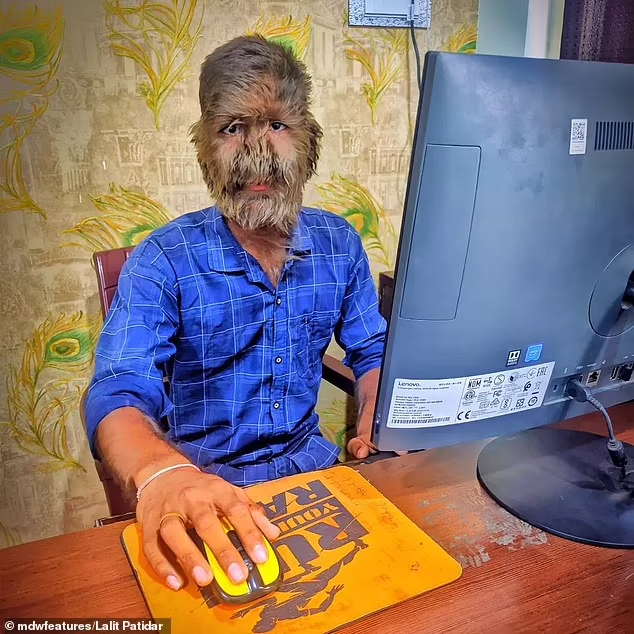
Lalit Patidar was born with hypertrichosis. The young man was born in INdia and was called ‘monkey boy’ by classmates. There are cases of this condition all over the world.
These case studies have caused the European Medicines Agency to suggest additional warnings to their labels about Minoxidil, warning about the risk of hair growth on infants.
The new warning explicitly warns parents that they and their children should not ingest the foam.
The FDA has not publicly commented on these Spanish cases, nor does it appear to be issuing additional warnings about Minoxidil usage.
In all eleven cases, the children’s hair growth ceased and reversed after their parents stopped exposing them to the drug.
Minoxidil isn’t known to be dangerous, but in one case study from France in 2014, an anonymous child who swallowed a teaspoon of the product was sent to the hospital with a dangerously high heart rate and low blood pressure.
Dr. Isabelle Claudet, the head of the pediatric emergency department at Children’s Hospital in Toulouse who authored the 2014 report told Reuters: ‘At therapeutic dosage, there is usually no serious adverse effect, but for a child, some milliliters or a teaspoon can lead to long-lasting hypotension.’
This is because the drug relaxes blood vessels, stimulating blood flow to the hair follicles, and in turn, promoting hair growth.
Beginning in 2023, sets of parents in Spain saw excessive amounts of hair bloom on their young child’s back, legs and thighs over a few months – in a condition known as hypertrichosis.
Officials at the Pharmacovigilance Center of Navarre traced the unexplained hair growth in 11 children back to minoxidil.
Minoxidil is an FDA approved formulation available at a range of concentrations, including 1 percent, 2 percent, 5 percent, 7 percent and 15 percent.
The foams and other topical treatments are generally available over the counter, though it’s more rare to see the higher concentrations, according to the telehealth provider Hims.
There are also pill forms that people can take, but these require a prescription.
It’s unclear how many Americans use some form of the drug, since users can purchase it without a prescription.
But 80million Americans struggle with some form of hair loss as they age, and Minoxidil is one of the most common treatments, according to Cleveland Clinic.
Usually, when the drug is applied to the scalp, it’s affects are isolated to that region.
But in the pill form, the FDA label on the drug notes that it can cause hypertrichosis in the: ‘eyebrows, between the hairline and the eyebrows, or in the sideburn area of the upper lateral cheek, later extending to the back, arms, legs, and scalp.’
The label also notes that the drug has not been used in infants, but does not note that there is any danger in being exposed to the drug.
In the case of the Spanish children, according to Newsweek, authorities report that the children may have ingested the drug from their caregivers scalp or hands, since children often put their mouths on things.
It could also be that skin to skin contact with a person who has Minoxidil on their body could permeate into the skin of the child, since their skin is more delicate than adults and substances can pass more easily into it.
In all 11 cases reported, the children’s excess hair growth began waning once Minoxidil exposure was removed.
These new cases in part prompted the EMA to add new warnings to their minoxidil labels.
In the EU the Product Information must now include: ‘Cases of hypertrichosis have been reported in infants following skin contact with minoxidil application sites of patients (caregivers) using topical minoxidil.
Hypertrichosis was reversible, within months, when infants were no longer exposed to Minoxidil. Contact between children and Minoxidil application sites should therefore be avoided.’
They also added: ‘Do not ingest’.
Older case studies have linked Minoxidil solution to unwanted hair growth.
In 2015, an anonymous 42 year old Spanish woman went in to see dermatologists after mats of thin, soft dark hair began growing like a beard across her face and lower back.
Doctors had prescribed her 5 percent topical Minoxidil to try to treat alopecia – or hair loss- and she had been taking it for two weeks. She said she was careful to avoid letting the solution sit anywhere but her scalp, yet she still saw the hair growth.
A similar outbreak occurred, again in Spain, in 2019 after a container of Minoxidil pills were mislabeled as acid-reflux medication. 17 children developed werewolf syndrome as a result, but their symptoms seized after they stopped taking the drugs.
Hypertrichosis can be a condition that someone is born with or one that someone develops, according to Medscape. In some cases, the hair grows in isolated areas – like on the tips of the elbows or on the face – in others, the hair grows all over the body.
Each of these scenarios is slightly different than the other, making it difficult for doctors to diagnose or determine a cause for the condition. Doctors aren’t even sure how common it is, but some estimates put it around one in a billion.
It affects people from every country and doesn’t seem to be more common in boys or girls.
Some children who are born with the condition see their excess hair start to thin during adolescence, others live with it for life. Aside from the hair growth, people with the condition lead a normal, healthy life.
Still, there can be psychological consequences of living with the condition, since some people with it are teased for their appearance.
A man has been jailed for stealing belongings worth TOP$46,783.00 from his sister’s home.
A glass pipe used for smoking methamphetamine with shards inside.
Siaosi Halaholo Vete, 42, pleaded guilty to one count of serious housebreaking and two counts of theft.
Vete was sentenced to a term of two years imprisonment with the last six months suspended for six months on the following conditions:
a. He must not commit any further offence punishable by imprisonment
b. He must be placed under probation during the term of your suspended sentence
c. He must report to the Probation Office within 24 hours of your release from custody.
d. He must live where directed by the Probation Officer
For the avoidance of doubt, Vete will serve 18 months of imprisonment and then six months of a suspended sentence on the conditions mentioned above.
Vete broke into the house twice. In the first instance, he stole goods for the value of $16,000 and, in the second, for the value of $30,798.
Much of the goods has not been recovered.
The court heard Vete was offending to fund his methamphetamine addiction and had similar previous convictions, but none for theft.
The offence was committed while his sister and her husband were abroad.
The court was told his sister and her husband had forgiven him for what he did.
“That is to their credit, and I bear it in mind in determining whether to suspend part of the custodial sentence, which in your case I consider inevitable”, Mr Bishop said.
A man who had breached his suspension sentence from a previous conviction was imprisoned for two years and three months for serious housebreaking and theft of property, including electrical goods, worth TOP$15,200.
Shreds of evidence presented in court showed Siosaia Vatikani, 40, left a clear trail of fingerprints at the Nursing School at Vaiola Hospital in Nuku’alofa.
He pleaded guilty to one count of serious housebreaking and one count of theft.
He had previous convictions, which nailed his fate as the judge, Lord Chief Justice Malcolm Bishop, refused to consider whether or not to suspend the whole or part of his sentence.
“In your case it does not apply because you are not young, you have previous convictions and, in my view, have very little prospects to benefit from rehabilitation should I take that course” Mr Bishop said.
The prisoner breached a suspension from a previous sentence, which he almost completed before he left.
Mr Bishop said: “I order that the suspended sentence be activated which is a period of 3 months is be served consecutively to the 2 years remaining for this current matter”.
Vatikani “ is to serve a total of 2 years and 3 months imprisonment at Hu’atolitoli Prison”.
Mr Bishop also held the view that the prisoner’s spouse was adversely impacted by his acts of theft.
“What is particularly aggravating about this case is that the school facility in question is related to your wife’s employment as a nurse and therefore must have caused her considerable embarrassment and distress”.
Eight men responsible for Toni Langilangi’s tragic death are now facing sentencing as they await the court’s decision on the consequences of their actions.
Tevita Lisiate, Mesui Finau, Mafua ‘i Vaha Palu, Moana Masima, Lisiate Evirn Vea, Salamani Filikitonga, Siosifa Vatuvei and Viliami Tongamana entered guilty pleas to common assault charges laid over the death of Mr Langilangi in Nuku’alofa.
The convictions come after a brawl in the centre of Nuku’alofa in the early hours of 17 September 2023.
The conflict arose between two groups of opposing young men, one from the town of Ha’ateiho and the other from Pahu.
Most of the accused hail from Ha’ateiho, while Finau is from Fo’ui. Palu comes from Pahu and Filikitonga from ‘Utulangivaka, Vava’u.
The deceased from Pahu suffered injuries and died shortly afterwards.
“It is asserted, and not challenged, that the deceased died of a preexisting condition and that the injuries he sustained did not cause or contribute to his death”, the court was told.
Mr Bishop said: “That strikes me as an extraordinarily surprising conclusion but that is the unchallenged medical evidence, and I must deal with the case as it is presented.
“It goes without saying that had there been evidence that the blows and kicks which the deceased suffered was a substantial cause of death then far more serious allegations would have been made.”