A woman who previously worked at Tonga Power company is expected to face a criminal trial following her arrest over embezzlement allegations, local media reports said.
Pou BJames Tahilanu
Tupou Seluini Tahilanu, 29, from Sopu ‘o Tāufa dishonestly made off with TOP$47,521.00, the reports allegedly said.
The accused was working at Tonga’s sole electricity supplier’s office in Tofoa from February to April 2022 when the allegations emerged.
A person by the Facebook name Pou BJames Tahilanu told Kaniva News the source who leaked the news was investigated.
She described the source’s actions in English as ‘illegal’ and it is allegedly misleading the public.
“It’s almost a year now I have moved on with my new job”, Tahilanu, the messenger, said.
She denied the news and asked to pull down the story as it affected her family.
In Tongan she said: “kole fakamolemole atu pe e lava nai ke tukuhifo post koia kataki pee ,he oku uesia hoku ki famili pea moe tokotaha’ ni he feaveaki holo ikai ke mooni”.
The news came amid electricity consumers’ ongoing complaints on social media about the electricity costs which they deemed it as ‘extremely expensive’.
There were also questions over what appears to be customers being asked to pay for the government’s electricity subsidy. As we previously reported extra reversal charges appeared on power bill invoices for consumers to pay had been made after the government apparently failed to pay its promised subsidy to Tonga Power.
This followed with the Ministry of Finance saying last month the government continued paying the subsidy to Tonga Power.
A high-profile rapper is among six men accused of kidnapping a man and ripping his teeth out with pliers over a $5million ransom bid.
Valeli Tonga, 20, aka ‘Leli SK’, was arrested on March 14 after Peter Vuong, 26, was rescued by dozens of heavily-armed tactical police from a derelict property in Belmore, in Sydney‘s southwest.
Valeli Tonga, who performs under 'Leli SK', (pictured) is one of six men charged over a high-profile alleged kidnapping
Police will allege Vuong was kidnapped from his influencer girlfriend’s Smithfield home six days earlier, and allegedly bound and tortured as his accused captors tried to extort her wealthy crypto trader relative for his safe return.
The group formed in late 2019 and are managed by independent label BHQ Records. Leli SK joined Sydney Yungins the following year, replacing a previous member of the group.
According to their social media bio, the trio – who hail from the Pacific Islands but were raised in western parts of Sydney – racked up around 500,000 views in two months after releasing their debut track ‘Who You With’.
‘These boys are fresh on the scene with songs that fall under a variety of musical genres. From UK drill style, hip hop party to laid back wavey flows,’ their YouTube page reads.
‘Their journey has taken them to perform at shows including the under 18 Sticky Cheeks Block Party, For the Culture Show at the Gold Coast and Darwin City at the Opium Club.’
Rico Tonga and Titoez have not been charged in relation to the alleged kidnapping and Daily Mail Australia does not suggest they are involved.
Photos posted on social media over the past two years show Leli SK performing on stage at bustling events and posing for photos in front of hundreds of fans.
In December, Tonga shared a picture of himself sitting on the ground in front of a white Mercedes admiringly gazing at one of his group’s records as it sat in his lap, writing: ‘plenty more where they came from’.
The post was inundated with comments from friends and loved ones offering their congratulations and saying they were ‘proud’.
Police will allege Tonga and five associates burst into Vuong’s girlfriend Angel Bowyer’s sprawling two-storey family home around 5.20am on March 9, armed with sledgehammers and guns.
Peter Vuong, 26 , and his glamorous influencer girlfriend Angel Bowyer (above, together) were sleeping in her family's Smithfield home when he was allegedly kidnapped at gunpoint and taken to a squalid house 20km and tortured
They are then accused of spiriting him away to the squalid property 20km away where they allegedly held him for days while sending Ms Bowyer’s relative Tran Dinh messages demanding $5million or they would ‘cut Mr Vuong into pieces’.
A huge police operation kicked off shortly after the alleged abduction – eventually leading to tactical officers armed with flash grenades storming the Belmore home and rescuing Mr Vuong.
Four men were arrested at the Canterbury Road property, and a further two were nabbed by officers a few streets away.
Alongside Tonga, Viliami Siasau, 19, Sunia Siasau, 20, John Totau Fahamokioa, 20, Lolo Liavaa, 19 and Kitueau Tatafu, 21, have been charged over the alleged abduction and torture.
Appearing in Bankstown Court on March 15, Tonga did not apply for bail and was remanded in custody until his next hearing.
Of the six, Fahamokioa was the only one who was granted bail under strict conditions.
Despite Tonga’s arrest, BHQ Records have continued to promote the group’s upcoming releases on social media.
Just three days ago, Sydney Yungins announced via Instagram that their new track ‘Meet me at the bottom’ was now out across their platforms.
Tonga is due to appear at Burwood Local Court on May 10.
Daily Mail Australia has contacted BHQ Records for comment.
The Prime Minister has had his flu and Covid-19 vaccinations and is encouraging others to do the same.
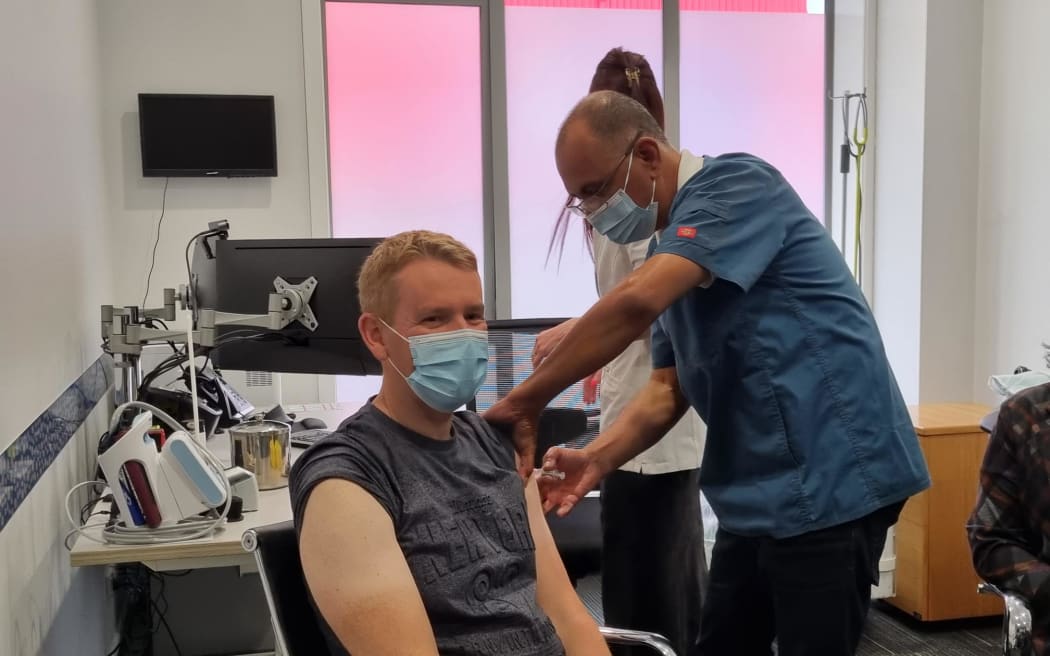
Prime Minister Chris Hipkins getting his flu vaccine and Covid booster shot at Queen Street Medical Centre in Upper Hutt. Photo: RNZ / Soumya Bhamidipati
From today, more people are eligible for the Covid-19 bivalent vaccine, which protects against two strains of coronavirus.
Chris Hipkins got his injections at a community vaccination event in Upper Hutt on Saturday morning, alongside Health Minister Ayesha Verrall.
He said it was important eligible people got the jabs before winter arrived.
“It will actually leave them better prepared for the winter season, help to ease pressure on the health system as well.
“So there’ll be more events like this happening around the country where our local community health providers will be encouraging people to get their flu jabs and their Covid boosters and I’d really encourage people to take up that opportunity.”
Health Minister Ayesha Verrall also received both injections this morning and she said many people would be able to get their flu and Covid booster shots at the same time.
There were currently more than 700,000 Covid vaccines and 800,000 flu jabs in the country, with more due to arrive, she said.
The government had ordered more flu vaccines than last year, she said.
“We have 1.7 million Covid bivalent vaccines and Pharmac has 1.8 million flu vaccines, last year we needed 1.2 million flu so we’ve got a margin there that we’re able to do more cause we hope we will be able to reach more people this year.”
A combination of Covid-19 and flu added to the strain on New Zealand’s hospitals last year and people should get the flu vaccine and Covid-19 booster to try and help avoid that this year, she said.
Doctor Andrew Narayan from Queen Street Medical said it was a privilege to administer the vaccines.
“But again you know, at the end of the day another human being protected against the virus, hopefully we all can take lessons from it and you know if he [Chris Hipkins] can do it then there should be no reason why anybody else can’t do it.”
The medical centre is one of many across New Zealand holding community vaccination events to mark the beginning of the rollout.
Dr Narayan said the aim was to administer at least 800 jabs by the end of the day.
Dr Verrall said all New Zealanders aged over 30 could now access the Covid booster, so long as it had been at least six months since their last Covid-19 booster or positive Covid test.
People at higher risk of severe illness from Covid-19 would also be able to receive an additional booster, regardless of how many doses they had had previously, she said.
The Covid-19 booster is free of charge.
The flu vaccine is free for people aged 65 years and over, Māori and Pacific people aged 55 years and over, pregnant people, and people who have long-term conditions like diabetes, asthma, or heart conditions, children aged six months to 12 years old, and people with mental health and addiction issues.
Many New Zealand workplaces also fund a free flu vaccine for their employees.
FAKAMATALA FAKATONGA
Kuo huhu malu’i Koviti mo Fulū ‘a e Palemia pea ‘oku ne fakalotolahi’i ‘a e kakai ke nau fai ‘a e me’a tatau.
Mei he ‘aho ni ‘o fai atu e lahi ange ‘a e kakai ‘oku nau ‘atā ke nau huhu malu’i i he Covid 19 bivalent, ‘a ia’ oku ne malu’i ‘e ia ‘a e fotunga ‘e ua ‘o e kolonavailasi.
Ne huhu malu’i ‘a Chris Hipkins ‘i ha ‘iveni ‘i Upper Hutt he pongipongi Tokonaki fakataha mo e Minisita Mo’ui Ayesha Verrall.
Na’a ne pehe ‘oku mahuinga ki he kakai ke nau huhu ki mu’a he a’u mai ‘a e fa’ahita’u momoko’.
Pehe ‘e Verrall e lava ‘a e kakai ke ma’u ‘enau huhu malu’i Koviti fakataha pe mo e huhu malu’i pusita Koviti he taimi ni.
Oku lolotonga ‘i he fonua ni ‘a e huhu malu’i Koviti ‘e 700,000 Covid mo e huhu malu’i ‘e 800,000 ki he fuluu’ pea ‘e toe a’utaki maim o ha toe huhu lahi ange.
Kuo ‘ota mai ‘e he pule’anga ha huhu malu’i fulū lahi ange ia he ta’u kuo ‘osi’.
Kuo ‘i ai ‘a e foi huhu malu’i pivaleni ‘e 1.7 miliona pea kuo ‘i ai ‘a e 1.8 miliona ko e huhu malu’i fulū ‘i he Pharmac, ta’u kuo ‘osi’ ne fiema’u ‘a e 1.2 miliona ki he fuluu’ aia oku ‘i ai ‘a e masini ai faka’amu ke lahi ange kakai e ala a’u ki ai he ta’u ni.
Na’e uesia lahi ‘a e ngaahi falemahaki Nu’u Sila he ta’u kuo ‘osi he ha’aki fakataha atu ‘a e Koviti mo e fuluu’ pea ‘oku totonu ki he kakai ke nau huhu malu’i fulū pea mo pusita koviti kae lava ke fakamama’o ha’ane toe hoko he ta’u ni.
Pehē ‘e Dr Andrew Narayan mei he Queen Street Medical ko e langilangi ia ke fakahoko ‘a e huhu.
Na’a pehe kuo huhu malu’i ‘a e palemia Chris Hipskins pea ko e ha ai ke kei tatali ‘a e toenga kae fai mo huhu malu’i leva.
Ko e taha foki ‘eni ‘a e ngaahi senita oku lahi taha ‘a e huhu malu’i ai ma’a e komiunitii ke faka’ilonga ‘a hono kamata e huhu malu’i’.
Pehe ‘e Dr Narayan ko e taumu’a ke lava ha fo’i huhu malui e 800 he ‘aho kotoa.
Na’a ne pehe kuo lava ke huhu malu’i ‘a e kakai ‘o Nu’u Sila laka hake ‘i he ta’u 30 koloa pe kuo ‘osi ha mahina ‘e ono mei he ‘uluaki huhu koviti’ pe tesi positivi’.
‘E lava foki ke toe tanaki atu ha huhu malu’i pusita makehe ki he kakai lahi ange ‘enau tu’u ‘i ha tu’unga fakatu’utamaki ki he puke lahi mei he Koviti tatau ai pe pe ko e ha ‘a e lahi ‘enau huhu malu’i ki mu’a.
‘Oku ‘ikai ke totongi ‘a e huhu malu’i pusitaa’.
Oku ta’etotongi ki he kakai ta’u 65 pe lahi ange , Mauli mo e Pasifiki ta’u 55 pe lahi ange, kakai feitama, mo e kakai kuo ‘i ai honau mahaki tauhi hange koe suka, hela pe mahaki mafu , fanau iiki mahina ono ki he 12 mo e kakai ‘oku puke faka’atamai mo ‘atikisini.
Tonga’s inter-island ferry, the MV ‘Otuanga’ofa, has departed Auckland this afternoon April 1.
Crowds gathered on the wharf to wave goodbye to crew members of the government’s owned vessel.
Some Tongans in Auckland made use of the opportunity of a shipment fee waiver when the ‘Otuanga’ofa returns to send vehicles, boat and goods to their families in the kingdom.
The ‘Otuanga’ofa arrived in Auckland in September 2022. It is expected to arrive back in Tonga next week Friday 7.
Tonga’s Minister of Transport told a press conference in late January that when the ferry arrived in New Zealand some unforeseen mechanical and electrical issues were identified which were not addressed when the ‘Otuanga’ofa was being repaired in Fiji in 2018.
Ship history
The ‘Otuanga’ofa was given to Tonga by the Japanese Government in October, 2010 to replace the Princess Ashika, which sank with the loss of 74 souls.
In January 2012 the ‘Otuanga’ofa hit the MV Sitka twice at the Queen Salote wharf in Nuku’alofa while trying to dock. Damage was estimated at UAS$50,000.
Last year the Fiji Sun reported that the ferry was having a new rudder fitted at the Industrial & Marine Engineering Limited (IMEL) floating dock in Suva.
Tonga’s Prime Minister Hu’akavameiliku Siaosi Sovaleni is advocating for the issue of sky-high tertiary education fees for Pacific students studying in New Zealand to be addressed.
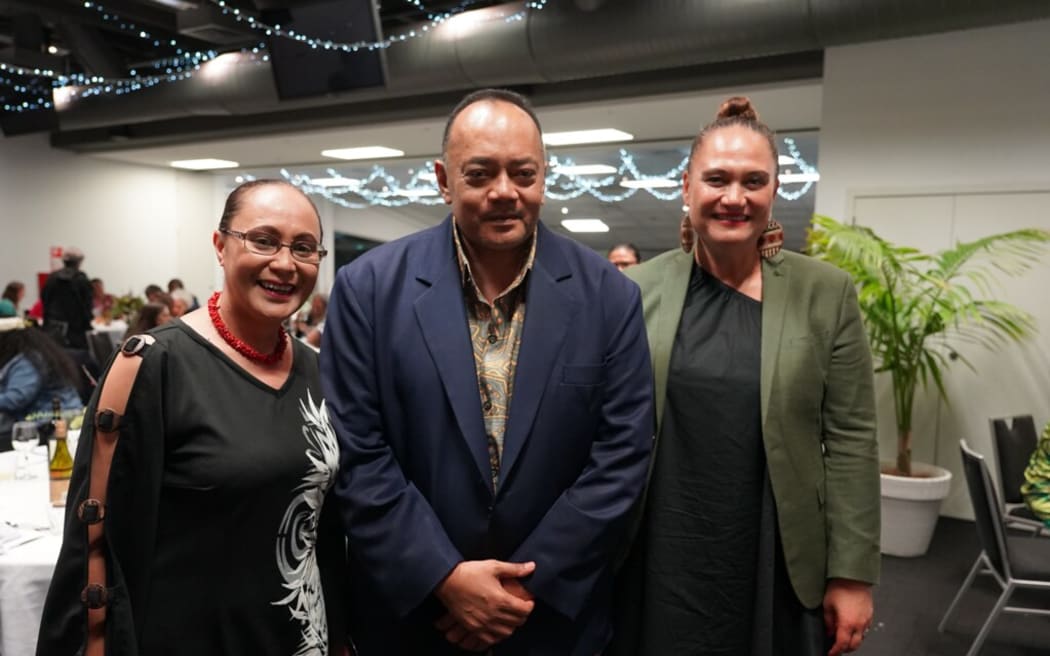
New Zealand MP, Jenny Salesa, Tongan PM Hu’akavameiliku Siaosi Sovaleni and New Zealand Deputy Prime Minister Carmel Sepuloni meet at the Inaugural Conference of Pacific Education Ministers. Photo: Supplied/MFAT
Hu’akavameiliku noted his concerns when he met with New Zealand’s Education Minister Jan Tinetti at the inaugural Conference of Pacific Education Ministers (PEM) held in Auckland last week.
This is not the first time the issue has been brought up by the Tongan leader.
Earlier this year, he told media that he has reservations around tertiary fees with the New Zealand high commissioner.
But now he has escalated the matter to the leaders’ level.
School fees at universities in Australia and New Zealand are high for Pacific students at the moment, Hu’akavameiliku said.
He said different fee structures applied to resident and international students.
Pacific students were on the international list and that meant they had to pay higher fees to be able to access higher education in Australia and New Zealand.
Tinetti said Hu’akavameiliku was not the only leader to have raised similar issues with her.
She said she is not ruling out changes being made to make it more affordable for Pacific students to study in Aotearoa.
But she concedes that it would be a massive change.
“I absolutely understand the issues that he is talking about. Let’s see if we can find a way forward,” she said.
“I have had similar discussions with other ministers here as well. This is something that we have discussed as a collective and I have committed to everyone in this room that we will continue to have those conversations.”
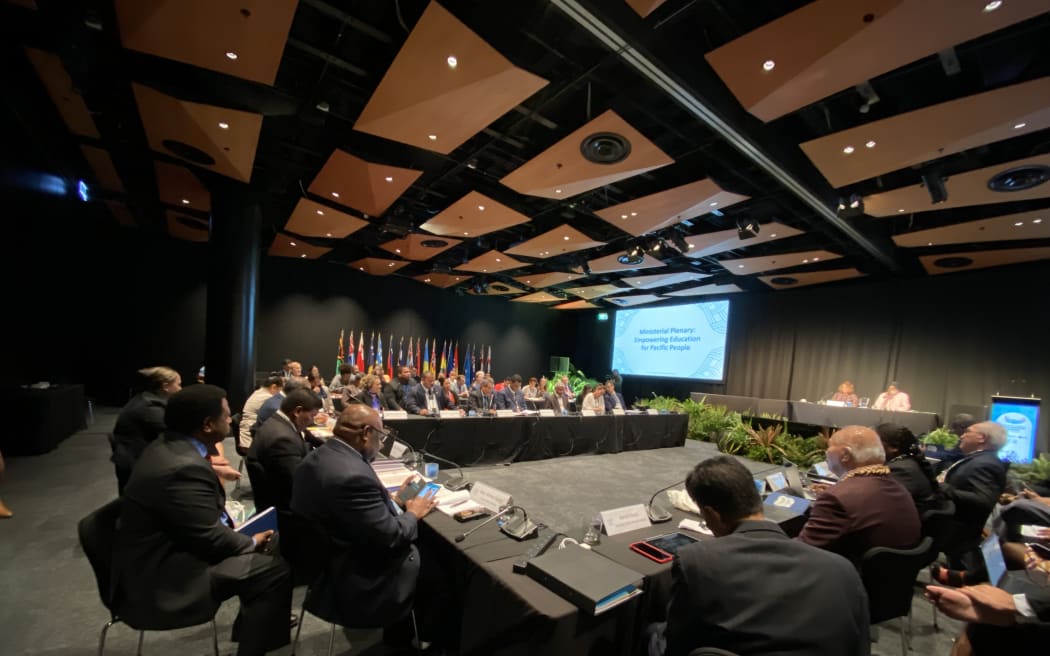
Pacific education ministers talanoa at Inaugural Conference of Pacific Education Ministers in Auckland New Zealand. Photo: RNZ Pacific/Lydia Lewis
Curriculum, teacher shortages, inclusivity
Education ministers from other nations also flagged issues and priority areas which they felt were crucial at the conference.
Curriculum development, inclusive education policies, teacher shortages, and women’s participation were high among the concerns.
Niue’s Education Minister Sauni Tongatule welcomed New Zealand government’s efforts to prioritise inclusive education for Pasifika students.
Last year, the New Zealand government funded the Vagahau Niue language app and progress was made to implement Gagana Tokelau and Vagahau Niue in the New Zealand curricula.
Jan Tinetti said it will be around three years until it is fully operational.
Potential for student exchanges needs to be explored
Papua New Guinea’s education minister Jimmy Uguro wants Pacific nations to ramp up teacher and student exchanges.
Uguro said there have been such programmes in the past but they came to a halt due to the covid pandemic.
He said for Pacific educators to be united, sharing knowledge and culture through exchanges was vital.
“Teachers from PNG can come to New Zealand and the Cook Islands and other places, so we see a culture and we are on the same page. Students can also do the same.”
“Now it is not happening because of covid-19 and the other challenges,” Uguro said.
Tinetti said she would like to explore teacher and student exchanges.
The Pacific Islands Forum Secretary-General Henry Puna said, “without education to drive economic growth, Pacific nations will remain dependent on others to finance development goals”.
Meanwhile, the conference also saw the establishment of an education ministers’ network.
“It’s basically a communication platform whereby we can continue the discussion, there are a whole lot of issues in education that we need to discuss, and we can’t cover it in two or three days,” Hu’akavameiliku said.
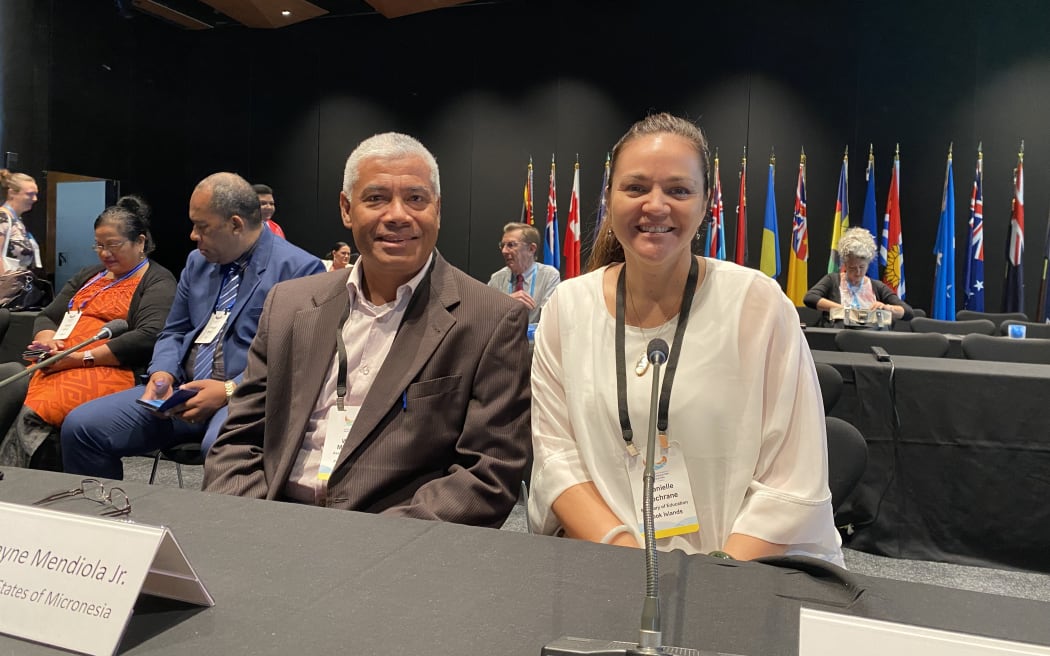
Assistant Secretary at FSM Department of Education Wayne Mendiola and Cook Islands Ministry of Education Secretary, Danielle Cochrane. Photo: RNZ Pacific/Lydia Lewis
Epidemiologist Michael Baker has urged eligible Kiwis to get the new bivalent Covid-19 booster to stay better protected from Omicron as New Zealand heads into winter.
The new booster is available from tomorrow for anyone aged 30 or over, and anyone at an increased risk of severe illness from Covid, provided it’s been six months since their last booster or positive test and they’ve completed their primary course (two doses).
It does not matter how many previous booster doses that person has had.
It has been available since March 1 for people aged 16 or over who hadn’t yet had their first booster, and for people at an increased risk of severe illness from Covid who have not yet had their first or second booster.
Baker told Breakfast “we’re entering our fourth wave of Covid-19 infection in New Zealand”.
“It’s a smaller wave than the previous three but… it’s the biggest infectious disease killer still in New Zealand,” he said.
“Technically it’s still a pandemic but it’s definitely not an emergency any more,” he added.
But with winter on the way, the new booster is a “welcome advance” in the battle against Omicron, he said.
“It’s got a second component that’s matched to the Omicron variant that’s circulating, so that gives much better protection and it produces a broader range of antibodies, it reduces your chance of getting seriously ill and dying from this infection,” Baker explained.
“A bit like the way the flu vaccine is revised every year or two to keep ahead of the range of flu viruses, this is doing the same thing, and I think we’re moving now to potentially having an annual Omicron injection just like with a flu vaccine.
“That just reflects the fact that we have what’s called waning immunity, so we need to boost that, and also the fact that the virus keeps evolving and we have to modify the vaccines to keep ahead of it.
“I just really hope that people will get this new booster now that it’s available.”
Asked what kind of uptake could be expected, Baker said that ideally 90% of eligible Kiwis would get the additional dose.
“We did very well with the primary course, that’s the two injections, so hopefully we can get there with the booster.”
It comes as this year’s flu vaccine is also available from tomorrow.
Flu vaccines are free for people most likely to get seriously ill. Anyone aged over six months can get one.
FAKAMATALA FAKATONGA
Kuo fakalotolahia ‘e he epitemolosisi ko Michael Baker ‘a e kau Kiwi kuo ‘atā ke nau huhu ‘i he huhu pusita fo’ou bivalent Covid-19 ke malu’i kinautolu mei he omikoloni ‘i he fakaofi mai ko eni ‘a e fa’ahi ta’u momoko.
E ‘atā ‘a e pusita fo’ou ko eni ‘apongipongi kia kinautolu ta’u 30 mo laka hake ha taha ‘oku ‘oku fakalalahi ‘ene puke lahi mei he Koviti, koloa pe ke osi ‘a e mahina ‘e ono mei he’enau pusita fakamuimui, pe tesi positivi ka kuo fakakakato ‘a e ongo ‘uluaki huhu malu’i ‘e ua.
‘E ‘ikai lau ia pe ko e huhu pusita ‘e fiha ‘a e taha ko ia ki mu’a’.
Na’e ‘atā ‘eni talu mei Ma’asi ki he kakai ta’u 16 pe laka hake ka ne teeki ma’u ‘enau fuofua huhu pusitaa’, pea mo e kakai fakalalahi ‘enau puke he Koviti mo kinautolu te’eki fakahoko ‘enau pusita ‘uluaki pe ua.
Ne fakaha ‘e Baker ki he Breakfast kuo hu atu ‘eni ‘a Nu’u Sila ki he kau peau hono fa ‘o e Koviti’.
Ko e ki’i kaupeau si’isi’i ia ‘i he peau ‘e tolu ki mu’a … ko e mahaki pipihi tamate lahi taha ‘eni ‘oku kei Nu’u Sila.
I he lau fakatekinikale ‘oku kei panatemiki ka ‘oku ‘ikai kei hoko ko ha fiema’u fakavavevave, ko ene lau ia.
Ka ‘i he kei fononga mai ‘a e fa’ahi ta’u momoko, kuo hoko ‘a e pusitaa ko hano talitali tomu’a ia ‘i hono tau’i ‘o e ‘omikoloni’.
Oku ne ma’u ‘e ia ‘a e komiponeni hono ua ‘e lava ke ne fakafepaki’i ‘a e fotunga fo’ou e Omikoloni ‘oku kei filo holo, ‘a ia ‘oku lahi ange ai ‘a e malu’i lelei pea ne fakaai ha ‘enitipoti lahi ange, fakasi’isi’i hono faingamalie ki he puke lahi mo mate mei he pipihi’, ko Baker ia.
Oku mei hange pe ia ko e founga ‘oku toe fakafo’ou’aki ‘a e huhu malu’i fuluu’ he ta’u taki taha pe taki ta’u ua, ke tō mu’a ma’u pe teuteu ki he vailasi, pea ‘oku tatau pe ia mo ‘eni, pea oku ou tui ‘oku tau unu atu ‘en ke fakahoko ha huhu malu’i ‘omikoloni fakata’u tatau pe mo e fuluu’.
I hano ‘eke ki ha fakafuofua ki ha tokolahi o kinautolu ‘e ma’u faingamalie ne pehe e Baker i he anga e fakakaukau e ‘i he peseti ‘e 90 o kinautolu kau Kiwi ‘atā ki ha toe huhu tanaki.
Hoko mai foki eni hili e mahino ‘e kamata ‘a pongipongi ‘a e ‘ata ‘a e huhu malu’i fuluu’.
Oku ta’etotongi pe ‘a e huhu malu’i fuluu ki he kakai ngalingali te nau puke lahi. Ko ha taha pe oku laka hake he mahina ono hono ta’u ‘oku ‘atā.
A statement from the Ministry for Infrastructure about the government’s troubled Lulutai airline means there is no hope of replacing it, an aviation industry leader said today.
Minister of Infrastructure and Civil Aviation Seventeen Toumo’ua
The letter, which was leaked to Kaniva News, signed by the Ministry’s chief executive (CEO), Lōpeti Heimuli, contains just three sentences.
“There is currently an ‘Open Markett’ for domestic air services in Tonga. The policy is restricted to Tongan-based air operators.
“As such, the Ministry will not be liable or responsible to any person(s) who may rely on the information provided therein.”
The letter is addressed ‘To Whom it May Concern’ and is dated February 27.
The CEO of Fly Niu, ‘Atu Finau, said of the letter: “It means they will not approve any other airline to compete with them”.
The Minister of Infrastructure, Sevenitini Toumoua, is also Minister for Civil Aviation.
Real Tonga Airlines CEO Tevita Palu said the letter stated there was an open sky policy in Tonga, so anyone could apply to operate an airline in Tonga, but this was restricted to an air service provider who was based in Tonga. He asked whether this meant Lulutai and Real Tonga.
“The person who wrote and signed the letter was under direction from the responsible policy maker, in this case the Minister of Civil Aviation,” Palu said.
“The writer of this letter also made a statement which contradicted the first statement by saying that the Ministry was not responsible and liable to what already stated on this letter.
“Basically, he said do not rely on information provided by Civil Aviation of Tonga. In other words, he said do not count on advice by the Ministry.
“I am disappointed, but not surprise to read such a letter”
Palu said there was a conflict of interest between the airline policy maker and the regulator, who also happened to be the airline operator.
“We need a Government that is transparent, accountable and responsible for their actions and directions,” he said.
As Kaniva News reported recently, Finau and Palu have said they would work together to provide an airline service to replace Lulutai.
In 2020 veteran Tongan journalist Kalafi Moala reported that Finau and Palu’s companies could have put a service into the air in a few days if there had been a joint venture with the government.
“Real Tonga has the expertise and experience, as well as the equipment, and with Government’s deep pockets, there is a high probability of a successful public/private venture,” Moala said.
“But it became clear by the day that Government did not want a joint venture. They wanted to start their own airline.”
Lulutai’s twin-engined Saab passenger aircraft undergoing lengthy repairs and Australia is funding a replacement service operated by Fiji Airlines.
This has reignited questions about the airline’s safety which surfaced when it abruptly replaced Real Tonga.
At the time of its launch Moala alleged that claims by the government that the Pacific Aviation Safety Office (PASO) was involved in certifying Lulutai were false. He said PASO had denied any involvement
Tongatapu 2 MP, Sēmisi Sika questioned the safety of the airline’s aircraft to provide commercial flight in Tonga.
Hon. Sika asked Cabinet about the safety of the airline’s airworthiness. He said he was surprised to learn it took only three months for Lulutai Airline to be issued with an AOC.
The former government issued a press release quoting Finance Minister Tevita Lavemaau saying Lulutai was “safe and reliable to provide air services in Tonga.”
The press release said Lulutai had undergone testing flights, which were required to demonstrate that it could provide safe and reliable flights.
The then Prime Minister, Pōhiva Tu’i’onetoa, said the new airline would be issued with an Air Operation Certificate (AOC).
The three roading contractors involved in a drawn-out dispute with the Ministry of Infrastructure have filed another civil case.
Minister of Infrastructure Seventeen Toumo’ua
The Minister for Infrastructure, Seventeen Toumoua, told Talaki newspaper a court appearance had been set for July.
He would not go into details, saying only that the contractors wanted the court to make a decision on what he described as things to which they have rights.
These proceedings are different from the contempt of court case which Kaniva News reported recently. That will go to court in April.
The Minister told Talaki the Ministry had won a case against a contractor who claimed he was owed $TP1.9 million by the previous government.
The Ministry’s internal auditor reviewed the contractor’s invoice and decided that the Ministry should only pay $TP900,000. The contractor disagreed and took the Ministry to court. The court ordered to pay the contractor only $TP826,000.
Two of the contractors, who had been hired by the previous government, were terminated by the court.
It is understood they were Inter Pacific Ltd owned by ‘Etuate Lavulavu, who had lost his political position and the Island Dredging Ltd owned by former Minister of Police Lord Nuku’s son.
It is believed that Island Dredging Ltd quarry ran out of rocks and Lavulavu was then in prison so his company was inoperative. The Ministry did not terminate the remaining company , the City Engineering and Constructions Ltd since it was still operative. The Ministry paid TP$150 to this contractor rather than the original $TP70 agreed.
The Minister said that under the original contract the government was paying $TP70 for a truck load of rocks, which was too little.
He said he met Miska Tu’ifua, who represented one of the three contractors and told him the government wanted to continue the roading works. Miska suggested increasing the price to $TP150 and the Ministry agreed. The contractors wanted to alter the original contract, which was approved by the former Pohiva Tu’i’onetoa’s government. The Minister suggested to Tu’ifua they should agree to a new contract of their own. After this, negotiations stalled.
The government then turned to the other quarry companies and purchased rocks from them, paying $TP200 per truckload to one company and $TP300 to another.
The three original contractors who signed with the former Tu’i’onetoa government then took the Ministry to court.
The Minister said the Ministry had complied with a Supreme Court order to reinstate the two contractors. The Minister said he then wanted the contractors to measure each truck load of rocks to make sure it agrees with the contract which said it must be a five tonne load of rocks or 3.8 cubic metre.
The Minister also wanted the contractors and the Ministry to reconcile the number of trucks on a daily basis. The Minister said he told the companies not to leave it long before they submitted their number of trucks to be paid to the Ministry.
The Minister confirmed that the original contract allows these contactors to provide rocks only for the government’s roading works.
Displaced families of ‘Atatā Island, who were affected by the 2022 January volcanic eruption and tsunami, faced catastrophic floods this morning.
Homes were flooded and people had no way out of their houses. Photos/Supplied
The newly built homes had been affected by an extreme weather event.
A resident took to Facebook to vent her frustration after her property was overwhelmed by the flooding.
Tolofi Folauhola Folau said she had messaged the Ministry of Infrastructure’s chief executive and invited him to have a chat about the situation.
She asked why the Ministry had removed so much soil and left the area in a pit.
She said the place was “flooded”.
“Although we were in an island, it was clear we lived on dry land”, Folau said.
She said living in their new village during the flooding was just like living in the sea.
She invited the chief executive to look at the photos taken at the flooded scene.
“Thanks for the assistance but it is not safe,” Folau said.
Folau described her reaction to the negative impact of the flooding in Tongan as “I remember Egypt with the straw”, referring to the complaint by the Israeli in the Holy Bible in which they told Prophet Moses it would have been better if the Lord had just killed them in the land of Egypt rather than taking them out into the desert to make them all die from hunger.
Commenters on Folau’s post on Facebook were concerned.
Car stuck in the flood. Photo/Supplied
“The government should urgently address this. And there should have been drainage, spillways and outlets in place. That should have been included in the plan designed for the place”, one commenter wrote.
The commenter said this showed the careless type of works commonly seen in Tonga when it came to incidents like this.
The new village at Masilamea on Tongatapu, on land allocated by the estate holder Prince Ata, was opened in December 2022.
It was 11 months after the destruction caused by the natural disaster before 22 displaced families started moving to this new village.
At the time, the Prime Minister said: “The government has worked with partners and all stakeholders to try and provide homes for the people of ‘Atata”.
Funding came through the Hunga-Tonga Hunga-Ha’apai Reconstruction budget from overseas donors and partners, in partnership with the Government of Tonga.
The Atatā islanders have also received fishing boats to help recover their livelihoods.
The flooding affected most of Tongatapu main island and images uploaded to Facebook showed flood waters entered houses in some other places.
There was no report of injuries.
The flooding came after Tonga Met Services warned earlier during the day that heavy raining and flooding would affect Tongatapu, ‘Eua, Ha’apai and Vava’u.
It announced this evening (March 28) that the weather warning had been cancelled.