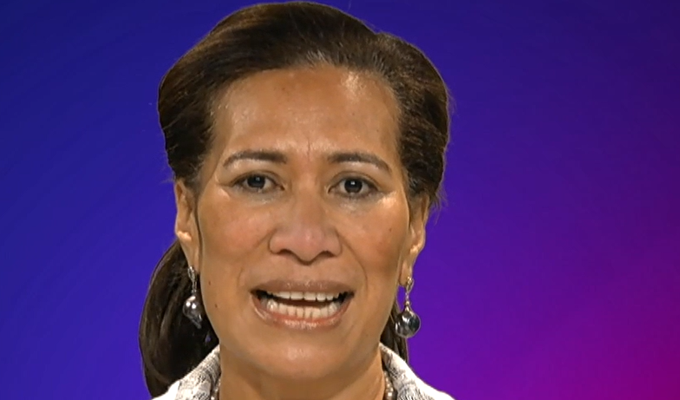
Tonga’s former Minister of Health, Dr Amelia Tu’ipulotu, has taken up her new role as Chief Nursing Officer with the World Health Organisation (WHO).
In her inaugural address, Dr Tu’ipulotu said she was privileged to be the WHO’s new Chief Nursing Officer.
Associate Prof ‘Amelia Afuha’amango Tu’ipulotu
She said she would be an advocate for nurses and midwives around the world.
She said they had faced tough times during the Covid-19 epidemic and shown courage, resilience and commitment to their profession.
They served some of the world’s most vulnerable communities.
She said the world needed to be better prepared to respond to challenges in the future.
Dr Tu’ipulotu told Kaniva News she was extremely overwhelmed and excited by the appointment.
“I cried as it was still confidential until the public announcement a few weeks later,” she said.
“So I prayed for comfort and thanked God for everything and I just felt totally lost and overwhelmed!”
She had been travelling to Lao PDR and Cambodia and had just returned to Manila when she was informed of the appointment.
“I was reflecting to my life, my family and Tonga and said to myself: Now I am going to be thrown into the Deepest Ocean!” she said.
“In Tonga I served 100,000 people and now it is more than seven billion people around the globe! “
“How can I? I continue to ask.”
The International Council of Nurses’ President, Dr Pamela Cipriano, welcomed Dr Tu’ipulotu’s appointment and offered the support of ICN in furthering the cause of nurses around the world.
“ICN firmly believes that successful healthcare policymaking requires a commitment to having the voices of nurses heard wherever decisions are made, and that all countries should have their own government-level CNO who reports directly to the top governing executive,” Dr Cipriano said.
“We will continue to campaign for this until every nation has a fully functional government-level CNO in place.”
She was a clinical nurse, a senior nursing lecturer, Chair of the Tongan nurses’ regulatory board and Chief Nursing Officer for Tonga from 2014 to 2019 before taking on the role as the Minister of Health.
Since 2019 she has been an Honorary Adjunct Associate Professor at the University of Sydney, Australia, and in 2022 she was appointed to the WHO’s Executive Board.
She was the first Tongan to win the Alumni Award for Professional Achievement, a prestigious honorary award from the University of Sydney, Australia.
The petitioner failed to prove its case beyond a reasonable doubt that MP Piveni Piukala allegedly committed five instances of bribery contrary to section 21 (1) (a) of the Bribery Act.
MP Piveni Piukala with media outside the Supreme Court
These were the alleged giving of cash prizes for poetry competitions at Mr. Piukala’s campaign events, the giving of cash prizes at an event at the Golf Club and, lastly, the giving of groceries to Mamata Kohinoa.
Piukala stood against an unsuccessful candidate, Feleti Fā’otusia during the November by-election. A supporter of Fā’otusia, Feleti Ulakai then brought an election petition before Judge Cooper, claiming that Piukala violated the electoral regulations by allegedly giving out $100 to a few voters of Tongatapu 7.
He accepted he had not enquired from whom that money had come. He had seen money given and so believed there had been acts of bribery.
“He had not checked and asked whether a prize winner felt bribed or induced by prize money, but he believed that was the effect of what had taken place because Mr. Puikala was present while those distributions were made.
“Because the Master of Ceremonies had mentioned sponsors would donate prizes and Mr Piukala was there with his supporters he equated the giving of the gifts with the Respondent.
“Of the event at the Golf Club, he had watched the broadcast and those people in the image were not golfers yet had won a prize. He did not know how much but the envelope handed over had a dollar sign on it, so he assumed that was a bribe.
He had not heard Piukala asking the winners to remember him at election day, but the giving of these prizes was made within the months of the by-election”.
Piukala gave away prizes and gave out free beer.
“As far as he was concerned this did not happen regularly, as was suggested, if it had he would have expected to see more live-stream broadcasts of him giving away prizes, which he hadn’t”.
In his defense, Mr. Piukala made a single submission to cover each of these events. These points included what he submitted to be three essential arguments:
a) None of the poetry competitions had been demonstrated to be organised by him.
b) The prizes had not been proved to have been given by him or on his behalf.
c) It was not with the aim to induce people to vote for him.
d) What other people post on their social media pages is out of his control.
In his summing up Judge Cooper said that regarding the golf club event that “allegation also has failed to be proved”.
In his comment on the poetry competitions Mr Cooper said: “There is no evidence how this event was organised, for example whether there was a program of activities or not.
“Without a more careful and detailed presentation of available evidence that shows, for example, positive links between the sponsors of the prize money and Mr. Piukala as well as a plan between them for this to have taken place, the only evidence being his attendance at the event where it happened.
He also said: “None of the allegations as set out in the Petition, on the evidence called, was proved beyond a reasonable doubt, so to the required standard. So the case for the Petitioner has not been proved.
The petitioner is to pay the costs of, and incidental to, the proceedings, to be taxed in default of an agreement”.
The Tongan government will look at the Dubai-based Validus after the New Zealand Financial Market Authority put a temporary ban on the promotion of the company’s multi-level marketing scheme.
The Deputy Prime Minister and Minister of Justice Samiu Vaipulu has confirmed this to Kaniva News this morning.
“‘E fai ‘a e ngāue ki ai”, he said in Tongan.
Deputy Prime Minister and Minister of Justice Samiu Vaipulu. Photo/Fale Alea ‘o Tonga
Promoters of Validus, which is registered in the United States, are prohibited in New Zealand from:
making offers, issues, sales or other acquisitions or disposals of financial products promoted under the brand or name Validus; and
accepting applications for financial products promoted under the brand or name Validus; and
distributing any restricted communication that relates to:
the offer, or intended offer, of financial products promoted under the brand or name Validus; and/or
the supply, or possible supply, of a financial advice service to any person; and
accepting further contributions, investments, or deposits in respect of financial products promoted under the brand or name Validus; and
supplying a financial advice service to any person; and
supplying the financial service of keeping, investing, administering, or managing money, securities, or investment portfolios on behalf of other persons”.
The FMA previously said: “We are concerned that Validus is operating in breach of the New Zealand financial markets legislation”.
“Validus is providing financial services in New Zealand without registration as a financial service provider as required by the Financial Service Providers (Registration and Dispute Resolution) Act 2008.
“We strongly recommend that investors do not trade or invest with entities that are not registered and/or licensed in New Zealand.”
The company has expanded its services to include Tonga with promoters from Australia and New Zealand arriving in the kingdom recently.
It came after promotions on social media including setting up of a Facebook account under the name Validus Tonga. It has more than a thousand followers.
It is understood Validus promoters held various meetings in Tongatapu including Nukunuku and Malapo this month.
Pyramid scheme
The Australian Securities & Investment Commission said Validus is a scam and warned people to be wary of the company.
“Validus encourages investors to recruit new investors into the scheme. This is a classical sign of a pyramid scheme”, it said.
Pyramid scheme is a form of investment illegal in Tonga, Australia, New Zealand and elsewhere in which each paying participant recruits two or more further participants, with returns being given to early participants using money contributed by later ones.
The Tongan community has already been affected by scams, including pyramid schemes in which people have lost hundreds of thousands of dollars.
Last year, two women had been found guilty at the Nuku’alofa Supreme Court for running a pyramid scheme.
The two accused, Viola Tupa (Tupa), and ‘Anaseini Pongi (Pongi) were charged with advertising a scheme in Kolomotu’a , where profits earned by participants in the scheme largely depended on increases in the number of participants in the scheme.
In 2021 it was reported that Tongans in New Zealand who put thousands of dollars into pyramid scheme, Tongi Tupe Nu’usila, have been left without cash for food or rent as the country is plunged into lockdown.
“Those recruited into the scheme are told if they put in anything from $2,500 – $10,000, after three weeks they can turn up to collect big money every Saturday, turning over profits of thousands of dollars”.
Unanswered questions
People who attended Validus meetings in New Zealand had been left with many unanswered questions.
They asked “why it was when you Google the one American residential address posted on one of the company’s several websites, several other firms with the same address”.
“I wanted to know why his firm was offering financial services but had not registered with any of the financial regulators in the countries in which it was operating.
“I wanted to hear his response to a warning by the Australian Securities & Investment Commission that Validus “had classical signs of a pyramid scheme”.
“I wanted to know why it seemed as if the only way to make money in Validus was to recruit others to join”.
MetService has issued an orange wanting meaning heavy rain is on the way for cyclone-hit Hawke’s Bay.
Workers scoop out silt in the rain in Pakowhai near Napier today. Photo: RNZ / Phil Pennington
From now through until 10am on Saturday people the region can expect 150 to 200mm of rain about the ranges and also away from the ranges north of Hastings (this includes the Esk Valley area and the Wairoa District), and 75 to 100mm elsewhere.
The heaviest falls are likely from 3pm on Friday, with peak rates of 20 to 30mm/hr possible.
Hawke’s Bay Civil Defence controller Ian Macdonald says people who live on the Heretaunga Plains area where stopbanks failed should make preparations in case they need to evacuate.
Other areas are under a heavy rain watch and thunderstorms are possible in Coromandel Peninsula and Bay of Plenty about and west of Te Puke from 2am on Friday until 1am Saturday.
Gisborne can expect periods of heavy rain, with thunderstorms possible in the 36 hours from 2pm today. Rainfall amounts may approach warning criteria, MetService says.
Auckland can also expect to be drenched tomorrow with some heavy rain and possible thunderstorms from midday until 10pm.
Meanwhile, as of Wednesday afternoon 346 people remained listed as uncontactable in flood-affected areas.
Police have deployed four specialist victim recovery dog teams to the Eastern District to help in the search.
The death toll remains at 11 – nine people in Hawke’s Bay, and two firefighters in Auckland.
About 700 people displaced by Cyclone Gabrielle across the North Island are still seeking shelter at Civil Defence centres.
Seasonal workers from the Pacific are bunking in emergency shelters after Cyclone Gabrielle tore through New Zealand’s North Island as they wait to hear if there’s still work available for them.
Photo: RNZ/ Anusha Bradley
Alusio Kaloudau, a team leader of a Fijian Recognised Seasonal Employer (RSE) group, said they are staying in Flaxmere Community Centre in Hastings in Hawke’s Bay on the east coast.
During and after the storm the group of 21 workers were forced to move into three different shelters.
Kaloudau said his team was told to “just relax” by one of the RSE caretakers when they arrived at the first shelter.
“Those of us who are from Fiji we don’t relax, we just do whatever we need to, so we put all the tables aside for other people to come and stay, then we managed to cook some food,” he said.
Kaloudau said his group continued to help out at each of the shelters they went to.
The Hawke’s Bay Cook Islands Community Centre has also taken in more than 75 RSE workers from different Pacific countries.
However, the centre’s president Derek Teariki said he didn’t know how long they would be able to host the workers.
“The help out there is really good, the supplies are coming in, there are a lot of organisations and communities helping as well,” Teariki said.
“We just don’t know how long they are going to last at the Cook Islands Community Centre. We will look at it day by day.”
Photo: RNZ/ Anusha Bradley
Tuatagaloa Joe Annandale, the founder of Samoa RSE recruiter organisation Falealili Seasonal Workers Programme, said his group needed to be rescued from the roof of their accommodation during the cyclone.
Tuatagaloa said there was “certainly fear” amongst the men as the water started to rise and he was thankful for their “good sense” to climb on the roof.
Since being rescued, Tuatagaloa said his team had been very well looked after.
“They have been overwhelmed with the generosity and the love and the care that that has been shown by their employers,” Tuatagaloa said.
“A lot of the boys didn’t even have suitcases, they had just a backpack when they went to New Zealand. But now they’ve got suitcases, they’ve got all the clothing they need, and they’ve been fed very, very well. And the accommodation they’ve been re-allocated to is great.”
Tuatagaloa said Samoa’s history with tropical cyclones would have prepared the workers for the weather event, even though they are a bit different.
“We know how to sleep in the sand and live on nothing for a day or two. Sure it’s inconvenient and stressful at times, but we’re a resilient people and that will have helped for sure.”
The cyclone caused damage to farms and closed off forestry blocks making some of the workers’ future uncertain.
However, Tuatagaloa said he had been assured by one of the employers, Johnny Appleseed, there was still work available.
“There is enough work for them cleaning up and there is some some crop to be harvested, so they don’t have to be sent back home, not just yet anyway.”
However, he said there was not enough work for those in Samoa hoping to arrive in Hawke’s Bay this month.
“It’s very sad because they were all looking forward to it.
“All the airfares are paid for and they’re ready to get on the plane. We got notice late last week, from our partners in New Zealand to say that sorry, there’s no point in bringing them up because there would not be any work for them.”
Tuatagaloa said the RSE workers planning to go to New Zealand may still be able to find work in Australia.
Solomon Island workers all safe
Solomon Islands New Zealand High Commissioner, Eliam Tangirongo, said the country had 200 RSE workers in Hawke’s Bay who are safe. But there was uncertainty over whether they would continue working.
“That is something that we are yet to receive a definite response on,” he said.
“There’s a possibility that they could be moved around to other farms, or other parts of New Zealand in the coming months.
“While some of them may be involved in the rebuilding and reconstruction phases.”
President of the Fiji Tairāwhiti Community, Iliesa Batisaresare, is in Te Poho o Rāwiri Marae in Gisborne helping the affected community.
Batisaresare said seasonal workers and people in the forestry industry were also uncertain if work was available.
He said the visa conditions meant they could not work outside of their prescribed businesses. With forestry roads closed he wants to know if the Fijian community could work for other companies.
Tonga Police have disrupted an illegal liquor sale conducted at a residence at Ngele’ia on Saturday 18.
Photo/Kaniva Tonga News
They seized approximately over 500 cans/bottles of various alcoholic beverages.
The owner, who has been charged for selling liquor and running a business without the required licences, appeared in court earlier today.
“Tonga Police recognizes the increase of clandestine markets, mostly known as ‘Black Markets’ in Tonga, which operates mainly for the illegal sale of alcohol amongst other products”, a statement said.
“Tonga Police urges the public to abstain from operating these illegal markets as they contribute to crime such as Domestic Violence, Housebreaking and Theft, and we have also witnessed many lives lost unnecessarily on our roads due to drink driving”.
Tonga’s inter-island ferry, the MV ‘Otuanga’ofa, was told to stay out of New Zealand waters for three weeks because it posed a biosecurity threat, Kaniva News can reveal.
The ‘Otuanga’ofa arrived in Auckland in September 2022 and was expected to return to the kingdom last October.
MV ‘Otuanga’ofa moores at Auckland’s Titan berth. Photo/Kalino Lātū
New Zealand’s Ministry for Primary Industries told Kaniva News that the ferry was ordered back to sea for being “non-compliant with New Zealand’s biosecurity regulations.”
The Ministry said she was allowed back into port to collect provisions.
However, even though the ferry had been ordered to leave port to be cleaned, there was a delay because vital equipment was not working.
Kent Smith, manager of Maritime New Zealand’s General Regulatory Operations, said his department became aware in early October that the ‘Otuanga’ofa had no functioning AIS (Automatic Identification System) which broadcasts the vessel’s details and location to other vessel’s in the vicinity.
Because the AIS was required as part of the vessel’s safety equipment, Maritime New Zealand detained the vessel for 24 hours to allow the issue to be rectified. The vessel sailed as directed by MPI Biosecurity on the evening of October 6.
“As of mid-February the vessel remains in Auckland,” Smith said.
Sources have reported that the vessel was told to remove marine growths from its hull and eliminate a cockroach infestation.
New Zealand has extremely strict regulations to prevent infestation by foreign species. In January two cruise ships were the subject of action by the Ministry of Primary Industries.
Sources have told Kaniva News the ‘Otuanga’ofa could have been cleaned in Tonga before the vessel arrived here to avoid incurring further costs.
Once the ferry met MPI’s requirements it was allowed back into port and was dry-docked at the Titan Marine Engineering Ltd wharf.
The vessel was expected to sail on January 31, but last night, February 21, was still at the Titan Marine wharf.
There is speculation that the vessel will stay in Auckland into March because more maintenance needs to be done before New Zealand authorities will allow the vessel to sail.
Tonga’s Minister of Transport told a press conference in late January that when the ferry arrived in New Zealand some unforeseen mechanical and electrical issues were identified which were not addressed when the ‘Otuanga’ofa was being repaired in Fiji in 2018.
The ‘Otuanga’ofa was given to Tonga by the Japanese Government in October, 2010 to replace the Princess Ashika, which sank in Tonga’s worst maritime disaster.
MPI regulations
The Ministry for Primary Industries says marine pests and diseases introduced to New Zealand on vessel hulls (biofouling) are regarded as a threat to the country’s marine environment and resources. All vessels arriving in New Zealand must provide evidence of biofouling management prior to arrival.
MPI warns visiting vessels to organise an underwater inspection and act on all biofouling found and to make sure a recent underwater inspection or underwater cleaning report is supplied to MPI.
Vessels that cannot provide verifiable evidence may be ordered to have a hull inspection on arrival to New Zealand. The vessel’s itinerary can be restricted, entry to New Zealand waters can be restricted or MPI can require a hull cleaning within 24 hours of arrival.
Any work is at the expense of the ship’s owner or operator.
Cruise ships
In early January the cruise ship Viking Orion was restricted to visiting approved ports and asked to leave New Zealand waters because of algae on its hull.
Two weeks later the Seven Seas Explorer was ordered to anchor 22 kilometres off Tauranga, outside New Zealand territorial waters, while the hull was cleaned.
A survey of the cruise ship’s hull while she was docked in Auckland revealed tubeworms, barnacles and oysters.
A man who killed his partner with a single blow to her head at a party in Manurewa has been sentenced to five months home detention.
‘Umukisia Tu’iono. Photo/Facebook
Penitiketo Uhatafe, 47, pleaded guilty last year to the manslaughter of his partner Umukisia Fiva, also known as Umukisia Tuiono, while they were on an extended holiday to New Zealand from Tonga.
She was 34 and the mother of a teenage daughter.
He appeared for sentence on Tuesday morning represented by Lorraine Smith in the Auckland High Court, before Justice Anne Hinton. The Judge said the short home detention sentence acknowledged the seven months he had already spent in prison plus the almost two years on electronically monitored bail.
Crown prosecutor Christopher Howard sought a starting point of four to four-and-a-half years while Smith submitted three-and-a-half years was appropriate.
Howard acknowledged it was a singular assault and that its lethal outcome was not intended.
But he said there were a number of aggravating features to the offending.
Uhatafe fled the scene rather than administer aid to his partner.
The assault was “completely unprovoked” and involved a degree of forethought because it was preceded by a threat, Howard said.
“It is a relationship in which Ms Fiva should have been entitled to feel safe.”
The Crown supported a discount of 15 percent for his previous good character, his remorse and his efforts at rehabilitation.
The Judge resisted a good character discount.
Penitiketo ‘Uhatafe
“I probably can’t allow a discount of good character for someone who’s killed his partner,” Justice Hinton said.
“But it could be characterised as rehabilitation and remorse.”
The Crown also suggested a further eight month discount to take into account the seven months he had spent in prison, plus the 22 months on electronically monitored bail.
Howard said the most that should be applied for his guilty plea was 15 per cent, given it came two years after he was charged.
Smith said the Crown relied on the case of Tyrone Palmer, a young man in Invercargill jailed for 22 months in 2016 for manslaughter following a one-punch assault described as a “king hit”. However, Palmer’s lethal assault was different from Uhatafe’s, Smith said.
“There is no suggestion in the summary of facts that Mr Uhatafe delivered a king hit,” she said.
Smith sought a 20 per cent discount for his guilty plea plus discounts for a number courses he has completed and community work he has voluntarily undertaken.
“It certainly shows real effort on his part,” Smith said.
Smith sought a discount of 15 per cent for a cultural report suggesting Uhatafe’s kava habit instilled by his father had developed into a drinking issue, a report the Crown said should be given no weight at sentencing.
Justice Hinton said there were a number of aggravating factors, including the breach of trust, the previous threat of violence and the fact he had targeted his partner’s head.
“You must now live with the reality that you were responsible for taking her life and depriving her daughter of a mother.”
However, Justice Hinton said she needed to take into account the case law of similar manslaughter decisions – what are referred to as the “one-punch” cases.
Justice Hinton applied the same starting point as in the Palmer case, four years imprisonment.
The Judge applied 10 per cent for the factors outlined in his cultural report, including his socio-economic deprivation growing up and the daily kava drinking sessions instilled by his father.
A 15 per cent discount was given for the guilty plea plus a further discount for a letter of remorse and the 60 hours community work already undertaken voluntarily out of a promised 200.
“I see you have taken very seriously working on your anger and alcohol issues.”
Justice Hinton applied the 8 month discount sought by the Crown for the nearly two years spent on restrictive electronic bail, taking the sentence to 21 months, within range for home detention.
The final sentence was five months home detention. Justice Hinton said this was much lower than it would have been given Uhatafe had already spent seven months in prison and two years on restrictive electronic bail.
Uhatafe and Fiva had been in a relationship for about five years when they came to New Zealand for a holiday in March 2020.
Covid-19 travel restrictions kept them in the country and on September 26, 2020, the couple went to a birthday party at the home of Uhatafe’s friend in Manurewa.
The revellers gathered on the home’s wooden deck where they ate and drank on long tables.
The party continued into the early hours. About 3am, the couple were sitting next to each other with several other guests.
A summary of facts released to the Herald by the court said Fiva used a phone to video one of the guests singing at the party.
This angered Uhatafe, who began arguing with Fiva.
“The defendant told her that, if she did it again, he would slap or smack her,” the summary said.
“He took the phone from her and placed it on the table. The deceased picked up the phone again, and they continued to argue.”
Uhatafe then stood up and hit Fiva once on the left side of her head “with significant force”.
She slumped forward in her chair unconscious, then fell onto the deck.
Another guest saw the assault and threw a glass at Uhatafe, who ran from the property to a family members home nearly, chased by several men from the party who saw the assault.
Meanwhile other guests went to the aid of Fiva, giving first aid, administering CPR and calling an ambulance.
Paramedics and police arrived and attempted CPR but did not find any signs of live.
Fiva was pronounced dead at the scene.
Uhatafe was found at a nearby home.
“When interviewed, he stated had struck the deceased once with an open palm and that she fell from her chair onto the deck.”
Both Fiva and Uhatafe have children. Family of Uhatafe including his sister, uncle and aunt were in the public gallery during sentencing.
Fiva’s family elected not to take part in the sentencing process.