Covid-19 Response Minister Chris Hipkins said surgical masks would likely become the default face covering to help contain community spread of the virus.
But University of Otago Wellington Department of Public Health research fellow Dr Lucy Telfar-Barnard said well-fitting N95 or P2 respirator masks were a better option.
“Surgical masks are not good enough in an Omicron outbreak,” she said.
“We do need to be making those respirators accessible to people across the population.
“I’m trying to come up with some sort of explanation as to why they are not recommending people wear N95s if they can access them, it just doesn’t make sense to me.”
High-grade N95 masks have become the international gold standard in efforts to stop the spread of Omicron.
When they are worn properly, N95s can filter out at least 95 percent of airborne particles, including the coronavirus.
University of Auckland aerosol chemist Dr Joel Rindelaub said N95 or P2 masks offered the best protection.
“If we want to do the best we can to try to stamp out Omicron we need the best technology available and that of course would be the N95 or P2 varieties,” he said.
Dr Rindelaub said people who did not have N95 masks could instead wear a surgical mask with a cloth one on top, or knot the loops for a tighter fit.
The government is expected to give updated advice on face coverings on Wednesday, with a likely focus on surgical masks.
Dr Telfar-Barnard said the government should urgently release a national mask strategy so people knew what sort of face covering they should wear to best prevent infection.
“These are all piecemeal decisions being made separately and we do need a national mask strategy that covers what masks should be worn, where, and making sure that when people buy masks they know what level of filtration it’s providing,” she said.
She said the government should consider distributing enough masks so that everyone had at least one or a set they could rotate over a week.
Children as young as eight years old will have to wear masks at school when the new term begins under the red traffic light setting.
While research on masks was still evolving, Hipkins said the government would act on any new advice quickly.
“We know that N95 masks are more effective at stopping the spread of Covid-19, having said that, an N95 mask needs to be the right fit, otherwise it can potentially be less effective,” he said.
“Surgical masks are probably likely to be the best masks for the public’s use.”
Hipkins said there were plenty of N95 masks in stock for healthcare and other essential workers.
There are 25 new cases of Covid-19 in the community today, including eight confirmed cases of the Omicron variant.
Photo: 123rf.com
There are 13 new community cases in Auckland, four in Waikato, four in Northland, two in Nelson Tasman, one in Rotorua 1 and one in Manawatū.
To date, there are 19 community cases of Covid-19 associated with the January Omicron Cluster, all are in isolation, the Ministry of Health said in a statement.
“Of these cases, today we are reporting eight – two are in the Nelson/Tasman region and are contacts of existing cases, five cases are in Auckland linked to one of the reported family events, and there is an additional case in Palmerston North, a household contact who was already isolating and linked to the previously reported Palmerston North Omicron case.
“The number of cases and contacts are expected to grow given the highly transmissible nature of Omicron and as we learn more from case interviews.”
There are also 50 new cases in managed isolation today.
There are 10 cases of Covid-19 in hospital today – five in North Shore, two in Auckland, one in Middlemore, one in Rotorua and one in Northland. There are no cases in ICU or HDU.
On vaccinations, 21,318 booster doses and 6399 paediatric doses were given yesterday. There were 10,061 tests in the past 24 hours.
From now, unlinked positive cases of Covid-19 in the community will get priority for whole genome sequencing, the ministry said.
These samples will be treated as urgent and tested within 12-24 hours of being received by the laboratory.
Previously, sequencing Covid-19 in international arrivals was the priority.
Yesterday health officials announced there were 24 new community cases of Covid-19 in the community, and 47 new cases in managed isolation and quarantine facilities.
Kāinga Ora hopes new fencing, speed bumps, signage and mirrors will stop vehicles hitting children in driveways.
Kāinga Ora is altering the properties of 8500 of its tenants in an attempt to stop vehicles hitting children in driveways (file picture). Photo: RNZ / Claire Eastham-Farrelly
Five children are hit and killed a year in driveways, and more than 20 are hospitalised.
Half the time the driver is the child’s parent.
Kāinga Ora is altering properties for 8500 tenants and has spent $2 million in the past financial year – to prevent these accidents.
Safekids Aotearoa director Mareta Hunt said driveway accidents cause extreme heartbreak for families.
Hunt said many families cannot afford these changes, and lives will be saved because of the initiative.
“Ensuring whanau get to enjoy their tamariki and live a wonderful life with their children without these adverse incidents because it is really painful.”
She hopes the funding will extend to all state housing.
Covid-19 data modeller Michael Plank said, once it gathered momentum, it could spread very quickly.
“It’s certainly possible that once an Omicron outbreak really gets going that we could see a significant proportion of the New Zealand population get infected – it could be up to half,” he said.
Covid-19 data modeller Michael Plank. Photo: Supplied.
That could take about four months from when cases started to rise exponentially, with a potential peak after eight weeks, and more people infected on the way down.
But he stressed the figure of 50 percent was not set in stone.
There was a lot of uncertainly about how the virus behaved because it had only been on the world scene for about eight weeks – and public health measures could have a big impact on the outcome, he said.
“The actions we take now and over the coming weeks could reduce the number of people who get infected and it could be a significantly lower proportion,” he said.
The prime minister said the government was planning for scenarios of up to 50,000 cases a day to make sure it was well prepared, but stressed it was not based on modelling.
Auckland’s three district health boards were predicting a 1800 cases a day for the city at the outbreak peak, expecting to see that in March.
Epidemiologist Michael Baker said it would be just a few days before Omicron started to surface in other parts of the country, after a family from Nelson-Marlborough and a flight attendant tested positive this weekend.
He wanted the government to consider putting alert level 2-to-3-style lockdowns back on the table if the virus gathered momentum too quickly.
It should also shorten the time people needed to wait for a booster from four months to three months, because that could stop people getting very sick and slow the spread, he said.
Director-General of Health Ashley Bloomfield said his teams would consider the booster issue next month, as well as whether to shorten the gap between doses for under 12s.
The government has continually ruled out lockdowns now that the traffic light system is in place.
Even those who got mild symptoms could feel very unwell and should be prepared, he said.
“This infection is extremely unpleasant for many people – it’s like the worst head cold you’ve ever had. So, people need to have stocks of basic medicines like paracetamol and anti-inflammatories,” he said.
Anyone due for their booster should get one now because it could be just two weeks before the virus was much more widespread, he said.
This story has been adapted from ‘The Evacuation of Niuafo’ou, an Outlier in the Kingdom of Tonga’ by Garth Rogers, which originally appeared in The Journal of Pacific History, July, 1981.
On October 12, 1946, the New Zealand Herald ran an article with five consecutive headlines: CALL FOR HELP . . . NIUAFO’OU ISLAND . . . MATUA DIVERTED . . . MOVING 1306 PEOPLE . . . COMPLETE EVACUATION followed by an article which gave the impression that Niuafo’ouans were on the brink of disaster and fiery death.
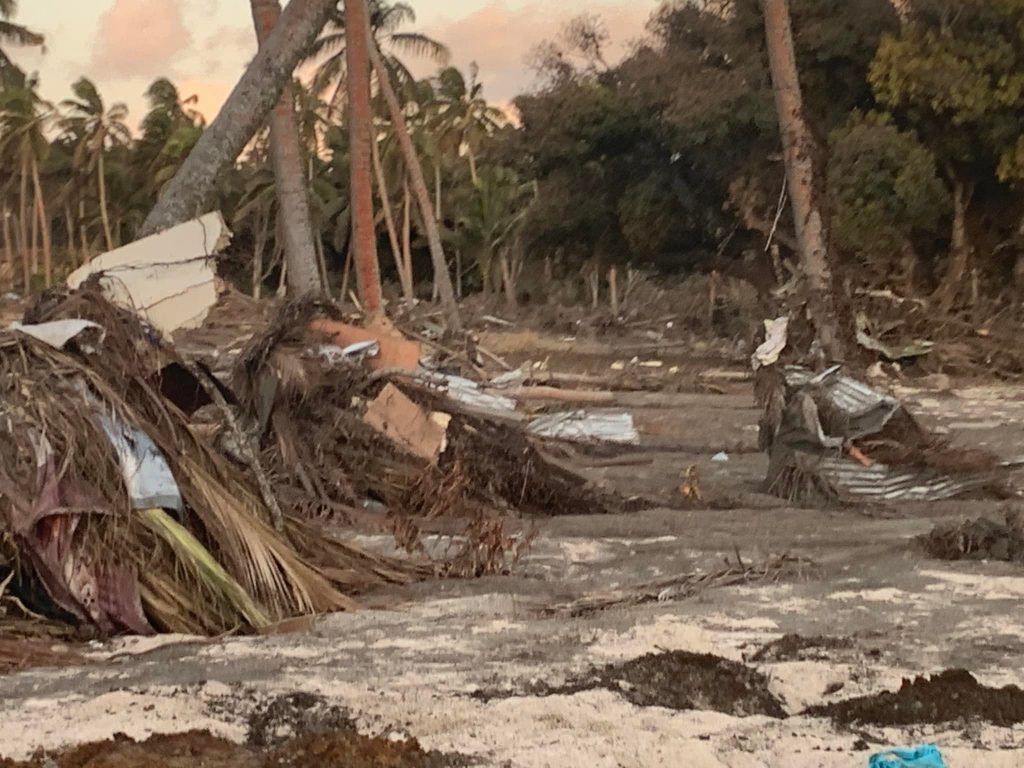
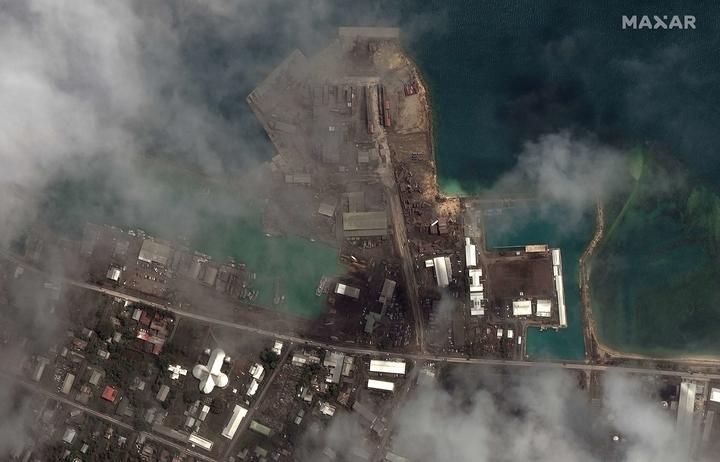
The powerful volcanic eruption in Tonga last week devastated the islands of Mango, Fonoifua and Nomuka and parts of the main island of Tongatapu. Photo/ Minister of Health, Dr Saia Piukala
Nothing could have been further from the truth, but the Tongan government decided to evacuate the 1300 people living on the island anyway. It was a decision that disrupted the lives of the evacuees for years, lost the government vital income and which eventually had to be rescinded.
The Herald’s dramatic headline came weeks after an eruption on Niuafo’ou on September 9, 1946. The island’s radio was put out of action and the Tongan government asked an aircraft flying from Fiji to Samoa to detour to the island and see what was happening. The aircraft reported volcanic activity on the northern tip of the island, with part of a village being destroyed. An SOS sign was visible from the air and people could be seen waving.
As soon as news of the plight of the Niuafo’ou people was announced, offers of advice and help came pouring in. It appeared that food was available, but additional medical supplies might be needed for the doctor.
The U.S. Air Force base in Tutuila offered to drop medical supplies and food. The ketch Hifofua was immediately commissioned by the Government to sail to Niuafo’ou. An emergency meeting of the Privy Council in Nuku’alofa decided to send the Minister of Lands, Hon. Havea Tu’iha’ateiho, together with a doctor, a radio technician, medical supplies, food and radio equipment to Niuafo’ou.
When they arrived on to Niuafo’ou, Hon. Tu’iha’ateiho and the Niuafo’ou noble faced a dilemma. The island was peaceful and root-crops, coconut palms and livestock were virtually unharmed. However, government workers, nearly all from other parts of Tonga, had lost their offices and buildings, their houses, and their personal possessions, and wanted to leave as soon as possible. Their departure would deprive the island of police, magistrate, jailor, radio operator, medical officer and teachers. The Government had lost nearly everything, including all the government copra, several lighters used for loading copra, the wharf and port facilities.
Apart from some residents of Angahā village who had lost their houses and village allotments, there seemed no urgent demand from Niuafo’ou people to leave the island. However, three senior civil servants on the island were asked to organise a vote on what people wanted to do. There are differing accounts of what the votes were, but all accounts suggest that the majority wanted to leave.
However, there was far less damage than the government thought. The eruption had not destroyed the food supply and had only partially destroyed one village. Even in Angahā the Catholic mission, the government dispensary, one school-house, and about half of the private dwellings were left unscathed. The other seven villages were completely unharmed and their residents largely unaffected except for government services.
So why did so many people want to leave? Historian Garth Rogers suggested that many islanders were dissatisfied with conditions on the Island and had already presented seven petitions to Parliament calling for improvements in everything from representation in Parliament, a government store, better roads and a bicycle for the local medical practitioner.
“The possibility therefore that some Niuafo’ou people used the 1946 eruption to move to Nuku’alofa for personal advantages such as the opportunity of wage labour, better schooling, outlets for handicrafts, etc., cannot be dismissed,” Roberts wrote.
At the same time it was also true that a considerable proportion of the inhabitants wanted to stay.
Eventually, after weeks of delays about 1000 people were removed from the island with some difficulty. The lack of harbour faculties and seasonal wind and tide conditions worked against any hopes of an easy operation.
Some people refused to go, but eventually, in October 1947, the last holdouts left on a government vessel. As Roberts wrote: “The people of Niuafo’ou had lost their island, the Government had lost an administrative centre and source of government finance, and the Tonga Copra Board had lost a large quantity of uninsured copra.”
The Niuafo’ouans met a hostile reception in Nuku’alofa. Very few Niuafo’ouans had been to the capital and the local people were worried they would compete for land and jobs. There was also simple prejudice based on the fact that the Niuafo’ouans looked and acted differently. They used different speech idioms and intonations, wore gawdy clothes and were regarded as being boisterous and uninhibited in public.
The Niuafo’ouans were resettled in the village of Vaikeli which offered ample shelter in old U.S. Army huts, but very little land for gardens or cultivation. The Niuafo’ou noble Fotofili sent cooked food to the camp; Dougald Quensell, former storekeeper at Angahā sent stores from his Nuku’alofa store and Prince Tu’ipelehake sent a cow for the New Year feasting. But the people felt humiliated for they had no means of reciprocating.
Early in January, about 100 people from Mata’aho were moved on Queen Sālote’s orders to her estate at Kauvai, Tongatapu, where the immigrants continued to depend on the charity of local residents and occasional government hand-outt. In January 1947 Fotofili invited the people of Niuafo’ou at Vaikeli to settle on his estate at Lapaha and ‘Alele.
The National evacuation Committee then decided to transfer all but the Petani people from the Vaikeli camp to the Queen’s estate at Matāliku where Queen Sālote had ordered a group of houses and huts for them. Eventually, in 1949, the NEC decided to resettle the migrants in permanent villages on ‘Eua. The plan was to provide land for each of the nine Niuafo’ou villages in the central valley on ‘Eua except Mata’aho, whose people were destined to take up land on a royal estate several kilometres north of the main Niuafo’ou settlements on ‘Eua.
The incomers and the local people clashed and this led to fighting.
By May 1950 the first batch of families had settled into their permanent homes in the new villages, and by 1955 most of the Niuafo’ou people had settled. By 1967, the Niuafo’ou people on ‘Eua had established their independence; they now had their own schools, churches, halls, shops, and lorries, and villages which were reputed to be the neatest in all Tonga.
But just as the immigrants were being settled on ‘Eua, the government was having second thoughts about Niuafo’ou. They realised the island was full of unharvested copra that could be sold to help pay for the costs of the evacuation. What is more, the government could reclaim control of the island and stop it either falling into foreign hands or becoming a haven for foreign fishermen. In the following years larger and larger numbers of copra cutters were landed.
Despite their success in re-establishing their lives on ‘Eua, agitation for a return continued among the Niuafo’ouans scattered across the kingdom. Finally, in 1958 the Evacuation Committee admitted that the people had a right to return.
Niuafo’ou was permanently re-settled by families in 1958, and the Government Primary School was opened in 1959. However, the radio station was not re-established until 1963; medical services were revived only by a voluntary unpaid worker in 1960 and an acceptable system of marketing copra, the chief source of income for the inhabitants was delayed until 1967. Police were not sent to the island until 1969 and even in 1974 there was no prospect of title being given to individual holders of bush allotments.
By 1967 more than 300 adults in 113 households had chosen to return and resettle their home island in spite of lack of services, rather than accept land and Government assistance on ‘Eua. By 1976 there were 678 Niuafo’ouans in Niuafo’ou and 2108 or over three times as many in ‘Eua.
Had Niuafo’ou been destroyed by eruption in the years immediately following the evacuation, the evacuation order would now be regarded as a wise and timely act. However, apart from an outburst in January 1947 reported by a passing yachtsman, the island suffered no natural catastrophe, eruption or severe hurricane while its population was elsewhere. It is not surprising that many Niuafo’ou people blamed the Government for their hardships and losses during their displacement.
Tonga faces a long road to recovery, with most of the population affected by the violent eruption and tsunami that followed, and many areas still scrambling to restore basic necessities.
Almost 85 percent of the country’s population of about 105,000 people has been affected by last weekend’s volcanic eruption and tsunami, the Tongan government said.
It shared more details about the impact of the twin disasters in a statement.
The death toll remains at three: those killed were Telai Tutu’ila, 65, from Mango Island, Lataimaumi Lauaki, 49, from Nomuka Island, and British woman Angela Glover, 50, who lived in Nuku’alofa.
Eight people on Nomuka Island were injured, and another six people had minor injuries (four on Fonoi Island, and two on Tungua Island).
Tongan naval vessels have returned to Tongatapu Island, bringing a person from the Ha’apai island group who needed emergency medical treatment.
The health centre on Nomuka was washed away by the tsunami, so a field hospital has been set up on the island.
The homes and all the belongings of 62 people from Mango Island were washed away, so they’ve been taken to Nomuka. However food and water are now both running low on Nomuka, and the group is likely to be taken on to Tongatapu Island.
Telephone communications between the islands are still a major challenge, the government said, but some islands are using radio to communicate, and a new radio station was being established to help with communications.
Ships from Australia, the UK, Japan and the US are on their way to Tonga carrying supplies and personnel, as well as a New Zealand navy ship. Two New Zealand navy ships and a Fijian vessel have already reached the island country, and two supply runs have been carried out by C-130 Hercules from New Zealand.
But aid deliveries arriving at sea are facing significant challenges, since the volcanic fallout on the ocean surface is damaging ships, the Tongan government said. Domestic flights remain suspended.
Tonga’s National Emergency Operations Centre said clean water was still their main request from those who needed help.
Tonga’s Parliament Speaker Lord Fakafanua said the international assistance was very much needed.
“Tonga’s recovery from this disaster is going to be long-term and I think we need to ensure we keep the momentum up.
“After Tonga’s got enough water we’re going to have to rebuild, and it’s going to be a long road to recovery.”
Lord Fakafanua was in Auckland yesterday taking part in a drive to raise supplies for Tonga.
Tech billionaire Elon Musk has reportedly offered assistance in the form of internet terminals, and Lord Fakafanua says any technological assistance would be a great help.
“I think it’s great, Elon Musk is one of the pioneers of technology… and this will help highlight the issues we have in the islands, and it would be great to have him on board to reconnect with our loved ones,” he said.
The sparsely populated islet of Mango was hit by tsunami waves of up to 15 metres high on Saturday 15.
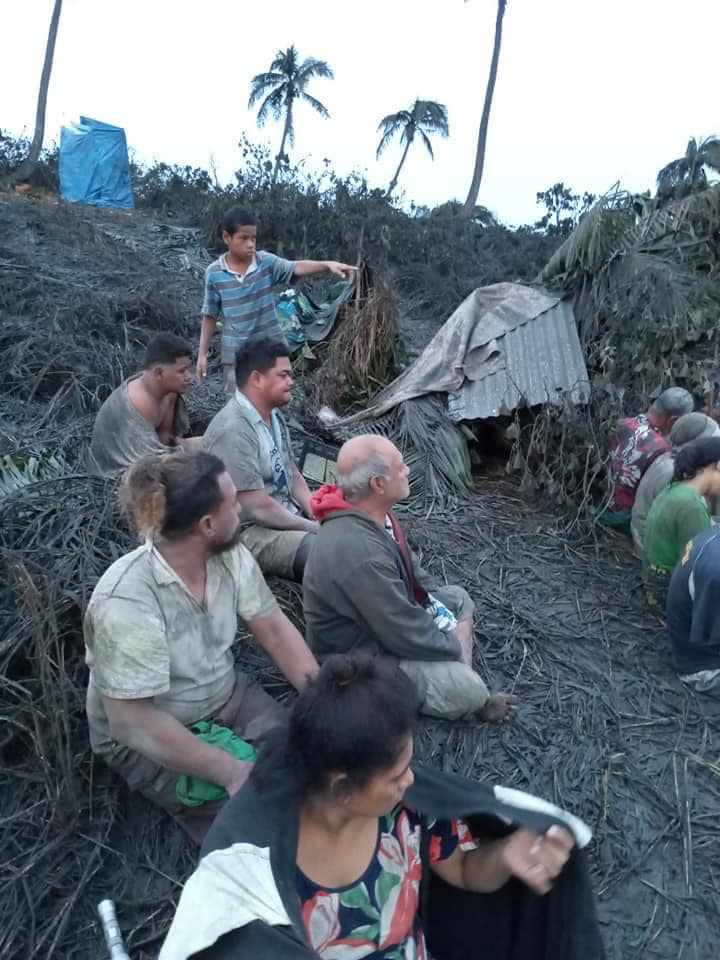
The tsunami wiped out all homes leaving the residents to sleep on the grounds and under mats.
Photos from the scene show the devastating aftermath, with what appeared to be the surviving residents sitting together and waiting for first responders.
The photos were uploaded to Facebook by a person who goes by the name Piokalafi Fakaoc.
Kaniva News could not independently verify the authenticity of the photos.
However, we can tell from comments, replies and the widely sharing of the photos on Facebook they were taken in Mango after the tsunami.
The Minister of Lands and Survey Hon Lord Tu’i’āfitu says the evacuation of the people affected by the tsunami is easy because they were residents of the king, royals and the nobility’s estates.
Lord Tu’i’āfitu
The Minister said it was fortunate that the damage happened to islands and towns owned by the king, royals and the nobility.
The Minister was responding to question raised by some journalists during the first government press conference after last week’s tsunami this afternoon at the St George Palace in Nuku’alofa.
“It’s easy. When the king will allow it it’s an evacuation to estates such as Prince Tungī’s “, Lord Tu’i’āfitu said in Tongan.
The Minister was referring to other estates of the king, royals and the nobility in Tonga which had not been affected by the tsunami as possible new homes for the tsunami survivors.
Lord Tu’i’āfitu said the king and the royals were the first to provide assistance immediately after the tsunami, but he did not say what did they provide.
The islands of Mango, Fonoifua, ‘Atatā and Nomuka as well as Kanoupolu town in Tongatapu were wiped out and blanketed in acidic ash from the tsunami triggered by the powerful eruption.
Kolomotu’a and Pātangata in Tongatapu were two towns which received extensive damages.
‘Atatā belongs to Prince Ata while Mango and Kanokupolu belong to the king. Nomuka is Crown Prince Tupouto’a’s estate and Fonoifua is one of Lord Tu’i’āfitu’s estates. Pātangata and Kolomotu’a are government’s estates.
The estates of the king’s nephew, Prince Tungī in Tongatapu included Tatakamotonga and Fua’amotu where the Fua’amotu Domestic and International airports situated.
Mango was commonly referred to in Tongan as “peito ‘o palasi” or the palace’s kitchen. Mango residents have royal duties which included providing food and fish to the palace. The residents always referred to their island as part of the palace.
The revelation comes after unconfirmed reports that the people of Kanokupolu in Tongatapu may be evacuated to the king’s estate of Mataki’eua in the central south of Nuku’alofa.
Kaniva News is seeking confirmation of the reports.
Mataki’eua estate is a huge area of land with only the king’s villa on top of its large extended height, and a few people living at its southern side.
Telai Tutuila, 65, of Mango and Maumi Lauaki of Nomuka were among the three people reported dead. The other was British woman Angela Glover, 50, who lived in Nuku’alofa.
The homes and all the belongings of 62 people from Mango Island were washed away, so they have been taken to Nomuka. However food and water are now both running low on Nomuka, and the group is likely to be taken on to Tongatapu Island, RNZ said.
Eight people on Nomuka Island were injured and another six people had minor injuries (four on Fonoi Island, and two on Tungua Island).
Tongan naval vessels have returned to Tongatapu Island, bringing a person from the Ha’apai island group who needed emergency medical treatment.
The health centre on Nomuka was washed away by the tsunami, so a field hospital has been set up on the island.
CBS has reported that two people drowned in Peru when the tsunami generated by the eruption crossed the Pacific.
Despite warnings from officials to stay away from Northern California beaches, rescue crews pulled five people to safety after they ventured too close to ocean waters churned up by the surge from Saturday’s tsunami.
Tsunami advisories issued Saturday for the entire U.S. West Coast and Alaska have since been lifted.
Supplies
Almost 85 percent of Tonga’s population of about 105,000 people has been affected by last weekend’s volcanic eruption and tsunami.
Telephone communications between the islands are still a major challenge, the government said, but some islands are using radio to communicate and a new radio station is being established to help with communications.
NASA has estimated that the volcanic explosion was equivalent to five to six million tonnes of TNT, 500 times as powerful as the nuclear explosion that destroyed Hiroshima in 1945.
Meanwhile, naval vessels from Australia, New Zealand and the United Kingdom are delivering supplies to the kingdom.
The harbour at Nuku’alofa is being surveyed by naval specialists to assess damage caused by the tsunami.
Because of fears of contamination of water supplies by volcanic ash, aid shipments have included water. HMS Spey and HMAS Adelaide are both carrying is carrying drinking water.
France 24 has reported that the Tonga Red Cross Society has prepared stockpiles of supplies to support 1200 households, However, these will need to be replenished in the coming days and weeks.
New Zealand will move to red light Covid-19 restrictions at 11.59pm tonight with Prime Minister Jacinda Ardern and Director-General of Health Ashley Bloomfield holding an update on the government’s response to the Omicron variant.
The information regarding the red traffic light setting has just been posted on the government website.
The Ministry of Health yesterday confirmed that another Auckland Airport worker has the Omicron variant of Covid-19. Another Auckland Airport worker was confirmed to have Omicron on 20 January.
An Omicron case was also detected in Palmerston North on Friday and the Health Ministry said it was likely the source of the infection was offshore “rather than transmission in the Christchurch MIQ facility where they stayed”.
The government’s approach to Omicron has come under flak with microbiologist Siouxsie Wiles warning the red traffic light setting will not be enough to slow the variant down and South Auckland GP Dr Api Talemaitoga saying the government had dropped the ball on rapid antigen tests.
New Zealand has been preparing for the arrival of Omicron in the community with doctors preparing to support people isolating with the virus at home and supermarkets starting to stockpile to meet demand.
The World Health Organisation has said although the Omicron variant appears to lead to fewer hospitalisations than the Delta variant and to be less severe in the elderly and very young, it should not be considered to be mild.
By Lydia Lewis of RNZ.co.nz and republished with permission.
A global aid effort is underway with vessels en route to Tonga from Australia, the UK, Japan and the US.
Supplies are loaded onboard the HMNZS Canterbury for Tonga’s relief effort. Photo: Supplied / NZ Defence Force
NZDF Maritime Component Commander Commodore Garin Golding told RNZ Pacific nearby Fiji was also assisting in the relief efforts.
“Fiji is assisting Tonga, they are providing land forces which are going to be embarked on the Adelaide,” he said.
Three New Zealand Navy vessels have departed already and a second C-130 Hercules dropped aid off yesterday.
The HMNZS Canterbury set sail for Tonga on Friday night, the latest to assist with the aid effort.
The ship has two NH90 helicopters, personnel and supplies onboard.
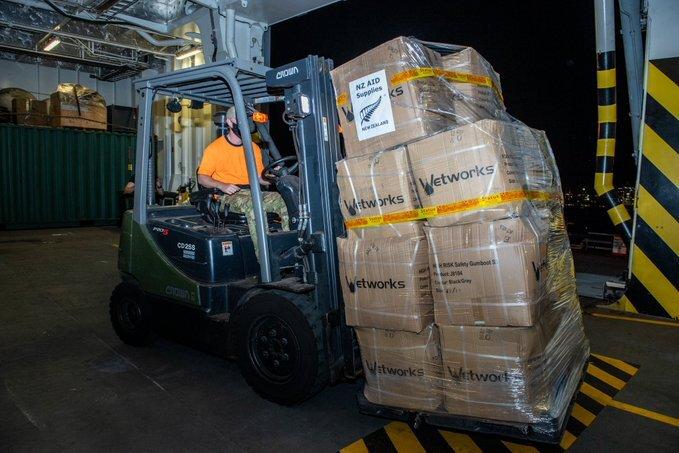
“On board the HMNZS Canterbury is water, milk powder and tarpaulins, but due to her size they have also embarked vehicles and forklifts which are needed to help distribute aid around the airport and port,” Golding said.
“We have also embarked an engineer task force and they can help purify water.”
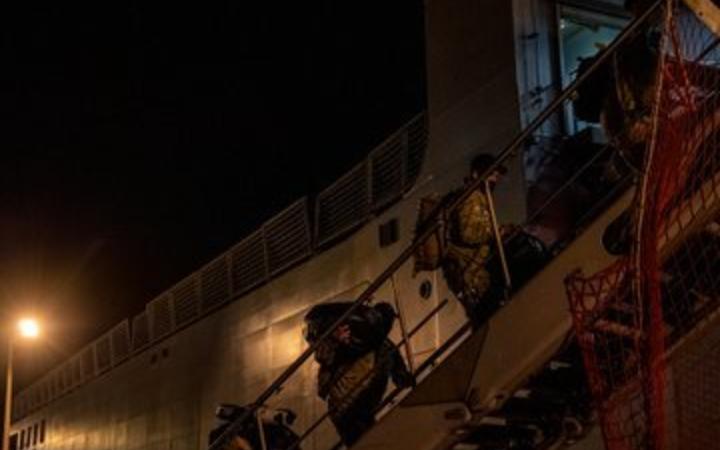
Defence Force personnel board the HMNZS Canterbury. Photo: Supplied / NZ Defence Force
The HMNZS Wellington and Aotearoa are already in Tonga.
Golding said the team onboard the Aotearoa had successfully offloaded five containers of stores and spent Saturday offloading bulk water supplies to be distributed across the island.
“They will be doing that today right through to early next week,” Golding said.
“The HMNZS Wellington sailed overnight [Friday], they received another survey task to the island Eua which is the south east of Tongatapu, they will spend the whole day using their hydrographic and diving personnel just to verify that it is safe for shipping to go in and out.”
Wellington was set to return to Nuku’alofa to continue the survey task, with Aotearoa to stay alongside to continue to offload water supplies.
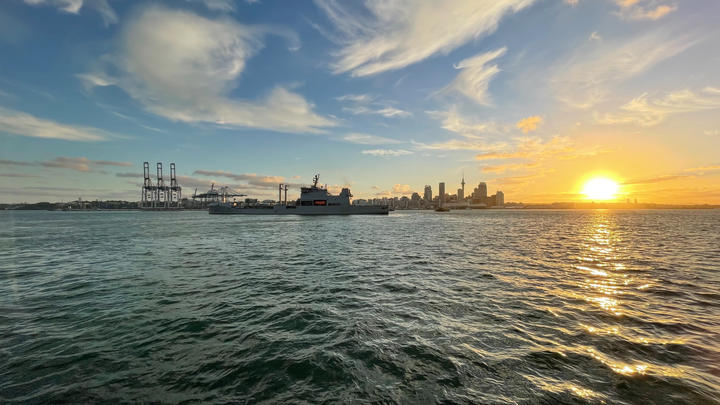
HMNZS Aotearoa leaves Auckland for Tonga. Photo: Supplied / NZDF
The Royal Australian Navy is supporting the effort too, while HMNZS Adelaide is on its way.
“My understanding is, in addition to the three ships we will have, [the] Adelaide from Australia, the [Royal Navy ship HMS] Spey from the UK and the US already has the Sampson [there] and a coast guard vessel is on its way down. I understand a Japanese vessel is on route. I have no information with respects to China,” Commander Commodore Garin Golding said.
The Tongan government has requested Covid-19 measures be observed during the effort and Golding said that was a major focus of the team.
“We will be receiving tasks from the Tongan government and we will be responsive to whatever these tasks are.”

 Covid-19 Response Minister Chris Hipkins said surgical masks would likely become the default face covering to help contain community spread of the virus.
 The tsunami wiped out all homes leaving the residents to sleep on the grounds and under mats.
 The photos were uploaded to Facebook by a person who goes by the name Piokalafi Fakaoc.
 However, we can tell from comments, replies and the widely sharing of the photos on Facebook they were taken in Mango after the tsunami.