A new tsunami warning is now in force for all of Tonga following this evening’s violent volcano eruption.
A tsunami wave struck Tongatapu after locals were urged to seek higher ground.
Photo taken by Patimiosi Ngungutau / Kaniva Tonga News
It came shortly after locals in Tongatapu reported “deafening” sound of an eruption this afternoon. They also reported stones pouring down on Tongatapu.
No injuries or deaths have been reported.
Our correspondent in Tonga Patimiosi Ngūngūtau shared a photo of sea waves flowing inland.
He described the deafening sound as “weird”.
“It was a rain of small black stones and black ashes”, he said.
He said they have evacuated to Liahona at the central south.
Ngūngūtau said ash not only covered vehicle screens but their impact sounded like they could break the screens.
Tonga Geological Services said at 1.45pm this afternoon satellite images captured this morning between showed volcanic eruption continues, with ash emitted and detected at 7.20am this morning.
“This ash plume was due to an eruption that lasted 10 – 15 minutes and was drifting downwind to the east from Hunga. No further eruption has been detected since then”, it said.
“Nearshore water turbulence caused by the eruption is expected to have ceased for all shores of Ha’apai and Tongatapu islands. It is advised that the public observe currents before entering the water.
“Owners of rainwater harvesting systems in all Tonga are advised to check for ashfall on your roofs for ash before reconnecting your guttering systems.
“Please clean if ashfall is evident. For locations of residents where the pungent smell of sulphur or ammonia is experienced please use breathing masks if helpful”.
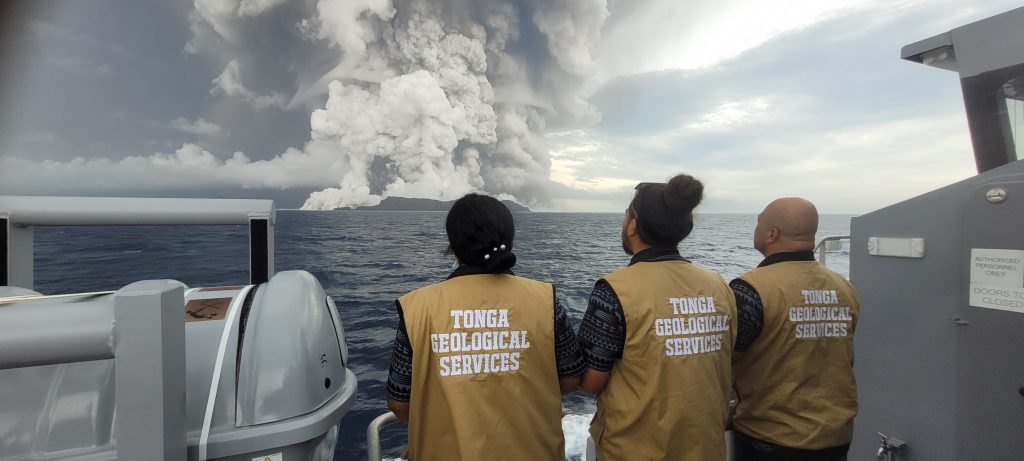
The ongoing activities at the two Hungas’ volcano, which sent ash, steam, and gas 20 kilometers into the air have a new twist.
Geologists on the site. Oversighting Hunga Ha’apai in the forefront and Hunga Tonga ‘o the left. The plumes up to 20km above sea level. Photo/ Tonga Geological Services
In the latest development, locals in Tongatapu have reported “deafening” sound of an eruption this afternoon. They also reported stones pouring down on Tongatapu.
No injuries or deaths have been reported.
Our correspondent in Tongat Patimiosi Ngūngūtau said the deafening sound was “weird”.
“It was a rain of small black stones and black ashes”, he said.
Ngūngūtau said ash not only covered vehicle screens but their impact sounded like they could break the screens.
Tonga Geological Services said at 1.45pm this afternoon satellite images captured this morning between showed volcanic eruption continues, with ash emitted and detected at 7.20am this morning.
“This ash plume was due to an eruption that lasted 10 – 15 minutes and was drifting downwind to the east from Hunga. No further eruption has been detected since then”, it said.
“Nearshore water turbulence caused by the eruption is expected to have ceased for all shores of Ha’apai and Tongatapu islands. It is advised that the public observe currents before entering the water.
“Owners of rainwater harvesting systems in all Tonga are advised to check for ashfall on your roofs for ash before reconnecting your guttering systems.
“Please clean if ashfall is evident. For locations of residents where the pungent smell of sulphur or ammonia is experienced please use breathing masks if helpful”.
A Tongan Police officer has been fired after he punched and kicked a man’s face and stomach while he was being handcuffed.
The final decision was made after a presiding Magistrate allowed him to continue on his job as he was young and took the opportunity to learn from his conviction.
Tēvita Pōhiva was found guilty of one charge of bodily harm, and convicted by Magistrate Sālesi Mafi.
He was ordered to pay $1,000 compensation within one month and in default of payment, he is to serve three months imprisonment with 12 months probation on the condition that he would not commit any further offending.
Pōhiva beats Mr Litili
Pōhiva was on duty on 29 October 2017 patrolling at Vuna Road. He tried to apprehend the complainant, Mr Litili, who was running away from a vehicle, stopped by the Police.
Mr Litili was a passenger in the stopped vehicle. After handcuffing him Mr Pōhiva continued to repeatedly punch his face, part of his stomach and jaw while taking him to the station and while they were outside the police station.
Mr Litili did not pose a threat to Pōhiva at any time, especially after being handcuffed, the Magistrate Court was told.
The ground for sentencing
The Presiding Magistrate Sālesi Mafi gave the following reasons for sentencing Mr Pōhiva:
The victim had made full recovery from the injury sustained as a result of the offending; and
Mr Pōhiva was a young Police Officer, 21 years old, who relatively new to the Police Force.
“The Magistrate wished to give him a chance to do better. He was warned that he would be subjected to a much harsher sentence if he continued to show such behavior in the future. Conclusion If compensation ordered by the Court has been paid, it is mitigating factor, also noting the reasons given by the Magistrate Court for its decision.
Pōhiva, is remorseful and seeks a second chance”.
Police Board decision
However, the Police took the matter further with the Police Board last month and recommended dismissing Mr Pōhiva.
“The Police Employment Committee concluded that Pōhiva used unnecessary and excessive force on the Complainant”.
The authority said that on 8 December 2021, it “considered the application by the Tonga Police after hearing Crown Counsel” for Tevita Pōhiva, in person and ordered, “that Constable Tevita Pohiva’s “employment be terminated effective from the date of this decision”, which was December 14, 2021.
There have been 29 new community cases of Covid-19 reported in New Zealand today and 25 new cases in managed isolation and quarantine (MIQ) facilities.
In a statement, the Ministry of Health said there were 11 new cases in Auckland, two in Northland, one in Western Bay of Plenty, 14 in Rotorua and one in Wellington.
There are 29 people in hospital with Covid-19 and two are in ICU or HDU.
An Auckland MIQ worker returned a positive result for Covid-19 late yesterday afternoon and is in isolation, the ministry said.
The test was taken as part of routine border worker surveillance testing.
Genome sequencing is being carried out to determine what variant the infection is and the results will be reported in tomorrow’s 1pm Covid-19 update.
Investigations are underway to determine if the infection originated from the community or the facility.
The ministry said the worker is fully vaccinated and up-to-date with regular testing.
Household contacts of the MIQ worker all returned negative tests last night.
The 25 cases at the border came from Australia, India, Brazil, Nepal, Fiji, France, Singapore, United Kingdom, United States and Canada.
The ministry said New Zealand continues to see many border cases arriving from overseas, reflecting the growing number of Omicron cases globally.
Yesterday the ministry said there had been 266 Omicron cases detected at the border since the start of December, with more than 18,000 people being processed through managed isolation and quarantine facilities in that time.
New significant volcanic activities at north of Tongatapu on Friday morning prompted a tsunami marine warning for Tonga in the afternoon, however Tonga MetService says this morning the threat has now passed.
The latest eruption had a radius of 260 km (161.5 miles), and sent ash, steam, and gas 20 kilometers (12.4 miles) into the air.
It was also about seven times more powerful than the previous eruption on Dec 20, 2021.
It triggered a 30 cm (one foot) unusual sea wave activities which were observed in Mango and at the Nuku’alofa waterfronts yesterday morning.
“Based on the observation data recorded from the tide gauge at Nuku’alofa it indicated that the state of the sea level is back to normal. The fluctuation of the sea level recorded in the tide gauge at Nuku’alofa was below 10cm over the past s6 hours”, Tonga Geological Services said this morning January 15.
“Therefore the tsunami marine warning previously indicated for the ‘Out Mu’omu’a in Ha’apai (Nomuka, Mango, Fonoifua) ‘Atata, ‘Eueiki, Tongatapu and ‘Eua coastal areas and waters are now cancelled”.
Last night residents throughout the kingdom mainly Tongatapu, Vava’u and Ha’apai shared dramatic photos of red-orange skies hanging over parts of the islands, from which the threatening volcanic eruption at the Hungas could be seen in the horizons.
Fonoi and Mango Islands residents were at the centre of an emergency response after significant volcanic ashfall from the Hungas has contaminated their water supplies.
His Majesty’s Armed Forces together with a team from NEMO will be transporting approximately 3450 litres of water on VOEA Ngahau Siliva to the islands today, January 15. Photo/Supplied
“The government is planning a response with the provision of clean drinking water to be supplied from Tongatapu to these affected populations, as soon as possible for the next 10 days”, NEMO said in a statement.
It said there were 69 residents in Fonoi and 36 in Mango.
“We are proposing a minimum of 3 litres per person daily”.
It has sent a shipment with over 3450 litres of potable water to the two Ha’apai islands.
“435 water containers have been filled from established water harvesting system located at NEMO’s Warehouse in Matatoa. The containers hold 8 litres of water each.
“NEMO has also commenced planning for a medium and long term solution to address the water contamination issue in the islands.
“Prior to the 10 day period completion, NEMO through the Logistics and Coordination Cluster will once again, transport clean drinking water supplies through water tanks. The logistics for the Government of Tonga’s medium term response is currently in progress.”
Tongan authorities previously warned residents in Tongatapu, Vava’u and Ha’apai to remove guttering systems from rainwater tank storage until the eruption finishes. These should not be reinstalled until after the next rainfall, to reduce the risk of contamination.
A New Zealand doctor has been accused of writing clinic notes describing Covid-19-vaccinated patients as “magnetic”.
(File image) When the Ministry of Health released data showing Covid-19 vaccinations rates by suburb and rural community in October, Murupara was the lowest per 1000 people. Photo: RNZ / Angus Dreaver
A colleague who discovered the records was so concerned, they wrote to Covid-19 Response Minister Chris Hipkins.
The ministerial emails have been released to RNZ under the Official Information Act.
The letter sent on 4 November, says “I have spoken to a pregnant patient at the practice in [redacted] who, despite an intention to get vaccinated, was convinced to not get the vaccine after listening to arguments.
“I have seen clinic notes for patients whom I was subsequently asked to review where [name redacted] records them as having become magnetic after getting vaccinated.”
RNZ understands the anti-vax practitioner is Dr Bernard Conlon from the Murupara Medical Centre.
The letter describes when the anti-vax doctor “literally jumped out of” their chair and “clapped hands in celebration” when they saw their community was “at the bottom of the league table for vaccinations”.
When the Ministry of Health released data showing Covid-19 vaccinations rates by suburb and rural community in October, Murupara was the lowest per 1000 people, when less than one third of residents had had one jab.
The doctor who wrote the letter to the minister said they had “been both a recipient of, and witness to, impassioned insistence that the vaccine should best be avoided”.
“[Name redacted] has told me directly, and in no uncertain terms, that the vaccine is dangerous. [Name redacted] insists that getting the vaccine puts the recipient at increased risk of harm, and will prevent that person from developing natural immunity, ultimately making them at greater risk of injury, but also greater risk to the people around them through an increased risk of transmitting the virus to others.
“I have personally been offered hydroxychloroquine and ivermectin (veterinarian ivermectin) from [name redacted] despite not being [name redacted] patient. I have listened to [name redacted] persuade patients that vaccinations are dangerous and ought to be avoided, instead insisting that ‘the smart money’ is on early intervention with zinc, vitamin C, N-Acetylcysteine, hydroxychloroquine, and ivermectin, with the promise that would help them through their infections (locally) and this would afford them ‘natural immunity’ towards the current strain, and future mutations.”
The author finished the letter by saying the anti-vax doctor was “not a safe person to be influencing the healthcare” of patients, “irrespective of history and great mana”.
“My fear is that [name redacted] already had more than enough time to poison local peoples’ beliefs, and I hope that you will deny [name redacted] request for a publicly endorsed platform to spread influence further.”
One of Chris Hipkins’ secretaries then emailed Health Minister Andrew Little’s office, with links to news stories about Dr Conlon.
They said the emailed letter was “pretty concerning” but, in another thread, Ministry of Health Chief Medical Officer Andrew Connolly said only the Medical Council could stop the doctor practising.
Dr Conlon and his partner and colleague Dr Britta Noske have been public about their anti-Covid-19 vaccination beliefs for months.
Both still have their Medical Council practising certificates, but Dr Conlon is being investigated for questioning the safety of the vaccine at a public meeting last year.
In posts on Facebook, the centre has encouraged community members to use a “Community Covid First Aid Kit”.
This includes a mouthwashes, ointment, vitamin D supplements, zinc, and multivitamins, while in other posts from the centre attributed to Dr Conlon, the vaccination is described as “a gene therapy injection”.
Dr Noske told RNZ this afternoon: “I’m yet to see a decent story that any of you guys have written about us”.
“Stuff that the media is putting out makes me completely unimpressed. I refuse to engage anymore because this is ridiculous,” Dr Noske said.
The pair have not been able to do face-to-face consultations since vaccines were mandated for health workers. They have relied on telehealth instead.
Royal New Zealand College of General Practitioners medical director Dr Bryan Betty told RNZ if notes were digital they could not normally be wiped.
“If it’s under a practice management system – which is a computerised system that doctors and GPs all across New Zealand use – those notes are all traceable,” Betty said.
Medical Council investigations were thorough but “like any judicial process it can take a period of time to resolve” – often months, he said.
“Obviously the person who is being investigated needs to be able to respond to anything that has been brought forward.”
In a statement, a government spokesperson said: “Ministers can not intervene directly in matters of professional standards or behaviour in any profession, other than to report any instances to the relevant professional body, in this case the Medical Council.”
In a statement, the Ministry of Health said: “The Covid-19 vaccine is one of the more well-studied medicines of our time.
“The technology used to create the vaccine has been developed over decades of research and interest has grown in these vaccines because they can be developed in a laboratory using readily available materials. This means the process can be standardised and scaled up, making vaccine development faster than traditional methods of making vaccines.
“This technology could be quickly adapted to create an effective vaccine against Covid-19. The Pfizer Covid-19 vaccine has met international standards for quality, safety, and efficacy. The vaccine is safe.”
There is no evidence the vaccine makes people magnetic.
The Medical Council said it was unable to comment on individual cases, for privacy reasons.
“Council steps in as early as possible when a notification is made, or information comes to light to put in place any necessary arrangements to ensure public safety. These may include voluntary undertakings, conditions, or suspension.
“If council considers that the notification needs to be investigated further, and the complaint relates to a doctor’s conduct, the matter is referred to a Professional Conduct Committee.
“A Professional Conduct Committee is separate to the council. All investigations are carried out by a PCC.”
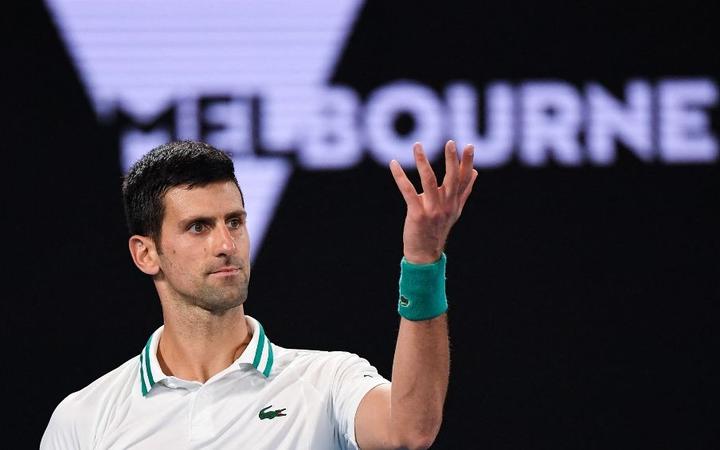
Australian Immigration Minister Alex Hawke has cancelled Novak Djokovic’s visa and the tennis player will be deported.
Photo: AFP
Hawke said he cancelled the visa on “health and good order grounds, on the basis that it was in the public interest to do so”.
“In making this decision I carefully considered information provided to me by the Department of Home Affairs, the Australian Border Force and Mr Djokovic,” he said.
The tennis star’s legal team has indicated they intend to file an injunction against the minister’s decision in a bid to allow him to stay and play in the Australian Open.
If Djokovic does not appeal the minister’s decision he will be deported and may be barred from being granted any future visa for the next three years.
It is unclear yet if he has been taken back into immigration detention in Melbourne.
Hawke had been considering whether to personally intervene since Monday, when Djokovic won a reprieve in court case that reversed an earlier decision to cancel his entry visa in the hours after he arrived in Australia on 6 January.
Djokovic, who is unvaccinated, had his visa revoked on 6 January shortly after arriving in Melbourne amid questions over the vaccine exemption that would have permitted him to enter.
Earlier today, the world number one seed was drawn to play compatriot Miomir Kecmanovic in the first round of the Australian Open, with Tennis Australia preparing as if he was going to play.
Hawke’s decision to revoke Djokovic’s dashes the Serb’s hopes of winning a record 21st Grand Slam at the Australian Open, the year’s first major, which starts in Melbourne on 17 January.
In a statement on Instagram he said his team filed the document and the mistake was a “human error”, and he had provided additional information to the government for the minister to consider.
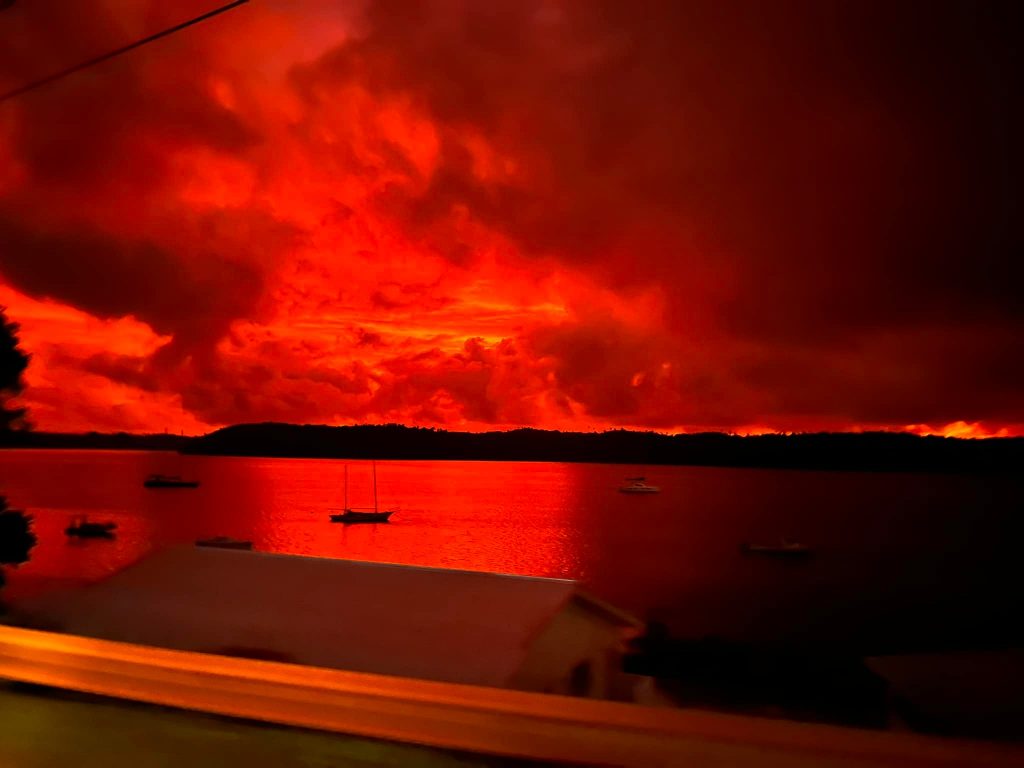
Startling images from Vava’u and Ha’apai islands this evening show otherworldly red-orange skies hanging over parts of the islands, from which the threatening volcanic eruption at the Hungas could be seen in the sky.
Apocalyptic photo taken in Vava’u. Photo/Gladys Guttenbeil (Facebook)
Neiafu and Mango island residents shared photos of the incidents on Facebook.
Tonga is now under a state of tsunami marine alert after large volcanic eruptions last night continued this morning causing some abnormal tides and waves in Tongatapu and Mango island seas.
Social media users are drawing parallels between the Hungas volcanic activities, red skies and the complete final destruction of the world, as described in the biblical book of Revelation.
Apocalyptic photo taken in Vava’u. Photo/Gladys Guttenbeil
Tonga Geological Services said this morning that volcanic plume of ash, steam and gas were detected.
“Eruption is forecasted to be imminent with significant emission of ash into the atmosphere like, or eruption is underway with significant emission of ash into the atmosphere”.
It said satellite images showed “ash plume at altitude 5-20 km above sea level”.
Why are skies red at night?
According to https://www.metoffice.gov.uk/ a red sky appears when dust and small particles are trapped in the atmosphere by high pressure. This scatters blue light leaving only red light to give the sky its notable appearance. A red sky at sunset means high pressure is moving in from the west, so therefore the next day will usually be dry and pleasant.
FAKAMATALA FAKATONGA NOUNOU
Ko e lanu kulokula ‘a e langi’ he po’uli’ ‘oku tupu mei hano fakafihia’i ‘e ha ‘ea mālohi ha ngaahi pātikolo iiki mo ha efu he ‘etimosifia’. Hanga ‘e he ongo me’a’ ni ‘o veteki ‘a e lanu pulū angamaheni ‘o e langi’ kae ‘asi kulokula mai ia. Ka taaitō leva ‘a e la’aa’ kuo ‘asi kulokula mai ‘a e langi’ pea ko e mahino ia kuo nga’unu ‘a e ‘ea mālohi’ ni mei he hihifo’ mo e efu mo e pātikolo ne fihia’. Ko ia ai ‘e ‘i ai ‘a e ‘amanaki lelei ki he ‘aho hono hoko’ ‘e langi ma’a ia mo mātu’u.
Tonga’s Minister of Internal Affairs Sangstar Saulala is concerned that significant eruptions at Hunga Tonga Hunga Ha’apai last night might affect two scheduled repatriation flights to bring back workers and Tongans who have been stuck overseas.
Minister of Internal Affairs Sangstar Saulala
At this stage no changes have been made to the schedules.
A flight to Tonga from Vanuatu was scheduled to arrive at the Fua’amotu International Airport next week on January 18 while the flight from Auckland, New Zealand was expected to arrive on January 20.
More than 70 Recognised Seasonal Employer workers in New Zealand were expected to return to the kingdom as part of this 300-passenger flight.
The chartered flight from Vanuatu will bring about a dozen Chinese passengers to work on His Majesty’s Armed Forces’ construction projects. Vanuatu is currently Covid free.
Tonga returned 215 stranded passengers on its last repatriation flight from New Zealand on 27 October 2021.
Previous flight cancellations
Hon Saulala’s concern came after Air New Zealand repeatedly cancelled its repatriation flight from Auckland to Tonga in December due to the high level ash eruption at Hunga Tonga- Hunga Ha’apai detected earlier.
About a month now since the volcanic activities were first reported, significant eruptions at the Hungas last night led to this morning’s tsunami marine alert from Tongan authorities. The public were warned to stay off the beach and out of the water.
“It has yet to be decided whether that could affect the aircraft coming”, Hon Saulala told Kaniva News in Tongan.
Fiji and Australia flights put on hold
Hon Saulala said repatriation flights from Fiji and Australia have been put on hold because of the community surges of Omicron virus in these two countries.
He said Omicron cases in New Zealand were detected at the border and were being monitored at managed isolations and quarantine facilities.
“This was why the New Zealand repatriation flight was allowed to bring part of the kāinga,” he saidin Tongan.
New Zealand authorities were currently studying Australia’s Omicron situation “in trying to determine what would happen if Omicron got into the community in New Zealand”, Te Pūnaha Matatini complex systems researcher Dion O’Neale told RNZ’s Morning Report yesterday.
“Australia’s Omicron surge is leading to staff shortages that have disrupted supply chains and hampered the economy’s recovery”, Aljazeera reported.
This morning it has been reported that New South Wales has recorded its deadliest day of the pandemic so far, with 29 Covid-related deaths and 63,018 new cases.
Fiji limit social gatherings
Meanwhile, “social gatherings in Fiji homes and communities are now limited to 20 people as the Government moved this week to contain the spread of the Omicron variant of Covid-19 in the country”.
RNZ reported on Fiji case saying that “As of 10 January, there were 4,863 active cases in isolation – of both the Omicron and Delta variants – with the death toll at 714”.


 The final decision was made after a presiding Magistrate allowed him to continue on his job as he was young and took the opportunity to learn from his conviction.
 The latest eruption had a radius of 260 km (161.5 miles), and sent ash, steam, and gas 20 kilometers (12.4 miles) into the air.