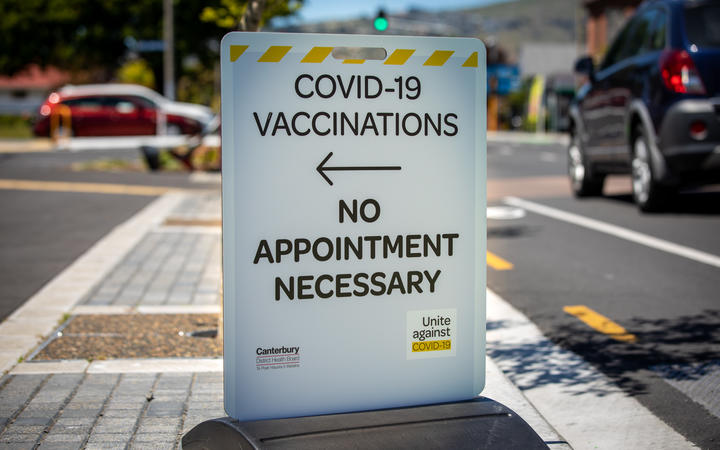
Ninety percent of eligible New Zealanders are now fully vaccinated, with the official count through overnight, Covid-19 Response Minister Chris Hipkins says.
Photo: RNZ / Nate McKinnon
The milestone means nearly 3,800,000 people have rolled up their sleeves for two Pfizer doses.
It comes hot on the heels of the three DHBs in Auckland’s metropolitan area reaching the target.
Seven of the country’s 20 DHBs have now reached 90 percent double-vaccination, and a handful of others are on track to reach the target in the next few days.
Ninety-four percent of the eligible population nationwide have had their first dose.
That means all three DHBs in the Auckland region have hit the vaccination target. By yesterday Auckland DHB was sitting on 95 percent and Waitemata DHB was on 92 percent.
Counties Manukau has the second biggest eligible Māori population for a DHB and the biggest eligible Pacific population in the country.
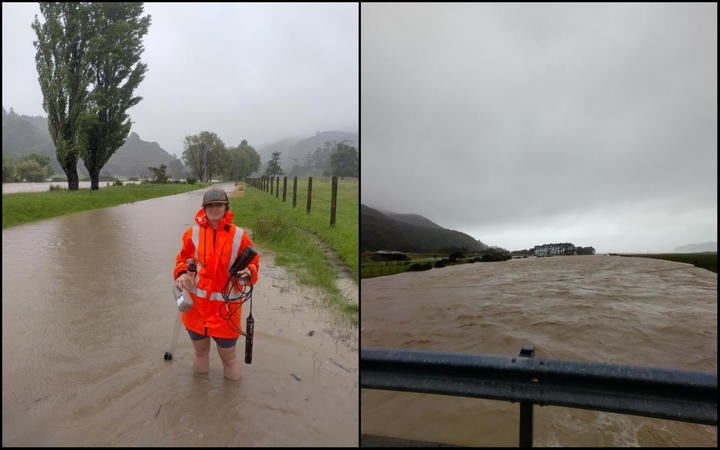
Heavy rain is causing slips and flooding around the country, affecting motorists across the regions.
Flooding near Te Araroa and the East Cape in the Tairāwhiti region today. Photo: Supplied / Gisborne District Council
Metservice have put heavy rain warnings in place for the Coromandel, Bay of Plenty and Gisborne regions.
Meanwhile in the South, Tasman (about and west of Motueka), eastern Marlborough south of Blenheim, Canterbury Plains north of Ashburton, including the foothills and Christchurch, are all under a heavy rain warning.
The East Cape in the Tairāwhiti region has been hit with serious flooding with heavy rain battering the area.
State Highway 35 near the East Cape, between Potaka and Te Araroa, is closed due to flooding.
Motorists are advised to avoid the area. It is not yet known when the flooding will subside enough for the road to be safely reopened to traffic.
Waka Kotahi is advising motorists in Tairāwhiti and further south in Hawke’s Bay to take extra care and to “stay alert” as severe weather creates challenging driving conditions.
The downpours caused potholes to appear on the road, which crews were doing their best to address.
“Our contractors have been out in the rain over the last couple of days, working hard to ensure that the state highways remain safe for motorists,” Waka Kotahi’s regional maintenance and operations manager Jaclyn Hankin said in a statement.
“Potholes and debris have appeared on roads across the region, so please keep speeds down and stay alert. We want everyone to get to their destinations and back home safely.
“It will take some time for us to repair all the potholes, especially while the severe weather continues. Making permanent repairs to potholes requires warm, dry weather so until the rain clears we can only make temporary repairs.”
“We need people to drive to the conditions for the safety of everyone on the roads, including our contractors who are doing a great job in very bad weather.”
“If anyone sees any issues on the state highways, please call 0800 44 44 49 so that our contractors can get to the site quickly and fix the issue.”
The highway between the small towns of Pōtaka and Te Araroa near the East Cape (SH35) shut due to flooding just before 4pm.
Waka Kotahi said it was not yet known when the flooding would subside enough for the road to be safely reopened.
Several rural council roads in the Gisbrone Tairāwhiti region are also shut due to flooding.
The heavy rain is expected to ease this afternoon.
Canterbury rain causing coastal slips
The heavy rain forecast for Canterbury is already causing chaos with slips along the Kaikōura coast making driving difficult.
Up to 140 millimetres of rain is forecast in the next 21 hours, three times the average amount the region would normally get in the entire month of December.
The police were urging motorists to avoid or delay travel between Blenheim and Kaikōura due to several slips, including one at Oaro where traffic was down to one lane.
They said there was a risk of injury from falling rocks.
Metservice meteorologist Peter Little said Christchurch was expected to bear the brunt of any flooding.
He said the worst was yet to come, with most of the rain forecast to fall on Wednesday evening.
Wellington trains suspended
Train services on the Johnsonville line in Wellington have been suspended due to a slip between Awarua Street and Simla Crescent.
Metlink is running bus replacements to the train timetable and will post updates on its website.
Meanwhile, the technical issue stopping smaller planes from landing and taking off at Wellington Airport yesterday has been fixed.
More than 100 flights in and out of the capital were cancelled or delayed yesterday.
Four flights were impacted today.
The landing system, which required fine weather to test it before it could be operational again, got up and running just before 5pm.
Tonga’s Parliament has elected a new prime minister to replace Pōhiva Tu’i’onetoa.
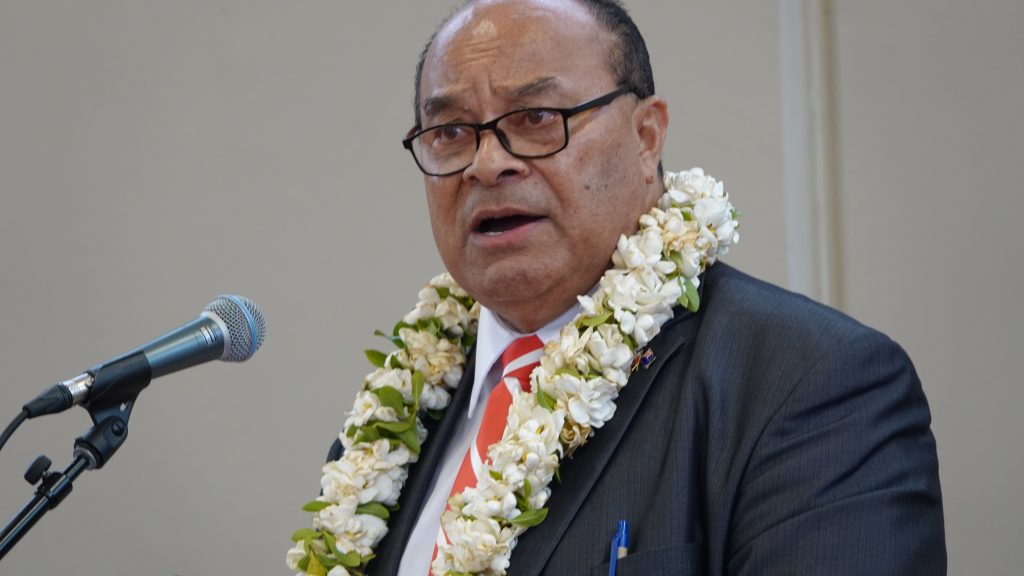
Siaosi Sovaleni. Photo/Koro Vaka’uta, RNZ
Siaosi Sovaleni, 51, the current Minister of Education, has won convincingly with 16 votes, against former Minister of Finance and MP Dr ‘Aisake Eke, who got 10 votes.
The Interim Speaker, Lord Tangi, announced the results this afternoon after he first informed King Tupou VI about the winner.
The results showed what appeared to be the nobility MPs’ votes being split with apparently four of them supporting Sovaleni while the remaining five voted for Dr Eke.
Sovaleni, who was a minister in good standing in the Tu’i’onetoa government, recently crossed the floor to form his new bloc and gain the support from a united group of independent MPs and PTOA Party MPs.
Three other MPs who were part of Tu’i’onetoa’s PAK party, also crossed the floor and joined Sovaleni.
The only People’s MP and interim cabinet minister who supported Dr Tu’i’onetoa was the Niua MP Vātau Hui.
The defection of the four members meant Dr Tu’i’onetoa was forced to withdraw his candidacy for the premiership election because he did not have the number of MPs required by law to support and nominate him as a candidate.
Education, health and climate among priorities In his speech before the election today, Sovaleni said people, the chiefs and the king lived under what he described as one house. He said people had to learn to know how to live together.
He said education, health, economic developments, e-government, climate change, war on illicit drugs, natural disasters, youths and women initiatives and good governance were some of his priorities.
In his vote of thanks after he was declared the winner this afternoon, Sovaleni was emotional and congratulated his supporters and all MPs.
He also thanked his unsuccessful rival candidate Dr Eke and said they had previously worked together in the Ministry of Finance.
Auckland’s Counties Manukau District Health Board has hit the vaccination target of having 90 percent of its eligible population fully vaccinated.
Photo: RNZ / Patrice Allen
That means all three DHBs in the Auckland region have hit the vaccination target. Auckland DHB is now sitting on 95 percent and Waitemata DHB is on 92 percent.
Counties Manukau has the second biggest eligible Māori population for a DHB and the biggest eligible Pacific population in the country.
DHB chief executive Margie Apa attributed it to the hard work of Māori and Pacific health providers and community organisations who’ve collaborated on the vaccine rollout.
Six DHBs are now 90 percent fully vaccinated.
The following DHBs are all close, on 89 percent fully vaccinated (with numbers required to get to 90 percent)
Midcentral (1755 doses to go)
Wairarapa (395 to go)
Nelson Marlborough (1905 to go)
South Canterbury (750 to go)
New Zealand is 7417 doses away from being nationally 90 percent fully vaccinated.
“The cases are self-isolating and initial interviews suggest they are all linked to the Eltham case reported on Sunday – with links to four of these new cases already confirmed.
“Investigations are also underway to identify, isolate, and test any close contacts and determine any locations of interest. People in Taranaki are asked to monitor the Ministry’s locations of interest page, which is updated regularly.”
The majority of these new cases are in pupils from a school in Eltham, which is now closed for the summer break.
There were 56 new cases reported in Auckland today, seven in Tauranga and nine in Waikato, which includes five in Te Kūiti and four in Hamilton.
There was also one new case in Canterbury and one in Rotorua.
The number of community cases in the Auckland region decreased for the third consecutive week, with 22% fewer cases than the week prior. This decline is mirrored across all three Auckland Metro DHBs.
Health and welfare providers are now supporting 1,971 people to isolate at home, including 474 cases.
There are 61 cases in hospital, including three in intensive care.
One person with Covid-19 has passed away in Tauranga Hospital, the Ministry has confirmed.
There were also two cases in managed isolation today.
There have now been 9963 cases in the current community outbreak and 12,773 cases since the pandemic began.
Vaccines and testing
Counties Manukau DHB has now reached 90 percent fully vaccinated, bringing all three Auckland Metro DHBs to 90 percent or more fully vaccinated. Auckland DHB is now sitting on 95 percent and Waitemata DHB is on 92 percent.
New Zealand is now 7417 doses away from being nationally 90 percent fully vaccinated.
There were 2485 first doses; 7877 second doses; 869 third primary doses and 9229 booster doses given yesterday.
It is also the first day that rapid antigen testing for Covid-19 is available at approved pharmacies for unvaccinated and asymptomatic travellers over the age of 12.
While the ministry has dispatched 250,000 tests across the country, some in Auckland have told RNZ they have only received a small number, or none at all, and may have to turn people away.
In its statement today, the Ministry said iy was aware that some people were being tested unnecessarily or at the wrong places.
“Unvaccinated people require a Covid-19 test for some travel including to leave Auckland. These people need to get a supervised rapid antigen test from a pharmacy, within 72 hours of travel.
“This testing is only for people over the age of 12 years and 3 months, who are not fully vaccinated and do not have any Covid-19 symptoms.
“The location and hours of pharmacies offering rapid antigen tests is available from Healthpoint. We ask people getting a rapid antigen test to be patient and kind to pharmacy staff while the system is fine-tuned.”
The Ministry also said the majority of the 70,000 people with overseas vaccinations or incorrect data who were emailed a temporary exemption letter from the My Vaccine Pass have now received their pass
But it said it was also issuing a further temporary exemption letter today to some people whose applications are still being processed.
“About 5000 people are getting a week-long exemption while their requests for My Vaccine Passes are cleared, while 20,000 people vaccinated overseas will get an extension to 17 January 2022 while their vaccinations are verified.”
ANALYSIS If we look at the history of Tonga’s premiership elections since 2010 it is hard to believe the popular candidate Siaosi Sovaleni will win the premiership election.
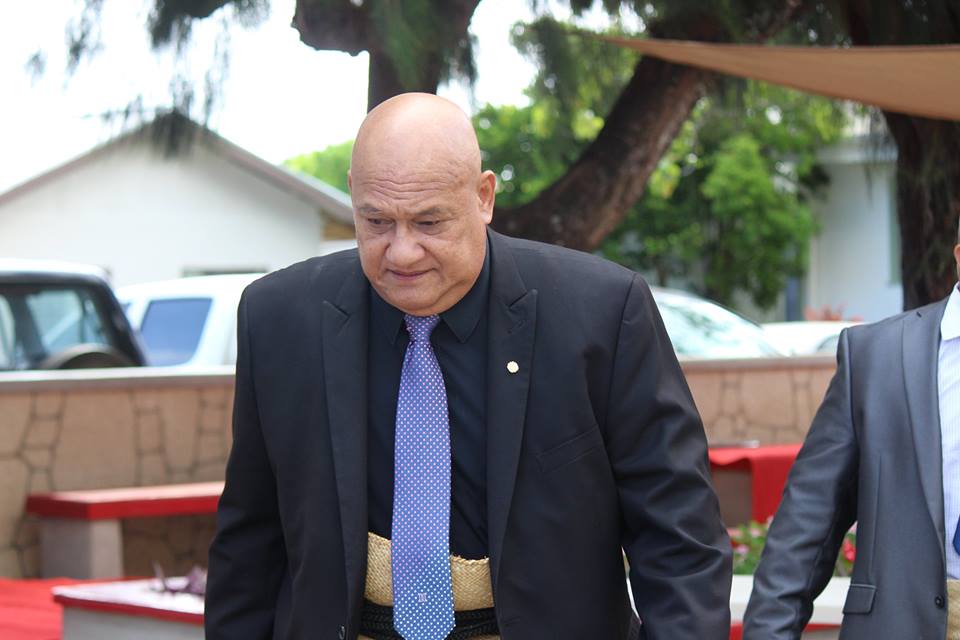
Dr ‘Aisake Eke (L), Siaosi Sovaleni
This is because the nobility MPs always side with the minority group of people’s MPs when the majority of them fail to get the numbers to win the premiership election themselves.
Tonga’s apparently designed-to-fail system of democracy should be blamed for this. And the Nobles’ representatives and the minority group of people’s MPs have always taken advantage of this to steal the power that was meant for the faction with the most MPs elected by the people.
Self-serving minority
The nobility are only interested in their affairs and what benefits them if they get the power such as their lands which is estimated to be 30 percent of all land in Tonga. This includes the controversial laws which treat them differently from the commoners as well as their rights to their cultural and traditional entitlements.
They did not care about the people or respect what is known in democracy as people’s rule or majority rule based on the highest number of votes cast by the people on elections day. They told the public they wanted the people’s 17 MPs to unite so they can form the government. What they did not tell the people was that, if the 17 MPs cannot unite the nobility will join the minority and form the government.
After Tonga’s first democratic election in 2010 there was an expectation the new government would be led by the majority of the people’s MPs. It did not happen because the nine nobility MPs aligned themselves with the five minority group of people’s MPs and formed the new government.
After the following election, the late ‘Akilisi Pōhiva successfully urged the minority group of five independent MPs to join his PTOA Party’s nine MPs and form the government.
The snap election of 2017 after the king dissolved parliament saw the first time in history the PTOA MPs were able to get the number and formed the government by themselves.
However, in 2019, after the death of ‘Akilisi, the Noble MPs struck again and managed to urge interim PM Pōhiva Tu’i’onetoa and two others from the PTOA Party and they formed the government.
Unity
The members of nobility are renowned for their unity and collaboration, especially when it comes to national politics.
Some of them might appear in the media and public and say things which might lead people to think they were supporting the people and acting differently from the other nobles, but at the end of the day the nobility still sticks together.
The withdrawal of Lord Fakafanua from the premiership candidacy was democratically promising but reports said the nobles were heavily involving in horse trading with the two blocs apparently in a bid to give them ministerial posts.
There is a strong sense that Sovaleni will win the premiership elections because he has managed to unite 12 MPs with him, while Dr Eke only have five. Sovaleni only needs the votes of two more MPs so he can win.
There are also reports that the king has advised the nobility to votes for the candidate with the most MPs.
There are also reports the Nobility is already split, with two MPs have already confirmed their votes for Sovaleni.
A man, who has been in and out of jail for sex offences against two young women, has lost his appeal against his five-year extended supervision order set to start on December 2020.
Supreme Court. Courts of New Zealand
Penisimani Ta’akimoeaka, 38, was convicted in 2005, when he was 17, of serious sexual offending against a 16-year-old young woman after entering her house without consent.
He was sentenced to six and a half years’ imprisonment for that offending and released in October 2010.
In 2013, five months after the expiry of his release conditions, Mr Taakimoeaka climbed through a window of a house in Picton, South Island where two 16-year-old young women were sleeping and sexually assaulted one of them.
He was sentenced to concurrent sentences of seven years and six months for assault with intent to commit sexual violation by rape, five years and six months for sexual violation by unlawful sexual connection and 12 months for each of the three charges of indecent assault.
The sentencing Judge said Mr Taakimoeaka had come “perilously close” to being sentenced to preventive detention.
Mr Taakimoeaka, who was reportedly living in Canterbury, argued that the two incidents of sexual offending fail to reach the “pervasive pattern” threshold.
He believed the Court of Appeal placed too much weight on the views of the health assessor in concluding there was a pervasive pattern. He also said that the Court of Appeal erred by deciding that there was an intense drive and a predilection for serious sexual offending on the basis of his prior offending alone as opposed to undertaking a current assessment of the individual.
The Supreme Court judge in a judgement released on Friday December 10, 2021 said, “The matters Mr Taakimoeaka seeks to raise are essentially issues related to the particular facts of this case.
“No point of general or public importance arises. His challenge to the imposition of the ESO was carefully considered by the Court of Appeal and nothing raised suggests that the Court’s analysis may have been wrong.
“There is thus no risk of a miscarriage of justice. The application for leave to appeal is dismissed”.
Interim Prime Minster Pōhiva Tu’i’onetoa has complained about being dumped by his own interim Cabinet Ministers, saying he just found out after the general elections that their unity in the past four months was fake.
Dr Pōhiva Tu’i’onetoa. Photo/Kalino Lātū
He said their union was heart-warming and they worked side by side.
He described the basis of their unity as a pledge and sacred oath “fuakava toputapu” with the people.
Tu’i’onetoa said he trusted the situation and they had looked forward together with the nobility to welcome the new MPs.
“Unfortunately, it never happened, as after the general elections on November 18 some of the Cabinet Ministers left with their plan to form the new government on their own,” Tu’i’onetoa said in Tongan in a post on Facebook this afternoon.
He said the Tongan saying was true – “Kehe lea he hifo’ mei he lea he hake” which can be translated into English as two faced people.
He confirmed that he has supported premiership candidate Dr ‘Aisake Eke. He said he wanted to hand over the work he had started during the past two years to Dr Eke and train him for it.
Stinging attack
The Interim Prime Minister then launched a stinging attack against the PTOA Party and its three MPs who supported premiership candidate Siaosi Sovaleni.
The former PTOA MP and Cabinet Minister said any ministerial posts for the PTOA MPs should be given to the nobility MPs.
He falsely accused the PTOA of plotting to create a government without the involvement of the nobility. He never gave any evidence to support his claim.
He also reiterated his ongoing misleading attacks against the Democrats to make them sound like they have a plan to dethrone the king. He referred to the raft of six Bills pushed by the late ‘Akilisi Pōhiva’s government in Parliament to support his claims. Former Acting Attorney General ‘Aminiasi Kefu previously advised the public during consultations on the Bills there was no such agenda.
Tu’i’ometoa supported the Bills
Apart from failing to provide any concrete evidence to support his claims Tu’i’onetoa was the Minister of Finance under the ‘Akilisi government when the Bills were re-submitted to Parliament in February 2019 after they were first introduced into the Legislative Assembly by Lord Tu’ivakano’s government in 2014.
He supported the Bills when they were debated in Parliament. Tu’i’onetoa also raised his hand up in support of a majority vote in Parliament at the time when the Speaker placed the Bills on the ballot to be taken for public consultations, according to Hansard of March 11, 2019.
When Tu’i’onetoa took over as Prime Minister after ‘Aklilisi’s death, he told Kaniva News that he had put aside the six Bills because “his government did not have enough time to do it”.
In a video clip seen by Kaniva News during the lead-up to the November 18 election, Hon. Tu’i’onetoa said he had left the PTOA Party because of their alleged plans to dethrone the king with the six Bills. This was untrue.
The real reason why he left PTOA, was that he was disappointed in what he described in a previous interview with Kaniva as some in the PTOA Party attempting to challenge the plans ‘Akilisi left for the party’s leadership. However, some critics believe Tu’i’onetoa left the PTOA after he had talked with the Nobles about forming his own government.
PTOA response
Hon. Tu’i’onetoa, who has been accused of repeated misleading the public and the media, has faced a public backlash from the Democrats on Facebook.
“You are full of crap,” a commenter responded to Tu’i’onetoa’s post.
“He is behaving like a woman,” another wrote.
“Karma. This was what you did for the PTOA you betrayed the Party and what goes around comes around,” one wrote in Tongan.
“You are dead.”
Some supporters of Tu’i’onetoa came to his defence and said he had done a good job while he was Prime Minister.
UPDATED: Lord Ma’afu, an interim Cabinet Minister and former nobility MP, has died aged 66, the Prime Minister’s office has confirmed this morning.
Lord Ma’afu. Photo/Tonga Parliament
“It is with profound sadness that the Office of the Prime Minister of the Kingdom of Tonga announces the untimely death of the Right Honourable Colonel, the Lord Ma’afu-Lord Minister in Waiting to His Majesty in Privy Council, Deputy Prime Minister, Minister for Lands and Natural Resources, and Minister responsible for His Majesty’s Armed Forces”, a statement from the Prime Minister’s Office said.
“His Lordship passed away in the early hours of Sunday, 12 December 2021, at the Auckland City Hospital, New Zealand.
“His Lordship has held Ministerial office for four consecutive Governments, with an exemplary and esteemed career in service to the Monarch and the Royal Household, as well as public and military services to His Majesty’s Government, spanning over 40 years”.
Lord Ma’afu was the interim Minister of His Majesty Armed Forces and Lands and Survey before he died. However, he was not re-elected when the 33 noble families went to the polls on November 18 to elect their nine representatives from within their own ranks.
Lord Ma’afu’s wife Princess Tāone died in 2018. They had two children Hon. Tevita ‘Unga and Hon. Fangaake Veikune.
Chief Secretary and Secretary to Cabinet Edgar Cocker has vehemently denied reports the government is planning to sell the Lulutai airlines to a private company after we reported the Prime Minister said the airline was available for sale.
Prime Minister Pōhiva Tu’i’onetoa and Chief Secretary Edgar Cocker. Photo/Kalino Lātu (Kaniva Tonga)
Cocker described the reports as a dreaming while sleeping “mohe misi” and wishful thinking “fakatuputupulangi”, the Kakalu ‘O Tonga newspaper reported.
He said he was the one who was in charge of the Lulutai airlines and anybody who wanted anything regarding it must come through him.
Absolute conflict
His denial was in absolute conflict with what we have seen in e-mails that appear to have been between interim Prime Minister Pōhiva Tu’i’onetoa and a Fly Niu airline spokesperson Semi Halanukonuka.
In an e-mail in Tongan purportedly sent from Tu’i’onetoa to Halanukonuka on November 2, 2021, seen by Kaniva News, the Prime Minister confirmed to Halanukonuka that if the Fly Niu airlines wanted to buy Lulutai that was the best option.
He said if Fly Niu could take over the airline the government would cease its involvement.
He also told Halanukonuka that it would not matter if his government was replaced after the general election.
Tu’i’onetoa said what the government was looking for was a buyer who could operate the airline successfully, unlike all previous failed operators who went bankrupt. He also mentioned in his email that he had previously asked Fly Niu to send him its business plan.
In Tongan the Prime Minister wrote:
“Pea ko e taha kapau te mou fakatau a e Lulutai ka mau malolo mautolu ko e toe sai taha ia. ‘oku ikai ke matter ia pe kohai oku government he koe service eni ia oku essential ki he fonua. Ko e me’a tepuu ha taha te ne fakalele pea vakai atu a e pule’anga ‘e ikai toe bankrupt o hange koe all others ka e safe and secure a e services. Koe uhinga pe ia na’a ku kole atu ai a e business plan ke vakai kiai a e government”.
Tu’i’onetoa said the history of airlines operated by Tongans showed no operators made any profits out of it.
In-principle agreement
As Kaniva News reported last month, the government has reached an in-principle agreement to sell the national airlines to the privately-owned Fly Niu airlines.
We said the agreement was subject to an assessment of the Fly Niu proposal by the new government.
Halanukonuka told us at the time they were working to fulfil what Tu’i’onetoa wanted to process their purchase application.
Last year, Cocker publicly supported statements by the Prime Minister regarding the appointment and sacking of Lulutai’s CEO, which were later called into question by documentary evidence.
When asked by Kaniva News whether former Lulutai CEO Maikolo Faasolo had held the position, Cocker said no. When e-mailed the copy of the contract which showed Fa’asolo was indeed the CEO of Lulutai before he was forced to resign, Cocker said nothing.
Cocker and Tu’i’onetoa muddles
There have been growing concerns over the Prime Minister and his Chief Secretary providing conflicting statements to the public.
In October, the Prime Minister’s office told the media in a press release the Government had approved a major upgrade for the Vava’u international airport.
It said the proposed US$121 million project would be led by a registered British company known as Raw Mana Ltd. It said Raw Mana’s involvement had been referred to the Tongan Government.
However, the following day, Cocker told local Matangi Tonga Online that a full proposal has not been received and that the Prime Minister’s office’s press release did not mean that Government had granted approval for the Raw Mana Ltd to undertake the project.
The following week, Tu’i’onetoa corrected Cocker during his Radio FM 87.5 official livestream show. Tu’i’onetoa said his office’s press release still stood and whenever His Majesty was informed of such important event there was no need to change such information.
Cabinet decision
In 2019 the Prime Minister corrected a Cabinet decision signed by Cocker which was leaked to media.
The resolution was meant to revoke a decision to allow a public consultation on growing hemp in Tonga, but the wording included the phrase “approved as amended”.
When Kaniva asked Cocker for clarification he insisted the wording “approved as amended” meant the consultation application was rejected by Cabinet. We insisted that the phrase “approved as amended” could mean it was approved.
Tu’i’onetoa later said the wording of the cabinet decision was vague.
He said it should either said it was “deferred” or “not approved.”
We recently reported that Cocker was involved in an encounter with Prince Tu’ipelehake in a bar in which he was shown in a video to have fallen to the floor. When we asked Cocker for his version of the incident, he said he had been praying and was asking the Prince to kneel down so they could pray together.
Cocker’s version of events appeared to contradict the evidence of the video and reports by witnesses on news and social media.