Ten people have been arrested on suspicion of murder after 23-year-old Hiko Lynch was stabbed to death on Market St, Blenheim, New Zealand this morning.
Hiko Lynch. Photo/Supplied
They have been charged with a range of charges including murder, wounding with intent to cause grevious bodily harm, assault and disorderly behaviour.
The first of those charged will appear in the Blenheim District Court tomorrow.
Police said: “Initial indications suggest the altercation was between local RSE (Recognised Seasonal Employer) workers and members of the Rebels gang from outside Marlborough”.
The scenes are no longer cordoned off but Police will continue to have an active presence in the area as they continue their investigation into the incident.
The two people in hospital remain in a serious condition.
Lynch arrived in New Zealand from Tonga as a Recognised Seasonal Employer worker. He worked for Hortus farm.
It is understood one of the men in hospital with knife wounds was celebrating his 26th birthday that night. He was also a Hortus employee, while the third worked for a separate RSE company.
Marlborough Area Commander Inspector Simon Feltham said further arrests are likely as Police continue to investigate.
“We acknowledge that today’s incident will be concerning to the wider community.
Police can assure the community that violent crimes will not be tolerated, and we will hold those who offend to account.”
Police continue to ask that anyone who was in the area at the time and may have seen anything that could assist the investigation to get in touch.
A dedicated portal has been set up to allow anyone with images or recordings to upload this information.
It can be accessed via https://alaia.nzpolice.org/
You can also phone Police on 105 and quote event number P046918039 or file number 210620/6521.
Alternatively, information can be provided anonymously by phoning Crime Stoppers on 0800 555 111.
Police would like to thank the public for their assistance and cooperation.
Police have launched a homicide investigation after a Tongan man died following an incident on Market St, Blenheim early this morning.
Hiko Lynch. Photo/Supplied
A cousin has identified the victim as Hiko Lynch. He was one of a group of Tongan Recognised Seasonal Employer workers who worked for Hortus in Blenheim.
Police were called to a disorder incident on Market St at about 2:55am, one person died at the scene.
Two people were also seriously injured and taken to hospital where they remain in a serious condition, Marlborough Area Commander Inspector Simon Feltham said.
“Police are speaking to several people in relation to this incident and an investigation is underway. We are also conducting scene examinations today,” Feltham said.
Reports said “members of a gang had been initimidating and eyeballing people in the lead-up to the stabbings”.
A person who had been at the bar told the NZ Herald and Newstalk ZB: “It’s not the normal thing that happens on a night out in Blenheim.
“There was a large presence of motorcycle gang members … I heard they were Rebels.
“I left there about 2.55am and they were closing up, I’m not really sure what happened but heard a scuffle broke out and knives came out and people got stabbed.
“One of them died … and they got chased all over town by police … yeah, it was a crazy morning in Blenheim.”
The witness said the nightclub was “usually fine” and there was not much of a gang presence in Blenheim.
He said it was “shocking”.
“The scenes remain cordoned off and there will be a Police presence in the area as we work to understand the circumstances of these incidents and ensure the community’s safety”, Feltham said.
“Anyone who was in the area at the time and may have seen anything that could assist is asked to get in touch.
“Police would like to hear from anyone who may have footage of the incidents.
You can phone Police on 105 and quote job number P046918039.
“Alternatively, information can be provided anonymously by phoning CrimeStoppers on 0800 555 111.
Further information will be released when it becomes available”.
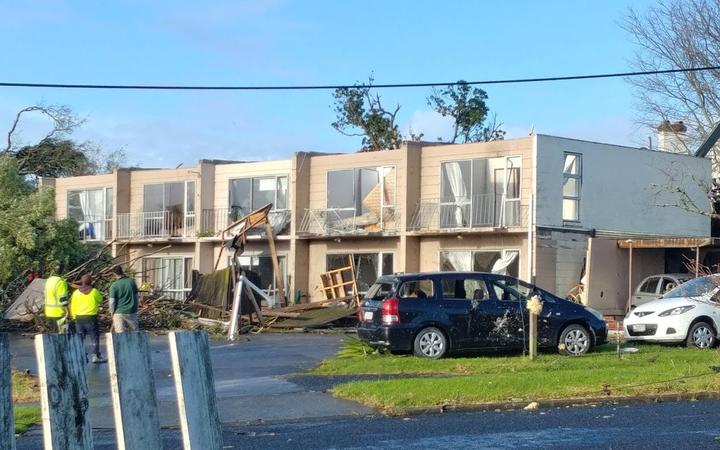
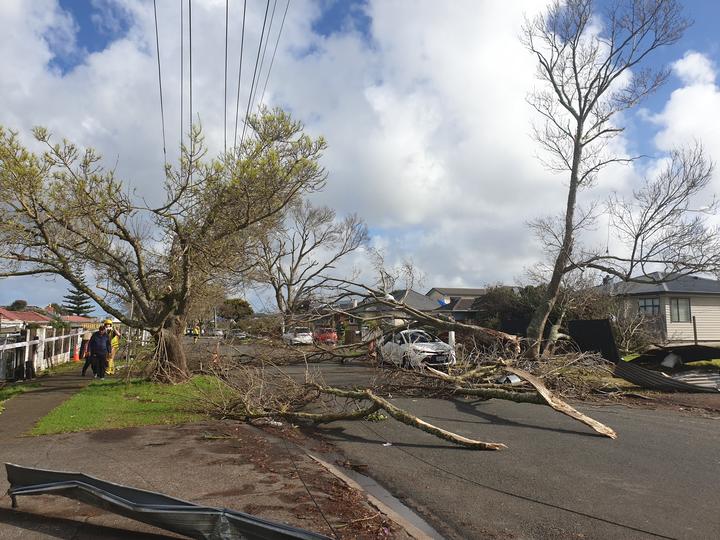
One person has been killed and two injured, in the tornado that swept through South Auckland this morning.
Tornado damage in Papatoetoe Photo: Ben Wilson
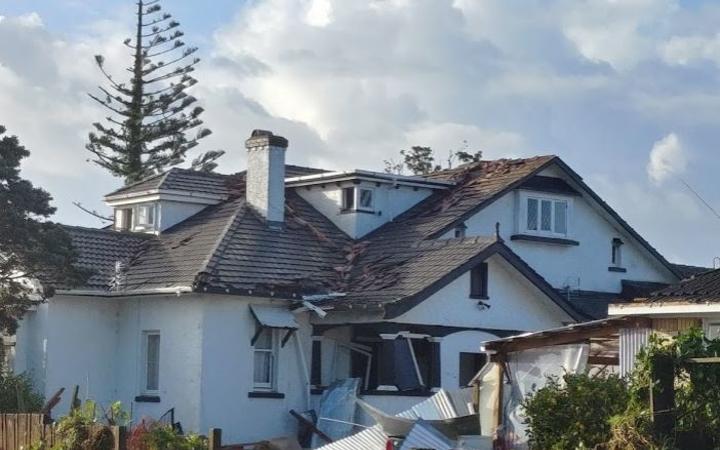
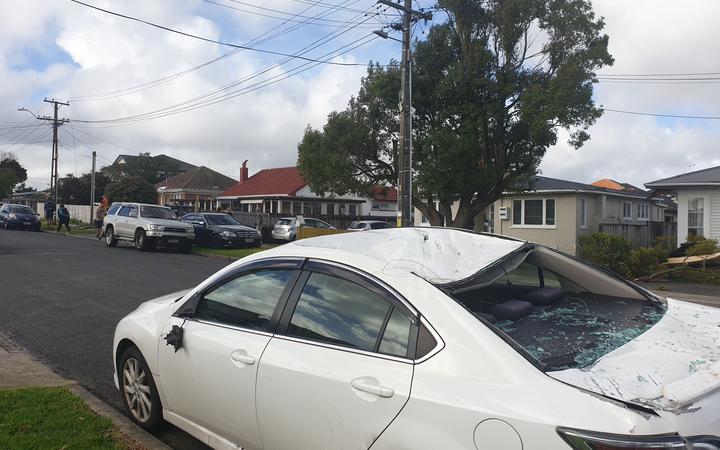
The storm lifted roofs, toppled trees and sent trampolines flying in the suburb of Papatoetoe at around 8:30am.
A worker was killed when the tornado struck a freight container hub in Wiri Station Road.
Two others were taken to Middlemore Hospital – one is in a moderate condition and the other has minor injuries.
Several containers were toppled by the strong wind.
Ports of Auckland says it operates the site with several other businesses but none of the injured people worked for the company.
It said it is shocked by the freak event and its thoughts are with the people affected.
WorkSafe is investigating the death.
Photo: Ben Wilson
RNZ reporter Katie Doyle, who was at the fire service cordon at Freyburg Avenue in Papatoetoe, described it as carnage saying there had been a lot of damage.
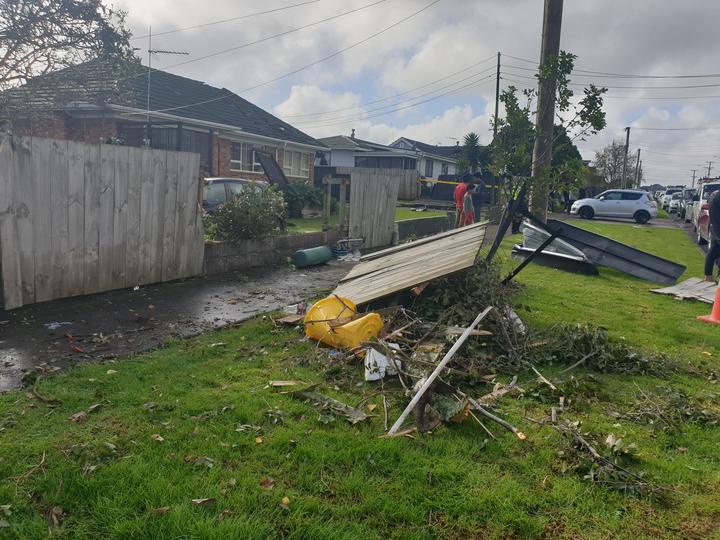
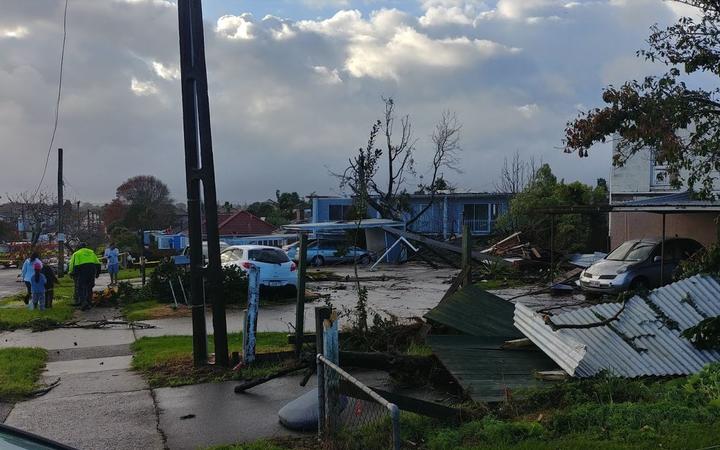
She said the street was strewn with branches and one tree had been completely uprooted. There were pieces of corrugated iron ripped away, power lines down and roof tiles ripped off by the tornado, she said.
Damage at a Papatoetoe house. Photo: RNZ / Katie Doyle
Photo: Ben Wilson
Binpin Thakkar who lives on Hayworth Road, said his whole house shook in the tornado and he feared it would be blown away.
He said he could see roof tiles flying down his street and there is broken glass from shattered windows everywhere.
Thakkar said it was a frightening experience, as the tornado struck with force.
He said at the time trees were flying about and all the fences on his property have been damaged.
“It was very scary, everything inside the house, the whole house was shaking actually, we were thinking the whole house will go away. The outside property damage like glass damage and roof damage and our neighbour’s house tiles were actually flying.”
He said neighbours are rallying to help to clean up the damage.
There is a heavy police presence in the areas most affected by the tornado.
MetService meteorologist Andrew James said the tornado was due to a front that moved towards Auckland overnight.
James said the bad weather has now moved away from Auckland.
Downed trees after the tornado Photo: RNZ / Katie Doyle
A Tongan general practitioner in Darwin was awarded a Medal of the Order of Australia for services to medicine through a range of roles.
Dr Albert Tonga
78 year-old Dr Albert Tonga has been looking after the health of Territorians from the Red Centre to Top End for more than 35 years and He has no plans to stop any time soon, North Territory News reported.
He has been honoured as part of the Queen’s Birthday Honours list.
Dr Tonga who was born in Tonga and raised in New Zealand moved to the NT after a five year stint in New Castle to work in his true field of interest – rural medicine.
He started in Alice Springs where he spent nine years working at the hospital – first as a medical officer, then as director of medical services and with the Royal Flying Doctor Service.
He then moved to Tenant Creek, where he set up his own GP practice and assisted at the hospital and aged-care facilities.
He worked in the town for a total of 14 years.
“I was the only GP for thousands of square kilometres “, he reportedly said.
“That’s a big task for any one little fella.”
In 2006 Dr Tonga moved to Darwin where he worked as GP at the Woods Street Surgery and Casuarina Night and Day Surgery, an examiner with the Royal Australian College of General Practitioners and a visiting medical officer at several Darwin City Medical Practice which set up in 2008.
Dr Tonga said he felt very privileged for his work to be recognised with an OAM.
I feel very honoured and blessed,” he said.
I think it’s a marvelous journey I’ve been on through many decades and a lot of people will not ever get to experience that.
“To me, it should be an encouragement to the graduates in the medical profession to think about working rural.
Prime Minister Pōhiva Tu’i’onetoa has threatened to fire Tonga Power Ltd director Paul Chapman.
Tu’i’onetoa has also put Chapman’s monthly director and meeting fees on hold.
Chapman was told he was “incompetence, neglect of duty, misconduct, or failing to assist the public enterprise to act in accordance with the principal objective.” Mr Chapman has “vehemently denied” this.
The director was given 14 days to make a response or his contract would be terminated.
Veteran journalist Kalafi Moala first published a story on Chapman and the prime minister last week.
Moala described Chapman as a person “who has been perceived by the TPL Board as someone who is not only a dissenter when he does not see things eye to eye with them, but can also be direct in his communication”.
Prime Minister Tu’i’onetoa, who is also the Minister of Public Enterprises, is expected to make a “final decision” when receiving a response from Chapman.
Tu’i’onetoa is being accused of refusing repeatedly to take immediate action against convicted Cabinet Minister Akosita Lavulavu after she and her disgraced husband Etuate Lavylavu defrauded more than half a million pa’anga of the government school grant scheme.
In a surprising political twist yesterday Friday 18, Tu’i’onetoa has placed Akoslita on leave, amid mounting calls and pressures for him to sack Akosita.
It is uncertain whether she will be paid while she is on leave.
Tu’i’onetoa has been accused of constantly shifting justifications to defend his refusal to take action against Akosita. He told his critics he cannot sack Akosita until the court due process is completed referring to the constitution clause 23 which allows a convict to remain in office if they have sought leave to appeal their sentencing.
However his critics said the prime minister has sole power given by clause 51(3)(a) of the constitution to take immediate actions against Akosita.
Fiji’s Permanent Secretary of Health, James Fong, reports there have been 115 new cases of Covid-19 in the past day.
Most of the cases can be traced to existing clusters or localities where significant transmission has occurred.
21 have been identified as primary contacts of previous cases and are under investigation by the contact tracing teams to determine if there is a cluster link.
There has been another death at the Colonial War Memorial Hospital.
Acting Permanent Secretary for Health, James Fong Photo: Fiji Govt
This 49 year old man was being treated for a severe pre-existing condition and his doctors are currently investigating whether his death is due to Covid-19.
To date there have been 6 deaths but another 7 Covid-19 positive patients have died of pre-existing illnesses.
There are 1182 active cases in isolation, with Fiji having recorded 1578 cases since the latest outbreak started in April 2021.
Dr Fong said since April, 121,193 samples have been tested, with averag daily testing now at 3443.
In terms of vaccinations, “43% of Fijians 18 and older have received their first dose, and 2.1% are fully vaccinated. That is a total of 252,791 who have received at least one dose and 12,246 who are fully vaccinated,” he said.
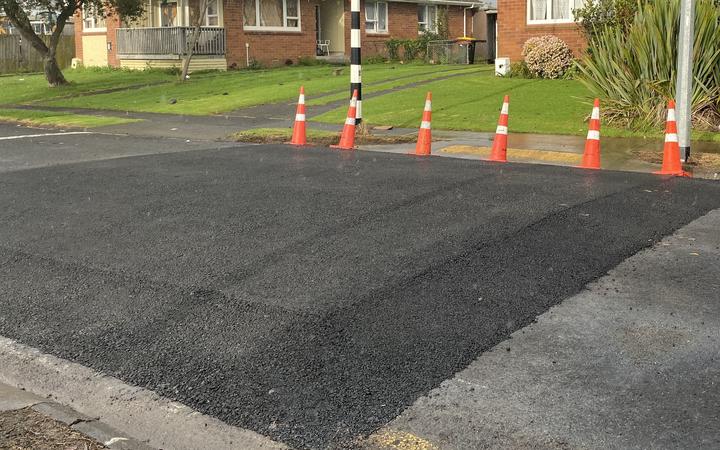
The nationwide Innovating Streets programme promised to make streets safer, but as a group of Māngere East residents is discovering, if the work is only partially complete, their local roads can get even more dangerous.
Community advocate Shirl’e Fruean saw her car tyres damaged after the vehicle was jolted by a speed hump. Photo: LDR / Justin Latif
Recent weeks have seen mounds of asphalt rise on Māngere roads like swells in calm water. What has enraged residents, however, is not the introduction of speed bumps, but the way they have been installed, and the failure to alert drivers to their existence.
South Auckland hip hop artist and community advocate Shirl’e Fruean lives off one of the roads affected and said despite driving at the speed limit, her car was jolted violently as she passed over a pair of bumps late one evening.
“I went flying, I was like, what was that?” she said. “It actually damaged my tyres. They’ve been there over a week, and they still aren’t painted.”
Cheryl G hit one and also thought she was going to get airborne.
“I hit the one at about 40km/h after my late braking and thought I was about to start flying. I’m sure I’m not the only one. So yea, the thought is great but the execution sucks.”
Another local, Sam Penitani, had witnessed a number of vehicles being damaged from the bumps. “I’ve seen a few cars lose bumpers and even [saw] an old man jump out to change his tyre with kids in the car because of those stupid bumps,” he said.
“It’s hard enough we struggle with other things; now we gotta pull out money to fix our cars.”
Mi Li Ka was driving at 50km/h but did not see the bumps when she drove over them.
“It slammed my car and my daughter started screaming so I stopped to check her and she had bitten her tongue. I get they are for the safety of our community, but they could have at least sprayed arrows or something so that we don’t go over the damn bumps at 50km.”
The impression was that council organisations thought they could deliver lower quality projects in areas like South Auckland, said Fruean.
“It feels like someone decided to punish us,” she said. “South Auckland, especially Māngere, seems to always be the target. We have homelessness, housing issues, liquor store exploitation and now these random bumps. Whoever is making these decisions needs to just back off.”
Photo: LDR / Justin Latif
Another local, Natasha Lilo shares Fruean’s concern, and is imploring her fellow locals to call Auckland Transport to complain.
“The speed bumps are a good idea especially if it’s to make our streets safer for all. Just poor execution as usual from Auckland Transport. Would this be the case in a suburb like Remuera? Why do we have dangerous road bumps with the purpose of making roads and pedestrians safer but they’re not safe during the progression of making them.”
‘We can quickly address the issues’
In a statement prior to the project’s delivery, Auckland Transport said the speed humps are part of a wider series of improvement that were the result of “community co-design”, which will make it “easier, and safer, to move around Māngere”.
The Māngere-Ōtāhuhu Local Board co-funded the project and board chair Lemauga Lydia Sosene said the temporary changes have been put in place in response to feedback from locals.
“We’ve heard from our community that parts of Māngere East are difficult to move around, crossings are not safe, and there needs to be easier and better ways for people to safely get around their neighbourhood. As the project is a consultation by trial, we can quickly address the issues, and determine if the proposals are working.”
In response to The Spinoff’s inquiries a spokesperson for Auckland Transport said the delay in marking the speed humps was a result of rain but was due to be completed soon.
“We have been aware of this as we are working very closely with our community partner,” the spokesperson said. “The weather has been holding us up on line marking over the last few days.”
But as Pila N Noa said on a community Facebook page, intentions to make these streets safer have been undermined by how the work has been carried out.
“These speed bumps have caused more harm and damage than safety! All we’re left with are damages to pay on our vehicles because of the poor work that has been done! As if life wasn’t hard enough already!”
Local Democracy Reporting is a public interest news service supported by RNZ, the News Publishers’ Association and NZ On Air.
The Prime Minister Tu‘i‘onetoa has placed convicted Cabinet Minister Akoslita Lavulavu on leave, but is still giving conflicting information about her situation.
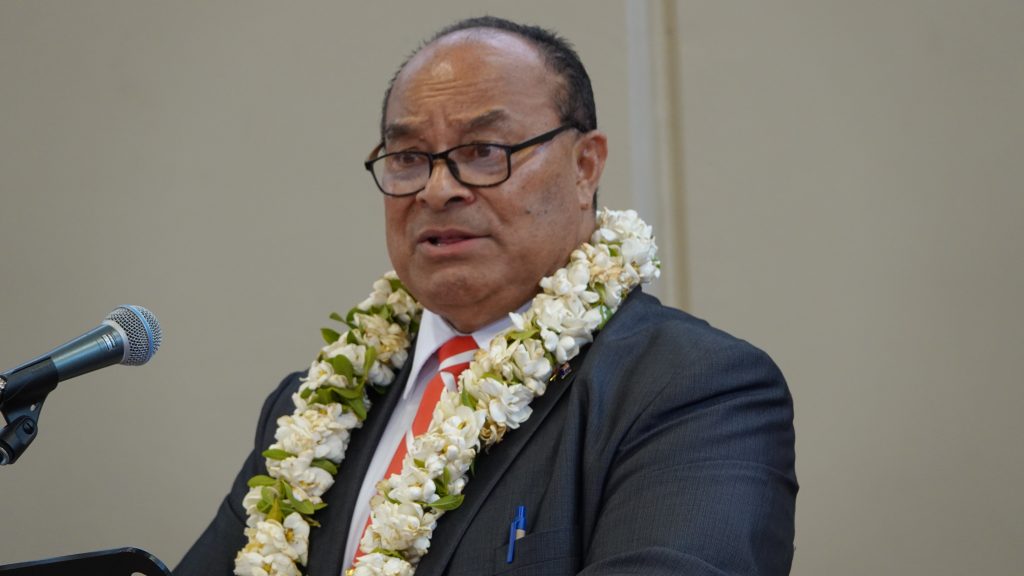
Prime Minister Pōhiva Tu’i’onetoa. Photo/Kalino Lātū (Kaniva Tonga)
The Prime Minister said Akosita was taking leave until after she had sought leave to appeal against her conviction in the supreme Court.
It is uncertain whether she will be paid while she is on leave.
Critics believe the move for Akosita to take leave was either the result of pressures from media and the public. Others have speculated that Tu‘i‘onetoa and the Lavulavus have made the move after the petition to impeach her was submitted to parliament last week.
On Tuesday Tu’ionetoa said Clause 23 of the Constitution allowed Akosita to stay in office for another 42 days from the day of their sentencing if they sought leave to appeal. He said he stood by that despite mounting calls for him to take immediate actions against the disgraced Minister.
Instead, the Prime Minister has tried to use three ministerial resignations from the former government to wrongly justify his refusal to take action against Akosita to the public.
He also appears to have downplayed question from the media on Radio 87.5 FM Facebook livestream on Tuesday about why he did not use his powers under Clause 51 to dismiss Akosita.
Wrong statements by the PM
Several of the Prime Minister’s statements appear to be wrong.
Tu’ionetoa claimed that if a Minister refused to resign the Prime Minster could not sack them and the King would not sign any recommendation for their resignations.
He also said that it was extremely difficult to sack a Cabinet Minister.
The Prime Minister also claimed that he might have acted against Akosita if she has committed her crimes while she was a Cabinet Minister. However, he said she committed the crimes in 2013 while she was not an MP or a Cabinet Minister.
He admitted that Akosita was being paid by the government while she was in court, but was only there some days and not the whole of the six weeks of the trial.
The Prime Minister also overstated the time it took for Akosita before she resigned in 2018 and Lord Ma’afu’s resignation to be processed and alleged the King declined to sign Late Prime Minister Akilisi Pōhiva’s recommendation to dismiss the noble.
What was the truth about the Prime Minister’s claims?
Tu’ionetoa was wrong when he said the Prime Minster could not sack a Minister who refused to resign according to clause 51 of the constitution.
Clause 51 (3) (a) says: “Minister shall retain his position as Minister until – (a) his appointment is revoked by the King on the recommendation of the Prime Minister or in accordance with clause 50B”.
This clause has two independent phrases divided by the conjunction “or” which means it is ether the prime minister can recommend a revocation to the king or the minister can be revoked according to clause 50B.
In his livestream talk show the Prime Minister appears to have intentionally avoided talking about the first phrase and claimed his power in clause 51(3)(a) can only be exercised according to clause 50B.
Former Minister of Finance Lisiate ‘Ākolo
In 2014 Prime Minister Lord Tu’ivakanō demanded the then Minister of Finance, Lisiate ‘Ākolo, resign. ‘Ākolo refused to resign, but the Prime Minister publicly announced he has sacked ‘Ākolo. ‘Ākolo was defiant and told the public he was still a minister, despite the announcement. Lord Tu’ivakanō brought security guards to guard the Cabinet house compound and barred Ākolo from entering a Cabinet meeting which was held to decide his fate. ‘Ākolo never resigned, but Lord Tu’ivakanō recommended to the palace that he be replaced.
The king appointed Dr ‘Aisake Eke as new Finance Minister. Dr Eke was appointed on January 10, 2014, despite Ākolo claiming he was still Minister. It is believed Ākolo was the first Cabinet Minister to be fired by the Prime Minster without tendering his resignation.
Respected lawyer Clive Edwards, who was in Cabinet at the time, told media that when ‘Ākolo refused to resign the Prime Minister has the “sole power” to dismiss him.
Tu’i’onetoa could also use this case as a precedent to sack Akosita.
There is also the Cabinet Manual which its section 26 says: “In formal terms, Cabinet Ministers are also appointed and dismissed by His Majesty the King on the recommendation of the Prime Minister”.
Dismissing a Cabinet minister was not difficult
Tu’i’onetoa was wrong when he said it was difficult to sack a Cabinet Minister who went through the due process before he was appointed by the King. In fact, the government representatives in ministerial posts are the easiest to dismiss.
If the Prime Minister wants a minister to resign, that minister must go immediately no matter if they agree or not. Some ministers in the past were sacked and left their office within 24 hours. The best example was ‘Ākolo’s case.
Again it was the Prime Minister’s exclusive power given by clause 51(3)(a).
Did Tu’i’onetoa ask Akosita to resign?
Tu’i’onetoa claimed the minister must agree to resign before he can make a recommendation to the king to dismiss her. The question now is for the Prime Minister to tell us whether he has asked Akosita to tender his resignation immediately after her conviction.
The Prime Minister’s claims that he may have taken action against Akosita if she committed the crimes while she was a Cabinet Minister seem unlikely. He said Akosita committed the offence in 2013 while she was not a Member of Parliament.
The truth is that the Lavulavu couple were charged in 2018 and that was the first time the public became aware of allegations that they had defrauded more than half a million pa’anga from the government school grant scheme.
Tu’i’onetoa knew Akosita had been charged with serious fraud before appointing her. Surely he had a duty to check the constitutional implications before he appointed her.
PM admits Akosita was paid while in court
Tu’i’onetoa was invited to tell the public how much Akosita was paid while she was out of office facing her fraud charges. He was expected to either justify the payment and state the legal position on Cabinet ministers being paid while effectively out of office and unable to do their job.
Instead he told the livestream audience that Cabinet Ministers worked 24 hours a day and they were equipped with internet at home and mobile phones to make it easier for them to get in touch with the public whenever they were needed.
PM overstated resignation cases
Tu’i’onetoa wrongly told the public it took four months before Akosita Lavulavu agreed to resign from her post as Internal Affairs Minister after the Late Prime Minister ‘Akilisi dismissed her. She was removed after she and her husband Etuate Lavulavu were charged with using forged documents and obtaining credit by false pretences in relation to the Unuaki ‘o Tonga Royal Institute, the same charges on which she has now been found guilty. She was sacked after refusing to resign.
Prime Minister Tu’i’onetoa claimed His Majesty would not sign ‘Akilisi’s recommendation to sack her. He also claimed that King did not approve recommendation by ‘Akilisi to dismiss Lord Ma’afu. He claimed this delayed the resignation process by four months. Tonga Broadcasting Commission at the time reported that ‘Akilisi denied claims the king did not approve his recommendation to sack Lord Ma’afu.
Only two months
In fact, Akosita was publicly dismissed on April 12 2018 before it was announced in June 21 that the king has signed ‘Akilisi’s recommendation to sack her. That was nine weeks and three days or two months one week and three days. Lord Ma’afu tendered his resignation on March 2 before he was returned to Cabinet on May 17. That was 10 weeks and five days or two months two weeks and two days.
We can tell from Akosita’s first refusal to resign before finally being dismissed in 2018, and Lord Ma’afu’s agreeing to resign the same year by handing his resignation letter to the then prime minister but was not immediately officially dismissed and ‘Ākolo’s repeatedly resisting Lord Tu’ivakanoo’s demand for his resignation but still the prime minister went ahead with his dismissal – the king’s approval of recommendation from prime ministers to sack a minister does not depend on the minister’s permission, as claimed by Tu’i’onetoa.
A failure of duty
Prime Minister Tu’i’onetoa’s lack of action over Akosita shows he has failed to fulfil his duty to make good decisions as leader of the government.
His responses to media, particularly his clinging to Clause 21, have all been about protecting Akosita. It was not until the media pushed for him to use Clause 51 of the Constitution that he finally did something.
The public expect the Prime Minister to talk about facts and support his arguments with a proper understanding of the law and constitution.
Unfortunately, the media and the public are still in the dark over certain issues, chief of which is the question of whether Akosita will continue to be paid while she is on leave.
If Akosita is jailed next month, will she receive any remuneration and money from the government? The public wants to know if their taxes are being used to pay her.
Tu’i’onetoa should explain to the public why he made the surprise move to send Akosita on leave. Given his constantly shifting justifications to defend his refusal to take actions against Akosita, it is important for the public to know whether his actions have been meant to benefit the government or to benefit the disgraced Minister.
Convicted Minister of Infrastructure and Tourism Akosita Lavulavu was placed on leave before her sentencing on July 2.
“The Prime Minister Hon. Rev. Dr. Pohiva Tu’i’onetoa has approved today the request of the Minister for Infrastructure and Tourism, Hon. ‘Akosita Lavulavu to take leave until a decision of the Court of Appeal is delivered regarding her court case”, the one line press release from the Prime Minister’s office says this morning.
No further details provided and it was unknown whether Akosita was placing on leave without pay or is still receiving her salary, allowances and other ministerial entitlements.
The announcement came after the prime minister appeared on livestream Tuesday saying he cannot take any actions against Akosita citing clause 23 of the constitution.
He again defended his refusal to take immediate action against Akosita saying if she has committed the fraud while she was in her roles as Cabinet Minister he would have placed her on leave. He said Akosita committed the serious offences in 2013.
The Prime Minister recommended Akosita’s appointment to the king in 2019 knowing she was charged with the fraud in 2018 and that was why she was dismissed by late Prime Minister ‘Akilisi Pōhiva.
Akosita’s leave came after a petition to impeach her was submitted by the leader of the Opposition Party Semisi Sika to parliament last week.
The Opposition Party petitioned their colleagues in parliament on Friday to impeach the fraudster Cabinet Minister Akosita Lavulavu after she was convicted with her husband for defrauding more than half a million pa’anga of the government school grant scheme.
Opposition Leader Semisi Sika has confirmed this to Kaniva News.
The petition was submitted after the Prime Minister announced he cannot take actions against Akosita citing clause 23 of the constitution.
According to the House procedures the motion of impeachment and its supporting affidavits have to go to the Standing Committee on Privileges first for consideration and recommendations. They will then be returned to the House for debate and put the recommendations to a vote.
The parliamentarians were scheduled to arrive in ‘Eua early this week to join the Free Wesleyan Church annual conference.
As we previously reported, the nobility MPs sided with the Opposition and called on the prime minister to do something against Akosita.
Last week AKosita had to take her seat shortly after she took the floor in parliament to announce her ministries’ new budgets for financial year 2021/2022.
She was skipped over during a parliament debate on the national budget before the Minister of Finance Tevita Lavemaau stepped in and announced the Ministry of Infrastructure and Tourism budgets on her behalf.
Akosita began addressing the House with the normal practice of fakatapu before she was interrupted by nobility MP Lord Tu’iha’angana.
The king’s noble said Akosita was convicted by the court and it was not appropriate for her to deliver a speech on her budgets in the House.
He said the House was debating on important matters relating to the national budget and law.
Lord Tu’iha’angana said it was not easy for him to raise his concerns in front of Akosita but he thought he must say it because all MPs have oaths to maintain the constitution and the law of the country.
The MAFF Minister Lord Tu’ilakepa spoke in support of Lord Tu’iha’angana.