UPDATED The government has officially approved the appointment of Dr. Tu’ipulotu Katonga as the first Pro-Chancellor of Tonga National University (TNU).
The announcement was made today by the Deputy Prime Minister, Dr. Taniela Fusimalohi, following a Cabinet meeting.
The TNU, which was officially inaugurated by the Crown Prince in January 2023, represents a major consolidation of Tonga’s tertiary education resources.
The university’s leadership comprises: the king, who serves as Chancellor, and Dr. Masaso Paunga, who serves as Vice-Chancellor.
Established by the legal mandate of The Tonga National University Act, the Government is obliged by law to ensure the establishment and prudent management of the TNU.
As such, six government-owned higher education institutions have merged to form a hybrid university – offering both academic and vocational study programs.”
The newly formed TNU is a comprehensive institution comprising five faculties.
It delivers over 50 programs ranging from certificates and diplomas to degrees.
This diverse portfolio is designed to directly meet the skills and knowledge-based demands of both the Tongan domestic employment market and to harness opportunities from overseas labour demands.
A new date has been set for the long-awaited opening of Tonga’s first dialysis centre, with celebrations now planned for the end of next month.
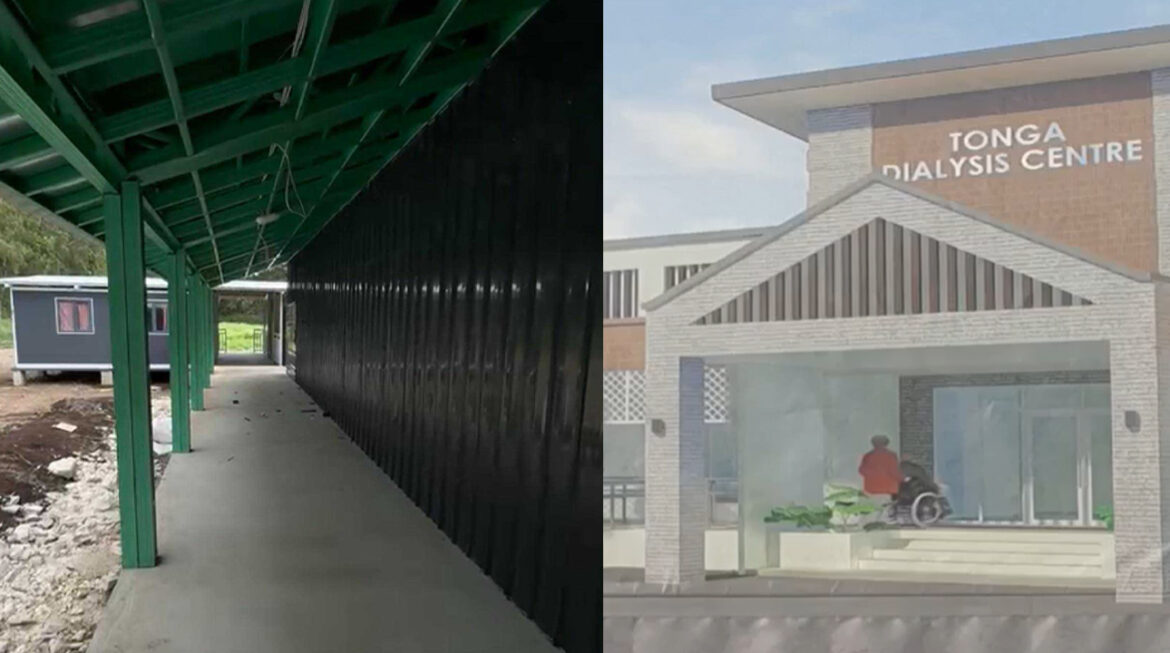
The new dialysis building in Tonga. This side view (L) shows the verandah, with the conceptual design of the full premises displayed on the right.
A reliable source confirmed to Kaniva News this morning that the Siaosi Brown Dialysis Centre is scheduled to open on October 31, pending final confirmation. The centre was previously expected to begin operations in November.
The new date marks a significant acceleration of plans, driven by the critical need for the service.
As we previously reported, the Minister of Health, Dr ‘Ana ‘Akau’ola, confirmed significant work has been ongoing to ensure the centre would open “as soon as possible given the needs and urgency for Tongan patients.”
For years, Tongans suffering from kidney failure have faced immense hardship, forced to seek costly and logistically challenging treatment overseas in countries like New Zealand, Australia, and the United States.
The centre, located at Lotoha’apai in southern Tongatapu, promises to end that struggle for many.
The facility is named in memory of Siaosi Brown, a Tongan man who passed away in the United States in 2017.
Its construction was funded by the Utah-based Siaosi Brown Dialysis Board.
In a major relief for patients and their families, services will be provided free of charge to all eligible individuals.
Minister Dr ‘Akau’ola has also highlighted the strict protocols surrounding overseas medical referrals, noting that all such cases are reviewed by a Health Committee of senior doctors.
The establishment of the local dialysis centre is expected to drastically reduce the need for these difficult referrals, keeping families together and saving lives within the kingdom.
The upcoming opening represents a monumental step forward for healthcare in Tonga, offering hope and a new lease on life for countless citizens.
The long-awaited multi-million dollar Fangaʻuta Lagoon Bridge project, a centrepiece of Tonga’s infrastructure development, is finally expected to break ground next month.
Conceptual design image of the proposed Fanga’uta Lagoon bridge. Image: Ministry of Infrastructure
The USD $55 million project is designed to transform connectivity and travel between the capital, Nukuʻalofa, and the densely populated south-eastern communities of Tongatapu from ‘Umusī to Folaha.
Once completed, the new link will directly address the country’s growing problem of road congestion, offering a major alternative route and reducing travel times.
The project, funded by the Asian Development Bank (ADB) and designed by the Japanese engineering firm Chodai Co, Ltd will feature a 720-metre bridge stretching across the lagoon, accompanied by 4.96 kilometres of new approach roads extending to Vaini.
While initially scheduled for completion this year, the project’s timeline has been updated.
Officials now anticipate construction will be finished within the next three years.
The launch will mark a significant step in modernising Tonga’s transportation network and is eagerly anticipated by residents and businesses alike who deal with daily traffic congestion.
Commentary – While Tonga has made notable progress in reducing multidimensional poverty, deep-rooted economic hardship and systemic legal inequalities remain key factors pushing some citizens to seek opportunities abroad—sometimes leading them to overstay their visas in countries like New Zealand.
Tongan travellers to New Zealand have been listed as having the highest rate of visa overstays for the period ending July, according to a new report from Immigration New Zealand (INZ). However, the authority was quick to note that the overall rate remains very low.
The Eke government has recently announced that 500 families have been identified as living in housing conditions so substandard that they are deemed unfit for human habitation.
A report based on Tonga’s 2021 Household Income and Expenditure Survey (HIES) reveals a complex picture. Although the nation successfully eradicated extreme poverty and saw its overall multidimensional poverty rate fall from 27% to 24% between 2015 and 2021, a significant portion of the population continues to struggle.
Crucially, the data shows that 20.6% of Tongans still live below the minimum standard required to meet their basic consumption needs. Parliament was told last year that the actual rate of people living under the poverty line had increased, putting the number at 25%.
The opposition criticised the then-government for allocating only $1 million to address the issue.
Barred from Inheritance by Law
This economic pressure is compounded by longstanding structural issues. Tonga’s inheritance and land tenure laws, which prohibit women from owning land, play a significant role.
The laws stipulate that upon a father’s death, all assets—including land, the family home, and belongings—automatically transfer to the eldest son.
This system disenfranchises women entirely and often forces younger sons to seek alternative living arrangements if the family land is insufficient to share.
This traditional and, in the view of many, unjust societal construct adversely impacts the commoners or ordinary people, creating a lack of long-term security and limiting economic mobility for a large part of the population.
No Welfare State, but Royalty Receives Stipends
Furthermore, Tonga lacks a social welfare system similar to New Zealand’s, which provides financial assistance to unemployed citizens and residents.
This absence of a public safety net exists alongside state expenditures for the monarchy, including the king and 33 noble titles, who receive annual stipends from the government.
Together, these push factors help explain why some Tongans, once granted visas to work or visit in more prosperous countries, choose to overstay despite the risks.
The chance to earn higher wages, own property, and build a secure future for their families can outweigh the fear of penalties, illustrating how domestic challenges are a direct driver of migration-related issues like visa non-compliance.
New Deportation Powers Threaten Diaspora
The recent announcement from Immigration New Zealand, which will allow the deportation of serious criminals who have been permanent residents for up to 20 years (doubled from 10), adds another layer of complexity for the Tongan diaspora, reminding migrants of the precarious nature of their status when seeking a better life abroad.
The statistics showed the top nationality of overstayer based on the past 30 years of data was Tonga, followed by China, then the United States.
Tonga: 2599
China: 2577
US: 2213
Samoa: 1697
India: 1582
Great Britain: 1256
Philippines: 938
Malaysia: 753
Canada: 510
Germany: 498
Other: 6356
Persecution, Law, and Seeking Refuge
Push factors include human rights issues, with many gay and trans people seeking opportunity in New Zealand. This is due to a legal contrast; New Zealand has protections for LGBTQ+ rights, while Tongan law criminalises consensual same-sex relations.
As Kaniva News recently reported, a Tongan woman was granted refugee status in New Zealand due to the persecution she would face in Tonga because of her lesbian identity, where same-sex relationships are illegal and can lead to jail time.
This case highlights the ongoing challenges for LGBTQ+ individuals in Tonga and their need for protection in countries like New Zealand, which has a history of protecting such individuals through its refugee system and is a globally recognized LGBTQ-friendly country
The Supreme Court has sentenced a woman to life imprisonment for her role in importing methamphetamine into the country.
The court found ‘Anita Toutaiólepo, 45, guilty on two charges.
The primary charge was that she knowingly, and without lawful excuse, caused to be imported approximately 137.36 grams of methamphetamine, a Class A illicit drug.
The second charge related to the knowing importation of drug utensils, namely six smoking pipes used for consuming illicit drugs.
The court was told a container arriving in Tonga aboard the vessel “Papalan Poly” on April 4, 2024, was inspected at SF Oceania Limited.
The court found that the container held illicit drugs shipped from Anthony Vea in San Francisco, California, USA, and that the shipment was intended for the accused, Toutaiolepo.
During the inspection, a drum within the container was found to contain a bag holding illicit items.
These items included a coffee bottle concealing a package of a white crystal substance, a pair of pants hiding six smoking pipes, and a second package containing another bottle with two more packages of the same crystalline material.
Police were immediately notified and subsequently arrested Toutai’olepo at the scene.
While she admitted the drum was hers, she denied any knowledge of the illicit contents, claiming they belonged to someone else and had been sent through her consignment.
Laboratory testing later confirmed the substances to be methamphetamine. The total net weight of the drugs seized was 137.36 grams.
Based on the evidence, defense lawyer Mr. Corbett argued that his client should be acquitted. He presented a positive defense, asserting that the illicit drugs were actually placed into the drum by another individual, Uinikoni.
Mr. Corbett pointed to three key factors that he stated should raise reasonable doubt: the absence of any forensic evidence linking his client to the drugs, the specific timing of when the drum was opened, and a lack of transparency in the procedural handling of the evidence. He contended that these grounds were sufficient for his client to be found not guilty.
Presiding Judge Tupou KC, however, found the account of Uinikoni to be credible, siding with his version of events. The court accepted that the broker, not Uinikoni, was the individual who opened the drum containing the illicit goods.
Furthermore, the judge believed Uinikoni’s testimony that he was with his supervisor, Fa’one, in a designated clearing area when the black bag containing the drugs was brought to them, supporting his claim that he was not directly involved in the discovery.
Justice Tupou delivered the stern sentence, emphasising the severity of the crimes which contravene Tonga’s Illicit Drugs Control Act.
In addition to the life imprisonment term, Justice Tupou ordered the immediate destruction of all illicit drugs and utensils seized during the investigation.
The order was made pursuant to section 32(2)(b) of the Illicit Drugs Control Act, which mandates the disposal of such materials to prevent them from re-entering the community.
Two people were killed in a drive-by shooting in Fremont, California, last week, according to US police.
Edwards Paasi and his parents. Photo/Supplied
Edward Paasi, a Tongan man, was among those killed in the shooting on Stevenson Boulevard.
According to a CBS report, two people were in a large parking lot when someone in a vehicle approached them.
An occupant of the vehicle then opened fire and struck them.
Police said one person died at the scene, and another victim died at the hospital.
It is understood Paasi and his family were attending a wedding reception at the Banquet Hall.
Witnesses said the parking lot was full, with many people attending.
The owner of the Banquet Hall, Jamal Saddiqi, declined to comment. When approached by CBS News Bay Area in front of the business, he shut the door without answering questions.
This is not the first time violence has erupted at the Royal Palace Banquet Hall, CBS reported. In May 2017, a wedding with an estimated 900 guests ended in multiple fights. Police said at the time, about 70 people were involved, and one man was beaten so badly he was left in a coma.
A Tongan family in Sydney is grieving the sudden loss of a beloved mother-of-four, Vaimoana Feohi-Moe-Langi Fonua, who passed away from a heart attack while holding her seriously ill infant son in a hospital.
A Sydney family is mourning the sudden loss of mother-of-four Vaimoana Feohi-Moe-Langi Fonua, who suffered a fatal heart attack while cradling her seriously-ill infant son in hospital.
Vaimoana was comforting her young son, who remains hospitalised, when she suffered a fatal cardiac arrest.
Her passing has sent shockwaves through her family, kāinga (extended family and community), and the broader Tongan diaspora in Australia.
Heartfelt tributes have poured in on social media, reflecting the profound love and respect she inspired.
One grieving family member wrote on Facebook: “Wake me up from this bad dream. Tell me it was all a dream a nightmare. Haueee my beautiful big sister Vaimoana Lanivia-Fonua I miss and love you so dearly. God called you home too soon. You left your husband Liongi Jr Fonua heartbroken sis 😭😭😭😭 I do my absolute best for your babies and make sure Mou is okay.”
Another close relative shared: “Vaimoana Lanivia-Fonua I praise God with all of my heart, for who you are my beautiful sister, I call my day one, my best friend…. Fakafeta’i kia Sihova he ko ia pe Pule ‘o mo’ui [Thank you to Jehovah, for He is the Lord of life]. It truly is an honour to live life with you. I thought we would grow old together, I love you so much. Thank you Vai for being our family’s rock and always putting others before your needs.”
Vaimoana is remembered as a selfless caregiver, a pillar of her family, and a devoted friend. Her passing underscores the immense emotional strain faced by families with critically ill children.
A fundraising page has been established to support her husband, Liongi Jr Fonua, and their four children during this profoundly difficult time, particularly to help cover costs associated with both Vaimoana’s passing and their son’s ongoing medical needs.
The family has requested privacy as they navigate this double tragedy.
Videos and reports circulating on social media appear to show passengers disembarking from what is believed to be the Lulutai Airlines Y12 aircraft, amid claims of mechanical issues.
The footage, which has yet to be independently verified, depicts individuals exiting the aircraft on the tarmac as emergency workers—including firefighters in full uniform—are seen attending the scene.
The presence of emergency personnel suggests precautions were taken in response to a reported incident, though the exact nature and severity of the situation remain unconfirmed.
Sources citing the videos indicate the aircraft may have experienced technical difficulties prior to departing or landing.
Kaniva News is working to verify the authenticity of the footage and the accuracy of these claims.
Lulutai Airlines has not yet issued a public statement regarding the incident, and repeated attempts to contact the airline for comment have been unsuccessful.
The airline recently expanded its fleet with a Twin Otter aircraft, which was intended to enhance connectivity across Tonga’s island groups.
This news follows a meeting held last month between the Civil Aviation Office (CAO) and Lulutai Airlines to discuss the carrier’s Air Operating Certificate (AOC) renewal.
A formal audit was scheduled to begin at Lulutai’s head office.
The audit will be conducted by inspectors from CASA PNG, who have been appointed by the Pacific Aviation Safety Office (PASO).
The initiative is co-funded by Australia’s Department of Foreign Affairs and Trade (DFAT) and CASA PNG.
Analysis – The new King’s Diplomatic Services Act, recently approved by the government, is a dangerous step backward for Tonga’s fragile democracy.
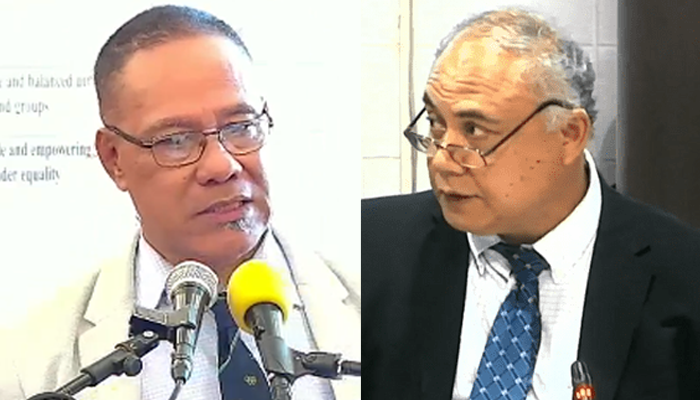
Dr Taniela Fusimalohi (L) and PM Dr ‘Aisake Eke
Despite the bill’s high risks, the government’s defence of the legislated King’s board has revealed two startling possibilities.
Was it an attempt to mislead the public about the dangers, or was it merely ignorant of them?
Let’s set the record straight.
The approved bill, under Part II, Clause 5(1), states: His Majesty The King is authorised to establish and maintain the diplomatic and consular services of the Kingdom. Crucially, Clause 5(2)(a) stipulates that this Diplomatic Services must be funded by the government.
This is where the danger arises: the board will be government-funded, yet there is no guarantee that the King and his board of directors will be held accountable for any issues arising from the use of those funds. Previously, funding for foreign affairs and diplomatic services was under the purview of the Minister and Chief Executive Officer of Foreign Affairs, ensuring its processing was transparent and accountable. This significant change to the legal framework directly contradicts claims by Prime Minister Eke and Deputy Prime Minister Fusimalohi that the controversial bill made no major alterations.
Absorbing Ministry Into King’s Board
The members of the royal board are handpicked by the King and are responsible for making decisions regarding diplomatic services, controlling and implementing these services, and monitoring their processes, as stipulated in Clause 7 of the bill. This distinguishes it from all other government boards governed by the Public Enterprise Act 2016, which mandates accountability to the Minister and the government. This reflects another inconsistency in the government’s insistence that the new bill makes no major changes.
While Section 9 of the controversial bill designates the Minister for Foreign Affairs as responsible for administering and managing His Majesty’s Diplomatic Services, clause 17 mandates that the Ministry of Foreign Affairs be dismantled and absorbed into the King’s new board. Clause 16 stipulates that any decision made by the Minister must be approved by the King and his board. This provision illustrates the extent of the power vested in the board, effectively making it the controlling authority. This highlights yet another contradiction in the government’s claim that the bill introduces no substantial reforms.
These developments are dangerous to the country’s economic and political stability and represent a regression to the pre-2010 era. The king’s inherent social and traditional authority renders him unchallengeable, irrespective of any errors in judgment. This effectively eliminates any mechanism within the board’s structure to guarantee the proper management of public funds, a further inconsistency in the government’s position that the legislation entails no significant alterations.
The Government’s Misguided Argument
The Eke government asserted that it was merely updating Clauses 39, 40 and 41 to reflect the King’s entitlements.
The clauses are as follows:
39. Treaties
It shall be lawful for the King to make treaties with Foreign States provided that such treaties shall be in accordance with the laws of the Kingdom. The King may appoint his representatives to other nations according to the custom of nations.
40. Foreign ministers
The King shall receive Foreign Ministers and may address the Legislative Assembly in writing regarding the affairs of the Kingdom and matters which he may wish to bring before the Assembly for deliberation.
41. King’s powers – Signature to Acts
The King is the Sovereign of all the Chiefs and all the people. The person of the King is sacred. He reigns the country but ministers are responsible. All Acts that have passed the Legislative Assembly must bear the King’s signature before they become law
These clauses did not authorise the King to make decisions and finance them from the public purse. Instead, if any of his constitutional duties required funding, the law mandated that approval was a matter for the Minister of Foreign Affairs and the Chief Executive Officer. This approval process was a critical safeguard, ensuring the King’s decisions were legally scrutinised. The new law enacted by the Eke government fundamentally violates these constitutional safeguards.
Misleading on Major Changes
Deputy Prime Minister Taniela Fusimalohi downplayed the high risks posed by this bill to public funds by telling the press last Friday that there were “no big changes” to the current law, and it was only name changes, removing the Ministry for Foreign Affairs and replacing it with His Majesty’s Diplomatic Services. He also stated that the Minister for Foreign Affairs would still manage and operate the department as usual, according to the current Acts and constitution.
His explanation was deceptively appealing to a public that failed to read the controversial law between the lines. It demonstrates his failure to grasp the bill’s core principle: that the King’s board must be funded from public funds. This represents a significant departure from the accountability measures enshrined in the constitution, particularly Clause 50, which outlines the function, constitution, and powers of the Cabinet.
He also claimed the king’s board was analogous to other government boards, such as the Ministry of Education’s. This was misleading, as those boards are accountable to their Minister and the government, with appointments made transparently under the Public Enterprises Act. In contrast, the King’s new board operates without oversight, solely under the King’s control.
Codifying Unchecked Royal Power
The bill is profoundly dangerous as it codifies the King’s traditionally unchecked authority, permitting him to appoint individuals to a board that spends public funds without independent oversight from a body like the Public Service Commission (PSC). The risk, as evidenced by past instances, is that appointments will be based on personal loyalty rather than the skills and qualifications essential for handling the nation’s significant diplomatic interests. This power, exercised without transparency and enforced by silencing dissent, has been proven to be at the core of many failed royal projects in the past, prompting the urgency of the 2010 democratic reforms.
A puppet Minister of Foreign Affairs
Fusimalohi further claimed that the Minister of Foreign Affairs would retain full operational control of the department. However, he failed to state that, under the new bill, the Minister is compelled to manage diplomatic services in accordance with the directives of the King and his appointed board—a body that holds no accountability to Parliament.
A more critical flaw in this argument is the evident trend that future appointments to this ministerial office will require alignment with the King’s preferences.
The King’s son, Crown Prince Tupouto’a, is the current Minister for Foreign Affairs. It appears that any future government would continue to appoint him to the role to appease the King.
This was demonstrated during the former Huʻakavameiliku government when the King insisted on trying to control the ministry, even though the Attorney General advised that it was unconstitutional. The King’s insistence persisted until he forced his noble MPs in the Huʻakavameiliku Cabinet to resign ahead of a vote of no confidence, which led to Huʻakavameiliku’s ouster.
Given this trend, any future Minister of Foreign Affairs would effectively be a puppet of the King and would enact the wishes of the King and his board regarding the use of public money. Furthermore, because the King and his board are not accountable to the public, their budget would lack transparency and accountability.
The government has faced widespread criticism both for its failure to conduct public consultation on the bill and for submitting it to Parliament for urgent approval on the eve of the annual adjournment. This haste has prompted widespread concern over why such a significant change was rushed through.