Eighty years ago, thousands of Tonga’s Niuafoʻou residents fled their homes in darkness, crying and praying as a volcanic eruption engulfed their main village in black smoke and eventually led to one of the most significant mass evacuations in Tonga’s history.
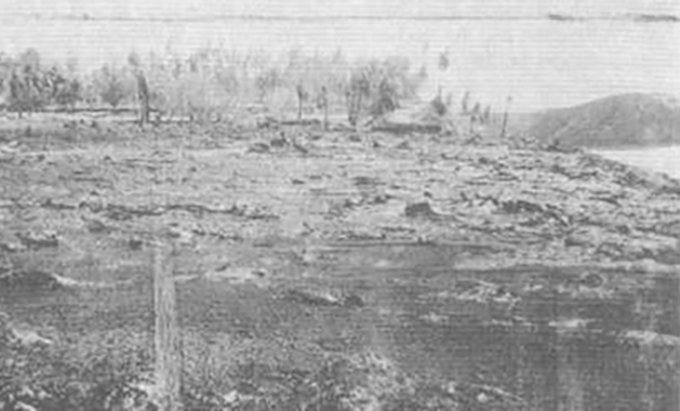
The dramatic events of September 1946 were documented by James Lewis in his account Volcano in Tonga, published in the Journal of Administration Overseas in 1979.
Lewis said his account of the eruption and subsequent evacuation was provided by Niuafoʻou Town Officer Moeaki Tākai, who had kept a diary recording the events as they unfolded.
The eruption began on the evening of Monday, September 9, 1946.
According to the account, darkness had fallen and a brass band was playing when, at about 7.30pm, residents felt the first earthquake.
The musicians stopped playing as fears grew that an eruption was imminent.
Within minutes the situation became much more serious, and residents began fleeing from the village towards higher ground.
Lewis described the climb up the mountain as apparently an instinctive reaction by people familiar with volcanic danger and the risk faced by settlements closer to the coast.
As families scrambled to safety, the darkness was filled with panic.
“People were crying and praying, calling to one another and shouting to find one another,” Lewis wrote.
When residents reached higher ground and looked back, their principal village was gone from view, with the area where it had stood engulfed in black smoke.
By about 10pm, authorities had instructed everyone to remain on the mountain.
Around 2,500 people eventually gathered on the mountainsides as the eruption continued below them.
Among those stranded were four Sisters from Belgium, France, Holland and the United States. Their national flags were raised on the highest tree in an attempt to attract attention.
Wireless operator stayed behind
One of the most extraordinary episodes recorded by Lewis involved wireless operator John Malekamu, who remained behind sending SOS signals calling for help.
He abandoned the wireless station only when lava had advanced to within about 30 feet of it, shortly before the station was destroyed.
Malekamu ran through intense heat before collapsing beneath a tree, where he was eventually found by a friend.
He survived and was taken back to join the rest of the community on the mountain.
At sunrise, Lewis wrote, the people joined together in giving thanks to God for their deliverance, with the eruption having caused no casualties.
But Niuafoʻou’s isolation meant outside help did not immediately arrive.
Lewis said none of the SOS messages sent from the island appeared to have been received by the Tongan Government in Nukuʻalofa.
It was not until Friday, September 14, when a US Navy aircraft flying from Pago Pago towards Naʻadi, Fiji, saw smoke rising from Niuafoʻou and people waving clothing from the mountainside, that word was relayed to Tonga.
The islanders remained there until Tuesday, September 18, when a government ship was finally sighted, more than a week after the eruption began.
Islanders vote on evacuation
The eruption did not immediately result in the permanent removal of Niuafoʻou’s population.
After officials arrived from Nukuʻalofa, a public meeting was held to determine whether the entire population should be evacuated to Tongatapu.
According to Lewis, Niuafoʻou’s communities were divided among four chiefs.
Three chiefs and their communities, representing about 1,800 people, voted in favour of evacuation, while one chief and about 700 people opposed it.
The majority decision ultimately resulted in evacuation being adopted for the island’s population of about 2,500.
The final evacuation was scheduled for Saturday, December 21, 1946, giving residents about three months to prepare to leave their island.
Homes had to be dismantled and building materials and personal possessions prepared for transportation.
On evacuation day, loading began at sunrise and continued until about 5pm.
Tongatapu, however, was intended only as a transit destination for many of the displaced Niuafoʻou people.
About 1,800 eventually agreed to resettle on ʻEua, while those who had opposed the evacuation remained on Tongatapu.
Hardship followed evacuation
Lewis described the years following the evacuation as difficult, particularly for the Niuafoʻou people attempting to establish themselves in unfamiliar surroundings on ʻEua.
Agricultural land had to be cleared and livelihoods rebuilt.
The economic hardship became so severe that in 1950, 74 men sailed back to Niuafoʻou to work in copra production.
They stayed for a year before returning to ʻEua and being replaced by another working party.
Further groups followed in 1952 and 1953, and Moeake Takai himself joined one of the parties returning to his home island.
There was no permanent settlement on Niuafoʻou between 1947 and 1959, according to Lewis.
The 1946 disaster was also not the island’s first major encounter with volcanic destruction.
Lewis recorded eruptions in 1929, 1935, 1936 and 1943 before the September 1946 eruption, with the village of Futu destroyed during the 1929 event.
Looking back on the 1946 evacuation more than three decades later, Lewis concluded that it appeared to have been “ad hoc and unplanned” and that the decision to proceed had been “precipitate”.
He argued that insufficient consideration had apparently been given to the eventual resettlement of the evacuees, contributing to greater hardship and making their resettlement a longer process than necessary.
Eight decades later, the account provides a vivid record not only of the night Niuafoʻou erupted, but of the extraordinary survival of its people, the loss of their homes and the difficult decision that ultimately uprooted an entire island community.