A woman’s public demonstration of her customary privileges as a fahu, placing her bare foot on a man’s face during a gathering, has sparked debate on social media over the relevance of certain Tongan traditional practices in contemporary society.
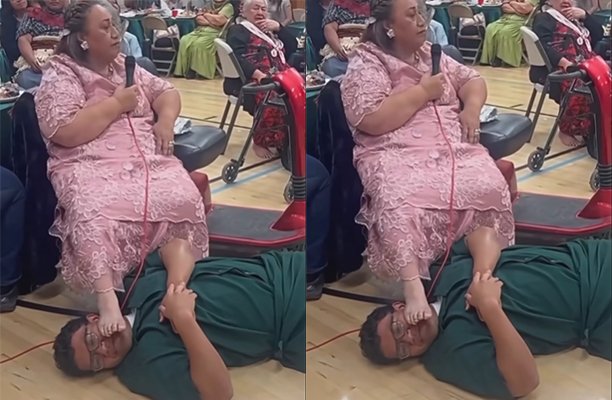
The woman told the gathering she was the fahu before calling the man forward to demonstrate her customary authority over him.
Footage shows her seated and holding a microphone while the man lies on the floor beside her, with one of her feet resting on his face.
The incident has divided opinion, with some social media users criticising the demonstration as excessive, while others defended the woman’s actions as an expression of Tongan tradition.
The controversy reflects a broader debate over whether certain inherited cultural practices remain compatible with contemporary principles of equality, individual dignity and mutual respect.
Understanding fahu and faʻitelihaʻanga
The concept of fahu is deeply embedded in Tonga’s traditional kinship hierarchy, in which a paternal sister and her descendants enjoy customary precedence over her brother and his descendants.
In contemporary Tongan society, however, fahu is not necessarily a permanent or predetermined status. Individuals may be selected to fulfil the role according to family preferences and availability, irrespective of whether they are from male or female lines of descent.
When a fahu exercises their customary authority to its fullest extent, as demonstrated by this woman’s actions towards her subordinate, the practice is known as fakafahufahu.
Closely associated with this hierarchy is the concept of faʻitelihaʻanga, which identifies a person in relation to whom a relative of superior customary rank is permitted to act as they please.
Expressions of this customary freedom can range from taking relatives’ possessions and speaking derogatorily towards them to physical acts such as slapping or placing a foot on their face.
These practices are grounded in the traditional ʻeiki–tuʻa (superior–subordinate) hierarchy and its associated sacred obligations, known as fatongia toputapu.
Certain obligations are embodied in cultural practices such as the consecration of first fruits as fuatapu, which may only be harvested when ripe and must be presented to relatives of superior hierarchical status, including the tuofefine, mehekitanga, fahu and even the ʻulumotuʻa.
This practice also extends beyond familial relationships to include village chiefs and church ministers.
Traditional privileges and contemporary values
The concerns raised by critics align with a broader argument among advocates of Tongan cultural reform, who maintain that some traditional practices have become outdated and no longer reflect contemporary understandings of equality and respect for every individual, regardless of inherited social or kinship rank.
From this perspective, preserving Tongan cultural identity does not necessarily require retaining every customary practice in its traditional form.
Defenders of the tradition, however, regard such practices as expressions of Tonga’s distinctive kinship hierarchy and the customary privileges and obligations that sustain it.
The controversy therefore raises a wider cultural question: can Tonga preserve the significance of the fahu institution while reforming aspects of its practice to accommodate contemporary principles of equality and human dignity?